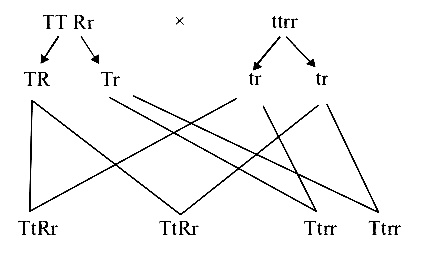
Solution
Dimension of impulse = [MLT-1]
So both of them have different dimensions.

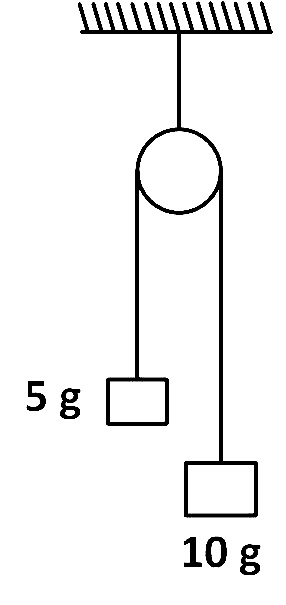
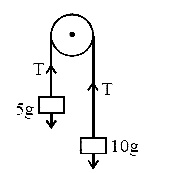
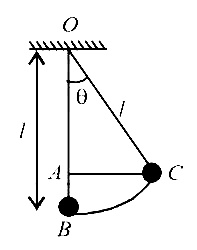
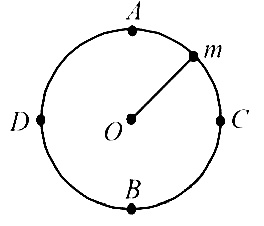
Let T be the tension in the string.


Using Gauss’s law, the total electric flux through a closed surface is
Here, the charge is placed at a corner of the cube, not at the centre.
To apply Gauss’s law easily, imagine identical cubes joined together so that the charge comes at the common corner and becomes the centre of the larger cube.
Now for the larger cube:
the charge enclosed =
so total flux through the larger cube is
Since the larger cube is made of identical small cubes, by symmetry the flux is equally shared by them.
So, flux through one small cube is
Hence, the electric flux through all the six faces of the given cube is
So, the correct answer is:


The bacteria commonly used for genetic engineering is Agrobacterium. Agrobacterium tumefaciens, in particular, is known for its ability to transfer DNA to plants, and it is widely used in the creation of genetically modified plants. This capability is harnessed in biotechnology for the purpose of introducing new traits to plants, such as resistance to pests, diseases, or harsh environmental conditions. Therefore, the correct option is :
Option C : Agrobacterium
The condition caused by trisomy in the 21st chromosome is called Down's syndrome. This is Option B
Down's syndrome is characterized by an extra copy of chromosome 21 (trisomy 21), leading to a total of 47 chromosomes instead of the usual 46. It causes a range of physical and developmental characteristics and health issues.
Klinefelter's syndrome (Option A) involves an extra X chromosome (usually XXY instead of the typical XY in males).
Turner's syndrome (Option C) is marked by the presence of only one complete X chromosome (45,X instead of 46,XX or 46,XY).
Triplex syndrome (Option D) is not a recognized chromosomal disorder in medical literature.

According to Mendelian genetics, certain traits are dominant over others. In the options you've provided, related to the classic pea plant experiments conducted by Gregor Mendel :
Option A - Green colour in seed coat : In Mendel's experiments, the yellow seed coat was the dominant trait over the green seed coat.
Option B - Wrinkled seed : Smooth or round seeds were dominant over wrinkled seeds.
Option C - Terminal position of flower : This refers to the position of the flower on the plant. Flowers at the end of the stem (terminal) were recessive compared to flowers along the stem (axial).
Option D - Green pod colour : Green pod colour was indeed a dominant trait over yellow pod colour in Mendel's experiments.
Based on this, the character showing dominance among the options is Option D - Green pod colour.
The pulmonary artery is different from the pulmonary vein in several aspects, but based on the options provided, the correct answer is:
Option B: Its wall is thick.
Let's explore why this is the case and clarify the reasoning behind each option:
Option A: Its lumen is broad. Both the pulmonary artery and vein can have broad lumens, but this characteristic does not fundamentally distinguish one from the other. The lumen size can vary based on the specific segment of the vessel and the volume of blood it is transporting.
Option B: Its wall is thick. This is true and distinguishes the pulmonary artery from the pulmonary vein. Typically, arteries have thicker walls than veins because they must withstand and convey the higher pressure of blood pumped from the heart. Even though the pulmonary artery carries deoxygenated blood to the lungs — and does so at a lower pressure than systemic arteries — its walls are still thicker than those of the pulmonary veins, which carry oxygenated blood back to the heart.
Option C: It has valves. This option is not correct. Pulmonary arteries do not have valves. The confusion might arise from the fact that vein systems, including pulmonary veins, generally have valves to prevent backflow of blood. This characteristic is not found in the pulmonary artery.
Option D: It does not possess endothelium. This is incorrect. All blood vessels, including the pulmonary artery and pulmonary vein, are lined with endothelium. The endothelium is a thin layer of cells that provides a barrier between the blood and the rest of the vessel wall, facilitating smooth blood flow and playing roles in vascular health and disease prevention.
Therefore, the primary distinction between the pulmonary artery and the pulmonary vein, as highlighted by the options given, is the thickness of their walls (Option B).