NEET-UG 2001

AIPMT 2001

Physics (Maximum Marks: 196)
  • This section contains 49 questions.
  • Each question has FOUR options (A), (B), (C) and (D). ONLY ONE of these four options is the correct answer.
  • Full Marks : +4 If ONLY the correct option is chosen;
  • Zero Marks : 0 If none of the options is chosen (i.e. the question is unanswered);
  • Negative Marks : −1 In all other cases.
Q.1
The dimensions of Planck's constant equals to that of
(A)
energy
(B)
momentum
(C)
angular momentum
(D)
power
(C)

Solution

Plank constant (h) = = = [ML2T-1]

Angular momentum (L) = I = [ML2][T-1] = [ML2T-1]
Q.2
A particle is thrown vertically upward. Its velocity at half of the height is 10 m/s, then the maximum height attained by it (g = 10 m/s2)
(A)
8 m
(B)
20 m
(C)
10 m
(D)
16 m
(C)

Solution

At height , speed is = 10 m/s

and at height h, speed = 0

Using formula,

v2 = u2 - 2gh

0 = (10)2 - 2(10)

h = = 10 m
Q.3
Two particles having mass M and m are moving in a circular path having radius R and r. If their time period are same then the ratio of angular velocity will be
(A)
(B)
(C)
1
(D)
(C)

Solution

. As t is same

Q.4
If then angle between A and B will be
(A)
90o
(B)
120o
(C)
0o
(D)
60o.
(C)

Solution

if . = 0o
Q.5
A 1 kg stationary bomb is exploted in three parts having mass 1 : 1 : 3 respectively. Parts having same mass move in perpendicular direction with velocity 30 m/s, then the velocity of bigger part will be
(A)
m/sec
(B)
m/sec
(C)
m/sec
(D)
m/sec
(A)

Solution

Apply conservation of linear momentum. Total momentum before explosion = total momentum after explosion


      m/sec

m/sec
Q.6
A cricketer catches a ball of mass 150 gm in 0.1 sec moving with speed 20 m/s, then he experiences force of
(A)
300 N
(B)
30 N
(C)
3 N
(D)
0.3 N.
(B)

Solution

Net force experienced =

Q.7
On the horizontal surface of a truck a block of mass 1 kg is placed (m = 0.6) and truck is moving with acceleration 5 m/sec2 then the frictional force on the block will be
(A)
5 N
(B)
6 N
(C)
5.88 N
(D)
8 N
(A)

Solution

Maximum friction force = mg

= .6 × 1 × 9.8 = 5.88 N

But here required friction force

= ma = 1 × 5 = 5 N
Q.8
250 N force is required to raise 75 kg mass from a pulley. If rope is pulled 12 m then the load is lifted to 3 m. the efficiency of pulley system will be
(A)
25%
(B)
33.3%
(C)
75%
(D)
90%
(C)

Solution

Load W = Mg = 75 × 10 = 750 N

Effort (P) = 250 N

Mechanical advantage


Velocity ratio


Efficiency

Q.9
A particle is projected making an angle of 45o with horizontal having kinetic energy K. The kinetic energy at highest point will be
(A)
(B)
(C)
2K
(D)
K
(B)

Solution

Kinetic energy of the ball = K and angle of projection () = 45o

Velocity of the ball at the highest point = v cos


Therefore kinetic energy of the ball

Q.10
Two springs A and B having spring constant KA and KB (KA = 2KB) are stretched by applying force of equal magnitude. If energy stored in spring A is EA then energy stored in B will be
(A)
2EA
(B)
EA/4
(C)
EA/2
(D)
4EA
(A)

Solution

Energy =


Q.11
A child is sitting on a swing. Its minimum and maximum heights from the ground 0.75 m and 2 m respectively, its maximum speed will be
(A)
10 m/s
(B)
5 m/s
(C)
8 m/s
(D)
15 m/s
(B)

Solution

Drop in P.E. = maximum K.E.

mg(2 – 0.75) = 1mv2

v =
Q.12
A disc is rolling, the velocity of its centre of mass is vcm. Which one will be correct?
(A)
the velocity of highest point is 2 vcm and point of contact is zero
(B)
the velocity of highest point is vcm and point of contact is vcm
(C)
the velocity of highest point is 2vcm and point of contact is vcm
(D)
the velocity of highest point is 2vcm and point of contact is 2vcm.
(A)

Solution

AIPMT 2001 Physics - Center of Mass and Collision Question 17 English Explanation
Q.13
With what velocity should a particle be projected so that its height becomes equal to radius of earth?
(A)
(B)
(C)
(D)
(A)

Solution

Using and given h = R

Q.14
A cylindrical rod having temperature T1 and T2 at its end. The rate of flow of heat Q1 cal/sec. If all the linear dimension are doubled keeping temperature constant, then rate of flow of heat Q2 will be
(A)
4Q1
(B)
2Q1
(C)
(D)
(B)

Solution

Heat flow rate

When linear dimensions are double.


Q.15
A scientist says that the efficiency of his heat engine which work at source temperature 127oC and sink temperature 27oC is 26%, then
(A)
it is impossible
(B)
it is possible but less probable
(C)
it is quite probable
(D)
data are incomplete.
(A)

Solution

Efficiency is maximum in Carnot engine which is an ideal engine.


efficiency 26% is impossible for his heat engine.
Q.16
The total energy of particle performing SHM depend on
(A)
k, a, m
(B)
k, a
(C)
k, a, x
(D)
k, x
(B)

Solution

Energy =
Q.17
Two waves having equation x1 = sin(t kx + 1), x2 = asin(t kx + 2). If in the resultant wave the frequency and amplitude remain equal to amplitude of superimposing waves, the phase difference between them is
(A)
(B)
(C)
(D)
(B)

Solution

Resultant amplitude = 2a (1 + cos) = a


Q.18
If the tension and diameter of a sonometer wire of fundamental frequency n is doubled and density is halved then its fundamental frequency will become
(A)
(B)
(C)
n
(D)
(C)

Solution


D' = 2D or r' = 2r


After solving,
Q.19
The equation of a wave is represented by

y 104 sin(100t ) m. then the velocity of wave will be
(A)
100 m/s
(B)
4 m/s
(C)
1000 m/s
(D)
10 m/s
(C)

Solution

Comparing the given equation with general equation,
, we get

and

Q.20
A charge QC is placed at the centre of a cube, the flux coming out from each face will be
(A)
(B)
(C)
(D)
(A)

Solution

For complete cube

For each face
Q.21
A dipole of dipole moment is placed in uniform electric field then torque acting on it is given by
(A)
(B)
(C)
(D)
(B)

Solution

When an electric dipole is placed in a uniform electrical field , the torque on the dipole is given by

Q.22
Copper and silicon is cooled from 300 K to 60 K , the specific resistance
(A)
decrease in copper but increase in silicon
(B)
increase in copper but decrease in silicon
(C)
increase in both
(D)
decrease in both
(A)

Solution

For metals specific resistance decrease with decrease in temperature whereas for semiconductors specific resistance increases with decrease in temperature.
Q.23
If specific resistance of a potentiometer wire is 10-7 m and current flow through it is 0.1 amp., cross-sectional area of wire is 106 m2 then potential gradient will be
(A)
102 volt/m
(B)
104 volt/m
(C)
106 volt/m
(D)
108 volt/m.
(A)

Solution

Potential gradient = Potential fall per unit length. In this case resistance of unit length.


Potential fall across R is

V = I.R = 0.1 10-1 = 0.01volt/m.

volt/m
Q.24
The resistance of each arm of the Wheatstone's bridge is 10 ohm. A resistance of 10 ohm is connected in series with a galvanometer then the equivalent resistance across the battery will be
(A)
10 ohm
(B)
15 ohm
(C)
20 ohm
(D)
40 ohm
(A)

Solution

Here, P = Q = S = R = 10

since , so it is balanced Wheatstone bridge and no current pass through galvanometer.

Equivalent resistance is given by

R =

Q.25
Energy per unit volume for a capacitor having area A and separation d kept at potential difference V is given by
(A)
(B)
(C)
(D)
(A)

Solution

Energy stored per unit volume


Q.26
An electron having mass m and kinetic energy E anter in uniform magnetic field B perpendiculaly, then its frequency will be
(A)
(B)
(C)
(D)
(C)

Solution

The frequency of revolution of charged particle in a perpendicular magnetic field is


Q.27
If number of turns, area and current through a coil is given by n, A and respectively then its magnetic moment will be
(A)
(B)
(C)
(D)
(A)

Solution

Magnetic moment M = niA
Q.28
Tangent galvanometer is used to measure
(A)
potential difference
(B)
current
(C)
resistance
(D)
charge
(B)

Solution

Tangent galvanometer is used to measure current.
Q.29
Among which the magnetic susceptibility does not depened on the temperature ?
(A)
diamagnetism
(B)
paramagnetism
(C)
ferromagnetism
(D)
ferrite.
(A)

Solution

Diamagnetism oes not depened on the temperature
Q.30
For a coil having L = 2 mH, current flow through it is then, the time at which emf become zero
(A)
2 sec
(B)
1 sec
(C)
4 sec
(D)
3 sec
(A)

Solution

Given,

So,


here emf is zero when = 0

= 0


= 0

As t , t 0

t = 2 sec
Q.31
A capacitor of capacity C has reactance X. If capacitance and frequency become double then reactance will be
(A)
4X
(B)
X/2
(C)
X/4
(D)
2X
(C)

Solution

Reactance X =

X

= =

X1 =
Q.32
The value of quality factor is
(A)
(B)
(C)
(D)
(B)

Solution

Quality factor Q =

As

Q =
Q.33
Biological inportance of ozone layer is
(A)
it stops ultraviolet rays
(B)
ozone layer reduces green house effect
(C)
ozone layer reflects radio waves
(D)
ozone layer controls O2/H2 ratio in atmosphertte.
(A)

Solution

The ozone layer absorbs the harmful ultraviolet rays coming from sun.
Q.34
Optical fibre are based on
(A)
total internal reflection
(B)
less scattering
(C)
refraction
(D)
less absorption coefficient.
(A)

Solution

Optical fibre are based on total internal reflection.
Q.35
A disc is placed on a surface of pond which has refractive index 5/3. A source of light is placed 4 m below the surface of liquid. The minimum radius of disc needed so that light is not coming out is,
(A)
(B)
3 m
(C)
6 m
(D)
4 m
(B)

Solution

AIPMT 2001 Physics - Geometrical Optics Question 39 English Explanation

=


tan = =

r = 3 m
Q.36
A ray of light travelling in air have wavelength , frequency n, velocity v and intensity . If this ray enters into water then these parameters are ', n', v' and ' respectively. Which relation is correct from following ?
(A)
= '
(B)
n = n'
(C)
v = v'
(D)
= '.
(B)

Solution

Frequency remains same.
Q.37
Energy released in nuclear fission is due to
(A)
some mass is converted into energy
(B)
total binding energy of fragments is more than the binding energy of parantal element
(C)
total binding energy of fragments is less than the binding energy of parental element
(D)
total binding energy of fragments is equal to the binding energy of parental element.
(A)

Solution

Energy released in nuclear fission is due to some mass is converted into energy.
Q.38
Mn and Mp represent the mass of neutron and proton respectively. An element having mass M has N neutrons and Z protons, then the correct relation will be
(A)
M < {N Mn + Z Mp}
(B)
M > {N Mn + Z Mp}
(C)
M = {N Mn + Z Mp}
(D)
M = N {Mn + Mp}
(A)

Solution

Given : Mass of neutron = Mn
Mass of proton = Mp;
Atomic mass of the element = M ;
Number of neutrons in the element = N and number of protons in the element = Z.

We know that the atomic mass (M) of any stable nucleus is always less than the sum of the masses of the constituent particles.

Therefore, M [NMn + ZMp].

X is a neutrino, when b-particle is emitted.
Q.39
The interplanar distance in a crystal is 2.8 108 m. The value of maximum wavelength which can be diffracted
(A)
2.8 108 m
(B)
5.6 108 m
(C)
1.4 108 m
(D)
7.6 108 m
(B)

Solution

2dsin = n


Therefore max = 2d

max = 2 2.8 108

= 5.6 108 m
Q.40
Half life of a radioactive element is 12.5 hour and its quantity is 256 g. After how much time its quantity will remain 1 g?
(A)
50 hrs
(B)
100 hrs
(C)
150 hrs
(D)
200 hrs
(B)

Solution

N = N0

1 = 256

n = 8

Time for 8 half life = 100 hours
Q.41
X(n, ) Li, then X will be
(A)
B
(B)
B
(C)
Be
(D)
He.
(A)

Solution

B + n He + Li
Q.42
Which rays contain (positive) charged particles ?
(A)
-rays
(B)
-rays
(C)
-rays
(D)
X-rays
(A)

Solution

-rays contain Helium nuclei which contains 2 unit of positive charge.
Q.43
The energy of hydrogen atom in nth orbit is En then the energy in nth orbit of singly ionised helium atom will be
(A)
4En
(B)
En/4
(C)
2En
(D)
En/2
(A)

Solution

As En =

For helium Z = 2. Hence requisite answer is 4En.
Q.44
A photo-cell is illuminated by a source of light, which is placed at a distance d from the cell. If the distance become d/2, then number of electrons emitted per second, will be
(A)
remain same
(B)
four times
(C)
two times
(D)
one-fourth
(B)

Solution

As Intensity becomes 4 times. So number of electrons emitted per second also becomes 4 times.
Q.45
Which one among the following shows particle nature of light?
(A)
photo electric effect
(B)
interference
(C)
refraction
(D)
polarization.
(A)

Solution

photo electric effect shows particle nature of light.
Q.46
In Thomson mass spectrograph then the velocity of electron beam will be
(A)
(B)
(C)
(D)
(A)

Solution

As eE = evB

v =
Q.47
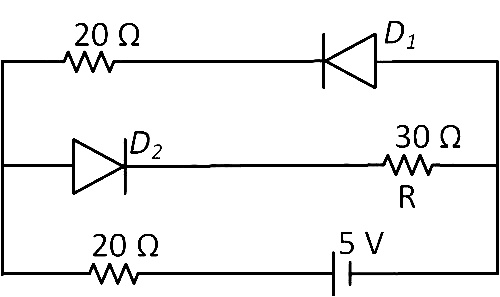
The current in the circuit will be

AIPMT 2001 Physics - Semiconductor Electronics Question 44 English
(A)
5/40 A
(B)
5/50 A
(C)
5/10 A
(D)
5/20 A
(B)

Solution

D1 is reverse biased and D2 is forward biased.

I = = A
Q.48
For a common base circuit if = 0.98 then current gain for common emitter circuit will be
(A)
49
(B)
98
(C)
4.9
(D)
25.5.
(A)

Solution

= 0.98 =

Current gain, = = = 49
Q.49
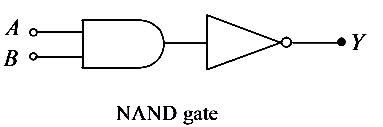
The given truth table is for which logic gate

              
(A)
NAND
(B)
XOR
(C)
NOR
(D)
OR
(A)

Solution

This truth table represents NAND gate. AIPMT 2001 Physics - Semiconductor Electronics Question 46 English Explanation
Chemistry (Maximum Marks: 204)
  • This section contains 51 questions.
  • Each question has FOUR options (A), (B), (C) and (D). ONLY ONE of these four options is the correct answer.
  • Full Marks : +4 If ONLY the correct option is chosen;
  • Zero Marks : 0 If none of the options is chosen (i.e. the question is unanswered);
  • Negative Marks : −1 In all other cases.
Q.1
Molarity of liquid HCl, if density of solution is 1.17 g/ce is
(A)
36.5
(B)
18.25
(C)
32.05
(D)
42.10
(C)

Solution

Molarity =
Q.2
Percentage of Se in peroxidase anhydrous enzyme is 0.5% by weight (at. wt. = 78.4) then minimum molecular weight of peroxide anhydrous enzyme is
(A)
1.568 104
(B)
1.568 103
(C)
15.68
(D)
2.136 104
(A)

Solution

Q.3
Specific volume of cylinfrical virus particle is 6.02 102 cc/g whose radius and length are 7 and 10 respectively. If NA = 6.02 1023, find molecular weight of virus.
(A)
15.4 kg/mol
(B)
1.54 104 kg/mol
(C)
3.08 104 kg/mol
(D)
3.08 103 kg/mol
(A)

Solution

Specific volume ( vol. of 1 g) cylindrical virus particle

= 6.02 10-2 cc/g

Radius of virus, r = 7 Å = 7 10-8 cm

Volume of virus =

=

= 154 10-23 cc

wt. of one virus particle =


Molecular wt of virus = wt. of NA particle

=

= 15400 g/mol = 15.4 kg/mol
Q.4
The following quantum numbers are possible for how many orbitals :

n = 3, = 2, m = +2 ?
(A)
1
(B)
2
(C)
3
(D)
4
(A)

Solution

n = 3, l = 2, m = +2

It shows one of the five d-orbitals(3d)
Q.5
Main axis of a diatomic molecule is z, molecular orbital px and py overlap to from which of the following orbitals.
(A)
molecular orbital
(B)
molecular orbital
(C)
molecular orbital
(D)
No bond will form
(A)

Solution

For overlap, the lobes of the atomic orbitals are perpendicularto the line joining the nuclei.

Hence only sidewise overlapping takes place.
Q.6
The beans are cooked earlier in pressure cooker because
(A)
boiling point increases with increasing pressure
(B)
boiling point decreases with increasing pressure
(C)
extra pressure of pressure cooker softens the beans
(D)
internal energy is not lost while coocking in pressure cooker.
(B)

Solution

When water pressure increases in the pressure cooker, water boils at lower temperature and the beans in pressure cooker are cooked earlier.
Q.7
Ionisation constant of CH3COOH is 1.7 105 and concentration of H+ ions is 3.4 104. Then find out initial concentration of CH3COOH molecules.
(A)
3.4 104
(B)
3.4 103
(C)
6.8 104
(D)
6.8 103
(D)

Solution

CH3COOH ⇌ CH3COO + H+

Kc =

[CH3COOH] =

= 6.8 × 10⁻³
Q.8
In HS, I, R NH2, NH3 order of proton accepting tendency will be
(A)
I > NH3 > R NH2 > HS
(B)
NH3 > R NH2 > HS > I
(C)
R NH2 > NH3 > HS > I
(D)
HS > R NH2 > NH3 > I
(C)

Solution

Strong base has higher tendency to accept the proton. Increasing order of base and hence the order of accepting tendency of proton is

R NH2 > NH3 > HS > I
Q.9
Solubility of M2S salt is 3.5 106 then find out solubility product.
(A)
1.7 106
(B)
1.7 1016
(C)
1.7 1018
(D)
1.7 1012
(B)

Solution

M2S ⇌ 2M+ + S2–

Ksp = [M+]2[S2–] = (2s)2(s) = 4s 3

Ksp = 4(3.5 × 10⁻⁶)3 = 1.7 × 10⁻¹⁶
Q.10
Correct relation between dissociation constants of a dibasic acid is
(A)
Ka1 = Ka2
(B)
Ka1 > Ka2
(C)
Ka1 < Ka2
(D)
Ka1 =
(B)

Solution

In polyprotic acids the loss of second proton occurs much less readily than the first. Usually the Ka values for successive loss of protons from these acids differ by at least a factor of 10–3.

Ka1 > Ka2
Q.11
Pure water can be obtained from sea water by
(A)
centrifugation
(B)
plasmolysis
(C)
reverse osmosis
(D)
sedimentation
(C)

Solution

The osmotic pressure of sea water is 25 atm at 15°C. When pressure greater than 26 atm is applied on sea water separated by a rigid semipermeable membrane. Pure water is obtained. This is also called desalination of sea water.
Q.12
PbO2   PbO; G298 < 0
SnO2 SnO;  G298 > 0

Most probable oxidation state of Pb and Sn will be
(A)
Pb4+, Sn4+
(B)
Pb4+, Sn2+
(C)
Pb2+, Sn2+
(D)
Pb2+, Sn4+
(D)

Solution

PbO2 → PbO

Pb has +4 oxidation state In PbO2.

Pb has +2 oxidation state In PbO.

Here G is negative that is why reaction is spontaneous and Pb4+ reduces Pb2+ thus, Pb2+ is most probable oxidation state of Pb.

SnO2 SnO;

Sn has +4 oxidation state In SnO2.

Sn has +2 oxidation state In SnO.

G is positive that is why reaction is not spontaneous thus, +4 oxidation state of Sn is more stable as it does not change to +2 oxidation state spontaneously.
Q.13
Change in enthalpy for reaction,

2H2O2(l) 2H2O(l) + O2(g)

if heat of formation of H2O2(l) and H2O(l) are 188 and - 286 kJ/mol respectively, is
(A)
196 kJ/mol
(B)
+ 196 kJ/mol
(C)
+948 kJ/mol
(D)
948 kJ/mol
(A)

Solution

2H2O2(l) 2H2O(l) + O2(g), Hr = ?

H2(g) + O2(g) → H2O2(l), H = – 188 kJ mol ...(1)

H2(g) + O2(g) → H2O(l), H = –286 kJ/mol ....(2)

(1) - (2)

H2O2(l) → H2O(l) + O2(g)

H = –286 – (– 188) = –98 kJ mol–1

Multiplying this equation by 2 we get the required equation

2H2O2(l) → 2H2O(l) + O2(g)

H = 2 (– 98) kJ/mol = – 196 kJ/mol
Q.14
When 1 mol of gas is heated at constant volume temperature is raised from 298 to 308 K. Heat supplied to the gas is 500 J. Then which statement is correct ?
(A)
q = w = 500 J, E = 0
(B)
q = E = 500 J, w = 0
(C)
q = w = 500 J, E = 0
(D)
E = 0, q = w = 500 J
(B)

Solution

As, E = q + W

Also, W = – pV

As V = 0

So, W = 0

E = q

Now, q = 500 J

Thus, E = q = 500 J
Q.15
Enthalpy of CH4 + O2 CH3OH is negative. If enthalpy of combustion of CH4 and CH3OH are x and y respectively. Then which relation is correct?
(A)
x > y
(B)
x < y
(C)
x = y
(D)
x3 y
(B)

Solution

CH4 + O2 CH3OH

Given that for this reaction, Hr = -ve

CH4 + 2O2 → CO2 + 2H2O,    H = x ....(1)

CH3OH + O2 → CO2 + 2H2O,    H = y ....(2)

Eqn. (1) – Eqn. (2)

CH4 + O2 CH3OH

Hr = x - y = -ve

x < y
Q.16
Standard electrode potentials are
Fe2+/Fe [Eo = 0.44] and
Fe3+/Fe2+[ Eo = 0.77];
If Fe2+, Fe3+ and Fe blocks are kept together, then
(A)
Fe3+ increases
(B)
Fe3+ decreases
(C)
Fe2+/Fe3+ remains unchanged
(D)
Fe2+ decreases.
(B)

Solution

The metals having higher negative values of their electrode potential can displace metals having lower values from their salt solutions.
Q.17
For the reaction;

2N2O5 4NO2 + O2 rate and rate constant are 1.02 104 and 3.4 105 sec1 respectively, then concentration of N2O5 at that time will be
(A)
1.732
(B)
3
(C)
1.02 104
(D)
3.4 105
(B)

Solution

For the reaction;

2N2O5 4NO2 + O2

This is a first order reaction.

rate = k [N2O5] ;

[N2O5] =

=

= 3
Q.18
When a bio-chemical reaction is carried out in laboratory, outside the human body in absence of enzyme, then rate of reaction obtained is 106 times, the activation energy of reaction in the presence of enzyme is
(A)
6/RT
(B)
P is required
(C)
different from E obtained in laboratory
(D)
can't say anything.
(C)

Solution

From Arrhenius equation, k = Ae –Ea/RT

The activation energy of the reaction in the presence of enzyme is different from Ea obtained in laboratory.
Q.19
A human body required 0.01 m activity of radioactive substance after 24 hours. Half life of radioactive substance is 6 hours. Then inhection of maximum activity of radioactive substance that can be injected is
(A)
0.08
(B)
0.04
(C)
0.16
(D)
0.32
(C)

Solution

At the end of 24 hrs. activity = 0.01 M

Half life = 6 hrs.

In 24 hrs. there are 24/6 = 4 half life.

Activity of substance after n half-life =


A = 0.16
Q.20
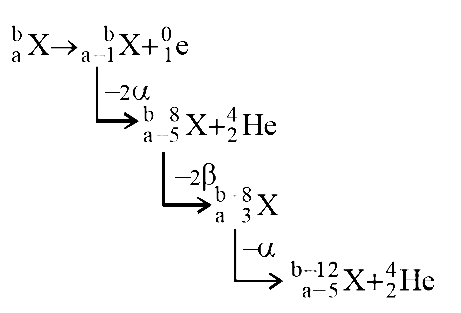
If a species emits first a position, then two a and two b particles and in the last, one a, is also emitted and gets converts to Y species. So correct relation is
(A)
c = a 12, d = b 5
(B)
c = a 5, d = b 1
(C)
c = a 6, d = b 0
(D)
c = a 4, d = b 2
(A)

Solution

AIPMT 2001 Chemistry - Nuclear Chemistry Question 3 English Explanation
Q.21
When Zn converts from melted state to its solid state, it has hcp structure, then find the number of nearest atoms.
(A)
6
(B)
8
(C)
12
(D)
4
(C)

Solution

hcp is a closed packed arrangement in which the unit cell is hexagonal and coordination number is 12.
Q.22
Which is not correct regarding the adsorption of a gas on surface of a solid?
(A)
On increasing temperature adsorption increases continuously.
(B)
Enthalpy and entropy change is negative.
(C)
Adsorption is more for some specific substance.
(D)
It is a reversible reaction.
(A)

Solution

Adsorption is the property of a substance to hold or to concentrate liquid or dissolved substances upon its surface. Solids adsorb greater amount of substance at lower temperature and in general adsorption decreases with increasing temperature.
Q.23
Correct order of 1st ionization potential among following elements Be, B, C, N, O is
(A)
B < Be < C < O < N
(B)
B < Be < C < N < O
(C)
Be < B < C < N < O
(D)
Be < B < C < O < N
(A)

Solution

Be – 1s22s2;

B – 1s22s22p1;

C – 1s22s22p2;

N – 1s22s22p3;

O – 1s22s22p4.

IP increases along the period. But IP of Be > B. Further IP of O < N because atoms with fully or partly filled orbitals are most stable and hence have high ionisation energy.

As in case of boron, 2p1 electron have to be removed to get B+(1s2 2s2) from B(1s2 2s2 2p1), while in case of Be (1s22s2) electron have to be removed to get Be+ (1s22s1). p electron can be removed more easily than s electron so the energy required to remove electron will be less in case of boron.
Q.24
In X - H --- Y, X and Y both are electronegative elements. Then
(A)
electron density on X will increase and on H will decrease
(B)
in both electron density will increase
(C)
in both electron density will decrease
(D)
on X electron density will decrease and on H increases.
(A)

Solution

As X and Y both are electronegative elements thus both attracts the electron density from H thus, electron density on H decreases and on X it increases.
Q.25
In which of the following bond angle is maximum ?
(A)
NH3
(B)
NH4+
(C)
PCl3
(D)
SCl2
(B)

Solution

Bond angle is maximum in NH4+ tetrahedral molecule with bond angle 109°.
Q.26
Which of the following two are isostructural?
(A)
XeF2, IF2
(B)
NH3, BF3
(C)
CO32, SO32
(D)
PCl5, ICl5
(A)

Solution

Compounds with same shape and same hybridisation are known as isostructural.

XeF2, IF2- both are sp3 hybridised linear molecules.
Q.27
Nitrogen forms N2, but phosphorus does not form P2, however, it converts P4, reason is
(A)
triple bond present between phosphorus atom
(B)
p p bonding is weak
(C)
p p bonding is strong
(D)
multiple bonds form easily.
(B)

Solution

For strong -bonding, p - p bonding should be strong. In case of P, due to larger size as compared to N-atom, p - p bonding is not so strong.
Q.28
The most convenient method to protect the botton of ship made of iron is
(A)
coating it with red lead oxide
(B)
white tin plating
(C)
connecting it with Mg block
(D)
connecting it with Pb block.
(B)

Solution

The most convenient method to protect the bottom of the ship made of iron is white tin plating preventing the build up of barnacles.
Q.29
Which of the following statement is not correct?
(A)
La(OH)3 is less basic than Lu(OH)3.
(B)
In lanthanide series ionic radius of Lu+3 ion decreases.
(C)
La is actually an element of transition series rather lanthanides.
(D)
Atomic radius of Zn and Hf are same because of lanthanide contraction.
(A)

Solution

In lanthanides the basic character of hydroxides decreases as the ionic radius decreases.

La3+ ions are larger than Li3+ so it easily gives OH ion thus La(OH)3 is more basic than Li(OH)3.
Q.30
Which of the following will give maximum number of isomers?
(A)
[Co(NH3)4Cl2]
(B)
[Ni(en)(NH3)4]2+
(C)
[Ni(C2O4)(en)2]2
(D)
[Cr(SCN)2(NH3)4]+
(D)

Solution

In [Cr(SCN)2(NH3)4]+ it shows linakge, geometrical and optical isomerism.
Q.31
Coordination number of Ni in [Ni(C2O4)3]4 is
(A)
3
(B)
6
(C)
4
(D)
2
(B)

Solution

Coordination number of nickel in [Ni(C2O4)3]4 is 6 because C2O42– is a bidentate ligand.
Q.32
Which statement is incorrect?
(A)
Ni(CO)4 tetrahedral, paramagnetic
(B)
Ni(CN)4 - square planar, diamagnetic
(C)
Ni(CO)4 - tetrahedral, diamagnetic
(D)
[Ni(Cl)4]2 - tetrahedral, paramagnetic.
(A)

Solution

In Ni(CO)4-, Ni in zero oxidation state

Ni(0) = [Ar] 3d84s2
AIPMT 2001 Chemistry - Coordination Compounds Question 44 English Explanation

It has no unpaired electron so acts as diamagnetic and has tetrahedral structure.
Q.33
Which of the following organometallic compounds is and bonded?
(A)
[Fe(5 C2H5)2]
(B)
K[PtCl3(2 C2H4)]
(C)
[Co(CO)5NH3]2+
(D)
Fe(CH3)3
(C)

Solution

[Co(CO)5NH3]2+ : In this complex, Co-atom is attached with NH3 through bonding and with CO with dative -bond.
Q.34
Which of the following will exhibit maximum ionic conductivity?
(A)
K4[Fe(CN)6]
(B)
[Co(NH3)6]Cl3
(C)
[Cu(NH3)4]Cl2
(D)
[Ni(CO)4
(A)

Solution

Ionic conductance increases with increasing the number of ions, produced after decomposition.

In K4[Fe(CN)6], it produces maximum 5 ions thus show more conductivity.

K4[Fe(CN)6] ⇌ 4K+ + [Fe(CN)6]4–
Q.35
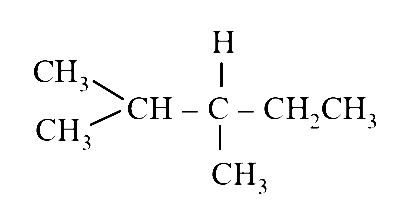
A compound of molecular formula C7H16 shows optical isomerism, compound will be
(A)
2, 3-dimethylpentane
(B)
2, 2-dimethylbutane
(C)
2-methylhexane
(D)
none of these
(A)

Solution

Organic compounds exhibit the property of enantiomerism (optical isomerism) only when their molecules are chiral. Most chiral compounds have a chiral centre, which is an atom bonded to four different atoms or groups. AIPMT 2001 Chemistry - Some Basic Concepts of Organic Chemistry Question 48 English Explanation
2,3-Dimethylpentane has one chiral C-atom and do not have any symmetric element.
Q.36
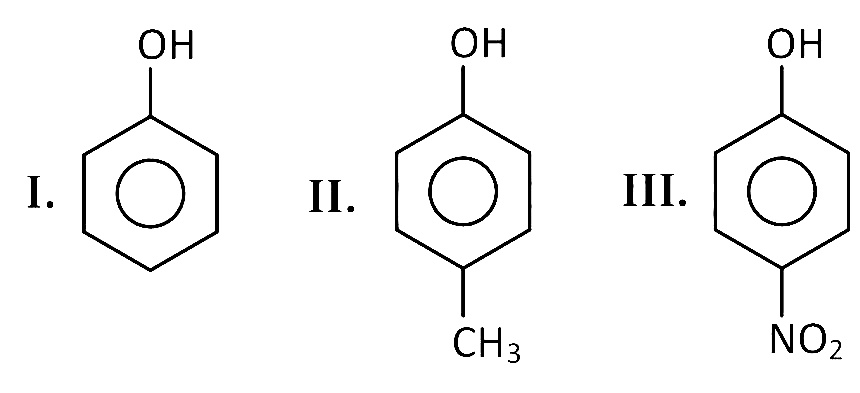
The correct acidic order of the following is

AIPMT 2001 Chemistry - Some Basic Concepts of Organic Chemistry Question 49 English
(A)
I > II > III
(B)
III > I > II
(C)
II > III > I
(D)
I > III > II
(B)

Solution

Presence of electron withdrawing groups (– NO2, –X, – CN) increase the acidity of phenols while the presence of electron releasing groups (– NH2, – CH3) decrease the acidity of phenols. This explains the following order of acidity.

p-nitrophenol > phenol > p-cresol.
Q.37
In steam distillation of toluene, the pressure of toluene in vapour is
(A)
equal to pressure of barometer
(B)
Less than pressure of barometer
(C)
equal to vapour pressure of toluene in simple distillation
(D)
more than vapour pressure of toluene in simple distillation.
(B)

Solution

In steam distillation of toluene, the pressure of toluene in vapour is less than pressure of barometer, because it is carried out when a solid or liquid is insoluble in water and is volatile with steam but the impurities are non-volatile.
Q.38
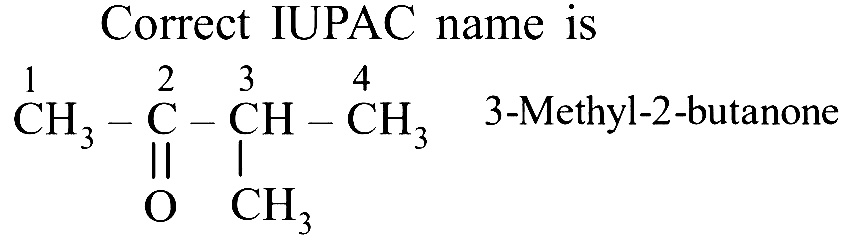
The incorrect IUPAC name is
(A)
AIPMT 2001 Chemistry - Some Basic Concepts of Organic Chemistry Question 56 English Option 1
(B)
AIPMT 2001 Chemistry - Some Basic Concepts of Organic Chemistry Question 56 English Option 2
(C)
AIPMT 2001 Chemistry - Some Basic Concepts of Organic Chemistry Question 56 English Option 3
(D)
AIPMT 2001 Chemistry - Some Basic Concepts of Organic Chemistry Question 56 English Option 4
(A)

Solution

AIPMT 2001 Chemistry - Some Basic Concepts of Organic Chemistry Question 56 English Explanation
Q.39
In preparation of alkene from alcohol using Al2O3 which is the effective factor ?
(A)
Porosity of Al2O3
(B)
Temperature
(C)
Concentration
(D)
Surface area of Al2O3
(B)

Solution

AIPMT 2001 Chemistry - Hydrocarbons Question 26 English Explanation
Q.40
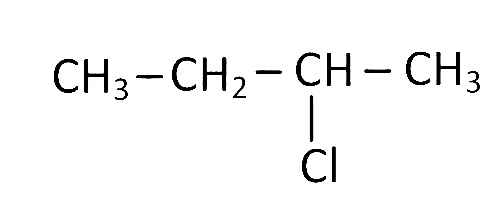
AIPMT 2001 Chemistry - Haloalkanes and Haloarenes Question 17 English
obtained by chlorination of n-butane will be
(A)
meso form
(B)
racemic mixture
(C)
d-form
(D)
-form
(B)

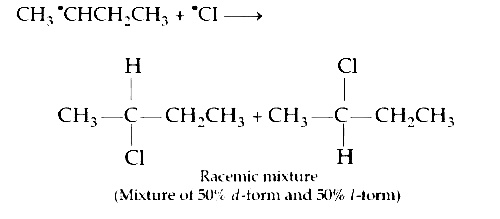
Solution

AIPMT 2001 Chemistry - Haloalkanes and Haloarenes Question 17 English Explanation Chlorination of n-butane takes place via free radical formation.
Q.41
An organic compound A(C4H9Cl) on reaction with Na/diethyl ether gives a hydrocarbon which on monochlorination gives only one chloro derivative then, A is
(A)
t-butyl chloride
(B)
s-butyl chloride
(C)
iso-butyl chloride
(D)
n-butyl chloride
(A)

Solution

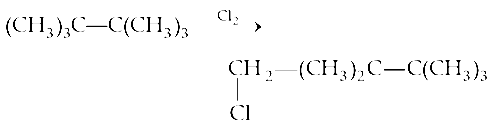
2C4H9Cl+2Na C4H9 - C4H9 + 2NaCl

In C4H9 - C4H9 i.e., (H3C)3C—C(CH3)3 there are primary hydrogens only.

Thus, only one chloro derivative is possible.
AIPMT 2001 Chemistry - Haloalkanes and Haloarenes Question 34 English Explanation
Q.42
Which of the following is correct?
(A)
On reduction, any aldehyde gives secondary alcohol.
(B)
Reaction of vegetable oil with H2SO4 gives glycerine
(C)
Alcoholic iodine with NaOH gives iodoform.
(D)
Sucrose on reaction with NaCl gives invert sugar.
(C)

Solution

C2H5OH + 4I2 + NaOH

CHI3 + NaI + HCOONa + H2O

Iodoform is a pale yellow solid which crystallises in hexagonal plates.
Q.43
Which of the following is incorrect?
(A)
FeCl3 is used in detection of phenol.
(B)
Fehling solution is used in detection of glucose
(C)
Tollen's reagent is used in detection of unsaturation.
(D)
NaHSO3 is used in detection of carbonyl compound.
(C)

Solution

Tollen's reagent is used to detect aldehydic group. Tollen's reagent is an ammonical solution of silver nitrate. When aldehyde is added to Tollen's reagent, silver oxide is reduced to metallic silver which deposits as mirror.

RCHO + Ag2O RCOOH + 2Ag
Q.44
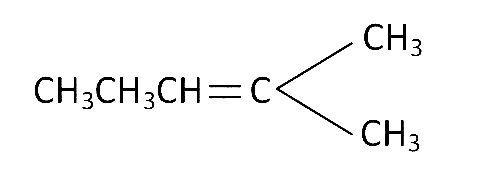
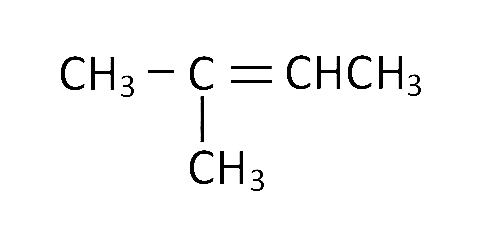
Which alkene on ozonolysis gives CH3CH2CHO and CH3COCH3?
(A)
AIPMT 2001 Chemistry - Aldehydes, Ketones and Carboxylic Acids Question 39 English Option 1
(B)
CH3CH2CH CHCH2CH3
(C)
CH3CH2CH CHCH3
(D)
AIPMT 2001 Chemistry - Aldehydes, Ketones and Carboxylic Acids Question 39 English Option 4
(A)

Solution

AIPMT 2001 Chemistry - Aldehydes, Ketones and Carboxylic Acids Question 39 English Explanation
Q.45
Which of the following give positive Fehling solution test?
(A)
Sucrose
(B)
Glucose
(C)
Fats
(D)
Protein
(B)

Solution

Glucose reduces Fehling solution because glucose has free –CHO group which is readily oxidised.
Q.46
Intermediates formed during reaction of
AIPMT 2001 Chemistry - Organic Compounds Containing Nitrogen Question 34 English
are
(A)
RCONHBr and RNCO
(B)
RNHCOBr and RNCO
(C)
RNH Br and RCONHBr
(D)
RCONBr2
(A)

Solution

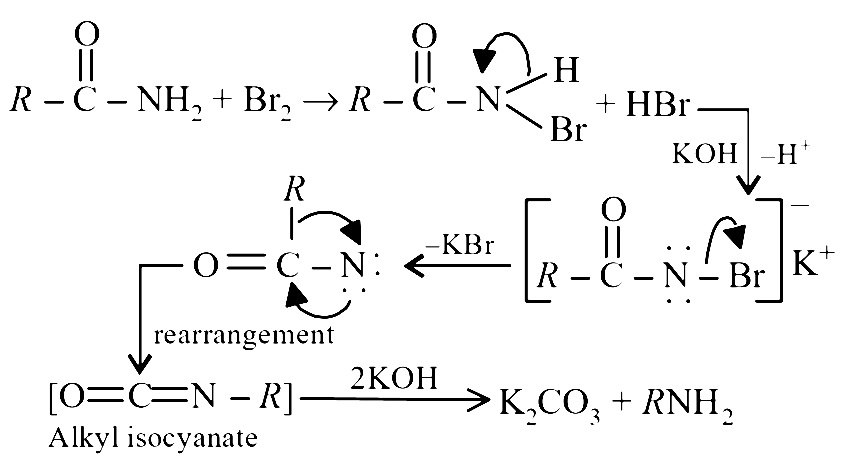
The Hofmann bromamide reaction is as :

RCONH2 + Br2 + KOH RNH2

The mechanism is as follows :

AIPMT 2001 Chemistry - Organic Compounds Containing Nitrogen Question 34 English Explanation
Q.47
Which of the following is not correctly matched?
(A)
AIPMT 2001 Chemistry - Polymers Question 18 English Option 1
(B)
AIPMT 2001 Chemistry - Polymers Question 18 English Option 2
(C)
AIPMT 2001 Chemistry - Polymers Question 18 English Option 3
(D)
AIPMT 2001 Chemistry - Polymers Question 18 English Option 4
(C)

Solution

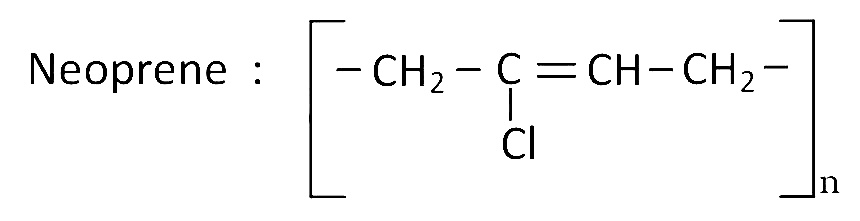
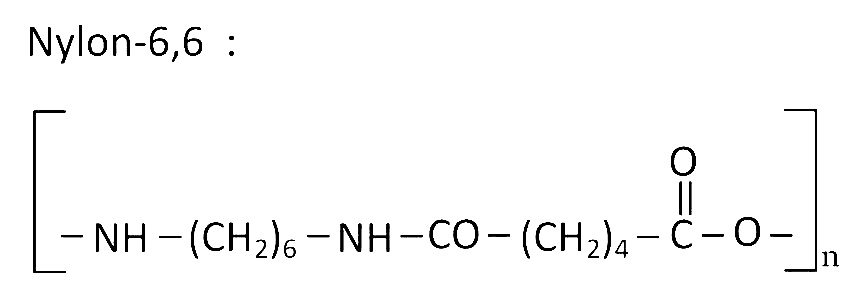
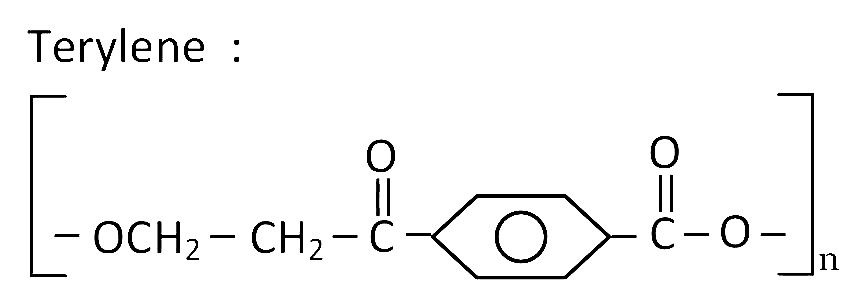
Terylene is the condensation polymer of ethylene glycol and terephthalic acid. AIPMT 2001 Chemistry - Polymers Question 18 English Explanation
Q.48
Which of the following is correct?
(A)
Cycloheptane is an aromatic compound.
(B)
Diastase is an enzyme
(C)
Acetophenone is an ether.
(D)
All of these.
(B)

Solution

Diastase is an enzyme. (The protein produced by living systems which acts as a biological catalyst). Enzymes are characterised by the name ending with -ase.
Q.49
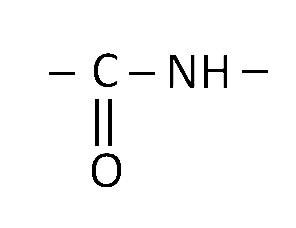
AIPMT 2001 Chemistry - Biomolecules Question 22 English
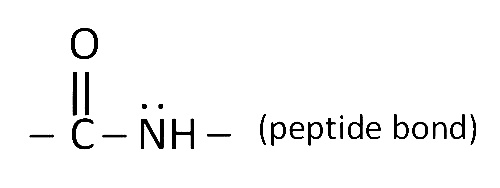
Which statement is incorrect about peptide bond?
(A)
C N bond length in proteins is longer than usual bond length of N C bond.
(B)
Spectroscopic analysis shows planar structure of group. AIPMT 2001 Chemistry - Biomolecules Question 22 English Option 2
(C)
C N bond length in proteins is smaller than usual bond length of C N bond.
(D)
None of the above.
(A)

Solution

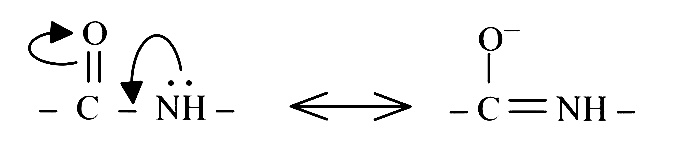
Due to resonance C — N bond in protein acquires double bond character and is smaller than usual C — N bond. AIPMT 2001 Chemistry - Biomolecules Question 22 English Explanation
Q.50
Which is the correct statement?
(A)
Starch is a polymer of -glucose.
(B)
Amylose is a component of cellulose.
(C)
Proteins are composed of only one type of amino acid.
(D)
In cyclic structure of fructose, there are four carbons and one oxygen atom.
(A)

Solution

Starch is also know as amylum which occurs in all green plants. A molecule of starch (C6H10O5)n is built of a large number of -glucose ring joined through oxygen-atom.
Q.51
Which of the following is correct about H-bonding in nucleotide?
(A)
A T, G C
(B)
A G, T C
(C)
G T, A C
(D)
A A, T T
(A)

Solution

Guanine G is linked to cytosine C by three hydrogen bonds and adenine A is linked with thymine T by two hydrogen bonds. It is abbreviate as : G ≡ C and A = T
Biology (Maximum Marks: 364)
  • This section contains 91 questions.
  • Each question has FOUR options (A), (B), (C) and (D). ONLY ONE of these four options is the correct answer.
  • Full Marks : +4 If ONLY the correct option is chosen;
  • Zero Marks : 0 If none of the options is chosen (i.e. the question is unanswered);
  • Negative Marks : −1 In all other cases.
Q.1
Element necessary for the middle lamella is
(A)
K
(B)
Cu
(C)
Ca
(D)
Zn
(C)

Solution

Middle lamella is the first formed layer, present between the two adjacent cells. It is situated outside the primary cell wall. It is made up of calcium and magnesium pectate.
Q.2
Microtubules are absent in : -
(A)
Spindle fibres
(B)
Mitochondria
(C)
Centriole
(D)
Flagella
(B)
Q.3
Proteinaceous pigment which control the activities concerned with light is
(A)
Carotenoids
(B)
Phytochrome
(C)
Chlorophyll
(D)
Anthocyanin
(B)

Solution

Phytochrome is a plant pigment that can detect the presence or absence of light and is involved in regulating many processes that are linked to day length (photoperiod), such as seed germination and initiation of flowering. It consists of a light-detecting portion, called a chromophore, linked to a small protein and exists in two interconvertible forms with different physical properties, particularly in the ability to bind to membranes.
Q.4
Enzyme first used for nitrogen fixation
(A)
nitrogenaase
(B)
nitroreductase
(C)
transferase
(D)
transaminase
(A)

Solution

Nitrogen fixation involves conversion of atmospheric nitrogen to ammonia. It is done with the help of nitrogenase enzyme which occurs inside thick walled heterocysts of the blue green algae. These provide suitable anaerobic environment for nitrogenase activity even in aerobic conditions.
Q.5
Adventive embryony in Citrus is due to
(A)
nucellus
(B)
integuments
(C)
zygotic embryo
(D)
fertilized egg.
(A)

Solution

Presence of more than one embryo inside the seed is called polyembryony. It is more common in gymnosperms than angiosperms. In angiosperms, it is generally present as an unusual feature in few cases like Citrus, mango etc.
In Citrus many embryos are formed from the structures outside the embryo (like nucellus). This is commonly called adventive polyembryony. In Citrus upto 10 nucellar embryos are formed.
Q.6
In grasses what happens in microspore mother cell for the formation of mature pollen grains?
(A)
One meiotic and two mitotic divisions
(B)
One meiotic and one mitotic divisions
(C)
One meiotic
(D)
One Mitotic division
(B)

Solution

Grass is a monocot plant. Primary sporogenous cell gives rise to microspore mother cells or pollen mother cells. Each MMC on reduction division gives rise to 4 microspores or pollens and this formation of microspores or pollens is called microsporogenesis. Karyokinesis is of successive type. The successive type of cytokinesis is common in monocots. Here both meiotic I and II nuclear divisions are followed by wall formation and it leads to isobilateral tetrad.
Q.7
Anemophily type of pollination is found in
(A)
Salvia
(B)
bottle brush
(C)
Vallisneria
(D)
coconut.
(D)

Solution

Vallisneria exhibits hydrophily and Salvia is pollinated by honey bee. In bottle brush pollination is carried out by birds.
Q.8
Which of the following is true pair of biofertilizers ?
(A)
Nostoc and legume
(B)
Rhizobium and grasses
(C)
Salmonella & E. Coli
(D)
Azolla and BGA
(D)

Solution

Azolla and blue green algae- Anabaena form biofertilizer in rice fields.
Q.9
Spoilage of oil can be detected by which fatty acid : -
(A)
Linolenic acid
(B)
Erusic acid
(C)
Linoleic acid
(D)
Oleic acid
(B)

Solution

Erucic acid is a monounsaturated omega-9 fatty acid, denoted 22 : 1 -9. It is prevalent in rapeseed, wallflower seed, and mustard seed, making up 40 to 50 percent of their oils. Erucic acid is also known as cis13-docosenoic acid and the trans isomer is known as brassidic acid.
Q.10
In plants inulin and pectin are
(A)
Excretory material
(B)
Reserved material
(C)
Insect attracting material
(D)
Wastes
(B)

Solution

Inulin is a water soluble fructosan. It is a common reserve food in members of family compositae. Pectin is a mucopolysaccharides and occur in plant cell walls. At the time of fruit ripening wall of pectins hydrolyse to give constituent sugars.
Q.11
Passive absorption of minerals depends on
(A)
temperature
(B)
temperature and metabolic inhibitor
(C)
metabolic inhibitor
(D)
humidity.
(A)

Solution

Rate of salt absorption increases when temperature increases but to a certain limit as salt absorption is inhibited at higher temperature because certain enzymes are not active at higher temperature and carriers are not synthesised. These carriers are required for active transport of salts from outer space in inner space.

Rate of diffusion of ions and molecules increases at enhanced temperature due to their increased kinetic activity. Thus passive salt absorption will increase.
Q.12
Loading of phloem is related to
(A)
increase of sugar in phloem cell
(B)
elongation of phloem cell
(C)
separation of phloem parenchyma
(D)
strengthening of phloem fiber.
(A)

Solution

Phloem is involved in transport of organic food. According to mass flow hypothesis organic substances flow in the form of solution in sieve elements due to development of an osmotically generated pressure gradient.
Q.13
Glycolate induces opening of stomata in
(A)
presence of oxygen
(B)
low CO2 concentration
(C)
high CO2
(D)
CO2 absent.
(B)

Solution

Tropical plants have evolved C4 cycle to overcome photorespiration.
Q.14
Which aquatic fern performs nitrogen fixation?
(A)
Azolla
(B)
Nostoc
(C)
Salvia
(D)
Salvinia
(A)

Solution

Azolla performs nitrogen fixation through its colonies of Anabaena azollae, which have the capacity to fix atmospheric nitrogen.
Q.15
Roots of which plant contains a red pigment which have affinity for oxygen?
(A)
Carrot
(B)
Soybean
(C)
Mustard
(D)
Radish
(B)

Solution

Leghaemoglobin is a red respiratory pigment found in the root nodules of leguminous plant if Rhizobium is present. Soybean is a legume plant so it contains leghaemoglobin in its root nodules.
Q.16
Cytochrome is
(A)
metallo flavo protein
(B)
Fe containing porphyrin pigment
(C)
glycoprotein
(D)
lipid.
(B)

Solution

Cytochrome is an Fe containing porphyrin pigment. These are electron transferring proteins often regarded as enzymes.
Q.17
Maximum number of bases in plasmids discovered so far : -
(A)
500 kilo base
(B)
5 kilo base
(C)
50 kilo base
(D)
5000 kilo base
(A)

Solution

A plasmid is a DNA molecule separate from the chromosomal DNA and capable of autonomous replication. In many cases, it is typically circular and double-stranded. It usually occurs in bacteria and is sometimes found in eukaryotic organisms. The size of plasmids varies from 1 to over 400 kilobase pairs (kbp). There may be one copy, for large plasmids, to hundreds of copies of the same plasmid in a single cell. The term plasmid was first introduced by the American molecular biologist Joshua Lederberg in 1952.
Q.18
Which of the following cut the DNA from specific places ?
(A)
Exonuclease
(B)
Alkaline phosphate
(C)
E.coli restriction endonuclease I
(D)
Ligase
(C)

Solution

The enzyme that cuts DNA at specific places is known as a restriction endonuclease. Among the options provided, the one that fits this description is :

Option C : E.coli restriction endonuclease I

Restriction endonucleases, also known as restriction enzymes, are enzymes that cut DNA at or near specific recognition nucleotide sequences known as restriction sites. E.coli restriction endonuclease I is an example of such an enzyme, derived from the bacterium Escherichia coli (E. coli). These enzymes are essential tools in molecular biology, particularly in processes like gene cloning, as they allow for precise cutting and manipulation of DNA.

Q.19
In lederberg's replica plating experiment what shall be used to obtain streptomycin resistant strain : -
(A)
Only minimal medium
(B)
Complete medium and streptomycine
(C)
Only complete medium
(D)
Minimal medium and streptomycine
(D)

Solution

This combination allows to select only streptomycin resistant strains and non resistant strains would die on medium containing antibiotic streptomycin.
Q.20
A mutant strain of T4 – Bacteriophage, R-II, fails to lyse the E-Coli but when two strains RIIX and R-IIY are mixed then they lyse the E.Coli. What may be the possible reason : -
(A)
Both strains have different cistrons
(B)
Both strains have simillar cistrons
(C)
It is not mutated
(D)
Bacteriophage transforms in wild
(A)

Solution

A mutant strain of T4 -bacteriophage, RII, fails to lyse the E.coli but when two strains R-IIX and R-IIY are mixed then they lyse the E.coli because both strains have different cistrons.
Q.21
Which of the following is less general in characters as compared to genus?
(A)
Species
(B)
Division
(C)
Class
(D)
Family
(A)

Solution

A taxonomic hierarchy is the sequence of arrangement of taxonomic categories in a descending order during the classification of an organism.

There are seven obligate categories - kingdom, division , class, order, family, genus and species. Species is the lowest category while kingdom is the highest category. The number of common characters is maximum in case of organisms placed in the lowest category.

Number of common characters decreases with the rise in category. Species are the smallest group of individuals which can be recognized by ordinary methods as groups and which are consistently and persistently different from other groups because their characters are less general.
Q.22
Adhesive pad of fungi penetrate the host with the help of
(A)
mechanical pressure and enzymes
(B)
hooks and suckers
(C)
softening by enzymes
(D)
only by mechanical pressure.
(A)

Solution

The fungal hyphae secrete enzymes which convert insoluble complex food material in the substratum to the soluble ones. The hyphae wall of intracellular hyphae come in contact with the host protoplasm and obtain food by direct diffusion.
Q.23
Cauliflower mosaic virus conrains
(A)
ss RNA
(B)
ds RNA
(C)
ds DNA
(D)
ss DNA
(C)

Solution

Cauliflower mosaic virus contain dsDNA. It is circular and shows semidiscontinuous type of replication.
Q.24
What is true for archaebacteria?
(A)
All halophiles
(B)
All photosynthetics
(C)
All fossils
(D)
Oldest living beings
(D)

Solution

Archaebacteria are the most ancient and halogenous group of bacteria and are called living fossils.
Q.25
Difference in gram positive and gram negative bacteria is due to
(A)
cell wall
(B)
cell membrane
(C)
ribosome
(D)
cytoplasm.
(A)

Solution

Using Gram stain, developed by Danish physician, Christian Gram in 1884, two kinds of bacteria were noted - those species of bacteria that are decolorized by alcohol are called gram negative and those that retain the stain are called gram positive.

This property of bacteria is related with the structure and compositional differences between the walls of gram positive and gram negative forms. In the cell wall of Gram +ve bacteria, both horizontal and vertical peptide linkages are present, due to which mesh is dense and hence the stain does not come out. Further outer layer of cell wall of Gram +ve bacteria is made of teichoic acid.

In the cell wall of Gram –ve bacteria, either horizontal or vertical peptide linkage are present, due to which mesh is loose and hence stain comes out. Further outermost layer of cell wall of Gram –ve bacteria is made of lipopolysaccharides.
Q.26
What is true for cyanobacteria ?
(A)
Oxygenic with nitrogenase
(B)
Oxygenic without nitrogenase
(C)
Non oxygenic with nitrogenase
(D)
Non oxygenic without nitrogenase
(A)

Solution

Cyanobacteria are a group of photosynthetic bacteria that are capable of performing oxygenic photosynthesis. During this process, they use sunlight to convert carbon dioxide and water into organic compounds, while producing oxygen as a byproduct. This oxygen production is a key characteristic of oxygenic photosynthesis, and is what allows cyanobacteria to release oxygen into the atmosphere.

In addition to oxygenic photosynthesis, many species of cyanobacteria also have the ability to fix atmospheric nitrogen into a form that can be used by other organisms. This process is facilitated by an enzyme called nitrogenase, which converts nitrogen gas into ammonia, a compound that can be taken up by plants and other organisms. Cyanobacteria are the primary nitrogen fixers in many ecosystems, and they play a critical role in maintaining the balance of nutrients in many environments.

So, to summarize, cyanobacteria are oxygenic because they produce oxygen during photosynthesis, and they are capable of fixing nitrogen because they contain the enzyme nitrogenase. Option A, "Oxygenic with nitrogenase," is the correct answer.
Q.27
Which is expressing right appropriate pairing?
(A)
Brassicaceae   -   sunflower
(B)
Malvaceae   -   cotton
(C)
Papilionaceae   -   catechu
(D)
Liliaceae   -   wheat
(B)

Solution

Malvaceae is also known as cotton family or mallow family. The plants of this family are cosmopolitan in distribution, although more common in tropical (warm) regions. Gossypium (cotton) is an important genera of this family. Sunflower belongs to Family Compositae. Wheat belong to Family Poaceae. Catechu belongs to Family Mimosaceae.
Q.28
Edible part of banana is
(A)
epicarp
(B)
mesocarp and less developed endocarp
(C)
endocarp and less developed mesocarp
(D)
epicarp and mesocarp.
(C)

Solution

Banana is a berry. It develops from monocarpellary or multicarpellary syncarpous ovary. Epicarp makes the rind of the fruit, mesocarp is fleshy and endocarp is thin and membranous. The edible portion of banana is endocarp and less developed mesocarp.
Q.29
What is the eye of potato?
(A)
Axillary bud
(B)
Accessory bud
(C)
Adventitious bud
(D)
Apical bud
(A)

Solution

Axillary bud is the bud arising in the axil of branch. Apical bud arises at the apex. Adventitious bud arises from any location other than its usual location.
Q.30
Which is correct pair for edible part?
(A)
Tomato-thalamus
(B)
Maize-cotyledons
(C)
Guava-mesocarp
(D)
Date palm-mesocarp
(D)

Solution

In guava, mesocarp and endocarp form the edible part. In maize seed coat is fused with fruit wall.
Q.31
In which of the following plant sunken stomata are found?
(A)
Nerium
(B)
Hydilla
(C)
Mango
(D)
Guava
(A)

Solution

Nerium is a xerophytic plant and has sunken stomata, confined to lower epidermis to reduce the rate of transpiration.
Q.32
Tetradynamous conditions occur in
(A)
Cruciferae
(B)
Malvaceae
(C)
Solanaceae
(D)
Lilliaceae.
(A)

Solution

Tetradynamous stamens consist of four long-sized stamens and two shortsized stamens. Such kind of stamens are found in family Cruciferae e.g. Sarsoo. Tetradynamous condition is characteristic of this family
Q.33
Bicarpellary gynoecium and oblique ovary occurs in
(A)
mustard
(B)
banana
(C)
Pisum
(D)
brinjal
(D)

Solution

Bicarpellary gynoecium and oblique ovary are present in brinjal (Solanum melongena).
Q.34
Which pair is wrong?
(A)
C3-maize
(B)
C4-kranz anatomy
(C)
Calvin cycle-PGA
(D)
Hatch and Slack cycle - OAA
(A)

Solution

Maize is a C4 plant exhibiting Hatch and Slack pathway. These plants show Kranz anatomy and overcome photorespiration.
Q.35
What is true for photolithotrophs?
(A)
Obtain energy from radiations and hydrogen from organic compounds
(B)
Obtain energy from radiations and hydrogen from inorganic compounds
(C)
Obtain energy from organic compounds
(D)
Obtain energy from inorganic compounds
(B)

Solution

Photolithotrophs are those plants that obtain energy from radiation and hydrogen from inorganic compounds.
Q.36
Which pigment system is inactivated in red drop?
(A)
PS-I and PS-II
(B)
PS-I
(C)
PS-II
(D)
None of the above
(C)

Solution

Emerson and Lewis worked on Chlorella and calculated the quantum yield for different wavelengths. Emerson observed that rate of photosynthesis declines in the red region of the spectrum. This decline in photosynthesis is called “Red drop”. It was observed that the quantum yield falls when the light of wavelengths more than 680 or 690 nm are supplied. As the PS-II P680 is driven by red light, so it remains inactive during red drop.
Q.37
Male XX and female XY sometime occur due to
(A)
Aneuploidy
(B)
Deletion
(C)
Transfer of segments in X and Y chromosomes
(D)
Hormonal imbalance
(C)

Solution

Male XX and female XY sometimes occur due to transfer of segments in X and Y chromosomes. Deletion is the loss of an intercalary segment of a chromosome which is produced by a double break in the chromosomes followed by the union of remaining parts. Aneuploidy is a condition of having fewer or extra chromosomes than the normal genome number of the species.
Q.38
Two nonallelic genes produces the new phenotype when present together but fail to do so independently then it is called : -
(A)
Polygene
(B)
Complimentry gen
(C)
Non complimentry gene
(D)
Epistasis
(D)

Solution

Epistasis is the phenomenon of suppression of phenotypic expression of gene by a non-allelic gene which shows its own effect. The gene which masks the effect of another is called epistatic gene while the one which is suppressed is termed hypostatic gene. Epistasis is of three types - dominant, recessive and dominant-recessive.
Q.39
Ratio of complementry genes is : -
(A)
9 : 3 : 4
(B)
9 : 7
(C)
12 : 3 : 1
(D)
9 : 3 : 3 : 4
(B)

Solution

If two genes present on different loci produce the same effect when present alone but interact to form a new trait when present together, they are called complementary genes. The F2 ratio is modified to 9 : 7 instead of 9 : 3 : 3 : 1.
Q.40
When dominant and recessive allels express itself together it is called : -
(A)
Dominance
(B)
Pseudo dominance
(C)
Co-dominance
(D)
Amphidominance
(C)

Solution

According to principle of dominance, out of the two factors of alleles representing different traits of a character, only one expresses itself. But when both express themselves it is codominance.
Q.41
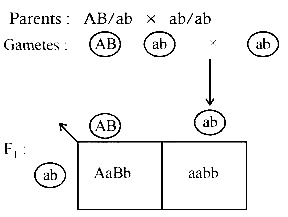
A and B genes are linked. What shall be genotype of progeny in a cross between AB/ab and ab/ab : -
(A)
AABB and aabb
(B)
None
(C)
AaBb and aabb
(D)
AAbb and aabb
(C)

Solution

AIPMT 2001 Biology - Principles of Inheritance and Variation Question 83 English Explanation
Q.42
Independent assortment of genes does not takes place when : -
(A)
Genes are located on non-homologous chromosome
(B)
Genes are linked and located on same chromosome
(C)
Genes are located on homologous chromosomes
(D)
All the above
(B)

Solution

According to law of independent assortment, the two factors of each trait assort at random and independent of the factors of other traits at the time of meiosis and get randomly as well as independently rearranged in the offspring. Principle of law of independent assortment is applicable to only those factors or genes which are present on different chromosomes.
Q.43
Number of Barr bodies in XXXX female is
(A)
3
(B)
1
(C)
2
(D)
4
(A)

Solution

Barr body is a mass of condensed sex chromatin in the nuclei of normal female somatic cells due to inactive X chromosome. Whenever the number of X-chromosomes is two or more than two, the number of barr bodies is one less than the number of X-chromosomes. Therefore, the number of barr bodies in XXXX female is three.
Q.44
Sickle cell anaemia is induce to : -
(A)
Change of Amino acid either a or b chain of Haemoglobin
(B)
Change of Amino Acid in a chain of Haemoglobin
(C)
Change of Amino acid in both a and b chain of Haemoglobin
(D)
Change of Amino Acid in b chain of Haemoglobin
(D)

Solution

Sickle cell anaemia is a hereditary disorder of autosomal nature caused by mutation of the gene controlling -chain of haemoglobin. It involves substitution of glutamine by valine.
Q.45
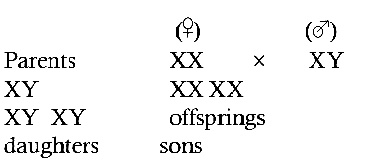
Probability of four son to a couple is : -
(A)
(B)
(C)
(D)
(A)

Solution

AIPMT 2001 Biology - Principles of Inheritance and Variation Question 76 English Explanation
probability of son

probability of four son =
Q.46
In Negative operon : -
(A)
CAMP have negative effect on lac operon
(B)
Co-repressor binds with inducer
(C)
Co-repressor binds with repressor
(D)
Co-repressor does not binds with repressor
(C)

Solution

In negative (repressible) operon, the repressor co-repressor complex binds with the operator. The free repressor cannot bind to the operator.
Q.47
m-RNA is synthesised on DNA template in which direction : -
(A)
Any
(B)
Both (c) and (d)
(C)
5' → 3'
(D)
3' → 5'
(C)

Solution

The enzyme polymerase can synthesize the bases only in 5′→3′direction.
Q.48
Gene and cistron words are sometimes used synonymously because : -
(A)
One gene contains one cistron
(B)
One cistron contains many gene
(C)
One gene contains no cistron
(D)
One gene contains many cistrons
(A)

Solution

Cistron is that segment of DNA which specifies synthesis of a polypeptide.
Q.49
Types of RNA polymerase required in nucleus for RNA synthesis : -
(A)
2
(B)
3
(C)
1
(D)
4
(B)

Solution

RNA polymerase enzyme catalyses the synthesis of RNA. It is single in prokaryotes. There are three types of RNA polymerases in eukaryotes– I for 28S, 18S and 5.8S RNA, II for mRNA and snRNA and III for tRNA, 5S RNA and scRNA. Primase is an RNA polymerase that is used to initiate DNA synthesis. RNA ligase reunites the exon segment after RNA splicing.
Q.50
Before the European invader which vegetable was absent in India ?
(A)
Simla mirch and Brinjal
(B)
Bitter gourd
(C)
Maize and chichinda
(D)
Potato and Tomato
(D)

Solution

Potato and tomato are new world crops. Their center of origin is Peru, so they are new world crops. They were brought to India by the European invaders.
Q.51
Which fish selectively feed on larva of mosquito ?
(A)
Clarias
(B)
Rohu
(C)
Exocoetus
(D)
Gambusia
(D)

Solution

Gambusia affinis is regarded as a larvicidal fish as it selectively feeds on mosquito larvae. It forms an effective tool for biological control of mosquitoes.
Q.52
Triticale is obtained by crossing wheat with
(A)
Barley
(B)
Rye
(C)
Oat
(D)
Maize
(B)

Solution

Triticale is the Ist man made cereal which is made by the crossing of wheat (Triticum aestivum) and Rye (Secale cereale).
Q.53
What is the intensity of sound in normal conversation ?
(A)
30 – 60 dB
(B)
10 – 20 dB
(C)
120 – 150 dB
(D)
70 - 90 dB
(A)

Solution

The word noise is taken from the latin word nausea and is defined as unwanted or unpleasant sound that causes discomfort.
Source Intensity (dB)
Breathing 10
Broadcasting studio 20
Trickling clock 30
Library 30-35
Normal conversetion 35-60
Telephone office Noise 60-80
Alarm clock 70-80
Traffic 50-90
Motorcycle 105
Jet fly over 100-110
Train whistle 110
Air craft 110-120
Q.54
What is B.O.D ?
(A)
The total amount of O2 present in water
(B)
The amount of O2 utilised by organisms in water
(C)
The amount of O2 utilized by micro organisms for decomposition
(D)
All of the above
(B)
Q.55
Cycas has two cotyledons but not included in angiosperms because of
(A)
naked ovules
(B)
seems like monocot
(C)
circinate ptyxis
(D)
compound leaves.
(A)

Solution

Cycas belongs to Order Cycadales of gymnosperms because it has naked seed. It is not enclosed inside a fruit. It does not have double fertilization and so the endosperm formed is haploid in nature and not triploid. So it is not included in angiosperms as they have ovules (or seeds) produced inside fruit. This is the main difference between gymnosperms and angiosperms.
Q.56
Which hormone breaks dormancy of potato tuber?
(A)
Gibberellin
(B)
IAA
(C)
ABA
(D)
Zeatin
(A)

Solution

Gibberellin is the hormone that breaks seed/ bud dormancy. The tubers of potato reproduce vegetatively to give rise to new plants. So the dormancy of these tubers can be overcome by applying gibberellins.
Q.57
Hormone responsible for senescence is
(A)
ABA
(B)
auxin
(C)
GA
(D)
cytokinin
(A)

Solution

ABA or Abscisic acid is responsible for leaf fall or senescence.
Q.58
Which of the following prevents the fall of fruits?
(A)
GA3
(B)
NAA
(C)
Ethylene
(D)
Zeatin
(B)

Solution

-Naphthalene acetic acid (NAA) is a synthetic or exogenous auxin. It prevents the formation of abscission layer, which is a layer of dead cells in the petiole and pedicel that causes fall of leaf or fruit. NAA prevents formation of this layer and so it prevents fall of leaf or fruit.
Q.59
Which plant is LDP?
(A)
Tobacco
(B)
Glycine max
(C)
Mirabilis jalapa
(D)
Spinach
(D)

Solution

Plants require a day length or light period for flowering, this light period is called as photoperiod. It was first studied by Garner and Allard (1920). Short day plants (SDP’s) flower in photoperiods less than critical day length, e.g., Nicotiana tabacum, Glycine max (Soybean), Xanthium strumarium. Further these plants require long uninterrupted dark period and hence are called long night plants. Long day plants (LDP’s) flower in photoperiod more than critical day length, e.g., Hyocyamus niger (Henbane), radish, Beta, spinach, Plantago, etc. Day neutral plants flower in any photoperiod, e.g., tomato, maize, cucumber, etc.
Q.60
Plant Decomposers are : -
(A)
Protista and Animalia
(B)
Anibalia and Mogna
(C)
Monera and fungi
(D)
Fungi and plants
(C)

Solution

Plant decomposers are bacteria (Kingdom Monera) and fungi.
Q.61
Reason of lung cancer is : -
(A)
Calcium fluoride
(B)
Cement factory
(C)
Coal mining
(D)
Bauxite mining
(C)

Solution

Asbestos fibres present in atmosphere due to industrial emission cause lung cancers (asbestosis).
Q.62
Salmonella is related with : -
(A)
T.B.
(B)
Tetanus
(C)
Typhoid
(D)
Polio
(C)

Solution

Typhoid is caused by Salmonella typhi. The organisms of the disease are present in the stool. They may be present in urine. They can, therefore, be carried by water and contaminated food. Their spread through water can give rise to severe epidemics.
Polio is caused by Enterovirus. TB is caused by Mycobacterium tuberculosis. Tetanus is caused by Clostridium tetani.
Q.63
Interferons are synthesized in response to
(A)
Bacteria
(B)
Mycoplasma
(C)
Viruses
(D)
Fungi
(C)

Solution

Interferons are virus induced proteins produced by cells infected with virus.
Q.64
Which of the most infectious disease ?
(A)
AIDS
(B)
Malaria
(C)
Hepatitis -B
(D)
Cough and cold
(D)

Solution

The term "most infectious" can vary depending on the context and specific factors such as mode of transmission, reproductive rate (R0), and prevalence within a population. However, if we're talking about the ease with which these diseases can be transmitted from person to person, cough and cold, which can be caused by numerous viruses, notably the common cold being typically caused by the rhinovirus, is generally the most infectious out of the options provided.

Therefore:

  • Option A: AIDS is caused by the human immunodeficiency virus (HIV) and is spread through certain body fluids from a person with HIV. It is a very serious and chronic condition, but it is less easily transmitted than cough and cold since it usually requires intimate contact or blood transfusion/needle sharing with an infected individual.
  • Option B: Malaria is caused by Plasmodium parasites and spread by the bite of infected Anopheles mosquitoes. It is not directly contagious from person to person like a virus that causes a cough and cold.
  • Option C: Hepatitis B is a liver infection caused by the hepatitis B virus (HBV). It is transmitted through exposure to infective blood, semen, and other body fluids, but is not as easily spread as a common cold.
  • Option D: Cough and cold are generally caused by a variety of respiratory viruses. Because they are spread through the air (via coughing, sneezing) and personal contact, they are highly contagious and infect a large number of people easily.

In sum, while the other diseases listed are infectious and can be serious, a cough and cold (Option D) typically have the highest rate of transmission in everyday circumstances, making it the most infectious in terms of how easily it can be spread from person to person.

Q.65
L.S.D. is : -
(A)
Stimulant
(B)
Tranquiliser
(C)
Hallucinogenic
(D)
Sedative
(C)

Solution

Hallucinogens are drugs that change thoughts, feelings and perceptions of individuals. They cause hallucinations. LSD (Lysergic acid diethylamide) is one such hallucinogen that causes horrible dreams, chronic psychosis and severe damage to the central nervous system. Sedatives give a feeling of calmness, relaxation or drowsiness in the body. Their high doses induce sleep. Tranquillisers lower tension and anxiety without inducing sleep. Stimulants are the drugs that stimulate the nervous system, make a person more wakeful, alert and active; and cause excitement.
Q.66
Which one of the following is correct match ?
(A)
Bhang – Analgesic
(B)
Cocaine – opiatic narcotic
(C)
Morphine – Hallucinogenic
(D)
Reserpine – Tranquilliser
(D)

Solution

Morphine is an opiate narcotic, Bhang is a hallucinogen, Reserpine derived form Rauwolfia, is used as tranquilizer, Cocaine is a stimulant.
Q.67
What is correct for blood group O?
(A)
No antigens but both a and b antibodies are present
(B)
A antigen and b antibody present
(C)
Antigen and antibody both absent
(D)
A and B antigens and a, b antibodies present
(A)

Solution

The correct answer is Option A: No antigens but both a and b antibodies are present.

Explanation:

In the ABO blood group system, blood group O is characterized by the absence of antigens on the surface of the red blood cells. Specifically, it does not have A or B antigens. However, the plasma of people with blood group O contains both anti-A and anti-B antibodies. These antibodies are ready to act against the A and B antigens if they are introduced into the body, such as via a blood transfusion with an incompatible blood type.

Thus, for blood group O:

  • Antigens present on red blood cells: None (neither A nor B antigens)
  • Antibodies present in the plasma: Both anti-A and anti-B antibodies

This unique feature allows individuals with blood group O to donate blood to any other group (universal donor), but they can only receive blood from other group O individuals due to the presence of both anti-A and anti-B antibodies in their plasma.

Q.68
What is sarcomere?
(A)
Part between two H-line
(B)
Part between two A-line
(C)
Part between two I-band
(D)
Part between two Z-line
(D)

Solution

Darks bands on the myofibril form A-band. Middle part of A-band contains light zones-Hensen line (H-lines). Light band on myofibril is called I-band. Middle part of I-band contains Z-lines. Sarcomere is part between two Z-lines.
Q.69
Which statement is correct for muscle contraction?
(A)
Length of H-zone decreases
(B)
Length of A-band remains constant
(C)
Length of I-band increases
(D)
Length of two Z-line increases
(A, B)

Solution

The correct statement for muscle contraction is :

Option A: Length of H-zone decreases During muscle contraction, the sliding filament theory explains that the thin filaments (actin) slide over the thick filaments (myosin) toward the center of each sarcomere. This results in a decrease in the length of the H-zone, which is the region in the center of the sarcomere that is primarily composed of myosin and devoid of actin. To present the information more clearly: - Option A: Length of H-zone decreases - Correct.

- Option B: Length of A-band remains constant - This is also correct; however, it is not the choice that is being asked for confirmation. The A-band length, which corresponds to the length of the myosin filaments, indeed remains constant during contraction.

- Option C: Length of I-band increases - This is incorrect. The I-band, which contains thin filaments with no overlapping thick filaments, actually decreases during muscle contraction.

- Option D: Length of two Z-line increases - This is incorrect. The distance between two Z-lines, or the length of the sarcomere, decreases during muscle contraction as the Z-lines move closer together. The H-zone's change in length is a direct indicator of muscle contraction because it specifically refers to the action of the sliding filaments during the process.
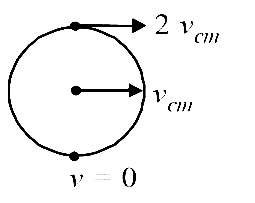
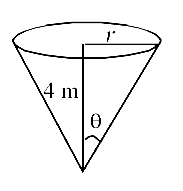
Q.70
Which of the following statements is the characteristics of human cornea?
(A)
It is secreted by conjuctiva and glandular layer.
(B)
It is a lacrimal gland which secrete tears.
(C)
Blood circulation is absent in cornea.
(D)
In old age it becomes the cause of cataract.
(C)

Solution

Cornea forms the anterior one-sixth of the fibrous coat. It is transparent, circular and fully visible from infront. It is composed of a peculiar variety of connective tissue covered externally by stratified nonkeratinized squamous epithelium and internally by simple squamous epithelium. It lacks blood vessels. It is nourished by lymph from adjacent area.
Q.71
When we migrate from dark to light, we fail to see for sometime but after a time visibility becomes normal. It is example of
(A)
accomodation
(B)
adaptation
(C)
mutation
(D)
photoperiodism.
(B)

Solution

It takes some time for rhodopsin to split into scotopsin and retinal (bleading) and release of transmitter passing nerve inpulse via bipolar and ganglion cells to the optic nerves.

This is a case of adaptation. It differs from accomodations which is a reflex mechanism by which the focus of the eye change to make the images of distant and near objects sharp on the retina.
Q.72
During regeneration, modification of an organ to other organ is known as
(A)
morphogenesis
(B)
epimorphosis
(C)
morphallaxis
(D)
accretionary growth.
(B)

Solution

There are two mechanisms of regeneration: morphallaxis and epimorphosis.
(i) Morphallaxis - It involves the reconstruction of the whole body from a small fragment by reorganising the existing cells. The regenerated organism is smaller than the original one, e.g., Amoeba. However, after the completion of the process it grows and attains normal size after some time.
(ii) Epimorphosis - It replaces a lost organ of the body by proliferating new cells from the surface of the wound or injured part. Regeneration of an appendage in an arthropod, arm in a starfish, and tail in a lizard occurs by the process of epimorphosis.
Q.73
Which cells do not form layer and remains structurally seperate ?
(A)
Nerve cells
(B)
Epithelial cells
(C)
Gland cells
(D)
Muscle cells
(A)

Solution

Nerve cells are the highly excitable cells, specialized for impulse conduction. They originate from neural plate of embryonic ectoderm and serve as structural and functional units of nervous tissue.
Q.74
During an injury Nasal septum gets damaged and for it's recovery which cartilage prefered : -
(A)
Fibrous cartilage
(B)
Elastic cartilage
(C)
Calcified cartilage
(D)
Hyaline cartilage
(D)

Solution

Hyaline cartilage is firm but slightly elastic with clear matrix. It is present in larynx, trachea, bronchi, nose. Elastic cartilage occurs in external ear. Calcified cartilage occurs in suprascapula. Fibrous cartilage occurs in intervertebral discs.
Q.75
Which one of the followinf is correctly matched?
(A)
Vitamin E   -   Tocopherol
(B)
Vitamin D   -    Riboflavin
(C)
Vitamin B   -   Calciferol
(D)
Vitamin A   -   Thiamine
(A)

Solution

Vitamin E is known as tocopherol. It prevents breakage of red blood cells, may act as an antioxidant, prevents oxidation of certain materials and maintains normal membrane structure. Vitamin D and Vitamin A are known as calciferol and retinol respectively.
Q.76
Which set is similar?
(A)
Corpus luteum    -    Graafian follicles
(B)
Sebum    -    Sweat
(C)
Bundle of His    -    Pace maker
(D)
Vitamin B7    -    Niacin
(A)

Solution

After ovulation many of the follicular cells remain in the collapsed Graafian follicle on the surface of the ovary. The antrum (cavity) of the collapsed follicle fills with a partially clotted fluid. The follicular cells enlarge and fill with a yellow pigment, lutein. Such a follicle is called a corpus luteum.
Q.77
Which set is similar : -
(A)
Vita B7 - Niacin
(B)
Sebum-sweat
(C)
Corpus luteum – graffian follicles
(D)
Bundle of his – Pace macker
(C)

Solution

Vitamin B3 or Niacin is a constituent of NAD. Corpus luteum is temporary endocrine tissue developing from ruptured grafian follicle. Bundle of His is a part of the conducting system of heart conducting cardiac impulse from atria to ventricles. Sebum is the name given to the oil secreted by sebaceous glands in the skin.
Q.78
In Hydra, waste material of food digestion and nitrogenous waste material are removed respectively from
(A)
mouth and mouth
(B)
body wall and body wall
(C)
mouth and body wall
(D)
mouth and tentacles.
(C)

Solution

Hydra being a coelenterate, has blind sac body plan. It has only one mouth which serves as the opening for ingestion and waste elimination besides diffusion across body wall.
Q.79
In which of the following animals, haemocyanin pigment is found?
(A)
Annelida
(B)
Echinodermata
(C)
Insecta
(D)
Mollusca
(D)

Solution

Haemocyanin is the pigment carrying O2 in molluscs. Annelids have erythrocruosin.
Q.80
In which of the following animals post anal tail is found?
(A)
Earthworm
(B)
Lower invertebrates
(C)
Scorpion
(D)
Snake
(D)

Solution

Snakes are limbless reptiles with elongated cylindrical body, covered with overlapping scales differentiated into shields and plates and have post anal tail which is long.
Q.81
Which of the following is closest relative of man ?
(A)
Gorilla
(B)
Chimpanzee
(C)
Gibbon
(D)
Orangutan
(B)

Solution

Chimpanzee is the closest relative of man. Banding pattern of human chromosome number 3 and 6 are remarkably similar to that of chimpanzee indicating common origin for both.
Q.82
Occurrence of endemic species in South America and Australia is due to
(A)
These is no terrestrial route to these places
(B)
Retrogressive evolution
(C)
These species has been extinct from other regions
(D)
Continental separation
(D)

Solution

Occurrence of endemic species in South America and Australia is due to geographic isolation (continental separation). Animals occupy all diverse habitats. The distribution, continuous or discontinuous of a species or a group of organisms depends on many factors like evolutionary, climatic, physical or biological barriers etc.
Q.83
Forthcoming generations are less adaptive than their parental generation due to
(A)
Genetic drift
(B)
Natural selection
(C)
Mutation
(D)
Adaptation
(C)

Solution

Natural selection operates through differential reproduction. Genetic drift is random change in the allele number and frequency in a gene pool.
Q.84
Reason of diversity in living being : -
(A)
Mutation
(B)
Short term evolutionary change
(C)
Long term evolutionary change
(D)
Gradual change
(C)

Solution

Diversity is due to the long term evolutionary changes. Adaptability to continuous changes in environmental conditions is important for natural selection of variants and variations generation after generation leading to emergence of diverse descendants.
Q.85
Most abundant organic compound on earth is
(A)
Cellulose
(B)
Steroids
(C)
Protein
(D)
Lipids
(A)

Solution

Cellulose is the most abundant organic compound, polysaccharide and biopolymer found on earth.
Q.86
First life on earth was : -
(A)
Autotrophs
(B)
Photoautotrophs
(C)
Cyanobacteria
(D)
Chemohetrotrophs
(D)

Solution

First living beings were formed in the environment of sea having abundant organic molecules. They absorbed the organic materials for the sake of nutrtion and hence were chemoheterotrophs.
Q.87
Darwins theory of pangenesis shows similarity with theory of inheritance of acquired characters then what shall be correct according to it
(A)
There should be some physical basis of inheritance
(B)
Size of organs increase with aging
(C)
Useful organs become strong and developed while useless organs become extinct. These organs help in struggle for survival
(D)
Development of organs is due to will power
(A)

Solution

According to theory of pangenesis Darwin thought that every somatic cell of the body produces a tiny particle called gemmule or pangene which contains both the parental and acquired characters. All gemmules or pangenes of the body cells collect in the gametes and are passed on to the zygote where they guide the growth of different parts of the embryo.
Q.88
Half life period of C14 is : -
(A)
5000 years
(B)
50 years
(C)
500 years
(D)
5 × 10⁴ years
(A)

Solution

14C has a half life of 5570 years and is used in radio carbon dating. Carbon in living things contains a uniform amount of radioactive 14C produced constantly in the atmosphere. From the amount of 14C in the dead sample, the age of the organism can be determined.
Q.89
Which of the following is correct order of the evolutionary history of man ?
(A)
Peking man, Hedalberg man, Neanderthal man, Cromagnon man
(B)
Peking man, Neanderthal man, Homosapiens Cromagnon man
(C)
Peking man, Neanderthal man, Homosapiens Hedalberg man
(D)
Peking man, Homo sapiens, Neanderthel man, Cromagnon man
(A)

Solution

Peking man had a cranial capacity of about 1000cc. Heidelberg man is regarded as ancestor of Neanderthal man. Cro-magnon is the form of modern man living in Europe.
Q.90
Similarities in organism with different genotype indicates : -
(A)
Divergent evolution
(B)
Macroevolution
(C)
Convergent evolution
(D)
Microevolution
(C)

Solution

Microevolution is a series of changes within a species due to gene mutations and accumulation of variations.
Macroevolution is evolution in which taxa higher than the level of species are formed due to morphological and cytological changes. Formation of different functional forms of a basically similar structure is called divergent evolution.
Q.91
Which statement is correct about centre of origin of plant ?
(A)
Climatic condition more favourable
(B)
More diversity in improved variety
(C)
None
(D)
Frequency of dominant gene is more
(B)

Solution

The two criteria on basis of which Nikolai Ivanwitch Vavilov proposed different centre of origin were (a) occurrence of maximum variation in the crop and (b) occurrence of wild relatives.