NEET-UG 2002

AIPMT 2002

Physics (Maximum Marks: 192)
  • This section contains 48 questions.
  • Each question has FOUR options (A), (B), (C) and (D). ONLY ONE of these four options is the correct answer.
  • Full Marks : +4 If ONLY the correct option is chosen;
  • Zero Marks : 0 If none of the options is chosen (i.e. the question is unanswered);
  • Negative Marks : −1 In all other cases.
Q.1
A particle A is dropped from a height and another particle B is projected in horizontal direction with speed of 5/sec from the same height then correct statement is
(A)
particle A will reach at ground first with respect to particle B
(B)
particle B will reach at ground first with respect to particle A
(C)
both particles will reach at ground simultaneously
(D)
both particles will reach at ground with same speed.
(C)

Solution

Time required to reach the ground is dependent on the vertical motion of the particle. Vertical motion of both the particles A and B are exactly same. Although particle B has an initial velocity, but that is in horizontal direction and it has no component in vertical (component of a vector at a direction of 90o = 0) direction. Hence they will reach the ground simultaneously.
Q.2
A block of mass 10 kg placed on rough horizontal surface having coefficient of friction m = 0.5, if a horizontal force of 100 N acting on it then acceleration of the block will be
(A)
10 m/s2
(B)
5 m/s2
(C)
15 m/s2
(D)
0.5 m/s2.
(B)

Solution

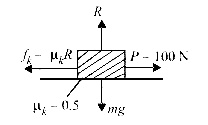
AIPMT 2002 Physics - Laws of Motion Question 34 English Explanation m = 10 kg, R = mg
Frictional force = fk

=

= 0.5 × 10 × 10

= 50 N [g = 10 m/sec2]

Net force acting on the body = F = P – fk
= 100 – 50 = 50 N.

Acceleration of the block = a = F/m
= 50/10 = 5 m/sec2 .
Q.3
An object of mass 3 kg is at rest. Now a force of = 6t2 + 4t is applied on the object then velocity of object at t = 3 sec. is
(A)
18 + 3
(B)
18 + 6
(C)
3 + 18
(D)
18 + 4
(B)

Solution

Mass (m) = 3 kg, force (F) =

acceleration


Now,


=
Q.4
A lift of mass 1000 kg which is moving with acceleration of 1 m/s2 in upward direction, then the tension developed in string which is connected to lift is
(A)
9800 N
(B)
10,800 N
(C)
11,000 N
(D)
10,000 N.
(B)

Solution

For a lift which is moving in upward direction with an acceleration a, the tension T developed in the string connected to the lift is given by

T = m (g + a).

Here m = 1000 kg, a = 1 m/s2, g = 9.8 m/s2

T = 1000(9.8 + 1) = 10,800 N.
Q.5
A rod of length is 3 m and its mass acting per unit length is directly proportional to distance x from one of its end then its centre of gravity from that end will be at :
(A)
1.5 m
(B)
2 m
(C)
2.5 m
(D)
3.0 m.
(B)

Solution

Let us consider an elementary length dx at a distance x from one end.

It’s mass = k ·x ·dx

[k = proportionality constant]

Then centre of gravity of the rod xc is given by


Centre of gravity of the rod will be at distance of 2 m from one end.
Q.6
If kinetic energy of a body is increased by 300% then percentage change in momentum will be :
(A)
100%
(B)
150%
(C)
265%
(D)
73.2%
(A)

Solution

Let m be the mass of the body and v1 and v2 be the initial and final velocities of the body respectively.

Initial kinetic energy =

Final kinetic energy =

Initial kinetic energy is increased 300% to get the final kinetic energy.


v2 = 2v1 or v2/v1 = 2 ... (i)

Initial momentum = p1 = mv1

Final momentum = p2 = mv2


So momentum has increased 100%.
Q.7
A disc is rotating with angular speed . If a child sits on it, what is conserved
(A)
linear momentum
(B)
angular momentum
(C)
kinetic energy
(D)
potential energy.
(B)

Solution

If external torque is zero, angular momentum remains conserved.
[External torque is zero because the weight of child acts downward]

L = I = constant
Q.8
A solid sphere of radius R is placed on smooth horizontal surface. A horizontal force F is applied at height h from the lowest point. For the maximum acceleration of centre of mass, which is correct ?
(A)
h = R
(B)
h = 2R
(C)
h = 0
(D)
no relation between h and R.
(D)

Solution

Since there is no friction at the contact surface (smooth horizontal surface) there will be no rolling. Hence, the acceleration of the centre of mass of the sphere will be independent of the position of the applied force F. Therefore, there is no relation between h and R.
Q.9
A point P consider at contact point of a wheel on ground which rolls on ground without slipping then value of displacement of point P when wheel completes half of rotation (if radius of wheel is 1 m)
(A)
2 m
(B)
(C)
(D)
(B)

Solution

AIPMT 2002 Physics - Rotational Motion Question 34 English Explanation In half rotation point P has moved horizontally.


In the same time, it has moved vertically a distance which is equal to its diameter = 2 m.

Displacement of P = m
Q.10
A circular disc is to be made by using iron and aluminium so that it acquired maximum moment of inertia about geometrical axis. It is possible with
(A)
aluminium at interior and iron surround to it
(B)
iron at interior and aluminium surround to it
(C)
using iron and aluminium layers in alternate order
(D)
sheet of iron is used at both external surface and aluminium sheet as internal layers.
(A)

Solution

A circular disc may be divided into a large number of circular rings. Moment of inertia of the disc will be the summation of the moments of inertia of these rings about the geometrical axis.

Now, moment of inertia of a circular ring about its geometrical axis is MR2, where M is the mass and R is the radius of the ring.

Since the density (mass per unit volume) for iron is more than that of aluminium, the proposed rings made of iron should be placed at a higher radius to get more value of MR2. Hence to get maximum moment of inertia for the circular disc, aluminium should be placed at interior and iron at the outside.
Q.11
Consider two rods of same length and different specific heats (S1, S2), conductivities (K1, K2) and area of cross-sections (A1, A2) and both having temperatures T1 and T2 at their ends. If rate of loss of heat due to conduction is equal, then
(A)
K1A1 = K2A2
(B)
(C)
K2A1 = K1A2
(D)
(A)

Solution

Rate of heat loss in rod 1 = Q1

Rate of heat loss in rod 2 = Q2

By problem, Q1 = Q2.


K1A1 = K2A2.   
Q.12
For a black body at temperature 727oC, its radiating power is 60 watt and temperature of surrounding is 227oC. If temperature of black body is changed to 1227oC then its radiating power will be
(A)
304 W
(B)
320 W
(C)
240 W
(D)
120 W
(B)

Solution

Radiating power of a black body


where is known as the Stefan-Boltzmann constant, A is the surface area of a black body, T is the temperature of the black body and T0 is the temperature of the surrounding.

60 = (10004 – 5004)    ...(i)

[T = 727oC = 727 + 273 = 1000 K, T0 = 227oC = 500 K].

In the second case, T = 1227oC = 1500 K and let E' be the radiating power.

E' = (15004 – 5004)    ...(ii)

From (i) and (ii) we have


Q.13
Unit of Stefan's constant is
(A)
watt m2 K4
(B)
watt m2/K4
(C)
watt/m2 K
(D)
watt/m2K4
(D)

Solution

Unit of Stefan’s constant is watt/m2K4.
Q.14
Which of the following is best close to an ideal black body?
(A)
black lamp
(B)
cavity maintained at constant temperature
(C)
platinium black
(D)
a lump of charcoal heated to high temperature.
(B)

Solution

AIPMT 2002 Physics - Properties of Matter Question 35 English Explanation
An ideal black body is one which absorbs all the incident radiation without reflecting or transmitting any part of it. Black lamp absorbs approximately 96% of incident radiation.

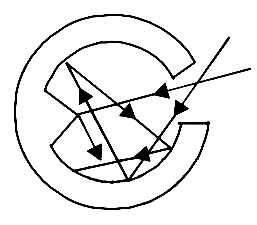
An ideal black body can be realized in practice by a small hole in the wall of a hollow body (as shown in figure) which is at uniform temperature. Any radiation entering the hollow body through the holes suffers a number of reflections and ultimately gets completely absorbed. This can be facilitated by coating the interior surface with black so that about 96% of the radiation is absorbed at each reflection. The portion of the interior surface opposite to the hole is made conical to avoid the escape of the reflected ray after one reflection.
Q.15
The Wien's displacement law express relation between
(A)
wavelength corresponding to maximum energy and temperature
(B)
radiation energy and wavelength
(C)
temperature and wavelength
(D)
colour of light and temperature.
(A)

Solution

Wien’s displacement law states that the product of absolute temperature and the wavelength at which the emissive power is maximum is constant i.e. T = constant. Therefore it expresses relation between wavelength corresponding to maximum energy and temperature.
Q.16
The efficiency of Carnot engine is 50% and temperature of sink is 500 K. If temperature of source is kept constant and its efficiency raised to 60%, then the required temperature of sink will be
(A)
100 K
(B)
600 K
(C)
400 K
(D)
500 K
(C)

Solution

Efficiency () of a carnot engine is given by , where T1 is the temperature of the source and T2 is the temperature of the sink.

Here, T2 = 500 K


Now, (T2' is the new sink temperature)

Q.17
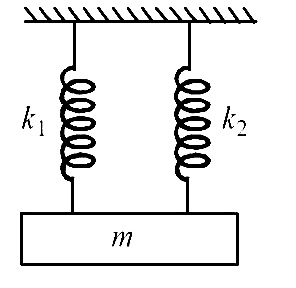
A mass is suspended separately by two different springs in (successive order then time periods is t1 and t2 respectively, If it is connected by both spring as shown in figure then time period is t0 , the correct relation is

AIPMT 2002 Physics - Oscillations Question 27 English
(A)
(B)
(C)
(D)
(B)

Solution

AIPMT 2002 Physics - Oscillations Question 27 English Explanation 1
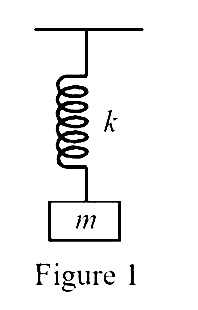
The time period of a spring mass system as shown in figure 1 is given by , where k is the spring constant.

   ...(i)
and    ...(ii)

AIPMT 2002 Physics - Oscillations Question 27 English Explanation 2
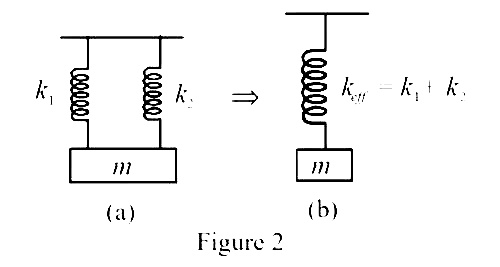
Now, when they are connected in parallel as shown in figure 2(a), the system can be replaced by a single spring of spring constant, keff = k1 + k2.
[Since mg = k1x + k2x = keffx]
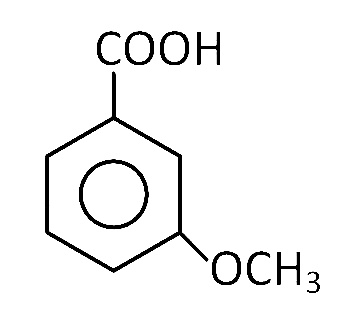
   ...(iii)

From (i),    ...(iv)

From (ii),    ...(v)

From (ii),    ...(vi)

Now (iv) + (v)


Q.18
Displacement between maximum potential energy position and maximum kinetic energy position for a particle executing simple harmonic motion is
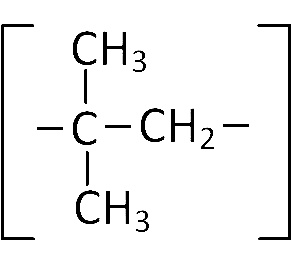
(A)
/2
(B)
+
(C)
(D)
1
(C)

Solution

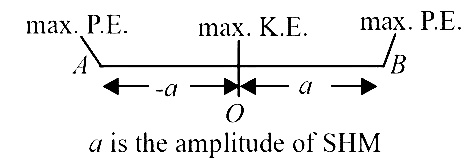
For a simple harmonic motion between A and B, with O as the mean position, maximum kinetic energy of the particle executing SHM will be at O and maximum potential energy will be at A and B.

AIPMT 2002 Physics - Oscillations Question 29 English Explanation
Displacement between maximum potential energy and maximum kinetic energy is .
Q.19
When an oscillator completes 100 oscillations its amplitude reduced to of initial value. What will be its amplitude, when it complettes 200 oscillations ?
(A)
(B)
(C)
(D)
(D)

Solution

This is a case of damped vibration as the amplitude of vibration is decreasing with time.
Amplitude of vibrations at any instant t is given by , where is the initial amplitude of vibrations and b is the damping constant.

Now, when t = 100T,   [T is time period]

Let the amplitude be at t = 200T.
i.e. after completing 200 oscillations.

   ...(i)

and ...(ii)

From (i),


From (ii),

The amplitude will be reduced to 1/9 of initial value.
Q.20
A wave travelling in positive X-direction with a 0.2 ms2, velocity = 360 ms1 and 60 m, then correct expression for the wave is
(A)
(B)
(C)
(D)
(C)

Solution

The equation of progressive wave travelling in positive x-direction is given by


Here a = 0.2 m, v = 360 m/sec, = 60 m


Q.21
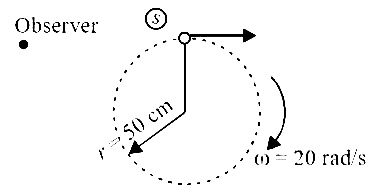
A whistle revolves in a circle with angular speed = 20 rad/s using a string of length 50 cm. If the frequency of sound from the whistle is 385 Hz, then what is the minimum frequency heard by an observer which is far away from the centre (velocity of sound 340 m/s)
(A)
385 Hz
(B)
374 Hz
(C)
394 Hz
(D)
333 Hz.
(B)

Solution

The whistle is revolving in a circle of radius 50 cm. So the source (whistle) is moving and the observer is fixed.

AIPMT 2002 Physics - Waves Question 19 English Explanation
The minimum frequency will be heard by the observer when the linear velocity of the whistle (source) will be in a direction as shown in the figure, i.e. when the source is receding.

The apparent frequency heard by the observer is then given by

where V and v are the velocities of sound and source respectively and is the actual frequency.

Now

V = 340 m/s, = 385 Hz.

Hz
Q.22
Some charge is being given to a conductor. Then its potential is
(A)
maximum at surface
(B)
maximum at centre
(C)
remain same throughout the conductor
(D)
maximum somewhere between surface and centre.
(C)

Solution

Electric field intensity E is zero within a conductor due to charge given to it.

Also,    (inside the conductor)

V = constant. [V is potential]

So potential remains same throughout the conductor.
Q.23
Identical charges (q) are placed at each corners of cube of side b then electrostatic potential energy of charge (+q) which is placed at centre of cube will be
(A)
(B)
(C)
(D)
(C)

Solution

There are eight corners of a cube and in each corner there is a charge of (–q). At the centre of the corner there is a charge of (+q). Each corner is equidistant from the centres of the cube and the distance (d) is half of the diagonals of the cube.

Diagonal of the cube =


Now, electric potential energy of the charge (+q) due to a charge (–q) at one corner

U

Total electric potential energy due to all the eight identical charges
=
Q.24
Specific resistance of a conductor increases with
(A)
increase in temperature
(B)
increase in cross-section area
(C)
increase in cross-section and decrease in length
(D)
decrease in cross secton area.
(A)

Solution

Resistance of a conductor is given by R = , where is the specific resistance, is the length and A is the cross-sectional area of the conductor. Now, when = 1 and A = 1, R = .

So specific resistance or resistivity of a material may be defined as the resistance of a specimen of the material having unit length and unit cross-section. Hence, specific resistance is a property of a material and it will increase with the increase of temperature, but will not vary with the dimensions (length, crosssection) of the conductor.
Q.25
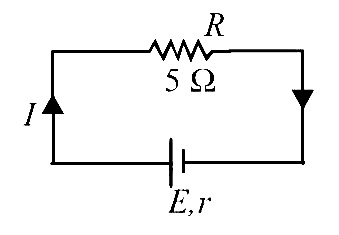
For a cell terminal potential difference is 2.2V when circuit is open and reduce to 1.8 V when cell is connected to a resistance of R = 5 . Determine internal resistance of cell (r)
(A)
(B)
(C)
(D)
(A)

Solution

AIPMT 2002 Physics - Current Electricity Question 56 English Explanation
Terminal potential difference is 2.2 V when circuit is open.

e.m.f. of the cell = E = 2.2 volt

Now, when the cell is connected to the external resistance, circuit current I is given by

ampere, where r is the internal resistance of the cell.

Potential difference across the cell = IR


5 + r = 11/1.8.

Q.26
A capacitor of capacity C1 charged upto V volt and then connected to an uncharged capacitor of capacity C2. The final potential difference across each will be
(A)
(B)
(C)
(D)
(A)

Solution

Charge Q = C1V
Total capacity of combination (parallel)

C = C1+ C2

Q.27
The magnetic field of given length of wire for single turn coil at its centre is B then its value for two turns coil for the same wire is
(A)
B/4
(B)
B/2
(C)
4B
(D)
2B
(C)

Solution

B1 = B =

Further, B2 =

Now 2 × 2r = 2R or r = R/2

Hence B2 =
Q.28
A charge q moves in a region where electric field and magnetic field both exist, then force on it is
(A)
(B)
(C)
(D)
(B)

Solution

Lorentz forece


=
Q.29
To convert a galvanometer into a voltmeter one should connect a
(A)
high resistance in series with galvanometer
(B)
low resistance in series with galvanometer
(C)
high resistance in parallel with galvanometer
(D)
low resistance in parallel with galvanometer.
(A)

Solution

For converting galvanometer to voltmeter, a high resistance should be connected in series with galvanometer.
Q.30
Two bar magnets having same geometry with magnetic moments M and 2M, are firstly placed in such a way that their similar poles are same side then its time period of oscillation is T1. Now the polarity of one of the magnet is reversed then time period of oscillation is T2, then
(A)
T1 < T2
(B)
T1 = T2
(C)
T1 > T2
(D)
T2 =
(A)

Solution

Time period, T =

T

M1 =2M + M = 3M  

M2 = 2M – M = M


T2 =

T1 T2
Q.31
For a series LCR circuit the power loss at resonance is
(A)
(B)
(C)
(D)
(C)

Solution

The impedance Z of a series LCR circuit is given by,

Z =

At resonance, XL = XC, hence Z = R.

Let, supply voltage = VR = V

R.M.S. current, I =

Power loss = VI = I2R
Q.32
The velocity of electromagnetic wave is parallel to
(A)
(B)
(C)
(D)
(B)

Solution

Since, the direction of propagation of electromagnetic waves is perpendicular to Electric field and Magnetic field. Also electric and magnetic fields perpendicular so, direction of the wave will be parallel to .
Q.33
What is the cause of Green house effect ?
(A)
infra-red rays
(B)
ultra violet rays
(C)
X-rays
(D)
radio waves.
(A)

Solution

Infrared ray is the cause of Green House effect. The glass transmits visible light while infrared rays are absorbed by plants. Then it emits long infrared rays, which are reflected back by glass.
Q.34
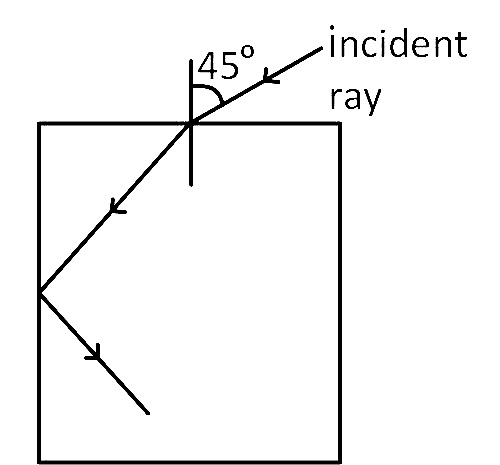
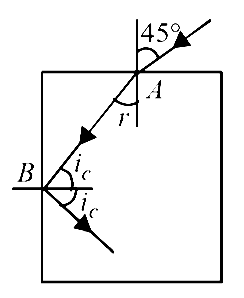
For the given incident ray as shown in figure, the condition of total internal refraction of this ray the required refractive index of prism will be

AIPMT 2002 Physics - Geometrical Optics Question 41 English
(A)
(B)
(C)
(D)
(C)

Solution

AIPMT 2002 Physics - Geometrical Optics Question 41 English Explanation

Applying Snell’s law of refraction at A,


r = ....(1)

Applying the condition of total internal reflection at B,

ic = ..........(2)

where ic is the critical angle.

From figure, r + ic =


=


Q.35
Diameter of human eye lens is 2 mm. What will be the minimum distance between two points to resolve them, which are situated at a distance of 50 meter from eye. The wavelength of light is 5000
(A)
2.32 m
(B)
4.28 mm
(C)
1.25 cm
(D)
12.48 cm
(C)

Solution

For the aparture, limit of resolution :


y

y 1.25 cm
Q.36
A bulb is located on a wall. Its image is to be obtained on a parallel wall with the help of convex lens. The lens is placed at a distance d ahead of second wall, then required focal length will be
(A)
only
(B)
only
(C)
more than but less than
(D)
less than
(B)

Solution

Using the lens formula

Given v = d, for equal size image |v| = |u| = d

By sign convention u = -d


f =
Q.37
A deutron is bombarded on 8O16 nucleus then -particle is emitted. The product nucleus is
(A)
7N13
(B)
5B10
(C)
4Be9
(D)
7N14
(D)

Solution

8O16 + 1H2 7N14 + 2He4

So when a deuteron is bombarded on 8O16 nucleus then an -particle (2He4) is emitted and the product nucleus is 7N14.
Q.38
A sample of radioactive element containing 4 1016 active nuclei. Half life of element is 10 days, then number of decayed nuclei after 30 days
(A)
0.5 1016
(B)
2 1016
(C)
3.5 1016
(D)
1 1016
(C)

Solution

N = 4 1016 = 1016

Atoms decayed = 4 1016 - 1016

= 3.5 1016
Q.39
Which of the following are suitable for the fusion process ?
(A)
light nuclei
(B)
heavy nuclei
(C)
element lying in the middle of the periodic table
(D)
middle elements, which are lying on binding energy curve.
(A)

Solution

The nuclei of light elements have a lower binding energy than that for the elements of intermediate mass. They are therefore less stable; consequently the fusion of the light elements results in more stable nucleus.
Q.40
The value of Planck's constant is
(A)
6.63 1034 J/sec.
(B)
6.63 1034 kg-m2/sec
(C)
6.63 1034 kg-m2
(D)
6.63 1034 J-sec.
(D)

Solution

The value of Planck’s constant is 6.63 1034 J-sec.
Q.41
When ultraviolet rays incident on metal plate then photoelectric effect does not occur, it occurs by incidence of
(A)
infrared rays
(B)
X-rays
(C)
radio wave
(D)
micro wave
(B)

Solution

It occurs by incidence of X-rays.
Q.42
If particles are moving with same velocity, then which has maximum de Broglie wavelength?
(A)
proton
(B)
-particle
(C)
neutron
(D)
-particle
(D)

Solution

de Broglie wavelength for a particle is given by

=

Since all the particles are moving with same velocity, the particle with least mass will have maximum de-Broglie wavelength.

Here -particles(electrons) has the lowest mass and therefore it has maximum wavelength.
Q.43
Which of the following is not the property of cathode rays ?
(A)
In produces heating effect
(B)
It does not deflect in electric field
(C)
It casts shadow
(D)
It produces fluorscence.
(B)

Solution

Cathode rays are basically negatively charged particles (electrons). If the cathode rays are allowed to pass between two plates kept at a difference of potential, the rays are found to be deflected from the rectilinear path. The direction of deflection shows that the rays carry negative charges.
Q.44
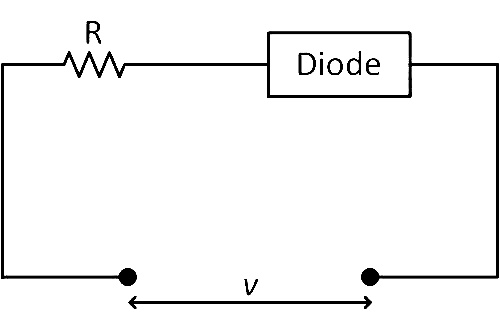
For the given circuit of p-n junction diode which is correct

AIPMT 2002 Physics - Semiconductor Electronics Question 45 English
(A)
in forward bias the voltage across R is V
(B)
in reverse bias the voltage across R is V
(C)
in forward bias the voltage across R is 2V
(D)
in reverse bias the voltage across R is 2V.
(A)

Solution

In forward biasing, the resistance of p-n junction diode is very low to the flow of current. So practically all the voltage will be dropped across the resistance R, i.e. voltage across R will be V.

In reverse biasing, the resistance of p-n junction diode is very high. So the voltage drop across R is zero.
Q.45
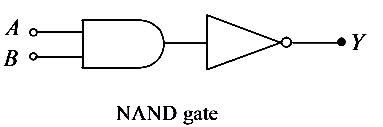
The given truth table is for which logic gate

              
(A)
NAND
(B)
XOR
(C)
NOR
(D)
OR.
(A)

Solution

This truth table represents NAND gate. AIPMT 2002 Physics - Semiconductor Electronics Question 47 English Explanation
Q.46
In a p-n junction
(A)
high potential at n side and low potential at p side
(B)
high potential at P side and low potential at n side
(C)
p and n both are at same potential
(D)
undetermined.
(B)

Solution

For conduction, p-n junction must be forward biased. For this p-side should be connected to higher potential and n-side to lower potential.
Q.47
For a transistor = 0.96, then current gain for common emitter is
(A)
12
(B)
6
(C)
48
(D)
24
(D)

Solution

= 0.96 =

Current gain, = = = 24
Q.48
Number of atom per unit cell in B.C.C.
(A)
9
(B)
4
(C)
2
(D)
1
(C)

Solution

In body-centred cubic (b.c.c.) lattice there are eight atoms at the corners of the cube and one at the centre.

Therefore number of atom per unit cell

= + 1 = 2
Chemistry (Maximum Marks: 196)
  • This section contains 49 questions.
  • Each question has FOUR options (A), (B), (C) and (D). ONLY ONE of these four options is the correct answer.
  • Full Marks : +4 If ONLY the correct option is chosen;
  • Zero Marks : 0 If none of the options is chosen (i.e. the question is unanswered);
  • Negative Marks : −1 In all other cases.
Q.1
2.5 litre of 1 M NaOH solution is mixed with another 3 litre of 0.5 M NaOH solution. Then find out molarity of resultant solution.
(A)
0.80 M
(B)
1.0 M
(C)
0.73 M
(D)
0.50 M
(C)

Solution

From molarity equation

M1V1 + M2V2 = MV

1× 2.5 + 0.5 × 3 = M × 5.5

M = = 0.73M
Q.2
The percentage of C, H and N in an organic compound are 40%, 13.3% and 46.7% respectively then empirical formula is
(A)
C3H13N3
(B)
CH2N
(C)
CH4N
(D)
CH6N
(C)

Solution

Element % Atomic
mass
Relative
no. of atoms
Simplest
ratio of atoms
1 C 40 12 = 3.33 = 1
2 H 13.3 1 = 13.3 = 4
2 N 46.7 14 = 3.3 = 1


The empirical formula is CH4N.
Q.3
Which has maximum molecules?
(A)
7 g N2
(B)
2 g H2
(C)
16 g NO2
(D)
16 g O2
(B)

Solution

1 mole = 6.023 1023 number of molecules.

1 g mole of O2 = 32 g of O2

16 g of O2 = 0.5 g mole of O2

1 g mole of N2 = 28 g of N2

7 g of N2 = 0.25 g mole of N2

1 g mole of H2 = 2 g of H2

2 g of H2 = 1 g mole of H2

1 g of NO2 = 14 + 16 2 = 46

16 g of NO2 = 0.35 mole NO2
Q.4
In hydrogen atom, energy of first excited state is 3.4 eV. Then find out K.E. of same orbit of hydrogen atom
(A)
+3.4 eV
(B)
+6.8 eV
(C)
13.6 eV
(D)
+13.6 eV
(A)

Solution

K.E = 1/2 mv2

= [ v = ]

Total energy = En =

= - 2m = -K.E

K.E = - En

Energy of first excited state is -3.4 eV

Kinetic energy of the same orbit (n = 2) will be +3.4 ev
Q.5
Van der Waal's real gas, acts as an ideal gas, at which conditions?
(A)
High temperature, low pressure
(B)
Low temperature, high pressure
(C)
High temperature, high pressure
(D)
Low temperature, low pressure
(A)

Solution

At higher temperature and low pressure real gas acts as an ideal gas.
Q.6
Reaction BaO2(g) BaO(s) + O2(g); H = +ve. In equilibrium condition, pressure of O2 depends on
(A)
increase mass of BaO2
(B)
increase mass of BaO
(C)
increase temperature on equilibrium
(D)
increase mass of BaO2 and BaO both.
(C)

Solution

For the reaction

BaO2(g) BaO(s) + O2(g); H = +ve.

At equilibrium Kp = PO2

[For solid and liquids concentration term is taken as unity]

Hence, the value of equilibrium constant depends only upon partial pressure of O2. Further on increasing temperature formation of O2 increases as this is an endothermic reaction.
Q.7
Which has highest pH?
(A)
CH3COOK
(B)
Na2CO3
(C)
NH4Cl
(D)
NaNO3
(B)

Solution

Na2CO3 is a salt of weak acid H2CO3 and strong base NaOH, therefore, its aqueous solution will be basic hence has pH more than 7.
Q.8
Solubility of MX2 type electrolytes is 0.5 104 mole/lit., then find out Ksp of electrolytes.
(A)
5 1012
(B)
25 1010
(C)
1 1013
(D)
5 1013
(D)

Solution

MX2 Ag2+ + 2X-
s s 2s


Ksp = [M2+] [X]2 = (S)(2S)2 = 4S3

Ksp = 4(0.5 × 10⁻⁴)3 = 5 × 10–13
Q.9
Solution of 0.1 N NH4OH and 0.1 N NH4Cl has pH 9.25. Then find out pKb of NH4OH
(A)
9.25
(B)
4.75
(C)
3.75
(D)
8.25
(B)

Solution

NH4OH and NH4Cl constitute to form a basic buffer.

pOH = pKb + log

We know, pOH+ pH = 14 or pOH = 14 – pH

14 - pH - = pKb

14 - 9.25 - = pKb

14 – 9.25 – 0 = pKb

pKb = 4.75
Q.10
A solution contains non volatile solute of molecular mass M2. Which of the following can be used to calculate the molecular mass of solute in terms of osmotic pressure?
(A)
(B)
(C)
(D)
(B)

Solution

For dilute solution, the van’t Hoff equation is


Q.11
A solution containing components A and B folloes Raoult's law
(A)
A - B attraction force is greater than A - A and B - B
(B)
A - B attraction force is less than A - A and B - B
(C)
A - B attraction force remains same as A - A and B - B
(D)
volume of solution is different from sum of volume of solute and solvent.
(C)

Solution

These two components A and B follows the condition of Raoult’s law if the force of attraction between A and B is equal to the force of attraction between A and A or B and B.
Q.12
Unit of entropy is
(A)
J K1 mol1
(B)
J mol1
(C)
J1 K1 mol1
(D)
J K mol1
(A)

Solution

Entropy is the change in heat per degree. Thus, its unit is as follows.

Entropy = = J mol-1 K-1
Q.13
Which reaction is not feasible?
(A)
2KI + Br2 2KBr + I2
(B)
2KBr + I2 2KI + Br2
(C)
2KBr + Cl2 2KCl + Br2
(D)
2H2O + 2F2 4HF + O2
(B)

Solution

2KBr + I2 2KI + Br2

reaction is not possible because Br ion is not oxidised in Br2 with I2 due to higher electrode (oxidation) potential of I2 than bromine.
Q.14
In a closed insulated container a liquid is stirred with a paddle to increase the temperature which of the following is true ?
(A)
E = W 0, q = 0
(B)
E = w = q 0
(C)
E = 0, W = q 0
(D)
W = 0, E = q 0.
(A)

Solution

When in a closed insulated container, a liquid is stirred, it increases the temperature of liquid thus it started behaving as adiabatic process resulting no change in heat and only temperature increases. Therefore, q = 0 for this process.

Also, E = q + W

E = W (As, q = 0)

As, there is rise in temperature thus, there must be change in internal energy, i.e., E = W ≠ 0.
Q.15
Heat of combustion Ho for C(s), H2(g) and CH4(g) are 94, 68 and 213 kcal/mol, then Ho for C(s) + 2H2(g) CH4(g) is
(A)
17 kcal
(B)
111 kcal
(C)
170 kcal
(D)
85 kcal
(A)

Solution

C(s) + 2H2(g) CH4(g), Ho = ?

C(s) + O2(g) → CO2(g), H = – 94 kcal/mol ....(1)

H2(g) + O2(g) H2O(g), H = – 68 kcal/mol ....(2)

CH4(g) + 2O2(g) CO2(g) + H2O(l), H = – 213 kcal/mol ....(3)

Performing (1) + 2 × (2) – (3)

Ho = [– 94 – 2(68)] – (–213) kcal/mol

= [– 94 – 136] + 213 k cal/mol

= – 230 + 213 = – 17 kcal/mol
Q.16
2 mole of ideal gas at 27oC temperature is expanded reversibly from 2 lit. to 20 lit. Find entropy change. (R = 2 cal/mol K)
(A)
92.1
(B)
0
(C)
4
(D)
9.2
(D)

Solution

For isothermal reversible expansion

w = q = nRT 2.303

= 2RT 2.303

= 2 × 2 × T × 2.303 × 1 = 9.2 T

Entropy change, S = = = 9.2 cal/mol K
Q.17
In electrolysis of NaCl when Pt electrode is taken then H2 is liberated at cathode while with Hg cathode it forms sodium amalgam
(A)
Hg is more inert than Pt
(B)
More voltage is required to reduce H+ at Hg than at Pt
(C)
Na is dissolved in Hg while it does not dissolve in Pt
(D)
Conc. of H+ ions is larger when Pt electrode is taken.
(B)

Solution

In electrolysis of NaCl when Pt electrode is taken then H2 liberated at cathode while with Hg cathode it forms sodium amalgam because more voltage is required to reduce H+ at Hg than Pt.
Q.18
2A B + C

It would be a zero order reaction when
(A)
the rate of reaction is proportional to square of concentration of A
(B)
The rate of reaction remains same at any concentration of A
(C)
the rate remains unchanged at any concentration of B and C
(D)
the rate of reaction doubles if concentrations of B is increased to double.
(B)

Solution

2A B + C

If it is zero order reaction r = k [A]o.

i.e the rate remains same at any concentration of 'A'. i.e independent upon concentration of A.
Q.19
U, nucleus absorbs a neutron and distintegrate in Xe, Sr and so, what will be product ?
(A)
3-neutrons
(B)
2-neutrons
(C)
-particle
(D)
-particle
(A)

Solution

U + n Xe + Sr + 3 n
Q.20
Position of non polar and polar part in micelle
(A)
polar at outer surface but non polar at inner surface
(B)
polar at inner surface non polar at outer surface
(C)
distributed over all the surface
(D)
are present in the surface only.
(A)

Solution

Micelles are formed by the association of colloids. They are formed by lyophilic and lyophobic groups. As the concentration increases the lyophobic parts receding away from the solvent approach each other are forms a cluster, the lyophobic ends are in the interior, lyophilic groups projecting outwards in contact with the solvent.
Q.21
Which of the following order is wrong?
(A)
NH3 < PH3 < AsH3 acidic
(B)
Li < Be < B < C 1st IP
(C)
Al2O3 < MgO < Na2O < K2O basic
(D)
Li+ < Na+ < K+ < Cs+ ionic radius.
(B)

Solution

Along the period, I.P. generally increases but not regularly. Be and B are exceptions. First I.P. increases in moving from left to right in a period, but I.P. of B is lower than Be.

As in case of boron, 2p1 electron have to be removed to get B+(1s2 2s2) from B(1s2 2s2 2p1), while in case of Be (1s22s2) electron have to be removed to get Be+ (1s22s1). p electron can be removed more easily than s electron so the energy required to remove electron will be less in case of boron.
Q.22
In NO3 ion number of bond pair and lone pair of electrons on nitrogen atom are
(A)
2, 2
(B)
3, 1
(C)
1, 3
(D)
4, 0
(D)

Solution


In NO3- ion, nitrogen has 4 bond pair of electrons and no lone pair of electrons.
Q.23
Which of the following has p d bonding?
(A)
NO3
(B)
SO32
(C)
BO33
(D)
CO32
(B)

Solution

Electronic structure of S atom in excited state
AIPMT 2002 Chemistry - Chemical Bonding and Molecular Structure Question 60 English Explanation

In 'S' unhybride d- orbital is present, which will involved in bond formation with oxygen atom.

In oxygen two unpaired p- orbital is present in these one is involved in bond formation while other is used in bond formation.

So, in SO32, p d bonding present.
Q.24
Which of the following is isoelectronic?
(A)
CO2, NO2
(B)
NO2, CO2
(C)
CN, CO
(D)
SO2, CO2
(C)

Solution

In CO, the number of electrons

6 + 8 = 14 [ Z of C = 6 and O = 8]

Electronic configuration of molecular orbital of CO :


CN- also get (6 + 7 + 1) 14 electrons and the configuration is similar to that CO.

So, CN and CO is isoelectronic.
Q.25
In which of the following processes, fused sodium hydroxide is electrolysed at a 330oC temperature for extraction of sodium?
(A)
Castner's process
(B)
Down's process
(C)
Cyanide process
(D)
Both 'b' and 'c'
(A)

Solution

In Castner’s process, for production of sodium metal, sodium hydroxide (NaOH) is electrolysed at temperature 330ºC.
Q.26
Which of the following statement is true?
(A)
Silicon exhibits 4 coordination number in its compound.
(B)
Bond energy of F2 is less than Cl2.
(C)
Mn(III) oxidation state is more stable than Mn(II) in aqueous state.
(D)
Elements of 15th group shows only + 3 and +5 oxidation states.
(B)

Solution

Fluorine is more reactive than chlorine. So, bond energy of chlorine is greater than fluorine.

Silicon exhibits 6 coordination numbers.

In aqueous state Mn(II) is more stable.

Mn ⇌ Mn2+ + 2e-
Q.27
Zn gives H2 gas with H2SO4 and HCl but not with HNO3 because
(A)
Zn act as oxidising agent when react with HNO3
(B)
HNO3 is weaker acid than H2SO4 and HCl
(C)
In electrochemical series Zn is above hydrogen
(D)
NO is reduced in preference to hydronium ion.
(D)

Solution

Zinc is on the top position of hydrogen in electrochemical series. So Zn displaces H2 from dilute H2SO4 and HCl with liberation of H2 .

Zn + H2SO4 ZnSO4 + H2

On the other hand HNO3 is an oxidising agent. Hydrogen obtained in this reaction is converted into H2O.

Zn + 2HNO3 Zn(NO3 )2 + 2H

2HNO3 H2O + 2NO2 + O

2H + O H2O.
Q.28
An atom has electronic configuration 1s2 2s2 2p6 3s2 3p6 3d3 4s2, you will place it in
(A)
fifth
(B)
fifteenth
(C)
second
(D)
third.
(A)

Solution

Given electronic configuration of atom 1s2 2s2 2p6 3s2 3p6 3d3 4s2.

In the configuration, the last electron of the atom is filled in d sub-shell as 3d3. Thus this element belongs to d-block of the periodic table with group no. V.
Q.29
Which of the following shows maximum number of oxidation states?
(A)
Cr
(B)
Fe
(C)
Mn
(D)
V
(C)

Solution

Mn : [Ar] 3d54s2

Shows +2, +3, +4, +5, +6 & +7 oxidation states
Q.30
General electronic configuration of lanthanides is
(A)
(B)
(C)
(D)
(A)

Solution

General electronic configuration of lanthanides is

.
Q.31
In the silver plating of copper, K[Ag(CN)2] is used instead of AgNO3. The reason is
(A)
a thin layer of Ag is formed on Cu
(B)
more voltage is required
(C)
Ag+ ions are completely removed from solution
(D)
less availability of Ag+ ions, as Cu can not displace Ag from [Ag(CN)2] ion.
(D)

Solution

Copper being more electropositive readily precipitate silver from their salt (Ag+) solution.

Cu + 2AgNO3 Cu(NO3)2 + Ag

In K[Ag(CN)2] solution a complex anion [Ag(CN)2] is formed so Ag+ ions are less available in the solution and Cu cannot displace Ag from this complex ion.
Q.32
CuSO4 when reacts with KCN forms CuCN, which is insoluble in water. It is soluble in excess of KCN, due to formation of the following complex
(A)
K2[Cu(CN)4]
(B)
K3[Cu(CN)4]
(C)
CuCN2
(D)
Cu[KCu(CN)4].
(B)

Solution

Copper sulphate react with KCN to give white ppt of CuCN and cyanogen gas. The insoluble copper cyanide dissolve in excess of KCN and give soluble potassium cuprocyanide

2CuSO4 + 4KCN 2CuCN + (CN)2 + 2K2SO4

CuCN + 3KCN K3[Cu(CN)4]
Q.33
The hypothetical complex chloro diaquatriammine cobalt(III) chloride can be represented as
(A)
[CoCl(NH3)3(H2O)2]Cl2
(B)
[Co(NH3)3(H2O)Cl3]
(C)
[Co(NH2)3(H2O)2Cl]
(D)
[Co(NH3)3(H2O)3]Cl3
(A)

Solution

The hypothetical complex "chloro diaquatriammine cobalt(III) chloride" can be broken down as follows :

  • "chloro" indicates the presence of a chloride ion (Cl⁻) as a ligand.

  • "diaqua" indicates the presence of two water molecules (H₂O) as ligands.

  • "triammine" indicates the presence of three ammonia molecules (NH₃) as ligands.

  • "cobalt(III)" indicates that cobalt is in the +3 oxidation state.

  • The additional "chloride" at the end suggests the presence of chloride ions outside the coordination sphere, likely as counterions.

Given this, let's analyze the options :

  • Option A - [CoCl(NH₃)₃(H₂O)₂]Cl₂ : This matches the description. It has one chloro ligand, three ammonia ligands, two water ligands, and two chloride ions as counterions, with cobalt in the +3 oxidation state.

  • Option B - [Co(NH₃)₃(H₂O)Cl₃] : Incorrect, as it suggests three chloride ligands inside the coordination sphere, which is not specified in the name.

  • Option C - [Co(NH₂)₃(H₂O)₂Cl] : Incorrect, as NH₂ is not the same as NH₃ (ammonia), and it also suggests a different ligand arrangement.

  • Option D - [Co(NH₃)₃(H₂O)₃]Cl₃ : Incorrect, as it has three water molecules instead of two and lacks the chloro ligand inside the coordination sphere.

Therefore, the correct representation is Option A - [CoCl(NH₃)₃(H₂O)₂]Cl₂.

Q.34
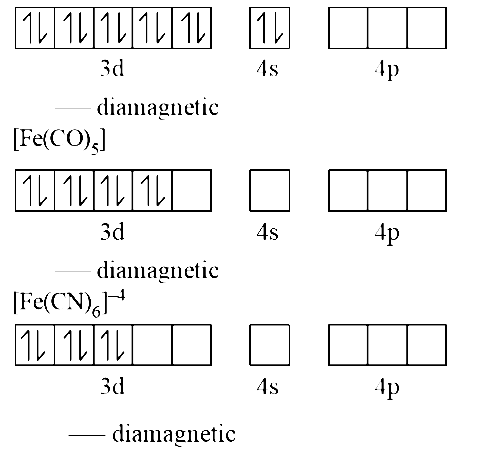
Atomic number of Cr and Fe are respectively 24 and 26, which of the following is paramagetic with the spin of electron?
(A)
[Cr(CO)6]
(B)
[Fe(CO)5]
(C)
[Fe(CN)6]4
(D)
[Cr(NH3)6]3+
(D)

Solution

Atoms, ions or molecules containing unpaired electrons are paramagnetic.

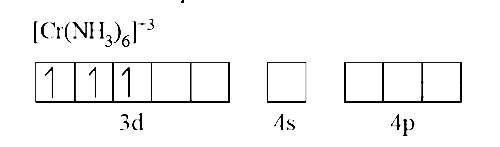
In [Cr(NH3)6]3+

Cr+3= [Ar]3d34s0

NH3 is weak field ligand so pairing of d-electrons take place odes not happen. AIPMT 2002 Chemistry - Coordination Compounds Question 51 English Explanation 1

Here, Number of unpaired electrons = 3

So it is paramagnetic.

In other cases pairing of d-electrons take place in presence of strong field ligands such as CO or CN.
AIPMT 2002 Chemistry - Coordination Compounds Question 51 English Explanation 2
Q.35
Geometrical isomers differ in
(A)
position of functional group
(B)
position of atoms
(C)
spatial arrangement of atoms
(D)
length of carbon chain.
(C)

Solution

Geometrical isomers have same molecular formula but differ in the position of atoms or groups in space due to hindered rotation about a double bond.
Q.36
IUPAC name of the following is

CH2 CH CH2 CH2 C CH
(A)
1-hexyne-5-ene
(B)
1, 5 -hexenyne
(C)
1-hexene-5-yne
(D)
1,5-hexynene.
(C)

Solution

AIPMT 2002 Chemistry - Some Basic Concepts of Organic Chemistry Question 58 English Explanation

IUPAC Name is 1-hexene-5-yne.
Q.37
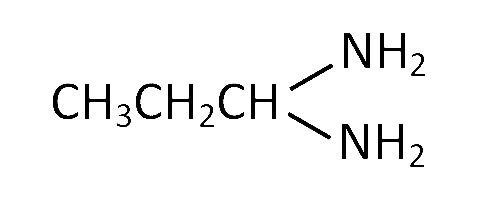
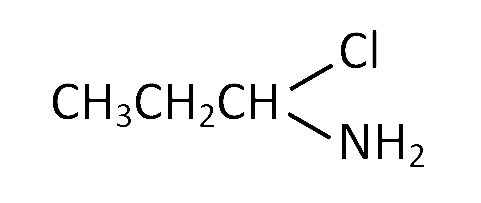
When CH3CH2CHCl2 is treated with NaNH2, the product formed is
(A)
CH3 CH CH2
(B)
CH3 C CH
(C)
AIPMT 2002 Chemistry - Hydrocarbons Question 27 English Option 3
(D)
AIPMT 2002 Chemistry - Hydrocarbons Question 27 English Option 4
(B)

Solution

AIPMT 2002 Chemistry - Hydrocarbons Question 27 English Explanation
Q.38
Reactivity order of halides for dehydrologenation is
(A)
(B)
(C)
(D)
(B)

Solution

atomic radii order :
I > Br > Cl > F

F, Cl, Br, I belongs to the same group orderly. Atomic radii go on increasing as the nuclear charge increases from top to bottom in a group. The decreasing order of bond length C – I > C – Br > C – Cl > C – F. The order of bond dissociation energy
R – F > R – Cl > R – Br > R – I. During dehydrohalogenation C – I bond breaks more easily than C – F bond.So reactivity order of halides

Q.39
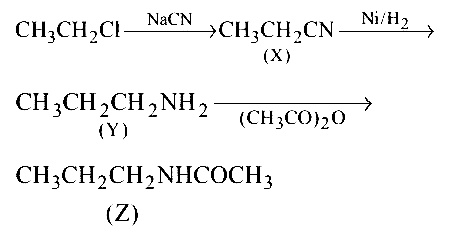
AIPMT 2002 Chemistry - Haloalkanes and Haloarenes Question 18 English
Z in the above reaction sequence is
(A)
CH3CH2CH2NHCOCH3
(B)
CH3CH2CH2NH2
(C)
CH3CH2CH2CONHCH3
(D)
CH3CH2CH2CONHCOCH3
(A)

Solution

AIPMT 2002 Chemistry - Haloalkanes and Haloarenes Question 18 English Explanation
Q.40
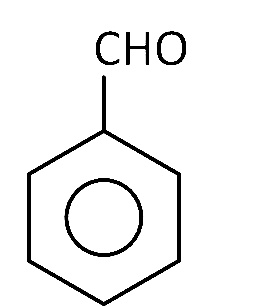
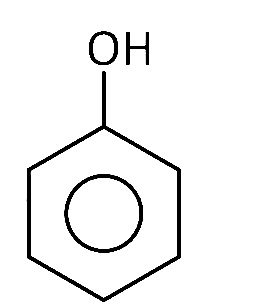
When phenol is treated with CHCl3 and NaOH, the product formed is
(A)
benzaldehyde
(B)
salicylaldehyde
(C)
salicylic acid
(D)
benzoic acid.
(B)

Solution

AIPMT 2002 Chemistry - Alcohol, Phenols and Ethers Question 37 English Explanation
Q.41
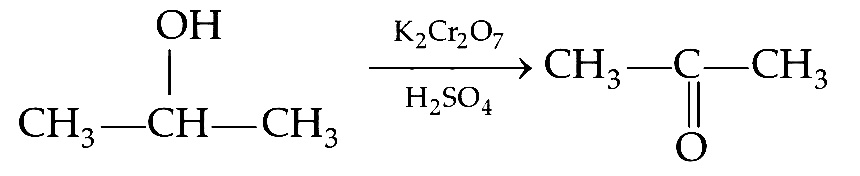
n-propyl alcohol and isopropyl alcohol can be chemically distinguished by which reagent
(A)
PCl5
(B)
reduction
(C)
oxidation with potassium dichromate
(D)
ozonolysis.
(C)

Solution

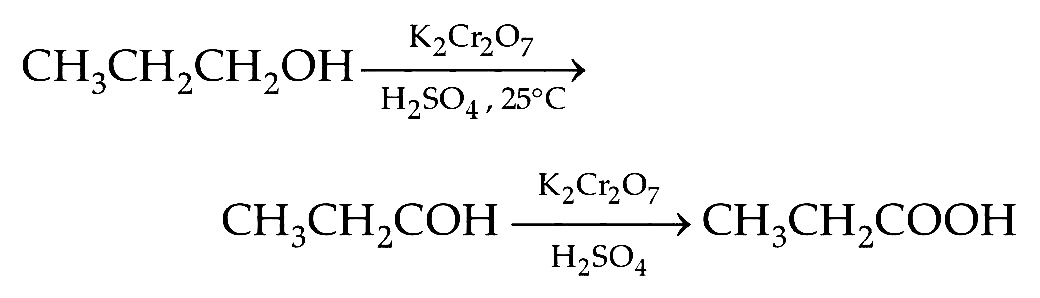
n-propyl alcohol on oxidation with K2Cr2O7 gives an aldehyde which on further oxidation gives an acid.

AIPMT 2002 Chemistry - Alcohol, Phenols and Ethers Question 38 English Explanation 1

Isopropyl alcohol on oxidation gives a ketone with the same number of carbon atoms as original alcohol.

AIPMT 2002 Chemistry - Alcohol, Phenols and Ethers Question 38 English Explanation 2
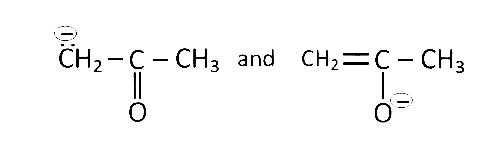
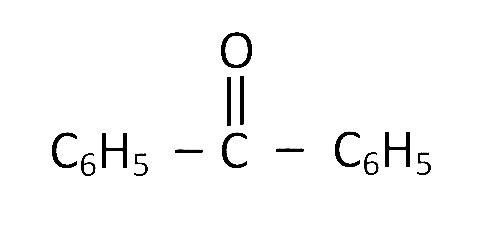
Q.42
AIPMT 2002 Chemistry - Aldehydes, Ketones and Carboxylic Acids Question 46 English
are
(A)
resonating structures
(B)
tautomers
(C)
geometrical isomers
(D)
optical isomers.
(A)

Solution

They are resonating forms because the position of the atomic nuclei remain the same and only electron redistribution has occurred.
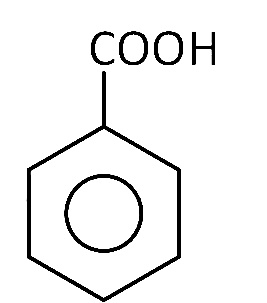
Q.43
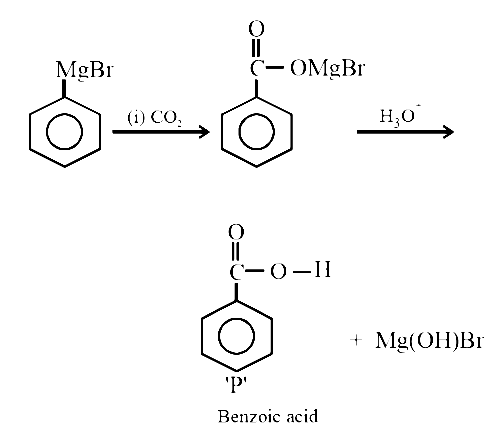
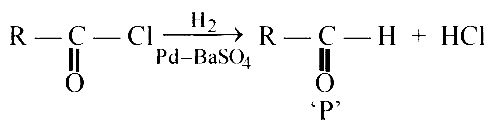
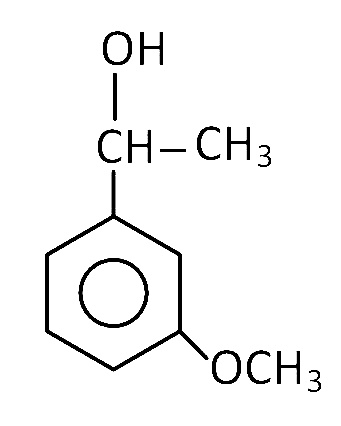
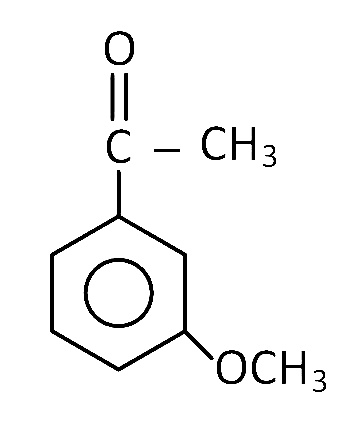
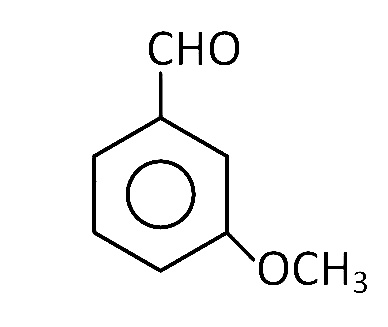
AIPMT 2002 Chemistry - Aldehydes, Ketones and Carboxylic Acids Question 96 English
In the above reaction product P is
(A)
AIPMT 2002 Chemistry - Aldehydes, Ketones and Carboxylic Acids Question 96 English Option 1
(B)
AIPMT 2002 Chemistry - Aldehydes, Ketones and Carboxylic Acids Question 96 English Option 2
(C)
AIPMT 2002 Chemistry - Aldehydes, Ketones and Carboxylic Acids Question 96 English Option 3
(D)
AIPMT 2002 Chemistry - Aldehydes, Ketones and Carboxylic Acids Question 96 English Option 4
(B)

Solution

Grignard reagent forms addition product with bubbled carbondioxide which on hydrolysis with HCl yields benzoic acid. AIPMT 2002 Chemistry - Aldehydes, Ketones and Carboxylic Acids Question 96 English Explanation
Q.44
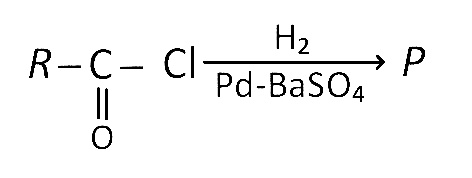
In the following reaction product is
AIPMT 2002 Chemistry - Aldehydes, Ketones and Carboxylic Acids Question 45 English
(A)
RCH2OH
(B)
RCOOH
(C)
RCHO
(D)
RCH3
(C)

Solution

AIPMT 2002 Chemistry - Aldehydes, Ketones and Carboxylic Acids Question 45 English Explanation
Q.45
AIPMT 2002 Chemistry - Organic Compounds Containing Nitrogen Question 25 English
Product 'P' in the above reaction is
(A)
AIPMT 2002 Chemistry - Organic Compounds Containing Nitrogen Question 25 English Option 1
(B)
AIPMT 2002 Chemistry - Organic Compounds Containing Nitrogen Question 25 English Option 2
(C)
AIPMT 2002 Chemistry - Organic Compounds Containing Nitrogen Question 25 English Option 3
(D)
AIPMT 2002 Chemistry - Organic Compounds Containing Nitrogen Question 25 English Option 4
(B)

Solution

AIPMT 2002 Chemistry - Organic Compounds Containing Nitrogen Question 25 English Explanation
Q.46
Monomer of
AIPMT 2002 Chemistry - Polymers Question 19 English
is
(A)
2-methylpropene
(B)
styrene
(C)
propylene
(D)
ethene
(A)

Solution

Monomer of
AIPMT 2002 Chemistry - Polymers Question 19 English Explanation
is 2-methylpropene.
Q.47
Cellulose is polymer of
(A)
glucose
(B)
fructose
(C)
ribose
(D)
sucrose.
(A)

Solution

Cellulose is a straight chain polysaccharide composed of D-glucose units joined by -glycosidic linkage.
Q.48
Enzymes are made up of
(A)
edible proteins
(B)
proteins with specific structure
(C)
nitrogen containing carbohydrates
(D)
carbohydrates.
(B)

Solution

Enzymes are proteins that act as catalyst for bio-chemical processes of life. They speed up these reactions enormously and with a high degree of selectivity.
Q.49
Which is not true statement?
(A)
-carbon of -amino acid is asymmetric.
(B)
All proteins are found in -form
(C)
Human body can synthesise all proteins they need.
(D)
At pH = 7 both amino and carboxylic groups exist in ionised form.
(B)

Solution

Some proteins are also found in the D-form.
Biology (Maximum Marks: 372)
  • This section contains 93 questions.
  • Each question has FOUR options (A), (B), (C) and (D). ONLY ONE of these four options is the correct answer.
  • Full Marks : +4 If ONLY the correct option is chosen;
  • Zero Marks : 0 If none of the options is chosen (i.e. the question is unanswered);
  • Negative Marks : −1 In all other cases.
Q.1
In fluid mosaic model of plasma membrane
(A)
Phospholipids form a bimolecular layer in middle part
(B)
Upper layer is non-polar and hydrophilic
(C)
Proteins form a middle layer
(D)
Polar layer is hydrophobic
(A)

Solution

Fluid mosaic model of plasma membrane proposes that plasma membrane comprises of a phospholipid bilayer wherein icebergs of proteins float in the sea of phospholipids.
Q.2
Ribosomes are produced in :
(A)
Mitochondria
(B)
Golgibody
(C)
Nucleolus
(D)
Cytoplasm
(C)

Solution

Nucleolus synthesizes and stores RNA. The ribosomal proteins are synthesized in the cytoplasm and shift to the nucleolus for the formation of ribosomal subunits by complexing with rRNA.
Q.3
Which of the following is a reducing sugar?
(A)
Galactose
(B)
Gluconic acid
(C)
-methyl galactoside
(D)
Sucrose
(A)

Solution

All those sugars which have free aldehyde or ketone group are called reducing sugars. These are able to reduce cupric ions (Cu+2) into cuprous ions (Cu+). Sucrose, starch are non-reducing sugars.
Q.4
Lipids are insoluble in water because lipid molecules are
(A)
hydrophilic
(B)
hydrophobic
(C)
neutral
(D)
zwitter ions.
(B)

Solution

Water attracting molecules are called hydrophilic. Water repelling molecules are called hydrophobic. Amino acids simultaneously carry positive and negative charges. Such substances are called zwitter ions. Lipids are compounds of C, H, O but the ratio of H and O is more than 2 : 1, that is, the ratio of oxygen is lesser than carbohydrates. Lipids are insoluble in water but soluble in non-polar solvents such as benzene, chloroform etc.

The most common lipid found in a cell is phospholipid. It contains a hydrophilic (polar) head and a hydrophobic (non- polar tail).
Q.5
Best material for the study of mitosis in laboratory is
(A)
anther
(B)
root tip
(C)
leaf tip
(D)
ovary.
(B)

Solution

Mitosis occurs both in somatic cells as well as in germ cells of the gonads. In plants mitosis occurs in the meristematic cells of root tip or shoot tip. These cells divide at a faster rate. So the root tip shows active cell division and are used in the laboratory to study mitosis. For studying meiosis young anthers are used.
Q.6
Mitotic spindle is mainly composed of which protein?
(A)
Actin
(B)
Myosin
(C)
Tubulin
(D)
Myoglobin
(C)

Solution

A spindle of fine fibres begins to develop during prophase. It consists of microtubules which are made of protein called tubulin and certain other associated proteins. These delicate fibres radiate from the centriole and constitute aster.
Q.7
If a diploid cell is treated with colchicine then it becomes : -
(A)
Tetraploid
(B)
Monoploid
(C)
Diploid
(D)
Triploid
(A)

Solution

Colchicine inhibits spindle formation, due to which chromatids are unable to separate during anaphase which results in doubling of chromosomes. So, if a diploid cell is treated with colchicine, there is doubling of chromosomes and it becomes tetraploid,. Its an alkaloid obtained from Colchicum autumnale.
Q.8
What is the reason of formation of embryoid from pollen grain in tissue culture medium ?
(A)
Double fertilization
(B)
Test tube culture
(C)
Cellular totipotency
(D)
Organogenesis
(C)

Solution

Cellular totipotency is the ability, shown by many living cells to form all types of tissue that constitute the mature organism.
Q.9
What is the direction of micropyle in anatropous ovule?
(A)
Upwards
(B)
Downward
(C)
Right
(D)
Left
(B)

Solution

In anatropous, ovule gets inverted and micropyle is on the lower side. It is the most common type of ovule. In orthotropous ovule micropyle is upward. This is the presentive type of ovule.
Q.10
In angiosperm all the four microspores of tetrad are covered by a layer which is formed by
(A)
pectocellulose
(B)
callose
(C)
cellulose
(D)
sporopollenin.
(A)

Solution

Each microspore or pollen is having a two layered wall. Outer layer is thick tough cuticularised called exine, which is chiefly composed of a material called ‘sporopollenin’. Inner layer is thin, delicate and smooth called intine, which is made of pectocellulose.

Exine is not uniform but is thin at one or more places in the form of germ pores. Whereas intine made of pectocellulose covers the entire surface of pollen grains.
Q.11
In angiosperms pollen tube liberate their male gametes into the
(A)
central cell
(B)
antipodal cells
(C)
egg cell
(D)
synergids.
(D)

Solution

On reaching of pollen tube inside the embryo sac, the 2 male gametes are discharged through a sub-terminal pore in pollen tube. The contents of pollen tube are discharged in the synergid and the pollen tube does not grow beyond it in the embryo sac. Further the cytoplasm of pollen tube is restricted to chalazal end of this synergid cell.
Q.12
Which bacteria is utilized in Gober gas plant ?
(A)
Nitrifying bacteria
(B)
Methanogens
(C)
Ammonifying bacteria
(D)
Denitrifying bacteria
(B)

Solution

Methanobacillus (methanogen) occurs in marshes and also in dung. It produces CH4 gas under anaerobic condition and is utilized in gobar gas plant.
Q.13
During the formation of bread it becomes porous due to release of CO2 by the action of : -
(A)
Protozoans
(B)
Bacteria
(C)
Yeast
(D)
Virus
(C)

Solution

Yeast carry out fermentation, releasing CO2 making bread soft and porous. Hence, Saccharomyces is referred to as baker’s yeast.
Q.14
Which of the following statement is true ?
(A)
Tracheids are unicellular and with wide lumen
(B)
Tracheids are multicellular and with narrow lumen
(C)
Vessels are multicellular and with wide lumen
(D)
Vessels are unicellular and with narrow lumen
(A)

Solution

Vessels are elongated, multicellular water conducting channels with wide lumen formed by end to end fusion of a large number of vessel elements. Tracheids are elongated dead cells with tapering ends having lignified walls and large or wide lumen. Their main function is conduction of water and minerals from root to leaf.
Q.15
Axillary bud and terminal bud derived from the activity of : -
(A)
Apical meristem
(B)
Parenchyma
(C)
Lateral meristem
(D)
Intercalary meristem
(A)

Solution

Apical meristems are situated at the tips of the root and shoot. They take part in initial growth. Plants elongate and increase in height as a result of divisions in this meristem. Promeristem and primary meristem (root and shoot apices) are included in this type of meristem.
Q.16
Vessels are found in : -
(A)
Most of the angiosperm and few gymnosperms
(B)
All angiosperms and some gymnosperm
(C)
All pteridophyta
(D)
All angiosperms, all gymnosperms and some pteridophyta
(A)

Solution

Generally gymnosperms do not have vessels but a few gymnosperms with vessels are Ephedra, Smilax etc. Most of angiosperms have vessels except of few e.g., Trochodendron.
Q.17
Four radial vascular bundle are found in : -
(A)
Monocot stem
(B)
Dicot stem
(C)
Dicot root
(D)
Monocot root
(C)

Solution

When xylem and phloem strands are present at different radii the vascular bundles are radial and 4 radial vascular bundles (tetrach condition) are present in dicot root. This is called tetrach conditions.
Q.18
Opening and closing of stomata is due to the
(A)
hormonal change in guard cells
(B)
change in turgor pressure of guard cells
(C)
gaseous exchange
(D)
respiration.
(B)

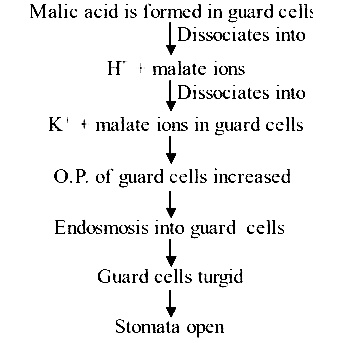
Solution

The mechanism of opening and closing of stomata is explained by active K+ ion transport theory. During day time : AIPMT 2002 Biology - Transport in Plants Question 20 English Explanation During night or dark : CO2 conc. increases in sub-stomatal cavities ABA participation K+ ions exchange stopped K+ ions transported back into subsidiary cells Decreased pH Starch synthesised in guard cells Decreased O.P. of guard cells Exosmosis from guard cell Stomata close.
Q.19
Main functional of lenticel is
(A)
transpiration
(B)
guttation
(C)
gaseous exchange
(D)
bleeding.
(C)

Solution

Lenticels are pores present in woody stem through which transpiration or loss of water vapour takes place. Lenticel formation begins during the development of the first periderm. In the stem, they usually appear below a stoma or group of stomata. It should also be noted that lenticels can be present on fruits such as apples and pears.
Q.20
Choose the correct match.
Bladderwort, sundew, Venus flytrap
(A)
Nepenthes, Dionea, Drosera
(B)
Nepenthes, Utricularia, Vanda
(C)
Uricularia, Drosera, Dionea
(D)
Dionea, Trapa, Vanda.
(C)

Solution

Bladderwort or Utricularia is a rootless free floating insectivorous plant. Its stem is green and bears green lobed or dissected leaves. Some lobes of the leaves become modified into bladder like structures for catching insects. Sundew or Drosera is another insectivorous plant which has leaves that are green and bear many glandular hairs or tentacles having shining droplets to attract the insects and later trap them.

Venus flytrap or Dionea is also an insectivorous plant in which the leaf is modified into two jaw like structures. Each jaw has long sensitive hairs on its upper surface and also has many digestive enzymes. These jaws interlock to trap the insect that enters in it. Thus Utricularia, Drosera and Dionea are all insectivorous plants.
Q.21
Organisms which obtain energy by the oxidation of reduced inorganic compounds are called
(A)
photoautotrophs
(B)
chemoautotrophs
(C)
saprozoic
(D)
coproheterophs.
(B)

Solution

Chemoautotrophs are organisms that are capable of manufacturing their organic food utilising chemical energy released in oxidation of some inorganic substances. The process of manufacture of food in such organisms is called chemosynthesis. It includes some aerobic bacteria. Photoautotroph obtain energy for their synthesis of food from light. Fungi living on dead or decaying plant or animal remains and also growing on dung of herbivores are saprophytes.
Q.22
How many ATP molecules are produced by aerobic oxidation of one molecule of glucose?
(A)
2
(B)
4
(C)
38
(D)
34
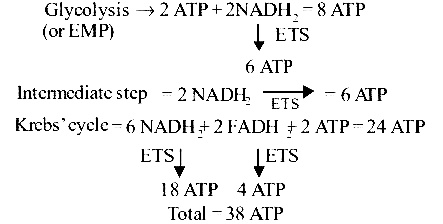
(C)

Solution

Energy gain in one complete cycle of aerobic respiration is : AIPMT 2002 Biology - Respiration in Plants Question 28 English Explanation In aerobic respiration complete oxidation of one glucose molecule produces 38 ATP molecules. But the number of ATP molecules so produced may vary depending upon the mode of entry of NADH2 in the mitochondria. If the electrons of NADH2 are accepted by malate then each molecule of NADH2 yields 3 ATP molecules and the total would be 38 ATP molecules. But if the electrons of NADH2 are accepted by FAD it yields only 2 ATP molecules making the total of 36 ATP molecules. This type of shuttle occurs in most of the eukaryotic cells.
Q.23
Manipulation of DNA in genetic engineering became possible due to the discovery of : -
(A)
Transcriptase
(B)
DNA ligase
(C)
Primase
(D)
Restriction endonuclease
(D)

Solution

DNA restriction endonuclease are important class of restriction exonucleases, class II, which cut double-stranded DNA molecules only at sites characterized by a specific nucleotide sequence. Restriction enzymes are isolated from bacterial cells and are tools for molecular biologists. Several hundred restriction enzymes are now known, each with a specific sequence requirement dictating where it will cut DNA. Some, such as

Hind III, make staggered cuts leaving ‘sticky ends’, three nucleotides long protruding on one strand from each severed terminus; others make clean cuts in both strands at the same place and thus generate ‘blunt ends’. Digesting DNA with a restriction enzyme therefore creates a characteristic set of fragments, which can be isolated by electrophoresis and subsequently analysed.
Q.24
Which of the following crops have been brought to India from New world ?
(A)
Mango, tea
(B)
Coffee
(C)
Tea, rubber, mango
(D)
Cashewnut, potato, rubber
(D)

Solution

Cashewnut, potato, rubber crops have been brought to India from New world.
Q.25
Wildlife is continuously decreasing. What is the main reason of this ?
(A)
Cutting down of fores
(B)
Predation
(C)
Hunting
(D)
Destruction of habitat
(D)

Solution

Wildlife refers to all living organisms (terrestrial, aquatic and aerial) living in all possible natural habitats of their own, other than the cultivated plants and domesticated animals. Thus “wildlife” does not exist only in jungles and are hunted down but wild life includes even the migrating birds, turtles, coral reefs, microorganisms, insects, fishes, etc.

Several hundred organisms are endangered or on the verge of extinction. The reasons are deforestation, pollution, killing, over exploitation etc. The most important among them is deforestation or destruction of their natural habitat because it will affect the species (flora and fauna) of complete area and not only the few organisms. The natural habitat may be destroyed by man for his settlements, grazing grounds, agriculture, mining, industries, dam building etc. As a consequence of this, the species must adapt to the changes, move elsewhere or may succumb to predation, starvation or disease, and eventually dies.
Q.26
Some bacteria are able to grow in streptomycin containing medium due to
(A)
natural selection
(B)
induced mutation
(C)
reproductive isolation
(D)
genetic drift.
(A)

Solution

Normally bacteria cannot survive in antibiotic containing medium but if it does so it must have acquired resistance against that antibiotic. These are well adapted to grow in streptomycin containing medium and thus are more evolved. So due to natural selection only the more evolved and better adapted species is able to survive.
Q.27
In bacteria, plasmid is
(A)
extra chromosomal material
(B)
main DNA
(C)
non functional DNA
(D)
repetitive gene.
(A)

Solution

In addition to the nucleoid, bacterial cytoplasm normally contains many small, separate pieces of DNA, called plasmids. These circular DNA units are 1/100 the size of the main nuclear DNA (nucleoid) and are also not enclosed in a membrane structure.

When found in cytoplasm, entirely independent of the bacterial chromosome, they replicate autonomously. Sometimes it becomes integrated into the main DNA and replicates with it. During conjugation, the plasmids, sometimes called episomes, help in the transfer of the genetic material between different bacteria. It may carry some genes of resistance to a variety of antibiotics.
Q.28
In five kingdom system, the main basis of classification is
(A)
structure of nucleus
(B)
mode of nutrition
(C)
structure of cell wall
(D)
asexual reproduction.
(B)

Solution

The five kingdom classification is a mode of classification based on the following criteria.
• Complexity of cell structure
• Complexity of body structure
• Modes of nutrition
• Ecological life styles
• Phylogenetic relationship
Q.29
The growth curve of bacterial population in lab is plotted against time. What will be the shape of graph?
(A)
Sigmoid
(B)
Hyperbolic
(C)
Ascending straight line
(D)
Descending straight line
(B)

Solution

Semilog of per minute growing bacterium when plotted against time, would yield ascending straight line.
Q.30
Which statement is correct for bacterial transduction?
(A)
Transfer of some genes from one bacteria to another bacteria through virus.
(B)
Transfer of genes from one bacteria to another bacteria by conjugation.
(C)
Bacteria obtained its DNA directly from mother cell.
(D)
Bacteria obtained DNA from other external source.
(A)

Solution

In transduction, genetic material of one bacterial cell goes to other bacterial cell by agency of bacteriophages or phages (viruses, infecting bacteria).

Transduction was first of all reported in Salmonella typhimurium by Zinder and Lederberg (1952). Transduction is used for gene mapping and analysis in bacteria and also for strain construction
Q.31
Choose the correct sequence of stages of growth curve for bacteria.
(A)
Lag, log, stationary, decline phase
(B)
Lag, log, decline, stationary phase
(C)
Stationary, lag, log, decline phase
(D)
Decline, lag, log phase, stationary
(A)

Solution

The growth curve for bacteria is sigmoid. First phase is the phase of slow growthLag phase. Second phase is the period of accelerated growth - Log phase. Third phase is the phase when growth rate becomes stable - Stationary phase. Finally growth rate declines.
Q.32
Which of the following secretes toxins during storage conditions of crop plants?
(A)
Aspergillus
(B)
Penicillium
(C)
Fusarium
(D)
Colletotrichum
(A)

Solution

Aspergillus flavus produces carcinogenic fungus toxin (Aflatoxin) during storage condition of crop plant.
Q.33
Which fungal disease spreads by seed and flowers?
(A)
Loose smut of wheat
(B)
Corn smut
(C)
Covered smut of barley
(D)
Soft rot of potato
(A)

Solution

Ustilago causes loose smut of wheat, as a result the grain and flower get converted into powdered mass.
Q.34
Edible part in mango is
(A)
mesocarp
(B)
epicarp
(C)
endocarp
(D)
epidermis
(A)

Solution

Mango (Mangifera indica) of Family Anacardiaceae is a drupe. The edible part in mango is mesocarp.
Q.35
Geocarpic fruit is
(A)
potato
(B)
peanut
(C)
onion
(D)
garlic.
(B)

Solution

Geocarpic fruits are those which develop underground. Groundnut is the fruit which develops underground, onion and carrot also occur within the soil but onion is a modified stem while carrot is a modified root.
Q.36
In photosynthersis energy from light reaction to dark reaction is transferred in the form of
(A)
ADP
(B)
ATP
(C)
RuDP
(D)
chlorophyll.
(B)

Solution

ATP molecules produced in the light reaction are used in the dark reaction to fix CO2 to form organic compounds.
Q.37
Which of the following absorb light energy for photosynthesis?
(A)
Chlorophyll
(B)
Water molecule
(C)
O2
(D)
RuBP
(A)

Solution

Each pigment has its own absorption spectrum, chlorophyll absorbs light energy in blue and red region.
Q.38
Which pigment absorbs the red and far-red light?
(A)
Cytochrome
(B)
Phytochrome
(C)
Carotenoids
(D)
Chlorophyll.
(B)

Solution

Phytochrome has a light absorbing or light detecting portion (the chromophore) attached to small protein of about 1,24,000 daltons. Phytochrome occurs in 2 forms, i.e., PR and PFR (i.e., red light and far red light absorbing forms) and these 2 forms are interconvertible.

Cytochromes are electron transferring proteins. They contain iron porphyrin or copper porphyrin as prosthetic groups. Chlorophyll is the fundamental green pigment of photosynthesis. It is localised in the chloroplasts. Carotenoids are lipid compounds and they are yellow, orange, purple, etc. in colour. These are found in higher plants red algae, green algae, fungi and photosynthetic bacteria.
Q.39
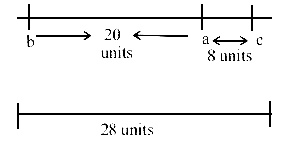
There are three genes a, b and c. The percentage of crossing over between a and b is 20%, b and c is 28% and a and c is 8%. What is the sequence of genes on chromosome
(A)
a, b, c
(B)
b, a, c
(C)
a, c, b
(D)
None
(B)

Solution

a – b = 20%, b – c = 28%, a – c = 8%

AIPMT 2002 Biology - Principles of Inheritance and Variation Question 89 English Explanation
Percent crossing over between two genes is proportional to the distance between them.
Q.40
A gene said to be dominant if : -
(A)
It expressed only in heterozygous condition
(B)
It express it's effect only in homozygous stage
(C)
It never expressed in any condition
(D)
It expressed both in homozygous and heterozygous condition
(D)

Solution

Dominant factor is an allele or Mendelian factor which expressess itself in the hybrid (heterozygous) as well as in homozygous state. It is denoted by capital letter.
Q.41
A diseased man marries a normal woman. They get three daughter and five sons. All the daughter were diseased and sons were normal. The gene of this disease is : -
(A)
Sex linked dominant
(B)
Autosomal dominant
(C)
Sex linked recessive
(D)
Sex limited character
(A)

Solution

Sex linked disorders follow criss-cross inheritance pattern that affected father passes it on to their daughters. The daughters receive one of their X - chromosome from their fathers.
Q.42
On selfing a plant of F1 generation with genotype “AABbCC”,the genotypic ratio in F2 generation will be
(A)
1 : 1
(B)
3 : 1
(C)
9 : 3 : 3 : 1
(D)
27 : 9 : 9 : 9 : 3 : 3 : 3 : 1
(B)

Solution

Selfing is the process of fertilisation with polar or male gametes of the same individual. AABbCC will produce two type of gametes ABC and AbC. Thus, in F2 generation three genotypes will be obtained. These are AABBCC, AABbCC and AAbbCC in the ratio of 1 : 2 : 1. Phenotypically AABBCC and AABbCC are same. So the phenotypic ratio in F2 generation will be 3 : 1.
Q.43
Which of the following is a correct match -
(A)
Sickel cell anaemia = X – Chromosome
(B)
Down Syndrome = 21st Chromosome
(C)
Haemophilia = Y – Chromosome
(D)
Parkinson Disease = X & Y Chromosome
(B)

Solution

Down’s syndrome (Mongolian Idiocy, Mongolism) is caused by the presence of an extra chromosome number 21. Sickle cell anaemia is not a sex linked (i.e., X linked) disease but an autosomally inherited recessive trait.
Haemophilia is X-linked but not holandric/Y-linked. Parkinson’s disease is a degenerative disease. It is not at all hereditary.
Q.44
Which of the following is the example of pleiotropy ?
(A)
Thalassemea
(B)
Haemophilia
(C)
Sickle cell anaemia
(D)
Colour blindness
(C)

Solution

Pleiotropic gene is such a gene which has a wider effect on phenotype i.e., it controls several phenotypic traits. Sickle cell anaemia is considered to be caused by one such pleiotropic gene. It is caused due to mutation in -globin gene of haemoglobin.
Q.45
Change in sequence of nucleotide in DNA is called as -
(A)
Recombination
(B)
Mutation
(C)
Mutagen
(D)
Translation
(B)

Solution

A mutation involves a change in the sequence of nucleotides in a nucleic acid molecule. This change will express itself in the form of a change in the sequence of aminoacids in the protein molecule synthesized through the information, encoded in nucleic acid segment. Therefore mutations at molecule level can be studied both by the study of the sequence of amino acids in a protein and also by the study of sequence of nucleotides in a segment of nucleic acid.
Q.46
Which of the following enzymes are used to join bits of DNA ?
(A)
Endonuclease
(B)
DNA polymerase
(C)
Ligase
(D)
Primase
(C)

Solution

Ligases are used to join bits of DNA. Primase is an RNA polymerase, used to initiate DNA synthesis. DNA polymerase enzyme catalyses the synthesis of DNA. Endonuclease, causes the splicing of the intron carrying the coding sequence of the same endonuclease.
Q.47
Which of the following reunites the exon segments after RNA splicing ?
(A)
RNA polymerase
(B)
RNA proteases
(C)
RNA primase
(D)
RNA ligase
(D)

Solution

RNA polymerase enzyme catalyses the synthesis of RNA. It is single in prokaryotes. There are three types of RNA polymerases in eukaryotes– I for 28S, 18S and 5.8S RNA, II for mRNA and snRNA and III for tRNA, 5S RNA and scRNA. Primase is an RNA polymerase that is used to initiate DNA synthesis. RNA ligase reunites the exon segment after RNA splicing.
Q.48
Out of 64 codons, 61 codons code for 20 types of amino acid it is called : -
(A)
Wobbling of codon
(B)
Universility of codons
(C)
Overlapping of gene
(D)
Degeneracy of genetic code
(D)

Solution

Out of 64 codons, only 3 signify stop codons. There are more than one codon for most of the amino acids, the genetic code is non-over lapping. Three successive nucleotides or bases code for only one amino acid wobbling refers to the third base degeneracy.
Q.49
Exon part of m-RNAs have code for : -
(A)
Lipid
(B)
Protein
(C)
Phospholipid
(D)
Carbohydrate
(B)

Solution

DNA transcribes to form mRNA. Its function is to carry coded information from DNA for the synthesis of proteins. The RNA consists of a coding region called exon and non-coding region called introns. The exons are thus the functional part that have code for proteins.
Q.50
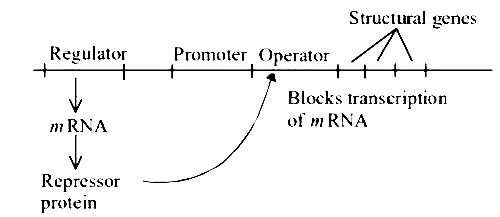
Jacob and Monad studied lactose metabolism in E.Coli and proposed operon concept. Operon concept applicable for :
(A)
All prokaryotes and all eukaryotes
(B)
All prokaryotes and some protozoanes
(C)
All prokaryotes
(D)
All prokaryotes and some eukaryotes
(A)

Solution

Gene regulation of eukaryotes is complex as compared to that of prokaryotes.
Q.51
In E. Coli, during lactose metabolism repressor binds to : -
(A)
Promoter gene
(B)
Operator gene
(C)
Structural gene
(D)
Regulator gene
(B)

Solution

In the lac operon of E.coli due to the activity of regulator gene synthesis of repressor molecules occurs. These repressor molecules get attached to the operator gene and thus check mRNA synthesis and because of this no protein synthesis occurs. AIPMT 2002 Biology - Molecular Basis of Inheritance Question 100 English Explanation
Q.52
Transformation experiment was first performed on which bacteria : -
(A)
Diplococcus pneumoniae
(B)
Pasteurella pestis
(C)
E. coli
(D)
Salmonella
(A)

Solution

Transformation involves transfer of genetic material of one bacterial cell into another bacterial cell by some unknown mechanism and it converts one type of bacterium into another type. This was first studied by Griffith (1928) in Diplococcus pneumoniae and hence is known as Griffith effect.
Q.53
In a DNA percentage of thymine is 20% then what is the percentage of guanine : -
(A)
40%
(B)
20%
(C)
30%
(D)
60%
(C)

Solution

In a DNA, the percentage of thymine is 20%. So, as it pairs with adenine, it is also 20%. So the guanine and cytosine together forms 60% of DNA and hence, guanine is 30%.
Q.54
What is true for individuals of same species ?
(A)
Live in same habitat
(B)
Live in different habitat
(C)
Interbreeding
(D)
Live in same niche
(C)

Solution

Individuals of the same species can interbreed. No two individuals share the same ecological niche.
Q.55
Two different species can not live for long duration in the same niche or habitat. This law is : -
(A)
Competitive exclusion principal
(B)
Weiseman's theory
(C)
Allen's law
(D)
Gause's hypothesis
(D)

Solution

Interspecific competition is rivalry amongst members of different species. The severity of competition depends upon similarity in the requirement of food and shelter. Every type of organism has a particular niche, no two organisms can live in same niche. One of the two is eliminated. This phenomenon is called Gause hypothesis of competitive exclusion.
Q.56
Which type of association is found in between entomophilous flower and pollinating agent ?
(A)
Coperation
(B)
Co-evolution
(C)
Mutualism
(D)
Commonsalism
(B)

Solution

Co-evolution can occur in any interspecific relationship like symbiosis or mutualism. The relation between an entomophilous flower and pollinating insect shows co-evolved mutualism. In this the plant depends exclusively on the insect for pollination and the insect relies on the plant for food.
Q.57
Which of the following is absent in polluted water ?
(A)
Larva of stone fly
(B)
Hydrilla
(C)
Blue green algae
(D)
Water hyacinth
(A)

Solution

Stone fly (Plecoptera Order) larva requires well aerated, non-polluted water. It is absent in polluted water.
Q.58
Maximum green house gas released by which country :
(A)
France
(B)
Britain
(C)
India
(D)
U.S.A.
(D)
Q.59
Which of the following is without exception in angiosperms?
(A)
Presence of vessels
(B)
Double fertilisation
(C)
Secondary growth
(D)
Autotrophic nutrition
(B)

Solution

Vesselless angiosperms are Wintera, Trochodendron etc. Secondary growth is absent in some angiosperms. Angiospermic plants are autotrophic in nutrition. But some angiosperms are heterotrophic in nutrition. The 4 special modes of nutrition and their examples include:
(i) Saprophytic : e.g. Neottia, Monotropa.
(ii) Symbiotic – e.g. Mycorrhiza-between fungus and roots of higher plants.
(iii) Parasitic – Cuscuta.
(iv) Insectivorous plant – Nepenthes. Double fertilization is characteristic of all angiosperms.
Q.60
Which of the following plants produces seeds but not flowers?
(A)
Maize
(B)
Mint
(C)
Peepal
(D)
Pinus
(D)

Solution

Maize, mint and peepal are flowering plants or angiosperms but Pinus is a gymnosperm in which seeds are produced but flowers are not produced or seeds are not enclosed in flowers.
Q.61
Dwarfness can be controlled by treating the plant with
(A)
cytokinin
(B)
gibberellic acid
(C)
auxin
(D)
antigibberellin.
(B)

Solution

Gibberellins helps in the reversal of dwarfism in many genetically dwarf plants. External supply of Gibberellic acid causes rapid elongation of growth. E.g., rosette plant of sugarbeet when treated with GA3 undergoes marked longitudinal growth of axis.
Q.62
Seed dormancy is due to the
(A)
ethylene
(B)
abscisic acid
(C)
IAA
(D)
starch.
(B)

Solution

Ethylene breaks dormancy of different plants. Abscisic acid induces dormancy in seeds, buds and underground storage organs.
Q.63
Bamboo plant is growing in a far forest then what will be the trophic level of it ?
(A)
Second trophic level (T2)
(B)
First trophic level (T1)
(C)
Fourth trophic level (T4)
(D)
Third trophic level (T3)
(B)

Solution

Trophic structure of ecosystem is a type of producer-consumer arrangement, in which each food level is called trophic level and the graphical representation of trophic structure of ecosystem constitutes ecological pyramids. The green plants are producers and represent the first trophic level (T1). So bamboo plant is the first trophic level (T1).
Q.64
Cancerous cells can easily be destroyed by radiations due to : -
(A)
Fast mutation
(B)
Lack of oxygen
(C)
Rapid cell division
(D)
Lack of nutrition
(C)

Solution

The ability of radiations to kill cells is highest in the tissue with the highest number of dividing cells. Tumour cells proliferate rapidly. Hence, tumours are killed more rapidly by radiations.
Q.65
Which of the following statements is true for lymph?
(A)
WBC + serum
(B)
Blood RBCs and some proteins
(C)
RBCs + WBCs + plasma
(D)
RBCs + proteins + platelets
(B)

Solution

Lymph is a colourless vascular connective tissue derived from tissue fluid. RBCs and platelets are absent. Only leucocytes and floating amoeboid lymphocytes are present.
Q.66
Impulse of heart beat originates from
(A)
SA node
(B)
AV node
(C)
vagus nerve
(D)
cardiac nerve
(A)

Solution

The impulse of a heartbeat originates from Option A, the SA node. The SA node, or sinoatrial node, is often referred to as the heart's natural pacemaker. It is located in the right atrium of the heart. This specialized cluster of cells generates electrical impulses that spread throughout the heart, prompting it to beat and pump blood. After the SA node fires, the electrical impulse triggers the atria to contract, pushing blood into the ventricles. The impulse then travels to the AV node (atrioventricular node), which acts as a gatekeeper, slowing the electrical signal before it enters the ventricles. This delay ensures that the atria have fully contracted and emptied their blood into the ventricles before the ventricles contract. Following the AV node, the impulse travels through the bundle of His, down the bundle branches, and through the Purkinje fibers, causing the ventricles to contract and pump blood to the lungs and the rest of the body.

The vagus nerve (Option C) and the cardiac nerves (Option D) are part of the autonomic nervous system, which regulates the speed and strength of heartbeats but does not originate the heartbeat. The vagus nerve primarily exerts a parasympathetic effect, meaning it can slow the heart rate, while the cardiac nerves, part of the sympathetic nervous system, can increase the heart rate and force of contraction. However, the initial impulse that starts each heartbeat comes from the SA node, not these nerves.

Q.67
What will happen if ligaments are torn?
(A)
Bones will move freely at joint and no pain.
(B)
Bone less movable at joint and pain.
(C)
Bone will become unfixed.
(D)
Bone will become fixed.
(B)

Solution

When ligaments are torn, the stability of the joint they serve is compromised, leading to increased mobility beyond the normal range, which can cause pain and instability. Therefore, the correct answer is:

Option B: Bone less movable at joint and pain.

This is because ligaments are tough, elastic bands of connective tissue that surround a joint to give support and limit the joint's movement. When ligaments are damaged, it can lead to pain, swelling, and a reduced ability to move the joint, contrary to the joint becoming more movable without pain or the bones moving freely without any discomfort. Ligaments provide stability to the joints, so their injury typically results in instability and pain due to the loss of this support and limitation of movement.

Q.68
Which cartilage is present at the end of long bones?
(A)
Calcified cartilage
(B)
Hyaline cartilage
(C)
Elastic cartilage
(D)
Fibrous cartilage
(B)

Solution

Cartilage is an important component of skeleton. It consists of a firm matrix containing collagen and elastin fibres and cells in fluid-filled lacunae. Cartilage has many types. Elastic cartilage occurs in the pinna and external auditory canal of the ear, epiglottis, Eustachian tubes and tip of the nose to make these organs flexible. Fibrous cartilage is very strong yet has a degree of flexibility. It is found in the intervertebral discs where it acts as a cushion and in pubic symphysis where it allows parturition without damage to the girdle. Hyaline cartilage occurs in sternal ribs where it allows expansion of chest during inspiration. It also forms the tracheal and bronchial rings and supports larynx and nasal septum and also at the end of long bones.
Q.69
Which of the following statement is correct for node of Ranvier of nerve?
(A)
Neurilemma is discontinuous
(B)
Myelin sheath is discontinuous
(C)
Both neurilemma and myelin sheath are discontinuous
(D)
Covered by myelin sheath
(B)

Solution

Neurons are the chief functional units of the nervous system. An ordinary neuron has a soma or cyton and a long thread called axon which is enclosed in a multilayered myelin sheath, made by Schwann cells. The myelin sheath is interrupted at the spaces between schwann cells to form gaps. These gaps are called Nodes of Ranvier. These nodes and the myelin sheath create condition that speed up the nerve impulses.
Q.70
In a population, unrestricted reproductive capacity is called as -
(A)
Biotic potential
(B)
Birth rate
(C)
Carring capacity
(D)
Fertility
(A)

Solution

Carrying capacity refers to the maximum number of individuals that can be sustained by the environment. Birth rate refers to number of births per unit population.
Q.71
Collagen is : -
(A)
Globular protein
(B)
Fibrous protein
(C)
Carbohydrate
(D)
Lipid
(B)

Solution

Collagen is a major fibrous protein of connective tissue occuring as white fibres produced by fibroblast.
Q.72
Melanin protect from :-
(A)
Infrared rays
(B)
U.V. rays
(C)
Visible rays
(D)
X-rays
(B)

Solution

Melanin is produced by specialized epidermal cells called melanophores (or melanocytes). Their dispersion in these cells is controlled by melanocyte - stimulating hormone and melatonin. Melanin, a pigment present in skin, protects it from harmful effects of UV rays. People living in tropics have more melanin in their skin which is an adaptation to protect themselves from harmful UV rays. Melanin cannot protect from infrared rays and X-rays.
Q.73
Continuous bleeding from an injured part of body is due to deficiency of
(A)
vitamin A
(B)
vitamin B
(C)
vitamin K
(D)
vitamin E.
(C)

Solution

Vitamin K is necessary for the synthesis of prothrombin in the liver. Prothrombin is a factor which is required for blood clotting. Deficiency of vitamin K leads to slow rate of blood clotting. Vitamin A deficiency leads to night blindness, xerophthalmia and retarded growth. Vitamin B deficiency causes beri-beri, pellagra, anaemia etc. Deficiency of vitamin E leads to destruction of RBCs.
Q.74
Hydrolytic enzymes which act on low pH called as
(A)
proteases
(B)
-amylases
(C)
hydrolases
(D)
peroxidases.
(A)

Solution

Stomach has low pH due to secretion of HCl. Protease, an enzyme for digesting protein acts in low pH i.e. in stomach. Amylase is a starch (carbohydrate) digesting enzyme and carbohydrate digestion does not occur in stomach. All digestive enzymes are hydrolases. Peroxidase is an iron containing enzyme, found mainly in plants but also present in leucocytes and milk, that catalyses the dehydrogenation (oxidation) of various substances in the presence of hydrogen peroxide.
Q.75
Stool of a person is which grey coloured due to malfunction of which of the following organ?
(A)
Pancreas
(B)
Spleen
(C)
Kidney
(D)
Liver
(D)

Solution

Stool colour is due to the bile pigments, biliverdine and bilirubin secreted by liver. whitish grey stool colour indicates secretion of biliveridin and bilirubin is not proper from the liver.
Q.76
Adrenaline directly affects on
(A)
S.A. node
(B)
-cells of Langerhans
(C)
dorsal root of spinal nerve
(D)
epithelial cells of stomach.
(A)

Solution

Adrenaline directly affects the SA node to increase rate of heartbeat. Adrenaline prepares the body for emergency reactions like fight and flight. Thus there is increase in heart rate, breathing rate, blood pressure, glucose level in blood, peripheral circulation, etc.
Q.77
When both ovaries are removed from rat then which hormone is decreased in blood?
(A)
Oxytocin
(B)
Prolactin
(C)
Estrogen
(D)
Gonadotropin releasing factor
(C)

Solution

Ovary secretes two hormones. Estrogen before ovulation and progesterone after ovulation. Oxytocin, prolaction are pituitary hormones and gonadotropin releasing factor is secreted by hypothlalamus of brain to stimulate pituitary for the secretion of gonadotropic hormones.
Q.78
Acromegaly is caused by
(A)
excess of STH
(B)
excess of thyroxine
(C)
deficiency of thyroxine
(D)
excess of adrenaline.
(A)

Solution

Acromegaly is caused by excess of STH (somatotrophic hormone), released by anterior lobe of pituitary after adolescence. The bones of the lower jaw and limbs become abnormally enlarge but the body does not attain a giant stature. Excess of thyroxine causes cretinism and myxoedema. Excess of adrenaline causes increased BMR (Basal Metabolic Rate), heart beat, excitement, etc.
Q.79
Mainly which type of hormones control the menstrual cycle in human beings?
(A)
FSH
(B)
LH
(C)
FSH, LH, estrogen
(D)
progesterone
(C)

Solution

Estrogens are steroid hormones secreted by growing ovarian follicles. During menstrual cycle a negative feedback prevents the secretion of estrogen. FSH stimulates maturation of Graafian follicles. LH stimulates ovulation and development of corpus luteum.
Q.80
What is true for cleavage : -
(A)
Size of embryo decrease
(B)
Size of embryo increase
(C)
Size of cells increase
(D)
Size of cells decrease
(D)

Solution

During cleavage, the zygote divides repeatedly to convert the large cytoplasmic mass into a large number of small blastomeres. It involves cell division without growth in size because cells continue to be retained within the zona pellucida. However, cell size decreases during cleavage.
Q.81
In which of the following animals nerve cell is present but brain is absent?
(A)
sponge
(B)
Earthworm
(C)
Cockroach
(D)
Hydra
(D)

Solution

Hydra which belongs to the Phylum Coelenterata has nerve cells but no brain. Its nervous system consists of nerve cells and their processes. Sensory cells are also present. Sponges do not have nerve cells, they lack nervous system.

Earthworm (annelida) has nervous system consisting of a circumenteric nerve ring and a solid, double, midventral nerve cord with ganglia. Cockroach (arthropoda) has the nervous system as that of earthworm.
Q.82
In which of the following, notochord is present in embryonic stage?
(A)
All chordates
(B)
Some chordates
(C)
Vertebrates
(D)
Non chordates
(A)

Solution

Presence of notochord in any stage of the life cycle is a major chordate characteristic.
Q.83
In protozoa like Amoeba and Paramecium, the organ for osmoregulation is
(A)
contractile vacuole
(B)
mitochondria
(C)
nucleus
(D)
food vacuole.
(A)

Solution

The function of contractile vacuole is osmoregulatory. Water in freshwater protozoa enters the organism by endosmosis and during feeding. If the organism does not possess a mechanism to get rid of this excess water, it will swell to the point of rupture and dissolution. The mechanism which is assumed to effect water regulation is the contractile vacuole. The vacuole periodically increases in volume (diastole) to get filled with water and contracts (systole) to discharge its water content to the surrounding environment.
Q.84
In which of the following animals dimorphic nucleus is found?
(A)
Amoeba proteus
(B)
Trypanosoma gambiense
(C)
Plasmodium vivax
(D)
Paramecium caudatum
(D)

Solution

Dimorphic nucleus means two types of nuclei are present in P. caudatum – large macronucleus and small micronucleus. The macronucleus is roughly kidney-shaped and with inconspicuous nuclear membrane. Macronucleus is the somatic or vegetative nucleus and controls the day-to-day metabolic activities of the cell. The micronucleusis lodged in a depression on the surface of the macronucleus.

It is usually spherical, with a nuclear membrane and with diploid number of chromosomes. It controls the reproductive activities of the organism. Amoeba, Trypanosoma and Plasmodium have only one nucleus.
Q.85
Sequence of which of the following is used to know the phylogeny ?
(A)
DNA
(B)
r-RNA
(C)
m-RNA
(D)
t-RNA
(B)

Solution

Carl Woese came up with the theory of life based on his discovery that the genes encoding ribosomal RNA are ancient and distributed over all lineages of life with little or no gene transfer. Therefore, rRNA are commonly recommended as molecular clocks to the phylogeny.
Q.86
Genetic drift oparates in : -
(A)
Slow reproductive population
(B)
Small isolated population
(C)
Large isolated population
(D)
Fast reproductive population
(B)
Q.87
Which of the following is important for speciation ?
(A)
Behavioural isolation
(B)
Seasonal isolation
(C)
Tropical isolation
(D)
Reproductive isolation
(D)

Solution

Seasonal isolation refers to the differences in season of breeding that can isolate two varieties. Behavioural or ethological isolation refers to differences in behaviour like courtship rituals etc. to prevent mating. Mechanical isolation refers to the differences in the position, size and structure of animal genitalia which prevent reproductive contact and thus bring about isolation. Reproductive isolation is the prevention of interbreeds between the population of two different species.
Q.88
In which era reptiles were dominant ?
(A)
Archaeozoic era
(B)
Mesozoic era
(C)
Coenozoic era
(D)
Paleozoic era
(B)

Solution

Mesozoic era is the era during which reptiles were dominant. It includes three periods : Triassic (240 million years ago), Jurassic (195 million years ago) and Cretaceous (135 million years ago). Origin of dinosaurs occurred during triassic period. During Jurassic period, lizards, crocodiles and alligators originated. Dinosaurs became large and reptiles were dominant during this period. During cretaceous period, dinosaurs got extinct.
Q.89
Cause of mimicry is -
(A)
offence
(B)
concealment
(C)
defence
(D)
both (b) and (c)
(D)

Solution

Mimicry is resemblance of an organism to its natural surroundings, a non living object or another organism for concealing itself from its natural predators or preys.
Q.90
In which condition, the gene ratio remains constant for any species population ?
(A)
Gene flow
(B)
Mutation
(C)
Sexual selection
(D)
Random mating
(D)

Solution

Mutation is any random sudden heritable change occurring in the genetic material. Sexual selection refers to selection of a mate by an organism.
Q.91
Which of the following are homologous organs ?
(A)
Wings of birds & Pectoral fins of fish
(B)
Wings of bat & Butterfly
(C)
Legs of frog & Cockroch
(D)
Wings of birds & Locust
(A)

Solution

Homologous organs have same basic structure and origin but they differ in their external appearance and function.
Q.92
According to fossils which discovered up to present time, origin and evolution of man was started from
(A)
Java
(B)
Africa
(C)
China
(D)
France
(B)

Solution

The common ancestor of both ape and man is Dryopithecus – a 20 million years old fossil discovered from Africa. Austroalopithecus also lived in Africa between 6 million to 1 million years ago. The genus Homo evolved 2 million years ago from one of such Australopithecines in Africa and then only moved out of the continent.
The first such Homo lived throughout Asia, some parts of Europe and Africa. But obviously its evolution took place in Africa.
Q.93
There is no life on moon due to the absence of -
(A)
O2
(B)
Light
(C)
Water
(D)
Temperature
(C)

Solution

Water is the most essential material to survive. One can thrive without O2 (anaerobic bacteria) and light and in a wide range of temperature but one cannot live without water which is the most important component of the body (about 90% of plasma consists of water) and life was originated from abiogenetic materials in water.