NEET-UG 2005

AIPMT 2005

Physics (Maximum Marks: 192)
  • This section contains 48 questions.
  • Each question has FOUR options (A), (B), (C) and (D). ONLY ONE of these four options is the correct answer.
  • Full Marks : +4 If ONLY the correct option is chosen;
  • Zero Marks : 0 If none of the options is chosen (i.e. the question is unanswered);
  • Negative Marks : −1 In all other cases.
Q.1
The ratio of the dimensions of Planck's constant and that of moment of inertia is the dimensions of
(A)
time
(B)
frequency
(C)
angular momentum
(D)
velocity
(B)

Solution

Plank constant (h) = = = [ML2T-1]

Moment of inertia (I) = mr2 = [ML2]

= [T-1] = frequency
Q.2
The displacement x of a particle varies with time t as x = aeat + bet, where a, b, and are positive constants. The velocity of the particle will
(A)
be independent of
(B)
drop to zero when =
(C)
go on decreasing with time
(D)
go on increasing with time.
(D)

Solution

x = aet + bet

= - aet + bet

v = - aet + bet

Velocity will go on increasing with time.
Q.3
A ball is thrown vertically upward. It has a speed of 10 m/sec when it has reached one half of its maximum height. How high does the ball rise?
(Take g = 10 m/s2.)
(A)
10 m
(B)
5 m
(C)
15 m
(D)
20 m
(A)

Solution

At height , speed is = 10 m/s

and at height h, speed = 0

Using formula,

v2 = u2 - 2gh

0 = (10)2 - 2(10)

h = = 10 m
Q.4
If a vector is perpendicular to the vector then the value of is
(A)
1/2
(B)
1/2
(C)
1
(D)
1.
(B)

Solution

For two vectors to be perpendicular to each other


–8 + 12 + 8 = 0

Q.5
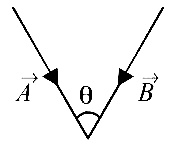
If the angle between the vectors and is , the value of the product is equal to
(A)
BA2sin
(B)
BA2cos
(C)
BA2sincos
(D)
zero.
(D)

Solution

AIPMT 2005 Physics - Motion in a Plane Question 25 English Explanation
Let
The cross product of and is perpendicular to the plane containing and
i.e. perpendicular to

If a dot product of this cross product and is taken, as
the cross product is perpendicular to , = 0

Therefore product of
Q.6
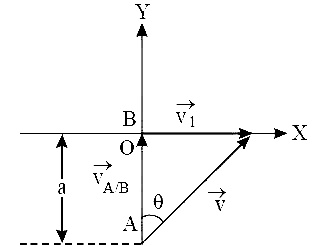
Two boys are standing at the ends A and B of a ground where AB = a. The boy at B starts running in a direction perpendicular to AB with velocity v1. The boy at A starts running simultaneously with velocity v and catches the other in a time t, where t is
(A)
(B)
(C)
(D)
(D)

Solution

AIPMT 2005 Physics - Motion in a Plane Question 27 English Explanation
Velocity of A relative to B is given by
    ...(i)

By taking x-components of equation (i), we get
    ...(ii)

By taking Y-components of equation (i), we get
    ...(iii)

Time taken by boy at A to catch the boy at B is given by

t =

=
[From equation (i)]

=

=
Q.7
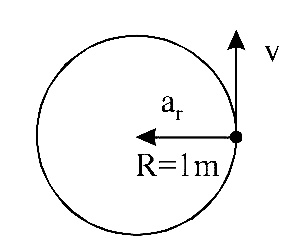
A stone tied to the end of a string of 1 m long is whirled in a horizontal circle with a constant speed. If the stone makes 22 revoluations in 44 seconds, what is the magnitude and direction of acceleration of the stone ?
(A)
m s2 and direction along the radius towards the centre
(B)
m s2 and direction along the radius away from the centre
(C)
m s2 and direction along the tangent to the circle
(D)
/4 ms2 and direction along the radius towards the centre.
(A, B)

Solution

&

or, ar= (2n)2R = 4n2R2
=
AIPMT 2005 Physics - Motion in a Plane Question 26 English Explanation
anet = ar = ms–2 and direction along the radius towards the centre.
Q.8
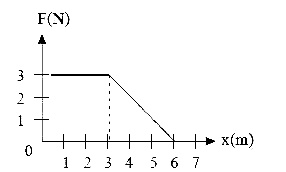
A force F acting

AIPMT 2005 Physics - Work, Energy and Power Question 26 English
on an object varies with distance x as shown here. The force is in N and x in m. The work done by the force in moving the object from x = 0 to x = 6 m is
(A)
18.0 J
(B)
13.5 J
(C)
9.0 J
(D)
4.5 J
(B)

Solution

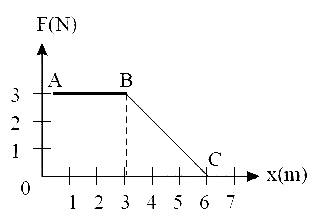
AIPMT 2005 Physics - Work, Energy and Power Question 26 English Explanation
Work done = area under F-x graph

= area of trapezium OABC

=
Q.9
A bomb of mass 30 kg at rest explodes into two pieces of masses 18 kg and 12 kg. The velocity of 18 kg mass is 6 m s1. The kinetic energy of the other mass is :
(A)
324 J
(B)
486 J
(C)
256 J
(D)
524 J
(B)

Solution

As per law of conservation of linear momentum

m1v1 + m2v2 = 0


Now, kinetic energy of second piece


K.E = 486 J
Q.10
Two bodies have their moments of inertia I and 2I respectively about their axis of rotation. If their kinetic energies of rotation are equal, their angular velocity will be in the ratio
(A)
2 : 1
(B)
1 : 2
(C)
(D)
(C)

Solution


Q.11
A drum of radius R and mass M, rolls down without slipping along an inclined plane of angle . The frictional force
(A)
dissipates energy as heat
(B)
decreases the rotational motion
(C)
decreases the rotational and translation motion
(D)
converts translational energy to rotational energy.
(D)

Solution

It is noted that net work done by frictional force when drum rolls down without slipping is zero, so Wnet = 0

Wtrans + Wrotational = 0

ΔKtrans + ΔKrotational = 0

ΔKtrans = – ΔKrotational

Hence, frictional force converts translational energy to rotational energy.
Q.12
The moment of inertia of a uniform circular disc of radius R and mass M about an axis passing from the edge of the disc and normal to the disc is
(A)
MR2
(B)
MR2
(C)
MR2
(D)
MR2
(C)

Solution

Moment of Inertia of uniform circular disc with radius ‘R’ and mass ‘M’ about axis passing through C.M. and normal to disc will be :

ICM = (1/2) MR2

Moment of Inertia about axis tangential to disc :

IT = ICM + MR2

IT = (1/2) MR2 + MR2

= (3/2) MR2
Q.13
For a satellite moving in an orbit around the earth, the ratio of kinetic energy to potential energy is
(A)
1/2
(B)
1/
(C)
2
(D)
(A)

Solution

K.E. of satellite moving in an orbit around the earth is


P.E. of satellite and earth system is


Q.14
Imagine a new planet having the same density as that of earth but it is 3 times bigger than the earth in size. If the acceleration due to gravity on the surface of earth is g and that on the surface of the new planet is g', then
(A)
g' = g/9
(B)
g' = 27g
(C)
g' = 9g
(D)
g' = 3g
(D)

Solution

We know that


g' = 3g
Q.15
Which of the following rods, (given radius r and length ) each made of the same material and whose ends are maintained at the same temperature will conduct most heat ?
(A)
r = r0, = 0
(B)
r = 2r0, = 0
(C)
r = r0, = 20
(D)
r = 2r0, = 20
(B)

Solution

Heat conducted


The rod with the maximum ratio of A/ will conduct most. Here the rod with r = 2r0 and will conduct most.
Q.16
Which of the following processes is reversible?
(A)
Transfer of heat by conduction
(B)
Transfer of heat by radiation
(C)
Isothermal compression
(D)
Electrical heating of a nichrome wire.
(C)

Solution

For a process to be reversible, it must be quasi-static. For quasi static process, all changes take place infinitely slowly. Isothermal process occur very slowly so it is quasi-static and hence it is reversible.
Q.17
An ideal gas heat engine operates in Carnot cycle between 227oC and 127oC. It absorbs 6 104 cal of heat at higher temperature. Amount of heat converted to work is
(A)
4.8 104 cal
(B)
6 104 cal
(C)
2.4 104 cal
(D)
1.2 104 cal.
(D)

Solution


Net heat converted into work

Q.18
The circular motion of a particle with constant speed is
(A)
periodic but not simple harmonic
(B)
simple harmonic but not periodic
(C)
period and simple harmonic
(D)
neither periodic not simple harmonic.
(A)

Solution

In circular motion of a particle with constant speed, particle repeats its motion after a regular interval of time but does not oscillate about a fixed point. So, motion of particle is periodic but not simple harmonic.
Q.19
A point source emits sound equally in all directions in a non-absorbing medium. Two points P and Q are at distances of 2 m and 3 m respectively from the source. The ratio of the intensities of the waves at P and Q is
(A)
3 : 2
(B)
2 : 3
(C)
9 : 4
(D)
4 : 9
(C)

Solution

d1 = 2 m, d2 = 3 m


and

Q.20
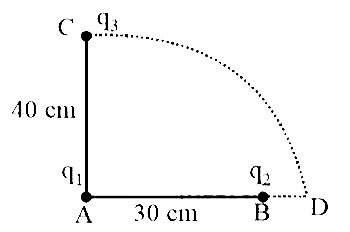
Two charges q1 and q2 are placed 30 cm apart, as shown in the figure. A third charge q3 is moved along the arc of a circle of radius 40 cm from C to D.

The change in the potential energy of the system is where k is

AIPMT 2005 Physics - Electrostatics Question 42 English
(A)
8q1
(B)
6q1
(C)
8q2
(D)
6q2
(C)

Solution

We know that potential energy of discrete system of charges is given by


According to question,


Q.21
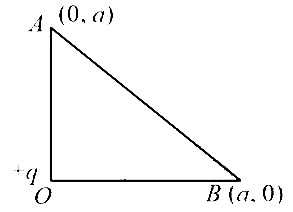
As per the diagram a point charge +q is placed at the origin O. Work done in taking another point charge Q from the point A [coordinates (0, )] to another point B

AIPMT 2005 Physics - Electrostatics Question 43 English
(A)
zero
(B)
(C)
(D)
(A)

Solution

Work done is equal to zero because the
potential of A and B are the same =

AIPMT 2005 Physics - Electrostatics Question 43 English Explanation
No work is done if a particle does not change its potential energy.
i.e. initial potential energy = final potential energy.
Q.22
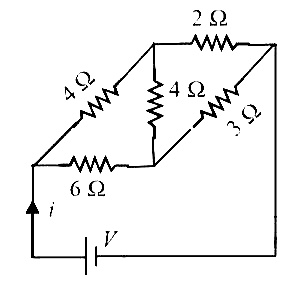
For the network shown in the figure the value of the current is

AIPMT 2005 Physics - Current Electricity Question 68 English
(A)
(B)
(C)
(D)
(D)

Solution

It is a balanced Wheatstone bridge. Hence resistance 4 can be eliminated.


Q.23
A 5-ampere fuse wire can withstand a maximum power of 1 watt in the circuit. The resistance of the fuse wire is
(A)
0.04 ohm
(B)
0.2 ohm
(C)
5 ohm
(D)
0.4 ohm
(A)

Solution

P = i2R or 1 = 25 × R

Q.24
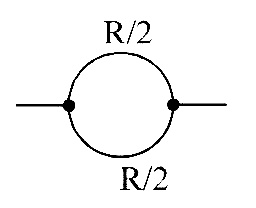
When a wire of uniform cross-section length and resistance R is bent into a complete circle. resistance between any two of diametrically opposite points will be
(A)
R/4
(B)
4R
(C)
R/8
(D)
R/2
(A)

Solution

AIPMT 2005 Physics - Current Electricity Question 69 English Explanation


Q.25
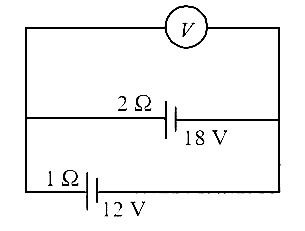
Two batteries, one of emf 18 volts and internal resistance 2 and the other of emf 12 volts and internal resistance 1 , are connected as shown. The voltmeter V will record a reading of

AIPMT 2005 Physics - Current Electricity Question 70 English
(A)
30 volt
(B)
18 volt
(C)
15 volt
(D)
14 volt
(D)

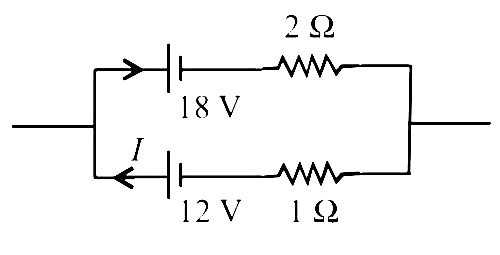
Solution

AIPMT 2005 Physics - Current Electricity Question 70 English Explanation
From Kirchhoff’s law, I × 2 + I × 1 = 18 – 12

Current in the circuit,


Voltage drop across ,

V1 = 2 × 2 = 4 V

Voltmeter reading = 18 – 4 = 14 V.
Q.26
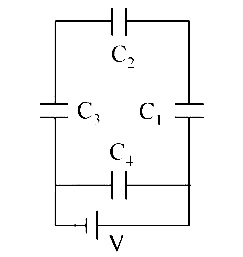
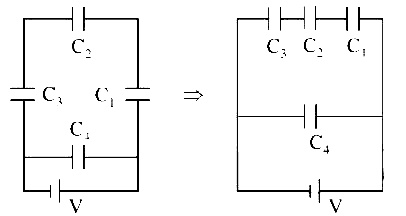
A network of four capacitors of capacity equal to C1 = C, C2 = 2C, C3 = 3C and C4 = 4C are connected to a battery as shown in the figure. The ratio of the charges on C2 and C4 is

AIPMT 2005 Physics - Capacitor Question 25 English
(A)
4/7
(B)
3/22
(C)
7/4
(D)
22/3
(B)

Solution

AIPMT 2005 Physics - Capacitor Question 25 English Explanation
Equivalent capacitance for three capacitors (C1, C2 & C3) in series is given by


Charge on capacitors (C1, C2 & C3) in series


Charge on capacitor

Q.27
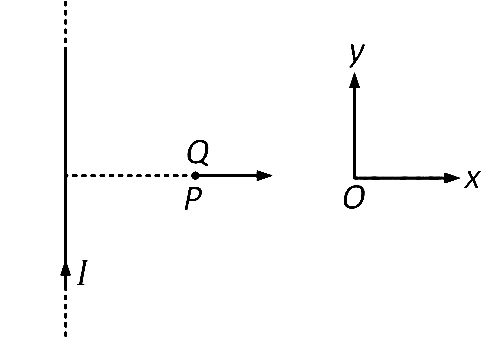
A very long straight wire carries a current . At the instant when a charge +Q at point P has velocity , as shown, the force on the charge is

AIPMT 2005 Physics - Moving Charges and Magnetism Question 40 English
(A)
along Oy
(B)
opposite to Oy
(C)
along Ox
(D)
opposite to Ox
(A)

Solution

The direction of is due to i is acting inwards i.e. into the paper along .

The magnetic force


So, is along Oy direction.
Q.28
An electron moves in a circular orbit with a uniform speed v. It producess a magnetic field B at the centre of the circle. The radius of the circle is proportional to
(A)
(B)
(C)
(D)
(C)

Solution

The magnetic field produce by moving electron in circular path

B =

and i =

B =

r
Q.29
If the magnetic dipole moment of an atom of diamagnetic material, paramagnetic material and ferromagnetic material are denoted by d, p and f respectively, then
(A)
and p 0
(B)
d 0 and p = 0
(C)
p = 0 and f 0
(D)
d 0 and f 0.
(A)

Solution

The magnetic dipole moment of diamagnetic material is zero as each of its pair of electrons have opposite spins, i.e., d = 0.

Paramagnetic substances have dipole moment 0, i.e. p 0, because of excess of electrons in its molecules spinning in the same direction.

Ferro-magnetic substances are very strong magnets and they also have permanent magnetic moment, i.e. f 0.
Q.30
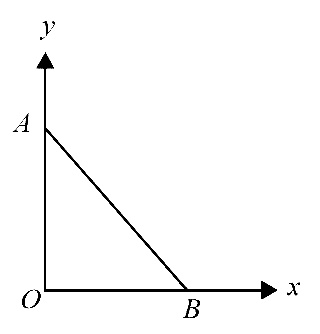
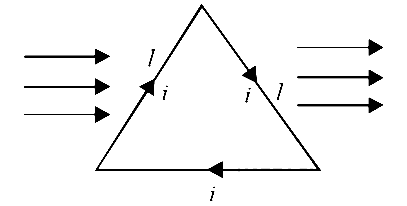
A coil in the shape of an equilateral triangle of side is suspended between the pole pieces of a permanent magnet such that is in plane of the coil. If due to a current i in the triangle a torque acts on it, the side of the triangle is
(A)
(B)
(C)
(D)
(B)

Solution

AIPMT 2005 Physics - Magnetism and Matter Question 23 English Explanation

The current flowing clockwise in the equilateral triangle has a magnetic field in the direction .

= BiNAsin = BiAsin90°

A =

Area of equilateral triangle

A = =


Q.31
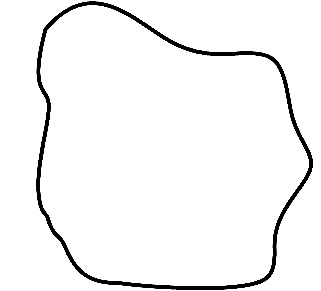
As a result of change in the magnetic flux linked to the closed loop as shown in the figure, an e.m.f. volt is induced in the loop. The work done (joule) in taking a charge Q coulomb once along the loop is

AIPMT 2005 Physics - Electromagnetic Induction Question 16 English
(A)
QV
(B)
2QV
(C)
QV/2
(D)
zero
(A)

Solution

Work done due to a charge W = QV
Q.32
In a circuit L, C and R are connected in series with an alternating voltage source of frquency The current leads the voltage by 45o. The value of C is
(A)
(B)
(C)
(D)
(D)

Solution

tan =


R =

R + 2fL =

C =
Q.33
If v, x and m represent the wavelengths of visible light, X-rays and microwaves respectively, then
(A)
(B)
(C)
(D)
(B)

Solution


In spectrum X-rays has minimum wavelength and microwave has maximum wavelength.
Q.34
The angular resolution of a 10 cm diameter telescope at a wavelength of 5000 is of the order of
(A)
106 rad
(B)
102 rad
(C)
104 rad
(D)
106 rad.
(C)

Solution

The angular resolution,

=

=

= 6.1 10-4

Order = 10-4
Q.35
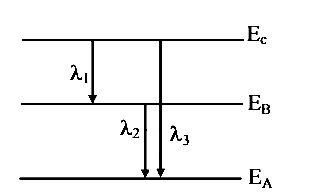
Energy levels A, B and C of a certain atom corresponding to increasing values of energy i.e. EA < EB < EC. If 1, 2 and 3 are wavelengths of radioations corresponding to transitions C to B, B to A and C to A respectively, which of the following relations is correct?
(A)
(B)
(C)
(D)
(B)

Solution

AIPMT 2005 Physics - Atoms and Nuclei Question 68 English Explanation

(EC – EB) + (EB – EA) = (EC – EA)


Q.36
Fission of nuclei is possible because the binding energy per nucleon in them
(A)
increases with mass number at low mass numbers
(B)
decreases with mass number at low mass numbers
(C)
increases with mass number at high mass numbers
(D)
decreases with mass number at high mass numbers.
(D)

Solution

For nuclei having A 56 binding energy per nucleon gradually decreases.
Q.37
In any fission process the ratio
mass of fission products
mass of parent nucleus
is
(A)
equal to 1
(B)
greater than 1
(C)
less than 1
(D)
depends on the mass of the parent nucleus.
(C)

Solution

Binding energy per nucleon for fission products is higher relative to Binding energy per nucleon for parent nucleus, i.e., more masses are lost and are obtained as kinetic energy of fission products. So, the given ratio 1.
Q.38
Which one of the following pairs of nuclei are isotones ?
(A)
34Se74,  31Ga71
(B)
38Sr84,  38Sr86
(C)
42Mo92,   40Zr92
(D)
20Ca40,  16S32
(A)

Solution

Isotones means number of neutron remains same.
Q.39
The total energy of an electron in the first excited state of hydrogen atom is about 3.4 eV. Its kinetic energy in this state is
(A)
3.4 eV
(B)
6.8 eV
(C)
3.4 eV
(D)
6.8 eV
(A)

Solution

Apply Bohr's Atomic model for H-atom

K.E = -T.E = +3.4 eV
Q.40
In the reaction H + H He + n, if the binding
energies of H, H and He are respectively a, b and c (in MeV),
then the energy (in MeV) released in this reaction is
(A)
a + b + c
(B)
a + b c
(C)
c a b
(D)
c + a b
(C)

Solution

Energy released in given reaction

= BE of products – BE of reactants = c – (a+ b) = c – a – b
Q.41
A photosensitive metallic surface has work function, h0. If photons of energy fall on this surface, the electrons come out with a maximum velocity of 4 106 m/s. When the photon energy is increased to 5 h0, then maximum velocity of photoelectrons will be
(A)
2 107 m/s
(B)
2 106 m/s
(C)
8 106 m/s
(D)
8 105 m/s
(C)

Solution

2h = h +

5h = h +

=

v = 8 106 m/s
Q.42
The work functions for metals A, B and C are respectively 1.92 eV, 2.0 eV and 5 eV. According to Einstein's equation the metals which will emit photoelectrons for a radiation of wavelength 4100 is/are
(A)
A only
(B)
A and B only
(C)
all the three metals
(D)
none
(B)

Solution

Energy of photon = = 3 eV

A and B will emit photoelectrons.
Q.43
In a p-n junction photo cell, the value of the photo-electromotive force profuced by monochromatic light is proportional to
(A)
The barrier voltage at the p-n junction.
(B)
The intensity of the light falling on the cell.
(C)
The frequency of the light falling on the cell.
(D)
The voltage applied at the p-n junction.
(B)

Solution

Electromotive force depends on intensity of light that falls on it and does not depend on the frequency.
Q.44
Copper has face centered cubic (fcc) lattice with interatomic spacing equal to 2.54 . The value of lattice constant for this lattice is
(A)
2.54
(B)
3.59
(C)
1.27
(D)
5.08
(B)

Solution

Lattice constant for (f.c.c.)

= a = interatomic spacing = 3.59
Q.45
Carbon, silicon and germanium atoms have four valence electrons each. Their valence and conduction bands are separated by energy band gaps represented by (Eg)C, (Eg)si and (Eg)Ge respectively. Which one of the following relationships is true in their case?
(A)
(Eg)C > (Eg)Si
(B)
(Eg)C < (Eg)Si
(C)
(Eg)C = (Eg)Si
(D)
(Eg)C < (Eg)Ge.
(A)

Solution

Band gap of carbon is 5.5 eV while that of silicon is 1.1 eV

(Eg)C (Eg)Si
Q.46
Zener diode is used for
(A)
amplification
(B)
rectification
(C)
stabilisation
(D)
producing oscillations in an oscillator.
(C)

Solution

Zener diode is used for stabilisation while p-n junction diode is used for rectification.
Q.47
Application of a forward bias to a p-n junction
(A)
widens the depletion zone
(B)
increases the potential difference across the depletion zone
(C)
increases the number of donors on the n side
(D)
decreases the electric field in the depletion zone.
(D)

Solution

Number of donors is more because electrons from –ve terminal of the cell pushes (enters) the n side and decreases the number of uncompensated pentavalent ion due to which potential barrier is reduced. The neutralised pentavalent atom are again in position to donate electrons.
Q.48
Choose the only false statement from the following.
(A)
In conductors the valence and conduction bands overlap.
(B)
Substances with energy gap of the order of 10 eV are insulators.
(C)
The resistivity of a semiconductor increases with increase in temperature.
(D)
The conductivity of a semiconductor increases with increase in temperature.
(C)

Solution

Option (a) is correct as in conductor conduction and valance band overlap and the conduction band is partially filled

Option (b) is correct as insulators have energy gap of 5 - 10 eV.

Option (c) is incorrect as resistivity decreases with increase in temperature.

Option (d) is correct as with increase in temperature, more and more electrons jump to conduction band, hence conductivity increases.
Chemistry (Maximum Marks: 196)
  • This section contains 49 questions.
  • Each question has FOUR options (A), (B), (C) and (D). ONLY ONE of these four options is the correct answer.
  • Full Marks : +4 If ONLY the correct option is chosen;
  • Zero Marks : 0 If none of the options is chosen (i.e. the question is unanswered);
  • Negative Marks : −1 In all other cases.
Q.1
The mole fraction of the solute in one molal aqueous solution is
(A)
0.009
(B)
0.018
(C)
0.027
(D)
0.036
(B)

Solution

One molal solution means one mole solute present in 1 kg (1000 g) solvent.

mole of solute = 1

Mole of solvent (H2O) =

Xsolute = = 0.018
Q.2
The energy of second Bohr orbit of the hydrogen atom is 328 kJ mol1; hence the energy of fourth Bohr orbit would be
(A)
41 kJ mol1
(B)
82 kJ mol1
(C)
164 kJ mol1
(D)
1312 kJ mol1
(B)

Solution

En = -K

Z = 1; n = 2

E2 = E2 = -328 kJ mol-1;

K = 4 328

E4 = E4 = -4 328

= -82 kJ mol-1
Q.3
Equilibrium constants K1 and K2 for the following equilibriam:

AIPMT 2005 Chemistry - Chemical Equilibrium Question 17 English
are related as
(A)
K2 = 1/K12
(B)
K2 = K12
(C)
K2 = 1/K1
(D)
K2 = K1/2
(A)

Solution

NO(g) + O2(g) ⇌ NO2(g) ,    K1

Reverse the above equation

NO2(g) ⇌ NO(g) + O2(g),    

Multiply the above equation by 2, we get

NO2(g) ⇌ NO(g) + O2(g),   
Q.4
At 25oC, the dissociation constant of a base, BOH, is 1.0 1012. The concentration of hydroxyl ions in 0.01 M aqueous solution of the base would be
(A)
1.0 105 mol L1
(B)
1.0 106 mol L1
(C)
2.0 106 mol L1
(D)
1.0 107 mol L1
(D)

Solution

BOH B+ + OH-
Initially C 0 0
At equilibbrium C - C C C


[OH-] = C

[OH-] =

[OH-] =

= 1.0 107 mol L1
Q.5
H2S gas when passed through a solution of cations containing HCl precipitates the cations of second group of qualitative analysis but not those belonging to the fourth group. It is because
(A)
presence of HCl decreases the sulphide ion concentration
(B)
solubility product of group II sulphides is more than that of group IV sulphates
(C)
presence of HCl increases the sulphide ion concentration
(D)
sulphides of group IV cations are unstable in HCl.
(A)

Solution

H2S ⇌ H+ + HS

HCl ⇌ H+ + Cl

In presence of HCl this ionization of H2S is suppressed due to the presence of extra H+ ions from HCl and produces less amount of sulphide ions due to common ion effect, thus HCl decreases the solubility of H2S which is sufficient to precipitate IInd group radicals.

Q.6
A solution of urea (mol. mass 56 g mol1) boils at 100.18oC at the atmospheric pressure. If Kf and Kb for water are 1.86 and 0.512 K kg mol1 respectively, the above solution will freeze at
(A)
0.654oC
(B)
0.654oC
(C)
6.54oC
(D)
6.54oC
(B)

Solution

Tf = Kfm ......(1)

Tb = Kbm ......(2)

.....(3)

Tb = T2 – T1 = 100.18 – 100 = 0.18

kf for water = 1.86 K kg mol–1

kb for water = 0.512 K kg mol–1


= 0.654

Tb = T2 – T1

0.654 = 0 – T2

T2 = 0.654oC
Q.7
A solution has a 1 : 4 mole ratio of pentane to hexane. The vapour pressures of the pure hydrocarbons at 20oC are 440 mm Hg for pentane and 120 mm Hg for hexane. The mole fraction of pentane in the vapour phase would be
(A)
0.200
(B)
0.549
(C)
0.786
(D)
0.478
(D)

Solution

As the ratio of pentane to hexane = 1 : 4

Mole fraction of pentane = 1/5

Mole fraction of hexane = 4/5

Total vapour pressure

=

= 184 mm of Hg

Vapour pressure of pentane in mixture

= (Vapour pressure of mixture pentane Mole fraction of in vapour phase)

88 = 184 × mole fraction of pentane in vapour phase

Mole fraction of pentane in vapour phase

= = 0.478
Q.8
The vapour pressure of two liquids P and Q are 80 and 60 torr, respectively. The total vapour pressure of solution obtained by mixing 3 mole of P and 2 mole of Q would be
(A)
72 torr
(B)
140 torr
(C)
68 torr
(D)
20 torr
(A)

Solution

Hence total vapour pressure

= [(Mole fraction of P) × (Vapour pressure of P)] + [(Mole fraction of Q) × Vapour pressure of Q)]

=

= 48 + 24 = 72 torr
Q.9
A reaction occurs spontaneously if
(A)
TS < H and both H and S are +ve
(B)
TS > H and H is +ve and S are ve
(C)
TS > H and both H and S are +ve
(D)
TS = H and both H and S are +ve
(C)

Solution

G = H – TS

For spontaneous reaction, G has to be negative.

Among the given options, it is positive only when TS > H and both H and S are +ve .
Q.10
Which of the following pairs of a chemical reaction is certain to result in a spontaneous reaction ?
(A)
Exothermic and increasing disorder
(B)
Exothermic and decreasing disorder
(C)
Endothermic and increasing disorder
(D)
Endothermic and decreasing disorder
(A)

Solution

G = H – TS

For a reaction to become spontaneous, G must be negative.

For case (a) exothermic and increasing disorder

For exothermic reaction,

H = –ve and increasing disorder,

S = +ve

G = –ve –T(+ve)

Thus, G is negative for all temperature range

For case (b) exothermic and decreasing disorder For exothermic reaction, H = –ve and for decreasing disorder,

S = –ve

G = –ve – T(–ve)

Thus, G is not negative for all temperature range.

For case (c) endothermic and increasing disorder. For endothermic reaction, H = +ve and increasing disorder,

S = +ve

Thus, G is not negative for all temperature range.

For case (d) endothermic and decreasing disorder

For endothermic reaction,

H = +ve and decreasing disorder,

S = –ve

G = +ve – T (–ve)

Thus, G is positive for all temperature range.
Q.11
The absolute enthalpy of neutralisation of the reaction :

Mg(O)(s) + 2HCl(aq) MgCl2(aq) + H2O(l) will be
(A)
57.33 kJ mol1
(B)
greater than 57.33 kJ mol1
(C)
less than 57.33 kJ mol1
(D)
57.33 kJ mol1
(C)

Solution

We know that enthalpy of neutralization of a strong acid and a strong base is –57.33 kJ mol–1.

Here, MgO is the weak base and HCl is a strong acid thus, a small amount of energy is used in the ionization of MgO thus, the heat of neutralization decreases. Therefore, enthalpy of neutralization is less than – 57.33 kJ mol–1
Q.12
The mass of carbon anode consumed (giving only carbon dioxide) in the production of 270 kg of aluminium metal from bauxite by the Hall process is
(Atomic mass : Al = 27)
(A)
270 kg
(B)
540 kg.
(C)
90 kg
(D)
180 kg
(C)

Solution

2Al2O3 + 3C 4Al + 3CO2

From the above equation,

3 mol × 12 g mol–1 = 36 g of carbon is consumed

to give 4 mol × 27 g mol–1 = 108 g of Al

So, 108 g of Al is produced by 36 g of carbon

270000 g of Al is produced by

= of C

= 90000 g of C

= 90 kg of C
Q.13
4.5 g of aluminium (at. mass 27 amu) is deposited at cathode from Al3+ solution by a certain quantity of electric charge. The volume of hydrogen produced at STP from H ions in solution by the same quantity of electric charge will be
(A)
44.8 L
(B)
22.4 L
(C)
11.2 L
(D)
5.6 L
(D)

Solution

Faraday second law of electrolysis


MH = 0.5 g

We know, Volume of 2 g H2 at STP = 22.4 L

Volume of 0.5 g H2 at STP

= = 5.6 L
Q.14
The rate of reaction between two reactions A and B decreases by a factor of 4 if the concentration of reactant B is doubled. The order of this reaction with respect to reactant B is
(A)
2
(B)
2
(C)
1
(D)
1
(B)

Solution

A + B Product

Rate [A]x [B]y .......(1)

The rate of the reaction decreases by a factor of 4 if the concentration of reactant B is doubled.

[A]x [2B]y ......(2)

From equation (1) and (2), we get


y = -2

Order of this reaction with respect to reactant B is -2.
Q.15
For a first order reaction A B the reaction rate a reactant concentration of 0.01 M is found to be 2.0 105 mol L1 s1. The half-life period of the reaction is
(A)
30 s
(B)
220 s
(C)
300 s
(D)
347 s
(D)

Solution

Given [A] = 0.01 M

Rate = 2.0 × 10⁻⁵ mol L–1 S–1

For a first order reaction

Rate = k[A]

k =

Q.16
A nuclide of an alkaline earth metal undergoes radioactive decay by emission of the periodic table to which the resulting daughter element would belong is
(A)
Gr.13
(B)
Gr. 17
(C)
Gr. 14
(D)
Gr. 16
(C)

Solution

When IIA group element (Ra) emits one -particle its group no. decreases by two unit. i.e., go into zero group (Gr. 16) But as it is radioactive thus due to successive emission last product is Pb i.e., (Gr.14).
Q.17
In a face-centered cubic lattice, a unit cell is shared equally by how many unit cells?
(A)
2
(B)
4
(C)
6
(D)
8
(C)

Solution

In given unit cell it is shared equally by six faces of different unit cells.
Q.18
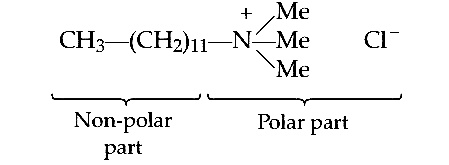
Which one of the following forms micelles in aqueous solution above certain concentration?
(A)
Dodecyl trimethyl ammonium chloride
(B)
Glucose
(C)
Urea
(D)
Pyridinium chloride
(A)

Solution

Dodecyl trimethyl ammonium chloride is a cationic surfactant and forms micelles in aqueous solution above critical micelle concentration (CMC).

AIPMT 2005 Chemistry - Surface Chemistry Question 15 English Explanation
Q.19
Which one of the following arrangements represents the correct order of electron gain enthalpy (with negative sign) of the given atomic species ?
(A)
S < O < Cl < F
(B)
Cl < F < S < O
(C)
F < Cl < O < S
(D)
O < S < F < Cl
(D)

Solution

The molar enthalpy change accompanying the addition of an electron to an atom (or ion) is known as electron gain enthalpy.
Generally in increases on moving from left to right in a period and in a group it decreases as the size increases.
Exception: Because of the small size of F, electron-electron repulsion present in its relatively compact 2p-subshell, do not easily allow the addition of an extra electron. On the other hand, Cl because of its comparatively bigger size than F, allows the addition of an extra electron more easily.
Q.20
The correct sequence of increasing covalent character is represented by
(A)
LiCl < NaCl < BeCl2
(B)
BeCl2 < LiCl < NaCl
(C)
NaCl < LiCl < BeCl2
(D)
BeCl2 < NaCl < LiCl
(C)

Solution

As difference of electronegativity increases % iconic charecter increases and covalent charecter decreases i.e, electronegativity difference decreases covalent charecter increases. Further greater the charge on the cation more will be its covalent character. Be has maximum (+2) charge.
Q.21
The surface tension of which of the following liquid is maximum ?
(A)
C2H5OH
(B)
CH3OH
(C)
H2O
(D)
C6H6
(C)

Solution

Hydrogen bonding in H2O > C2H5OH > CH3OH

Hence, H2O has maximum surface tension.
Q.22
The correct order in which the O O bond length increases in the following is
(A)
O2 < H2O2 < O3
(B)
O3 < H2O2 < O2
(C)
H2O2 < O2 < O3
(D)
O2 < O3 < H2O2
(D)

Solution

Bond lengths of O O in O2 is 1.21 Å, in H2O2 is 1.48 Å and in O3 is 1.28Å. Therefore, correct order of the O O bond length is H2O2 > O3 > O2 or O2 < O3 < H2O2
Q.23
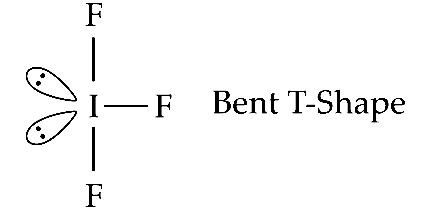
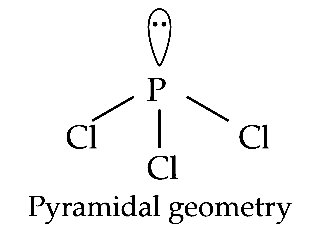
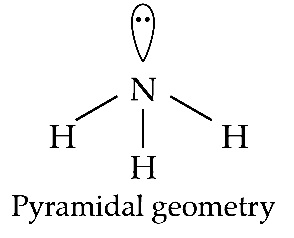
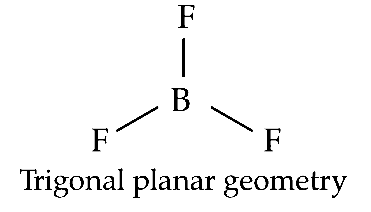
Which of the following molecules has trigonal planar geometry?
(A)
BF3
(B)
NH3
(C)
PCl3
(D)
IF3
(A)

Solution

IF3 has three bond pairs and two lone pairs, thus, it has sp3d hybridization.

AIPMT 2005 Chemistry - Chemical Bonding and Molecular Structure Question 68 English Explanation 1

PCl3 has three bond pairs and one lone pair thus, it has sp3 hybridization.

AIPMT 2005 Chemistry - Chemical Bonding and Molecular Structure Question 68 English Explanation 2

NH3 has three bond pairs and one lone pair thus, it has sp3 hybridisation.
AIPMT 2005 Chemistry - Chemical Bonding and Molecular Structure Question 68 English Explanation 3

BF3 has three bond pairs and no lone pair thus, it has sp2 hybridisation.
AIPMT 2005 Chemistry - Chemical Bonding and Molecular Structure Question 68 English Explanation 4
Q.24
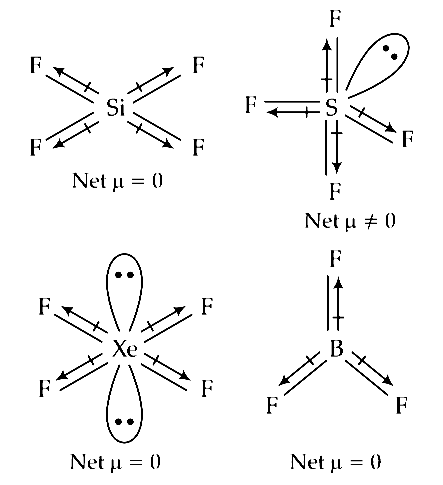
Which of the following would have a permanent dipole moment?
(A)
SiF4
(B)
SF4
(C)
XeF4
(D)
BF3
(B)

Solution

AIPMT 2005 Chemistry - Chemical Bonding and Molecular Structure Question 46 English Explanation
Q.25
Which one of the following orders correctly represents the increasing acid strengths of the given acids?
(A)
HOClO < HOCl < HOClO3 < HOClO2
(B)
HOClO3 < HOClO2 < HOClO < HOCl
(C)
HOClO2 < HOClO3 < HOClO < HOCl
(D)
HOCl < HOClO < HOClO2 < HOClO3
(D)

Solution

AIPMT 2005 Chemistry - p-Block Elements Question 37 English Explanation

As the oxidation number of the central atom increases, strength of acid also increases.
Q.26
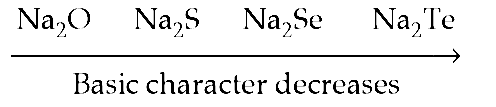
What is the correct relationship between the pH of isomolar solutions of sodium oxide, Na2O (pH1), sodium sulphide, Na2S (pH2), sodium srlenide, Na2Se (pH3) and sodium telluride Na2Te (pH4)?
(A)
pH1 > pH2 > pH3 > pH4
(B)
pH1 > pH2 pH3 > pH4
(C)
pH1 < pH2 < pH3 < pH4
(D)
pH1 < pH2 < pH3 pH4
(A)

Solution

Basic character decreases down the group Thus Na2O is most basic.

AIPMT 2005 Chemistry - p-Block Elements Question 38 English Explanation

We know that more the basic compound more is the pH.

Hence, pH1 > pH2 > pH3 > pH4
Q.27
Which one of the following oxides is expected to exhibit paramagnetic behaviour?
(A)
CO2
(B)
SiO2
(C)
SO2
(D)
ClO2
(D)

Solution

AIPMT 2005 Chemistry - p-Block Elements Question 41 English Explanation
Q.28
Four successive members of the first row transition elements are listed below with their atomic numbers. Which one of them is expected to have the highest third ionisation enthalpy?
(A)
Vanadium (Z = 23)
(B)
Chromium (Z = 24)
(C)
Manganese (Z = 25)
(D)
Iron (Z = 26)
(C)

Solution

For third ionization enthalpy electronic configuration of

V2+ (21) : [Ar]18 3d34s0

Cr2+ (22) : [Ar]18 3d44s0

Mn2+ (23) : [Ar]18 3d54s0

Fe2+ (24) : [Ar]18 3d54s1

Mn has most stable configuration due to half filled d-orbital. Hence 3rd ionization energy will be highest for Mn.
Q.29
The aqueous solution containing which one of the following ions will be colourless?
(Atomic number : Sc = 21, Fe = 26, Ti = 22, Mn = 25)
(A)
Sc3+
(B)
Fe2+
(C)
Ti3+
(D)
Mn2+
(A)

Solution

If the transition metal ion has unpaired electron then it shows colour.

Sc3+ : [Ar]18 3d04s0

Fe2+ : [Ar]18 3d54s1

Ti3+ : [Ar]18 3d14s0

Mn2+ : [Ar]18 3d54s0

Hence, Sc3+ do not contain unpaired electron and hence it will not undergo d – d transition and do not show colour.
Q.30
The number of moles of KMnO4 reduced by one mole of KI in alkaline medium is
(A)
one
(B)
two
(C)
five
(D)
one fifth
(B)

Solution

The chemical reactions involved in this case are as follows :

KI + H2O KOH + HI

2KMnO4 + 2KOH → 2K2MnO4 + H2O + [O]

Thus, for overall reaction, two moles of KMnO4 are reduced by two moles of KOH or KI. Hence, one mole of KI is required to reduce one mole of KMnO4.
Q.31
More number of oxidation states are exhibited by the actinoids than by the lanthanoids. The main reason for this is
(A)
more active nature of the actinoids
(B)
more energy difference between 5f and 6d orbitals than that between 4f and 5d orbitals
(C)
lesser energy difference between 5f and 6d orbitals than that between 4f and 5d orbitals
(D)
greater metallic character of the lanthanoids than that of the corresponding actinoids.
(C)

Solution

The 5f-orbitals extend into space beyond the 6s and 6p-orbitals and participate in bonding. This is in direct contrast to the lanthanides where the 4f-orbitals are buried deep inside in the atom, totally shielded by outer orbitals and thus unable to take part in bonding.
Q.32
Which one of the following is expected to exhibit optical isomerism? (en = ethylenediamine)
(A)
cis-[Pt(NH3)2Cl2]
(B)
trans-[Pt(NH3)2Cl2]
(C)
cis-[Co(en)2Cl2]+
(D)
trans-[Co(en)2Cl2]+
(C)

Solution

cis-[Co(en)2Cl2]+ show optical isomerism because it forms a non-superimposable mirror image. AIPMT 2005 Chemistry - Coordination Compounds Question 60 English Explanation 1
While trans-form contains plain of symmetry thus optically inactive.

AIPMT 2005 Chemistry - Coordination Compounds Question 60 English Explanation 2
Q.33
Which one of the following is an inner orbital complex as well as diamagnetic in behaviour?
(A)
[Zn(NH3)6]2+
(B)
[Cr(NH3)6]3+
(C)
[Co(NH3)6]3+
(D)
[Ni(NH3)6]2+
(C)

Solution

In [Co(NH3)6]3+

Co+3 = [18Ar] 3d64s0 AIPMT 2005 Chemistry - Coordination Compounds Question 61 English Explanation

[Co(NH3)6]3+ is an inner orbital complex as well as diamagnetic in behaviour (due to absence of unpaired electrons).
Q.34
The best method for the separation of naphthalene and benzoic acid from their mixture is
(A)
distillation
(B)
sublimation
(C)
chromatography
(D)
crystallisation.
(B)

Solution

Sublimation would be the best method because it is applicable for those organic compounds which pass directly from solid to vapour state on heating and vice versa on cooling. In these compounds naphthalene is volatile and benzoic acid is nonvolatile due to the formation of dimer via intermolecular hydrogen bonding.
Q.35
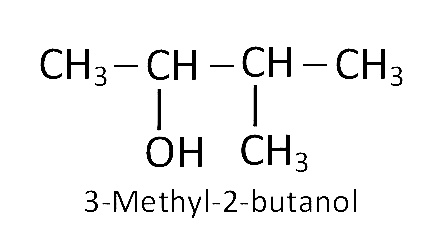
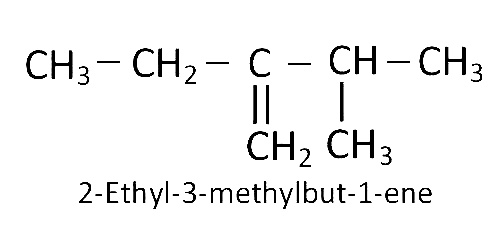
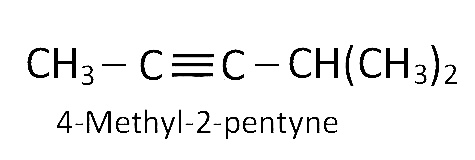
Names of some compounds are given. Which one is not in IUPAC system?
(A)
AIPMT 2005 Chemistry - Some Basic Concepts of Organic Chemistry Question 66 English Option 1
(B)
AIPMT 2005 Chemistry - Some Basic Concepts of Organic Chemistry Question 66 English Option 2
(C)
AIPMT 2005 Chemistry - Some Basic Concepts of Organic Chemistry Question 66 English Option 3
(D)
AIPMT 2005 Chemistry - Some Basic Concepts of Organic Chemistry Question 66 English Option 4
(A)

Solution

AIPMT 2005 Chemistry - Some Basic Concepts of Organic Chemistry Question 66 English Explanation
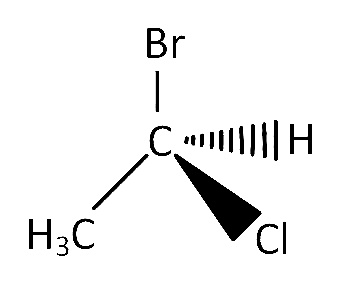
Q.36
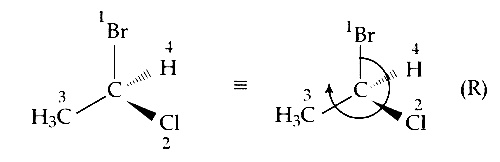
The chirality of the compound
AIPMT 2005 Chemistry - Some Basic Concepts of Organic Chemistry Question 65 English
(A)
R
(B)
S
(C)
E
(D)
Z
(A)

Solution

AIPMT 2005 Chemistry - Some Basic Concepts of Organic Chemistry Question 65 English Explanation
Q.37
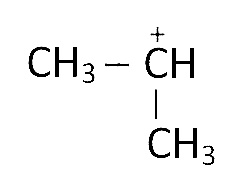
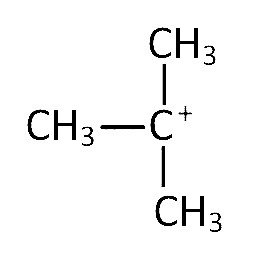
Which amongst the following is the most stable carbocation?
(A)
H3
(B)
CH3H2
(C)
AIPMT 2005 Chemistry - Some Basic Concepts of Organic Chemistry Question 64 English Option 3
(D)
AIPMT 2005 Chemistry - Some Basic Concepts of Organic Chemistry Question 64 English Option 4
(D)

Solution

3o C is more stable due to the stabilization of the charge by three methyl groups (or inductive effect). It can also be explained on the basis of hyperconjugation.
Q.38
Which one of the following pairs represents stereoisomerism?
(A)
Structural isomerism and gemetrical isomerism
(B)
Optical isomerism and geometrical isomerism
(C)
Chain isomerism and rotational isomerism
(D)
Linkage isomerism and geometrical isomerism.
(B)

Solution

Pair of optical isomerism and geometrical isomerism are able to exhibit the phenomenon of stereoisomerism because both type of isomers differ only in their orientation in space.
Q.39
Products of the following reaction :
AIPMT 2005 Chemistry - Hydrocarbons Question 33 English
(A)
CH3COOH + CO2
(B)
CH3COOH + HOOC.CH2CH3
(C)
CH3CHO + CH3CH2CHO
(D)
CH3COOH + CH3COCH3
(B)

Solution

AIPMT 2005 Chemistry - Hydrocarbons Question 33 English Explanation
Q.40
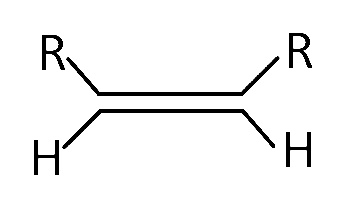
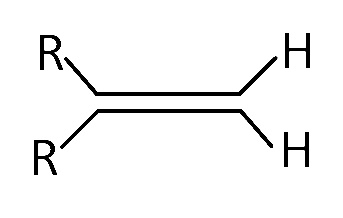
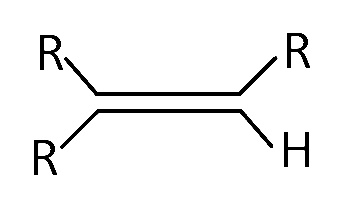
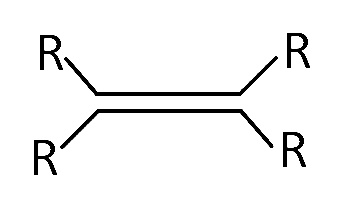
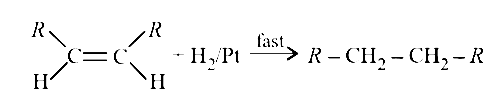
Which one of the following alkenes will react faster with H2 under catalytic hydrogenation conditions ?
(A)
AIPMT 2005 Chemistry - Hydrocarbons Question 34 English Option 1
(B)
AIPMT 2005 Chemistry - Hydrocarbons Question 34 English Option 2
(C)
AIPMT 2005 Chemistry - Hydrocarbons Question 34 English Option 3
(D)
AIPMT 2005 Chemistry - Hydrocarbons Question 34 English Option 4
(A)

Solution

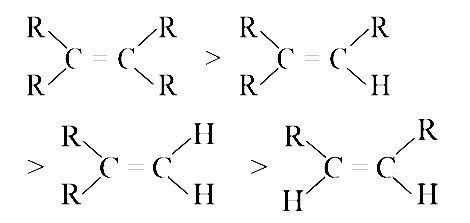
Greater the number of alkyl groups(R) attached to the double bonded carbon atoms more stable is the alkene. Further the relative rates of hydrogenation decrease with increase of steric hindrance.
Thus, the stability of alkene will be
AIPMT 2005 Chemistry - Hydrocarbons Question 34 English Explanation 1

Hence alkene which will react faster with H2 is that which is most unstable. AIPMT 2005 Chemistry - Hydrocarbons Question 34 English Explanation 2
Q.41
Which of the following undergoes nucleophilic substitution exclusively by SN1 mechanism?
(A)
Ethyl chloride
(B)
Isopropyl chloride
(C)
Chlorobenzene
(D)
Benzyl chloride
(D)

Solution

SN1 reaction is favoured by heavy groups on the carbon atom attached to halogen i.e

Benzyl > allyl > tertiary > primary > secondary > primary > alkyl halides
Q.42
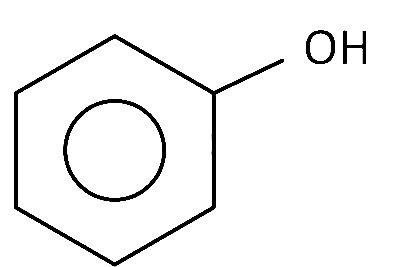
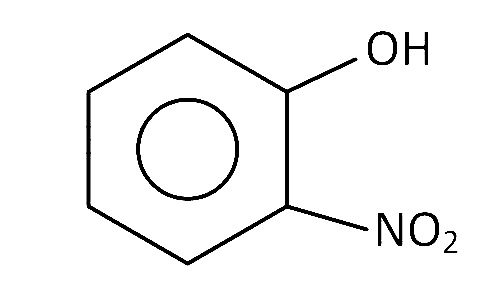
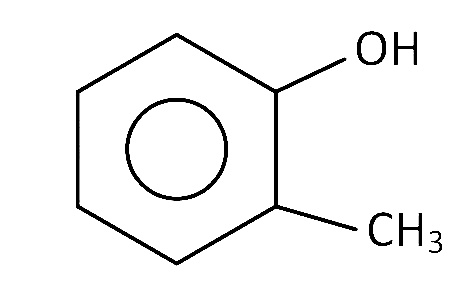
Which one of the following compounds is most acidic?
(A)
Cl CH2 CH2 OH
(B)
AIPMT 2005 Chemistry - Alcohol, Phenols and Ethers Question 35 English Option 2
(C)
AIPMT 2005 Chemistry - Alcohol, Phenols and Ethers Question 35 English Option 3
(D)
AIPMT 2005 Chemistry - Alcohol, Phenols and Ethers Question 35 English Option 4
(C)

Solution

Phenols are more acidic than alcohols as they are resonance stabilised whereas alcohols are not.

Further –NO2 is an electron withdrawing group which increases acidic character and facilitates release of proton, whereas –CH3 is an electron donating group which decreases acidic character, thus removal of H+ becomes difficult.
Q.43
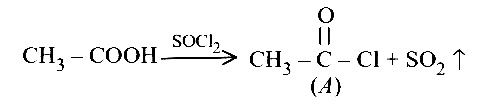
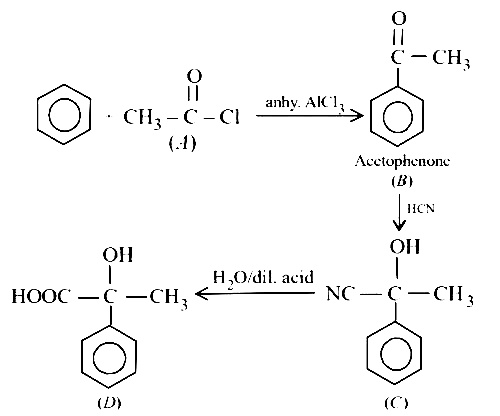
In a set of reactions acetic acid yielded a product D.
AIPMT 2005 Chemistry - Aldehydes, Ketones and Carboxylic Acids Question 52 English
The structure of D would be
(A)
AIPMT 2005 Chemistry - Aldehydes, Ketones and Carboxylic Acids Question 52 English Option 1
(B)
AIPMT 2005 Chemistry - Aldehydes, Ketones and Carboxylic Acids Question 52 English Option 2
(C)
AIPMT 2005 Chemistry - Aldehydes, Ketones and Carboxylic Acids Question 52 English Option 3
(D)
AIPMT 2005 Chemistry - Aldehydes, Ketones and Carboxylic Acids Question 52 English Option 4
(D)

Solution

AIPMT 2005 Chemistry - Aldehydes, Ketones and Carboxylic Acids Question 52 English Explanation 1 AIPMT 2005 Chemistry - Aldehydes, Ketones and Carboxylic Acids Question 52 English Explanation 2
Q.44
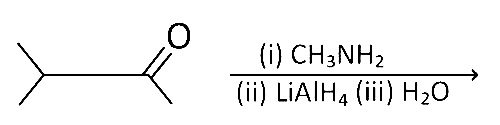
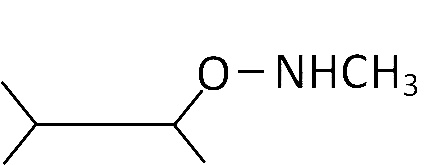
The major organic product formed from the following reaction :

AIPMT 2005 Chemistry - Aldehydes, Ketones and Carboxylic Acids Question 53 English
is
(A)
AIPMT 2005 Chemistry - Aldehydes, Ketones and Carboxylic Acids Question 53 English Option 1
(B)
AIPMT 2005 Chemistry - Aldehydes, Ketones and Carboxylic Acids Question 53 English Option 2
(C)
AIPMT 2005 Chemistry - Aldehydes, Ketones and Carboxylic Acids Question 53 English Option 3
(D)
AIPMT 2005 Chemistry - Aldehydes, Ketones and Carboxylic Acids Question 53 English Option 4
(B)

Solution

AIPMT 2005 Chemistry - Aldehydes, Ketones and Carboxylic Acids Question 53 English Explanation
Q.45
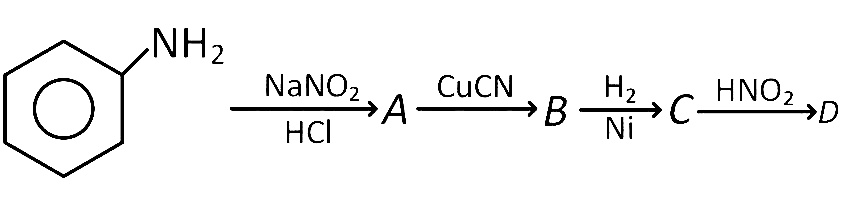
Aniline in a set of reactions yielded a product D.
AIPMT 2005 Chemistry - Organic Compounds Containing Nitrogen Question 28 English
The structure of the product D would be
(A)
C6H5NHOH
(B)
C6H5NHCH2CH3
(C)
C6H5CH2NH2
(D)
C6H5CH2OH
(D)

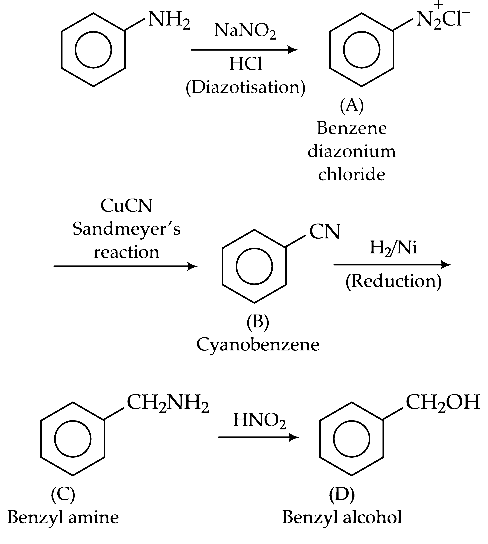
Solution

AIPMT 2005 Chemistry - Organic Compounds Containing Nitrogen Question 28 English Explanation
Q.46
Electrolytic reduction of nitrobenzene in weakly acidic medium gives
(A)
N-phenylhydroxylamine
(B)
nitrosobenzene
(C)
aniline
(D)
p-hydroxyaniline.
(C)

Solution

AIPMT 2005 Chemistry - Organic Compounds Containing Nitrogen Question 35 English Explanation
Q.47
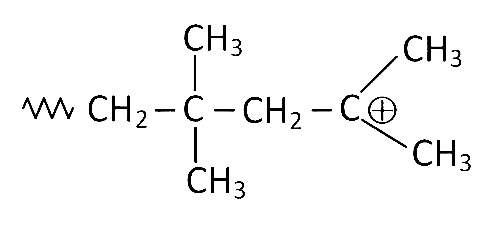
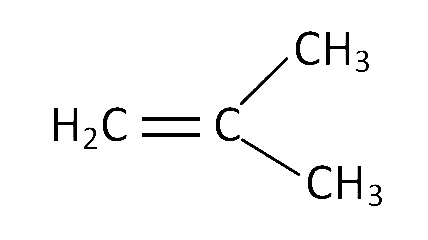
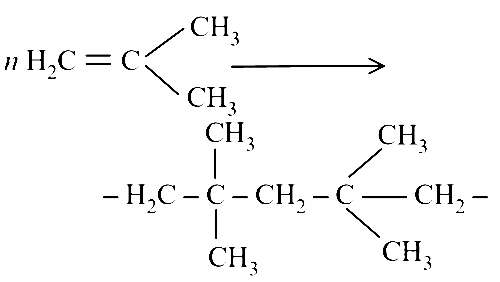
The monomer of the polymer
AIPMT 2005 Chemistry - Polymers Question 17 English
(A)
AIPMT 2005 Chemistry - Polymers Question 17 English Option 1
(B)
CH3CHCHCH3
(C)
CH3CHCH2
(D)
(CH3)2CC(CH3)2
(A)

Solution

AIPMT 2005 Chemistry - Polymers Question 17 English Explanation
Q.48
The cell membranes are mainly composed of
(A)
fats
(B)
proteins
(C)
phospholipids
(D)
carbohydrates
(C)

Solution

Cell membranes (Plasma membranes) constitutes bilayer of phospholipid with embedded proteins. In humans, lipids accounts for upto 79% of cell membrance.
Q.49
Which functional group participates in disulphide bond formation in proteins?
(A)
Thioester
(B)
Thioether
(C)
Thiol
(D)
Thiolactone
(C)

Solution

Disulphide bond may be reduced to thiol by means of reagents i.e., NaBH4 , which shows the presence of thiol group in disulphide bond formation.
Biology (Maximum Marks: 380)
  • This section contains 95 questions.
  • Each question has FOUR options (A), (B), (C) and (D). ONLY ONE of these four options is the correct answer.
  • Full Marks : +4 If ONLY the correct option is chosen;
  • Zero Marks : 0 If none of the options is chosen (i.e. the question is unanswered);
  • Negative Marks : −1 In all other cases.
Q.1
Chlorophyll in chloroplasts is located in
(A)
Stroma
(B)
Grana
(C)
Pyrenoid
(D)
Both (A) and (C)
(B)

Solution

Internally a chloroplast contains a matrix or stroma which is similar to cytoplasm in its constitution. It contains DNA, RNA, ribsomes, enzymes for CO2 assimilation, proteins, starch grains and fat droplets or plastoglobuli.
Q.2
A student wishes to study the cell structure under a light microscope having 10X eyepiece and 45X objective. He should illuminate the object by which one of the following colours of light so as get the best possible resolution ?
(A)
Yellow
(B)
Red
(C)
Blue
(D)
Green
(C)

Solution

Resolution of microscope is inversely proportional to wavelength of light used. Out of four options given, blue light has minimum wavelength and hence maximum resolution.
Q.3
Centromere is required for -
(A)
Crossing over
(B)
Movement of chromosomes towards poles
(C)
Transcription
(D)
Cytoplasmic cleavage
(B)

Solution

During anaphase APC (anaphase promoting complex) develops. It degenerates proteins binding the two chromatids in the region of centromere.

As a result, the centromere of each chromosome divides. This converts the two chromatids into daughter chromosomes.
Q.4
According to widely accepted "fluid mosaic model" cell membranes are semi-fluid, where lipids and integral proteins can diffuse randomly. In recent years, this model has been modified in several respects. In this regard, which of the following statements are incorrect ?
(A)
Proteins in cell membranes can travel within the lipid bilayer
(B)
Proteins can also undergo flip-flop movements in the lipid bilayer
(C)
Proteins can remain confined within certain domains of the membranes
(D)
Many proteins remain completely embedded within the lipid bilayer
(B)

Solution

Flip-Flop movement is due to migration of lipid molecules from one lipid monolayer to other monolayer of lipid bilayer.
Q.5
The main organelle involved in modification and routing of newly synthesized proteins to their destinations is -
(A)
Mitochondria
(B)
Endoplasmic Reticulum
(C)
Chloroplast
(D)
Lysosome
(B)

Solution

Endoplasmic reticulum transport proteins and enzymes to their destinations i.e. within the cell and outside the cell.
Q.6
Chemiosmotic theory of ATP synthesis in the chloroplasts and mitochondria is based on
(A)
Proton gradient
(B)
Membrane potential
(C)
Accumulation of Na+ ions
(D)
Accumulation of K+ ions
(A)

Solution

Chemiosmotic coupling hypothesis is the most widely accepted explanation for oxidative phosphorylation in mitochondria and photophosphorylation in thylakoid membranes. Mitchell proposed the idea of chemiosmotic coupling. He suggested that a concentration gradient of protons is established across the mitochondrial membrane because there is an accumulation of hydrogen ions on one side of the mitochondrial membrane. The proton accumulation is necessary for energy transfer to the endergonic ADP phosphorylation process.
Q.7
Nucleotides are building blocks of nucleic acids. Each nucleotide is a composite molecule formed by
(A)
base-sugar-phosphate
(B)
base-sugar-OH
(C)
(base-sugar-phosphate)
(D)
sugar-phosphate
(A)

Solution

Each nucleotide consists of three distinct units - a phosphate group derived from phosphoric acid, a pentose sugar and a ring shaped nitrogenous base.
Nucleoside + Phosphoric acid Nucleotide + H2O
Q.8
Carbohydrates, the most abundant biomolescule on earth, are produced by
(A)
some bacteria, algae and green plant cells
(B)
fungi, algae and green plant cells
(C)
all bacteria, fungi and algae
(D)
viruses, fungi and bacteria.
(A)

Solution

Some bacteria (such as Rhodopseudomonas), algae and green plants cell produce carbohydrates.
Q.9
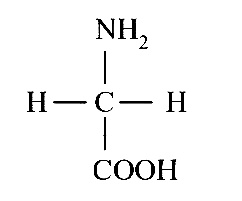
Which of the following is the simplest amino acid?
(A)
Alanine
(B)
Asparagine
(C)
Glycine
(D)
Tyrosine
(C)

Solution

Glycine is considered as the simplest amino acid as it has one amino group, one carboxylic group and no substituent functional group.AIPMT 2005 Biology - Biomolecules Question 67 English Explanation
Q.10
Which one of the following statements regarding enzyme inhibition is correct?
(A)
Competitive inhibition is seen when a substrate competes with an enzyme for binding to an inhibitor protein.
(B)
Competitive inhibition is seen when the substrate and the inhibitor compete for the active site on the enzyme.
(C)
Non-competitive inhibition of an enzyme can be overcome by adding large amount of substrate.
(D)
Non-competitive inhibitors often bind to the enzyme irreversibly.
(B)

Solution

In competitive inhibition the inhibitor resembles the substrate in structure and hence compete for the active site of the enzyme.
Q.11
The catalytic efficiency of two different enzymes can be compared by the
(A)
formation of the product
(B)
pH of optimum value
(C)
Km value
(D)
molecular size of the enzyme.
(C)

Solution

Km (Michealis Menten constant). It is defined as that substrate concentration at which, under optimum conditions, the rate of an enzyme catalysed reaction reaches half the maximum rate. Km is inversely proportional to affinity of enzyme far its substrate.
Q.12
Enzymes, vitamins and hormones can be classified into a single category of biological chemicals, because all of these
(A)
help in regulating metabolism
(B)
are exclusively synthesized in the body of a living organism as at present
(C)
are conjugated proteins
(D)
enhance oxidative metabolism.
(A)

Solution

The major life processes are controlled by enzymes as they enhance the rate of biological reactions.
Vitamins are required in limited amounts by organisms for regulation of metabolism and growth.
Hormones are organic compounds produced by certain organs in small quantities. They act physiologically far from their site of origin.
Q.13
At what stage of the cell cycle are histone proteins synthesized in a eukaryotic cell?
(A)
During G2 stage of prophase
(B)
During S-phase
(C)
During entire prophase
(D)
During telophase
(B)

Solution

Histone proteins are synthesized during S-phase of cell cycle. S-phase or synthetic phase is when synthesis of DNA takes place.
Q.14
In a type of apomixis known as advice embryony, embryos develop directly from the
(A)
nucellus or integuments
(B)
zygote
(C)
synergids or antipodals in an embryo sac
(D)
accessory embryo sacs in the ovule.
(A)

Solution

Normal type of sexual reproduction having two regular features, i.e., meiosis and fertilization, is called amphimixis. But in some plants, this normal sexual reproduction (amphimixis) is replaced by some abnormal type of sexual reproduction called apomixis.

Apomixis may be defined as, ‘abnormal kind of sexual reproduction in which egg or other cells associated with egg (synergids, antipodals, etc.) develop into embryo without fertilization and with or without meiosis’. Adventive embryony is a type of apomixis in which development of embryos directly takes place from sporophytic tissues like nucellus and integuments, e.g., Citrus, mango, etc.
Q.15
Through which cell of the embryo sac, does the pollen tube enter the embryo sac?
(A)
Egg cell
(B)
Persistant synergid
(C)
Degenerated synergids
(D)
Central cell
(C)

Solution

After entering the ovule, the pollen tube is attracted towards the micropylar end of the embryosac. The attractants are secreted by synergids or help cells. The pollen tube pierces one of the two synergids and bursts it. The synergid is simultaneously destroyed.
Q.16
Which one of the following represents an ovule, where the embryo sac becomes horse-shoe shaped and the funiculus and micropyle are close to each other?
(A)
Amphitropous
(B)
Circinotropous
(C)
Atropous
(D)
Anatropous
(A)

Solution

Circinotropous : The funicle is large and coiled around the ovule eg. Opuntia.
Amphitropous : Both body of ovule and embryo sac are curved. The embryo sac assumes horse-shoe shape. e.g. Papaveraceae.
Q.17
In a woody dicotyledonous tree, which of the following parts will mainly consist of primary tissues ?
(A)
Shoot tips and root tips
(B)
Flowers, fruit and leaves
(C)
Stem and root
(D)
All parts
(B)

Solution

Primary Meristems : They are those meristematic tissues which are dervied directly from the meristems of the embryo and retain their meristematic activity. They are present at root, shoot tip and leaf primordia.
Q.18
Potometer works on the principle of
(A)
osmotic pressure
(B)
amount of water absorbed equals the amount transpired
(C)
root pressure
(D)
potential difference between the tip of the tube and that of the plant.
(B)

Solution

Potometer is an instrument or apparatus with the help of which, rate of transpiration can be measured. Main types of potometers are as under: Simple potometer, Farmer’s potometer and Ganong’s potometer.

The whole instrument is made of glass and consists of a long tube, having a side tube, bent at right angles. A fresh plant shoot is cut under water and is inserted into the side tube through a cork, fitted into the mouth of this tube. The whole apparatus is filled with water and the joints are made air tight. The apparatus is placed in the sunlight. Air bubble enters the tube and after this lower end of the tube is placed in the beaker, containing water. Water is absorbed by the shoot and is transpired through the leaves. Transpiration pull is created and the air bubble begins to move alongwith the transpiration pull. Readings are taken for the air bubble and thus amount of water absorbed and transpired is calculated.
Q.19
The deficiencies of micronutrients, not only affects growth of plants but also vital functions such as photosynthetic and mitochondrial electron flow. Among the list given below, which group of three elements shall affect most, both photosynthetic and mitochondrial electron transport?
(A)
Co, Ni, Mo
(B)
Ca, K, Na
(C)
Mn, Co, Ca
(D)
Cu, Mn, Fe
(D)

Solution

Iron is mainly available in the ferrous form and it is absorbed in the ferric form, also. It is a part of catalases, peroxidases, cytochromes, etc. and plays a role in electron transport system in photosynthesis. Manganese is absorbed by the plants when it is in the bivalent form. Manganese participates in the photolysis of water in pigment system II during photosynthesis and thus it helps in the electron transport from water to chlorophyll.

Copper is absorbed on the clay particles as divalent cations, from where it can be absorbed by the plants by exchange mechanism. It is constituent of plastocyanin which takes part in electron transport during photosynthetic phosphorylation.
Q.20
During which stage in the complete oxidation of glucose are the greatest number of ATP molecules formed from ADP?
(A)
Glycolysis
(B)
Krebs' cycle
(C)
Conversion of pyruvic acid to acetyl CoA
(D)
Electron transport chain
(D)

Solution

ATP molecules from ADP are generated in maximum number in electron transport chain.
Q.21
Biodiversity Act of India was passed by the Parliament in the year -
(A)
2000
(B)
2002
(C)
1992
(D)
1996
(B)

Solution

Biodiversity Act of India was passed by the parliament in the year 2002.
Q.22
According to IUCN Red List, what is the status of Red Panda (Ailurus fulgens) ?
(A)
Extinct species
(B)
Vulnerable species
(C)
Endangered species
(D)
Critically endangered species
(C)

Solution

According to IUCN Red list, the status of Red panda (Ailurus fulgens) is endangered species. Endangered species are those species that are facing a very high risk of extinction in the wild in the near future. This category is used when the species suffered a population reduction of 80% or more.
Vulnerable species have sufficient population at present but are depleting fast. e.g., Golden langur, leopard cat. Extinct species no longer exist, e.g., Dodo. Critically endangered species are threatened to a greater extent.
Q.23
One of the most important functions of botanical gardens is that
(A)
they provide a beautiful area for recreation
(B)
one can observe tropical plants there
(C)
they allow ex situ conservation of germplasm
(D)
they provide the natural habitat for wild life.
(C)

Solution

Ex situ conservation means “offsite conservation”.

It is the process of protecting endangered species of plants and animals by removing it from an unsafe or threatened habitat and placing it or part of it under the care of humans.

Botanical garden serve as ex situ conservation of germplasm of different plants, to maintain rare and endemic plant species and also to provide recreation and knowledge about plants to a common man.
Q.24
There exists a close association between the alga and the fungus within a lichen. The fungus
(A)
provides protection, anchorage and absorption for the algae
(B)
provides food for the alga
(C)
fixes the atmospheric nitrogen for the alga
(D)
releases oxygen for the alga
(A)

Solution

Lichens (coined by Theophrastus) are composite or dual organisms which are formed by a fungus partner or mycobiont (mostly ascomycetes) and an algal partner (mostly blue green algae). Fungus forms the body of lichen as well as its attaching and absorbing structures. Algae performs photosynthesis and provides food to the fungus.
Q.25
All of the following statements concerning the actinomycetous filamentous soil bacterium Frankia are correct except that Frankia
(A)
can induce root nodules on many plant species
(B)
can fix nitrogen in the free-living state
(C)
cannot fix specialized vesicles in which the nitrogenase is protected from oxygen by a chemical barrier involving triterpene hopanoids
(D)
like Rhizobium, it usually infects its host plant through root hair deformation and stimulates cell proliferation in the host's cortex.
(B)

Solution

Frankia, is a nitrogen fixing mycelial bacterium which is not free living and associated symbiotically with the root nodules of several non legume plants.
Q.26
For retting of jute the fermenting microbe used is
(A)
methanophilic bacteria
(B)
butyric acid bacteria
(C)
Helicobactor pylori
(D)
Streptococcus lactin.
(B)

Solution

In bryophytes the main plant body is gametophytic which is independent and may be thallose (no differentiation in root, stem and leaves) e.g., Riccia, Marchantia, Anthoceros, etc. or foliose (having leafy axis) e.g., Sphagnum, Funaria, etc.

The gametophyte bears the sex organs antheridium and archegonium. Sexual reproduction is of oogamous type. It forms zygote that gives rise to the sporophytic phase. It is differentiated into foot, seta and capsule.

The capsule produces spores after meiosis that again gives rise to gametophytic phase. The sporophyte is partially or full dependent upon the gametophyte and is of shorter duration.
Q.27
Basophilic prokaryotes
(A)
grow and multiply in very deep marine sediments
(B)
occur in water containing high concentrations of barium hydroxide
(C)
readily grow and divide in sea water enriched in any soluble salt of barium
(D)
grow slowly in highly alkaline frozen lakes at high altitudes.
(A)

Solution

Basopilic prokaryotes are facultatively anaerobic bacteria. They grow and multiply in very deep marine sediments. Most basophiles grow better at a pH of 8.5 or higher.
Q.28
Which of the following represents the edible part of the fruit of litchi?
(A)
Mesocarp
(B)
Endocarp
(C)
Pericarp
(D)
Juicy aril
(D)

Solution

In litchi, aril forms the edible part in fruit. It is a collar like outgrowth from the base of the ovule forming a kind of third integument. Aril is also found in Asphodelus, Trianthema and Ulmus. Litchi is a nut. In litchi, the epicarp and mesocarp (layers of pericarp) together become leathery and the endocarp is membranous.
Q.29
Why is vivipary an undesirable character for annual crop plants?
(A)
It reduces the vigour of the plant.
(B)
It adversely affects the fertility of the plant.
(C)
The seeds exhibit long dormancy.
(D)
The seeds cannot be stored under normal conditions for the next season.
(D)

Solution

Vivipary is the condition when seeds germinate on the plant. It is an undesirable character for annual crop plants because germinated seeds cannot be stored under normal conditions for the next season.
Q.30
As compared to a C3-plant, how many additional molecules of ATP are needed for net production of one molecule of hexose sugar by C4-plants?
(A)
Two
(B)
Six
(C)
Twelve
(D)
Zero
(C)

Solution

Equation for C4 pathway is :
6 PEP + 6 RuBP + 6CO2 + 30 ATP + 12 NADPH + 6PEP + 6 RuBP + C6H12O6 + 30 ADP + 30 H3PO4 + 12 NADP +

The net reaction of C3 dark fixation is
6RuBP + 6CO2 + 18ATP + 12 NADPH 6 RuBP + C6H12O6 + 18 ADP + 18 P + 12 NADP +
Q.31
Photosynthesis in C4 plants is relatively less limited by atmospheric CO2 levels because
(A)
effective pumping of CO2 into bundle sheath cells
(B)
RuBisCo in C4 plants has higher affinity for CO2
(C)
four carbon acids are the primary intial CO2 fixation products
(D)
the primary fixation of CO2 is mediated via PEP carboxylase.
(D)

Solution

In C4 plants, initial fixation of carbon dioxide occurs in mesophyll cells. The primary acceptor of CO2 is phosphoenol pyruvate or PEP. It combines with carbon dioxide in the presence of PEP carboxylase or Pepcase to form oxaloacetate.
C4 plants are more efficient in picking up CO2 even when it is found in low concentration because of the high affinity of PEP case.
Q.32
Photosynthetic Active Radiation (PAR) has the following range of wavelengths.
(A)
340-450 nm
(B)
400-700 nm
(C)
500-600 nm
(D)
450-950 nm
(B)

Solution

Wavelengths between 400 and 700 nm, which comprise the visible range of electromagnetic spectrum are capable of causing photosynthesis. These are called photosynthetically active radiations. Chlorophyll a and b absorb too much light in the blue and red region of spectrum of light. Carotenoids mostly absorb light in the blue region of the spectrum.
Q.33
G-6-P dehydrogenase deficiency is associated with haemolysis of -
(A)
RBCs
(B)
Lymphocytes
(C)
Platelets
(D)
Leucocytes
(A)

Solution

Glucose-6-P dehydrogenase is the first enzyme of glucose oxidation during Pentose Phosphate Pathway. RBC contain haemoglobin which combines with oxygen to form oxyhaemoglobin which gives its oxygen for oxidation of food. In haemolysis there is destruction of RBCs with release of haemoglobin into plasma resulting in jaundice. So, now RBCs cannot provide oxygen for oxidation of food thereby causing deficiency of G-6-P dehydrogenase.
Q.34
A women with 47 chromosomes due to three copies of chromosome 21 is characterized by
(A)
triploidy
(B)
Down’s syndrome
(C)
superfemaleness
(D)
Turner’s syndrome
(B)

Solution

Down's syndrome is caused by the presence of an extra chromosome number 21 and the off spring has 47 chromosomes.
Q.35
A man and a woman, who do not show any apparent signs of a certain inherited disease, have seven children (2 daughter and 5 sons). Three of the sons suffer from the given disease but none of the daughters are affected. Which of the following mode of inheritance do you suggest for this disease
(A)
Autosomal dominant
(B)
Sex-linked recessive
(C)
Sex-linked dominant
(D)
Sex-limited recessive
(B)

Solution

The daughters receive one X chromosome from the father and one X chromosome from the mother. Since all the daughters suffer from their father’s disease, the X chromosome from the father must be carrying a dominant trait.
Q.36
In order to find out the different types of gametes produced by a pea plants having the genotype AaBb, it should be crossed to a plant with the genotype -
(A)
aaBB
(B)
aabb
(C)
AaBb
(D)
AABB
(B)

Solution

A test cross involving the crossing of F1 individual with the homozygous recessive parent. It is done to find out homozygous and heterozygous individuals. So AaBb, should be crossed with aabb.
Q.37
A women with 47 chromosomes due to three copies of chromosome 21 is characterized by -
(A)
Superfemaleness
(B)
Turner's syndrome
(C)
Triploidy
(D)
Down's syndrome
(D)

Solution

A woman with 47 chromosomes due to three copies of chromosome 21 is characterized by Down's syndrome, which is Option D.

Here's a brief explanation of each option :

  • Option A, Superfemaleness: This term is sometimes colloquially used for a condition known as Triple X syndrome, where a female has an extra X chromosome (47,XXX instead of the typical 46,XX). It's not associated with three copies of chromosome 21.


  • Option B, Turner's syndrome: This is a condition where a female partially or completely lacks one of the two X chromosomes (usually represented as 45,X instead of 46,XX). It's unrelated to having an extra copy of chromosome 21.


  • Option C, Triploidy: This is a rare chromosomal disorder where individuals have three copies of every chromosome (69 chromosomes in total), not just an extra copy of chromosome 21.


  • Option D, Down's syndrome: This is the correct answer. Down syndrome, also known as trisomy 21, is a genetic disorder caused by the presence of all or part of a third copy of chromosome 21. It's the most common chromosome abnormality in humans.

Q.38
Haemophilia is more commonly seen in human males than in human females because -
(A)
This disease is due to an X-linked dominant mutation
(B)
This disease is due to a Y-linked recessive mutation
(C)
This disease is due to an X-linked recessive mutation
(D)
A greater proportion of girls die in infancy
(C)

Solution

This disease is due to an X-linked recessive mutation. Males suffer this disorder since they have only one X chromosome and hence express any trait on this chromosome.
Q.39
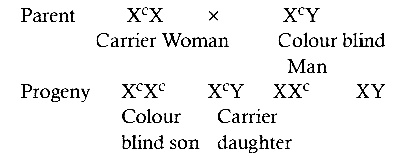
A woman with normal vision, but whose father was colour bind, marries a colour blind man. Suppose that the fourth child of this couple was a boy. This boy -
(A)
May be colour blind or may be normal vision
(B)
Must have normal colour vision
(C)
Must be colour blind
(D)
Will be partially colour blind since he is heterozygous for the colour blind mutant allele.
(A)

Solution

Since the woman’s father was colour blind. She would be a carrier of the colour blindness gene. When she marries a colour blind man. Their progeny could be AIPMT 2005 Biology - Principles of Inheritance and Variation Question 104 English Explanation
Q.40
Which of the following is not a hereditary disease ?
(A)
Cretinism
(B)
Cystic fibrosis
(C)
Haemophilia
(D)
Thalasasemia
(A)

Solution

Cretinism occurs due to hyposecretion of thyroid hormones. Haemophilia is a sex linked recessive trait. Cystic fibrosis is also a recessive autosomal disorder resulting in mucus clogging in lungs. Thalassemia involves a gene mutation in the polypeptide chains of haemoglobin.
Q.41
Protein synthesis in an animal cell occurs -
(A)
On ribosomes present in the nucleolus as well as in cytoplasm
(B)
On ribosomes presents in cytoplasm as well as in mitochondria
(C)
Only on the ribosomes present in cytosol
(D)
Only on ribosomes attached to the nuclear envelope and endoplasmic reticulum
(B)

Solution

The mitochondria contains its own set of ribosomes which synthesize proteins, so protein synthesis occurs both in mitochondria and cytoplasm.
Q.42
E. coli cells with a mustard z gene of the lac operon cannot grow in medium containing only lactose as the source of energy because -
(A)
They cannot transport lactose from the medium into the cell
(B)
They cannot synthesize functional beta galactosidase
(C)
In the presence of glucose, E. coli cells do not utilize lactose
(D)
The lac operon is constitutively active in these cells
(B)

Solution

Operons are segments of genetic material which function as regulated unit or units that can be switched on and switched off. An operon consists of one to several structural genes. (Three in lac operon)
These are genes which produce mRNAs for forming polypeptides / proteins / enzymes. Z (produces enzyme β galactosidase for splitting lactose into glucose and galactose). Y (produces enzyme galactoside permease required in entry of lactose) A (produces enzyme thiogalactoside trans- acetylase).
The three structural genes of the operon produce a single polycistronic mRNA.
Q.43
Telomerase is an enzyme which is a -
(A)
RNA
(B)
Repetitive DNA
(C)
Simple protein
(D)
Ribonucleoprotein
(D)

Solution

Telomerase is a ribonucleoprotein which synthesize the rich strand of telomers in DNA. Telomerase is an enzyme that adds specific DNA sequence repeats ("TTAGGG" in all vertebrates) to the 3' ("three prime") end of DNA strands in the telomere regions, which are found at the ends of eukaryotic chromosomes. The telomeres contain condensed DNA material, giving stability to the chromosomes. The enzyme is a reverse transcriptase that carries its own RNA molecule, which is used as a template when it elongates telomeres, which are shortened after each replication cycle. Telomerase was discovered by Carol W. Greider in 1984.
Q.44
Using imprints from a plate with complete medium and carrying bacterial colonies, you can select streptomycin resistant mutants and prove that such mutations do not originates as adaptation. These imprints need to be used -
(A)
On plates with minimal medium
(B)
Only on plates with streptomycin
(C)
Only on plates without streptomycin
(D)
On plates with and without streptomycin
(B)

Solution

Adaptation is generally due to selection of pre-existing variations and not due to new mutations or variations. This tends to support Darwin’s theory of natural selection. The basis was proved by replica plating experiment of Joshua Lederberg and Esther Lederberg. A number of sterile agar plates having antibiotic streptomycin were prepared. Bacteria were inoculated on the renicilling plates from the master plate by sterile velvet plate. Most bacterial colonies did not form replicas and inoculum died. Moreover a few colonies survived showing that they were resistant to streptomycin.
Q.45
Which one of the following hydrolyses internal phosphodiester bonds in a polynucleotide chain ?
(A)
protease
(B)
Endonuclease
(C)
Lipase
(D)
Exonuclease
(B)

Solution

Endonucleases hydrolyse internal phosphodiester bonds in a polynucleotide chain (DNA). While exonucleases hydrolyse terminal phosphodiester bonds in a polynucleotide chain (DNA).
Q.46
Which one of the following makes use of RNA as a template to synthesize DNA -
(A)
Reverse transcriptase
(B)
DNA dependant RNA polymerase
(C)
RNA polymerase
(D)
DNA polymerase
(A)

Solution

Reverse transcriptase (RNA dependent DNA polymerase) is present in some retroviruses eg. HIV virus.
Q.47
During transcription holoenzyme RNA polymerase binds to a DNA sequence and the DNA assumes a saddle like structure at the point. What is the sequence called ?
(A)
TATA box
(B)
GGTT box
(C)
CAAT box
(D)
AAAT box
(A)

Solution

After 25 bases from start of transcription point are TATA boxes. After 40 bases from TATA boxes appears CAAT boxes. Both of these sequences serve as recognition sites in eukaryotic promoters. Transcription in eukaryotic genes is a far more complicated process than in prokaryotes.
Q.48
Which of the following is generally used for induced mutagenesis in crop plants ?
(A)
UV (260 nm)
(B)
Alpha particles
(C)
Gamma rays (from cobalt 60)
(D)
X rays
(C)

Solution

Gamma rays are produced when an unstable atomic nucleus like cobalt-60 releases energy to gain stability. Sharbati Sonora and Pusa Lerma are the two important varieties of wheat that are responsible for green revolution in India. These are produced by gamma rays treatment of Sonora-64 and Lerma Rojo64 which are Mexican dwarf wheat varieties.
Q.49
Three crops that contribute maximum to global food grain production are -
(A)
Wheat maize and sorghum
(B)
Wheat, rice and barley
(C)
Wheat, rice and maize
(D)
Rice, maize and sorghum
(C)

Solution

Most important source of food in the world are cereals. They are a rich source of carbohydrates, present in endosperms which is the edible portion in cereals. Wheat, corn and rice contribute to about two thirds of the total world’s food. Rice alone is the staple food of 60% of world population and more than 50% Indians. Wheat is world’s most widely cultivated crop. Maize is an important kharif crop of India and also contributes to food production.
Q.50
The name of Norman Borlaug is associated with-
(A)
Blue Revolution
(B)
Yellow Revolution
(C)
Green Revolution
(D)
White Revolution
(C)

Solution

The term Green revolution refers to the very substantial increase in yield obtained by breeding high yielding varieties of crops, under intensive application of fertilizers, irrigation and pesticides. The world wide increase, in productivity has come to be known as the ‘Green Revolution’ for which Dr. Borlaug won the Noble Peace Prize in 1970.
Q.51
Bacillus thuringiensis (Bt) strains have been used for designing novel -
(A)
Bio-metallurgical techniques
(B)
Biofertilizers
(C)
Bioinsecticidal plants
(D)
Bio-mineralization processes
(C)

Solution

Bt cotton, a transgenic crop variety has been introduced in India. The Bt cotton variety contains a foreign gene obtained from Bacillus thuringiensis. This bacterial gene protects cotton from the ball worm, a major pest of cotton.
Q.52
Golden rice is a transgenic crop of the future with the following improved trait -
(A)
High lysine (essential amino acid) content
(B)
High protein content
(C)
Insect resistance
(D)
High vitamin – A content
(D)

Solution

Golden rice is a transgenic crop rice with high vitamin A content. It has been developed by transferring beta carotene synthesizing gene into the transgenic rice. Beta carotene is the precursor of vitamin A. This transgenic rice has been crossed with the already adapted varieties of rice to make them grow well in a particular area. It is very useful for the people suffering from vision impairment due to vitamin A deficiency.
Q.53
Production of a human protein in bacteria by genetic engineering is possible because
(A)
The human chromosome can replicate in bacterial cell
(B)
The genetic code is universal
(C)
Bacterial cell can carry out the RNA splicing reactions
(D)
The mechanism of gene regulation is identical in humans and bacteria
(B)

Solution

Genetic code may be defined as the sequence of nucleotides in polynucleotide chain which determines the sequence of amino acids in a polypeptide chain. Thus the genetic code is universal. These is no ambiguity regarding genetic code. It means that each codon codes for the same amino acid in all organisms including bacteria, plants and animals.
Q.54
Animals have the innate ability to escape from predation. Examples for the same are given below. Select the incorrect example
(A)
Poison fangs in snakes
(B)
Enlargement of body size by swallowing air in puffer fish
(C)
Colour change in chameleon
(D)
Melanism in moths
(A)

Solution

Animals resist predation by cryptic coloration deceptive marking, behavioural defenses and possession of mechanical or chemical defenses. Examples are
colour change in Chameleon
Enlargement of body size by swallowing air in potter fish, Melanism in moths.
Q.55
Which one of the following pairs in mismatched ?
(A)
Tundra - permafrost
(B)
Savanna - acacia trees
(C)
Prairie - epiphytes
(D)
Coniferous forest - evergreen trees
(C)

Solution

A biome is a major terrestrial community characterized by a distinct climate and inhabited by a particular species of plants and animals. Tundra is characterized by precipitation of less than 25 cm annually. Permafrost or permanent ice is found about a meter down from the surface, it never melts and is impenetrable to both water and roots. Savannahs are open grasslands with scattered shrubs and trees. Coniferous forest contain evergreen trees. In these forests all plants do not shed their leaves at the same time hence forest remains always evergreen. But Prairies is a grassland and epiphytes and ephemerals are found in deserts.
Q.56
At which latitude, heat gain through insolation approximately equals heat loss through terrestrial radiation -
(A)
40o North and South
(B)
42 North and South
(C)
66o North and South
(D)
22 North and South
(A)

Solution

Earth does not receive equal radiation at all points. The East West rotation of earth provides equal exposure to sunlight but latitude and dispersion do affect the amount of radiation received. The poles receive far less radiation than equator. This uneven heating is called differential insolation. At 40º North and South, approximately the heat gain is equal to heat loss through terrestrial radiation.
Q.57
More than 70% of world's fresh water is contained in –
(A)
Polar ice
(B)
Greenland
(C)
Antarctica
(D)
Glaciers and Mountains
(A)

Solution

Three fourth surface of earth is covered by oceans which contain 97.5% of total water. It is marine water with about 3.5% salt content only 2.5% is fresh water which occurs on land. Most of this water (1.97%) occurs as frozen ice caps and glaciers, 0.5% fresh water occurs as ground water. Rivers and lakes contain 0.02%, soil 0.01% while atmosphere possesses 0.001% of water as vapours.
Q.58
Prolonged liberal irrigation of agricultural fields is likely to create the problem of -
(A)
salinity
(B)
Acidity
(C)
Aridity
(D)
Metal toxicity
(A)

Solution

Since all surface and ground water contains salts to varying degrees. Therefore excessive irrigation followed by evaporation of the unabsorbed water leads to salinity. This also leads to waterlogging.
Q.59
Which of the following is not used for disinfection of drinking water ?
(A)
Chloramine
(B)
Ozone
(C)
Chlorine
(D)
Phenyl
(D)

Solution

Chlorine, ozone, chloramine are used for disinfection of drinking water.
Q.60
Which one of the following pairs is mismatched ?
(A)
Fossil fuel burning – release of CO2
(B)
Nuclear power – radioactive wastes
(C)
Biomass burning – release of CO2
(D)
Solar energy – green house effect
(D)

Solution

Solar energy coming to the earth is not responsible for green house effect. It is the increase in green house gases in atmosphere like CO2 which is released by complete combustion of fossil fuels or biomass in industries or transportation vehicles that prevent the reradiation of infrared radiation from the earth and result in increase in temperature of the earth.
Q.61
Identify the correctly matched pair -
(A)
Basal Convention – Biodiversity Conservation
(B)
Kyoto protocol – Climatic change
(C)
Ramsar Convention – Ground water pollution
(D)
Montreal Protocol - Global warming
(B)

Solution

Kyoto Protocol (1997) : International conference held in Kyoto, Japan obtained commitments from different countries for reducing overall greenhouse gas emissions at a level 9% below 1990 level by 2008-2012. Montreal Protocol (1987) : Industrialized countries agreed to limit production of chloroflourocarbons to half the level of 1986.
Q.62
Ectophloic siphonostele is found in
(A)
Osmunda and Equisetum
(B)
Marsilea and Botrychium
(C)
Adiantum and Cucurbitaceae
(D)
Dicksonia and Maiden hair fern.
(A)

Solution

Stele is a column containing vascular tissues which is surrounded by pericycle and separated from ground tissue by endodermis.

Siphonostele is medullated protostele or protostele with a central non-vascular pith. Leaf gaps are absent. Siphonostele is of two types :

In Ectophloic siphonostele, central pith is surrounded successively by xylem, phloem, pericycle and endodermis. In amphiphloic siphonostele there is a central pith and xylem is surrounded on either side by phloem, pericycle and endodermis. It is found in Osmunda and Equisetum.
Q.63
Auxospores and hormogonia are formed, respectively, by
(A)
some diatoms and several cyanobacteria
(B)
some cyanobacteria and many diatoms
(C)
several cyanobacteria and several diatoms
(D)
several diatoms and a few cyanobacteria.
(D)

Solution

Until 1907, auxospore formation was regarded as asexual process but now it is considered as an act of sexual process. The auxospores may be autogamous, isogamous, anisogamous or oogamous. Their pattern of formation differs in pennate and centric diatoms.

Formation of hormogonia is the common method of reproduction in Nostoc which are produced by accidental breaking of trichome into several pieces. It may also be formed by death and decay of ordinary intercalary cells. Soon, the hormogonium escapes from mucilage and grows into a new filament and then into a new colony.
Q.64
Match items in column with those in column .

Column Column
(A) Peritrichous flagellation (J) Ginkgo
(B) Living fossil (K) Macrocystis
(C) Rhizophore (L) Eschericha coli
(D) Smallest flowering plant (M) Selaginella
(E) Largest perennial alga (N) Wolffia

Select the correct answer from the following.
(A)
(A) - (L);  (B) - (J);  (C) - (M);  (D) - (N);  (E) - (K)
(B)
(A) - (K);  (B) - (J);  (C) - (L);  (D) - (M);  (E) - (N)
(C)
(A) - (N);  (B) - (L);  (C) - (K);  (D) - (N);  (E) - (J)
(D)
(A) - (J);  (B) - (K);  (C) - (N);  (D) - (L);  (E) - (K)
(A)

Solution

Peritrichous flagellation : Flagella all around e.g. Escherichia coli.

Living fossil : Organisms which have undergone very little change since they first evolved e.g. Ginkgo.

Rhizophore : Rhizophores are present in Selaginella which is a colourless, leafless, positively geotropic, elongated structure. Smallest flowering plant : Wolffia.

Largest perennial alga : Macrocystis
Q.65
Top-shaped multiciliate male gametes and the nature seed which bears only one embryo with two cotyledons, are characterised features of
(A)
cycads
(B)
conifers
(C)
polypetalous angiosperms
(D)
gamopetalous angiosperms
(A)

Solution

Cycads is a group of gymnosperms which have top shaped multiciliated male gametes and each mature seed of these plants contain one embryo and two cotyledons e.g., Cycas.
Q.66
The ability of the Venus Flytrap to capture insects is due to
(A)
specialized ''muscle-like'' cells
(B)
chemical stimulation by the prey
(C)
a passive process requiring no special ability on the part of the plant
(D)
rapid turgor pressure changes.
(D)

Solution

Thigmonastic movements are exhibited by some insectivorous plants such as Dionaea, venus fly trap, Drosera, etc. These plants have tentacles, which are sensitive to the stimulus of touch. In the case of the venus flytrap, turgor pressure changes occur in which hydrogen ions are rapidly pumped into the walls of cells on the outside of each leaf in response to the action potentials from the trigger hairs.

The protons apparently loosen the cell walls so rapidly that the tissue actually becomes flaccid so that cells quickly absorb water, causing the outside of each leaf to expand and the trap to snap shut.
Q.67
Which one of the following depresses brain activity and produces feelings of calmness, relaxation and drowsiness ?
(A)
Hashish
(B)
Amphetamines
(C)
Morphine
(D)
Valium
(D)

Solution

Valium is a benzodiazephine (sedative) that gives a feeling of relaxation, calmness or drowsiness in the body. Morphine is the main opium alkaloid that depresses respiratory centre and contributes to the fall in blood pressure. Amphetamines are synthetic drugs and are stimulant in nature. Hashish is a hallucinogen.
Q.68
Damage to thymus in a child may lead to
(A)
A reduction in stem cell production
(B)
Loss of cell mediated immunity
(C)
A reduction in haemoglobin content of blood
(D)
Loss of antibody mediated immunity
(B)

Solution

The thymus is a major gland of our immune system. The thymus is responsible for production of T (thymus dervied) lymphocytes from immature lymphocytes, a type of white blood cells responsible for cell mediated immunity. Cell mediated immunity is extremely important for raising immune response against bacteria, yeast, fungi, parasites and virus. It is also critical in protecting against cancer, autoimmune disorders like rheumatoid arthritis, allergies etc.
Q.69
Which of the following pairs is correctly matched?
(A)
Hinge joint - Between vertebrae
(B)
Gliding joint - Between zygapophyses of the
successive vertebrae
(C)
Cartilaginous joint - Skull bones
(D)
Fibrous joint - between phalanges
(B)

Solution

Gliding joint permits sliding movements of two bones over each other. Hinge joint allows movements in one plane only. Knee joint, elbow joint, ankle joint are of this type. Cartilaginous joint is a slightly movable joint and is found between the centre of vertebrae, at the pubic symphysis and between ribs and sternum. Fibrous joint is an immovable joint which occur between the bones of cranium.
Q.70
An acromian process is characteristically found in the
(A)
pelvic girdle of mammals
(B)
pectoral girdle of mammals
(C)
skull of frog
(D)
sperm of mammals.
(B)

Solution

Each half of pectoral girdle has two bones i.e. clavicle and scapula. A spine like, acromian process is attached to scapula for articulation with clavicle bone.
Q.71
Which one of the following is the example of the action of the autonomous nervous system?
(A)
Swallowing of food
(B)
Pupillary reflex
(C)
Peristalsis of the intestine
(D)
Knee-jerk response
(C)

Solution

Autonomic nerveous system regulates and coordinates involuntry activities like heart beat, homeostasis, body temperature, breathing, gut peristalsis and secretion of glands. Human intestine shows movements during food digestion called peristalsis.
Q.72
Parkinson's disease (characterized by tremors and progressive rigidity of limbs) is caused by degeneration of brain neurons that are involved in movement control and make use of neurotransmitter
(A)
acetylcholine
(B)
norepinephrine
(C)
dopamine
(D)
norepinephrine
(C)

Solution

Parkinsonism is caused by degenerations of neurons in substantia nigra tract which are essentially dopaminergic. This striatum controls muscle tones and coordinates movements. An imbalance is caused by deficiency of dopamine (an inhibitory neurotransmitter) vis-a-vis.
Q.73
In a man, abducens nerve is injured. Which one of the following functions will be affected?
(A)
Movement of the eyeball
(B)
Movement of the tongue
(C)
Swallowing
(D)
Movement of the neck
(A)

Solution

Abducens is the sixth cranial nerve which innervates the external rectus muscle of the eye ball. It is responsible for turning the eye outwards. Movement of the tongue is controlled by the hypoglossal nerve. Neck movements is controlled by the facial nerve. Swallowing is controlled by glossopharyngeal nerves.
Q.74
Four healthy people in their twenties got involved in injuries resulting in damage and death of a few cell of the following. Which of the cells are least likely to be replaced by new cells -
(A)
Malpighian layer of the skin
(B)
Osteocytes
(C)
Neurons
(D)
Liver cells
(C)

Solution

The neurons are cells specialised to conduct an electrochemical current. Neuron cells do not have the capability of division.
Q.75
Which group of three of the following five statements (1 - 5) contain all three correct statements regarding beri-beri?
1.  A crippling disease prevalent among the native population of sub-Saharan Africa
2.  A deficiency disease caused by lack of thiamine (vitamin B1)
3.  A nutritional disorder in infants and young children when the diet is persistently deficient in essential protein
4.  Occurs in those countries where the staple diet is polished rice
5.  The symptoms are pain from neuritis, paralysis, muscle wasting, progressive oedema, mental deterioration and finally heart failure.
(A)
2, 4 and 5
(B)
1, 2 and 4
(C)
1, 3 and 5
(D)
2, 3 and 5
(A)

Solution

Beri-beri which is caused due to the deficiency of vitamin B1 , is characterized by pain from neuritis, paralysis, muscle wasting, oedema, mental deterioration and finally heart failure. It occurs in those countries (coastal districts of A.P.) where the diet is based on polished rice, which lacks the thiamine-rich seed coat.
Q.76
Secretin and cholecystokinin are digestive hormones. They are secreted in
(A)
pyloric stomach
(B)
duodenum
(C)
ileum
(D)
oesophagus.
(B)

Solution

Secretin and cholecystokinin are secreted in the duodenum. They provide stimulus to
(i) Secretin : Acidic chyme entry into duodenum
(ii) CCK-PZ : Presence of fat in duodenum Their action involves:
(i) Secretin : Releases bicarbonates in the pancreatic juice.
(ii) CCK-PZ : contracts the gall bladder to release bile. Stimulating pancreas to secrete and release digestive enzymes in the pancreatic juice.
Q.77
Epithelial cells of the intestine involved in food absorption have on their surface
(A)
pinocytic vesicles
(B)
microvilli
(C)
zymogen granules
(D)
phagocytic vesicles.
(B)

Solution

Microvilli are countless minute, closely - set projections from the free surface of the mucosal cells of the intestine. There may be about 500 microvilli on each cell. These are meant to increase the absorptive surface area of the intestine. Pinocytic vesicles are involved in intake of extracellular fluid. Phagocytic vesicles are involved in engulfing of large solid particles. Zymogen granules contain proteolytic enzymes in an inactive form.
Q.78
A patient is generally advised to specially consume more meat, lentils, milk and eggs in diet only when he suffers from
(A)
scurvy
(B)
kwashiorkar
(C)
rickets
(D)
anaemia.
(B)

Solution

A child may have a diet containing sufficient carbohydrates and fats but still suffers a serious form of malnutrition. This form of malnutrition is known as Kwashiorkor. It develops in children whose diets are deficient in protein. When the first child is weaned (not accustomed to food other than its mother’s milk) after the second is born, its primary supply of protein (the mother’s milk) is lost. If the new diet is very low in protein the needs of the growing individual this disease develops.
All the food stuff eg. milks, lentils, meat and eggs are rich in proteins.
Q.79
The net pressure gradient that causes the fluid to filter out of the glomeruli into the capsule is
(A)
50 mm Hg
(B)
75 mm Hg
(C)
20 mm Hg
(D)
30 mm Hg
(C)

Solution

Walls of glomerular capillaries and Bowman’s capsule are very thin and are semipermeable due to the presence of pores in the former and slit-pores in the latter. They allow water and small molecules in the blood to pass through them. Fluid containing these materials is forced out of the glomerular capillaries into the Bowman’s capsule by the high pressure of the blood in the glomerular capillaries.

This pressure is about 70 mm Hg in man. The fluid tends to move in the reverse direction due to (i) the osmotic pressure of plasma proteins in the glomerular capillaries, and (ii) hydrostatic pressure of the fluid in the urinary tubule. These pressures in man are about 30 mm Hg and 20 mm Hg respectively. The net force moving the fluid from the glomerular capillaries, called the filtration pressure, is 70 – (30 + 20) or 20 mmHg.
Q.80
In ornithine cycle, which of the following wastes are removed from the blood?
(A)
CO2 and urea
(B)
Ammonia and urea
(C)
CO2 and ammonia
(D)
Urea and urine
(C)

Solution

Urea NH2 – CO – NH2 is formed from two molecules of ammonia and one molecule of carbon dioxide. A molecule of ammonia combines with carbondioxide to form carbonyl phosphate. It reacts with ornithine to form citrulline. Citrulline accepts another molecule of NH4 + giving rise to arginine. Arginine is hydrolysed into urea and ornithine with the help of enzyme arginase.
Q.81
A person is undergoing prolonged fasting. His urine will be found to contain abnormal quantities of
(A)
fats
(B)
amino acids
(C)
glucose
(D)
ketones.
(D)

Solution

Under fasting conditions which are associated with high rate of fatty acid oxidation, the liver produces large amount of ketone bodies viz. acetoacetate, -hydroxybutyrate and acetone. The normal level of ketone blood level is 0.2 mmol/L. Presence of excess ketone bodies in urine is termed as ketonuria.
Q.82
Grey crescent is the area -
(A)
Just opposite to the site of entry of sperm into ovum
(B)
At the point of entry of sperm into ovum
(C)
At the vegetal pole
(D)
At the animal pole
(A)

Solution

Grey crescent is the area just opposite to the site of entry of sperm into ovum. It marks the future dorsal side of the embryo.
Q.83
If mammalian ovum fails to get fertilized, which one of the following is unlikely
(A)
Corpus luteum will disintegrate
(B)
Estrogen secretion further decreases
(C)
Primary follicle starts developing
(D)
Progesterone secretion rapidly declines
(B)

Solution

Since corpus luteum degenerates so progesterone also decreases rapidly (progesterone is essential for maintenance of pregnancy). Also estrogen continues to curve growth of the endometrium which ultimately becomes thick enough to break down and cause menstruation. Hence choice (c) is incorrect as estrogen secretion does not decreases further. Primary follicles start developing.
Q.84
In contrast to annelids the platyhelminthes show
(A)
absence of body cavity
(B)
bilateral symmetry
(C)
radial symmetry
(D)
presence of pseudocoel.
(A)

Solution

Platyhelminthes do not have body cavity so they are acoelomates. In annelids, the body cavity is true and schizocoelous. Both annelids and platyhelminthes have bilateral symmetry.
Q.85
From the following statements select the wrong one
(A)
Prawn has two pairs of antennae.
(B)
Nematocysts are characteristics of the phylum cnidaria.
(C)
Millepedes have two pairs of appendages in each segment of the body.
(D)
Animals belonging to phylum porifera are marine and frsh water.
(A)

Solution

Animals belonging to Phylum Porifera are mostly marine except a few which are found in fresh water- e.g. Spongilla, Euspongia.
Q.86
The world's highly prized wool yielding 'Pashmina' breed is -
(A)
Sheep
(B)
Goat-sheep cross
(C)
Kashmir sheep-Afghan sheep cross
(D)
Goat
(D)

Solution

The world’s highly prized wool yielding Pashmina breed is the under fur of Kashmiri and Tibetan goats.
Pashmina is an almost generic name for accessories made from a type of mohair that is obtained from a special breed of goat indigenous to high altitudes of the Himalayan Range Belt of Asia.
The name comes from Pashmineh, made from Persian pashm (= “wool”). The special goat’s fleece has been used for thousands of years to make high-quality shawls that also bear the same name.
Q.87
Which one of the following characters is not typical of the class mammalia?
(A)
Thecodont dentition
(B)
Alveolar lungs
(C)
Ten pairs of cranial nerves
(D)
Seven cervical vertebrae
(C)

Solution

Mammals have twelve pair of cranial nerves. Ten pairs of cranial nerves are present in fish and amphibians. Reptiles and birds also have 12 pairs of cranial nerves.
Q.88
Which of the following unicellular organisms has a macronucleus for trophic function and one or more micronuclei for reproduction?
(A)
Euglena
(B)
Amoeba
(C)
Paramecium
(D)
Trypanosoma
(C)
Q.89
Which of the following is the relatively most accurate method for dating of fossils ?
(A)
Radio-carbon method
(B)
Uranium-lead method
(C)
Potassium–argon method
(D)
Electron-spin resonance method
(D)

Solution

Electron spin resonance (ESR) measures the number of charges occupying deep traps in the crystal bandgap. By measuring the change in absorption of microwave energy within a continuously varying strong magnetic field, this method detects the number of “unpaired spins” of electronic charges trapped at various defects in the mineral lattice.

The principle of ESR dating is that radiation damage occurs in minerals as a result of uranium uptake, and external effects. This damage is usually repaired in living tissue, but in dead tissue it accumulates. If the method of uptake can be judged, then the approximate age of the tissue can be deduced from the extent of the radiation damage.
Q.90
Which one of the following phenomena supports Darwin's concept of natural selection in organic evolution ?
(A)
Prevalence of pesticide resistant insects
(B)
Development of organs from 'stem' cells for organ transplantation
(C)
production of 'Dolly', the sheep by cloning
(D)
Development of transgenic animals
(A)

Solution

When DDT was sprayed to kill mosquitoes, there were only few mosquitoes which were already resistant to DDT, and hence survived. Most of the mosquitoes which were sensitive to DDT died.
Due to differential reproduction the resistant mosquitoes got more chances of reproduction and multiplied. After few generations most of the mosquitoes were resistant. The sensitive were very few. This supports Darwin’s theory of natural selection and survival of the fittest.
Q.91
De Vries gave his mutation theory on organic evolution while working on -
(A)
Althea rosea
(B)
Oenothera lamarckiana
(C)
Pisum sativum
(D)
Drosophila melanogaster
(B)

Solution

Pisum sativum - Mendel
Drosophila melanogaster - T. H. Morgan.
Q.92
Which one of the following experiments suggests that simplest living organisms could not have originated spontaneously from non-living matter ?
(A)
Meat was not spoiled, when heated and kept sealed in a vessel
(B)
Larva cound appear in decaying organic matter
(C)
Microbes appeared form unsterilized organic matter
(D)
microbes did not appear in stored meat
(A)

Solution

Microbes were killed by heating the meat and the sealed vessel formed a closed system wherein the new microbes could not come in contact with the nutrient medium and hence no spoilage of meat.
Q.93
Which of the following is not true for a species ?
(A)
Variations occur among members of a species
(B)
Gene flow does not occur between the populations of a species
(C)
Each species is reproductively isolated from every other species
(D)
Members of a species can interbreed
(B)

Solution

Gene flow is the spread of genes through populations as effected by movements of individual and their propagules, e.g. seeds spores etc. Gene flow ensures that all populations of a given species share a common gene pool. i.e. it reduces difference between populations. The interruption of gene flow between populations is a prerequisite for the formation of new species.
Q.94
There are two opposing views about origin of modern man. According to one view Homo erectus in Asia were the ancestors of modern man. A study of variation of DNA however suggested African origin of modern man. What kind of observation of DNA variation could suggest this ?
(A)
Variation only in Asia and no variation in Africa
(B)
Similar variation in Africa and Asia
(C)
Greater variation in Africa than in Asia
(D)
Greater variation in Asia than in Africa
(C)

Solution

According to Neodarwinism variation is the root cause of evolution.
Q.95
At a particular locus, frequency of 'A' allele is 0.6 and that of 'a' is 0.4. What would be the frequency of heterozygotes in a random mating population at equilibrium ?
(A)
0.48
(B)
0.24
(C)
0.36
(D)
0.16
(A)

Solution

In a stable population, for a gene with two alleles, A (dominant) and a (recessive), if the frequency of A is p and the frequency of a is q, then the frequencies of the three possible genotypes (AA, Aa, and aa) can be expressed by the given HardyWeinberg equation :
p2 + 2pq + q2 = 1.
where p2 = frequency of AA (homozygous dominant) individuals, 2pq = frequency of Aa (heterozygous) individuals, and q2 = frequency of aa (homozygous recessive) individuals. The equation can be used to calculate allele frequencies if the numbers of homozygous recessive individuals in the population is known. The equation and the equilibrium are named after British mathematician G.H. Hardy and German physician W. Weinberg.
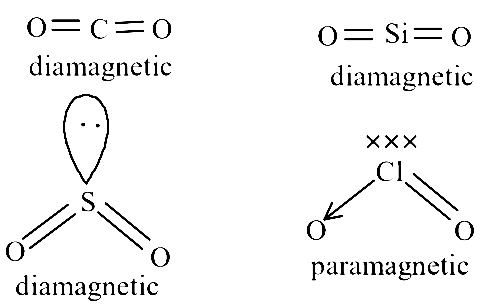
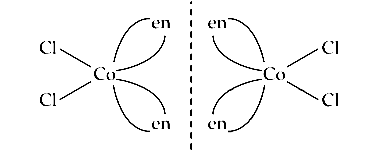
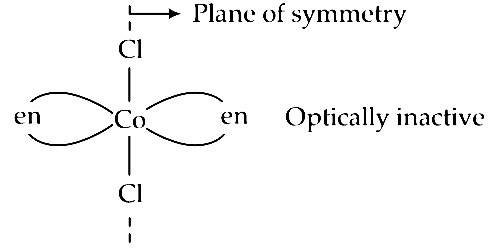
So p = 0.6 and q = 0.4 (given)
2pq (frequency of heterozygote)
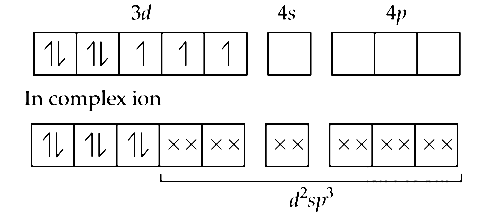
= 2 × 0.6 × 0.4 = 0.48