NEET-UG 2006

AIPMT 2006

Physics (Maximum Marks: 200)
  • This section contains 50 questions.
  • Each question has FOUR options (A), (B), (C) and (D). ONLY ONE of these four options is the correct answer.
  • Full Marks : +4 If ONLY the correct option is chosen;
  • Zero Marks : 0 If none of the options is chosen (i.e. the question is unanswered);
  • Negative Marks : −1 In all other cases.
Q.1
The velocity v of a particle at time t is given by v = at + , where a, b and c are constants. The dimensions of a, b and c are
(A)
[L], [LT] and [LT2]
(B)
[LT2], [L] and [T]
(C)
[L2], [T] and [LT2]
(D)
[LT2], and [LT] and [L]
(B)

Solution

Given, v = at +

Dimension of at = Dimension of velocity v

[at] = [LT-1]

[a] = = [LT-2]

As c is added to t,

[c] = [T]

= [LT-1]

[b] = [L]
Q.2
A particle moves along a straight line OX. At a time t (in seconds) the distance x (in metres) of the particle from O is given by x = 40 + 12t t3. How long would the particle travel before coming to rest ?
(A)
16 m
(B)
24 m
(C)
40 m
(D)
56 m
(A)

Solution

Given x = 40 + 12t t3

v = = 12 - 3t2

When particle comes to rest then v = 0.

12 - 3t2 = 0

t = 2 s

Distance travelled before coming to rest,

s = =

=

= 24 - 8 = 16 m
Q.3
A car runs at a constant speed on a circular track of radius 100 m, taking 62.8 seconds for every circular lap. The average velocity and average speed for each circular lap respectively is
(A)
10 m/s, 0
(B)
0, 0
(C)
0, 10 m/s
(D)
10 m/s, 10 m/s.
(C)

Solution

Distance covered in one circular loop = 2r = 23.14100 = 628 m

Average speed = m/s

Net displacement in one loop = 0

Average velocity = = 0
Q.4
Two bodies A (of mass 1 kg) and B (of mass 3 kg) are dropped from heights of 16 m and 25 m, respectively. The ratio of the time taken by them to reach the ground is
(A)
4/5
(B)
5/4
(C)
12/5
(D)
5/12
(A)

Solution

Here h =

For body A, 16 =

For body B, 25 =


Q.5
The vectors and are such that The angle between the two vectors is
(A)
45o
(B)
90o
(C)
60o
(D)
75o
(B)

Solution


So, A2 + B2 + 2AB cos

= A2 + B2 – 2AB cos

4AB cos = 0 cos = 0

= 90º

So, angle between A & B is 90º.
Q.6
For angles of projection of a projectile at angle (45o ) and (45o + ), the horizontal range described by the projectile are in the ratio of
(A)
2 : 1
(B)
1 : 1
(C)
2 : 3
(D)
1 : 2.
(B)

Solution

(45º – ) & (45º + ) are complementary angles as 45º – + 45º + = 90º. We know that if angle of projection of two projectiles make complementary angles, their ranges are equal. In this case also, the range will be same. So the ratio is 1 : 1.
Q.7
A body of mass 3 kg is under a constant force which causes a displacement s in metres in it, given by the relation s = t2, where t is in seconds. Work done by the force in 2 seconds is
(A)
(B)
(C)
(D)
(D)

Solution

Acceleration = d2s/dt2
= 2/3 m/s2

Now force acting on body = mass × acceleration

F = 3 × (2/3) = 2 Newton

Hence displacement in 2 secs
= (1/3) × 2 × 2 = 4/3 m

Finally, work done = 2 × 4/3 = 8/3 J
Q.8
The potential energy of a long spring when stretched by 2 cm is U. If the spring is stretched by 8 cm the potential energy stored in it is
(A)
U/4
(B)
4U
(C)
8U
(D)
16U
(D)

Solution

Potential energy of a spring

= force constant (extension)2

Potential energy (extension)2

or, or,


Q.9
300 J of work is done in sliding a 2 kg block up an inclined plane of height 10 m. Work done against friction is (Take g = 10 m/s2)
(A)
1000 J
(B)
200 J
(C)
100 J
(D)
zero
(C)

Solution

Loss in potential energy = mgh

= 2 × 10 × 10 = 200 J.

Gain in kinetic energy = work done = 300 J

Work done against friction = 300 – 200 = 100 J
Q.10
A 0.5 kg ball moving with a speed of 12 m/s strikes a hand wall at an angle of 30o with the wall. It is reflected with the same speed at the same angle. If the ball is in contact with the wall for 0.25 seconds, the average force acting on the wall is :
(A)
96 N
(B)
48 N
(C)
24 N
(D)
12 N
(C)

Solution

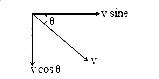
AIPMT 2006 Physics - Center of Mass and Collision Question 37 English Explanation 1 Resolving the velocities in vertical and horizontal directions, resolved parts of first velocity

AIPMT 2006 Physics - Center of Mass and Collision Question 37 English Explanation 2

v cos perpendicular to the wall and v sinq parallel to the wall. In the second case, they are –v sin & v cos respectively. Here, –ve sign is because direction is opposite to the earlier ones. So we see a net change in velocity perpendicular to way
= v sin – (–v sin) = 2v sin

This change has occured in 0.25 sec, so, rate of

change of velocity =


Thus, acceleration a = 48 m/sec2

Force applied = m a = 0.5 × 48 = 24 N
Q.11
A uniform rod AB of length and mass m is free to rotate about point A. The rod is released from rest in the horizontal position. Given that the moment of inertia of the rod about A is ml2/3, the initial angular acceleration of the rod will be

(A)
(B)
(C)
(D)
(C)

Solution

Torque about A,


Angular acceleration,
Q.12
A tube of length L is filled completely with an incompressible liquid of mass M and closed at both the ends. The tube is then rotated in a horizontal plane about one of its ends with a uniform angular velocity . The force exerted by the liquid at the other end is
(A)
(B)
(C)
(D)
(B)

Solution

The centre of the tube will be at length L/2. So radius r = L/2.

The force exerted by the liquid at the other end = centrifugal force

Centrifugal force
=
Q.13
The moment of inertia of a uniform circular disc of radius R and mass M about an axis touching the disc at its diameter and normal to the disc
(A)
MR2
(B)
MR2
(C)
(D)
(D)

Solution

Moment of inertia of a uniform circular disc about an axis through its centre and perpendicular to its plane is by the theorem of parallel axes.

Moment of inertia of a uniform circular disc about an axis touching the disc at its diameter and normal to the disc is I.

Q.14
The earth is assumed to be a sphere of radius R. A platform is arranged at a height R from the surface of the earth. The escape velocity of a body from this platform is fv, where v is its escape velocity from the surface of the Earth. The value of f is
(A)
1/2
(B)
(C)
1/
(D)
1/3
(C)

Solution

Escape velocity of the body from the surface of earth is v =

For escape velocity of the body from the platform potential energy + kinetic energy = 0


From the surface of the earth,

,
Q.15
A black body at 1227oC emits radiations with maximum intensity at a wavelength of 5000 . If the temperature of the body is increased by 1000oC, the maximum intensity will be observed at
(A)
3000
(B)
4000
(C)
5000
(D)
6000
(A)

Solution

Applying Wein's displacement law,


Q.16
A Carnot engine whose sink is at 300 K has an efficiency of 40%. By how much should the temperature of source be increased so as to increase its efficiency by 50% of original efficiency ?
(A)
380 K
(B)
275 K
(C)
325 K
(D)
250 K
(D)

Solution

We know that efficiency of Carnot Engine


where, T1 is temp. of source & T2 is temp. of sink


Now efficiency to be increased by 50%


Increase in temp = 750 – 500 = 250 K
Q.17
The molar specific heat at constant pressure of an ideal gas is (7/2) R. The ratio of specific heat at constant pressure to that at constant volume is
(A)
9/7
(B)
7/5
(C)
8/7
(D)
5/7
(B)

Solution


Q.18
A rectangular block of mass m and area of cross-section A floats in a liquid of density . If it is given a small vertical displacement from equilibrium it undergoes with a time period T, then
(A)
(B)
(C)
(D)
(C)

Solution

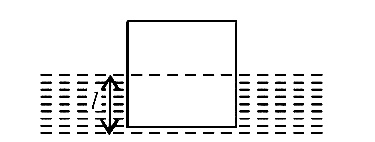
Let l be the length of block immersed in liquid as shown in the figure. When the block is floating,

AIPMT 2006 Physics - Oscillations Question 38 English Explanation

mg = Alm

If the block is given vertical displacement y then the effective restoring force is


Restoring force = . As this F is directed towards its equilibrium position of block, so if the block is left free, it will execute simple harmonic motion.

Here inertia factor = mass of block = m
Spring factor =

Time period =    i.e.
Q.19
Two vibrating tuning forks produce waves given by y1 = 4 sin 500t and y2 = 2 sin506 t. Number of beats produced per minute is
(A)
360
(B)
180
(C)
60
(D)
3
(B)

Solution

Y1 = 4 sin500t, Y2 = 2 sin506t

, ,


beats/s

Number of beats per minute = 3 × 60 = 180
Q.20
The time of reverberation of a room A is one second. What will be the time (in seconds of reverberation of a room, having all the dimensions double of those of room A ?
(A)
1
(B)
2
(C)
4
(D)
1/2
(B)

Solution

Reverberation time is defined as the time during which the intensity of sound in the auditorium becomes one millionth of the initial intensity.

Sabine has shown that standard reverberation time for an auditorium is given by the formula


Here, V is volume of the auditorium, S is the surface area.

(given)


(Assuming auditorium to be cubic in shape)


If dimension is doubled, reverberation time t will be doubled.
So, New TR = 2 sec.
Q.21
Two sound waves with wavelengths 5.0 m and 5.5. m respectively, each propagate in a gas with velocity 330 m/s. We expect the following number of beats per second.
(A)
6
(B)
12
(C)
0
(D)
1
(A)

Solution

Frequencies of sound waves are
&

i.e., 66 Hz and 60 Hz

Frequencies of beat = 66 – 60 = 6 per second
Q.22
Which one of the following statements is true ?
(A)
both light and sound waves can travel in vaccum
(B)
both light and sound waves in air are transverse
(C)
The second waves in air are longitudinal while the light waves are transverse
(D)
both light and sound waves in air are
(C)

Solution

Light waves are electromagnetic waves. Light waves are transverse in nature and do not require a medium to travel, hence they can travel in vacuum. Sound waves are longitudinal waves and require a medium to travel. They do not travel in vacuum.
Q.23
A transverse wave propagating along x-axis is represented by y(x, t) = 8.0 sin (0.5 x 4t /4) where x is in metres and t is in seconds. The speed of the wave is
(A)
8 m/s
(B)
4 m/s
(C)
0.5 m/s
(D)
/4 m/s.
(A)

Solution


Compare with a standard wave equation,


we get


.

Wave velocity, m/sec.
Q.24
An electric dipole of moment is lying along a uniform electric field . The work done in rotating the dipole by 90o is
(A)
pE
(B)
(C)
pE/2
(D)
2pE
(A)

Solution

Work done in deflecting a dipole through an angle is given by


Since = 90°

W = pE(1 – cos90°) W = pE
Q.25
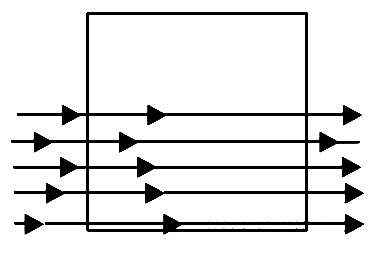
A square surface of side L metres is in the plane of the paper. A uniform electric field (volt/m), also in the plane of the paper is limited only to the lower half of the square surface (see figure). The electric flux in SI inits associated with the surface is

AIPMT 2006 Physics - Electrostatics Question 44 English
(A)
EL2
(B)
EL2/20
(C)
EL2/2
(D)
zero
(D)

Solution

Electric flux,


The lines are parallel to the surface.
Q.26
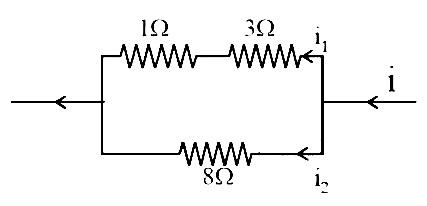
Power dissipated across the 8 resistor in the circuit shown here is 2 watt. The power dissipated in watt units across the 3 resistor is

AIPMT 2006 Physics - Current Electricity Question 71 English
(A)
3.0
(B)
2.0
(C)
1.0
(D)
0.5
(A)

Solution

Power = V . I = I2R


=

Potential over

This is the potential over parallel branch. So,


Power of
Q.27
Kirchoff's first and second laws of electrical circuits are consequences of
(A)
conservation of energy and electric charge respectively
(B)
conservation of energy
(C)
conservation of electric charhge and energy respectively
(D)
conservation of electric charge.
(C)

Solution

Kirchhoff’s first law of electrical circuit is based on conservation of charge and Kirchhoff’s second law of electrical circuit is based on conservation of energy.
Q.28
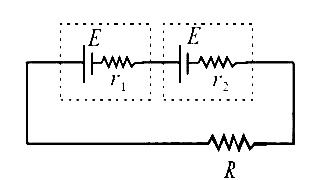
Two cells, having the same e.m.f. are connected in series through an external resistance R. Cells have internal resistances r1 and r2 (r1 > r2) respectively. When the circuit is closed, the potential difference across the first cell is zero. The value of R is
(A)
r1 + r2
(B)
r1 r2
(C)
(D)
(B)

Solution

Kirchhoff’s law has to be applied to the whole loop.

AIPMT 2006 Physics - Current Electricity Question 72 English Explanation
while

If through one section (here the first battery) has zero potential difference, current cannot flow. The question could have been modified.

The statement that when the circuit is closed, the potential difference across the first cell is zero implies that in a series circuit, one part cannot conduct current which is wrong. Kirchhoff’s law is violated.

Assuming that ir1 = E as given in the question paper, some students could have found that R = r1 – r2. They have to be given marks.
Q.29
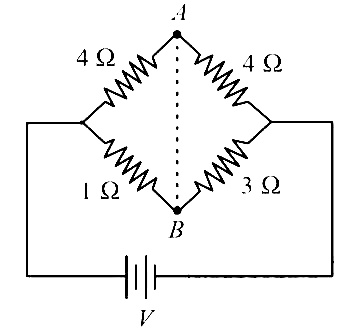
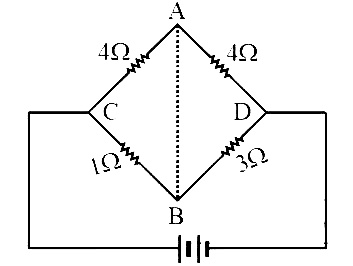
In the circuit shown, if a conducting wire is connected between points A and B, the current in this wire will

AIPMT 2006 Physics - Current Electricity Question 74 English
(A)
flow from B to A
(B)
flow from A to B
(C)
flow in the direction which will be decided by the value of V be zero.
(D)
be zero
(A)

Solution

Current will flow from B to A

AIPMT 2006 Physics - Current Electricity Question 74 English Explanation
Potential drop over the resistance CA will be more due to higher value of resistance. So potential at A will be less as compared with at B. Hence, current will flow from B to A.
Q.30
A parallel plate air capacitor is charged to a potential difference of V volts. After disconnecting the charging battery the distance between the plates of the capacitor is increased using an insulting handle. As a result the potential difference between the plates
(A)
increases
(B)
decreases
(C)
does not charge
(D)
becomes zero
(A)

Solution

If we increase the distance between the plates its capacity decreases resulting in higher potential as we know Q = CV. Since Q is constant (battery has been disconnected), on decreasing C, V will increase.
Q.31
Two circular coils 1 and 2 are made from the same wire but the radius of the 1st coil is twice that of the 2nd coil. What is the ratio of potential difference in volts should be applied across them so that the magnetic field at their centres is the same?
(A)
2
(B)
3
(C)
4
(D)
6
(C)

Solution

Let r1 and r2 are the radius of coil 1 and 2. If B1 and B2 are magnetic induction at their centre, then

and

Since B1 = B2 ; and r1 = 2r2 therefore I1 = 2I2.

Again if R1 and R2 are resistance of the coil 1 and 2 then R1 = 2R2 (as R length = 2r) and if V1 and V2 are the potential difference across them respectively, then

Q.32
When a charged particle moving with velocity is subjected to a magnetic field of induction , the force on it is non-zero. This implies that
(A)
angle between is either zero or 180o
(B)
angle between is necessarily 90o
(C)
angle between can have any value other than 90o
(D)
angle between can have any value other than zero and 180o.
(D)

Solution

Force on a particle moving with velocity in a magnetic field is


F = qvBsin

(i) When = 0°, F = qvBsin0° = 0

(ii) When = 90°, F = qvBsin90° = qvB

(iii) When = 180°, F = qvBsin180° = 0

If angle between v and B is either zero or 180º, then value of F will be zero.
Q.33
Curie temperature above which
(A)
paramagnetic material becomes ferromagnetic material
(B)
ferromagnetic material becomes diamagnetic material
(C)
ferromagnetic material becomes paramagnetic material
(D)
paramagnetic material becomes diamagnetic material
(C)

Solution

Curie temperature is the temperature above which ferromagnetic material becomes paramagnetic material.
Q.34
Two coils of self inductance 2 mH and 8 mH are placed so close together that the effective flux in one coil is completely linked with the other. The mutual inductance between these coils is
(A)
16 mH
(B)
10 mH
(C)
6 mH
(D)
4 mH
(D)

Solution

Mutual inductance is given as,

M = K

Now given, K = 1, L1 = 2 mH, L2 = 8 mH

M = = 4 mH
Q.35
A transistor-oscillator using a resonant circuit with an inductor L (of negligible resistance) and a capacitor C in series produce oscillations of frequency . If L is doubled and C is changed to 4C, the frequency will be
(A)
(B)
(C)
(D)
(D)

Solution

We know that frequency of electrical oscillation in L.C. circuit is

f =


=


[As f1 = f]
Q.36
The core of a transformer is laminated because
(A)
ratio of voltage in primary and secondary may be increased
(B)
energy losses due to eddy currents may be minimised
(C)
the weight of the transformer may be reduced
(D)
rusting of the core may be prevented.
(B)

Solution

The core of a transformer is laminated to minimise the energy losses due to eddy currents.
Q.37
A coil of inductive reactance 31 has a resistance of 8 . It is placed in series with a condenser of capacitative reactance 25 . The combination is connected to an a.c. source of 110 V. The power factor of the circuit is
(A)
0.33
(B)
0.56
(C)
0.64
(D)
0.80
(D)

Solution

Impedance of series LCR is

Z =

=

= = 10

Power factor, cos =
Q.38
A convex lens and a concave lens, each having same focal length of 25 cm, are put in contact to form a combination of lenses. The power in diopters of the combination is
(A)
zero
(B)
25
(C)
50
(D)
infinite.
(A)

Solution

Power of combination in dioptres

P = P1 + P2

= +

= = 0
Q.39
A microscope is focussed on a mark on a piece of paper and then a slab of glass of thickness 3 cm and refractive index 1.5 is placed over the mark. How should the microscope be moved to get the mark in focus again ?
(A)
2 cm upward
(B)
1 cm upward
(C)
4.5 cm downward
(D)
1 cm downward
(B)

Solution

Apparent depth = = = 2 cm

As image appears to be raised by 1 cm, therefore, microscope must be moved upwards by 1 cm.
Q.40
The radius of germanium (Ge) nuclide is measured to be twice the radius of Be. The number of nucleons in Ge are
(A)
72
(B)
73
(C)
74
(D)
75
(A)

Solution

For berillium, R1 = R0 (9)1/3

For germanium, R2 = R0 A1/3

=

=


A = 72
Q.41
Ionization potential of hydrogen atom is 13.6 eV. Hydrogen atoms in the ground state are excited by monochromatic radiation of photon energy 12.1 eV. According to Bohr's theory, the spectral lines emited by hydrogen will be
(A)
one
(B)
two
(C)
three
(D)
four
(C)

Solution

Energy required for exciting the hydrogen atom in the ground state to orbit n is given by

E = En - E1

12.1 = - = 3

n2 = = 9

n = 3

Number of spectral lines emitted

= =
Q.42
In a radioactive material the activity at time t1 is R1 and at a later time t2, it is R2. If the decay constant of the material is , then
(A)
R1 = R2
(B)
R1 = R2e(t1t2)
(C)
R1 = R2e(t1t2)
(D)
R1 = R2(t2/t1).
(B)

Solution

R1 = R0e-t1 and R2 = R0e-t2

= =

R1 = R2e(t1t2)
Q.43
The binding energy of deuteron is 2.2 MeV and that of He is 28 MeV. If two deuterons are fused to form one He then the energy released is
(A)
30.2 MeV
(B)
25.8 MeV
(C)
23.6 MeV
(D)
19.2 MeV
(C)

Solution

+ + energy

Energy released = 28 – 2 × 2.2 = 23.6 MeV
Q.44
A photocell employs photoelectric effect to convert
(A)
change in the frequency of light into a change in the electric current
(B)
change in the frequency of light into a change in electric voltage
(C)
change in the intensity of illumination into a change in photoelectric current
(D)
change in the intensity of illumination into a change in the work function of the photocathode.
(C)

Solution

The photoelectric current is directly proportional to the intensity of illumination. Therefore a change in the intensity of the incident radiation will change the photocurrent also.
Q.45
When photons of energy h fall on an aluminimum plate (of work function E0), photoelectrons of maximum kinetic energy K are ejected. If the frequency of radiation is doubled, the maximum kinetic energy of the ejected photoelectrons will be
(A)
K + h
(B)
K + E0
(C)
2K
(D)
K.
(A)

Solution

According to Einstein’s photoelectric equation,

K = h – E0 ... (i)

and K' = h(2) – E0 ... (ii)

= 2h – E0 = h + h – E0

K'= h + K [using (i)]
Q.46
In a discharge tube ionization of enclosed gas is produced due to collisions between
(A)
neutral gas atoms/molecules
(B)
positive ions and neutral atoms/molecules
(C)
negative electrons and neutral atoms/molecules
(D)
photons and neutral atoms/molecules.
(C)

Solution

In a discharge tube ionization of enclosed gas is produced due to collisions between negative electrons and neutral atoms/molecules.
Q.47
The momentum of a photon of energy 1 MeV in kg m/s will be
(A)
5 1022
(B)
0.33 106
(C)
7 1024
(D)
1022
(A)

Solution

Momentum of photon p = E/c

p =

= 5 1022
Q.48
Which one of the following represents forward bias diode ?
(A)
AIPMT 2006 Physics - Semiconductor Electronics Question 39 English Option 1
(B)
AIPMT 2006 Physics - Semiconductor Electronics Question 39 English Option 2
(C)
AIPMT 2006 Physics - Semiconductor Electronics Question 39 English Option 3
(D)
AIPMT 2006 Physics - Semiconductor Electronics Question 39 English Option 4
(D)

Solution

A diode is said to be forward biased if p-side is at higher potential than n-side of p-n junction.
Q.49
A transistor is operated in common emitter configuration at constant collector voltage VC = 1.5 V such that a change in the base current from 100 A to 150 A profuces a change in the collector current from 5 mA to 10 mA. The current gain is
(A)
50
(B)
67
(C)
75
(D)
100
(D)

Solution

Current gain, =

= = 100
Q.50
The following figure shows a logic gate circuit with two inputs A and B and the output C.

AIPMT 2006 Physics - Semiconductor Electronics Question 66 English 1

The voltage waveforms of A, B and C are as shown below.

AIPMT 2006 Physics - Semiconductor Electronics Question 66 English 2

The logic circuit gate is
(A)
OR gate
(B)
AND gate
(C)
NAND gate
(D)
NOR gate
(B)

Solution

The truth table corresponding to waveform is given by


The given logic circuit gate is AND gate.
Chemistry (Maximum Marks: 200)
  • This section contains 50 questions.
  • Each question has FOUR options (A), (B), (C) and (D). ONLY ONE of these four options is the correct answer.
  • Full Marks : +4 If ONLY the correct option is chosen;
  • Zero Marks : 0 If none of the options is chosen (i.e. the question is unanswered);
  • Negative Marks : −1 In all other cases.
Q.1
Given : The mass of electron is 9.11 1031 kg, Planck constant is 6.626 1034 J s, the uncertainty involved in the measurement of velocity within a distance of 0.1 is
(A)
5.79 105 m s1
(B)
5.79 106 m s1
(C)
5.79 107 m s1
(D)
5.79 108 m s1
(B)

Solution


0.1 10-10 9.11 10-31 =

=

= 5.79 106 m s-1
Q.2
The orientation of an atomic orbital is governed by
(A)
principal quantum number
(B)
azimuthal quantum number
(C)
spin quantum number
(D)
magnetic quantum number.
(D)

Solution

Magnetic quantum number describes the orientation.
Q.3
For the reaction :
CH4(g) + 2O2(g) CO2(g) + 2H2O(l),
Hr = 170.8 kJ mol1.
Which of the following statements is not true?
(A)
The reaction is exothermic.
(B)
At equilibrium, the concentrations of CO2(g) and H2O(l) are not equal.
(C)
The equilibrium constant for the reaction is given by Kp =
(D)
Addition of CH4(g) or O2(g) at equilibrium will cause a shift to the right.
(C)

Solution

Option C is incorrect as the value of KP given is wrong. It should have been

KP =
Q.4
Which of the following pairs constitutes a buffer?
(A)
HCl and KCl
(B)
HNO2 and NaNO2
(C)
NaOH and NaCl
(D)
HNO3 and NH4NO3
(B)

Solution

HNO2 is a weak acid and NaNO2 is its salt thus these two constitute to form an acidic buffer.
Q.5
The hydrogen ion concentration of a 108 M, HCl aqueous solution at 298 K (Kw = 1014) is
(A)
1.0 108 M
(B)
1.0 106 M
(C)
1.0525 107 M
(D)
9.525 108 M
(C)

Solution

In HCl solution [H+] = 10-8 M

Also from water, [H+] = 10-7 M

Total [H+] = 10-8 M + 10-7 M

= 1.1 ×10⁻⁷ M

1.0525 107 M
Q.6
A solution of acetone in ethanol
(A)
obeys Raoult's law
(B)
shows a negative deviation from Raoult's law
(C)
shows a positive deviation from Raoult's law
(D)
behaves like a near ideal solution.
(C)

Solution

A solution of acetone in ethanol shows positive deviation from Raoult's law. It is because ethanol molecules are strongly hydrogen bonded. When acetone is added, these molecules break the hydrogen bonds and ethanol becomes more volatile. Therefore its vapour pressure is increased.
Q.7
During osmosis, flow of water through a semipermeable membrane is
(A)
from solution having lower concentration only
(B)
from solution having higher concentration only
(C)
from both sides of semipermeable membrane with equal flow rates
(D)
from both sides of semipermeable membrane with unequal flow rates.
(D)

Solution

The correct answer is Option D: from both sides of semipermeable membrane with unequal flow rates.

In osmosis, water (or any solvent) moves through a semipermeable membrane from a region of lower solute concentration to a region of higher solute concentration. This semipermeable membrane allows the passage of solvent molecules but not solute molecules. The primary aim of this process is to equalize the solute concentrations on both sides of the membrane. However, it is essential to note that while water molecules predominantly move from the area of lower concentration to the area of higher concentration, there is still some movement of water from the higher concentration to the lower concentration side as well. This bidirectional movement occurs because water molecules are constantly in motion, but the net flow results in a higher volume of water moving to the side with higher solute concentration.

This process does not occur with equal flow rates because the driving force of osmosis is to reduce the concentration gradient between the two sides. Therefore, the flow rate is predominantly higher from the lower solute concentration side to the higher solute concentration side until an equilibrium is reached, at which point the net flow of water equalizes, but does not necessarily stop. This imbalance in flow rates demonstrates why Option D is the most accurate description of osmotic flow through a semipermeable membrane.

Q.8
1.00 g of a non-electrolyte solute (molar mass 250 g mol1) was dissolved in 51.2 g of benzene. If the freezing point depression constant, Kf of benzene is 5.12 K kg mol1, the freezing point of benzene will be lowered by
(A)
0.2 K
(B)
0.4 K
(C)
0.3 K
(D)
0.5 K
(B)

Solution

Molality of non-electrolyte solute

= = 0.0781 m

Tf = kf m

= 5.12 × 0.0781 = 0.4 K
Q.9
A solution containing 10 g per dm3 of urea (molecular mass = 60 g mol1) is isotonic with a 5% solution of a nonvolatile solute is
(A)
200 g mol1
(B)
250 g mol1
(C)
300 g mol1
(D)
350 g mol1
(C)

Solution

For isotonic solution,

osmotic pressure of urea = osmotic pressure of nonvolatile solute

=

m = 300 g mol–1
Q.10
Identify the correct statement for change of Gibb's energy for a system (Gsystem) at constant temperature and pressure.
(A)
If Gsystem < 0, the process is not spontaneous.
(B)
If Gsystem > 0, the process is spontaneous.
(C)
If Gsystem = 0, the system has attained equilibrium.
(D)
If Gsystem = 0, the system is till moving in a particular direction.
(C)

Solution

Gsystem < 0, process is spontaneous.

Gsystem = 0, process is in equilibrium.

Gsystem > 0, process is not spontaneous.
Q.11
Assume each reaction is carried out in an open container. For which reaction will H = E ?
(A)
2CO(g) + O2(g)   2CO2(g)
(B)
H2(g) + Br2(g)  2HBr(g)
(C)
C(s) + 2H2O(g)  2H2(g) + CO2(g)
(D)
PCl5(g) PCl3(g) + Cl2(g)
(B)

Solution

We know that

H = E + ngRT

In the reaction, H2(g) + Br2(g) 2HBr(g)

ng = 2 - (1 + 1) = 0

So, H = E for this reaction.
Q.12
The enthalpy and entropy change for the reaction:
Br2(l) + Cl2(g) 2BrCl(g)
are 30 kJ mol1 and 105 J K1 mol1 respectively.
The temperature at which the reaction will be in equilibrium is
(A)
300 K
(B)
285.7 K
(C)
273 K
(D)
450 K
(B)

Solution

G = H – TS

Now, at equilibrium G = 0

0 = H – TS

0 = 30000 –T (105)

T = = 285.7 K
Q.13
The enthalpy of hydrogenation of cyclohexene is is 119.5 kJ mol1. If resonance energy of benzene is 150.4 kJ mol1, its enthalpy of hydrogenation would be
(A)
358.5 kJ mol1
(B)
508.9 kJ mol1
(C)
208.1 kJ mol1
(D)
269.9 kJ mol1
(C)

Solution

AIPMT 2006 Chemistry - Thermodynamics Question 53 English Explanation

The resonance energy provides extra stability to the benzene molecule so it has to over come for hydrogenation to take place.

So H = – 358.5 – (–150.4) = –208.1 kJ
Q.14
A hypothetical electrochemical cell is shown below.


The emf measured is + 0.20 V. The cell reaction is
(A)
A + B+ A+ + B
(B)
A+ + B A + B+
(C)
A+ + e A;  B+ + e B
(D)
the cell reaction cannot be predicted.
(A)

Solution

From the given expression:

At anode : A A+ + e

At cathode : B+ + e B

Overall reaction is : A + B+ A+ + B
Q.15
EoFe2+/Fe = 0.441 V and EoFe3+/Fe2+ = 0.771 V, the standard EMF of the reaction Fe + 2Fe3+ 3Fe2+ will be
(A)
0.111 V
(B)
0.330 V
(C)
1.653 V
(D)
1.212 V
(D)

Solution

At anode : Fe Fe2+ + 2e-; Eo = -0.441 V

At cathode : Fe3+ + e Fe2+; Eo = 0.771 V

Fe + 2Fe3+ 3Fe2+; Eo = ?

To get the above equation, (ii) × 2 – (i)

2Fe3+ + 2e 2Fe2+; Eo = 0.771 V

Fe Fe2+ + 2e-; Eo = - 0.441 V
------------------------------------------------
Fe + 2Fe3+ 3Fe2+

Eo = 0.771 + 0.441 = 1.212 V
Q.16
For the reaction, 2A + B 3C + D, which of the following does not express the reaction rate?
(A)
(B)
(C)
(D)
(B)

Solution

Given,

2A + B 3C + D

Rate of reaction =

=

Q.17
Consider the reaction :  N2(g) + 3H2(g) 2NH3(g)

The equality relationship between and is
(A)
(B)
(C)
(D)
(C)

Solution

N2(g) + 3H2(g) 2NH3(g)

Rate =

Q.18
The appearance of colour in solid alkali metal halides is generally due to
(A)
interstitial positions
(B)
F.-centres
(C)
Schottky defect
(D)
Frenkel defect
(B)

Solution

F-centres are the sites where anions are missing and instead electrons are present. They are responsible for colours.
Q.19
CsBr crystallises in a body centered cubic lattice. The unit cell length is 436.6 pm. Given that the atomic mass of Cs = 133 and that of Br = 80 amu and Avogadro number being 6.02 1023 mol1, the density of CsBr is
(A)
4.25 g/cm3
(B)
42.5 g/cm3
(C)
0.425 g/cm3
(D)
8.25 g/cm3
(A)

Solution

Density of CsBr =

=

= 4.25 g/cm3
Q.20
A plot of log(x/m) versus log p for the adsorption of a gas on a solid gives a straight line with slope equal to
(A)
log K
(B)
log K
(C)
n
(D)
1/n
(D)

Solution

According to Freundlich adsorption isotherm, in the median range of pressure


   = kP

taking log both sides, we get,

log = logk + logP

Here in graph between log and logP, slope is and intercepts = log k.
Q.21
Which one of the following orders is not in accordance with the property stated against it?
(A)
F2 > Cl2 > Br2 > I2 : Bond dissociation energy
(B)
F2 > Cl2 > Br2 > I2 : Oxidising power
(C)
HI > HBr > HCl > HF : Acidic property in water
(D)
F2 > Cl2 > Br2 > I2 : Electronegativity.
(A)

Solution

Bond dissociation energy is kcal/mol of F - F, Cl - Cl, Br - Br and I - I are 38, 57, 45.5 and 35.6 respectively.

Bond dissociation energy of fluorine is less because of its small size and repulsion between electrons of two atoms.
Q.22
Which one of the following orders is not in accordance with the property stated against it ?
(A)
F2 > Cl2 > Br2 > I2 : Bond dissociation energy
(B)
F2 > Cl2 > Br2 > I2 : Oxidising power
(C)
HI > HBr > HCl > HF : Acidic property in water
(D)
F2 > Cl2 > Br2 > I2 : Electronegativity
(A)

Solution


X - X bond dissociation energy (kcal/mol)

The lower value of bond dissociation energy of fluorine is due to the high inter-electronic repulsion between non-bonding electrons in the 2p-orbitals of fluorine. As a result F - F bond is weaker in comparison to Cl - Cl and Br - Br bonds.
Q.23
Which of the following is not isostructural with SiCl4 ?
(A)
NH4
(B)
SCl4
(C)
SO42
(D)
PO43
(B)

Solution

SiCl4, NH4+, SO42- and PO43- ions are the examples of molecules/ions which are of AB4 type and have tetrahedral structure. SCl4 is AB4(lone pair) types species. Although the arrangement of five sp3d hybrid orbitals in space is trigonal bipyramidal, due to the presense of one lone pair of electron in the basal hybrid orbital, the shape of AB4(lone pair) species gets distorted and becomes distorted tetrahedral or see-saw.
Q.24
Which of the following is not a correct statement?
(A)
Multiple bonds are always shorter than corresponding single bonds.
(B)
The electron-deficient molecules can act as Lewis acids.
(C)
The canonical structures have no real existence.
(D)
Every AB5 molecule does in fact have square pyramid structure.
(D)

Solution

AB5 molecule has generally trigonal bipyramidal structure. Sometimes due to presence of lone pair of electrons the structure gets distorted.
Q.25
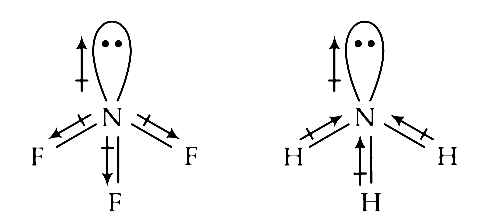
The electronegativity difference berween N and F is greater than that between N and H yet the dipole moment of NH3 (1.5D) is larger than that of NF3 (0.2 D). This is because
(A)
in NH3 the atomic dipole and bond dipole are in the opposite directions whereas in NF3 these are in the same direction
(B)
in NH3 as well as in NF3 the atomic dipole and bond dipole are in the same direction
(C)
in NH3 the atomic dipole and bond dipole are in the same direction whereas in NF3 these are in opposite directions
(D)
in NH3 as well as in NF3 the atomic dipole and bond dipole are in opposite directions.
(C)

Solution

The dipole moment of NF3 is 0.24 D and of NH3 is 1.48 D. In NF3, the dipole moment vector are aligned in opposite direction to that of the dipole moment vector of lone pair on N–atom which partly cancel out. On the other hand, N–H bonds in NH3 are in the same direction of dipole moment of the lone pair on N-atom which adds up the new resultant dipole moment. AIPMT 2006 Chemistry - Chemical Bonding and Molecular Structure Question 47 English Explanation
Q.26
Which of the following species has a linear shape?
(A)
O3
(B)
NO2
(C)
SO2
(D)
NO2+
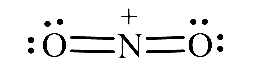
(D)

Solution

Due to sp hybridisation of N+, NO2+ ion has linear shape.
AIPMT 2006 Chemistry - Chemical Bonding and Molecular Structure Question 69 English Explanation
Q.27
The correct order of the mobility of the alkali metal ions in aqueous solution is
(A)
Rb+ > K+ > Na+ > Li+
(B)
Li+ > Na+ > K+ > Rb+
(C)
Na+ > K+ > Rb+ > Li+
(D)
K+ > Rb+ > Na+ > Li+
(A)

Solution

Ionic radii of alkali metals in water follows the order
Li+ > Na+ > K+ > Rb+ > Cs+

Thus in aqueous solution due to larger ionic radius Li+ has lowest mobility and hence the correct order of ionic mobility is

Rb+ > K+ > Na+ > Li+
Q.28
Which of the following is the most basic oxide?
(A)
SeO2
(B)
Al2O3
(C)
Sb2O3
(D)
Bi2O3
(D)

Solution

SeO2 acidic oxide

Al2O3 amphoteric,

Sb2O3 amphoteric

Bi2O3 basic oxide.
Q.29
In which of the following molecules are all the bonds are not equal?
(A)
NF3
(B)
ClF3
(C)
BF3
(D)
AlF3
(B)

Solution

The Cl - F (Cl - Fb) bond length is equal to 1.60 while each of two axial Cl - F (Cl - Fa) bond length is equal to 1.70 .
Q.30
The correct order regarding the electronegativity of hybrid orbitals of carbon is
(A)
sp < sp2 < sp3
(B)
sp > sp2 < sp3
(C)
sp > sp2 > sp3
(D)
sp < sp2 > sp3
(C)

Solution

Among the three given hybrid orbitals, sp hybrid orbital is most electronegative. Contribution of s in sp hybrid orbital is maximum (50%) so this orbital is closer to nucleus. Naturally it will have greater tendency to pull electron towards it. Hence it becomes more electronegative and sp3 becomes least electronegative as it has only 25% s-character.
Q.31
Copper sulphate dissolves in excess of KCN to give
(A)
Cu(CN)2
(B)
CuCN
(C)
[Cu(CN)4]3
(D)
[Cu(CN)4]2
(C)

Solution

Copper sulphate on treatment with excess of KCN forms complex K3[Cu(CN)4] or [Cu(CN)4]3–

2CuSO4 + 10KCN 2K3[Cu(CN)4] + 2K2SO4 + (CN)2
Q.32
More number of oxidation states are exhibited by the actinoids than by the lanthanoids. The main reason for this is
(A)
more active nature of the actinoids
(B)
more energy difference between 5f and 6d orbitals than that between 4f and 5d orbitals
(C)
lesser energy difference between 5f and 6d orbitals than that between 4f and 5d orbitals
(D)
greater metallic character of the lanthanoids than that of the corresponding actinoids.
(C)

Solution

The 5f-orbitals extend into space beyond the 6s and 6p-orbitals and participate in bonding. This is in direct contrast to the lanthanides where the 4f-orbitals are buried deep inside in the atom, totally shielded by outer orbitals and thus unable to take part in bonding.
Q.33
In which of the following pairs are both the ions coloured in aqueous solution?
(At. no. : Sc = 21, Ti = 22, Ni = 28, Cu = 29, Co = 27)
(A)
Ni2+, Cu+
(B)
Ni2+, Ti3+
(C)
Sc3+, Ti3+
(D)
Sc3+, Co2+.
(B)

Solution

For Ni+2 = [Ar] 3d84s0 (2 Unpaired electrons)

Ti+3 = [Ar] 3d84s0 (1 unpaired electron)

Sc+3 = [Ar] (0 unpaired electron)

Cu+ = [Ar] 3d10 (0 unpaired electron)

Hence, Ni+2 and Ti3+ are coloured in aqueous solution due to the presence of unpaired electrons in d-subshell.
Q.34
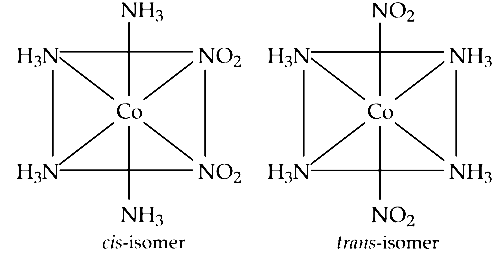
[Co(NH3)4(NO2)2]Cl exhibits
(A)
linkage isomerism, geometrical isomerism and optical isomerism
(B)
linkage isomerism, ionization isomerism and optical isomerism
(C)
linkage isomerism, ionization isomerism and geometrical isomerism
(D)
ionization isomerism, geometrical isomerism and oprical isomerism.
(C)

Solution

Ionization isomerism arises when the coordination compounds give different ions in solution.

Co(NH3)4(NO2)2]Cl ⇌ Co(NH3)4(NO2)2]+ + Cl-

Co(NH3)4(NO2)2]Cl and Co(NH3)4(ONO)2]Cl are linkage isomers as NO2 is linked through N or through O.

Octahedral complexes of the type MA4B2 exhibit geometrical isomerism.

AIPMT 2006 Chemistry - Coordination Compounds Question 62 English Explanation
Q.35
[Cr(H2O)6]Cl3 (At. no. of Cr = 24) has a magnetic momen of 3.83 B.M. The correct distribution of 3d electrons in the chromium of the complex is
(A)
(B)
(C)
(D)
(D)

Solution

3.83 =

n = 3

Thus, number of unpaired electrons in d-orbitals subshells of chromium (Cr = 24) = 3

Configuration of Cr = 1s2 2s2 2p6 3s2 3p6 3d3

In 3d3 the distribution of electrons

,
Q.36
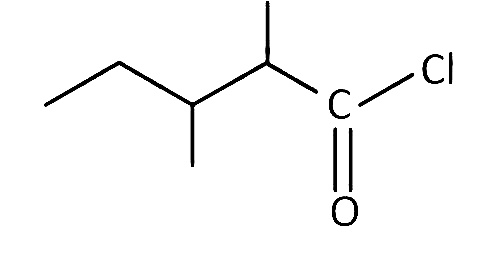
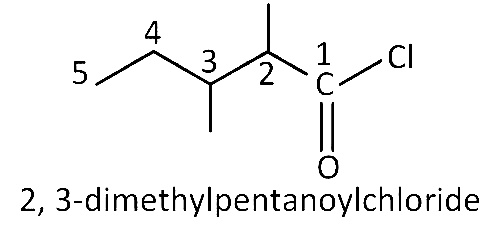
The IUPAC name of

AIPMT 2006 Chemistry - Some Basic Concepts of Organic Chemistry Question 67 English

is
(A)
1-chloro-1-oxo-2, 3-dimethylpentane
(B)
2-ethyl-3-methylbutanoyl chloride
(C)
2, 3-dimethylpentanoyl chloride
(D)
3, 4-dimethylpentanoyl chloride.
(C)

Solution

AIPMT 2006 Chemistry - Some Basic Concepts of Organic Chemistry Question 67 English Explanation
Q.37
Which of the following is not chiral?
(A)
2-Hydroxypropanoic acid
(B)
2-Butanol
(C)
2,3-Dibromopentane
(D)
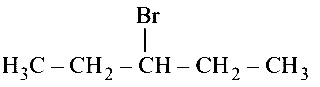
3-Bromopentane
(D)

Solution

AIPMT 2006 Chemistry - Haloalkanes and Haloarenes Question 31 English Explanation

Due to absence of asymmetric carbon atom.
Q.38
The general molecular formula, which represents the homologous series of alkanols is
(A)
CnH2nO
(B)
CnH2nO2
(C)
CnH2n + 2O
(D)
CnH2n + 1O
(C)

Solution

All alcohols follow the general formula as CnH2n+2O.
Q.39
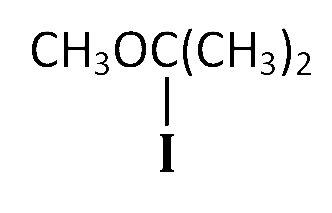
The major organic product in the reaction is

CH3 O CH(CH3)2 + HI products
(A)
CH3I + (CH3)2CHOH
(B)
CH3OH + (CH3)2CHI
(C)
ICH2OCH(CH3)2
(D)
AIPMT 2006 Chemistry - Alcohol, Phenols and Ethers Question 34 English Option 4
(A)

Solution

In case of unsymmetric ethers when treated with HI then I attaches to smaller and less complex alkyl group as it follows SN2 mechanism

CH3 O CH(CH3)2 + HI CH3I + (CH3)2CHOH
Q.40
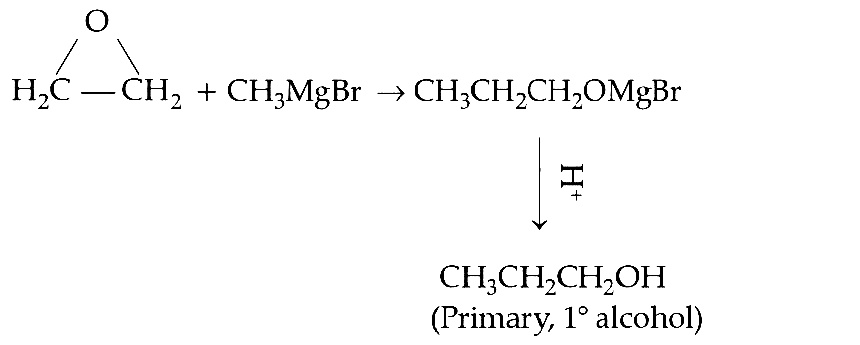
Ethylene oxide when treated with Grignard reagent yields
(A)
primary alcohol
(B)
secondary alcohol
(C)
tertiary alcohol
(D)
cyclopropyl alcohol
(A)

Solution

AIPMT 2006 Chemistry - Alcohol, Phenols and Ethers Question 40 English Explanation
Q.41
The general molecular formula, which represents the homologous series of alkanols is
(A)
CnH2n+2O
(B)
CnH2nO2
(C)
CnH2nO
(D)
CnH2n+1O
(A)

Solution

General molecular formula of alkanols is

CnH2n+2O or CnH2n+1OH
Q.42
Self condensation of two moles of ethyl acetate in presence of sodium ethoxide yields
(A)
ethyl propionate
(B)
ethyl butyrate
(C)
acetoacetic ester
(D)
methyl acetoacetate
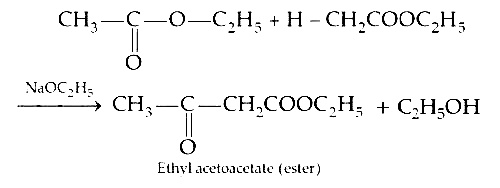
(C)

Solution

AIPMT 2006 Chemistry - Aldehydes, Ketones and Carboxylic Acids Question 54 English Explanation
Q.43
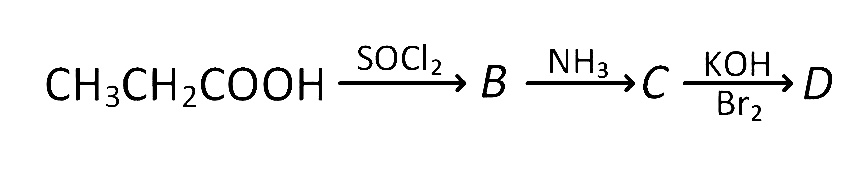
In a set of reactions propionic acid yielded a compound D.
AIPMT 2006 Chemistry - Aldehydes, Ketones and Carboxylic Acids Question 55 English
The structure of D would be
(A)
CH3CH2NH2
(B)
CH3CH2CH2NH2
(C)
CH3CH2CONH2
(D)
CH3CH2NHCH3
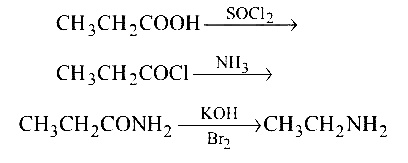
(A)

Solution

AIPMT 2006 Chemistry - Aldehydes, Ketones and Carboxylic Acids Question 55 English Explanation
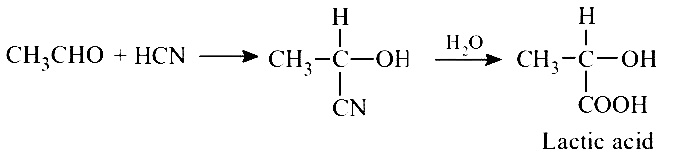
Q.44
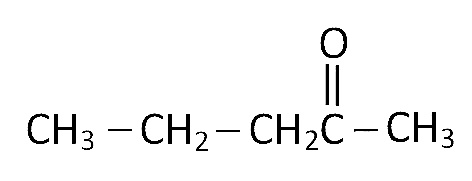
A carbonyl compound reacts with hydrogen cyanide to form cyanohydrin which on hydrolysis forms a racemic mixture of -hydrixy acid. The carbonyl compound is
(A)
formaldehyde
(B)
acetaldehyde
(C)
acetone
(D)
diethyl ketone
(B)

Solution

AIPMT 2006 Chemistry - Aldehydes, Ketones and Carboxylic Acids Question 78 English Explanation
Q.45
Nucleophilic addition reaction will be most favoured in
(A)
CH3CHO
(B)
AIPMT 2006 Chemistry - Aldehydes, Ketones and Carboxylic Acids Question 57 English Option 2
(C)
(CH3)2C O
(D)
CH3CH2CHO
(A)

Solution

Aldehydes are more reactive than ketones due to +I effect of –CH3 group. There are two –CH3 group in acetone which reduces +ve charge density on carbon atom of carbonyl group. More hindered carbonyl group too becomes less reactive. So in the given case CH3CHO is the right choice.
Q.46
Which of the following is more basic than aniline?
(A)
Benzylamine
(B)
Diphenylamine
(C)
Triphenylamine
(D)
-Nitroaniline
(A)

Solution

Benzylamine is more basic than aniline. The reason is that in aniline, the lone pair of nitrogen is conjugated with benzene ring so it is not available readily for others. On the other hand in Benzylamine, nitrogen is not directly attached with ring so lone pairs are not conjugated with ring.
Q.47
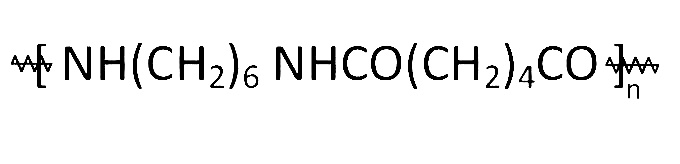
AIPMT 2006 Chemistry - Polymers Question 10 English
is a
(A)
homopolymer
(B)
copolymer
(C)
addition polymer
(D)
thermosetting polymer.
(B)

Solution

It is formed by the condensation of adipic acid and hexamethylene diamine. It is a copolymer.
Q.48
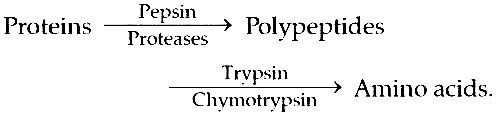
During the process of digestion, the proteins present in food materials are hydrolysed to amino acids. The two enzymes involved in the process-
AIPMT 2006 Chemistry - Biomolecules Question 20 English
are respectively
(A)
invertase and zymase
(B)
amylase and maltase
(C)
diastage and lipase
(D)
pepsin and trypsin
(D)

Solution

AIPMT 2006 Chemistry - Biomolecules Question 20 English Explanation
Q.49
The human body does not produce
(A)
enzymes
(B)
DNA
(C)
vitamins
(D)
hormones
(C)

Solution

Vitamins are not produced in human body and they have to be taken from an outside source.
Q.50
Which one of the following is a peptide hormone?
(A)
Adrenaline
(B)
Glucagon
(C)
Testosterone
(D)
Thyroxine
(B)

Solution

Glucagon is a single chain peptide of 29 amino acids, synthesised by the -cells in the islets of Langerhans of the pancreas.
Biology (Maximum Marks: 372)
  • This section contains 93 questions.
  • Each question has FOUR options (A), (B), (C) and (D). ONLY ONE of these four options is the correct answer.
  • Full Marks : +4 If ONLY the correct option is chosen;
  • Zero Marks : 0 If none of the options is chosen (i.e. the question is unanswered);
  • Negative Marks : −1 In all other cases.
Q.1
Which of the following statements regarding mitochondrial membrane is not correct ?
(A)
The inner membrane is highly convoluted forming a series of infoldings
(B)
The outer membrane resembles a sieve
(C)
The outer membrane is permeable to all kinds of molecules
(D)
The enzymes of the electron transfer chain are embedded in the outer membrane
(D)

Solution

The enzymes of electron transport system are present in inner mitochondrial membrane
Q.2
Which of the following statements regarding cilia is not correct ?
(A)
Microtubules of cilia are composed of tubulin
(B)
The organized beating of cilia is controlled by fluxes of Ca2+ across the membrane
(C)
Cilia are hair-like cellular appendages
(D)
Cilin contain an outer ring of nine doublet microtubules surrounding two single microtubules
(B)

Solution

Eukaryotic cilia are made up of tubulin protein. Cilia have a core of 2 microtubules and around there are 9 doublet microtubules. These are not at all hair like structures.
Q.3
A major breakthrough in the studies of cells came with the development of electron microscope. This is because
(A)
Electron beam can pass through thick materials, whereas light microscopy requires thin sections
(B)
The resolution power of the electron microscope is much higher than that of the light microscope
(C)
The electron microscope is more powerful than the light microscope as it uses a beam of electrons which has wavelength much longer than that of photons
(D)
The resolving power of the electron microscope is 200-350 nm as compared to 0.1-0.2 nm for the light microscope
(D)

Solution

Microscopes are used for studying cellular structures. They are used to magnify small objects. In electron microscopes, a high energy beam of electrons is focused through electromagnetic lenses. It can magnify very small details with high resolving power. The increased resolution results from the shorter wavelength of the electron beam.
Q.4
An organic substance bound to an enzyme and essential for its activity is called
(A)
isoenzyme
(B)
coenzyme
(C)
holoenzyme
(D)
apoenzyme.
(B)

Solution

Coenzyme is an organic substance that enhances the action of an enzyme by binding with the protein molecule. Holoenzyme is a biochemically active compound formed by the combination of an enzyme with a coenzyme. Apoenzyme is the protein part of an enzyme to which the coenzyme attaches to form an active enzyme. Isoenzyme is one of the several forms of an enzyme that catalyse the same reaction but differ from each other in such properties as substrate affinity and maximum rates of enzyme substrate reaction.
Q.5
The arrangement of the nuclei in a normal embryo sac in the dicot plants is
(A)
3 + 3 +2
(B)
2 + 4 + 2
(C)
3 + 2 + 3
(D)
2 + 3 + 3
(C)

Solution

In a dicot plant general arrangement of nuclei in the embryosac is that 3 nuclei in 3 cells of egg apparatus (one egg cell & 2 synergids) at micropylar end and 2 polar nuclei in almost middle region and 3 nuclei in the form of antipodals at the distal end from micropyle, towards nucellus. So total nuclei 3 + 2 + 3.
Q.6
In a cereal grain the single cotyledon of embryo is represented by
(A)
coleoptile
(B)
coleorhiza
(C)
scutellum
(D)
prophyll.
(C)

Solution

Single cotyledon of embryo in cereal grain is represented by scutellum. Coleoptile represents the covering of stem. Coleorrhiza represents the covering of root.
Q.7
Parthenocarpic tomato fruits can be produced by
(A)
treating the plants with phenylmercuric acetate
(B)
removing androcium of flowers before pollen grains are released
(C)
treating the plants with low concentrations of gibberellic acid and auxins
(D)
raising the plants from vernalized seeds.
(C)

Solution

Parthenocarpy is the development of fruits without prior fertilization which results in the formation of seedless fruits. In some plant species, parthenocarpic fruits are produced naturally or they may be induced by treatment of the unpollinated flowers with auxin.

Removal of androecium before pollen release is called emasculation which is helpful in preventing unwanted pollination. Vernalized seeds are treated at ion temperature for breaking dormancy. Phenyl Mercuric Acetate is an antitranspirant.

Gibberellins and Auxins are known to induce parthenocarpy in plants. If a tomato plant is treated with a low concentration of auxin and gibberellic acid it’ll produce fruits without fertilization i.e. parthenocarpic fruits.
Q.8
A common structural feature of vessel elements and sieve tube elements is-
(A)
Enucleate condition
(B)
Presence of p-protein
(C)
Thick secondary walls
(D)
Pores on lateral wall
(A)

Solution

In plants, conducting tissue xylem has an important integral cell as xylem vessel which is enucleate. The phloem on other hand has a row of sieve tubes which are also enucleate at maturity.
Q.9
The translocation of organic solutes in sieve tube members is supported by
(A)
cytoplasmic streaming
(B)
root pressure and transpiration pull
(C)
P-proteins
(D)
mass flow involving a carrier and ATP.
(C)

Solution

P-protein is the supporting factor for the translocation of organic solutes in sieve tubes
Q.10
Sulphur is an important nutrient for optimum growth and productivity in
(A)
oilseed crops
(B)
pulse crops
(C)
cereals
(D)
fibre crops.
(A)

Solution

Sulphur is present in all the cells of the body in association with proteins made of sulphur containing amino acids, viz., cystine, cysteine and methionine. Members of Cruciferae and animal proteins are rich sources of sulphur; other vegetable proteins (e.g., pulses) have only little sulphur. Plants absorb sulphur from soil in the form of sulphate ions (SO4 – –).

It is a constituent of ferredoxin and some of the lipids present in chloroplasts. Pungent odour of mustard, cabbage, turnip, etc. of Family Brassicaceae is due to the presence of sulphur containing oils. Application of 40 kg/ha to oilseed based cropping system is found to increase the yield, oil and protein content of the seeds.
Q.11
How many ATP molecules could maximally be generated from one molecule of glucose, if the complete oxidation of one mole of glucose to CO2 and H2O yields 686 kcal and the useful chemical energy available in the high energy phosphate bond of one mole of ATP is 12 kcal?
(A)
1
(B)
2
(C)
30
(D)
57
(D)

Solution

12 kcal of energy present in one molecule of ATP & on oxidation of one mole of glucose into CO2 and H2O energy released is 686 kcal. So no. of ATP which can store this energy would be = 57.1 = 57 ATPs.
Q.12
Restriction endonuclease -
(A)
Cuts the DNA molecule at specific sites
(B)
Synthesizes DNA
(C)
Restricts the synthesis of DNA inside the nucleus
(D)
Cuts the DNA molecule randomly
(A)

Solution

Restriction endonucleases were found by Arber in 1962 in bacteria. They act as “molecular scissors” or chemical scalpels. They recognize the specific base sequence at palindrome sites in DNA duplex and cut its strands. For example, restriction endonuclease EcoRI found in the colon bacteria E. coli recognizes the base sequence GAATTC in DNA duplex and cuts its strands between G and A.
Q.13
Two microbes found to be very useful in genetic engineering are-
(A)
Diplococcus sp.and Pseudomonas sp.
(B)
Vibrio cholerae and a tailed bacteriophage
(C)
Crown gall bacterium and Caenorhabditis elegans
(D)
Escherichia coli and Agrobacterium tumefaciens
(D)

Solution

Escherichia coli is a bacterium found in human colon. On this bacterium scientists have made extensive genetic experiments to make some vital chemicals like insulin. Another bacterium is Agrobacterium tumefaciens which causes crown gall in plants is extensively used for genetic experiments.
Q.14
Which of the following pairs of an animal and a plant represents endangered organisms in India ?
(A)
Cinchona and Leopard
(B)
Tamarind and Rhesus monkey
(C)
Banyan and Black buck
(D)
Bentinckia nicobarica and Red Panda
(D)

Solution

Endangered plant is Bentinckia nicobarica & endangered animal is Red Panda (Ailurus fulgens).
Q.15
Which one of the following is the correctly matched pair of an endangered animal and a National Park ?
(A)
Wild Ass – Dudhwa National Park
(B)
Lion – Corbett National Park
(C)
Great Indian – Keoladeo National Park Bustard
(D)
Rhinoceros – Kaziranga National Park
(D)

Solution

Kaziranga National Park of Assam is known for the conservation of rhinoceros.
Q.16
Which one of the following is not included under in-situ conservation ?
(A)
Biosphere reserve
(B)
National park
(C)
Sanctuary
(D)
Botanical garden
(D)

Solution

In situ conservation means “on-site conservation”. In situ conservation is the protection and management of important components of biological diversity through a network of protected areas e.g., National Park, sanctuary, biosphere reserve, etc. Botanical gardens come under ex situ conservation.
Q.17
Which of the following is considered a hot-spot of biodiversity in India ?
(A)
Eastern Ghats
(B)
Western Ghats
(C)
Aravalli Hills
(D)
Indo-Gangetic Plain
(B)

Solution

Hot spot are those areas which were rich in biodiversity but now under threat due to direct or indirect interference of human activites. These regions are on the edge to get some of their species extinct due to humans. Western Ghats in India are under threat due to continuous developmental activities and Doon valley is under threat due to continuous mining activities.
Q.18
Which of the following environmental conditions are essential for optimum growth of Mucor on a piece of bread?
A.   Temperature of about 25o C
B.   Temperature of about 5o C
C.   Relative humidity of about 5%
D.   Relative humidity of about 95%
E.   A shady place
F.   A brightly illuminated place
Choose the answer from the following options.
(A)
B, C and F only
(B)
A, C and E only
(C)
A, D and E only
(D)
B, D and E only
(C)

Solution

Mucor is a fungus and most of the fungi require the optimum temperature of about 15- 30ºC, good moisture content in atmosphere and not very dark and not very lightened place. So Mucor requires a temperature of about 25ºC, humidity about 95% and a shady place to grow fully.
Q.19
Curing of tea leaves is brought about by the activity of
(A)
fungi
(B)
bacteria
(C)
mycorrhiza
(D)
viruses.
(B)

Solution

For curing of tea, a bacteria Micrococcus candicans is used.

Curing of tea leaves is brought about by the activity of bacteria. It is essentially an oxidation, dry fermentation process, during which water is driven off the green colour is lost and the leaves assume a tougher texture and undergo chemical changes.
Q.20
Pineapple (ananas) fruit develops from
(A)
a multilocular monocarpellary flower
(B)
a unilocular polycarpellary flower
(C)
a multipistillate syncarpous flower
(D)
a cluster of compactly borne flowers on a common axis.
(D)

Solution

Pineapple (Ananas sativus) is a sorosis fruit developed from a composite inflorescence which is actually a cluster of compactly borne flowers on a common axis
Q.21
In which of the following fruits, the edible part is the aril ?
(A)
Litchi
(B)
Custard apple
(C)
Promegranate
(D)
Orange
(A)

Solution

In litchi, aril forms the edible part in fruit. It is a collar like outgrowth from the base of the ovule forming a kind of third integument. Aril is also found in Asphodelus, Trianthema and Ulmus. Litchi is a nut. In litchi, the epicarp and mesocarp (layers of pericarp) together become leathery and the endocarp is membranous.
Q.22
Long filamentous threads protruding at the end of a young cob of maize are
(A)
hairs
(B)
anthers
(C)
styles
(D)
ovaries.
(C)

Solution

Long filamentous threads of maize are the styles of the ovaries. In fact, these are the longest styles in plants.
Q.23
Pentamerous actinomorphic flowers, bicarpellary ovary with oblique septa, and fruit capsule or berry, are characteristic features of
(A)
Liliaceae
(B)
Asteraceae
(C)
Brassicaceae
(D)
Solanaceae
(D)

Solution

A pentamerous actinomorphic flower is one where the floral parts are in multiples of five and the flower can be divided into two equal halves in more than one plane. Gynoecium is bicarpellary, syncarpous, forming a superior bilocular ovary. Each locule has many ovule on axile placentation. Members of solanaceae are characterised by the presence of an obliquely placed septum in the ovary and highly swollen placentae.
Q.24
During photorespiration, the oxygen consuming reaction(s) occur in
(A)
stroma of chloroplasts
(B)
stroma of chloroplasts and mitochondria
(C)
stroma of chloroplasts and peroxisomes
(D)
grana of chloroplasts and peroxisomes.
(C)

Solution

Photorespiration is the process which occurs in C3 plants. In this process, peroxisomes, chloroplast and mitochondria take part. The oxygen consuming reactions occurs in peroxisomes and stroma of chloroplast while CO2 releasing reaction occurs in mitochondria.
Q.25
In photosystem I, the first electron acceptor is
(A)
an iron-sulphur protein
(B)
ferredoxin
(C)
cytochrome
(D)
plastocyanin.
(A)

Solution

In light reaction of photosynthesis two types of photosystems are involved. PS-I consists of plenty of chlorophyll-a and very less quantity of chlorophyll-b. These pigments absorb light energy and transfer it to the reaction centre - P700. After absorbing adequate amount of light energy electron gets excited from P700 molecule and moves to iron-sulphur protein complex, designated as A (Fe-S). It gets reduced after accepting electrons. It later gives these electron to ferredoxin and gets oxidised again.
Q.26
Phenotype of an organism is the result of-
(A)
Environmental changes and sexual dimorphism
(B)
Cytoplasmic effects and nutrition
(C)
Genotype and environment interactions
(D)
Mutations and linkages
(C)

Solution

Phenotype is the appearance of one organism while genotype is the gene complement it has from its ancestors. These genes only show their effect in phenotype but environment also plays an important role in this. Hence phenotype is a result of genotype and environmental interaction.
Q.27
Which one of the following is an example of polygenic inheritance ?
(A)
Skin colour in humans
(B)
Pod shape in garden pea
(C)
Production of male honey bee
(D)
Flower colour in Mirabilis jalapa
(A)

Solution

Polygenic inheritance is the inheritance of traits which are dependent on the no. of genes such as the skin colour of human beings. eg. AABB is black AaBB in neither dark nor black. AaBb is again wheatish Aabb is light and aabb is white colour.
Q.28
How many different kinds of gametes will be produced by a plant having the genotype AABbCC ?
(A)
Two
(B)
Nine
(C)
Four
(D)
Three
(A)

Solution

It would make only two types of gametes, these are ABC & AbC.
Q.29
Sickle cell anaemia has not been eliminated from the African population because-
(A)
It is not a fatal disease
(B)
It is controlled by dominant genes
(C)
It is controlled by recessive genes
(D)
It provides immunity against malaria
(D)

Solution

In sickle cell anaemia RBCs become sickle shaped which are not supportive for the growth of malarial parasite Plasmodium so it provides immunity against malaria disease.
Q.30
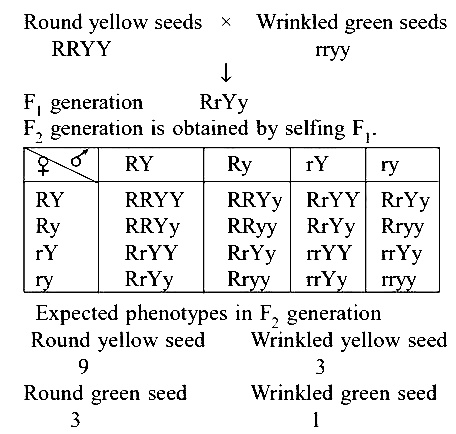
In Mendel's experiments with garden pea, round seed shape (RR) was dominant over wrinkled seeds (rr), yellow cotyledon (YY) was dominant over green cotyledon (yy). What are the expected phenotypes in the F2 generation of the cross RRYY × rryy ?
(A)
Round seeds with yellow cotyledons, and wrinkled seeds with yellow cotyledons
(B)
Only wrinkled seeds with green cotyledons
(C)
Only wrinkled seeds with yellow cotyledons
(D)
Only round seeds with green cotyledons
(A)

Solution

Since round seed shape is dominant over wrinkled seed shape and yellow cotyledon is dominant over green cotyledon so RRYY individuals is round yellow and rryy is wrinkled green. AIPMT 2006 Biology - Principles of Inheritance and Variation Question 114 English Explanation
Q.31
Cri-du-chat syndrome in humans is caused by the-
(A)
Loss of half of the long arm of chromosome 5
(B)
Loss of half of the short arm of chromosome 5
(C)
Trisomy of 21st chromosome
(D)
Fertilization of an XX egg by a normal Y-bearing sperm
(B)

Solution

Cri-du-chat syndrome, also called deletion 5p syndrome, (or 5p minus), is a rare genetic disorder. Cri-du-chat syndrome is due to a partial deletion of the short arm of chromosome number 5. The name of this syndrome is French for “cry of the cat,” referring to the distinctive cry of children with this disorder. The cry is caused by abnormal larynx development, which becomes normal within a few weeks of birth. Infants with cri-du-chat have low birth weight and may have respiratory problems. Some people with this disorder have a shortened lifespan, but most have a normal life expectancy.
Q.32
If a colour blind woman marries a normal visioned man, their sons will be
(A)
All normal visioned
(B)
Three-fourths colourblind and one-fourth normal
(C)
One-half colourblind and one-half normal
(D)
All colourblind
(D)

Solution

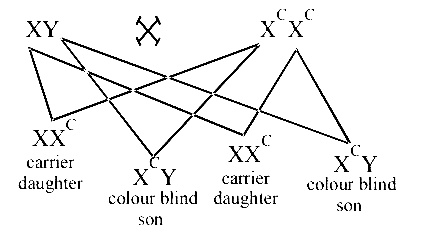
Colour blindness in a X-chromosome linked character. So they’ll be having all colour blind sons and carrier daughters. AIPMT 2006 Biology - Principles of Inheritance and Variation Question 117 English Explanation
Q.33
Both sickle cell anemia and Huntington's chorea are-
(A)
Congenital disorders
(B)
Bacteria-related diseases
(C)
Virus-related diseases
(D)
Pollutant-induced disorders
(A)

Solution

A congenital disorder is a medical condition that is present at birth. Congenital disorders can be a result of genetic abnormalities, the intrauterine environment, or unknown factors. Sickle cell disease [a group of genetic disorders caused by sickle haemoglobin (HbS). HbS molecules tend to clump together, making red blood cells sticky, stiff and more fragile and causing them to form into a curved, sickle shape] and Huntington’s chorea (an inherited disorder characterised by degenerative changes in the basal ganglia structures, which ultimately result in a severely shrunken brain and enlarged ventricles, abnormal body movements called chorea and loss of memory) are congenital disorders.
Q.34
Test cross involves-
(A)
Crossing between two F1 hybrids
(B)
Crossing the F1 hybrid with a double recessive genotype
(C)
Crossing between two genotypes with recessive trait
(D)
Crossing between two genotypes with dominant trait
(B)

Solution

A cross of F1 hybrid with its recessive homozygous parent is called the test cross. It is done to determine the genotype of a given plant. If the given plant has homozygous dominant traits then on test cross it gives all dominant trait plants but if it is heterozygous dominant than it gives dominant and recessive phenotypes in 1 : 1 ratio.
Q.35
Amino acid sequence, in protein synthesis is decided by the sequence of -
(A)
cDNA
(B)
mRNA
(C)
tRNA
(D)
rRNA
(B)

Solution

Messenger RNA or mRNA has been named so because it carries the coded information from DNA for the synthesis of proteins. It carries the coded information in a number of base triplets called codons. It is transcribed on DNA by the enzyme RNA polymerase. Hence, its base sequence is complementary to DNA on which it has been synthesized. In eukaryotes each gene transcribes its own mRNA, therefore the number of mRNAs corresponds to the number of genes. rRNA is a type of RNA that forms structural and functional components of ribosomes. tRNA is a class of RNA having structures with triplet nucleotide sequences that are complementary to the triplet nucleotide coding sequences of mRNA. It binds with amino acids and transfers them to ribosomes.
Q.36
Antiparallel strands of a DNA molecule means that-
(A)
The phosphate groups at the start of two DNA strands are in opposite position (pole)
(B)
One strand turns anti-clockwise
(C)
One strand turns clockwise
(D)
The phosphate groups of two DNA stands, at their ends, share the same position
(A)

Solution

Griffith’s experiment with Pneumococcus proves that DNA is the genetic material. It consists of a long polymer of nucleotides which transcribes the coded information in the form of a triplet code of nucleotides in mRNA. It is a double helical molecule. The two strands of DNA run in opposite directions to one another with the hydrogen bonds between them. One strand of DNA has 5'-3' direction and the other strand has 3'-5' direction. So they are antiparallel. This direction is determined by the presence of a free phosphate or OH group at the end of the strand.
Q.37
Which antibiotic inhibits interaction between tRNA and mRNA during bacterial protein synthesis ?
(A)
Neomycin
(B)
Erythromycin
(C)
Tetracycline
(D)
Streptomycin
(A)

Solution

Neomycin is the antibiotic which inhibits the translation of bacterial cell so that it can not affect the host cell.
Q.38
One turn of the helix in a B-form DNA is approximately -
(A)
20 nm
(B)
3.4 nm
(C)
2 nm
(D)
0.34 nm
(B)

Solution

DNA or deoxyribose nucleic acid is the largest macromolecule made of the helically twisted two antiparallel polydeoxyribonucleotide strands held together by hydrogen bonds. The two strands of DNA are together called DNA duplex. It has a diameter of 20Å. One turn spiral has a distance of 34 Å or 3.4 nm.
Q.39
One gene-one enzyme hypothesis was postulated by -
(A)
A.Garrod
(B)
Hershey and Chase
(C)
Beadle and Tatum
(D)
R. Franklin
(C)

Solution

In 1948, Beadle and Tatum proposed onegene one-enzyme hypothesis which states that a gene controls metabolic machinery of the organism through synthesis of an enzyme. This laid the foundation of biochemical genetics. Beadle and Tatum were awarded Nobel Prize in 1958. This one gene one enzyme theory has been changed to one gene one polypeptide hypothesis proposed by Yanofsky, i.e., one gene synthesizes one polypeptide and many polypeptides form one enzyme.
Q.40
Triticale, the first man-made cereal crop, has been obtained by crossing wheat with
(A)
Pearl millet
(B)
Sugarcane
(C)
Rye
(D)
Barley
(C)

Solution

Triticale is the first man made cereal or crop, which has been produced by intergeneric hybridization between common wheat (Triticum aestivum) and European rye (Secale cereale) with a view to combine characters of these two parent plants. Triticale is hexaploid, i.e, 2n = 6x = 62 (when tetraploid wheat is used) or octaploid, i.e., 2n = 8x = 56 (when hexaploid wheat is used). Triticale or Triticosecale is not suitable for purpose of bread making due to low glutein content, but it is a good forage crop.
Q.41
In order to obtain virus-free plants through tissue culture the best method is-
(A)
Anther culture
(B)
Protoplast culture
(C)
Meristem culture
(D)
Embryo rescue
(C)

Solution

Meristem culture is done for the development of virus free plants. Meristematic tissue cell can be taken either from shoot or root tip.
Q.42
In Maize, hybrid vigour is exploited by-
(A)
Crossing of two inbred parental lines
(B)
Inducing mutations
(C)
Harvesting seeds from the most productive plants
(D)
Bombarding the protoplast with DNA
(A)

Solution

Hybridisation or heterosis or hybrid vigour is defined as superiority of hybrid over parents. It has been commercially exploited in different commercial crops like maize, sorghum, bajra, etc. The main steps include: selection of parents, selfing of parents, emasculation, bagging, crossing of desired and selected parents and finally seed setting and harvesting.
Q.43
Crop plants grown in monoculture are-
(A)
Characterised by poor root system
(B)
Highly prone to pests
(C)
Low in yield
(D)
Free from intraspecific competition
(B)

Solution

Crop plants grown in monoculture are highly prone to pests.
Q.44
Golden rice is a promising transgenic crop. When released for cultivation, it will help in
(A)
Herbicide tolerance
(B)
Alleviation of vitamin A deficiency
(C)
Producing a petrol-like fuel from rice
(D)
Pest resistance
(B)

Solution

Golden rice is a transgenic variety of rice (Oryza sativa) which contains good quantities of -carotene (provitamin A - inactive state of vitamin A). -carotene is a principal source of vitamin A. Since the grains of this rice is yellow in colour due to -carotene and commonly called golden rice.
Q.45
The formula for exponential population growth is-
(A)
dN/dt = rN
(B)
dt/dN = rN
(C)
rN/dN = dt
(D)
dN/rN = dt
(A)

Solution

Nearly all populations will tend to grow exponentially as long as there are resources available. The formula for exponential population growth is dN/dt = rN. In this equation d is the rate of change, N is the number of existing individuals, r is the intrinsic growth rate, t is time, and dN/dt is the rate of change in population size.
Q.46
Niche overlap indicates-
(A)
Sharing of one or more resources between the two species
(B)
Mutualism between two species
(C)
Active cooperation between two species
(D)
Two different parasites on the same host
(A)

Solution

Niche indicate the habitat of a particular species and the interaction of that species with the resources present in the habitat. Niche overlap means that two or more species share the resources present in a particular niche.
Q.47
Limit of BOD prescribed by Central Pollution Control Board for the discharge of industrial and municipal waste waters into natural surface waters, is -
(A)
< 30 ppm
(B)
< 3.0 ppm
(C)
< 100 ppm
(D)
<10 ppm
(A)

Solution

According to central pollution control board, limit of BOD prescribed is < 30 ppm (mg/d) for 3 days at 27º C.
Q.48
Photochemical smog pollution does not contain-
(A)
Nitrogen dioxide
(B)
PAN (peroxy acyl nitrate)
(C)
Ozone
(D)
Carbon dioxide
(D)

Solution

Photochemical smog is grey or yellow brown opaque smog having oxidising environment with little smoke. Photochemical smog contains secondary pollutants or photochemical oxidants. It was first reported over Los Angeles in 1940s. Photochemical smog is formed at high temperature over cities and towns due to still air, emission of nitrogen oxides and carbohydrates from automobile exhausts and solar energy. Nitrogen dioxides splits into nitric oxide and nascent oxygen. Nascent oxygen combines with molecular oxygen to form ozone. Ozone reacts with carbohydrates to form aldehydes and ketones. Nitrogen oxides, oxygen and ketones combine to form peroxyacyl-nitrates (PAN). In areas with intense solar radiations, photoelectrical smog forms brown air.
Q.49
Montreal Protocol which calls for appropriate action to protect the ozone layer from human activities was passed in the year-
(A)
1988
(B)
1986
(C)
1985
(D)
1987
(D)

Solution

Montreal protocol which calls for appropriate action (like less production of ozone depleting substances called ODS such as CFCs) to protect the ozone layer was passed by a forum of 27 industralized countries on 16 September 1987. Till now 175 countries have joined this.
Q.50
Peat moss is used as a packing material for sending flowers and live plants to distant places because
(A)
it serves as a disinfectant
(B)
it is easily available
(C)
it is hygroscopic
(D)
it reduces transpiration.
(C)

Solution

The partially decomposed Sphagnum mass accumulates to form compressed mass called peat, which after drying is used as coal. So it is also called peat moss. Sphagnum has the capacity to retain water for long periods and thus it is used to cover plant roots during transportation.
Q.51
Conifers differ from grasses in the
(A)
formation of endosperm before fertilization
(B)
production of seeds from ovules
(C)
lack of xylem tracheids
(D)
absence of pollen tubes.
(A)

Solution

Conifers (Gymnosperms) differ from grasses (angiosperms) because in gymnosperms the female gametophyte is actually endosperm which is made before fertilization. While in grasses endosperm is a tissue formed by the fertilization of second male gamete to polar nuclei. Moreover in gymnosperms the endosperm is a haploid tissue while in angiosperms it is triploid.
Q.52
In a moss, the sporophyte
(A)
manufactures food for itself, as well as for the gametophyte
(B)
is partially parasitic on the gametophyte
(C)
produces gametes that give rise to the gametophyte
(D)
arises form a spore produced from the gametophyte.
(B)

Solution

In moss main plant body is gametophyte while sporophyte is meant for spore dispersal mainly. Hence it is called that the sporophyte is partially parasitic on gametophyte.
Q.53
Treatment of seeds at low temperature under moist conditions to break its dormancy is called
(A)
stratification
(B)
scarification
(C)
vernalization
(D)
chelation.
(C)

Solution

Vernalization is the method of promoting flowering by exposing young plants to cold treatment, e.g., winter varieties of wheat, barley, oats and rye are given artificial cold treatment and planted in spring in areas of very harsh winters such as Soviet Union to promote flowering in them. In most cereals optimum temperature for vernalization is 4ºC. Receptive organ to chilling is the apical meristem.

Chelation is the process by which certain micronutrients are treated to keep them readily available to a plant once they are introduced into the soil. Stratification is a process by which seeds are pretreated to simulated winter conditions so that germination may occur. The degradation of the seed coat is called scarification. This process permits water to pass through the sead coat so that embryo can begin metabolism.
Q.54
How does pruning help in making the hedge dense?
(A)
It releases wound hormones.
(B)
It induces the differentiation of new shoots from the rootstock.
(C)
It frees axillary buds from apical dominance.
(D)
The apical shoot grows faster after pruning.
(C)

Solution

When an apical bud is present on a plant, it suppresses the growth of axillary buds, this is called apical dominance. When in pruning apical bud is cut off the axillary buds start growing & hedge become dense.
Q.55
An enzyme that can stimulate germination of barley seeds is
(A)
invertase
(B)
-amylase
(C)
lipase
(D)
protease
(B)

Solution

The process by which the dormant embryo of seed resumes active growth and forms a seedling is known as germination. The initial step in germination process is the uptake of water and rehydration of the seed tissues by the process of imbibition. The first visible sign of germination is the emergence of the radicle from the seed. But this event is preceded by a series of biochemical reactions. Imbibition of water causes the embryo within seed to produce - and -amylases. These enzymes hydrolyze the starch stored in endosperm into glucose which is necessary for use both as a respiratory substrate and as a source of carbon skeletons of the molecules needed for growth.
Q.56
Farmers in a particular region were concerned that pre-mature yellowing of leaves of a pulse crop might cause decrease in the yield. Which treatment could be most beneficial to obtain maximum seed yield?
(A)
Application of iron and magnesium to promote synthesis of chlorophyll
(B)
Frequent irrigation of the crop
(C)
Treatment of the plants with cytokinins along with a small does of nitrogenous fertilizer
(D)
Removal of all yellow leaves and spraying the remaining green leaves with 2, 4, 5-trichlorophhenoxy acetic acid
(C)

Solution

Nitrogen is the fourth most abundant element. Chief source of nitrogen for plants is nitrates of Ca and K. It is important for plants as it is a component of nucleic acids, proteins, chlorophyll and cytochromes. Deficiency of nitrogen causes poor root development, lower respiration rate, chlorosis of older leaves, etc. Cytokinins are also very important for plant development. They are associated with the control of apical dominance, fruit development, root growth, cambial activity. So a nitrogenous fertilizer like NPK and cytokinins are most beneficial to the plant.
Q.57
Which one of the following is not used for construction of ecological pyramids ?
(A)
Rate of energy flow
(B)
Dry weight
(C)
Fresh weight
(D)
Number of individuals
(C)

Solution

Fresh weight is not used for the construction of ecological pyramids because the total fresh weight does not change into energy. Hence we can say that fresh weight is not continuous in the tropic levels.
Q.58
The bacterium (Clostridium botulinum) that causes botulism is-
(A)
A facultative aerobe
(B)
An obligate aerobe
(C)
A facultative anaerobe
(D)
An obligate anaerobe
(D)

Solution

Clostridium botulinum is an obligate anaerobe i.e. it normally lives in the absence of oxygen. Facultative anaerobes are those who generally live in oxygen but may live without oxygen in suitable medium. Obligate aerobes can only live in the presence of oxygen while facultative aerobes generally live in oxygen but can also live without oxygen.
Q.59
A person showing unpredictable moods, outbursts of emotion, quarrelsome behaviour and conflicts with others is suffering from-
(A)
Mood disorders
(B)
Addictive disorders
(C)
Schizophrenia
(D)
Borderline Personality Disorder (BPD)
(D)

Solution

In Borderline Personality Disorder (BPD) a person suffers from emotionally unstable personality, unpredictable moods, highly reactive, anxeity and irritability. While in Schizophrenia a person suffers from distorted thoughts, he/she shows some extreme responses, sometimes auditory hallucinations.
Q.60
The causative agent of mad-cow disease is a-
(A)
Virus
(B)
Bacterium
(C)
Prion
(D)
Worm
(C)

Solution

Mad cow disease is actually Bovine Spongiform Encephalopathy or BSE. In this disease cattles in Britain got spongy brain & ultimately gradual degradation of nervous system. It is caused by some virus like but nucleic acid devoid proteinaceous particles called prions (proteinaceous infectious particle).
Q.61
HIV that causes AIDS, first starts destroying
(A)
Helper T-lymphocytes
(B)
B-lymphocytes
(C)
Leucocytes
(D)
Thrombocytes
(A)

Solution

After infection, HIV starts to destroy the T-cells (T-helper lymphocytes). T. cells are very important for the immune system. In the early stage of infection, the decline in numbers of T.cells is observed.
Q.62
Antibodies in our body are complex-
(A)
Prostaglandins
(B)
Steroids
(C)
Glycoproteins
(D)
Lipoproteins
(C)

Solution

Whenever our body gets attacked by some foreign invadors, our body’s immune system produces some chemicals to kill or to react against the invader. These chemicals are actually made up of carbohydrates & proteins i.e. glycoproteins called antibody.
Q.63
Which one of the following has an open circulatory system?
(A)
Octopus
(B)
Pheratima
(C)
Periplaneta
(D)
Hirudinaria
(C)

Solution

Periplaneta has open circulatory system i.e., the blood does not flow in blood vessels but flows in a haemocoel (body cavity). The circulatory systems of all vertebrates, as well as of annelids (for example, earthworms) and cephalopods (squid and Octopus) are closed, in which the blood never leaves the system of blood vessels consisting of arteries, capillaries and veins.
Q.64
The contractile protein of skeletal muscle involving ATPase activity is
(A)
troponin
(B)
tropomyosin
(C)
myosin
(D)
-actinin.
(C)

Solution

Myosin is a contractile protein that interacts with actin to bring about contraction of muscle or cell movement. The type of myosin molecule found in muscle fibres consists of a tail, by which it aggregates with other myosin molecules to form socalled thick filaments and a globular head, which has sites for the attachment of actin and ATP molecule. Troponin, tropomyosin and -actinin are the actin in the thin filament.
Q.65
Which one of the following does not act as a neurotransmitter?
(A)
Cortisone
(B)
Acetylcholine
(C)
Epinephrine
(D)
Norepinephrine
(A)

Solution

Epinephrine or adrenaline, norepinephrine or noradrenaline and acetylchloline are the neurotransmitters. These are released by the nerve fibres to transmit the impulse to the next neuron. Cortisone is not the neurotransmitter.
Q.66
Bowman's glands are found in
(A)
juxtamedullary nephrons
(B)
Olfactory epithelium
(C)
external auditory canal
(D)
cortical nephrons only
(B)

Solution

Bowman’s glands are found in olfactory epithelium which secrete mucus to keep the olfactory epithelium moist and free from germs.
Q.67
Earthworms are -
(A)
Uricotelic when plenty of water is available
(B)
Ammonotelic when plenty of water is available.
(C)
Ureotelic when plenty of water is available
(D)
Uricotelic under conditions of water scarcity
(B)

Solution

Earthworm has excretory organ called nephridia. Ammonia is the chief excretory waste when water is available and hence it is ammonotelic in water and terrestrial earthworm is ureotelic.
Q.68
Mast cells secrete-
(A)
Histamine
(B)
Hippurin
(C)
Heamoglobin
(D)
Myoglobin
(A)

Solution

Mast cells are granulated wandering cells that are found in connective tissue. Their granules contain histamine which is a vasodilator. It causes running nose, sneezing and itching; and narrows the airways in the lungs. Haemoglobin and myoglobin are the pigments present in the blood and muscles respectively.
Q.69
Areolar connective tissue joins-
(A)
Bones with muscles
(B)
Bones with bones
(C)
Fat body with muscles
(D)
Integument with muscles
(D)

Solution

Areolar connective tissue has rich supply of nerve fibres and blood vessels. It joins skin epithelia with muscles, nerves & blood vessels. Binding of body parts together is the main function of areolar connective tissue.
Q.70
Examination of blood of a person suspected of having anaemia shows large, immature, nucleated erythrocytes without haemoglobin. Supplementing his diet with which of the following is likely to alleviate his symptoms?
(A)
Iron compounds
(B)
Thiamine
(C)
Folic acid and cobalamine
(D)
Riboflavin
(C)

Solution

Anaemia is not a disease. It is a symptom of various diseases which may result from excessive blood loss, excessive blood cell destruction, or decreased blood cell formation. Folic acid is a part of coenzymes for protein and nucleic acid metabolism and is essential for growth and formation of RBCs. Its deficiency leads to anaemia, failure of RBCs to mature and sprue. Vitamin B12 or cyanocobalamine acts as a coenzyme for nucleic acid metabolism and is essential for formation of RBCs and myelin formation. Its deficiency leads to Pernicious (injurious) anaemia and malformation of RBCs.
Q.71
Angiotensinogen is a protein produced and secreted by
(A)
juxtaglomerular (JG) cells
(B)
macula densa cells
(C)
endothelial cells (cells lining the blood vessels)
(D)
liver cells.
(D)

Solution

Angiotensinogen is a protein secreted by the liver cells.
Q.72
Which one of the following is not a secondary messenger in hormone action?
(A)
cAMP
(B)
cGMP
(C)
Calcium
(D)
Sodium
(D)

Solution

Secondary messengers are low-weight diffusible molecules that are used to relay signals within a cell. They are synthesized or released by specific enzymatic reactions, usually as a result of an external signal that is received by a transmembrane receptor. cAMP, cGMP and Ca2+ act as secondary messengers and are located within the cytoplasm. Sodium is an essential nutrient which helps to maintain blood volume and keeps nerves functioning.
Q.73
Which one of the following statements is correct?
(A)
Endocrine glands regulate neural activity, but not vice versa.
(B)
Neurons regulate endocrine activity, but not vice versa.
(C)
Endocrine glands regulate neural activity, and nervous system regulates endocrine glands.
(D)
Neither hormones control neural activity nor the neurons control endocrime activity.
(C)

Solution

Endocrine glands regulate neural activity as endocrine glands secrete epinephrine & norepinephrine which have their effects on neuron activity. On the other hand neuron also controls the activity of endocrine glands by secreting neurohormones which regulate the activity of many endocrine glands.
Q.74
A steroid hormone which regulates glucose metabolism is
(A)
cortisone
(B)
cortisol
(C)
corticosterone
(D)
11-deoxycorticosterone.
(B)

Solution

Cortisol is the steroid hormone secreted by adrenal cortex and plays an important role in carbohydrate metabolism. It retards the glucose consumption & hence level of glucose in blood increases & blood pressure increases.
Q.75
Which of the following is an accumulation and release center of neurohormones?
(A)
Anterior pituitary lobe
(B)
Posterior pituitary lobe
(C)
Intermediate lobe of the pituitary
(D)
Hypothalamus
(B)

Solution

Neurohormones are actually secreted by the neurosecretory cells of the hypothalamus. They are circulated to the posterior part of the pituitary gland through the blood & stored there and released when required.
Q.76
Which hormone causes dilation of blood vessels, increased oxygen consumption and glucogenesis?
(A)
Glucagon
(B)
ACTH
(C)
Insulin
(D)
Adrenaline
(D)

Solution

Adrenaline (called Frieght-Flight-Fight hormone) is responsible for the dilation of blood vessels, increased oxygen consumption by tissues & glucogenesis to prepare the body for emergency reactions under the threatening conditions.
Q.77
Withdrawal of which of the following hormones is the immediate cause of menstruation ?
(A)
Progesterone
(B)
FSH
(C)
FSH-RH
(D)
Estrogen
(A)

Solution

The menstrual cycle consists of three phases; proliferative phase, secretory phase and menstrual phase. During menstrual phase the production of LH is considerably reduced. The withdrawal of this hormone causes degeneration of the corpus luteum and, therefore, progesterone production is reduced. The endometrium degenerates and breaks down. Thus menstruation begins.
Q.78
Sertoli cells are regulated by the pituitary hormone known as-
(A)
LH
(B)
FSH
(C)
GH
(D)
Prolactin
(B)

Solution

Sertoli cells are present in the germinal epithelium of the seminiferous tubules. These cells nourish the developing sperms. These cells differentiate spermatogonia into sperms. They are under the influence of FSH released by anterior pituitary gland.
Q.79
What is common about Trypanosoma, Noctiluca, Monocystis and Giardia?
(A)
These are all parasities.
(B)
These are all unicellular protists.
(C)
They have flagella.
(D)
They produce spores.
(B)

Solution

Trypanosoma, Noctiluca, Monocystis & Giardia are unicellular protists i.e. unicellular eukaryotes.
Q.80
Annual migration does not occur in the case of
(A)
arctic term
(B)
salmon
(C)
siberian crene
(D)
salamander
(D)

Solution

Salamander does not undergo any annual migration as it occurs in Siberian crane, Arctic tern and Salmon mainly for the search of food or for breeding.
Q.81
Metameric segmentation is the characteristic of
(A)
mollusca and chordata
(B)
platyhelminthes and arthropoda
(C)
echinodermata and annelida
(D)
annelida and arthropoda.
(D)

Solution

Metameric segmentation means body is divided externally as well as internally. This characteristic is present in annelida (eg. earth worm) and arthropoda (eg. cockroach). Their body is divided externally and internally as well.
Q.82
In which one of the following sets of animals do all the four give birth to young ones?
(A)
Kangaroo, hedgehog, dolphin, Loris
(B)
Lion, bat, whale, ostrich
(C)
Platypus, penguin, bat, hippopotamus
(D)
shrew, bat, cat, kiwi
(A)

Solution

Kangaroo, hedgehog, dolphin and Loris are mammals and thus give brith to young ones. Ostrich and kiwi are brids that lay eggs. Platypus is a most primitive living mammal that lays eggs. Other animals in the options are mammals and give birth to young ones.
Q.83
Which one of the following is a matching set of a phylum and its three examples?
(A)
Porifera   -  Spongilla, Euplectella, Pennatula
(B)
Cnidaria  -  Bonellia, Physalia, Aurelia
(C)
Platyhelminthes  -  Planaria, Schistosoma, Enterobius
(D)
Mollusca  -  Loligo, Teredo, Octopus
(D)

Solution

Mollusca includes those animals which have soft bodies, usually furnished with a shell. The body is often divided into a head, with eyes or tentacles, a muscular foot and a visceral mass housing the organs. Loligo (squid or sea arrow), Teredo (shipworm), Octopus are some of their examples.

In option (a) Spongilla and Euplectella belong to porifera but Pennatula (the sea pen or sea feather) belongs to coelenterata. In option (b) Physalia and Aurelia belong to cnidaria but Bonellia belongs to Phylum Annelida. In option (c) Planaria and Schistosoma belong to platyhelminthes but Enterobius (Pinworm) belongs to aschelminthes.
Q.84
Two common characters found in centipede, cockroach, and crab are
(A)
book lungs and antennae
(B)
compound eyes and anal cerci
(C)
jointed legs and chitinous exoskeleton
(D)
green gland and tracheae.
(C)

Solution

Jointed legs & chitinous exoskeleton are the common characters found in centipede, cockroach & crab.
Q.85
Biradial symmetry and lack of cnidoblasts are the characteristic of
(A)
Hydra and starfish
(B)
starfish and sea anemone
(C)
Ctenoplana and Beroe
(D)
Aurelia and Paramecium.
(C)

Solution

Ctenophora is a small phylum of exclusively marine, invertebrate animals. Ctenoplana and Beroe are examples of ctenophora. They have biradial symmetry (a combination of radial and bilateral symmetries).

They lack the specialized stinging cells (nematocysts) found in coelenterates, but one species (Haeckelia rubra) incorporates those of its jellyfish prey for its own defense.
Q.86
Which one of the following is not a living fossil?
(A)
Peripatus
(B)
King crab
(C)
Sphenodon
(D)
Archaeopteryx
(D)

Solution

Archaeopteryx is a fossile (dead) found from the mesozoic rocks. It is a connecting link between reptiles and birds.
Q.87
Which one of the following statements is incorrect?
(A)
The principle of countercurrent flow facilitates efficient respiration in gills of fishes.
(B)
The residual air in lungs slightly decreases the efficiency of respiration in mammals.
(C)
The presence of non-respiratory air sacs, increases the efficiency of respiration in birds.
(D)
In insects, circulating body fluids serve to distribute oxygen to tissues.
(D)

Solution

Option A: The principle of countercurrent flow facilitates efficient respiration in the gills of fishes.

This statement is correct. In fish, water flows over the gills in one direction while blood flows in the opposite direction. This countercurrent flow mechanism maximizes oxygen uptake and carbon dioxide removal, making respiration more efficient.

Option B: The residual air in lungs slightly decreases the efficiency of respiration in mammals.

This statement is also correct. In mammals, some air always remains in the lungs after exhalation (residual volume). This air is less oxygenated compared to fresh air, which slightly decreases the overall efficiency of gas exchange in the lungs.

Option C: The presence of non-respiratory air sacs increases the efficiency of respiration in birds.

This statement is correct as well. Birds have a unique respiratory system that includes air sacs in addition to lungs. These air sacs do not participate directly in gas exchange but help to ensure a continuous flow of air through the lungs, leading to highly efficient respiration.

Option D: In insects, circulating body fluids serve to distribute oxygen to tissues.

This statement is incorrect. In insects, oxygen is distributed directly to tissues through a network of small tubes called tracheae. The tracheae deliver oxygen directly to the cells, and the circulatory system (haemolymph) does not play a significant role in oxygen transport.

Therefore, the incorrect statement is Option D.
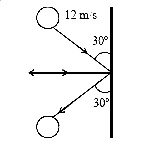
Q.88
The majority of carbon dioxide produced by our body cells is transported to the lungs as
(A)
attached to haemoglobin
(B)
dissolved in the blood
(C)
as bicarbonates
(D)
as carbonates.
(C)

Solution

Transport of CO2 is much easier than O2 because of the higher solubility of CO2 than O2. Almost 7% of CO2 is transported in dissolved state in plasma. About 23% of the CO2 is transported in the form of carbamino haemoglobin. 70% of CO2 is transported in the form of bicarbonate ions. CO2 reacts with water present in plasma. Carbonic acid is unstable & gives H+ and HCO3–. H+ bind with haemoglobin to maintain the pH of blood while HCO3– remain in the blood and carries the CO2 to lungs.
Q.89
People living at sea level have around 5 million RBC per cubic millimeter of their blood whereas those living at altitude to 5400 metres have around 8 million. This is because at high altitude
(A)
people eat more nutritive food, therefore more RBCs are formed
(B)
people get pollution-free air to breath and more oxygen is available
(C)
atmospheric O2 level is less and hence more RBCs are needed to absorb the required amount of O2 to survive
(D)
there is more UV radiation which enhances RBC production.
(C)

Solution

At an altitude of 5400 meters the low atmospheric pressure of O2 will be very low, so the solubility of oxygen in the blood will be very less hence the oxygen carried by each RBC will be too less. But to fulfill the oxygen requirement of the body, blood has to carry more oxygen to the body tissue and this is done by the increased no. of RBCs.
Q.90
Jurassic period of the Mesozoic era characterized by-
(A)
Radiation of reptiles and origin of mammal like reptiles
(B)
Flowering plants and first dinosaurs appear
(C)
Gymnosperms are dominant plants and first birds appear
(D)
Dinosaurs become extinct and angiosperms appear
(C)

Solution

Jurassic period of meoszoic era was about 19-20 crore years ago & lasted for about 5.5-6 crore years. The climate was hot and damp. It is called the age of dinosaurs. Ist primitive bird Archaeopteryx evolved from reptiles. Ist angiosperm appeared as a dicotyledon but gymnosperms were dominant.
Q.91
Praying mantis is a good example of-
(A)
Warning colouration
(B)
Camouflage
(C)
Mullerian mimicry
(D)
Social insects
(B)

Solution

Praying mantis shows the phenomenon of camouflage by blending itself into the background. This enables it to elude predators.
Q.92
An important evidence in favour of organic evolution is the occurrence of-
(A)
Homologous organs onl
(B)
Homologous and vestigial organs
(C)
Homologous and analogous organs
(D)
Analogous and vestigial organs
(B)

Solution

Homologous organs represent the divergent evolution. These are the organs belonging to different organisms of different species may be for dissimilar function but they all have the same basic structure. On the other hand vestigial organs show that how a species evolved from its ancestors through the ages according to the use and disuse of organs. These are the organs which were sometime functional in humans (or may be any other organisms) but during the course of evolution their utility gradually decline and now they are present as non-functional and vestigial organs.
Q.93
Which one of the following amino-acids was not found to be synthesized in Miller's experiment ?
(A)
Aspartic acid
(B)
Alanine
(C)
Glycine
(D)
Glutamic acid
(D)

Solution

Stanley Miller in 1953, who was then a graduate student of Harold Urey at the University of Chicago, circulated four gases - methane, ammonia, hydrogen and water vapour in an air tight apparatus and passed electrical discharges from electrodes. He passed the mixture through a condenser. He circulated the gases continuously in this way for one week and then analysed the chemical composition of the liquid inside the apparatus. He found a large number of simple organic compounds including some amino acid such as alanine, glycine and aspartic acid. Glutamic acid was not found.