NEET-UG 2011

AIPMT 2011 Mains

Physics (Maximum Marks: 120)
  • This section contains 30 questions.
  • Each question has FOUR options (A), (B), (C) and (D). ONLY ONE of these four options is the correct answer.
  • Full Marks : +4 If ONLY the correct option is chosen;
  • Zero Marks : 0 If none of the options is chosen (i.e. the question is unanswered);
  • Negative Marks : −1 In all other cases.
Q.1
The density of a material in CGS system of units is 4 g cm3. In a system of units in which unit of length is 10 cm and unit of mass is 100 g, the value of density of material will be
(A)
0.04
(B)
0.4
(C)
40
(D)
400
(C)

Solution

In CGS system,

Density = 4

When unit of mass is 100g and unit of length is 10 cm, then

Density = x

4 = x

x = 40 unit
Q.2
A particle covers half of its total distance with speed v1 and the rest half distance with speed v2. Its average speed during the complete journey is
(A)
(B)
(C)
(D)
(C)

Solution

Let total distance = 2S

Let particle take t1 time to cover first S distance,

t1 =

Let particle take t2 time to cover last S distance,

t2 =

Average speed = =
Q.3
A projectile is fired at an angle of 45o with the horizontal. Elevation angle of the projectile at its highest point as seen from the point of projection, is
(A)
45o
(B)
60o
(C)
tan1
(D)
tan1
(C)

Solution

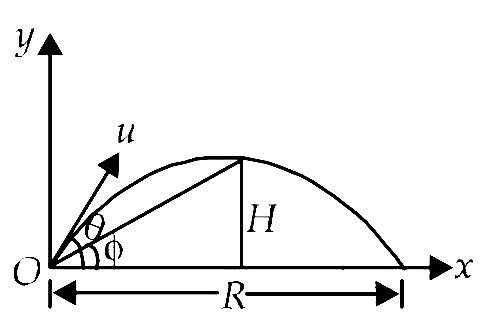
AIPMT 2011 Mains Physics - Motion in a Plane Question 35 English Explanation Let be elevation angle of the projectile at its highest point as seen from the point of projection O and be angle of projection with the horizontal.

From figure, tan =      ....(1)

In case of projectile motion

Maximum height H =

Horizontal range, R =

Substituting these values of H and R in (1), we get


=


Here, = 45°


Q.4
A conveyor belt is moving at a constant speed of 2 ms1. A box is gently dropped on it. The coefficient of friction between them is = 0.5. The distance that the box will move relativce to belt before coming to rest on it, taking g = 10 m s2,, is
(A)
0.4 m
(B)
1.2 m
(C)
0.6 m
(D)
zero
(A)

Solution

Force of friction, f = mg


ms-2

Using v2 – u2 = 2aS

02 – 22 = 2(–5) S

S = 0.4 m
Q.5
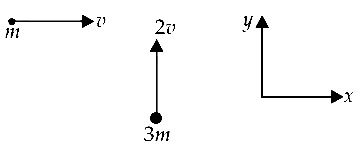
A mass m moving horizontally (along the x-axis) with velocity collides and sticks to a mass of 3m moving vertically upwards (along the y-axis) with velocity 2. The final velocity of the combination is
(A)
(B)
(C)
(D)
(B)

Solution

AIPMT 2011 Mains Physics - Work, Energy and Power Question 38 English Explanation
According to conservation of momentum, we get


where is the final velocity after collision
Q.6
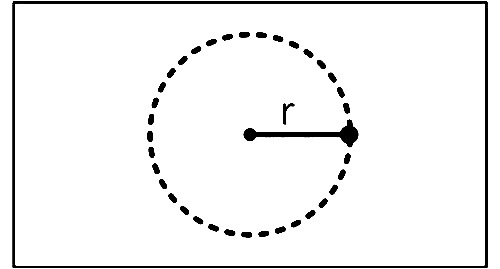
A small mass attached to a string rotates on a frictionless table top as shown. If the tension in the string is increased by pulling the string causing the radius of the circular motion to decrease by a factor of 2, the kinetic energy of the mass will

AIPMT 2011 Mains Physics - Rotational Motion Question 62 English
(A)
decrease by a factor of 2
(B)
remain constant
(C)
increase by a factor of 2
(D)
increase by a factor of 4
(D)

Solution

According to law of conservation of angular momentum

mvr = mv'r'


    ...(i)


   (Using (i))

Q.7
A particle of mass M is situated at the centre of a spherical shell of same mass and radius a. The magnitude of the gravitational potential at a point sutuated at a/2 distance from the centre, will be :
(A)
(B)
(C)
(D)
(C)

Solution

Here, Mass of a particle = M
Mass of a spherical shell = M
Radius of a spherical shell = a
Let O be centre of a spherical shell.
Gravitational potential at point P due to particle at O is


Gravitational potential at point P due to spherical shell is


Hence, total gravitational potential at point P is V = V1 + V2


Q.8
A particle of mass m is thrown upwards from the surface of the earth, with a velocity u. The mass and the radius of the earth are, respectively, M and R. G is gravitational constant and g is acceleration due to gravity on the surface of the earth. The minimum value of u so that the particle does not return back to earth, is
(A)
(B)
(C)
(D)
(B)

Solution

According to law of conservation of mechanical energy


Q.9
A mass of diatomic gas at a pressure of 2 atmospheres is compressed adiabatically so that its temperature rises from 27oC to 927oC. The pressure of the gas in the final state is
(A)
8 atm
(B)
28 atm
(C)
68.7 atm
(D)
256 atm
(D)

Solution

T1 = 273 + 27 = 300K

T2 = 273 + 927 = 1200K

For adiabatic process,

= constant


= P1 (27) = 2 × 128 = 256 atm
Q.10
Two particles are oscillating along two close parallel straight lines side by side, with the same frequency and amplitudes. They pass each other, moving in opposite directions when their displacement is half of the amplitude. The mean positions of the two particles lie on a straight line perpendicular to the paths of the two particles. The phase difference is
(A)
(B)
0
(C)
(D)
(C)

Solution

Equation of SHM is given by
is called phase.

When x = , then


For second particle,

AIPMT 2011 Mains Physics - Oscillations Question 48 English Explanation


Q.11
Two identical piano wires, kept under the same tension T have a fundamental frequency of 600 Hz. The fractional increase in the tension of one of the wires which will lead to occurrence of 6 beats/s when both the wires oscillate together would be
(A)
0.01
(B)
0.02
(C)
0.03
(D)
0.04
(B)

Solution

As


Q.12
The electric potential V at any point (x, y, z), all in metres in space is given by V = 4x2 volt. The electric field at the point (1, 0, 2) in volt/meter, is
(A)
8 along negative X-axis
(B)
8 along positive X-axis
(C)
16 along negative X-axis
(D)
16 along positive X-axis
(A)

Solution


where


Here, V = 4x2


The electric field at point (1, 0, 2) is


So electric field is along the negative X-axis.
Q.13
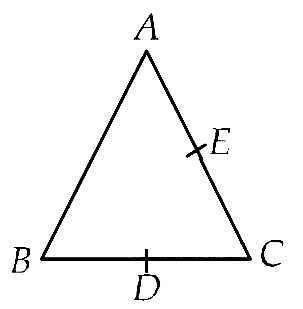
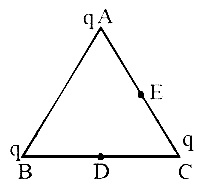
Three charges, each +q, are placed at the corners of an isosceles triangle ABC of sides BC and AC, 2. D and E are the mid points of BC and CA. The work done in taking a charge Q from D to E is

AIPMT 2011 Mains Physics - Electrostatics Question 57 English
(A)
(B)
(C)
(D)
zero
(D)

Solution

AIPMT 2011 Mains Physics - Electrostatics Question 57 English Explanation
AC = BC

VD = VE

We have, W = Q (VE – VD)

W = 0
Q.14
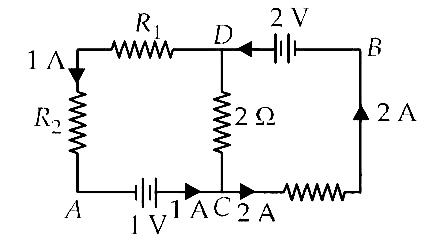
In the circuit shown in the figure, if the potential at point A is taken to be zero, the potential at point B is

AIPMT 2011 Mains Physics - Current Electricity Question 88 English
(A)
+1 V
(B)
1 V
(C)
+2 V
(D)
2 V
(A)

Solution

Current from D to C = 1A

VD – VC = 2 × 1 = 2V

VA = 0 VC = 1V,

VD – VC = 2

VD – 1 = 2   VD = 3V

VD – VB = 2 3 – VB = 2 VB = 1V
Q.15
A thermocouple of negligible resistance produces an e.m.f. of 40 µV/ºC in the linear range of temperature. A galvanometer of resistance 10 ohm whose sensitivity is 1 µA/division, is employed with the thermocouple. The smallest value of temperature difference that can be detected by the system will be
(A)
1ºC
(B)
0.5 ºC
(C)
0.1ºC
(D)
0.25ºC
(D)

Solution

For minimum deflection of 1 division required current = 1 µA

Voltage required = IR = (1µA) (10) = 10 µV

40 µV ≡ 1ºC

10 µV ≡ ºC = 0.25ºC
Q.16
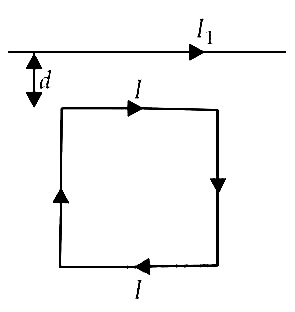
A square loop, carrying a teady current , is placed in a horizontal plane near a long straight conductor carrying a steady current 1 at a distance d from the conductor as shown in figure. The loop will experience
AIPMT 2011 Mains Physics - Moving Charges and Magnetism Question 57 English
(A)
a net attractive force towards the conductor
(B)
a net repulsive force away from the conductor
(C)
a net torque acting upward perpendicular to the horizontal plane
(D)
a net torque acting downward normal to horizontal plane
(A)

Solution

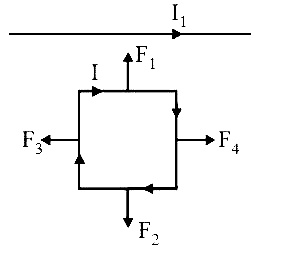
AIPMT 2011 Mains Physics - Moving Charges and Magnetism Question 57 English Explanation
as , and and are equal and opposite. Hence, the net attraction force will be towards the conductor.
Q.17
Charge q is uniformly spread on a thin ring of radius R. The ring rotates about its axis with a uniform frequency Hz. The magnitude of magnetic induction at the center of the ring is
(A)
(B)
(C)
(D)
(B)

Solution

When the ring rotates about its axis with a uniform frequency f Hz, the current flowing in the ring is

I = = qf

Magnetic field at the centre of the ring is

B = =
Q.18
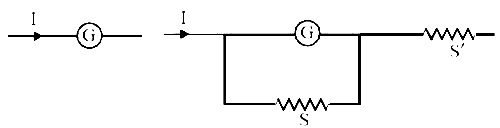
A galvanometer of resistance, G, is shunted by a resistance S ohm. To keep the main current in the circuit unchanged, the resistance to be put in series with the galvanometer is
(A)
(B)
(C)
(D)
(D)

Solution

AIPMT 2011 Mains Physics - Moving Charges and Magnetism Question 60 English Explanation
To keep the main current in the circuit unchanged, the resistance of the galvanometer should be equal to the net resistance.


Q.19
A short bar magnet of magnetic moment 0.4 J T1 is placed in a uniform magnetic field of 0.16 T. The magnet is in stable equilibrium when the potential energy is
(A)
0.064 J
(B)
0.064 J
(C)
zero
(D)
0.082 J
(B)

Solution

When a bar magnet of magnetic moment is placed in a uniform magnetic field , its potential energy is

U =

For stable equilibrium, = 0o

U = –MB = – (0.4) (0.16) = – 0.064 J
Q.20
A coil has resistance 30 ohm and inductive reactance 20 ohm at 50 Hz frequency. If an ac source, of 200 volt, 100 Hz, is connected across the coil, the current in the coil will be
(A)
2.0 A
(B)
4.0 A
(C)
8.0 A
(D)
(B)

Solution

Current flowing in the coil is

I = = 4 A
Q.21
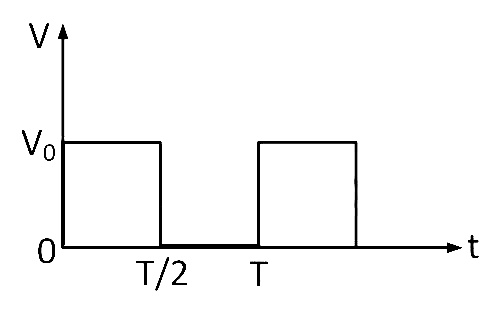
The r.m.s. value of potential difference V shown in the figure is

AIPMT 2011 Mains Physics - Alternating Current Question 50 English
(A)
(B)
V0
(C)
(D)
(C)

Solution

Vrms =
Q.22
A converging beam of rays is incident on a diverging lens. Having passed through the lens the rays intersect at a point 15 cm from the lens on the opposite side. If the lens is removed the point where the rays meet will move 5 cm closer to the lens. The focal length of the lens is
(A)
5 cm
(B)
10 cm
(C)
20 cm
(D)
30 cm
(D)

Solution

Here, v = +15 cm, u = +(15 – 5) = +10 cm

According to lens formula


f = -30 cm
Q.23
A thin prism of angle 15o made of glass of refractive index 1 = 1.5 is combined with another prism of glass of refractive index 2 = 1.75. The combination of the prisms produces dispersion without deviation. The angle of the second prism should be
(A)
5o
(B)
7o
(C)
10o
(D)
12o
(C)

Solution

For without deviation


A' = 10o
Q.24
An electron in the hydrogen atom jumps from excited state n to the ground state. The wavelength so emitted illuminates a photosensitive material having work function 2.75 eV. If the stopping potential of the photoelectron is 10 V, then the value of n is
(A)
2
(B)
3
(C)
4
(D)
5
(C)

Solution

KEmax = 10eV

= 2.75 eV

Total incident energy

E = + KEmax = 12.75 eV

Energy is released when electron jumps from the excited state n to the ground state.

E4 – E1 = {– 0.85 – (–13.6) ev} = 12.75eV

value of n = 4
Q.25
Two radioactive nuclei P and Q, in a given sample decay into a stable nucleus R. At time t = 0. number of P species are 4 N0 and that of Q are N0. Half -life of P (for conversion to R) is 1 minute where as that of Q is 2 minutes. Initially there are no nuclei of R present in the sample. When number of nuclei of P and Q are equal, the number of nuclei of R present in the sample would be
(A)
2 N0
(B)
3 N0
(C)
(D)
(C)

Solution

Initially P = 4N0

Q = N0

Half life TP = 1 min.

TQ = 2 min.

Let after time t number of nuclei of P and Q are equal, that is

NP = NQ

=


t = 4 min

After 4 minutes, both P and Q have equal number of nuclei.

Number of nuclei of R

= +

=
Q.26
Out of the following which one is not a possible energy for a photon to be emitted by hydrogen atom according to Bohr's atomic model?
(A)
0.65 eV
(B)
1.9 eV
(C)
11.1 eV
(D)
13.6 eV
(C)

Solution

En =

E1 = –13.6 eV

E2 = –3.4 eV

E3 = –1.5 eV

E4 = –0.85 eV

E3 – E2 = –1.5 – (–3.4) = 1.9 eV

E4 – E3 = –0.85 – (–1.5) = 0.65 eV

Obviously, difference of 11.1 eV is not possible.
Q.27
The threshold frequency for a photosensitive metal is 3.3 1014 Hz. If light of frequency 8.2 1014 Hz is incident on this metal, the cut- off voltage for the photoelectron emission is nearly
(A)
1 V
(B)
2 V
(C)
3 V
(D)
5 V
(B)

Solution

K.E. = h – hth = eV0 (V0 = cut off voltage)

V0 =

=

2 V
Q.28
Pure Si at 500 K has equal number of electron (ne) and hole (nh) concentrations of 1.5 1016 m3. Doping by indium increases nh to 4.5 1022 m3. The doped semiconductor is of
(A)
p-type having electron concentration ne = 5 109 m3
(B)
n-type with electron concentration ne = 5 1022 m3
(C)
p-type with electron concentration ne = 2.5 1010 m3
(D)
n-type with electron concentration ne = 2.5 1023 m3
(A)

Solution

(ni)2 = ne × nh

(1.5 × 10¹⁶)2 = ne (4.5 × 10²²)

So ne = 5 × 10⁹

Now nh = 4.5 × 10²²

nh ne

Hence, semiconductor is p-type

and ne = 5 × 10⁹ m–3
Q.29
In the following figure, the diodes which are forward biased, are

AIPMT 2011 Mains Physics - Semiconductor Electronics Question 84 English
(A)
(A), (B) and (D)
(B)
(C) only
(C)
(C) and (A)
(D)
(B) and (D)
(C)

Solution

p-n junction is said to be forward biased when p side is at high potential than n side. It is for circuit (A) and (C).
Q.30
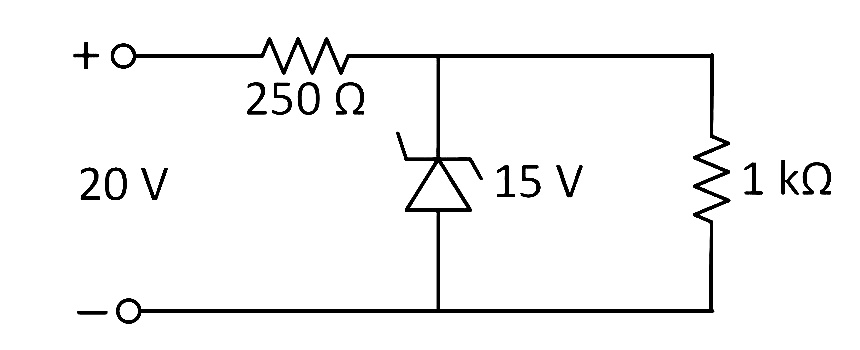
A Zener diode, having breakdown voltage equal to 15 V, is used in a voltage regulator circuit shown in figure. The current through the diode is

AIPMT 2011 Mains Physics - Semiconductor Electronics Question 85 English
(A)
5 mA
(B)
10 mA
(C)
15 mA
(D)
20 mA
(A)

Solution

Voltage across 250 Ω resistance = 20 V – 15 V = 5 V

Now current through 250 resistance: 5/250 = 20 mA

If voltage across load resistance 1 k is 15 V, then

current through 1 kΩ is 15/1000 = 15 mA

The current through the zener diode is

= Current through 250 resistance – Current through 1 k resistance.

= 20 - 15

= 5 mA
Chemistry (Maximum Marks: 120)
  • This section contains 30 questions.
  • Each question has FOUR options (A), (B), (C) and (D). ONLY ONE of these four options is the correct answer.
  • Full Marks : +4 If ONLY the correct option is chosen;
  • Zero Marks : 0 If none of the options is chosen (i.e. the question is unanswered);
  • Negative Marks : −1 In all other cases.
Q.1
Which has the maximum number of molecules among the following ?
(A)
44 g CO2
(B)
48 g O3
(C)
8 g H2
(D)
64 g SO2
(C)

Solution

8 g H2 has 4 moles while the others has 1 mole each.
Q.2
According to the Bohr theory, which of the following transitions in the hydrogen atom will give rise to the least energetic photon ?
(A)
n = 6 to n = 1
(B)
n = 5 to n = 4
(C)
n = 6 to n = 5
(D)
n = 5 to n = 3
(C)

Solution

We know that

, where n2 > n1

n = 6 and n = 5 will give least energetic photon.
Q.3
A bubble of air is underwater at temperature 15oC and the pressure 1.5 bar. If the bubble rises to the surface where the temperature is 25oC and the pressure is 1.0 bar, what will happen to the volume of the bubble?
(A)
Volume will become greater by a factor of 1.6.
(B)
Volume will become greater by a factor of 1.1
(C)
Volume will become smaller by a factor of 0.70
(D)
Volume will become greater by a factor of 2.5
(A)

Solution

Given

P1 = 1.5 bar, T1 = 273 + 15 = 288 K, V1 = V

P2 = 1.0 bar, T1 = 273 + 25 = 298K, V2 = ?


V2 = 1.55V

Volume of bubble will be almost 1.6 time to initial volume of bubble.
Q.4
In qualitative analysis, the metals of group I can be separated from other ions by precipitating them as chloride salts. A solution initially contains Ag+ and pb2+ at a concentration of 0.10 M. Aqueous HCl is added to this solution until the Cl concentration is 0.10 M. What will the concentrations of Ag+ and Pb2+ be at equilibrium ?

(Ksp for AgCl = 1.8 1010, Ksp for PbCl2 = 1.7 105)
(A)
[Ag+] = 1.8 107 M, [Pb2+] = 1.7 106 M
(B)
[Ag+] = 1.8 1011 M, [Pb2+] = 8.5 105 M
(C)
[Ag+] = 1.8 109 M, [Pb2+] = 1.7 103 M
(D)
[Ag+] = 1.8 1011 M, [Pb2+] = 1.7 104 M
(C)

Solution

Ksp[AgCl] = [Ag+][Cl-]

[Ag+] = = 1.8 109 M

Ksp[PbCl2] = [Pb2+][Cl-]2

[Pb2+] = = 1.7 103 M
Q.5
200 mL of an aqueous solution of a protein contains its 1.26 g. The osmotic pressure of this solution at 300 K is found to be 2.57 103 bar. The molar mass of protein will be (R = 0.083 L bar mol1 K1)
(A)
51022 g mol1
(B)
122044 g mol1
(C)
31011 g mol1
(D)
61038 g mol1
(D)

Solution

Osmotic pressure, = CRT

= RT

V = RT

M =

=

=

= 61038 g mol–1
Q.6
A 0.1 molal aqueous solution of a weak acid is 30% ionized. If Kf for water is 1.86oC/m, the freezing point of the solution will be
(A)
0.18oC
(B)
0.54oC
(C)
0.36oC
(D)
0.24oC
(D)

Solution

We know that Tf = i × Kf × m

Here i is van’t Hoff’s factor.

i for weak acid is 1 + .

Here is degree of dissociation i.e., 30/100 = 0.3

i = 1 + = 1 + 0.3 = 1.3

Tf = i × Kf × m = 1.3 × 1.86 × 0.1 = 0.24

Freezing point = – 0.24
Q.7
Consider the following processes :

H (kJ/mol)
1/2A B +150
3B   2C + D -125
E + A   2D +350

For B + D E + 2C, H will be
(A)
525 kJ/mol
(B)
175 kJ/mol
(C)
325 kJ/mol
(D)
325 kJ/mol
(B)

Solution

H (kJ/mol)
1/2A B +150
3B   2C + D -125
E + A   2D +350
___________________________________
   B + D E + 2C;

H = (300 - 125 - 350) = - 175 kJ/mol
Q.8
A solution contains Fe2+, Fe3+ and I ions. This solution was treated with iodine at 35oC. Eo for Fe3+/Fe2+ is + 0.77 V and Eo for I2/2I = 0.536 V.
The favourable redox reaction is
(A)
I2 will be reduced to I
(B)
there will be no redox reaction
(C)
I will be oxidised to I2
(D)
Fe2+ will be oxidised to Fe3+
(C)

Solution

Since the reduction potential of Fe3+/Fe2+ is greater than that of I2 /I , Fe3+ will be reduced and I will be oxidised.

2Fe3+ + 2I 2Fe2+ + I2
Q.9
The rate of the reaction :   2N2O5 4NO2 + O2
can be written in three ways.


The relationship between k and k' and between k and k'' are
(A)
(B)
(C)
(D)
(B)

Solution

Rate of disappearance of reactants = Rate of appearance of products

= =

= =


Q.10
The unit of rate constant for a zero order reaction is
(A)
mol L1 s1
(B)
L mol1 s1
(C)
L2 mol2 s1
(D)
s1
(A)

Solution

Rate = K[A]0

Unit of k = mol L–1 sec–1
Q.11
The half-life of a substance in a certain enzyme-catalysed reaction is 138 s. The time required for the concentration of the substance to fall from 1.28 mg L1 to 0.04 mg L1 is
(A)
414 s
(B)
552 s
(C)
690 s
(D)
276 s
(C)

Solution

We know,

Give N0(original amount) = 1.28 mg L–1

N (amount of substance left after time T) = 0.04 mg L–1


n = 5

Time required = 5 × t1/2 = 5 × 138 = 690 s
Q.12
A solid compound XY has NaCl structure. If the radius of the cation is 100 pm, the radius of the anion (Y) will be
(A)
275.1 pm
(B)
322.5 pm
(C)
241.5 pm
(D)
165.7 pm
(C)

Solution

For NaCl crystal,

Given, r+ = 100 pm


= 241.5 pm
Q.13
What is the value of electron gain enthalpy of Na+ if IE1 of Na = 5.1 eV?
(A)
5.1 eV
(B)
10.2 eV
(C)
+2.55 eV
(D)
+10.2 eV
(A)

Solution

Na Na+ + e-; H = 5.1 eV

Na+ + e- Na; H = -5.1 eV
Q.14
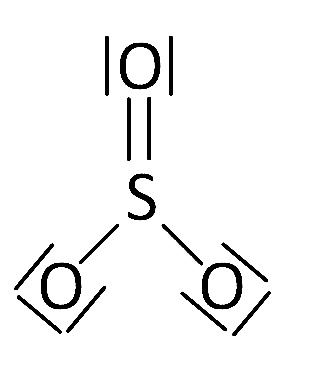
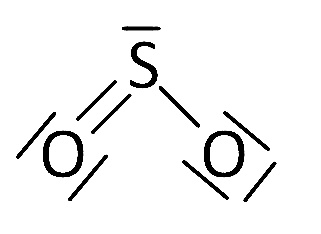
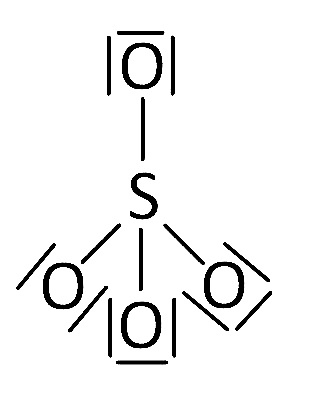
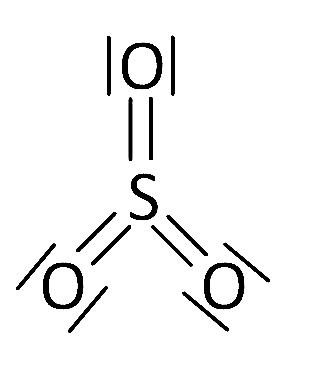
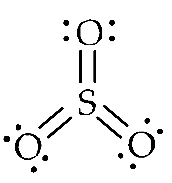
Which of the following structures is the most preferred and hence of lowest energy for SO3?
(A)
AIPMT 2011 Mains Chemistry - Chemical Bonding and Molecular Structure Question 50 English Option 1
(B)
AIPMT 2011 Mains Chemistry - Chemical Bonding and Molecular Structure Question 50 English Option 2
(C)
AIPMT 2011 Mains Chemistry - Chemical Bonding and Molecular Structure Question 50 English Option 3
(D)
AIPMT 2011 Mains Chemistry - Chemical Bonding and Molecular Structure Question 50 English Option 4
(D)

Solution

AIPMT 2011 Mains Chemistry - Chemical Bonding and Molecular Structure Question 50 English Explanation has maximum number of covalent bonds.
Q.15
The pairs of species of oxygen and their magnetic behaviours are noted below. Which of the following presents the correct description?
(A)
- Both diamagnetic
(B)
- Both paramagnetic
(C)
O, - Both paramagnetic
(D)
- Both paramagnetic
(B)

Solution

O2+ = KKσ2s2 σ*2s2 σ2pz2 (π2px2 = π2py2) (π*2px1)

O2 = KKσ2s2 σ*2s2 σ2pz2 (π2px2 = π2py2) (π*2px 1 = π*2py1)

O2 and O2+ contain unpaired electron in π* ABMO so paramagnetic.
Q.16
The following reactions take place in the blast furnace in the preparation of impure iron. Identify the reaction pertaining to the formation of the slag.
(A)
Fe2O3(s) + 3CO(g) 2Fe(l) + 3CO2(g)
(B)
CaCO3(s) CaO(s) + CO2(g)
(C)
CaO(s) + SiO2(s) CaSiO3(s)
(D)
2C(s) + O2(g) 2CO(g)
(C)

Solution

Slag is formed by the reaction

CaO + SiO2 CaSiO3
Q.17
Match List-I with List-II for the compositions of substances and select the correct answer using the code given above.

List-I
(Substances)
List-II
(Composition)
(A) Plaster of Pairs (i) CaSO42H2O
(B) Epsomite (ii) CaSO41/2 H2O
(C) Kieserite (iii) MgSO47H2O
(D) Gypsum (iv) MgSO4H2O
(v) CaSO4
(A)
(A)-(iii),  (B)-(iv),  (C)-(i),  (D)-(ii)
(B)
(A)-(ii),  (B)-(iii),  (C)-(iv),  (D)-(i)
(C)
(A)-(i),  (B)-(ii),  (C)-(iii),  (D)-(iv)
(D)
(A)-(iv),  (B)-(iii),  (C)-(ii),  (D)-(i)
(B)

Solution

(A) Plaster of paris = CaSO4.H2O

(B) Epsomite = MgSO4.7H2O

(C) Kieserite = MgSO4.H2O

(D) Gypsum = CaSO4.2H2O
Q.18
Which of the following statements is incorrect?
(A)
Pure sodium metal dissolves in liquid ammonia to give blue solution.
(B)
NaOH reacts with glass to give sodium silicate.
(C)
Aluminium reacts with excess NaOH to give Al(OH)3.
(D)
NaHCO3 on heating gives Na2CO3.
(C)

Solution

Al reacts with NaOH to give sodium metaaluminate.

2Al(s) + 2NaOH (aq) + 2H2O(l) 2NaAlO2 + 3H2
Q.19
Which of the following oxide is amphoteric?
(A)
SnO2
(B)
CaO
(C)
SiO2
(D)
CO2
(A)

Solution

SnO2 reacts with acid as well as base. So SnO2 is an amphoteric.

SnO2 + 4HCl SnCl2 + 2H2O

SnO2 + 2NaOH Na2SnO3 + H2O

CaO is basic in nature while SiO2 and CO2 are acidic in nature.
Q.20
Which of the following complex compounds will exhibit highest paramagnetic behaviour?
(At. No. Ti = 22, Cr = 24, Co = 27, Zn = 30)
(A)
[Cr (NH3)6] 3+
(B)
[Co (NH3)6]3+
(C)
[Zn (NH3)6]2+
(D)
[Ti(NH3)6] 3+
(A)

Solution

[Cr(NH3)6]+3 [Ar] 3d3 4s0

three unpaired electron are present in t2g orbited
Q.21
Which of the following carbonyls will have the strongest C–O bond ?
(A)
Cr (CO)6
(B)
Fe (CO)5
(C)
Mn (CO)6+
(D)
V(CO)6-
(C)

Solution

Due to positive oxidation state of Mn back donation in π* ABMO of CO is minimum therefore C–O bond is strongest.
Q.22
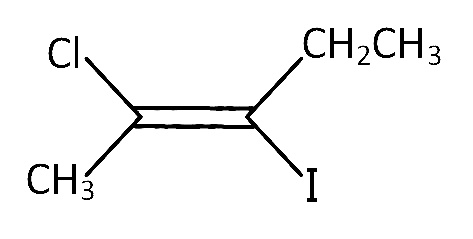
The IUPAC name of the following compound is

AIPMT 2011 Mains Chemistry - Some Basic Concepts of Organic Chemistry Question 76 English
(A)
trans-2-chloro-3-iodo-2-pentene
(B)
cis-3-iodo-4-chloro-3-pentane
(C)
trans-3-iodo-4-chloro-3-pentene
(D)
cis-2-chloro -3-iodo-2-pentene.
(A)

Solution

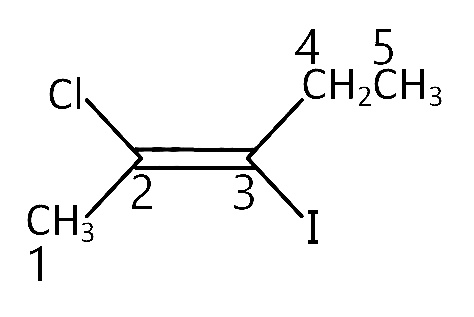
AIPMT 2011 Mains Chemistry - Some Basic Concepts of Organic Chemistry Question 76 English Explanation

IUPAC name is trans-2-chloro-3-iodo-2-pentene.
Q.23
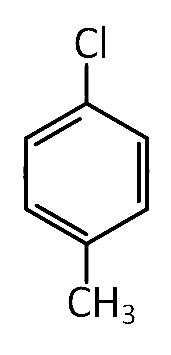
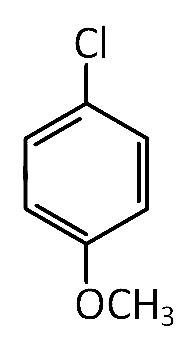
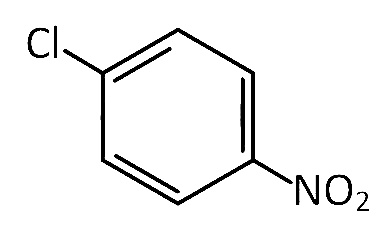
Which of the following compounds undergoes nucleophilic substitution reaction most easily?
(A)
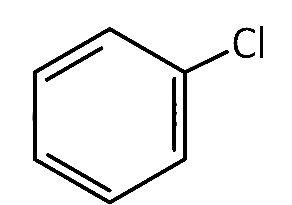
AIPMT 2011 Mains Chemistry - Haloalkanes and Haloarenes Question 37 English Option 1
(B)
AIPMT 2011 Mains Chemistry - Haloalkanes and Haloarenes Question 37 English Option 2
(C)
AIPMT 2011 Mains Chemistry - Haloalkanes and Haloarenes Question 37 English Option 3
(D)
AIPMT 2011 Mains Chemistry - Haloalkanes and Haloarenes Question 37 English Option 4
(A)

Solution

Electron withdrawing group like -NO2 facilitates nucleophilic substitution reaction in chlorobenzene.
Q.24
Consider the reactions.
AIPMT 2011 Mains Chemistry - Haloalkanes and Haloarenes Question 22 English
The mechanisms of reactions (i) and (ii) are respectively
(A)
SN1   and  SN2
(B)
SN1   and  SN1
(C)
SN2   and  SN2
(D)
SN2   and  SN1
(C)

Solution

These reactions are purely SN2 reactions as in reaction (i) and (ii) there is no rearrangement takes place (rearrangement occurs in SN1 mechanism). Simple substitution of nucleophile takes place.
Q.25
Match the compounds given in List-I with List-II and select the suitable option using the code given below.

List-I
List-II
(A) Benzaldehyde (i) Phenolphthalein
(B) Phthalic anhydride (ii) Benzoin condensation
(C) Phenyl benzoate (iii) Oil of wintergreen
(D) Methyl salicylate (iv) Fries rearrangement
(A)
(A)-(iv),  (B)-(i),  (C)-(iii),  (D)-(ii)
(B)
(A)-(iv),  (B)-(ii),  (C)-(iii),  (D)-(i)
(C)
(A)-(ii),  (B)-(iii),  (C)-(iv),  (D)-(i)
(D)
(A)-(ii),  (B)-(i),  (C)-(iv),  (D)-(iii)
(D)

Solution

(A) Benzaldehyde          (ii) Benzoin condensation

(B) Phthalic anhydride    (i) Phenolphthalein

(C) Phenyl benzoate       (iv) Fries rearrangement

(D) methyl salicylate      (iii) Oil of wintergreen
Q.26
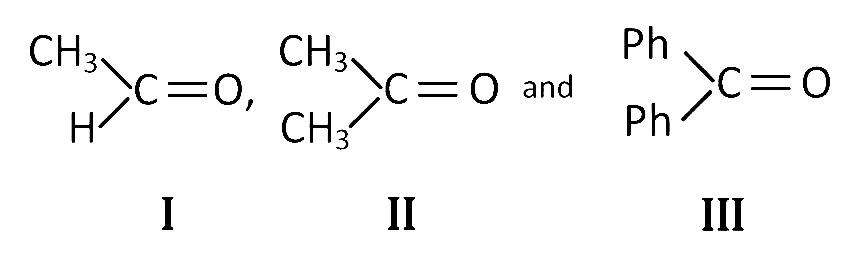
The order of reactivity of phenyl magnesium bromide (PhMgBr) with the following compounds:
AIPMT 2011 Mains Chemistry - Aldehydes, Ketones and Carboxylic Acids Question 65 English
(A)
III > II > I
(B)
II > I > III
(C)
I > III > II
(D)
I > II > III
(D)

Solution

The reactivity of the carbonyl group towards the nucleophilic addition reactions depend upon the magnitude of the positive charge on the carbonyl carbon atom (electronic factor) and also on the crowding around the carboxyl carbon atom in the transition state (steric factor). Both these factors predict the following order
I > II > III
Q.27
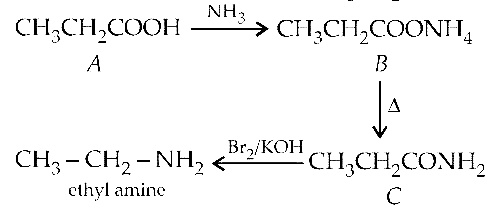
An organic compound A on treatment with NH3 gives B, which on heating gives C. C when treated with Br2 in the presence of KOH produces ethyl amine. Compound A is
(A)
CH3COOH
(B)
CH3CH2CH2COOH
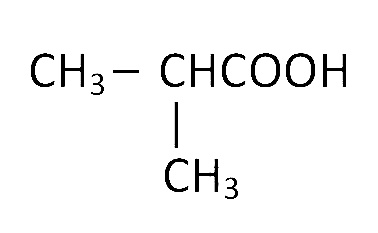
(C)
AIPMT 2011 Mains Chemistry - Aldehydes, Ketones and Carboxylic Acids Question 64 English Option 3
(D)
CH3CH2COOH
(D)

Solution

AIPMT 2011 Mains Chemistry - Aldehydes, Ketones and Carboxylic Acids Question 64 English Explanation
Q.28
What of the following compounds is most basic?
(A)
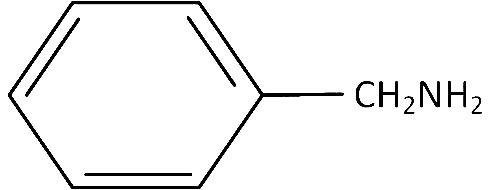
AIPMT 2011 Mains Chemistry - Organic Compounds Containing Nitrogen Question 32 English Option 1
(B)
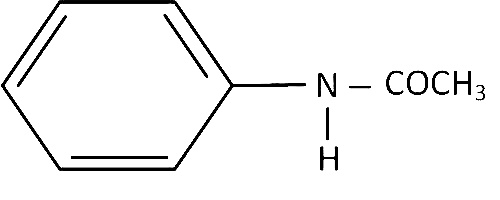
AIPMT 2011 Mains Chemistry - Organic Compounds Containing Nitrogen Question 32 English Option 2
(C)
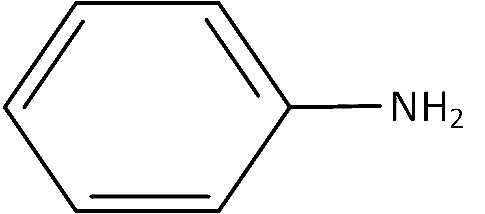
AIPMT 2011 Mains Chemistry - Organic Compounds Containing Nitrogen Question 32 English Option 3
(D)
AIPMT 2011 Mains Chemistry - Organic Compounds Containing Nitrogen Question 32 English Option 4
(B)

Solution

In benzylamine the electron pair present on the nitrogen is not delocalised with the benzene ring.
Q.29
Which of the statements about ''Denaturation'' given below are correct?

(1)  Denaturation of proteins causes loss of secondary and tertiary structures of the protein.
(2)  Denaturation leads to the conversion of double strand of DND into single strand.
(3)  Denaturation affects primary structure which gets distorted.
(A)
(2) and (3)
(B)
(1) and (3)
(C)
(1) and (2)
(D)
(1), (2) and (3)
(C)

Solution

When the proteins are subjected to the action of heat, mineral acids or alkali, the water soluble form of globular protein changes to water insoluble fibrous protein. This is called denaturation of proteins. During denaturation secondary and tertiary structures of protein destroyed but primary structures remains intact.
Q.30
Which of the following is not a fat soluble vitamin?
(A)
Vitamin B complex
(B)
Vitamin D
(C)
Vitamin E
(D)
Vitamin A
(A)

Solution

Vitamin B complex is not a fat soluble vitamin. It is a water soluble vitamin.
Biology (Maximum Marks: 232)
  • This section contains 58 questions.
  • Each question has FOUR options (A), (B), (C) and (D). ONLY ONE of these four options is the correct answer.
  • Full Marks : +4 If ONLY the correct option is chosen;
  • Zero Marks : 0 If none of the options is chosen (i.e. the question is unanswered);
  • Negative Marks : −1 In all other cases.
Q.1
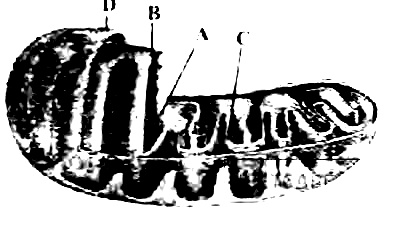
The figure below shows the structure of a mitochondrion with its four parts labelled (A), (B), (C). and (D) Select the part correctly matched with its function. – AIPMT 2011 Mains Biology - Cell - The Unit of Life Question 87 English
(A)
Part (B) : Inner membrane – forms infoldings called cristae
(B)
Part (C) : Cristae – possess single circular DNA molecule and ribosome
(C)
Part (A) : Matrix – major site for respiratory chain enzymes
(D)
Part (D) : Outer membrane – gives rise to inner membrane by splitting
(A)

Solution

Each mitochondrion is a double membranebound structure with the outer membrane and the inner membrane dividing its lumen distinctly into two aqueous compartments, i.e., the outer compartment and the inner compartment. The inner compartment is called the matrix.

The outer membrane forms the continuous limiting boundary of the organelle. The inner membrane forms a number of infoldings called the cristae towards the matrix. The cristae increase the surface area. The two membranes have their own specific enzymes associated with the mitochondrial function.
Q.2
Which one of the following is not considered as a part of the endomembrane system ?
(A)
Vacuole
(B)
Lysosome
(C)
Golgi complex
(D)
Peroxisome
(D)

Solution

Except peroxisome the remaining three and ER are the parts of endomembrane system.
Q.3
At metaphase, chromosomes are attached to the spindle fibres by their
(A)
satellites
(B)
secondary constrictions
(C)
kinetochores
(D)
centromeres.
(C)

Solution

Kinetochores are large protein complexes that bind the centromeres of chromosomes to the microtubules of mitotic spindle fibres, during metaphase in the cell cycle.
Q.4
What is common between vegetative reproduction and apomixts?
(A)
Both are applicable to only dicot plants
(B)
Both bypass the flowering phase
(C)
Both occur round the year
(D)
Both produced progeny identical to the parent.
(D)

Solution

Apomixis is a reproductive process in plants that superficially resembles normal sexual reproduction but in which there is no fusion of gametes. The embryos develop simply by division of a diploid cell the ovule. So, the progenies produced are identical to the parent. In vegetative reproduction the progenies produced are also identical to the parent.
Q.5
In angiosperms, functional megaspore develops into
(A)
embryo sac
(B)
ovule
(C)
endosperm
(D)
pollen sac.
(A)

Solution

During megagametogenesis functional megaspore (mostly chalazal) gives rise to embryo sac. This is the mature female gametophyte generation.
Q.6
Consider the following statements (A-D) about organic farming :
(A) Utilizes genetically modified crops like Bt cotton
(B) Uses only naturally produced inputs like compost
(C) Does not use pesticides and urea
(D) Produces vegetables rich in vitamins and minerals
Which of the above statements are correct ?
(A)
(B) and (C) only
(B)
(B), (C) and (D)
(C)
(C) and (D) only
(D)
(A) and (B) only
(A)

Solution

Organic farming is the form of agriculture that relies on the techniques like crop rotation, green manure, compost and biological pest control.
Q.7
Read the following statement having two blanks (A and B) :
''A drug used for ______ (A)___ patients is obtained from a species of the organism ______ (B)___ ''.
The one correct option for the two blanks is :
(A)
A Organ-transplant , B Trichoderma
(B)
A AIDS, B Pseudomonas
(C)
A Swine flu, B Monascus
(D)
A Heart , B Penicillium
(A)

Solution

Trichoderma is a species of filamentous fungi. Cyclosporin A is immunosuppressive drug obtained from Trichoderma and used in organ transplantation.
Q.8
Which one of the following is a wrong matching of a microbe and its industrial product, while the remaining three are correct ?:
(A)
Acetobacter aceti – acetic acid
(B)
Clostridium butylicum – lactic acid
(C)
Aspergillus niger – citric acid
(D)
Yeast – statins
(B)

Solution

Microbes are used for commercial and industrial production of certain chemicals like organic acids, alcohols and enzymes. Examples of acid producers are Aspergillus niger (a fungus) of citric acid, Acetobacter aceti (a bacterium) of acetic acid; Clostridium butylicum (a bacterium) of butyric acid and Lactobacillus (a bacterium) of lactic acid.
Q.9
Some vascular bundles are described as open because these :
(A)
are capable of producing secondary xylem and phloem
(B)
are not surrounded by pericycle
(C)
possess conjunctive tissue between xylem and phloem
(D)
are surrounded by pericycle but no endodermis
(A)

Solution

In dicot stem, cambium is present between xylem and phloem, such vascular bundles are called open. In monocot stem, the cambium is absent, such vascular bundles are called closed. Cambium are the meristematic cells which produces secondary xylem and phloem.
Q.10
Function of companion cells is :
(A)
Providing water to phloem
(B)
Loading of sucrose into sieve elements
(C)
Loading of sucrose into sieve elements by passive transport
(D)
Providing energy to sieve elements for active transport
(B)

Solution

Companion cells move sugar and amino acids into and out of the sieve elements. In “source” tissue such as leaf companion cells use transmembrane proteins to take up sugar and amino acids by active transport. Movement of sugars in the phloem begins at the source, where sugars are loaded (actively transported) into a seive tube. Loading sets up a water potential gradient that facilitates movement of sugar.
Q.11
Guttation is the result of
(A)
diffusion
(B)
transpiration
(C)
osmosis
(D)
root pressure.
(D)

Solution

The main cause of guttation in plants is root pressure. During night when root pressure is high, water drops ooze out with the assistance of special structures called hydathodes which help in guttation.
Q.12
Which one of the following is not an essential mineral element for plants while the remaining three are?
(A)
Iron
(B)
Manganese
(C)
Cadmium
(D)
Phosphorus
(C)

Solution

Cadmium is not an essential element for plants. Phosphorus is a macronutrient and iron and manganese are micronutrients for plants.
Q.13
In mitochondria, protons accumulate in the
(A)
outer membrane
(B)
inner membrane
(C)
intermembrane space
(D)
matrix
(C)

Solution

In respiration, protons accumulate in the intermembrane space of the mitochondria when electrons move through the ETS.
Q.14
Which one of the following techniques made it possible to genetically engineer living organisms ?
(A)
Recombinant DNA techniques
(B)
X-ray diffraction
(C)
Heavier isotope labeling
(D)
Hybridization
(A)

Solution

Recombinant DNA technology is the process joining together two DNA molecules from two different species that are inserted into a host organism to produce new genetic combination.
Q.15
Consider the following statements (A)-(D) each with one or two blanks :
(A) Bears go into _____ (1) ____ during winter to _____(2)____ cold weather.
(B) A conical age pyramid with a broad base represents ____(3)_____ human population.
(C) A wasp pollinating a fig flower is an example of _____ (4) _____ .
(D) An area with high levels of species richness is known as ____(5)_____.
Which of the following options, gives the correct fill ups for the respective blank numbers from (1) to (5) in the statements ?
(A)
(1) - aestivation, (2) - escape,
(3) - stable, (4) - mutualism
(B)
(3) - expanding, (4) - commensalism,
(5) - biodiversity park
(C)
(1) - hibernation, (2) - escape,
(3) - expanding, (5) - hot spot
(D)
(3) - stable, (4) - commensalism,
(5) - marsh
(C)
Q.16
Biodiversity of a geographical region represents :
(A)
The diversity in the organisms living in the region
(B)
Species endemic to the region
(C)
Genetic diversity present in the dominant species of the region.
(D)
Endangered species found in the region
(A)

Solution

Biodiversity is the number of variety of organism found within a specified geographic region.
Q.17
Which one of the following aspects is in exclusive characteristics of living things?
(A)
Isolated metabolic reactions occur in vitro
(B)
Increase in mass from inside only
(C)
Perception of events happening in the environment and their memory.
(D)
Increase in mass by accumulation of material both on surface as well as internally.
(C)

Solution

All living things have an ability to respond to their environment, that is also called stimulation.
Q.18
The pathogen Microsporum responsible for ringworm disease in humans belongs to the same kingdom of organisms as that of
(A)
Taenia, a tapeworm
(B)
Wuchereria, a filarial worm
(C)
Rhizopus, a mould
(D)
Ascaris, a round worm.
(C)

Solution

Microsporum is a member of Deuteromycetes of fungi & Rhizopus is also fungi and member of Zygomycetes.
Q.19
Whorled, simple leaves with reticulate venation are present in
(A)
Calotropis
(B)
neem
(C)
China rose
(D)
Alstonia.
(D)

Solution

Whorled phyllotaxy is a feature of Nerium and Alstonia. In Alstonia five leaves are present in a whorl while in Nerium three leaves are present in a whorl.
Q.20
Which one of the following pairs is wrongly matched while the remaining three are correct?
(A)
Penicillium              conidia
(B)
Water hyacinth         runner
(C)
Bryophyllum            leaf buds
(D)
Agave                      bulbils
(B)

Solution

Water hyacinth is a free floating perennial plant, which can grow to a height of 3 feet.
Q.21
Which one of the following figures represents the placentation in Dianthus?
(A)
AIPMT 2011 Mains Biology - Morphology of Flowering Plants Question 39 English Option 1
(B)
AIPMT 2011 Mains Biology - Morphology of Flowering Plants Question 39 English Option 2
(C)
AIPMT 2011 Mains Biology - Morphology of Flowering Plants Question 39 English Option 3
(D)
AIPMT 2011 Mains Biology - Morphology of Flowering Plants Question 39 English Option 4
(D)

Solution

The figure given in option (d) represents the free central placentation. In free central placentation, ovary is unilocular and ovules are borne on the axis in the center of the ovary and septa are absent. It is seen in Dianthus and Primrose.
Q.22
Sweet potato is homologous to
(A)
potato
(B)
Colocasia
(C)
ginger
(D)
turnip.
(D)

Solution

Sweet potato is homologous to turnip as both are having same origin i.e., both are root but modified for different functions. Sweet potato is a modified root for storage and vegetative propagation while turnip is modified for storage only.
Q.23
Which one of the following is essential for photolysis of water?
(A)
Copper
(B)
Manganese
(C)
Boron
(D)
Zinc
(B)

Solution

Manganese (Mn2+) is used for photolysis of water to produce oxygen and electrons during light reaction of photosynthesis. It is the phenomenon of breaking up of water into hydrogen and oxygen in the illuminated chloroplast. It acts as an essential cofactor.
Q.24
In kranz anatomy, the bundle sheath cells have
(A)
thin walls, may intercellular spaces and no chloroplasts
(B)
thick walls, no intercellular spaces and large number of chloroplasts
(C)
thin walls, no intercellular spaces and several chloroplasts
(D)
thick walls, many intercellular spaces and few chloroplasts.
(B)

Solution

In Kranz anatomy, the bundle sheath cells have thick wall, no intracellular spaces and large number of chloroplasts.
Q.25
Which one of the following conditions of the zygotic cell would lead to the birth of a normal human female child ?
(A)
only one Y chromosome
(B)
only one X chromosome
(C)
one X and one Y chromosome
(D)
two X chromosomes
(D)

Solution

Two X chromosomes would lead to the birth of normal human female child.
Q.26
Test cross in plants or in Drosophila involves crossing :
(A)
the F1 hybrid with a double recessive genotype
(B)
between two genotypes with dominant trait
(C)
between two F1 hybrids
(D)
between two genotypes with recessive trait
(A)

Solution

In test cross, genotype of an organism showing dominant phenotype is determined by crossing it with homozygous recessive genotype.
Q.27
The unequivocal proof of DNA as the genetic material came from the studies on a :
(A)
Viroid
(B)
Bacterium
(C)
Fungus
(D)
Bacterial virus
(D)

Solution

The unequivocal proof that DNA is the genetic material came from the experiments of Alfred Hershey and Martha Chase (1952). They worked with viruses that infect bacteria called bacteriophages.
Q.28
Silencing of mRNA has been used in producing transgenic plants resistant to :
(A)
White rusts
(B)
Nematodes
(C)
Bacterial blights
(D)
Bollworms
(B)

Solution

In this technique nematode specific genes are introduced in the host plant in such a way that it produces both sense and antisense RNA. The two RNA’s being complementary to each other from a double stranded RNA (dsRNA) which is also called interfering RNA responsible for initiating RNA interference (RNA i). This (dsRNA) bind to and prevent translation of specific mRNA of nematode (gene silencing). Thus transgenic plants based on RNAi technology are resistant to nematode.
Q.29
Read the following four statements (A-D) about certain mistakes in two of them :
(A) The first transgenic buffalo, Rosie produced milk which was human alpha-lactalbumin enriched.
(B) Restriction enzymes are used in isolation of DNA from other macro-molecules
(C) Downstream processing is one of the steps of R-DNA technology
(D) Disarmed pathogen vectors are also used in transfer of R-DNA into the host
Which are the two statements having mistakes ?
(A)
Statements (B) and (C)
(B)
Statements (A) and (C)
(C)
Statements (A) and (B)
(D)
Statements (C) and (D)
(C)

Solution

In 1997, the first transgenic cow, Rosie, produced human protein enriched milk. The milk contained the human alpha-lactalbumin and was nutritionally a more balanced product for human babies than natural cow-milk. Isolation of DNA from other macromolecule is achieved by treating the bacterial cells/plant or animal tissue with enzymes such as lysozyme (bacteria), cellulase (plant cells), chitinase (fungus).
Q.30
Bacillus thuringiensis forms protein crystals which contain insecticidal protein. This protein :
(A)
is activated by acid pH of the foregut of the insect pest.
(B)
binds with epithelial cells of midgut of the insect pest ultimately killing it
(C)
is coded by several genes including the gene cry
(D)
does not kill the carrier bacterium which is itself resistant to this toxin
(B)

Solution

Bacillus thuringiensis produces a large amount of crystalline protein during sporulation. In the cell toxins are formed along with the spore and are referred to as parasporal body. The bacteria are capable of entering the insect’s blood and using the host insect to reproduce. The proteins from ingested spores are activated by gut, high pH and the polypeptide toxins destroy gut epithelial cells and kill the pest.
Q.31
The logistic population growth is expressed by the equation :
(A)
(B)
(C)
(D)
(B)

Solution

The logistic population growth is expressed by the equation where N is population density at time t, r is the Malthusian parameter (rate of maximum population growth) and K is the so called carrying capacity (i.e. maximum sustainable population). It is a type of population growth when resources are limiting.
Q.32
''Good ozone'' is found in the :
(A)
Troposphere
(B)
Ionosphere
(C)
Stratosphere
(D)
Mesosphere
(C)

Solution

Bad ozone is formed in the lower atmosphere (troposphere) that harms plants and animals. Good ozone is found in the upper part of the atmosphere called the stratosphere and it acts as a shield absorbing ultraviolet radiation from the sun. UV rays are highly injurious to living organisms since DNA and proteins of living organisms preferentially absorb UV rays and its high energy breaks the chemical bonds within these molecules.
Q.33
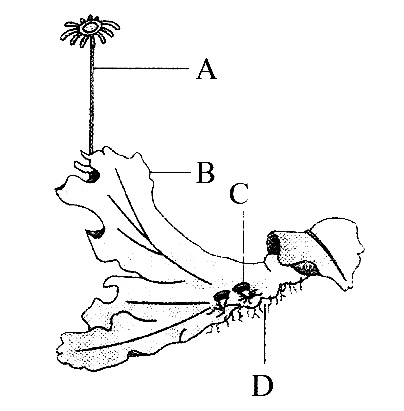
Examine the figure given below and select the correct option giving all the four parts (A, B, C and D) rightly identified. AIPMT 2011 Mains Biology - Plant Kingdom Question 33 English
(A)
(A) Archegoniophore
(B) Female thallus
(C) Gemmacup
(D) Rhizoids
(B)
(A) Antheridiophore
(B) Male thallus
(C) Globule
(D) Roots
(C)
(A) Archegoniophore
(B) Female thallus
(C) Bud
(D) Foot
(D)
(A) Seta
(B) Sporophyte
(C) Protonema
(D) Rhizoids
(A)

Solution

The given figure is of female thallus of Marchantia (bryophyte) in which A, B, C and D are archegoniophore, female thallus, gemmacup and rhizoids respectively.
Q.34
Consider the following four statements whether they are correct or wrong.
A.   The sporophyte in liverworts is more eleborate than that in mosses.
B.    Salvinia is heterosporous.
C.   The life-cycle in all seed-bearing plants is diplontic.
D.   In Pinus male and female cones are borne on different trees.

The two wrong statements together are
(A)
A and C
(B)
A and D
(C)
B and C
(D)
A and B.
(B)

Solution

The sporophyte in mosses is more elaborate than that in liverworts. The male and female cones or strobili is borne on same tree in (Pinus). In Cycas male cones and megasporophylls are borne on different trees.
Q.35
Selaginella and Salvinia are considered to represent a significant step toward evolution of seed habit because
(A)
female gametophyte is free and gets dispersed like seeds.
(B)
female gametophyte lacks archegonia.
(C)
megaspores possess endosperm and embryo surrounded by seed coat.
(D)
embryo develops in female gametophyte which is retained on parent sporophyte.
(D)

Solution

Selaginella and Salvinia are advanced pteridophytes.
Q.36
The breakdown of detritus into smaller particles by earthworm is a process called
(A)
Fragmentation
(B)
Catabolism
(C)
Mineralisation
(D)
Humification
(A)

Solution

The break down of detritus into smaller particles by earthworm is known as fragmentation.
Q.37
Both, hydrarch and xerarch successions lead to :
(A)
Xeric conditions
(B)
Excessive wet conditions
(C)
Highly dry conditions
(D)
Medium water conditions
(D)

Solution

Hydrarch succession takes place in wetter areas and the successional series progress from hydric to the mesic condition . Xerarch succession takes place in dry areas and the series progress from xeric to mesic condition. Hence, both hydrarch and xerarch succession leads to medium water conditions (mesic).
Q.38
Which one of the following animals may occupy more than one trophic levels in the same ecosystem at the same time ?
(A)
Lion
(B)
Frog
(C)
Goat
(D)
Sparrow
(D)

Solution

Sparrow can be herbivorous (eating seeds and fruits) or carnivorous (eating insects).
Q.39
Which one of the following options gives the correct matching of a disease with its causative organism and mode of infection ?
(A)
Disease Pneumonia, Causative Organisms Streptococcus pneumoniae, Mode of Infection Droplet infection
(B)
Disease Malaria, Causative Organisms Plasmodium vivax, Mode of Infection Bite of male Anopheles mosquito
(C)
Disease Elephantiasis , Causative Organisms Wuchereria bancrofti, Mode of Infection With infected water and food
(D)
Disease Typhoid , Causative Organisms Salmonella typhi, Mode of Infection With inspired air
(A)

Solution

Pneumonia disease is spread by the organism Streptococcus pneumoniae and the mode of infection is by droplet infection.
Q.40
Common cold is not cured by antibiotics because it is :
(A)
caused by a Gram-positive bacterium
(B)
caused by a Gram-negative bacterium
(C)
not an infectious disease
(D)
caused by a virus
(D)

Solution

Common cold is due to rhinovirus. Recent studies found that antibiotics do not kill this virus.
Q.41
Given below is the ECG of a normal human. Which one of its components is correctly interpreted below?
AIPMT 2011 Mains Biology - Body Fluids and Its Circulation Question 55 English
(A)
Complex QRX - one complete pulse
(B)
Peak T - initiation of total cardiac contraction
(C)
Peak P and peak R together - systolic and diastolic blood pressures
(D)
Peak P- initiation of left atrial contraction only
(A)

Solution

By counting the number of QRS complexes that occur in a given time period, one can determine the heart beat rate (pulse) of an individual. The QRS complex represents the depolarisation of the ventricles, which initiates the ventricular contraction.
Q.42
The type of muscles present in our
(A)
heart is involuntary and unstriated smooth muscles
(B)
intestine is striated and involuntary
(C)
thigh is striated and voluntary
(D)
upper arm is smooth muscle and fusiform in shape.
(C)

Solution

Cardiac muscles are found in the wall of the heart. It is involuntary and slightly striated. Smooth muscles are found in gastrointestinal tract. These are non-striated and involuntary. Striated (or skeletal) muscles are found in the limbs and body walls. These muscles are voluntary (under the control of animals’ will) and show dark and light bands thus are striated.
Q.43
The technique called gamete intrafallopian transfer (GIFT) is recommended for those females :
(A)
who cannot produce an ovum
(B)
who cannot retain the foetus inside uterus
(C)
who cannot provide suitable environment for fertilisation
(D)
whose cervical canal is too narrow to allow passage for the sperms
(A)

Solution

Gamete Intra Fallopian Transfer (GIFT) is transfer of an ovum collected from a donor into the Fallopian tube of another female who cannot produce ova but can provide proper environment for fertilization and further development.
Q.44
Which one of the following structure in pheretima is correctly matched with its function ?
(A)
Gizzard-absorbs digested food
(B)
Setae-defence against predators
(C)
Typhlosole-storage of extra nutrients
(D)
Clitellum-secretes cocoon
(D)

Solution

Clitellum - secretes cocoon during breading season of earthworm. Gizzard is used for- grinding of food particles. Setae help in locomotion. Typhlosole increases the absorption area in intestine.
Q.45
Frogs differ from humans in possessing :
(A)
hepatic portal system
(B)
paired cerebral hemispheres
(C)
nucleated red blood cells
(D)
thyroid as well as parathyroid
(C)

Solution

Human possesses enucleated RBCs in mature state. But frog blood has both white and red blood cells which are nucleated. Frog cells do not lack platelets.
Q.46
The cells lining the blood vessels belongs to the category of :
(A)
Squamous epithelium
(B)
Columnar epithelium
(C)
Connective tissue
(D)
Smooth muscle tissue
(A)

Solution

Simple squamous epithelium is composed of large flat cells whose edges fit closely together like the tiles in a floor, hence it is also called pavement epithelium. The nuclei of the cells are flattened and often lie at the centre of the cells and cause bulgings of cells surface. The epithelium lines the blood vessels, lymph vessels, heart, terminal bronchioles, alveoli of the lungs, walls of the Bowman’s capsules, descending limbs of loop of Henle. In the blood vessels and heart it is called endothelium.
Q.47
Which one of the following correctly represents the normal adult human dental formula?
(A)
(B)
(C)
(D)
(C)

Solution

The adult dental formula of human is Incisor , Canine , Premolar , Molar ..
Q.48
One of the constituents of the pancreatic juice which is poured into the duodenum in humans is
(A)
trypsinogen
(B)
chymotrypsin
(C)
trypsin
(D)
enterokinase.
(A)

Solution

Duodenum follows the stomach. It is somewhat C-shaped and about 25 cm. long. It receives the hepatopancreatic ampulla of the hepatopancreatic duct formed by the union of bile duct (from liver) and pancreatic duct (from pancreas) and whose opening is guarded by sphincter of Oddi. Pancreatic juice contains proenzymes—trypsinogen, chymotrypsinogen and procarboxypeptidase. In the presence of enterokinase (a protease of intestinal juice), inactive trypsinogen is converted to active trypsin. Trypsin then activates chymotrypsinogen and procarboxypeptidase into chymotrypsin and carboxypeptidase respectively. This enables simultaneous action of all pancreatic proteases for a rapid digestion of proteins. The bile provides alkaline medium for various reactions.
Q.49
Uricotelic mode of excreting nitrogenous wastes is found in
(A)
reptiles and birds
(B)
birds and annelids
(C)
amphibians and reptiles
(D)
insects and amphibians.
(A)

Solution

Reptiles, birds, land snails and insects excrete nitrogenous wastes as uric acid in the form of pellet or paste with a minimum loss of water and are called uricotelic animals.
Q.50
The 24 hour (diurnal) rhythm of our body such as the sleep-wake cycle is regulated by the hormone
(A)
calcitonin
(B)
prolactin
(C)
adrenaline
(D)
melatonin
(D)

Solution

Melatonin is a hormone that regulates the 24 hour rhythm of our body such as the sleep-wake cycle etc. Melatonin is produced by pineal gland in the brain, which is responsible for operation and regulation of the biological clock in mammals.
Q.51
What happens during fertilization in humans after many sperms reach close to the ovum?
(A)
Only two sperms nearest the ovum penetrate zona pellucida
(B)
Secretions of acrosome helps one sperm enter cytoplasm of ovum through zona pellucida
(C)
All sperms except the one nearest to the ovum lose their tails
(D)
Cells of corona radiate trap all the sperms except one.
(B)

Solution

The process of fusion of a sperm with an ovum is called fertilization. During fertilization, a sperm comes in contact with the zona pellucida layer of the ovum and induces changes in the membrane that block the entry of additional sperms. Thus, it ensures that only one sperm can fertilize an ovum. The secretions of the acrosome help the sperm enter into the cytoplasm of the ovum through the zona pellucida and the plasma membrane. In contact with the surface of egg covering, the acrosome releases its contained hydrolytic enzymes, also called sperm lysins. It is known as acrosomal reaction. Acrosome reaction results in dissolving of corona cells and degeneration of zona pellucida which helps in sperm penetration.
Q.52
About which day in a normal human menstrual cycle does rapid secretion of LH (popularly called LH-surge) normally occurs?
(A)
11th day
(B)
14th day
(C)
20th day
(D)
5th day
(B)

Solution

At 14th day of normal human menstrual cycle rapid secretion of LH normally occurs.
Q.53
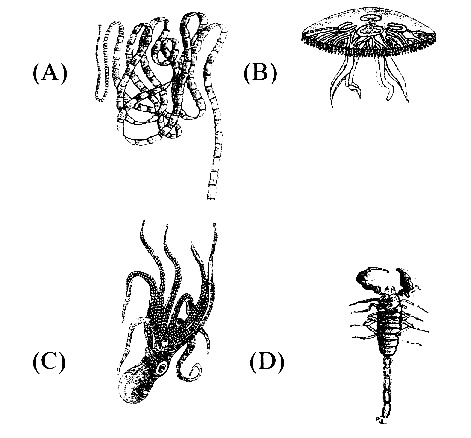
The figures (A – D) show four animals. Select the correct option with respect to a common characteristic of two of these animals. AIPMT 2011 Mains Biology - Animal Kingdom Question 44 English
(A)
(A) and (B) have cnidoblasts for selfdefence
(B)
(A) and (D) respire mainly through body wall
(C)
(C) and (D) have a true coelom
(D)
(B) and (C) show radial symmetry
(C)

Solution

From annelida to chordata all organisms are eucoelomate. C-Mollusca (Octopus), D-Arthropoda (Scorpion) have a true coelom.
Q.54
Which one of the following statements is totally wrong about the occurrence of notochord, while the other three are correct?
(A)
It is present only in larval tail in ascidian.
(B)
It is replaced by a vertebral column in adult frog.
(C)
It is absent throughout life in humans form the very beginning.
(D)
It is present throughout life in Amphioxus.
(C)

Solution

Notochord is present is the embryonic stage which is replaced by bony vertebral column.
Q.55
Consider the following four statements (AD) related to the common frog Rana tigrina, and select the correct option starting which ones are true (T) and which ones are false (F). Statements:
A.  On dry land it would die due to lack of O2 if its mouth is forcibly kept closed for a few days.
B.  It has four-chambered heart.
C.  On dry land it turns uricotelic from ureotelic.
D.  Its life-history is carried out in pond water.
(A)
A-T,  B-F,  C-F,  D-T
(B)
A-T,  B-T,  C-F,  D-F
(C)
A-F,  B-F,  C-T,  D-T
(D)
A-F,  B-T,  C-T,  D-F
(A)

Solution

(A) Dry skin causes ceased cutaneous respiration
(B) Three chambered heart.
(C) Frog never becomes uricotelic
(D) External fertilization occurs in water
Q.56
Ureters act as urinogenital ducts in
(A)
human males
(B)
human females
(C)
both male and female frogs
(D)
male frogs
(D)

Solution

In male frogs, two ureters act as urinogenital duct which open into the cloaca. They run backwards from the kidneys and open into the cloaca. In female ureters carry urine alone, while in male both sperms and urine are carried. Hence, are called urinogenital ducts.
Q.57
Bulk of carbon dioxide (CO2) released from body tissues into the blood is present as
(A)
bicarbonate in blood plasma and RBCs
(B)
free CO2 in blood plasma
(C)
70% carbamino-haemoglobin and 30% as bicarbonate
(D)
carbamino-haemoglobin in RBCs.
(A)

Solution

70% to 75% CO2 is transported as primary buffer of the blood bicarbonate ion (HCO3) in blood plasma. When CO2 diffuses from tissues into blood then it is acted upon by the enzyme carbonic anhydrase.
Q.58
Which one of the following is a possibility for most of us in regard to breathing, by making a conscious effort?
(A)
One can breathe out air totally without oxygen.
(B)
One can breathe out air through Eustachian tube by closing both nose and mouth.
(C)
One can consciously breathe in and breathe out by moving the diaphragm alone, without moving the ribs at all.
(D)
The lungs can be made fully empty by forcefully breathing out all air from them.
(C)

Solution

Option C is correct because the diaphragm is the main muscle responsible for breathing, and it separates the chest cavity from the abdominal cavity. By making a conscious effort, one can control the movement of the diaphragm and breathe in and out without moving the ribs at all. This is called diaphragmatic breathing or belly breathing. It is a technique often used in yoga, meditation, and other relaxation exercises to increase oxygenation and reduce stress. With practice, diaphragmatic breathing can become a natural and automatic way of breathing, even during regular activities.