NEET-UG 2012

AIPMT 2012 Mains

Physics (Maximum Marks: 120)
  • This section contains 30 questions.
  • Each question has FOUR options (A), (B), (C) and (D). ONLY ONE of these four options is the correct answer.
  • Full Marks : +4 If ONLY the correct option is chosen;
  • Zero Marks : 0 If none of the options is chosen (i.e. the question is unanswered);
  • Negative Marks : −1 In all other cases.
Q.1
The dimensions of are
(A)
(B)
(C)
(D)
(C)

Solution

= = Speed of light in vacuum = c

So the dimension of = [c] =[LT-1]
Q.2
A stone is dropped from a height h. It hits the ground with a certain momentum P. If the same stone is dropped from a height 100% more than the previous height, the momentum when it hits the ground will change by
(A)
68%
(B)
41%
(C)
200%
(D)
100%
(B)

Solution

When a stone is dropped from a height h, it hits the ground with a momentum

     ....(1)

where m is the mass of the stone.
When the same stone is dropped from a height 2h (i.e. 100% of initial), then its momentum with which it hits the ground becomes

    [Using (1)]     ...(2)

% change in momentum =

Q.3
A car of mass m starts from rest and accelerates so that the instantaneous power delivered to the car has a constant magnitude P0. The instantaneous velocity of this car is proportional to
(A)
t2P0
(B)
t1/2
(C)
t1/2
(D)
(B)

Solution

Constant power of car P0 = F.V = ma.v


P0dt = mvdv Integrating


P0 , m and 2 are constant

Q.4
Three masses are placed on the x-axis : 300 g at origin, 500 g at x = 40 cm and 400 g at x = 70cm. The distance of the centre of mass from the orgin is :
(A)
40 cm
(B)
45 cm
(C)
50 cm
(D)
30 cm
(A)

Solution

The distance of the centre of mass of the system of three masses from the origin O is


Q.5
A car of mass m is moving on a level circular track of radius R. If s represents the static friction between the road and tyres of the car, the maximum speed of the car in circular motion is given by
(A)
(B)
(C)
(D)
(D)

Solution

For smooth driving maximum speed of car v then


Q.6
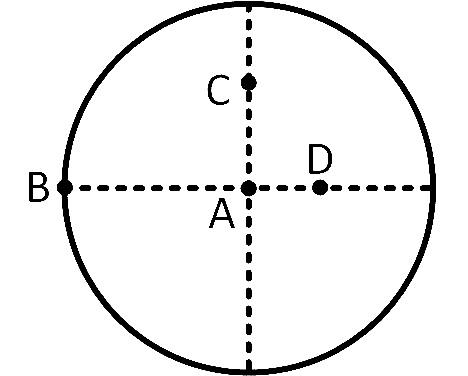
The moment of inertia of a uniform circular disc is maximum about an axis perpendicular to the disc and passing through

AIPMT 2012 Mains Physics - Rotational Motion Question 65 English
(A)
B
(B)
C
(C)
D
(D)
A
(A)

Solution

According to the theorem of parallel axes,
I = ICM + Ma2
As a is maximum for point B.
Therefore I is maximum about B.
Q.7
A circular platform is mounted on a frictionless vertical axle. Its radius R = 2 m and its moment of inertia about the axle is 200 kg m2. It is initially at rest. A 50 kg man stands on the edge of the platform and begins to walk along the edge at the speed of 1 ms1 relative to the ground. Time taken by the man to complete one revolution is
(A)
s
(B)
s
(C)
2 s
(D)
s
(C)

Solution

Using conservation
Li = 0 (Initial moment)
Lf = mvR – I (Final moment)

According to the conservation of momentum
Li = Lf

mvR – I. = 0

mvR = I.


t = 2 sec.
Q.8
If is escape velocity and is orbital velocity of a satellite for orbit close to the earth's surface, then these are related by
(A)
(B)
vo ve
(C)
(D)
(D)

Solution

Escapevelocity,     ...(i)

where M and R where M and R be the mass and radius of the earth respectively. The orbital velocity of a satellite close to the earth’s surface is

   ...(ii)

From (i) and (ii), we get

Q.9
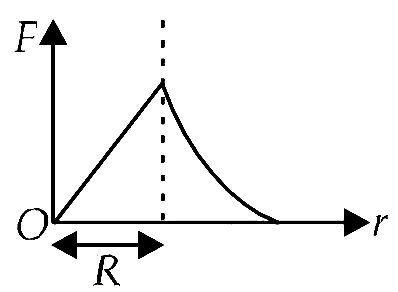
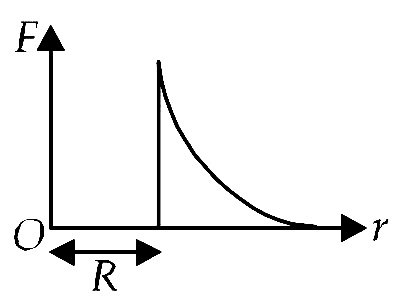
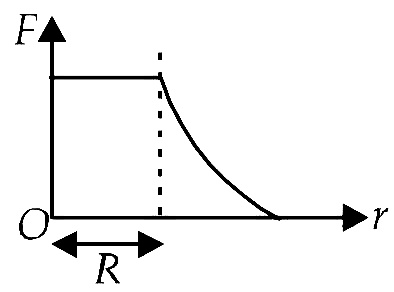
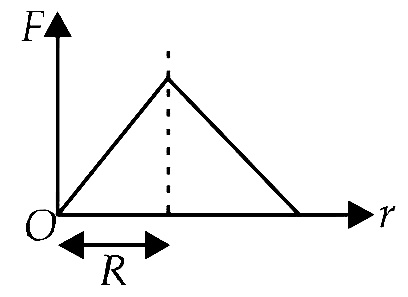
Which one of the following plots represents the variation of gravitiational field on a particle with distance r due to a thin spherical shell of radius R? (r is measured from the centre of the spherical shell)
(A)
AIPMT 2012 Mains Physics - Gravitation Question 47 English Option 1
(B)
AIPMT 2012 Mains Physics - Gravitation Question 47 English Option 2
(C)
AIPMT 2012 Mains Physics - Gravitation Question 47 English Option 3
(D)
AIPMT 2012 Mains Physics - Gravitation Question 47 English Option 4
(B)

Solution

Gravitational field due to the thin spherical shell Inside the shell, i.e. (For r < R)

F = 0

On the surface of the shell, i.e. (For r = R)


Outside the shell, i.e. (For r > R)


The variation of F with distance r from the centre is as shown in the adjacent figure.
Q.10
A slab of stone of area 0.36 m2 and thickness 0.1 m is exposed on the lower surface to steam at 100oC. A block of ice at 0oC rests on the upper surface of the slab. In one hour 4.8 kg of ice is melted. The thermal conductivity of slab is
(Given latent heat of fusion of ice = 3.36 105 J kg1)
(A)
1.24 J/m/s/oC
(B)
1.29 J/m/s/oC
(C)
2.05 J/m/s/oC
(D)
1.02 J/m/s/oC
(A)

Solution

Rate of heat given by steam = Rate of heat taken by ice

where K = Thermal conductivity of the slab
m = Mass of the ice
L = Latent heat of melting/fusion
A = Area of the slab

,


K =1.24 J/m/s/°C
Q.11
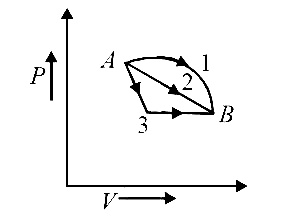
An ideal gas goes from state A to state B via three different processes as indicated in the P-V diagram.

AIPMT 2012 Mains Physics - Heat and Thermodynamics Question 62 English

If Q1, Q2, Q3 indicate the heat absorbed by the gas along the three processes and U1, U2, U3 indicate the change in internal energy along the three processes respectively, then
(A)
Q1 > Q2 > Q3 and U1 = U2 = U3
(B)
Q3 > Q2 > Q1 and U1 = U2 = U3
(C)
Q1 = Q2 = Q3 and U1 > U2 > U3
(D)
Q3 = Q2 = Q1 and U1 > U2 > U3
(A)

Solution

Initial and final condition is same for all process


from first law of thermodynamics


Work done

   (Area of P.V. graph)

So
Q.12
A train moving at a speed of 220 m s1 towards a stationary object, emits a sound of frequency 1000 Hz. Some of the sound reaching the object gets reflected back to the train as echo. The frequency of the echo as detected by the driver of the train is
(Speed of sound in air is 330 m s1)
(A)
3500 Hz
(B)
4000 Hz
(C)
5000 Hz
(D)
3000 Hz
(C)

Solution

Here, Speed of the train, vT = 220 ms–1
Speed of sound in air, v = 330 ms–1
The frequency of the echo detected by the driver of the train is


Q.13
The equation of a simple harmonic wave is given by

y = 3 sin(50t x),

where x and y are in metres and t is in seconds. The ratio of maximum particle velocity to the wave velocity is
(A)
2
(B)
(C)
(D)
(B)

Solution


on comparing with the standard wave equation


Wave velocity

The velocity of particle


then
Q.14
Two metallic spheres of radii 1 cm and 3 cm are given charges of 1 102 C and 5 102 C, respectively. If these are connected by a conducting wire, the final charge on the bigger sphere is
(A)
2 102 C
(B)
3 102 C
(C)
4 102 C
(D)
1 102 C
(B)

Solution

At equilibrium potential of both sphere becomes same if charge of sphere one x and other sphere Q – x
then where Q = 4 × 10⁻² C

v1 = v2


3x = Q – x 4x = Q


Q' = Q – x = 3 × 10⁻² C
Q.15
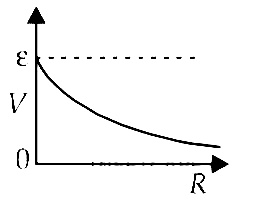
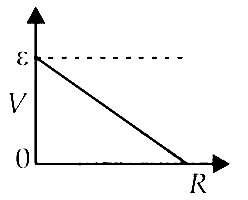
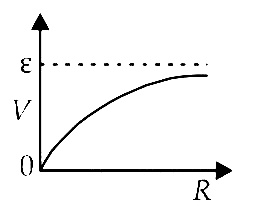
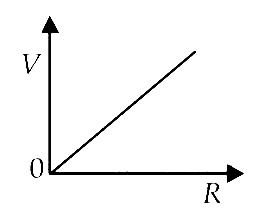
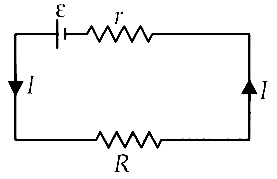
A cell having an emf and internal resistance r is connected across a variable external resistance R. As the resistance R is increased, the plot of potential difference V across R is given by
(A)
AIPMT 2012 Mains Physics - Current Electricity Question 92 English Option 1
(B)
AIPMT 2012 Mains Physics - Current Electricity Question 92 English Option 2
(C)
AIPMT 2012 Mains Physics - Current Electricity Question 92 English Option 3
(D)
AIPMT 2012 Mains Physics - Current Electricity Question 92 English Option 4
(C)

Solution

AIPMT 2012 Mains Physics - Current Electricity Question 92 English Explanation
Current in the circuit,

Potential difference across R,


When R = 0, V = 0 and when R = , V =

option (c) represents the correct graph.
Q.16
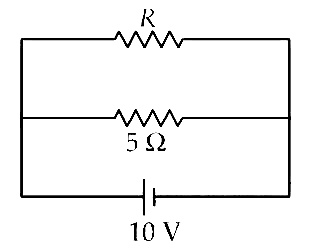
The power dissipated in the circuit shown in the figure is 30 watts. The value of R is
AIPMT 2012 Mains Physics - Current Electricity Question 91 English
(A)
20
(B)
15
(C)
10
(D)
30
(C)

Solution

The power dissipated in the circuit

    ...(i)

v = 10 volt


P = 30 W
Substituting the values in equation (i)


15R = 50 + 10R

5R = 50

R = 10
Q.17
A parallel plate capacitor has a uniform electric field E in the space between the plates. If the distance between the plates is d and area of each plate is A, the energy stored in the capacitor is
(A)
(B)
(C)
(D)
(C)

Solution

Capacitance of a parallel plate capacitor is

   ...(i)

Potential difference between the plates is

V = Ed    ...(ii)

The energy stored in the capacitor is

   (Using (i) and (ii))

Q.18
A proton carrying 1 MeV kinetic energy is moving in a circular path of radius R in uniform magnetic field. What should be the energy of an -particle to describe a circle of same radius in the same field?
(A)
2 MeV
(B)
1 MeV
(C)
0.5 MeV
(D)
4 MeV
(B)

Solution

According to the principal of circular motion in a magnetic field


but (given)

K = K' = 1 MeV
Q.19
A magnetic needle suspended parallel to a magnetic field requires of work to turn it through 60o. The torque needed to maintain the needle in this position will be
(A)
(B)
(C)
(D)
(B)

Solution

According to work energy theorem

W = Ufinal – Uinitial = MB (cos 0 – cos 60°) = = ....(1)

The torque on the needle is


= = ....(2)

From equation (1) and (2),

= = 3 J
Q.20
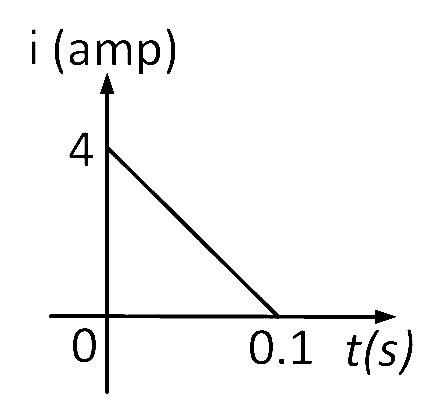
In a coil of resistance 10 , the induced current developed by changing magnetic flux through it, is shown in figure as a function of time. The magnitude of change in flux through the coil in weber is

AIPMT 2012 Mains Physics - Electromagnetic Induction Question 24 English
(A)
8
(B)
2
(C)
6
(D)
4
(B)

Solution

q = Area under i-t graph

= = 0.2 C

As q =

= qR = 0.210 = 2 weber
Q.21
The instantaneous values of alternating current and voltage in a circuit are given as

sin (100 t) ampere

Volt

The average power in watts consumed in the circuit is
(A)
(B)
(C)
(D)
(D)

Solution

irms = A

erms = V

Average power consumed in the circuit,

P = irmserms cos

= = W
Q.22
The ratio of amplitude of magnetic field to the amplitude of electric field for an electromagnetic wave propagatting in vacuum is equal to
(A)
the speed of light in vacuum
(B)
reciprocal of speed of light in vacuum
(C)
the ratio of magnetic permeability to the electric susceptibility of vacuum
(D)
unity
(B)

Solution

If the speed of light c then

E0 = B0c


Hence ratio of amplitude of magnetic field to amplitude of electric field for electromagnetic wave in a vacuum is reciprocal of speed of light.
Q.23
For the angle of minimum deviation of a prism to be equal to its refracting angle, the prism must be made of a material whose refractive index.
(A)
lies between and 1
(B)
lies between 2 and
(C)
is less than 1
(D)
is greater than 2
(B)

Solution

=

=

=

=

=

The angle of minimum deviation is given as

min = i + e – A

for minimum deviation

min = A and i = e then

2A = i + i

i = A

imin = 0 = Amin min = 2

imax = 900 = Amax max =

lies between 2 and .
Q.24
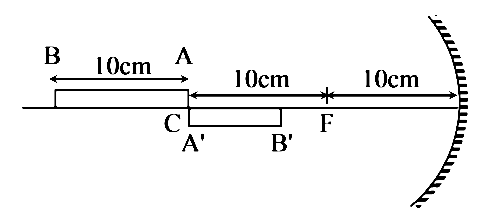
A rod of length 10 cm lies along the principal axis of a concave mirror of focal length 10 cm in such a way that its enf closer to the pole is 20 cm away from the mirror. The length of the image is
(A)
10 cm
(B)
15 cm
(C)
2.5 cm
(D)
5 cm
(D)

Solution

AIPMT 2012 Mains Physics - Geometrical Optics Question 61 English Explanation

Image position of end A


vA = - 20 cm

Image position of the end B


vB = -15 cm

Length of the image is

LA'B' = |vA| - |vB| = 20 - 15 = 5 cm
Q.25
The transition from the state n = 3 to n = 1 in a hydrogen like atom results in ultraviolet radiation. Infrared radiation will be obtained in the transition from
(A)
2 1
(B)
3 2
(C)
4 2
(D)
4 3
(D)

Solution

The frequency of the transition v

when n = 1, 2, 3.
Q.26
The half life of a radioactive nucleus is 50 days. The time invertal (t2 t1) between the time t2 when of it has decayed and the time t1 when of it had decayed is
(A)
30 days
(B)
50 days
(C)
60 days
(D)
15 days
(B)

Solution

At time t2, of the sample had decayed

N = N0

N0 = N0 ......(1)

At time t1, of the sample had decayed

N = N0

N0 = N0 ......(2)

Divide (i) by (ii), we get


= ln 2

= = = T1/2 = 50 days
Q.27
Two radiations of photons energies 1 eV and 2.5 eV, successively illuminate a photosensitive metallic surface of work function 0.5 eV. The ratio of the maximum speeds of the emitted electrons is
(A)
1 : 4
(B)
1 : 2
(C)
1 : 1
(D)
1 : 5
(B)

Solution

According to Einsten’s photoelectric effect, the K.E. of the radiated electrons

K.Emax = E – W

= (1 - 0.5) eV = 0.5 eV

= (2.5 - 0.5) eV = 2 eV

= 1 : 2
Q.28
If the momentum of an electron is changed by P, then the de Broglie wavelength associated with changes by 0.5%. The initial momentum of electron will be
(A)
200 P
(B)
400 P
(C)
(D)
100 P
(A)

Solution

de Broglie wavelength associated with an electron is


P =


Pinitial = 200P
Q.29
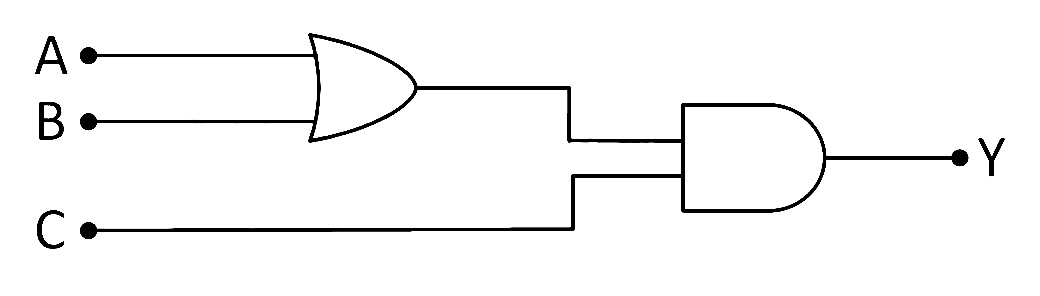
To get an output Y= 1 in given circuit which of the following input will be correct ?

AIPMT 2012 Mains Physics - Semiconductor Electronics Question 91 English
(A)
A 1,  B 0,  C 0
(B)
A 1,  B 0,  C 1
(C)
A 1,  B 1,  C 0
(D)
A 0,  B 1,  C 0
(B)

Solution

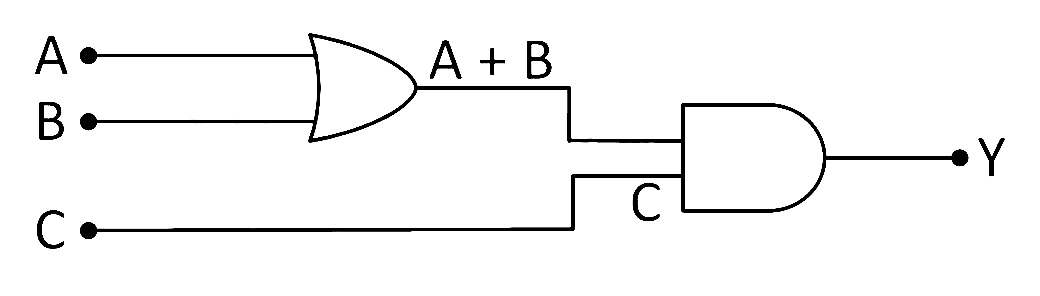
AIPMT 2012 Mains Physics - Semiconductor Electronics Question 91 English Explanation

The Boolen expression for the given combination is

output Y = (A + B) · C

So it is clear that Y = 1, when A = 1, B = 0 and C = 1
Q.30
The input resistance of a silicon transistor is 100 . Base current is changed by 40 A which results in a change in collector current by 2 mA. This transistor is used as a common emitter amplifier with a load resistance of 4 k. The voltage gain of the amplifier is
(A)
2000
(B)
3000
(C)
4000
(D)
1000
(A)

Solution

Current gain () :

=

= = 50

Voltage gain of the amplifier is

AV =

= 50 = 2000
Chemistry (Maximum Marks: 120)
  • This section contains 30 questions.
  • Each question has FOUR options (A), (B), (C) and (D). ONLY ONE of these four options is the correct answer.
  • Full Marks : +4 If ONLY the correct option is chosen;
  • Zero Marks : 0 If none of the options is chosen (i.e. the question is unanswered);
  • Negative Marks : −1 In all other cases.
Q.1
The orbital angular momentum of a p-electron is given as
(A)
(B)
(C)
(D)
(A)

Solution

Orbital angular momentum (m) =

For p-electrons; l = 1

Thus, m = = =
Q.2
For real gases van der Waals equation is written as

(V nb) = n RT
where and are van der Waals constants. Two sets of gases are
(I)  O2, CO2, H2 and He
(II)  CH4. O2 and H2

The gases given in set-I in increasing order of b and gases given in set-II in decreasing order of , are arranged below. Select the correct order from the following
(A)
(I) He < H2 < CO2 < O2   (II) CH4 > H2 > O2
(B)
(I) O2 < He < H2 < CO2   (II) H2 > O2 > CH4
(C)
(I) H2 < He < O2 < CO2   (II) CH4 > O2 > H2
(D)
(I) H2 < O2 < He < CO2   (II) O2 > CH4 > H2
(C)

Solution

Van der Waal gas constant '' represent intermolecular force of attraction of gaseous molecules and Van der Waal gas constant 'b' represent effective size of molecules . Therefore order should be

(I) H2 < He < O2 < CO2   (II) CH4 > O2 > H2
Q.3
A certain gas takes three times as long to effuse out as helium. Its molecular mass will be
(A)
27 u
(B)
36 u
(C)
64 u
(D)
9 u
(B)

Solution

According to Graham's law of diffusion


Rate of diffusion =


If same volume of two gases diffuse then V1 = V2


Here t2 = 3t, M1 = 4 u, M2 = ?


Q.4
Equal volumes of two monoatomic gases, A and B at same temperature and pressure are mixed. The ratio of specific heats (Cp/Cv) of the mixture will be
(A)
0.83
(B)
1.50
(C)
3.3
(D)
1.67
(D)

Solution

Cp for monoatomic gas mixture of same volume =

CV =

Q.5
Given the reaction between 2 gases represented by A2 and B2 to give the compound AB(g),

A2(g) + B2(g) 2AB(g)

At equilibrium, the concentration of
A2 = 3.0 103 M, of B2 = 4.2 103 M, of AB = 2.8 103 M
If the reaction takes place in a sealed vessel at 527oC, then the value of Kc will be
(A)
2.0
(B)
1.9
(C)
0.62
(D)
4.5
(C)

Solution

A2(g) + B2(g) 2AB(g);

Kc =

=

= 0.62
Q.6
Given that the equilibrium constant for the reaction,
2SO2(g) + O2(g) 2SO3(g)
has a value of 278 at a particular temperature. What is the value of the equilibrium constant for the following reaction at the same temperature ?
SO3(g) SO2(g) + O2(g)
(A)
1.8 103
(B)
3.6 103
(C)
6.0 102
(D)
1.3 105
(C)

Solution

2SO2(g) + O2(g) 2SO3(g),    K

SO3(g) SO2(g) + O2(g),     K' =

K' = 6.0 102
Q.7
Vapour pressure of chloroform (CHCl3) and dichloromethane (CH2Cl2) at 25oC are 200 mm Hg and 41.5 mm Hg respectively. Vapour pressure of the solution obtained by mixing 25.5 g of CHCl3 and 40 g of CH2Cl2 at the same temperature will be
(Molecular mass of CHCl3 = 119.5 u and molecular mass of CH2Cl2 = 85 u)
(A)
173.9 mm Hg
(B)
615.0 mm Hg
(C)
90.6 mm Hg
(D)
285.5 mm Hg
(C)

Solution

nCHCl3 = = 0.213

nCH2Cl2 = = 0.47

PT = PoAXA + PoBXB

=

= 62 + 28.55

= 90.63
Q.8
The Gibb's energy for the decomposition of Al2O3 at 500oC is as follows
Al2O3 Al + O2
rG = +960 kJ mol1
The potential difference needed for the electrolytic reduction of aluminium oxide (Al2O3) at 500oC is at least
(A)
4.5 V
(B)
3.0 V
(C)
2.5 V
(D)
5.0 V
(C)

Solution

We know,

Go = – nFEo

Al2O3 Al + O2

Total number of Al atoms in Al2O3

=

Al3+ + 3e Al

As 3e change occur for each Al atom

n =

Eo = -

= -

= - 2.5 V
Q.9
Standard reduction potentials of the half reactions are given below :
F2(g) + 2e 2F(aq) ;   Eo = + 2.85 V
Cl2(g) + 2e 2Cl(aq) ;   Eo = + 1.36 V
Br2(l) + 2e 2Br(aq) ;   Eo = + 1.06 V
I2(s) + 2e 2I(aq) ;  Eo = + 0.53 V

The strongest oxidising and reducing agents 23 respectively are
(A)
F2 and I
(B)
Br2 and Cl
(C)
Cl2 and Br
(D)
Cl2 and I2
(A)

Solution

Higher the value of reduction potential higher will be the oxidising power whereas the lower the value of reduction potential higher will be the reducing power.
Q.10
Molar conductivities at infinite dilution of NaCl, Hcl and CH3COONa are 126.4, 425.9 and 91.0 S cm2 mol1 respectively. for CH3COOH will be
(A)
425.5 S cm2 mol1
(B)
180.5 S cm2 mol1
(C)
290.8 S cm2 mol1
(D)
390.5 S cm2 mol1
(D)

Solution

oCH3COOH = oCH3COONa + oHCl - oNaCl

= = 91 + 425.9 – 126.4 = 390.5
Q.11
Activation energy (E) and rate constants (k1 and k2) of a chemical reaction at two different temperatures (T1 and T2) are related by
(A)
(B)
(C)
(D)
(B, D)

Solution

Let

......(1)


....(2)

From eq.(1) and (2), we have


Q.12
Structure of a mixed oxide is cubic close packed (ccp). The cubic unit cell of mixed oxide is composed of oxide ions. One fourth of the tetrahedral voids are occupied by divalent metal A and the octahedral voids are cooupied by a monovalent metal B. The formula of the oxide is
(A)
ABO2
(B)
A2BO2
(C)
A2B3O4
(D)
AB2O2
(D)

Solution

Number of atoms in cubic close packing = 4 = O2-

Number of tetrahedral voids = 2 × N = 2 × 4

Number of A2+ ions = 8 = 2

Number of octahedral voids = Number of B+ ions = N = 4

Ratio of ions will be,

O2– : A2+ : B+ = 4 : 2 : 4 = 2 : 1 : 2

Formula of oxide = AB2O2
Q.13
During change of O2 to O ion, the electron adds on which one of the following orbitals ?
(A)
orbital
(B)
orbital
(C)
orbital
(D)
orbital
(A)

Solution

Electronic configuration of O2


Thus the incoming electron will enter in to form
Q.14
Four diatomic species are listed below. Identify the correct order in which the bond order is increasing in them
(A)
(B)
(C)
(D)
(D)

Solution

Diatomic species Bond order
NO 2.5
1.5
3.0
0.5
The increasing order:
Q.15
In which of the following arrangements the given sequence is not strictly according to the property indicated against it?
(A)
HF < HCl < HBr < HI : increasing acidic strength
(B)
H2O < H2S < H2Se < H2Te : increasing pKa values
(C)
NH3 < PH3 < AsH3 < SbH3 : increasing acidic character
(D)
CO2 < SiO2 < SnO2 < PbO2 : increasing oxidising power
(B)

Solution

If acidic nature is high, Ka is high and pKa is low.

since pKa = – log Ka

Hence the order of pKa will be

H2O > H2S > H2Se > H2Te
Q.16
Which of the following exhibits only + 3 oxidation state?
(A)
U
(B)
Th
(C)
Ac
(D)
Pa
(C)

Solution

U exhibits + 3, + 4, + 5, + 6

Th exhibits + 3, + 4 ;

Ac exhibits + 3 only;

Pa exhibits + 3, + 4, + 5
Q.17
The catalytic activity of transition metals and their compounds is ascribed mainly to
(A)
their magnetic behaviour
(B)
their unfilled -orbitals
(C)
their ability to adopt variable oxidation states
(D)
their chemical reactivity
(C)

Solution

The transition metals and their compounds are used as catalysts because of the variable oxidation states. Due to this, they easily absorb and re-emit wide range of energy to provide the necessary activation energy.
Q.18
Four successive members of the first series of the transition metals are listed below. For which one of them the standard potential value has a positive sign?
(A)
Co (Z = 27)
(B)
Ni (Z = 28)
(C)
Cu (Z = 29)
(D)
Fe (Z = 26)
(C)

Solution

= -0.28

= -0.25

= +0.34

= -0.44
Q.19
Which one of the following does not correctly represent the correct order of the property indicated against it?
(A)
Ti < V < Cr < Mn; increasing number of oxidation states
(B)
Ti3+ < V3+ < Cr3+ < Mn3+ : increasing magnetic moment
(C)
Ti < V < Cr < Mn : increasing melting points
(D)
Ti < V < Mn < Cr : increasing 2nd ionization enthalpy
(C)

Solution

The melting points of the transition elements first rise to a maximum and then fall as the atomic number increases, manganese have abnormally low melting points.
Q.20
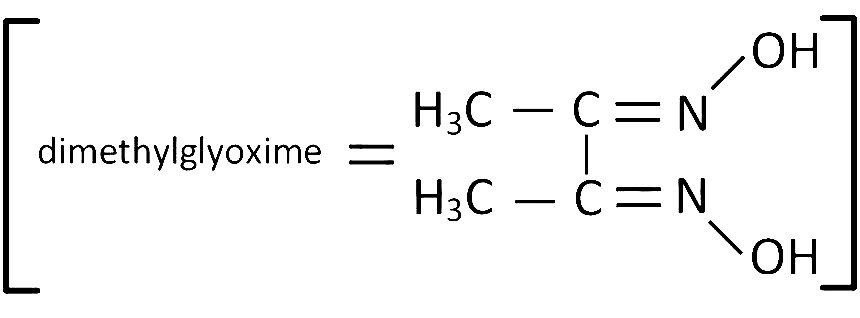
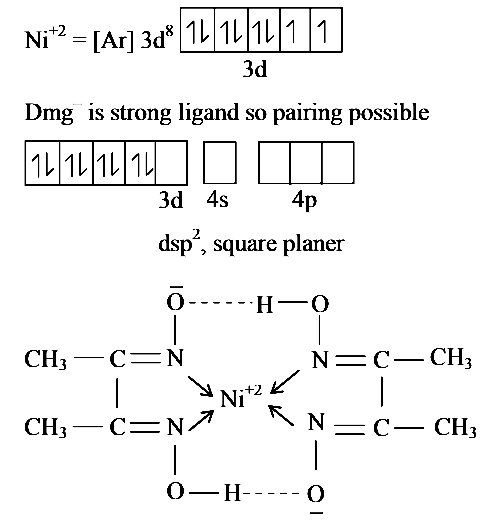
Red precipitate is obtained when ethanol solution of dimethylglyoxime is added to ammoniacal Ni(II). Which of the following statements is not true?
AIPMT 2012 Mains Chemistry - Coordination Compounds Question 40 English
(A)
Red complex has a square planar geometry.
(B)
Complex has symmetrical H-bonding.
(C)
Red complex has a tetrahedral geometry.
(D)
Dimethylglyoxime functions as bidenate ligand.
(C)

Solution

Ni+2 + 2Dmg– → [Ni(Dmg)2]

AIPMT 2012 Mains Chemistry - Coordination Compounds Question 40 English Explanation
Dimethyl glyoxime act as bidentate ligand.
Q.21
Low spin complex of d6-cation in an octahedral field will have the following energy
(A)
(B)
(C)
(D)
(B)

Solution

For low spin d6 complex electronic configuration

=

x = 6, y = 0, z = 3

C.F.S.E. = (– 0.4 × 6 + 0 × 0.6)0 + 3P

=
Q.22
Which of the following reagents will be able to distinguish between 1-butyne and 2-butyne?
(A)
NaNH2
(B)
HCl
(C)
O2
(D)
Br2
(A)

Solution

AIPMT 2012 Mains Chemistry - Hydrocarbons Question 45 English Explanation
Q.23
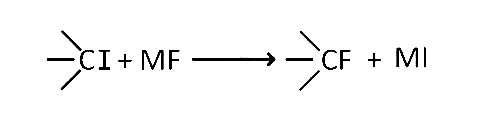
In the replacement reaction
AIPMT 2012 Mains Chemistry - Haloalkanes and Haloarenes Question 23 English
The reaction will be most favourable if M happens to be
(A)
Na
(B)
K
(C)
Rb
(D)
Li
(C)

Solution

Tertiary alkyl halides shows SN1 mechanism to the greater extent. In the given reaction negative ion will attack on carbocation. Thus, greater the tendency of ionization (greater ionic character in M-F bond) more favourable will be reaction. In the given options Rb-F is most ionic and hence it will be most favourable for SN1 mechanism.
Q.24
Which of the following compounds can be used as antifreeze in automobile radiators?
(A)
Methyl alcohol
(B)
Glycol
(C)
Nitrophenol
(D)
Ethyl alcohol
(B)

Solution

Glycol is used as an antifreeze in automobiles.
Q.25
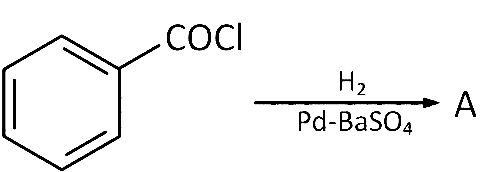
Consider the following reaction

AIPMT 2012 Mains Chemistry - Aldehydes, Ketones and Carboxylic Acids Question 67 English
The product A is
(A)
C6H5CHO
(B)
C6H5OH
(C)
C6H5COCH3
(D)
C6H5Cl
(A)

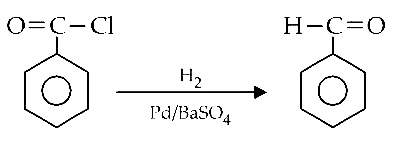
Solution

AIPMT 2012 Mains Chemistry - Aldehydes, Ketones and Carboxylic Acids Question 67 English Explanation

It is Rosenmund’s reaction.
Q.26
Consider the reaction :
RCHO + NH2NH2 RCH N NH2

What sort of reaction is it?
(A)
Electrophilic addition-elimination reaction
(B)
Free radical addition-elimination reaction
(C)
Electrophilic substitution-elimination reaction
(D)
Nucleophilic addition-elimination reaction
(D)

Solution

RCHO + NH2NH2 RCH N NH2

Such reactions take place in slightly acidic medium and involve nucleophilic addition of the ammonia derivative.
Q.27
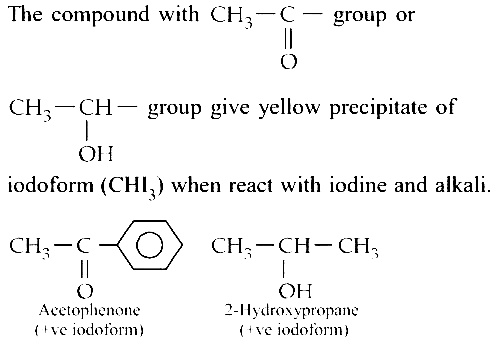
Which of the following compounds will give a yellow precipitate with iodine and alkali?
(A)
Acetophenone
(B)
Methyl acetate
(C)
Acetamide
(D)
2-Hydroxypropane
(A, D)

Solution

AIPMT 2012 Mains Chemistry - Aldehydes, Ketones and Carboxylic Acids Question 87 English Explanation
Q.28
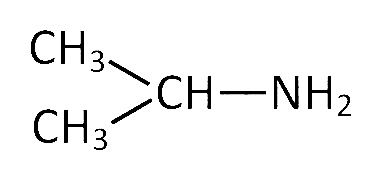
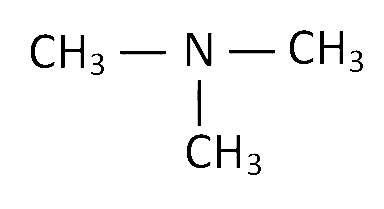
An organic compound (C3H9N) (A), when treated with nitrous acid, gave an alcohol and N2 gas was evolved. (A) on warming with CHCl3 and caustic potash gave (C) which on reduction gave isopropylmethylamine. Predict the structure of (A)
(A)
AIPMT 2012 Mains Chemistry - Organic Compounds Containing Nitrogen Question 40 English Option 1
(B)
CH3CH2 NH CH3
(C)
AIPMT 2012 Mains Chemistry - Organic Compounds Containing Nitrogen Question 40 English Option 3
(D)
CH3CH2CH2 NH2
(A)

Solution

As A gives alcohol on treatment with nitrous acid thus it should be primary amine. C3H9N has two possible structure with –NH2 group.

AIPMT 2012 Mains Chemistry - Organic Compounds Containing Nitrogen Question 40 English Explanation 1

As it gives isopropylmethylamine thus it should be isopropyl amine not n-propyl amine.
AIPMT 2012 Mains Chemistry - Organic Compounds Containing Nitrogen Question 40 English Explanation 2
Q.29
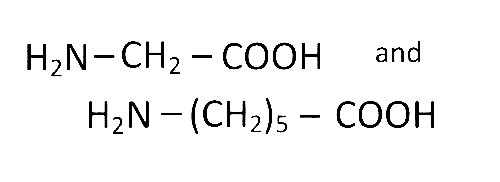
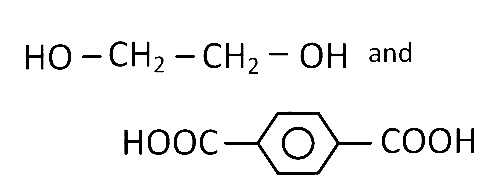
Which one of the following sets forms the biodegradable polymer?
(A)
AIPMT 2012 Mains Chemistry - Polymers Question 14 English Option 1
(B)
AIPMT 2012 Mains Chemistry - Polymers Question 14 English Option 2
(C)
AIPMT 2012 Mains Chemistry - Polymers Question 14 English Option 3
(D)
AIPMT 2012 Mains Chemistry - Polymers Question 14 English Option 4
(B)

Solution

Biodegradable polymer is Nylon-2-Nylon-6 which is copolymer of glycine (H2N – CH2– COOH) and amino caproic acid (H2N–(CH2)5 – COOH).
Q.30
Chloroamphenicol is an
(A)
antifertility drug
(B)
antihistaminic
(C)
antiseptic and disinfectant
(D)
antibiotic-broad spectrum
(D)

Solution

Chloramphenicol is an antibiotic broad spectrum.
Biology (Maximum Marks: 240)
  • This section contains 60 questions.
  • Each question has FOUR options (A), (B), (C) and (D). ONLY ONE of these four options is the correct answer.
  • Full Marks : +4 If ONLY the correct option is chosen;
  • Zero Marks : 0 If none of the options is chosen (i.e. the question is unanswered);
  • Negative Marks : −1 In all other cases.
Q.1
Which one of the following structures is an organelle within an organelle ?
(A)
Mesosome
(B)
Peroxisome
(C)
Ribosome
(D)
ER
(C)

Solution

Ribosome are small naked (non membrane bound) particles made of r-RNA and proteins. Ribosomes are also seen in the organelles like mitochondria and chloroplasts. They are the cell’s protein factories and are found on RER and scattered in the cytoplasm as polyribosomes. Ribosomes are the sites at which information carried in the genetic code is converted into protein molecules.
Q.2
Which one of the following cellular parts is correctly described ?
(A)
Lysosomes - optimally active at a pH of about 8.5
(B)
Centrioles - sites for active RNA synthesis
(C)
Thylakoids - flattened membranous sacs forming the grana of chloroplasts
(D)
Ribosomes - those on chloroplasts are larger (80s) while those in the cytoplasm are smaller (70s)
(C)

Solution

Thylakoids are the flattened sac-like membranous structures that are stacked on top of one another to form the grana of plant chloroplast. Chlorophyll and other photosynthetic pigments are situated in the thylakoid membranes, which are the site for the light-dependent reactions of photosynthesis.
Q.3
Which one of the following biomolecules is correctly characterized?
(A)
Lecithin - a phosphorylated glyceride found in cell membrane.
(B)
Palmitic acid - an unsaturated fatty acid with 18 carbon atoms.
(C)
Adenylic acid - adenosine with a glucose phosphate molecule.
(D)
Alanine amino acid - contains an amino group and an acidic group anywhere in the molecule.
(A)

Solution

Palmitic acid is one of the most common, saturated fatty acids found in animals and plants. It has 16 carbons including the carboxyl carbon. Adenylic acid is a nucleotide consisting of adenine, ribose or deoxyribose, and a phosphate group. It is a constituent of DNA or RNA. It is also called adenosine monophosphate. Amino acids are organic acids (with carboxylic group COOH) having amino group (–NH2) generally attached to Carbon or carbon next to carboxylic group. The carbon also bears a variable alkyl group (R) or hydrogen or hydrocarbon. In alanine (R) is represented by methyl group.
Q.4
Identify the meiotic stage in which the homologous chromosomes separate while the sister chromatids remain associated at their centromeres.
(A)
Metaphase I
(B)
Metaphase II
(C)
Anaphase I
(D)
Anaphase II
(C)

Solution

During anaphase I, from each tetrad two chromatids of a chromosome move as a unit (dyad) to one pole of a spindle and the remaining two chromatids of its homologue migrate to the opposite pole. Thus, the homologous chromosomes of each pair, rather than the chromatids of a chromosome, are separated. As a result, half of the chromosomes, which appear in early prophase, go to each pole. Thus the paternal and maternal chromosomes of each homologous pair segregate during anaphase I independently of the other chromosomes.
Q.5
Plants with ovaries having only one or a few ovules, are generally pollinated by
(A)
bees
(B)
butterflies
(C)
birds
(D)
wind.
(D)

Solution

Anemophily is an abiotic means of pollination by wind and being non-directional, a wasteful process as the pollen would reach the stigma through wind is a hit-or-miss affair. During the transit of pollen through wind, a considerable amount of pollen is lost because it never reaches a proper stigma. To stand this loss, anemophilous plants have to produce enormous quantities of pollen.

Anemophily is also associated with reduction in the number of ovules per ovary. Some models predict that plants benefit from numerous inexpensive flowers distributed throughout the inflorescence, each with a single ovule or a few ovules. In grasses there is just one ovule per ovary. This is to increase the probability of successful pollination of each ovule.
Q.6
Which one of the following statements is wrong?
(A)
When pollen is shed at two-celled stage, double fertilization does not take place.
(B)
Vegetative cell is larger than generative cell.
(C)
Pollen grains in some plants remain viable for months.
(D)
Intine is made up of cellulose and pectin.
(A)

Solution

In over 60 per cent of angiosperms, pollen grains are shed at cell 2-celled stage. In the remaining species the generative cell divides mitotically to give rise to the two male gametes before pollen grains are shed (3-celled stage.)
Q.7
What is the function of germ pore?
(A)
Emergence of radicle
(B)
Absorption of water for seed germination
(C)
Initiation of pollen tube
(D)
Release of male gametes
(C)

Solution

In a pollen grain, exine is thin or absent at certain places. These areas may have thickened intine or deposition of callose. They are called germ pores (if rounded) or germinal furrows (if elongated). After pollination, the pollen grain on the stigma absorbs water and nutrients from the stigmatic secretion through its germ pores. The tube or vegetative cell enlarges and comes out of pollen grains through germ pore to form a pollen tube.
Q.8
Consider the following four statements (a-d) and select the option which includes all the correct ones only :
(a) Single cell Spirulina can produce large quantities of food rich in protein, minerals, vitamins etc.
(b) Body weight-wise the microorganisms Methylophilus methylotrophus may be able to produce several times more proteins than the cow per day
(c) Common button mushrooms are a very rich source of vitamin C
(d) A rice variety has been developed which is very rich in calcium
(A)
Statements (b), (c) and (d)
(B)
Statements (c), (d)
(C)
Statements (a), (c) and (d)
(D)
Statements (a), (b)
(D)

Solution

Spirulina is rich in protein, vitamins & minerals. 250 gram biomass of Methylophilus methylotrophus produces 25 tonne protein/day while cow of 250 Kg produces only 200 gm. protein/day.
Common button mushrooms are a very rich source of vitamin D. A rice variety has been developed which is very rich in iron content.
Q.9
The domestic sewage in large cities :
(A)
has very high amounts of suspended solids and dissolved salts
(B)
has a high BOD as it contains both aerobic and anaerobic bacteria.
(C)
is processed by aerobic and then anaerobic bacteria in the secondary treatment in Sewage Treatment Plant (STPs)
(D)
When treated in STPs does not really require the aeration step as the sewage contains adequate oxygen
(C)

Solution

Sewage treatment is the process of removing contaminants from wastewater and household sewage, both runoff (effluents) and domestic. It includes physical, chemical, and biological processes to remove physical, chemical and biological contaminants. Sewage treatment generally involves three stages, called primary, secondary and tertiary treatment. It is processed by aerobic and then anaerobic bacteria in the secondary treatment in Sewage Treatment Plants (STPs).
Q.10
In gobar gas, the maximum amount is that of :
(A)
Propane
(B)
Butane
(C)
Methane
(D)
Carbon dioxide
(C)

Solution

In gobar gas the maximum amount of methane which is produced by methanogenic bacteria. Gobar gas is a gas mixture which is generated when organic compounds are fermented in the absence of air (anaerobic fermentation). Biogas contains 50% – 70% methane, 30% – 40% carbon dioxide, and traces of hydrogen, hydrogen sulphide and nitrogen. Methane is a combustible gas, which means it can be burned. It can be used as a fuel for cooking and lighting.
Q.11
As compared to a dicot root, a monocot root has
(A)
More abundant secondary xylem
(B)
Relatively thicker periderm
(C)
Many xylem bundles
(D)
Inconspicuous annual rings
(C)

Solution

The vascular bundles are arranged in a loose circle inside the endodermis of a monocot root. In a monocot root, more than six vascular bundles are present. It shows polyarch condition.
Q.12
For its action, nitrogenase requires
(A)
high input of energy
(B)
light
(C)
Mn2+
(D)
super oxygen radicals.
(A)

Solution

Nitrogenase enzyme is present in prokaryotic nitrogen fixers. The enzyme nitrogenase requires a high input of energy to carry out biological nitrogen fixation. This can be illustrated by the following equation. AIPMT 2012 Mains Biology - Mineral Nutrition Question 36 English Explanation
Q.13
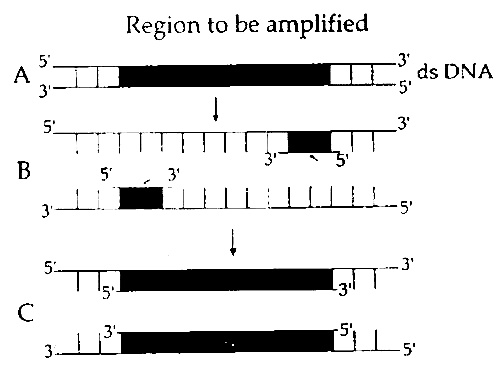
The figure below shows three steps (A, B, C) of Polymerase Chain Reaction (PCR). Select the option giving correct identification together with what it represents ?
AIPMT 2012 Mains Biology - Biotechnology: Principles and Processes Question 85 English
(A)
C - Extension in the presence of heat stable DNA polymerase
(B)
B - Denaturation at a temperature of about 98ºC separating the two DNA strands
(C)
A - Denaturation at a temperature of about 50ºC
(D)
A - Annealing with two sets of primers
(A)

Solution

PCR is a technique for enzymatically replicating DNA without using a living organism such as E. coli or yeast. It is commonly used in medical and biological research labs for a variety of tasks like detection of hereditary diseases, identification of genetic fingerprints etc.
The correct steps shown in the above figure are:
A – Denaturation at a temperature of about 94° to 98°C. During the denaturation, the double strand melts open to single stranded DNA, and all enzymatic reactions stop.
B – Annealing (binding of DNA primer to the separated strands. Occurs at 50° to 65°Celsius, which is lower than the optimal temperature of the DNA polymerases)
C – Extension or elongation of the strands using the DNA primer with heat-stable DNA polymerases, most frequently Taq (Thermus aquaticus) at 72ºC.
Q.14
Which one of the following represents a palindromic sequence in DNA ?
(A)
5'-GAATTC-3'
3'-CTTAAG-5'
(B)
5'-GATACC-3'
3'-CCTAAG-5'
(C)
5'-CCAATG-3'
3'-GAATCC-5'
(D)
5'-CATTAG-3'
3'-GATAAC-5'
(A)

Solution

A palindromic sequence is a nucleic acid sequence (DNA or RNA) that is the same whether read 5' (five-prime) to 3' (three prime) on one strand or 5' to 3' on the complementary strand with which it forms a double helix.
5' - GAATTC - 3'
3' - CTTAAG - 5'
It is a palindromic sequence of DNA cut by restriction enzyme Eco RI.
Q.15
Biolistics (gene-gun) is suitable for -
(A)
DNA finger printing
(B)
Constructing recombinant DNA by joining with vectors
(C)
Disarming pathogen vectors
(D)
Transformation of plant cells
(D)

Solution

Biolistic it is direct gene transferred method for constructing recombinant DNA. The gene gun was invented by John C. Sanford with Edward Wolf. A gene gun can be used to genetically infect cells or whole organisms with foreign DNA by aiming the barrel of the gun and firing. The microshot projectiles in the biolistic gene gun are made of microscopic (or nano) sized gold or platinum powders. These expensive powders are soaked in DNA or RNA (in raw or plasmid form) that are engineered for insertion into the genome of the cells or organisms under the gun.
Q.16
In genetic engineering, the antibiotics are used
(A)
As sequences from where replication starts
(B)
As selectable markers
(C)
To keep the cultures free of infection
(D)
To select healthy vectors
(B)

Solution

Antibiotics are powerful medicines that fight bacterial infections. They either kill bacteria or keep them from reproducing. In genetic engineering, the antibiotics are used as selectable markers.
Q.17
Select the correct statement about biodiversity :
(A)
Western Ghats have a very high degree of species richness and endemism
(B)
The desert areas of Rajasthan and Gujarat have a very high level of desert animal species as well as numerous rare animals
(C)
Large scale planting of Bt cotton has no adverse effect on biodiversity
(D)
Conservation of biodiversity is just a fad pursued by the developed countries
(A)

Solution

Western ghat is biodiversity rich zone along with endemism. The forests of the western ghats are some of the best representatives of non-equatorial tropical evergreen forests in the world. The Western Ghats have evolved into one of the richest centers of endemism owing to their isolation from other moist areas.
Q.18
Sacred groves are specially useful in
(A)
year-round flow of water in rivers
(B)
conserving rare and threatened species
(C)
preventing soil erosion
(D)
generating environmental awareness
(B)

Solution

An area with particular types of trees dedicated to local deities or ancestral spirits that are protected by local communities through social traditions and taboos incorporating spiritual and ecological values are called as sacred groves.
Sacred groves act as an ideal centre for biodiversity conservation. Several plants and animals that are threatened in the forest are still well conserved in some of the sacred groves. It has been observed that several medicinal plants that are not to be found in the forest are abundant in the sacred groves. Further, rare, endangered, threatened and endemic species are often concentrated in sacred groves.
Q.19
Which one of the following organisms is scientifically correctly named, correctly printed according to the international Rules of Nomenclature and correctly described?
(A)
Musca domestica - the common house lizard, a reptile
(B)
Plasmodium falciparum - a protozoan pathogen causing the most serious type of malaria.
(C)
Felis tigris - the Indian tiger, well protected in Gir forests.
(D)
E.coli - full name Entamoeba coil, a commonly occuring bacterium in human intestine.
(B)

Solution

Plasmodium falciparum – A protozoan pathogen causes the most serious type of malaria that is falciparum malaria.
Musca domestica – House fly, an insect belongs to phylum arthropoda.
Felis tigris - The Bengal tiger, is well protected in Sundarbans (tiger reserve)
E.coli - Escherichia coli, a commonly occurring bacterium in human intestine
Q.20
In the five kingdom classification, Chlamydomonas and Chlorella have been included in
(A)
protista
(B)
algae
(C)
plantae
(D)
monera.
(A)

Solution

In the five kingdom classification system proposed by R.H. Whittaker, the kingdom Protista includes all unicellular eukaryotic organisms. Both Chlamydomonas and Chlorella are unicellular green algae, which are eukaryotic and photosynthetic organisms. They are placed under Protista because of their unicellular organization and eukaryotic cell structure.

Although they are photosynthetic like plants, they are not included in the kingdom Plantae because Plantae is reserved for multicellular, predominantly terrestrial organisms with specialized tissues and organs.

Answer: Option A – protista
Q.21
How many plants in the list given below have marginal placentation?
Mustard, Gram, Tulip, Asparagus, Arhar, Sun hemp, Chilli, Colchicum, Onion, Moong, Pea, Tobacco, Lupin
(A)
Four
(B)
Five
(C)
Six
(D)
Three
(C)

Solution

Marginal placentation is a placentation with ovules borne on the wall along the ventral suture of a simple ovary. Gram, Arhar, Sun hemp, Moong, Pea & Lupin belong to fabaceae family that bear marginal placentation.
Q.22
Which one of the following organisms is correctly matched with its three characteristic?
(A)
Pea: C3 pathway, endospermic seed, vexillary aestivation
(B)
Tomato : twisted aestivation, axile placentation, berry
(C)
Onion : bulb, imbricate aestivation, axile placentation
(D)
Maize : C3 pathway, closed vascular bundles, scutellum
(C)

Solution

Onion - Bulb - Underground stems -Imbricate aestivation -Axile placentation - Member of Liliaceae.
Q.23
Read the following four statements (A D). phosphorylation involve uphill transport of protons across the membrane.
(A)  Both photophosphorylation and oxidative phosphorylation involve uphill transport of protons across the membrane.
(B)  In dicot stems, a new cambium originates from cells of pericycle at the time of secondary growth.
(C)  Stamens in flowers of Gloriosa and Petunia are polyandrous.
(D)  Symbiotic nitrogen fixers occur in free-living state also in soil.

How many of the above statements are right?
(A)
Two
(B)
Three
(C)
Four
(D)
One
(A)

Solution

Polyandrous condition (having large and indefinite number of stamens) is present in Gloriosa (family liliaceae) and Petunia (family solanaceae). Nitrogen fixation is the conversion of inert atmospheric nitrogen into utilisable compounds of nitrogen like nitrate, ammonia, amino acids, etc. Biological nitrogen fixation is performed by free living and symbiotic bacteria and cyanobacteria.

Symbiotic nitrogen fixers occur in association with roots of higher plants. For example Rhizobium is nitrogen fixing bacterial symbiont of papilionaceous roots and Frankia is symbiont in root nodules of several non-leguminous plants like Casuarina. Both Rhizobium and Frankia live free as aerobes in the soil and develop the ability to fix nitrogen only as symbionts when they become anaerobic.
Q.24
A test cross is carried out to :
(A)
Determine whether two species or varieties will breed successfully
(B)
Determine the genotype of a plant at F2
(C)
Predict whether two traits are linked
(D)
Assess the number of alleles of a gene
(B)

Solution

Test cross is performed to determine the genotype of F2 plant. In a typical test cross an organism showing dominant phenotype and whose genotype is to be determined is crossed with one that is homozygous recessive for the allele being investigated, instead of self-crossing. The progenies of such a cross can easily be analysed to predict the genotype of the test organism.
Q.25
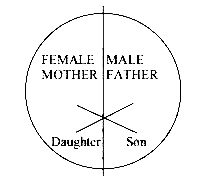
Represented below is the inheritance pattern of the certain type of traits in humans. Which one of the following conditions could be an example of this pattern ? AIPMT 2012 Mains Biology - Principles of Inheritance and Variation Question 145 English
(A)
Haemophilia
(B)
Sickel cell anaemia
(C)
Thalassemia
(D)
Phenylketonuria
(A)

Solution

The inheritance pattern of a particular trait shown in the picture results in haemophilia. Haemophilia is a group of inherited blood disorders in which the blood does not clot properly. It is caused by a fault in one of the genes that determine how the body makes blood clotting factor VIII or IX. These genes are located on the X chromosome.
Q.26
Which one of the following is a wrong statement regarding mutations ?
(A)
UV and Gamma rays are mutagens
(B)
Deletion and insertion of base pairs cause frame-shift mutations
(C)
Cancer cells commonly show chromosomal aberrations
(D)
Change in a single base pair of DNA does not cause mutation
(D)

Solution

Change in single base pair of DNA is also a type of mutations called point mutations. It is a type of mutation that causes the replacement of a single base nucleotide with another nucleotide of the genetic material, DNA or RNA. For example, a point mutation is the cause of sickle cell disease.
Q.27
Read the following four statements (A-D) :
(A) In transcription, adenosine pairs with uracil
(B) Regulation of lac operon by repressor is referred to as positive regulation
(C) The human genome has approximately 50,000 genes
(D) Haemophilia is a sex-linked recessive disease
How many of the above statements are right ?
(A)
Four
(B)
Two
(C)
Three
(D)
One
(B)

Solution

Let's evaluate each of the statements:

(A) In transcription, adenosine pairs with uracil

This statement is correct. During transcription, adenosine (A) in the DNA pairs with uracil (U) in the RNA.

(B) Regulation of lac operon by repressor is referred to as positive regulation

This statement is incorrect. The regulation of the lac operon by the repressor is an example of negative regulation, where the repressor protein inhibits the expression of the lac genes when lactose is absent.

(C) The human genome has approximately 50,000 genes

This statement is incorrect. The human genome is estimated to have about 20,000-25,000 genes.

(D) Haemophilia is a sex-linked recessive disease

This statement is correct. Haemophilia is indeed a sex-linked recessive disorder, typically associated with mutations on the X chromosome.

Therefore, the correct statements are (A) and (D).

Hence, the number of correct statements is: two.

Option B: Two
Q.28
Green revolution in India occurred during -
(A)
1980's
(B)
1950's
(C)
1960's
(D)
1970's
(C)

Solution

Green revolution is the introduction of high-yielding varieties of seeds and the increased use of fertilizers and irrigation, which provided the increase in production needed to make India self-sufficient in food grains, thus improving agriculture in India. Green revolution in India occurred in 1960.
Q.29
Tobacco plants resistant to a nematode have been developed by the introduction of DNA that produced (in the host cells) :
(A)
An antifeedant
(B)
A toxic protein
(C)
Both sense and anti-sense RNA
(D)
A particular hormone
(C)

Solution

RNA interference technique, sense & antisense RNA fused to form dsRNA that silent the expression of m- RNA of nematode. RNA interference is a novel strategy adopted to prevent infestation of nematode, Meloidegyne incognitia in roots of tobacco plants.
Q.30
What is it that forms the basis of DNA Fingerprinting ?
(A)
The relative proportions of purines and pyrimidines in DNA
(B)
The relative amount of DNA in the ridges and grooves of the fingerprints
(C)
The relative difference in the DNA occurrence in blood, skin and saliva
(D)
Satellite DNA occurring as highly repeated short DNA segments
(D)

Solution

DNA fingerprinting is a test to identify and evaluate the genetic information-called DNA (deoxyribonucleic acid)-in a person’s cells. DNA fingerprinting is a form of identification based on sequencing specific non-coding portions of DNA that are known to have a high degree of variability from person to person. These sections are known as Tandem repeats. The test is used to determine whether a family relationship exists between two people, to identify organisms causing a disease, and to solve crimes.
Q.31
The first clinical gene therapy was given for treating -
(A)
Rheumatoid arthritis
(B)
Adenosine deaminase deficiency
(C)
Diabetes mellitus
(D)
Chicken pox
(B)

Solution

Gene therapy is an experimental technique that uses genes to treat or prevent disease. The first clinical gene therapy was given for treating adenosine deaminase deficiency. A four-year old girl became the first gene therapy patient on September 14, 1990 at the NIH Clinical Center. Adenosine deaminase deficiency, also called ADA deficiency or ADA-SCID is an autosomal recessive metabolic disorder that causes immunodeficiency. ADA deficiency is due to a lack of the enzyme adenosine deaminase.
Q.32
Cuscuta is an example of :
(A)
Ectoparasitism
(B)
Predation
(C)
Endoparasitism
(D)
Brood parasitism
(A)

Solution

Cuscuta, or Dodder plant, is a parasitic plant that wraps around other plants for nourishment. Cuscuta is found on outer side of the host and is total stem parasite. Cuscuta a parasite of Acacia.
Q.33
Which one of the following pairs is wrongly matched?
(A)
Ginkgo        Archegonia
(B)
Salvinia        Prothallus
(C)
Viroids        RNA
(D)
Mustard        Synergids
(B)

Solution

Viroids: T. O. Diener discovered that potato tuber spindle disease is caused by a new infectious agent which was smaller than virus. It was found to be free RNA (low molecular weight) later and given the term viroid.

Mustard: An angiosperm, therefore contain synergids (part of ovule).

Ginkgo: A gymnosperm, therefore possess archegonia.
Q.34
How many organisms in the list given below are autotrophs?
Lactobacillus, Nostoc, Chara, Nitrosomonas, Nitrobacter, Streptomyces, Saccharomyces, Trypanosoma, Porphyra, Wolffia
(A)
Four
(B)
Five
(C)
Six
(D)
Three
(C)

Solution

Autotrophs are those organisms that are able to make energy-containing organic molecules from inorganic raw material by using basic sunlight. Nostoc, Chara, Porphyra and Wolffia are photoautotrophs while Nitrosomonas and Nitrobacter are chemoautotrophs.
Q.35
Read the following five statements (A - E) and answer as asked next to them.
(A)   In Equisetum, the female gametophyte is retained on the parent sporophyte.
(B)   In Ginkgo, male gametophyte is not independent.
(C)   The sporophyte in Riccia is more developed than that in Polytrichum.
(D)   Sexual reproduction in Volvox is isogamous.
(E)   The spores of slime moulds lack cell walls.

How many of the above statements are correct?
(A)
Two
(B)
Three
(C)
Four
(D)
One
(D)

Solution

Equisetum is a pteridophyte and in pteridophytes, the main plant body is a sporophyte which is differentiated into true root, stem and leaves. Gametophytes are small or inconspicuous and free living, mostly photosynthetic thalloid called prothallus.

Riccia is a liverwort and Polytrichum is a moss. The sporophyte in mosses is more elaborate than that in liverworts.

Volvox shows oogamous type of sexual reproduction, i.e., fusion between one large, non motile (static) female gamete and a smaller, motile male gamete. During unfavourable conditions, the slime mould differentiates and forms fruiting bodies bearing spores at their tips. The spores possess true walls. They are extremely resistant and survive for many years, even under adverse conditions.
Q.36
Vernalization simulates flowering in
(A)
zamikand
(B)
turmeric
(C)
carrot
(D)
ginger.
(C)

Solution

Carrot is a biennial plant that requires stimulus of low temperature for flowering. It remains vegetative during the warm season and bears flowers and fruits only during winter. It can be made to flower in one growing season by providing low temperature treatment to young plants or seedlings which is referred to as vernalization. Hence, vernalization stimulates flowering in carrot.
Q.37
Through their effects on plant growth regulators, what do the temperature and light control in the plants?
(A)
Apical dominance
(B)
flowering
(C)
Closure of stomata
(D)
Fruit elongation
(B)

Solution

Light and temperature may affect flowering in plants in various ways. The effect of photoperiods or daily duration of light hours (and dark periods) on flowering is called photoperiodism. For example, in short day plants flowering occurs when day length is below critical period, e.g., dahlia, rice, etc. In long day plants, flowering occurs when day length is above critical period, e.g., spinach, lettuce, etc. In short-long day plants, short photoperiod is required for floral initiation and long photoperiod is required for blossoming and vice-versa for long-short day plants.
Q.38
Which one of the following generally acts as an antagonist to gibberellins?
(A)
Zeatin
(B)
Ethylene
(C)
ABA
(D)
IAA
(C)

Solution

Gibberellins & ABA are antagonistic to each other. ABA counteracts many effects of gibberellins like induction of hydrolases and alpha- amylases in barley seedlings.
Q.39
The rate of formation of new organic matter by rabbit in a grassland, is called :
(A)
Net productivity
(B)
Gross primary productivity
(C)
Secondary productivity
(D)
Net primary productivity
(C)

Solution

The rate of resynthesis of organic matter by consumers or the rate at which food energy is assimilated at the trophic level of consumers is called secondary productivity. In a grassland ecosystem, the rate of formation of new organic matter by rabbit is referred as secondary productivity.
Q.40
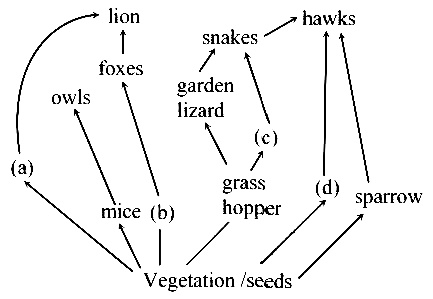
Identify the likely organisms (a), (b), (c) and (d) in the food web shown below : AIPMT 2012 Mains Biology - Ecosystem Question 57 English
(A)
(a) deer , (b) rabbit , (c) frog, (d) rat
(B)
(a) squirrel , (b) cat, (c) rat , (d) pigeon
(C)
(a) dog, (b) squirrel , (c) bat , (d) deer
(D)
(a) rat , (b) dog , (c) tortoise, (d) crow
(A)

Solution

Food web is a network of food chains or feeding relationships by which energy and nutrients are passed on from one species of living organisms to another.
Q.41
The second stage of hydrosere is occupied by plants like
(A)
Vallisneria
(B)
Typha
(C)
Azolla
(D)
Salix
(A)

Solution

A hydrosere is a plant succession which occurs in a freshwater lake. Second stage of hydrosere is submerged stage that is represented by Vallisneria, Hydrilla, Elodea, Utricularia etc.
Q.42
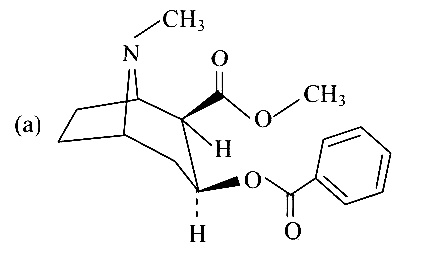
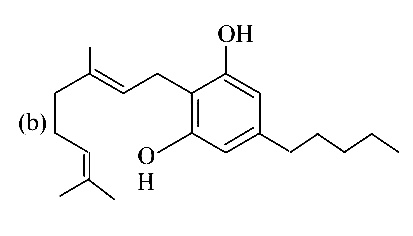
Identify the molecules (a) and (b) shown below and select the right option giving their source and use. AIPMT 2012 Mains Biology - Human Health and Diseases Question 94 English 1 AIPMT 2012 Mains Biology - Human Health and Diseases Question 94 English 2
(A)
Molecule (b) Heroin, Source Cannabis sativa, Use Depressant and slows down body functions
(B)
Molecule (a) Morphine, Source Papaver somniferum , Use Sedative and pain killer
(C)
Molecule (a) Cocaine, Source Erythroxylum coca , Use Accelerates the transport of dopamine
(D)
Molecule (b) Cannabinoid, Source Atropa belladona, Use Produces hallucinations
(B)

Solution

Molecule (a) represents structure of morphine. Morphine is the most abundant alkaloid found in opium, the dried sap (latex) derived from shallowly slicing the unripe seedpods of the opium, or common and/or edible, poppy-Papaver somniferum. Morphine is a potent opiate analgesic drug that is used to relieve severe pain.
Q.43
Which one of the following sets of items in the option A – D are correctly categorized with one exception in it ?
(A)
ITEMS CATEGORY EXCEPTION
Kangaroo, Koala, wombat Australian masupials Wombat
(B)
ITEMS CATEGORY EXCEPTION
Typhoid, Pneumonia, Diphtheria Bacterial diseases Diphtheria
(C)
ITEMS CATEGORY EXCEPTION
UAA, UAG, UGA Stop codons UAG
(D)
ITEMS CATEGORY EXCEPTION
Plasmodium, Cuscuta, Trypanosoma Protozoan parasites Cuscuta
(D)

Solution

UAG is also a stop codon. Wombats are also Australian marsupials. They are shortlegged, muscular quadrupeds, approximately 1 metre (40 in) in length with a short, stubby tail. Diphtheria is an acute infectious disease caused by the bacteria Corynebacterium diphtheriae.

Cuscuta, or Dodder plant, is not a protozoan. It is a parasitic vine that wraps around other plants for nourishment.
Q.44
Read the following four statements (A-D) :
(A) Colostrum is recommended for the new born because it is rich in antigen
(B) Chikengunya is caused by a Gram negative bacterium
(C) Tissue culture has proved useful in obtaining virus-free plants
(D) Beer is manufactured by distillation of fermented grape juice
How many of the above statements are wrong ?
(A)
Two
(B)
One
(C)
Four
(D)
Three
(D)

Solution

Let's evaluate each of the statements for accuracy:

(A) Colostrum is recommended for the new born because it is rich in antigen.

This statement is partially correct but is somewhat misleading. Colostrum, the first form of milk produced by mammals immediately following delivery of the newborn, is indeed recommended for newborns, but not merely because it is rich in antigens. It contains a variety of beneficial components like antibodies (especially IgA), growth factors, and nutrients. The antibodies are crucial for passive immunity which protects the infant from infections during the early days of life. Therefore, the rationale behind recommending colostrum is not just because it is 'rich in antigen' but because it contains antibodies and other immune components essential for the newborn's defense.

(B) Chikungunya is caused by a Gram-negative bacterium.

This statement is false. Chikungunya is not caused by a bacterium at all; rather, it is a viral disease caused by the Chikungunya virus, which is transmitted to humans by mosquitoes, namely Aedes aegypti and Aedes albopictus. The categorization of bacteria as Gram-negative or Gram-positive is based on their cell wall composition and staining properties, which are irrelevant to viruses like the Chikungunya virus.

(C) Tissue culture has proved useful in obtaining virus-free plants.

This statement is true. Tissue culture techniques can be used to produce virus-free plants by culturing tissues from plants that are infected with a virus, and then using a technique called meristem culture, which often results in the production of new, virus-free plants. This is an important practice in agriculture and horticulture for maintaining the health and productivity of crops.

(D) Beer is manufactured by distillation of fermented grape juice.

This statement is false. Beer is usually made from the fermentation of cereal grains, primarily barley, although other grains can be used. The production of beer involves malting, mashing, boiling, fermenting, conditioning, filtering, and packaging. Distillation is not a part of the beer brewing process; it is a process used in the production of spirits. Furthermore, fermented grape juice results in wine, not beer.

Considering the above explanations: statement (B) is unquestionably wrong; statement (D) is also wrong; and, while statement (A) contains an element of truth, the wording is misleading and could be considered incorrect for the purpose of this question. Therefore, it is reasonable to conclude that:

Three out of the four given statements are wrong, which corresponds with Option D: Three.
Q.45
Which one of the following statements is correct with respect to immunity?
(A)
Rejection of a kidney graft is the function of B-lymphocytes.
(B)
Preformed antibodies need to be injected to treat the bite by a viper snake.
(C)
The antibodies against small pox pathogen are produced by T – lymphocytes
(D)
Antibodies are protein molecules, each of which has four light chains.
(B)

Solution

Preformed antibodies need to be injected to treat the bite by a viper snake. It is also a type of immunization which is called as passive immunization.

Antibodies, produced by B-cells, are typically made of basic structural units—each with two large heavy chains and two small light chains. B cells differentiate into plasma cells that secrete antibodies. Antibodies are proteins that bind to specific antigens and mark them for destruction by, for example, marking them more recognizable to phagocytic cells. Rejection of a kidney graft is not a function of B lymphocyte.
Q.46
Which one of the following human organs is often called the ''graveyard'' of RBCs?
(A)
Gall blader
(B)
Kidney
(C)
Spleen
(D)
Liver
(C)

Solution

Spleen is an organ of the lymphatic system located in the left side of the abdominal cavity under the diaphragm, the muscular partition between the abdomen and the chest. It is called graveyard of RBC because fragment of red blood cells, old and dead cells are constantly being removed from the blood streams by it.
Q.47
Which one of the following pairs of chemical substances, is correctly categarised ?
(A)
Secretin and rhodopsin - Polypeptide hormones
(B)
Pepsin and prolactin - Two digestive enzymes secreted in stomach
(C)
Troponin and myosin - Complex proteins in striated muscles
(D)
Calcitonin and thymosin - Thyroid hormones
(C)

Solution

Troponin is a protein which is found on actin filament and myosin protein is found in myosin filament. Both actin and myosin are complex proteins in striated muscles.
Thymosin is a hormone secreted by the thymus that stimulates development of T cells. Prolactin is a hormone released by the pituitary gland that stimulates breast development and milk production in women. Rhodopsin, also known as visual purple, is not a hormone. It is a biological pigment in photoreceptor cells of the retina that is responsible for the first events in the perception of light.
Q.48
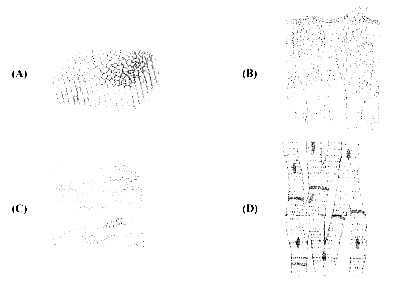
The four sketches (A, B, C and D) given below, represent four different types of animal tissues. Which one of these is correctly identified in the options given, along with its correct location and function ? AIPMT 2012 Mains Biology - Structural Organisation in Animals Question 66 English
(A)
(A) Tissue Columnar epithelium , Location Nephron, Function Secretion and absorption
(B)
(C) Tissue Collagen fibres, Location Cartilage, Function Attach skeletal muscles to bones
(C)
(B) Tissue Glandular epithelium, Location Intestine , Function Secretion
(D)
(D) Tissue Smooth muscle tissue, Location Heart , Function Heart contraction
(C)

Solution

Glandular epithelium invaginates epithelia into connective tissue which differentiate into secretory units. Examples include sebaceous glands of the skin and glands in the intestinal lining (exocrine glands), and many endocrine glands releasing hormones, such as the thyroid follicle.
Q.49
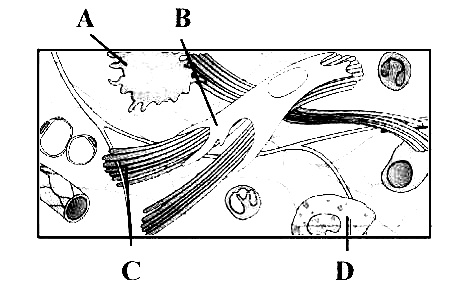
Given below is the diagrammatic sketch of a certain type of connective tissue. identify the parts labeled A, B, C and D and select the right option about them AIPMT 2012 Mains Biology - Structural Organisation in Animals Question 68 English
(A)
A Mast cell, B Collagen fibres , C Fibroblast, D Macrophage
(B)
A Mast cell, B Marcophage , C Fibroblast, D Collagen fibres
(C)
A Macrophage, B Fibroblast , C Collagen fibres, D Mast cell
(D)
A Macrophage, B Collegen fibres , C Fibroblast, D Mast cell
(C)

Solution

Connective tissue is the most diverse of the four tissue types with a wide variety of functions. Connective tissue is made up of cells and fibers in a “jelly-like” ground substance.
Q.50
The supportive skeletal structures in the human external ears and in the nose tip are examples of
(A)
Ligament
(B)
Areolar tissue
(C)
Cartilage
(D)
Bone
(C)

Solution

Cartilage is a type of connective tissue which is present in external ears and in the nose tip of humans.
Q.51
Where do certain symbiotic microorganisms normally occur in human body?
(A)
Caecum
(B)
Oral lining and tongue surface
(C)
Vermiform appendix and rectum
(D)
Duodenum
(A)

Solution

The caecum is a pouch-like portion of the large intestine which hosts some symbiotic micro-organisms. The caecum absorbs water and salts from undigested foods before they continue on to the large intestine.
Q.52
For its activity, carboxypeptidase requires
(A)
Zinc
(B)
iron
(C)
niacin
(D)
copper.
(A)

Solution

Carboxypeptidase is an exopeptidase enzyme secreted by the pancreas that acts only on the peptide linkage of a terminal amino acid containing a free carboxyl group. Zinc is a cofactor for carboxypeptidase. In Digestion of carboxypeptidase, requires zinc for its protein degrading action.
Q.53
Which one of the following characteristics is common both in humans and adult frogs?
(A)
Four chambered heart
(B)
Internal fertilization
(C)
Nucleated RBCs
(D)
Ureotelic mode of excretion
(D)

Solution

Adult frog and human exhibit ureotelism because there excretory waste product is urea.
Q.54
A fall in glomerular filtration rate (GFR) activates
(A)
juxtaglomerular cells to release renin
(B)
adrenal cortex to release aldosterone
(C)
adrenal medulla to release adrenaline
(D)
posterior pituitary to release vasopressin.
(A)

Solution

The amount of the filtrate formed by the kidneys per minute is called glomerular filtration rate (GFR). GFR in a healthy individual is approximately 125 ml/minute, i.e., 180 litres per day. A fall in GFR can activate the JG cells to release renin which can stimulate the glomerular blood flow and thereby the GFR back to normal. Renin converts angiotensinogen in blood to angiotensin I and further angiotensin II. Angiotensin II being powerful vasoconstrictor increases the glomerular blood pressure and thereby GFR.
Q.55
Which one of the following options gives the correct categorization of six animals according to the type of nitrogenous waste they give out?
(A)
Ammonotelic Ureotelic Uricotelic
Pigeon,
Humans
Aquatic amphibia,
lizards
Cockroach,
frog
(B)
Ammonotelic Ureotelic Uricotelic
Frog,
lizards
Aquatic amphibia,
humans
Cockroach,
pigeon
(C)
Ammonotelic Ureotelic Uricotelic
Aquatic amphibia Frog,
humans
Pigeon,
lizards,
Cockroach
(D)
Ammonotelic Ureotelic Uricotelic
Aquatic amphibia Cockroach,
humans
Frog,
pigeon,
lizards
(C)

Solution

Those animals that excrete ammonia are called as ammonotelic, eg. aquatic amphibia.
Those animals that excrete urea are called as ureotelic, eg. frog, humans.
Those animals that excrete uric acid are called as uricotelic, eg. pigeon, lizards, and cockroach.
Q.56
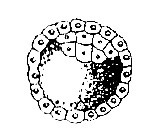
Identify the human developmental stage shown below as well as the related right place of its occurrence in a normal pregnant woman, and select the right option for the two, together. AIPMT 2012 Mains Biology - Human Reproduction Question 43 English
(A)
Developmental stage 8-celled morula, Site of occurrence Starting point of Fallopian tube
(B)
Developmental stage Blastula, Site of occurrence End part of Fallopian tube
(C)
Developmental stage 8-celled morula, Site of occurrence Starting point of Fallopian tube
(D)
Developmental stage Blastocyst, Site of occurrence Uterine wall
(D)

Solution

Blastocyst is a thin-walled hollow structure in early embryonic development that contains a cluster of cells called the inner cell mass from which the embryo arises. The outer layer of cells gives rise to the placenta and other supporting tissues needed for fetal development within the uterus while the inner cell mass cells give rise to the tissues of the body. The blastocyst reaches the womb (uterus) around day 5, and implants into the uterine wall on about day 6.
Q.57
The secretory phase in the human menstrual cycle is also called :
(A)
Follicular phase lasting for about 6 days
(B)
Luteal phase and lasts for about 13 days
(C)
Follicular phase and lasts for about 13 days
(D)
Luteal phase and lasts for about 6 days
(B)

Solution

The menstrual cycle is the scientific term for the physiological changes that can occur in fertile women for the purposes of sexual reproduction and fertilization. The secretory phase in the human menstrual cycle is also called luteal phase and lasts for about 13 days. During secretory phase, the endometrium prepares for the implantation of an embryo and the corpus luteum is active and secretes progesterone hormone.
Q.58
Which one of the following categories of animals, is correctly described with no single exception in it?
(A)
All reptiles posses scales, have a three chambered heart and are cold blooded (poikilothermal).
(B)
All bony fishes have four pairs of gills and an operculum on each side.
(C)
All sponges are marine and have collared cells.
(D)
All mammals are viviparous and possess diaphargm for breathing.
(B)

Solution

Heart is generally 3-chambered in reptiles but in crocodile, it is 4-chambered. Sponges are generally marine and have collared cells but few fresh water forms can also be seen like Spongilla. All mammals are viviparous (giving birth to young ones) with an exception, Ornithorhynchus (platypus), which is oviparous (egg laying).
Q.59
Which one of the following pairs of animals are similar to each other pertaining to the feature stated against them?
(A)
Pteropus and
Ornithorhynchus
_ Viviparity
(B)
Garden lizard and
crocodile
_ Three chambered heart
(C)
Ascaris and Ancylostoma - Metameric segmentation
(D)
Sea horse and flying fish - Cold blooded (poikilothermal)
(D)

Solution

Sea horse and flying fish are cold blooded animals. Ornithorhyncus is oviparous. Crocodile has four chambered heart. Ascaris and Ancylostoma are segmented roundworms.
Q.60
The idea of mutations was brought forth by :
(A)
Charles Darwin, who observed a wide variety of organisms during sea voyage
(B)
Hugo do Vries, who worked on evening primrose
(C)
Gregor Mendol, who worked on Pisum sativum
(D)
Hardy Weinberg, who worked on allele frequencies in a population
(B)

Solution

The term mutation was coined by Hugo de Vries (1901) for large spontaneous inheritable changes which occur suddenly in naturally reproducing population. He also proposed mutation theory of evolution in his book “The Mutation Theory” published in 1903 in which he put forth that evolution occurred due to large discontinuous variations. He worked on Oenothera lamarckiana or evening primrose. During his experiments he found 834 mutations in a population of 54343 plants. It was later on found that the mutations observed by Hugo de Vries were actually chromosomal aberrations.