Solution
Put dimensions of various quantities,
[M0LT-1] = [ML-1T-1]x [ML-3T0]y [M0LT0]z
= [Mx + y L- x - 3y + z T- x]
Equating power both sides, we get
x + y = 0;
- x - 3y + z = 1;
- x = - 1
On solving, we get
x = 1, y = -1, z = -1

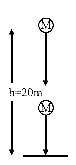
When ball collides with the ground it loses
its 50% of energy
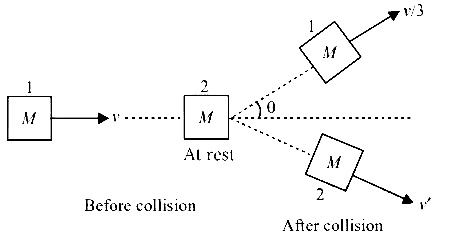
Let v' be speed of second block after the collision.
As the collision is elastic, so kinetic energy is
conserved.
| AgNO3 | + | NaCl | AgCl | + | Na | + | Cl | |
|---|---|---|---|---|---|---|---|---|
| 1 mole | 1 mole | 1 mole | ||||||
| 0.049 mole | 0.049 mole | 0.049 mole of AgCl |
To determine the heat released when 35.2 g of CO2 is formed from carbon and oxygen gas, we will follow these steps:
1. Calculate the number of moles of CO2:
The molar mass of CO2 can be calculated as follows:
Carbon (C): 12.01 g/mol
Oxygen (O): 16.00 g/mol
So, the molar mass of CO2 is:
The number of moles of CO2 in 35.2 g is calculated using:
2. Calculate the heat released for 0.8 moles of CO2:
The heat of combination given is -393.5 kJ/mol. This is the energy released when 1 mole of CO2 is formed:
After rounding, the heat released is approximately -315 kJ.
Answer: Option D 315 kJ.


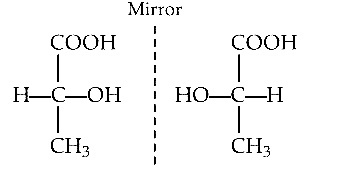
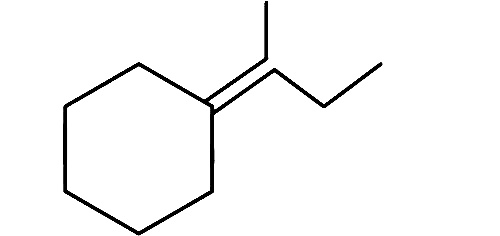
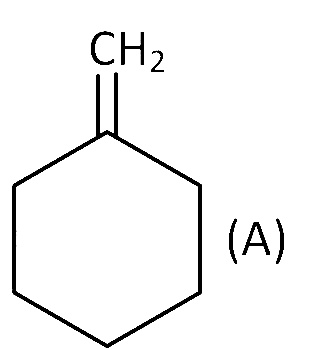
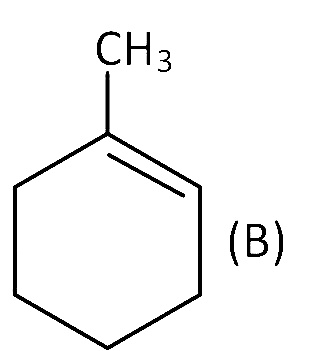
They are enantiomers (non-superimposable
mirror images)


| Column I | Column II |
|---|---|
| (a) Thylakoids | (i) Disc-shaped sacs in Golgi apparatus |
| (b) Cristae | (ii) Condensed structure of DNA |
| (c) Cisternae | (iii) Flat membranous sacs in stroma |
| (d) Chromatin | (iv) Infoldings in mitochondria |
The correct matching is:
Option C
(a) (iii), (b) (iv), (c) (i), (d) (ii)
Here's a detailed explanation of the match:
(a) Thylakoids (iii) Flat membranous sacs in stroma: Thylakoids are indeed the flattened, sac-like structures found within the stroma of chloroplasts. They are the sites of light-dependent reactions in photosynthesis.
(b) Cristae (iv) Infoldings in mitochondria: Cristae are the inward folds of the inner membrane of mitochondria. These folds increase the surface area, providing more space for the electron transport chain and ATP synthesis, crucial processes in cellular respiration.
(c) Cisternae (i) Disc-shaped sacs in Golgi apparatus: Cisternae are the flattened, stacked membrane-bound compartments that make up the Golgi apparatus. They play a role in modifying, sorting, and packaging proteins and lipids.
(d) Chromatin (ii) Condensed structure of DNA: Chromatin is the complex of DNA and proteins found in the nucleus of eukaryotic cells. It condenses during cell division to form visible chromosomes.
| Column I | Column II |
|---|---|
| (a) Sacharomyces cerevisiae | (i) Production of immunosuppressive agent |
| (b) Monascus purpureus | (ii) Ripening of Swiss cheese |
| (c) Trichoderma polysporum | (iii) Commercial production of ethanol |
| (d) Propionibacterium sharmanii | (iv) Production of blood cholesterol lowering agents |
| Gaseous nutrient cycle |
Carbon and Sulphur |
|---|---|
| Sedimentary nutrient cycle |
Nitrogen and Phosphorus |
| Gaseous nutrient cycle |
Sulphur and Phosphorus |
|---|---|
| Sedimentary nutrient cycle |
Carbon and Nitrogen |
| Gaseous nutrient cycle |
Nitrogen and Sulphur |
|---|---|
| Sedimentary nutrient cycle |
Carbon and Phosphorus |
| Gaseous nutrient cycle |
Carbon and Nitrogen |
|---|---|
| Sedimentary nutrient cycle |
Sulphur and Phosphorus |
| Mode of reproduction | Example |
|---|---|
| Binary fission | Sargassum |
| Mode of reproduction | Example |
|---|---|
| Conidia | Penicillium |
| Mode of reproduction | Example |
|---|---|
| Offset | Water hyacinth |
| Mode of reproduction | Example |
|---|---|
| Rhizome | Banana |