NEET-UG 2015

AIPMT 2015 Cancelled Paper

Physics (Maximum Marks: 176)
  • This section contains 44 questions.
  • Each question has FOUR options (A), (B), (C) and (D). ONLY ONE of these four options is the correct answer.
  • Full Marks : +4 If ONLY the correct option is chosen;
  • Zero Marks : 0 If none of the options is chosen (i.e. the question is unanswered);
  • Negative Marks : −1 In all other cases.
Q.1
If energy (E), velocity (V) and time (T) are chosen as the fundamental quantities, the dimensional formula of surface tension will be
(A)
(B)
(C)
(D)
(A)

Solution

Let surface tension

S =kEVbTc
where k is a dimensionless constant

Writing the dimensions on both sides,

=

=

Comparing both sides of the equation we get,

= 1                   ....(1)
2 + b = 0            ....(2)
-2 - b + c = - 2            ....(3)

Solving equation (1), (2) and (3), we get

= 1, b = - 2, c = - 2

Dimension of surface tension =
Q.2
A particle of unit mass undergoes one-dimensional motion such that its velocity varies according to , where and n are constants and x is the position of the particle. The acceleration of the particle as a function of x, is given by
(A)
(B)
(C)
(D)
(D)

Solution

Given


So acceleration of the particle is
= = () ()

              =
Q.3
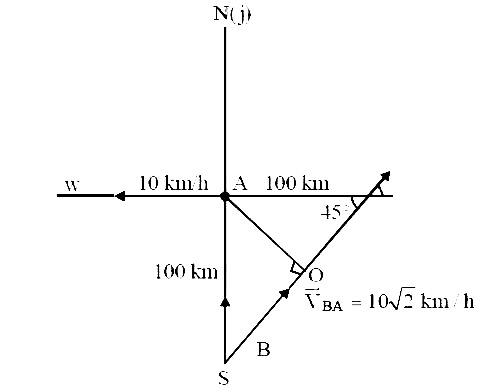
A ship A is moving Westwards with a speed of 10 km h1 and a ship B 100 km South of A, is moving Northwards with a speed of 10 km h1. The time after which the distance between them becomes shortest, is
(A)
h
(B)
h
(C)
0 h
(D)
5 h
(D)

Solution


Distance OB = 100 cos 45° = 50 km

AIPMT 2015 Cancelled Paper Physics - Motion in a Plane Question 45 English Explanation
Time taken to reach the shortest distance between
A and B =
Q.4
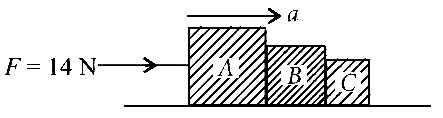
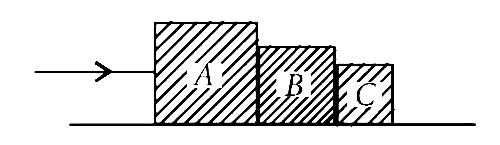
Three blocks A, B and C, of masses 4 kg, 2 kg and 1 kg respectively, are in contact on a frictionless surface, as shown. If a force of 14 N is applied on the 4 kg block, then the contact force between A and B is
AIPMT 2015 Cancelled Paper Physics - Laws of Motion Question 27 English
(A)
8 N
(B)
18 N
(C)
2 N
(D)
6 N
(D)

Solution

AIPMT 2015 Cancelled Paper Physics - Laws of Motion Question 27 English Explanation Here, MA = 4 kg, MB = 2 kg, MC = 1 kg, F = 14 N

Net mass, M = MA + MB + MC = 4 + 2 + 1 = 7 kg

Let a be the acceleration of the system.
Using Newton’s second law of motion,

F = Ma
14 = 7a    a = 2 ms–2

Let F' be the force applied on block A by block B i.e. the contact force between A and B. Free body diagram for block A

Again using Newton’s second law of motion,
F – F' = 4a
14 – F' = 4 × 2 14 – 8 = F' F' = 6 N
Q.5
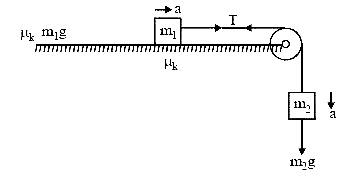
A block A of mass m1 rests on a horizontal table. A light string connected to it passes over a frictionless pully at the edge of table and from its other end another block B of mass m2 is suspended. The coefficient of kinetic friction between the block and the table is k. When the block A is sliding on the table, the tension in the string is
(A)
(B)
(C)
(D)
(A)

Solution

For the motion of both the blocks
m1a = T – m1g
m2g – T = m2a

AIPMT 2015 Cancelled Paper Physics - Laws of Motion Question 50 English Explanation


solving we get tension in the string

Q.6
A block of mass 10 kg, moving in x direction with a constant speed of 10 m s1, is subjected to a retarding force F = 0.1x J/m during its travel from x = 20 m to 30 m. Its final KE will be
(A)
275 J
(B)
250 J
(C)
475 J
(D)
450 J
(C)

Solution

Here, m = 10 kg, vi = 10 ms–1
Initial kinetic energy of the block is


Work done by retarding force


According to work-energy theorem,

W = Kf – Ki

Kf = W + Ki = – 25 J + 500 J = 475 J
Q.7
Two similar springs P and Q have spring constants KP and KQ, such that KP > KQ. They are stretched first by the same amount (case a), then by the same force (case b). The work done by the springs WP and WQ are related as, in case (a) and case (b) respectively
(A)
WP > WQ;  WQ > WP
(B)
WP < WQ;  WQ < WP
(C)
WP = WQ;  WP > WQ
(D)
WP = WQ;  WP = WQ
(A)

Solution

Here, KP > KQ

Case (a) : Elongation (x) in each spring is same.


Case (b) : Force of elongation is same.

So, and


Q.8
A particle of mass m is driven by a machine that delivers a constant power k watts. If the particle starts from rest the force on the particle at time t is
(A)
(B)
(C)
(D)
(C)

Solution

As we know power P =


So,

Hence, acceleration

Therefore, force on the particle at time ‘t’

Q.9
Two particles of masses m1, m2 move with initial velocities u1 and u2. On collision, one of the particles get excited to higher level, after absorbing energy . If final velocities of particles be v1 and v2 then we must have :
(A)
m1u + m2u = m1v + m2v
(B)
mu + mu + = mv + mv
(C)
mu1 + mu2 = mv1 + mv2
(D)
m1u + m2u = m1v + m2v
(A)

Solution

By law of conservation of energy,

K.Ef = K.Ei – excitation energy (e)

Q.10
Two spherical bodies of mass M and 5M and radii R and 2R are released in free space with initial separation between their centres equal to 12R. If they attract each other due to gravitational force only, then the distance covered by the smaller body before collision is :
(A)
7.5R
(B)
1.5R
(C)
2.5R
(D)
4.5R
(A)

Solution

AIPMT 2015 Cancelled Paper Physics - Center of Mass and Collision Question 16 English Explanation

Let the distance moved by spherical body of mass M is x1 and by spherical body of mass 5m is x2.

As their C.M. will remain stationary

(M) (x1) = (5M) (x2) x1 = 5x2

x1 + x2 = 9R

So, x1 = 7.5 R
Q.11
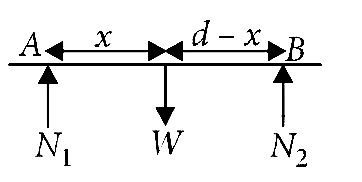
A rod of weight W is supported by two parallel knife edges A and B and is in equilibrium in a horizontal position. The knives are at a distance d from each other. The centre of mass of the rod is at distance x from A. The normal reaction on A is
(A)
(B)
(C)
(D)
(B)

Solution

AIPMT 2015 Cancelled Paper Physics - Rotational Motion Question 79 English Explanation
Given situation is shown in figure.

N1 = Normal reaction on A

N2 = Normal reaction on B

W = Weight of the rod

In vertical equilibrium,
N1 + N2 = W …(i)

Torque balance about centre of mass of the rod,

N1x = N2(d – x)

Putting value of N2 from equation (i)

N1x = (W – N1)(d – x)

N1x = Wd – Wx – N1d + N1x

N1d = W(d – x)

Q.12
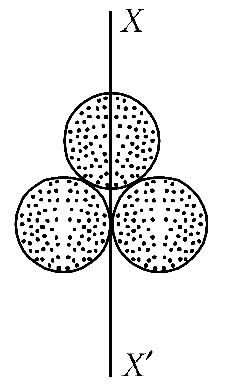
Three identical spherical shells, each of mass m and radius r are placed as shown in figure. Consider an axis XX' which is touching to two shells and passing through diameter of third shell. Moment of inertia of the system consisting of these three spherical shells about XX' axis is

AIPMT 2015 Cancelled Paper Physics - Rotational Motion Question 77 English
(A)
(B)
4mr2
(C)
(D)
3mr2
(B)

Solution

Net moment of inertia of the system,

I = I1 + I2 + I3

The moment of inertia of a shell about its diameter,

I1 = mr2

The moment of inertia of a shell about its tangent is given by


Q.13
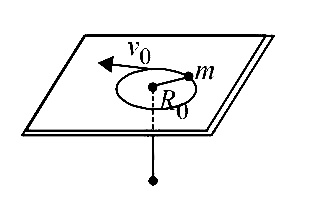
A mass m moves in a circle on a smooth horizontal plane with velocity v0 at a radius R0. The mass is attached to a string which passes through a smooth hole in the plane as shown. the tension in the string is increased gradually and finally m moves in a circle of radius .

The final value of the kinetic energy is
AIPMT 2015 Cancelled Paper Physics - Rotational Motion Question 78 English
(A)
2mv
(B)
mv
(C)
mv
(D)
mv
(A)

Solution

According to law of conservation of angular momentum

mvr = mv'r'

   …(i)


   (Using (i))

K = 4K0 = 2
Q.14
Kepler's third law states that square of period of revoluation (T) of a planet around the sun, is proportional to third power of average distance r between sun and planet i.e. T2 = Kr3 here K is constant. If the masses of sun and planet are M and m respectively then as per Newton's law of gravitation force of attraction between them is F = , here G is gravitational constant. The relation between G and K is described as
(A)
K = G
(B)
K =
(C)
GK = 42
(D)
GMK = 42
(D)

Solution

Gravitational force of attraction between planet and sun gives centripetal force,

GMm/r2 = mv2/r

Now velocity v = 

Time period of planet T = 2r/v
T2 = 4r3/GM

From Kepler’s third law, T2 = Kr3

Using equations, we see 42r3/GM = Kr3,

so relation between G and K is GMK = 4
Q.15
The two ends of a metal rod are maintained at temperatures 100oC and 110oC. The rate of heat flow in the rod is found to be 4.0 J/s. If the ends are maintained at temperatures 200oC and 210oC, the rate of heat flow will be
(A)
8.0 J/s
(B)
4.0 J/s
(C)
44.0 J/s
(D)
16.8 J/s
(B)

Solution

As the temperature difference = 10°C as well as the thermal resistance is same for both the cases, so thermal current or rate of heat flow will also be same for both the cases.
Q.16
On observing light from three different starts P, Q and R, it was found that intensity of violet colour is maximum in the spectrum of P, the intensity of green colour is maximum in the spectrum of R and the intensity of red colour is maximum in the spectrum of Q. If TP, TQ and TR are the respective absolute temperatures of P, Q and R, then it can be conclued from the above observations that
(A)
TP < TR < TQ
(B)
TP < TQ < TR
(C)
TP > TQ > TR
(D)
TP > TR > TQ
(D)

Solution

According to Wein’s displacement law

= constant    …(i)

For star P, intensity of violet colour is maximum.
For star Q, intensity of red colour is maximum.
For star R, intensity of green colour is maximum.

Also,

Using equation (i), Tr < Tg < Tv

TQ < TR < TP
Q.17
A wind with speed 40 m/s blows parallel to the roof of a house. The area of the roof is 250 m2. Assuming that the pressure inside the house is atmospheric pressure, the force exerted by the wind on the roof and the direction of the force will be
(A)
2.4 105 N, upwards
(B)
2.4 105 N, downwards
(C)
4.8 105 N, downwards
(D)
4.8 105 N, upwards
(A)

Solution

Using Bernoulli's theorem and assuming density constant,

P1+1/2ρv12 = P2+1/2ρv22

where:
P2 = pressure outside house
P1 = pressure inside house
v1 = speed of air inside house
v2 = speed of air outside house

Pressure difference,

P1 – P2 = 1/2ρ [v22 – v12]

Now, P1 – P2 = 1/2 × 1.2 [402 – 02]

P1 – P2 = 960 N/m2

Since Pressure P = Force/Area, so force acting on roof will be :

F = P × A

F = 960 × 250

F = 960 × 1000/4

F = 24×104 or 2.4×10⁵ N

which is acting upward.
Q.18
The approximate depth of an ocean is 2700 m. The compressiblity of water is 45.4 1011 Pa1 and density of water is 103 kg/m3. What fractional compression of water will be obtained at the bottom of the ocean?
(A)
1.2 102
(B)
1.4 102
(C)
0.8 102
(D)
1.0 102
(A)

Solution

Compressibility of water, K = 45.4 × 10⁻¹¹ Pa–1

density of water P = 103 kg/m3

depth of ocean, h = 2700 m

We have to find

As we know, compressibility,


So,

= 45.4 × 10–11 × 103 × 10 × 2700 = 1.2258 × 10⁻²
Q.19
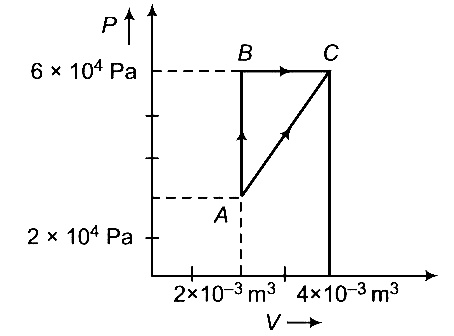
Figure below shows two paths that may be taken by a gas to go from a state A to a state C.

AIPMT 2015 Cancelled Paper Physics - Heat and Thermodynamics Question 75 English
In process AB, 400 J of heat is added to the system and in process BC, 100 J of heat is added to the system. The heat absorbed by the system in the process AC will be
(A)
460 J
(B)
300 J
(C)
380 J
(D)
500 J
(A)

Solution

AIPMT 2015 Cancelled Paper Physics - Heat and Thermodynamics Question 75 English Explanation
Considering the cyclic process ABCA
Qcyclic = W = area of ABC


Hence, QAC = 460 J
Q.20
A Carnot engine, having an efficiency of as heat engine, is used as a refrigerator. If the work done on the system is 10 J, the amount of energy absorbed from the reservoir at lower temperature is
(A)
90 J
(B)
1 J
(C)
100 J
(D)
99 J
(A)

Solution

Given, efficiency of engine,

work done on system W = 10J

Coefficient of performance of refrigerator


Energy absorbed from reservoir


Q.21
The ratio of the specific heats in terms of degrees of freedom (n) is given by
(A)
(B)
(C)
(D)
(A)

Solution

For n degrees of freedom,

Also,


Q.22
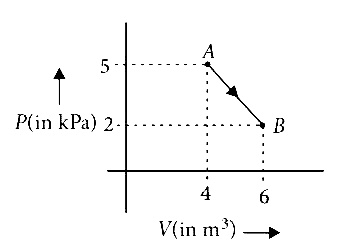
One mole of an ideal diatomic gas undergoes a transition from A to B along a path AB as shown in the figure.

AIPMT 2015 Cancelled Paper Physics - Heat and Thermodynamics Question 76 English

The change in internal energy of the gas during the transition is
(A)
20 J
(B)
12 kJ
(C)
20 kJ
(D)
20 kJ
(D)

Solution

Change in internal energy from A B


(As gas is diatomic f = 5)


Q.23
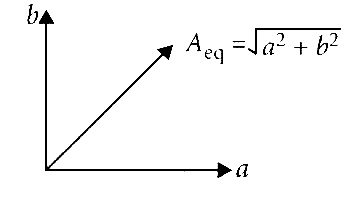
When two displacements represented by y1 = a sin and y2 = b cos aresuperimposed the motion is
(A)
simple harmonic with amplitude
(B)
simple harmonic with amplitude
(C)
not a simple harmonic
(D)
simple harmonic with amplitude
(A)

Solution

Here,


AIPMT 2015 Cancelled Paper Physics - Oscillations Question 52 English Explanation
Hence, resultant motion is SHM with amplitude .
Q.24
A particle is executing SHM along a straight line. Its velocities at distances x1 and x2 from the mean position are V1 and V2 respectively. Its time period is
(A)
(B)
(C)
(D)
(D)

Solution

As we know, for particle undergoing SHM,


Substracting we get,


Q.25
The electric field in a certain region is acting radially outward and is given by E = Ar. A charge contained in a sphere of radius 'a' centred at the origin of the field, will be given by
(A)
(B)
(C)
(D)
(A)

Solution

According to question, electric field varies as

E = Ar

Here r is the radial distance.

At r = a, E = Aa     …(i)

Net flux emitted from a spherical surface of radius a is

   [Using equation (i)]

Q.26
Across a metallic conductor of non-uniform cross section a constant potential difference is applied. The quantity which remains constant along the conductor is
(A)
drift velocity
(B)
electric field
(C)
current density
(D)
current
(D)

Solution

The area of cross section of conductor is non uniform so current density will be different but the flow of electrons will be uniform so current will be constant.
Q.27
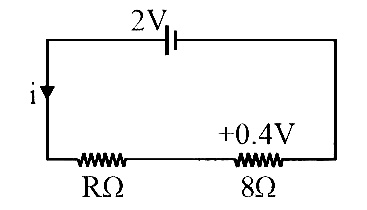
A potentiometer wire has length 4 m and resistance 8 . The resistance that must be connected in series with the wire and an accumulator of e.m.f. 2 V, so as to get a potential gradient 1 mV per cm on the wire is
(A)
44
(B)
48
(C)
32
(D)
40
(C)

Solution

Total potential difference across potentiometer wire

= 10–3 × 400 volt = 0.4 volt

potential gradient =


Let resistance of R connected in series.

AIPMT 2015 Cancelled Paper Physics - Current Electricity Question 105 English Explanation


R + 8 = 40 or, R = 32
Q.28
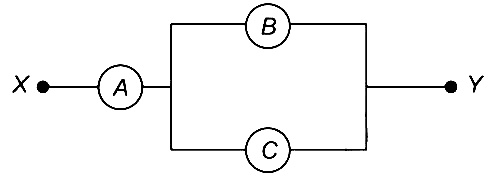
A, B and C are voltmeters of resistance R, 1.5 R and 3R respectively as shown in the figure. When some potential difference is applied between X and Y, the voltmeter readings are VA, VB and VC respectively, Then

AIPMT 2015 Cancelled Paper Physics - Current Electricity Question 107 English
(A)
VA = VB VC
(B)
VA VB VC
(C)
VA = VB = VC
(D)
VA VB = VC
(C)

Solution

Effective resistance of
B & C = (1.5R)(3R)/(1.5R + 3R) = R

In series sequence voltage across A = voltage across B & C

Now B & C are parallel, so VB = VC,

VA = VB = VC
Q.29
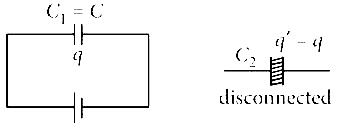
A parallel plate air capacitor of capacitance C is connected to a cell of emf V and then disconnected from it. A dielectric slab of dieletric constant K, which can just fill the air gap of the capacitor, is now inserted in it . Which of the following is incorrect ?
(A)
The change in energy stored is
(B)
The charge on the capacitor is not conserved.
(C)
The potential difference between the plates decreases K times.
(D)
The energy stored in the capaciotor decreases K times.
(B)

Solution

AIPMT 2015 Cancelled Paper Physics - Capacitor Question 35 English Explanation
q = CV V = q/C

Due to dielectric insertion, new capacitance C2 = CK

Initial energy stored in capacitor,

Final energy stored in capacitor,

Change in energy stored, U = U2 – U1


New potential difference between plates

Q.30
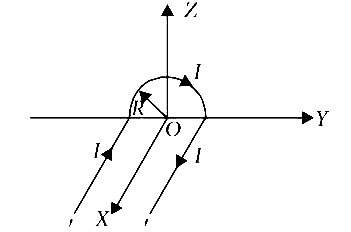
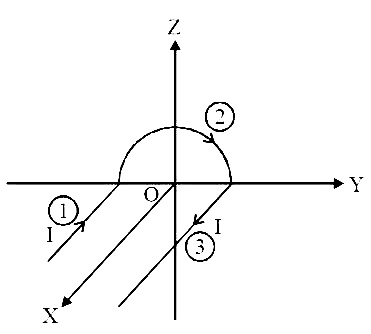
A wire carrying current has the shape shown in adjoining figure.

AIPMT 2015 Cancelled Paper Physics - Moving Charges and Magnetism Question 73 English
Linear parts of the wire are very long and parallel to X-axis while semicircular protion of radius R is lying in Y-Z plane. Magtnetic field at pont is
(A)
(B)
(C)
(D)
(A)

Solution

Magnetic field due to segment ‘1’


Magnetic field due to segment 2


AIPMT 2015 Cancelled Paper Physics - Moving Charges and Magnetism Question 73 English Explanation
at centre


Q.31
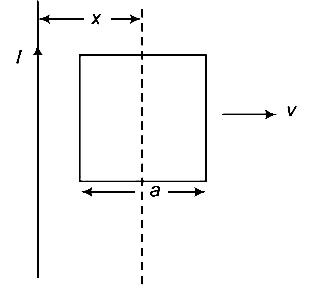
A conducting square frame of side 'a' and a long straight wire carrying current are located in the same plane as shown in the figure. The frame moves to the right with a constant velocity 'V'. The emf induced in the frame will be proportional to

AIPMT 2015 Cancelled Paper Physics - Moving Charges and Magnetism Question 72 English
(A)
(B)
(C)
(D)
(B)

Solution

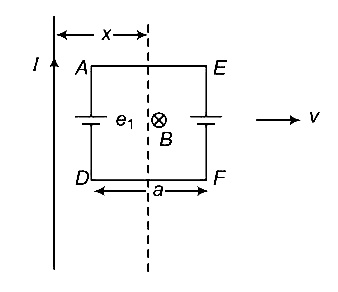
AIPMT 2015 Cancelled Paper Physics - Moving Charges and Magnetism Question 72 English Explanation
The emf in AD:

e1 = (a × μ0iv)/2π(x −a/2)

The emf in EF :

e2 = (a × μ0i × v)/2π(x + a/2)

Net emf = e1 – e2


Q.32
An electron moving in a circular orbit of radius r makes n rotations per second. The magnetic field produced at the centre has magnitude
(A)
(B)
(C)
(D)
Zero
(B)

Solution

Current in the orbit,


Magnetic field at centre of current carrying circular coil is given by

Q.33
A resistance 'R' draws power 'P' when connected to an AC source. If an inductance is now placed in series with the resistance, such that the impedance of the circuit becomes 'Z'. the power drawn will be
(A)
(B)
P
(C)
(D)
(C)

Solution

For pure resistor circuit, power

P =

= PR

For L-R series circuit, power

P' = Vrms Irms cos

=

= =

P' =
Q.34
A radiation of energy 'E' falls normally on a perfectly reflecting surface. The momentum transferred to the surface is (C = Velocity of light)
(A)
(B)
(C)
(D)
(D)

Solution

Momentum transferred to the surface

= change in momentum

= Pf - Pi

=

=
Q.35
The refracting angle of a prism is A, and refractive index of the material of the prism is cot (A/2). The angle of minimum deviation is
(A)
90o A
(B)
180o + 2A
(C)
180o 3A
(D)
180o 2A
(D)

Solution

As =

=


=

= 180o - 2A
Q.36
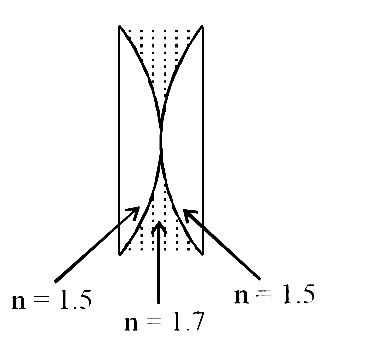
Two identical thin plano-convex glass lenses (refractive index 1.5) each having radius of curvature of 20 cm are placed with their convex surfaces in contact at the centre. The intervening space is filled with oil of refractive index 1.7. The focal length of the combination is
(A)
50 cm
(B)
50 cm
(C)
20 cm
(D)
25 cm
(A)

Solution

AIPMT 2015 Cancelled Paper Physics - Geometrical Optics Question 73 English Explanation

We know,

For the lens on the left,

For the lensh on the right,

For the oil in the intervening space,

Hence, if the focal length of the combination is F, then

i.e., F = 50 cm

Q.37
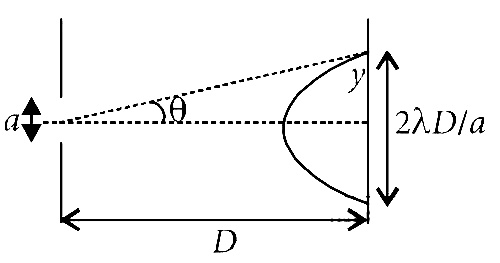
For a parallel beam of monochromatic light of wavelength '' , diffraction is produced by a single slit whose width 'a' is of the order of the wavelength of the light. If 'D' is the distance of the screen from the slit, the wifth of the central maxima will be
(A)
(B)
(C)
(D)
(C)

Solution

AIPMT 2015 Cancelled Paper Physics - Wave Optics Question 31 English Explanation

For central maxima, sin =

Also, is very-very small so

sin tan =

=

y =

Width of central maxima = 2y =
Q.38
In a double slit experiment, the two slits are 1 mm apart and the screen is placed 1 m away. A monochromatic light of wavelength 500 nm is used. What will be the width of each slit for obtaining ten maxima of double slit within the central maxima of single slit pattern ?
(A)
0.5 mm
(B)
0.02 mm
(C)
0.2 mm
(D)
0.1 mm
(C)

Solution

Fringe width, =

As per question, width of central maxima of single slit pattern = width of 10 maxima of double slit pattern


= = = 0.2 10-3 m = 0.2 mm
Q.39
Consider 3rd orbit of He+ (Helium), using non-relativistic approach, the speed of electron in this orbit will be [given K = 9 109 constant, Z = 2 and h (Planck's Constant) = 6.6 1034 J s]
(A)
0.73 106 m/s
(B)
3.0 108 m/s
(C)
2.92 106 m/s
(D)
1.46 106 m/s
(D)

Solution

Energy of electron in He+ 3rd orbit

E3 = -13.6

= -13.6 1.6 10-19 J

= - 9.7 10-19 J

According to Bohr’s model,

Kinetic energy of electron in the 3rd orbit = – E3

9.7 10-19 =

v = = 1.46 106 m/s
Q.40
If radius of the Al nucleus is taken to be RAl, then
the radius of Te nucleus is nearly
(A)
(B)
(C)
(D)
(D)

Solution

As we know, R = R0 (A)1/3

where A = mass number

RAl = R0 (27)1/3 = 3R0

RTe = R0 (125)1/3 = 5R0 =
Q.41
Which of the following figures represent the variation of particle momentum and the associated de-Broglie wavelength?
(A)
AIPMT 2015 Cancelled Paper Physics - Dual Nature of Radiation and Matter Question 78 English Option 1
(B)
AIPMT 2015 Cancelled Paper Physics - Dual Nature of Radiation and Matter Question 78 English Option 2
(C)
AIPMT 2015 Cancelled Paper Physics - Dual Nature of Radiation and Matter Question 78 English Option 3
(D)
AIPMT 2015 Cancelled Paper Physics - Dual Nature of Radiation and Matter Question 78 English Option 4
(D)

Solution

de-Broglie wavelength, =


p = constant

This represents a rectangular hyperbola.
Q.42
A certain metallic surface is illuminated with monochromatic light of wavelength, The stopping potential for photo-electric current for this light is 3V0. If the same surface is illuminated with light of wavelength 2 , the stopping potential is V0. The threshold wavelength for this surface for photo-electric effect is
(A)
(B)
(C)
6
(D)
4
(D)

Solution

Stopping potential, = E - Kmax

3eV0 + = ......(1)

eV0 + = ......(2)

Solving equation (1) and (2), we get

=

So, threshold wavelength,

th = = = 4
Q.43
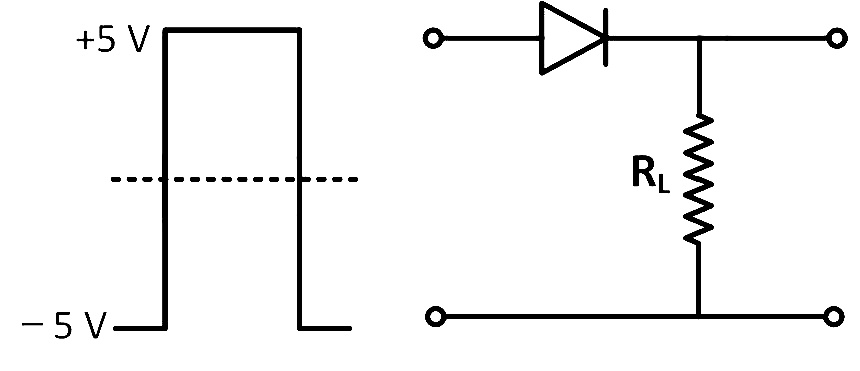
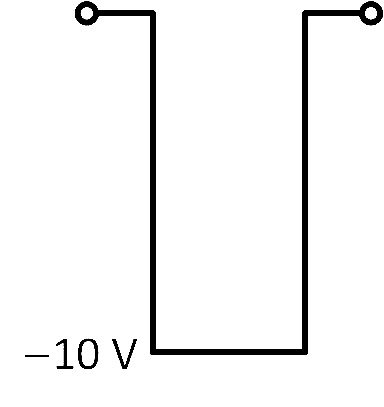
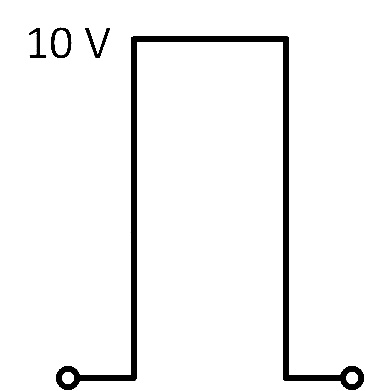
If in a p-n junction, a square input signal of 10 V is applied, as shown,

AIPMT 2015 Cancelled Paper Physics - Semiconductor Electronics Question 106 English

then the output across RL will be
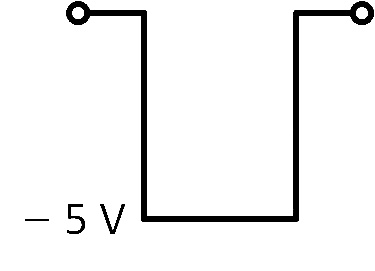
(A)
AIPMT 2015 Cancelled Paper Physics - Semiconductor Electronics Question 106 English Option 1
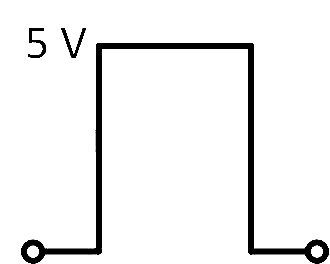
(B)
AIPMT 2015 Cancelled Paper Physics - Semiconductor Electronics Question 106 English Option 2
(C)
AIPMT 2015 Cancelled Paper Physics - Semiconductor Electronics Question 106 English Option 3
(D)
AIPMT 2015 Cancelled Paper Physics - Semiconductor Electronics Question 106 English Option 4
(B)

Solution

Here P-N junction diode rectifies half of the ac wave i.e., acts as half wave rectifier.
During + ve half cycle Diode is forward biased output across RL will be AIPMT 2015 Cancelled Paper Physics - Semiconductor Electronics Question 106 English Explanation

During –ve half cycle Diode is reverse biased output will not obtained.
Q.44
Which logic gate is represented by the following combination of logic gates ?

AIPMT 2015 Cancelled Paper Physics - Semiconductor Electronics Question 107 English
(A)
AND
(B)
NOR
(C)
OR
(D)
NAND
(A)

Solution

The Boolean expression of this arrangement is

Y = = = A.B

Thus, the combination represents AND gate.
Chemistry (Maximum Marks: 180)
  • This section contains 45 questions.
  • Each question has FOUR options (A), (B), (C) and (D). ONLY ONE of these four options is the correct answer.
  • Full Marks : +4 If ONLY the correct option is chosen;
  • Zero Marks : 0 If none of the options is chosen (i.e. the question is unanswered);
  • Negative Marks : −1 In all other cases.
Q.1
A mixture of gases contains H2 and O2 gases in the ratio of 1 : 4 (w/w). What is the molar ratio of the two gases in the mixture ?
(A)
16 : 1
(B)
2 : 1
(C)
1 : 4
(D)
4 : 1
(D)

Solution

Ratio of weight of gases = wH2 : wO2 = 1 : 4

Number of moles of H2 =

Number of moles of O2 =

Ratio of moles of gases

= nH2 : nO2

= :

= = 4 : 1
Q.2
The angular momentum of electron in 'd' orbital is equal to
(A)
(B)
0
(C)
(D)
(C)

Solution

We know Anglular momentum =

For d obtial l = 2

Angular momentum =
Q.3
The number of d-electrons in Fe2+ (Z = 26) is not equal to the number of electrons in which one of the following ?
(A)
d-electrons in Fe (Z = 26)
(B)
p-electrons in Ne (Z = 10)
(C)
s-electrons in Mg (Z = 12)
(D)
p-electrons in Cl(Z = 17)
(D)

Solution

Number of d-electrons in Fe2+ = 6

Number of p-electrons in Cl = 11
Q.4
If the value of equilibrium constant for a particular reaction is 1.6 1012, then at equilibrium the system will contain
(A)
mostly products
(B)
similar amounts of reactants and products
(C)
all reactants
(D)
mostly reactants.
(A)

Solution

As, 1.6 × 10¹² is very high value of K. Thus, the reaction proceeds almost to completion and mixture must contain mostly products.
Q.5
Which of the following statements is correct for a reversible process in a state of equilibrium?
(A)
Go = 2.30 RT log K
(B)
Go = 2.30 RT log K
(C)
G = 2.30 RT log K
(D)
G = 2.30 RT log K
(A)

Solution

G = Go + 2.303 RT log Q

At equilibrium, when G = 0 and Q = K

then 0 = Go + 2.303 RT log K

Go = – 2.303 RT log K
Q.6
The Ksp of Ag2CrO4,  AgCl,  AgBr  and Agl  are respectively, 1.1 1012, 1.8 1010, 5.0 1013, 8.3 1017. Which one of the following salts will precipitate last if AgNO3 solution is added to the solution containing equal moles of NaCl, NaBr, Nal and Na2CrO4?
(A)
AgBr
(B)
Ag2CrO4
(C)
Agl
(D)
AgCl
(B)

Solution

From the Ksp values of the given salts calculate the solubility values. Salt having highest solubility will precipitate at last.
AgCrO4 2Ag+ + CrO42-
s 2s s


Ksp = (2s)2(s) = 1.1 × 10⁻¹²

s = 0.65 × 10⁻⁴

AgCl Ag+ + Cl-
s s s


Ksp = s × s

1.8 × 10–10 = s 2

s = 1.34 × 10⁻⁵

AgBr Ag+ + Br-
s s s


Ksp = s × s

5 × 10–13 = s2

s = 0.71 × 10⁻⁶

AgI Ag+ + I-
s s s


Ksp = s × s

8.3 × 10–17 = s2

s = 0.9 × 10⁻⁸

Solubility of Ag2CrO4 is maximum so, it will precipitate at last.
Q.7
Which one of the following electrolytes has the same value of van't Hoff factor (i) as that of Al2(SO4)3 (if all are 100% ionised)?
(A)
Al(NO3)3
(B)
K4[Fe(CN)6]
(C)
K2SO4
(D)
K3[Fe(CN)6]
(B)

Solution

Ai2(SO4)3 ⇌ 2Al+3 + 3SO42–

van't Hoff factor, i = 5

K2SO4 ⇌ 2K+ + SO42–

van't Hoff factor, i = 3

K3[Fe(CN)6] ⇌ 3K+ + [Fe(CN)6]2-

van't Hoff factor, i = 4

Al(NO3)3 ⇌ Al3+ + 3NO3

van't Hoff factor, i = 4

K4[Fe(CN)6] ⇌ 4K+ + [Fe(CN)6]4–

van't Hoff factor, i = 5
Q.8
The boiling point of 0.2 mol kg1 solution of X in water is greater than equimolal solution of Y in water. Which one of the following statements is true in this case?
(A)
Molecular mass of X is less than the molecular mass of Y.
(B)
Y is undergoing dissociation in water while X undergoes no change.
(C)
X is undergoing dissociation in water.
(D)
Molecular mass of X is greater than the molecular mass of Y.
(C)

Solution

Tb = iKbm

Given, (Tb)x > (Tb)y

ixKbm > iyKbm

ix > iy

(Kb is same for same solvent)

So, x is undergoing dissociation in water.
Q.9
Which of them is not equal to zero for an ideal solution?
(A)
(B)
(C)
(D)
(D)

Solution

For an ideal solution, Smix > 0 while Hmix, Vmix and P all are 0.
Q.10
A device that converts energy of combustion of fuels like hydrogen and methane, directly into electrical energy is known as
(A)
dynamo
(B)
Ni-Cd cell
(C)
fuel cell
(D)
electrolytic cell
(C)

Solution

A device that converts energy of combustion of fuels, directly into electrical energy is known as fuel cell.
Q.11
When initial concentration of a reactant is doubled in a reaction, its half-life period is not affected. The order of the reaction is
(A)
second
(B)
more than zero but less than first
(C)
zero
(D)
first.
(D)

Solution

Half-life period of a first order reaction is independent of initial concentration,

Q.12
The activation energy of a reaction can be determined from the slope of which of the following graphs?
(A)
ln k vs.
(B)
vs.
(C)
ln k vs.
(D)
vs.
(A)

Solution

According to Arrhenius equation,


Taking natural log on both the sides we get,

ln k = ln A ...........(1)

Comparing (1) with standard form of equation of line

y = mx + C

We get Slope, m =

Hence, if ln k is plotted against 1/T, slope of the line will be .
Q.13
A given metal crystallises out with a cubic structure having edge length of 361 pm. If there are four metal atoms in one unit cell, what is the radius of one atom?
(A)
80 pm
(B)
108 pm
(C)
40 pm
(D)
127 pm
(D)

Solution

As Z = 4, so, structure is fcc.

Hence, r = = 127.65 pm = 127 pm
Q.14
Which property of colloidal solution is independent of charge on the colloidal particles?
(A)
Electro-osmosis
(B)
Tyndall effect
(C)
Coagulation
(D)
Electrophoresis
(B)

Solution

Tyndall effect is the scattering of light by sol particles which cannot be affected by charge on them.
Q.15
The species Ar, K+ and Ca2+ contain the same number of electrons. In which order do their radii increase ?
(A)
Ca2+ < K+ < Ar
(B)
K+ < Ar < Ca2+
(C)
Ar < K+ < Ca2+
(D)
Ca2+ < Ar < K+
(A)

Solution

For isoelectronic species, radius of atom decreases with increase in nuclear charge.
Q.16
Which of the following options represents the correct bond order ?
(A)
O2  > O2 < O2+
(B)
O2  <  O2  >  O2+
(C)
O2  >  O2  >  O2+
(D)
O2  <  O2  <  O2+
(D)

Solution

Bond order [Nb Na]

Nb = No of electrons in bonding molecular orbital

Na No of electrons in anti bonding molecular orbital

In O atom 8 electrons present, so in O2, 8 2 = 16 electrons present.

Then in no of electrons = 15

in no of electrons = 17

Molecular orbital configuration of O2 (16 electrons) is


Na = 6

Nb = 10

BO =

Molecular orbital configuration of O (15 electrons) is


Nb = 10

Na = 5

BO = = 2.5

Molecular orbital configuration of (17 electrons) is


Nb = 10

Na = 7

BO = = 1.5

B.O. : 1.5 2.0 2.5
Q.17
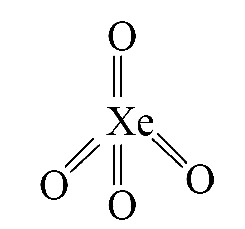
Which of the following species contains equal number of - and -bonds ?
(A)
(CN)2
(B)
CH2(CN)2
(C)
HCO3
(D)
XeO4
(D)

Solution

AIPMT 2015 Cancelled Paper Chemistry - Chemical Bonding and Molecular Structure Question 49 English Explanation

Number of bonds = 4

Number of bonds = 4
Q.18
Which of the following pairs of ions are isoelectronic and isostructural ?
(A)
SO32,  NO3
(B)
ClO3,  SO32
(C)
CO32, SO32
(D)
ClO3, CO32,
(B)

Solution

Species Hybridisation Shape No. of e-
sp3 Pyramidal 42
sp3 Pyramidal 42
sp2 Triangular planar 32
Q.19
The correct bond order in the following species is
(A)
O2+ < O2 < O22+
(B)
O2 < O2+ < O22+
(C)
O22+ < O2+ < O2
(D)
O22+ < O2 < O2+
(B)

Solution

Bond order [Nb Na]

Nb = No of electrons in bonding molecular orbital

Na No of electrons in anti bonding molecular orbital

In O atom 8 electrons present, so in O2, 8 2 = 16 electrons present.

Then in no of electrons = 15

in no of electrons = 17

in no of electrons = 14

Molecular orbital configuration of O2 (16 electrons) is


Na = 6

Nb = 10

BO =

Molecular orbital configuration of O (15 electrons) is


Nb = 10

Na = 5

BO = = 2.5

Molecular orbital configuration of (17 electrons) is


Nb = 10

Na = 7

BO = = 1.5

Molecular orbital configuration of O (14 electrons) is


Nb = 10

Na = 4

BO = [ 10 4] = 3

B.O. : 1.5 2.0 2.5 3.0
Q.20
Maximum bond angle at nitrogen is present in which of the following ?
(A)
NO2+
(B)
NO3
(C)
NO2
(D)
NO2
(A)

Solution

Species
Hybridisation sp2 sp2 sp2 sp(linear)
Bond Angle 120o 134o 115o 180o
Q.21
''Metals are usually not found as nitrates in their ores.'' Out of the following two (I and II) reasons which is/are true for the above observation?
I.  Metal nitrates are highly unstable.
II.  Metal nitrates are highly soluble in water.
(A)
I is false but II is true.
(B)
I is true but II is false.
(C)
I and II are true.
(D)
I and II are false
(A)

Solution

All nitrates are soluble in water and are quite stable as they do not decompose easily on heating.
Q.22
Solubility of the alkaline earth metal sulphates in water decreases in the sequence
(A)
Sr > Ca > Mg > Ba
(B)
Ba > Mg > Sr > Ca
(C)
Mg > Ca > Sr > Ba
(D)
Ca > Sr > Ba > Mg
(C)

Solution

Solubility of alkaline earth metal sulphates decreases down the group because hydration energy decreases.
Q.23
The function of ''Sodium pump'' is a biological process operating in each and every cell of all animals. Which of the following biologically important ions is also a constituent of this pump?
(A)
K+
(B)
Fe2+
(C)
Ca2+
(D)
Mg2+
(A)

Solution

K+ ion is a constituent of sodium pump.
Q.24
Nitrogen dioxide and sulphur dioxide have some properties in common . Which property is shown by one of these compounds , but not by the other?
(A)
Is soluble in water.
(B)
Is used as a food preservative.
(C)
Forms 'acid-rain'.
(D)
Is a reducing agent.
(B)

Solution

SO2 is widely used in food and drinks industries for its property as a preservative and antioxidant while NO2 is not used as food preservative.
Q.25
Which of the following processes does not involve oxidation of iron?
(A)
Formation of Fe(CO)5 from Fe.
(B)
Liberation of H2 from steam by iron at high temperature.
(C)
Rusting of iron sheets.
(D)
Decolourisation of blue CuSO4 solution by iron.
(A)

Solution

Fe + 5CO Fe(CO)5

Thus, formation of Fe(CO)5 from Fe does not involve oxidation of iron because there is no change in oxidation state.

Rest in all options there is a change in oxidation state of Fe.
Q.26
Because of lanthanoid contraction, which of the following pairs of elements have nearly same atomic radii? (Numbers in the parenthesis are atomic numbers)
(A)
Zr(40) and Hf(72)
(B)
Zr(40) and Ta(73)
(C)
Ti(22) and Zr(40)
(D)
Zr(40) and Nb(41)
(A)

Solution

Because of the lanthanoid contraction Zr (atomic radii 160 pm) and Hf (atomic radii 158 pm) have nearly same atomic radii.
Q.27
Magnetic moment 2.84 B.M. is given by (At. nos. Ni = 28, Ti = 22, Cr = 24, Co = 27)
(A)
Cr2+
(B)
Co2+
(C)
Ni2+
(D)
Ti3+
(C)

Solution

Magnetic moment () =

For = 2.84

2.84 =

n = 2

Cr2+ – [Ar]3d44s0 , 4 unpaired electrons

Co2+ – [Ar]3d74s0 , 3 unpaired electrons

Ni2+ – [Ar]3d8 4s0 , 2 unpaired electrons

Ti3+ – [Ar]3d14s0 , 1 unpaired electron
Q.28
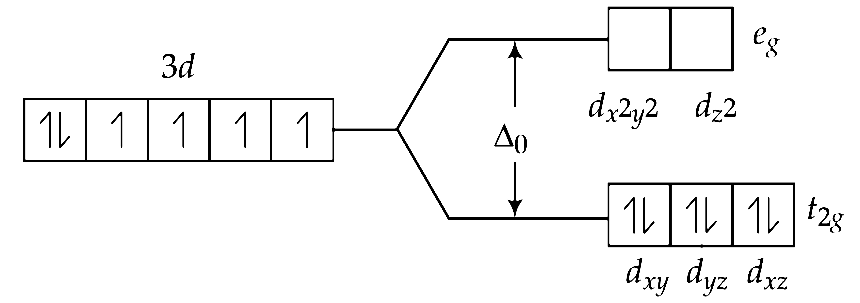
Which of these statements about [Co(CN)6]3 is true?
(A)
[Co(CN)6]3 has four unpaired electrons and will be in a high-spin configuration.
(B)
[Co(CN)6]3 has no unpaired electrons and will be in a high-spin configuration.
(C)
[Co(CN)6]3 has no unpaired electrons and will be in a low-spin configuration.
(D)
[Co(CN)6]3 has four unpaired electrons and will be in a low-spin configuration.
(C)

Solution

[Co(CN)6]3

oxidation no. of Co = +3

Co+3 = [Ar] 3d6 4s0

CN is a strong field ligand and as it approaches the metal ion the electrons must pair up. AIPMT 2015 Cancelled Paper Chemistry - Coordination Compounds Question 93 English Explanation

[Co(CN)6]3– has no unpaired electrons and will be in a low spin configuration.
Q.29
Cobalt (III) chloride forms several octahedral complexes with ammonia. Which of the following will not give test for chloride ions with silver nitrate at 25oC?
(A)
CoCl3 5NH3
(B)
CoCl3 6NH3
(C)
CoCl3 3NH3
(D)
CoCl3 4NH3
(C)

Solution

As For octahedral complexes, coordination number is 6.

CoCl3 . 3NH3 or [Co(NH3)3Cl3] will not give test for chloride ions with silver nitrate due to absence of ionisable chloride atoms.
Q.30
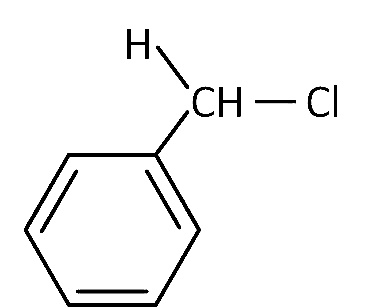
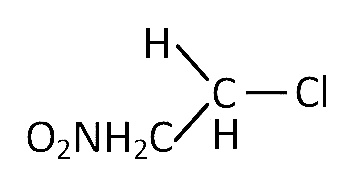
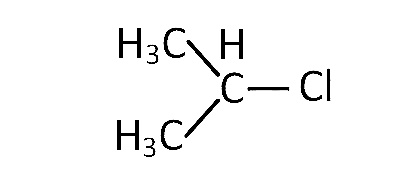
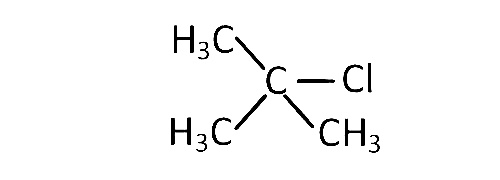
In which of the following compounds, the CCl bond ionisation shall give most stable carbonium ion?
(A)
AIPMT 2015 Cancelled Paper Chemistry - Some Basic Concepts of Organic Chemistry Question 90 English Option 1
(B)
AIPMT 2015 Cancelled Paper Chemistry - Some Basic Concepts of Organic Chemistry Question 90 English Option 2
(C)
AIPMT 2015 Cancelled Paper Chemistry - Some Basic Concepts of Organic Chemistry Question 90 English Option 3
(D)
AIPMT 2015 Cancelled Paper Chemistry - Some Basic Concepts of Organic Chemistry Question 90 English Option 4
(D)

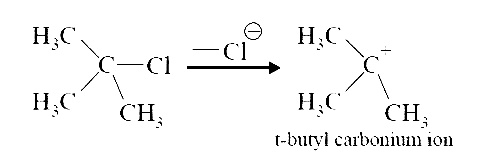
Solution

Tertiary butyl chloride will give the most stable tertiary carbonium ion among the other given compounds due to hyperconjugation.
AIPMT 2015 Cancelled Paper Chemistry - Some Basic Concepts of Organic Chemistry Question 90 English Explanation
Q.31
In Duma's method for estimation of nitrogen, 0.25 g of an organic compound gave 40 mL of nitrogen collected at 300 K temperature and 725 mm pressure. If the aqueous tension at 300 K is 25 mm, the percentage of nitrogen in the compound is
(A)
16.75
(B)
15.76
(C)
17.36
(D)
18.20
(A)

Solution

Wt. of organic substance = 0.25 g

V1 = 40 mL, T1 = 300 K

P1 = 725 – 25 = 700 mm of Hg

P2 = 760 mm of Hg (at STP)

T2 = 273 K


V2 = = 33.52 mL

Percentage of nitrogen

=

= 16.76%
Q.32
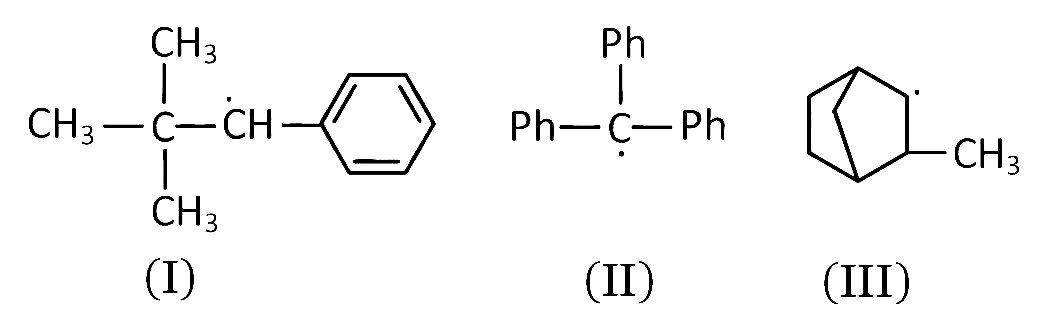
Consider the following compounds :
AIPMT 2015 Cancelled Paper Chemistry - Some Basic Concepts of Organic Chemistry Question 92 English
Hyperconjunction occurs in
(A)
III only
(B)
I and III
(C)
I only
(D)
II only
(A)

Solution

Only structure (III) has -H in conjugation with free radical.

So, hyperconjugation is possible in III only.
Q.33
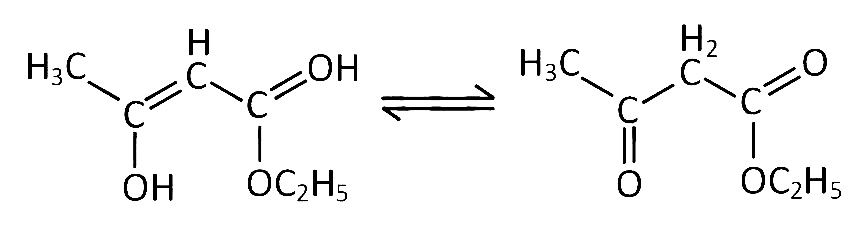
The enolic form of ethyl accetoacetate as shown below has
AIPMT 2015 Cancelled Paper Chemistry - Some Basic Concepts of Organic Chemistry Question 91 English
(A)
9 sigma bonds and 2 pi-bonds
(B)
9 sigma bonds and 1 pi-bond
(C)
18 sigma bonds and 2 pi-bonds
(D)
16 sigma bonds and 1 pi-bond.
(C)

Solution

The given structure has 18 bonds and 2 bonds.
Q.34
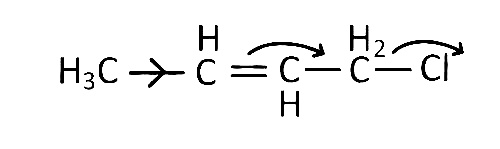
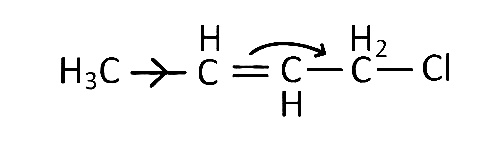
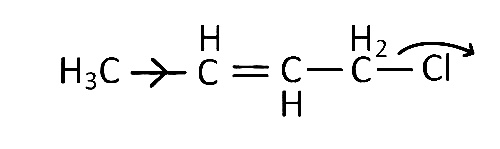
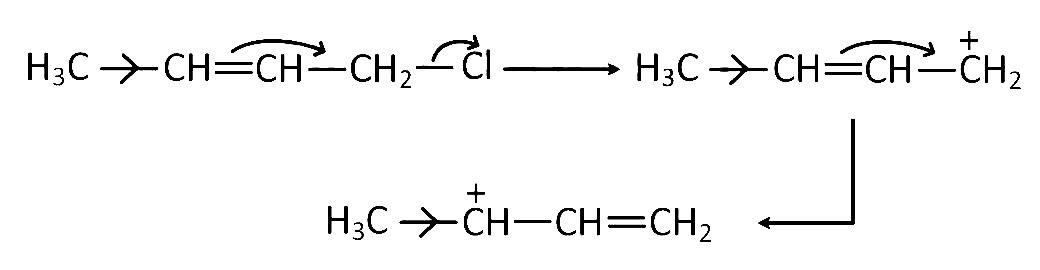
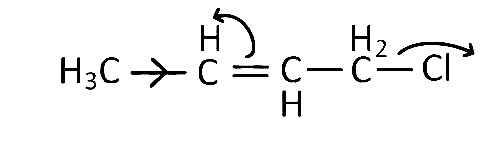
Which of the following is the most correct electron displacement for a nucleophilic reaction to take place?
(A)
AIPMT 2015 Cancelled Paper Chemistry - Some Basic Concepts of Organic Chemistry Question 94 English Option 1
(B)
AIPMT 2015 Cancelled Paper Chemistry - Some Basic Concepts of Organic Chemistry Question 94 English Option 2
(C)
AIPMT 2015 Cancelled Paper Chemistry - Some Basic Concepts of Organic Chemistry Question 94 English Option 3
(D)
AIPMT 2015 Cancelled Paper Chemistry - Some Basic Concepts of Organic Chemistry Question 94 English Option 4
(A)

Solution

bond is transferred after leaving Cl then nucleophile will attack a stable carbocation.

AIPMT 2015 Cancelled Paper Chemistry - Some Basic Concepts of Organic Chemistry Question 94 English Explanation
Q.35
Given :
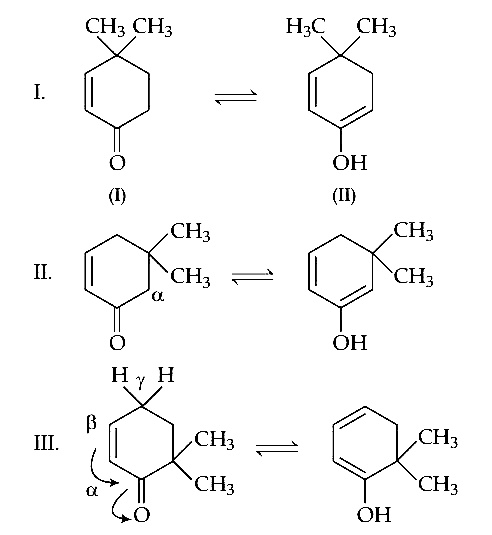
AIPMT 2015 Cancelled Paper Chemistry - Some Basic Concepts of Organic Chemistry Question 95 English
Which of the given compounds can exhibit tautomerism?
(A)
II and III
(B)
I, II and III
(C)
I and II
(D)
I and III
(B)

Solution

AIPMT 2015 Cancelled Paper Chemistry - Some Basic Concepts of Organic Chemistry Question 95 English Explanation

In first two cases -H participates in tautomerism.

And in third case, -H participate in tautomerism.
Q.36
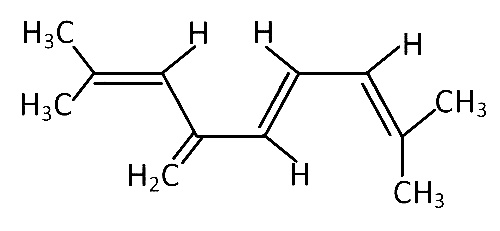
The total number of -bond electrons in the following structure is

AIPMT 2015 Cancelled Paper Chemistry - Some Basic Concepts of Organic Chemistry Question 96 English
(A)
12
(B)
16
(C)
4
(D)
8
(D)

Solution

No. of double bonds = 4

No. of bond electrons

= 2 × no. of double bond

= 2 × 4 = 8
Q.37
Given :

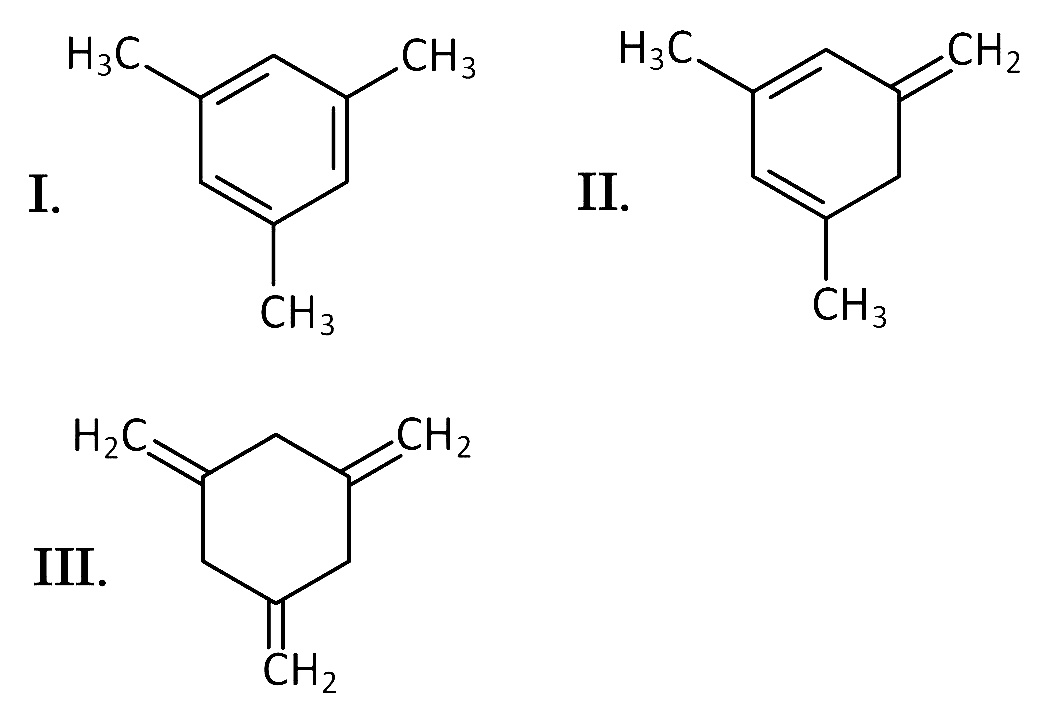
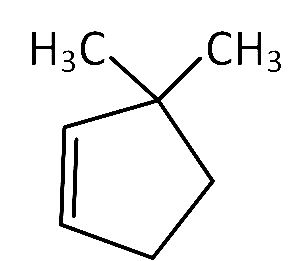
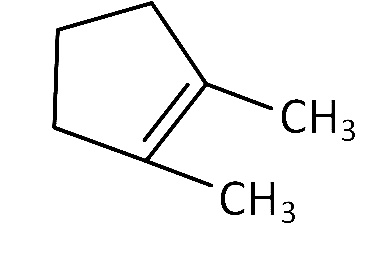
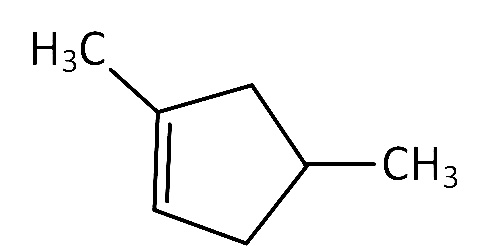
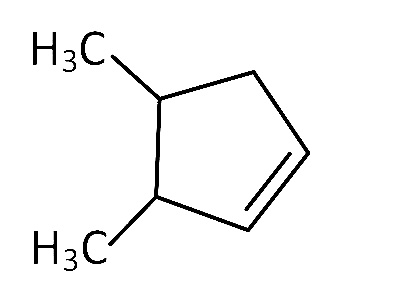
AIPMT 2015 Cancelled Paper Chemistry - Hydrocarbons Question 52 English

The enthalpy of hydrogenation of these compounds will be in the order as
(A)
II > III > I
(B)
II > I > III
(C)
I > II > III
(D)
III > II > I
(D)

Solution

Enthalpy of hydrogenation is inversely proportional to the stability of alkenes.

Stability of alkenes : I II III

Enthalpy of hydrogenation : I II II
Q.38
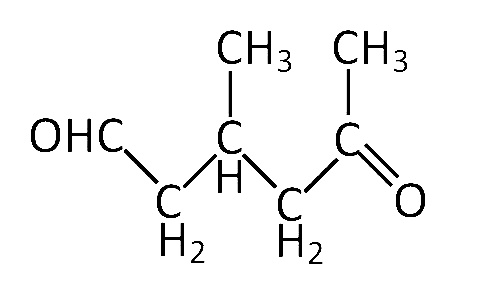
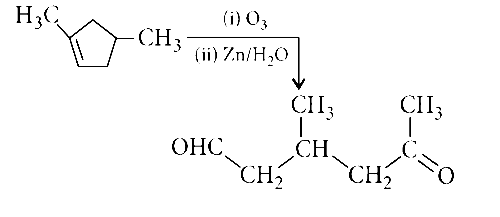
A single compound of the structure,

AIPMT 2015 Cancelled Paper Chemistry - Hydrocarbons Question 53 English

is obtainable from ozonolysis of which of the following cyclic compounds?
(A)
AIPMT 2015 Cancelled Paper Chemistry - Hydrocarbons Question 53 English Option 1
(B)
AIPMT 2015 Cancelled Paper Chemistry - Hydrocarbons Question 53 English Option 2
(C)
AIPMT 2015 Cancelled Paper Chemistry - Hydrocarbons Question 53 English Option 3
(D)
AIPMT 2015 Cancelled Paper Chemistry - Hydrocarbons Question 53 English Option 4
(C)

Solution

AIPMT 2015 Cancelled Paper Chemistry - Hydrocarbons Question 53 English Explanation
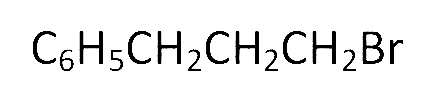
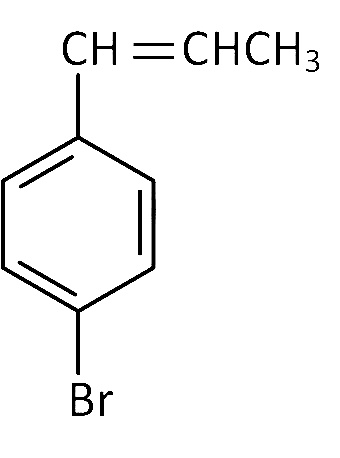
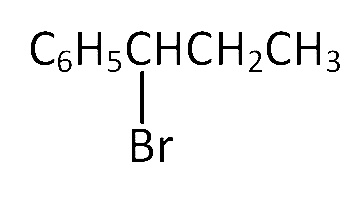
Q.39
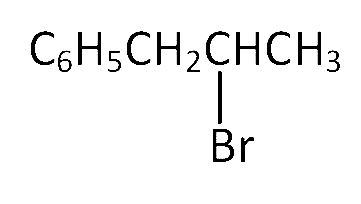
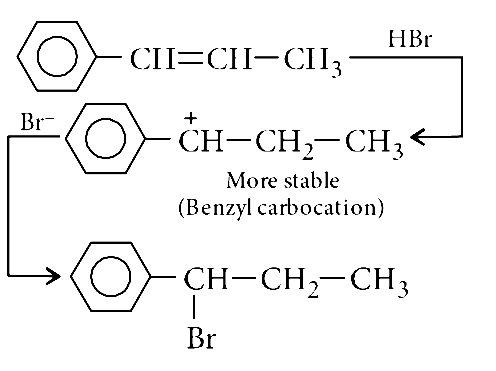
The reaction of C6H5CH CHCH3 with HBr produces
(A)
AIPMT 2015 Cancelled Paper Chemistry - Haloalkanes and Haloarenes Question 25 English Option 1
(B)
AIPMT 2015 Cancelled Paper Chemistry - Haloalkanes and Haloarenes Question 25 English Option 2
(C)
AIPMT 2015 Cancelled Paper Chemistry - Haloalkanes and Haloarenes Question 25 English Option 3
(D)
AIPMT 2015 Cancelled Paper Chemistry - Haloalkanes and Haloarenes Question 25 English Option 4
(C)

Solution

AIPMT 2015 Cancelled Paper Chemistry - Haloalkanes and Haloarenes Question 25 English Explanation
Q.40
The reaction,

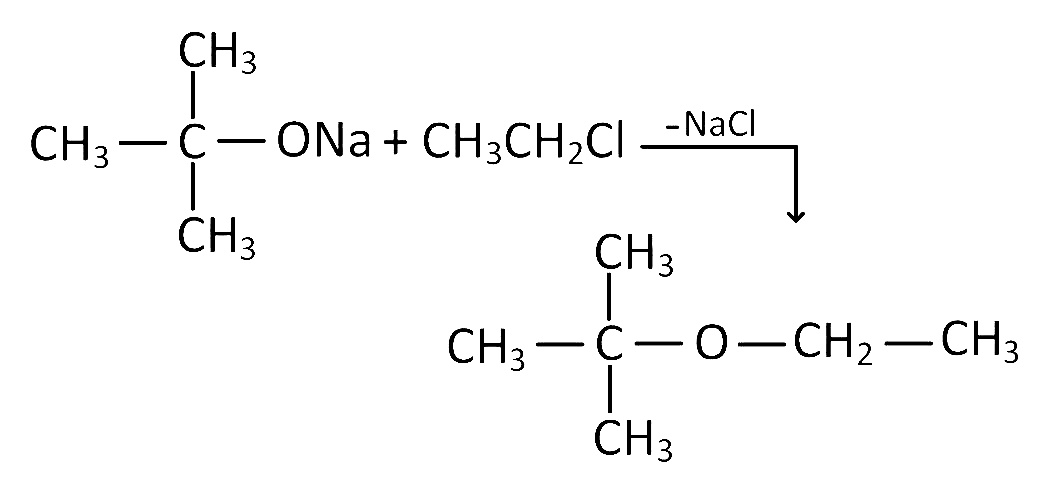
AIPMT 2015 Cancelled Paper Chemistry - Alcohol, Phenols and Ethers Question 24 English
is called
(A)
Etard reaction
(B)
Gattermann-Koch reaction
(C)
Williamson synthesis
(D)
Williamson continuous etherification process
(C)

Solution

Williamson synthesis is the best method for the preparation of ethers.
Q.41
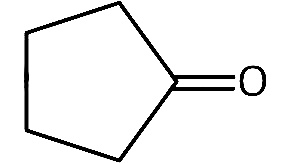
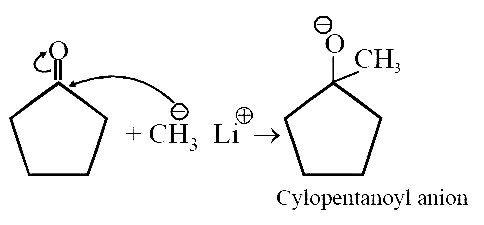
Treatment of cyclopentanone

AIPMT 2015 Cancelled Paper Chemistry - Aldehydes, Ketones and Carboxylic Acids Question 100 English
with methyl lithium gives which of the following species ?
(A)
Cyclopentanonyl radical
(B)
Cyclopentanonyl biradical
(C)
Cyclopentanonyl anion
(D)
Cyclopentanonyl cation
(C)

Solution

AIPMT 2015 Cancelled Paper Chemistry - Aldehydes, Ketones and Carboxylic Acids Question 100 English Explanation
Q.42
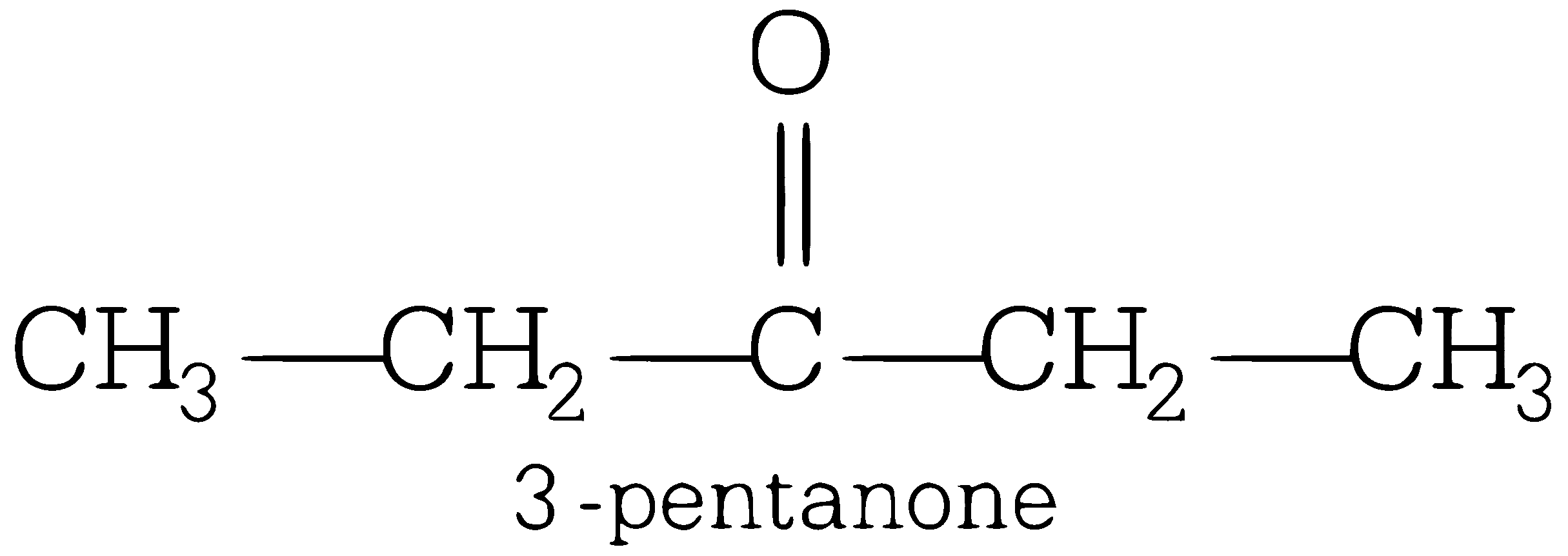
An organic compound 'X' having molecular formula C5H10O yields phenylhydrazone and gives negative response to the iodoform test and Tollens' test. It produces n-pentane on reduction. 'X' could be
(A)
3-pentanone
(B)
n-amyl alcohol
(C)
pentanal
(D)
2-pentanone
(A)

Solution

As the compound X yields phenyl hydrazone and gives negative response to the iodoform test and Tollen’s test so it must contain a C = O group but neither a methyl ketone nor in aldehyde. Thus, the structure of X will be

AIPMT 2015 Cancelled Paper Chemistry - Aldehydes, Ketones and Carboxylic Acids Question 91 English Explanation
Q.43
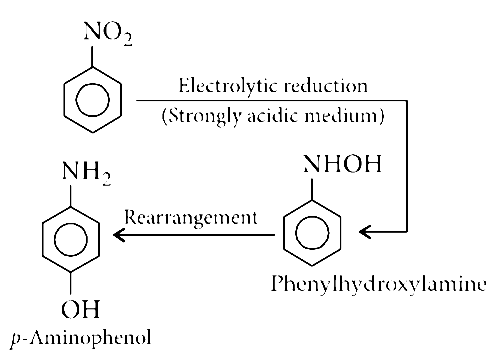
The electrolytic reduction of nitrobenzene in strongly acidic medium produces
(A)
azobenzene
(B)
aniline
(C)
-aminophenol
(D)
azoxybenzene.
(C)

Solution

AIPMT 2015 Cancelled Paper Chemistry - Organic Compounds Containing Nitrogen Question 47 English Explanation
Q.44
Biodegradable polymer which can be produced from glycine and aminocaproic acid is
(A)
buna - N
(B)
nylon 6, 6
(C)
nylon 2-nylon 6
(D)
PHBV
(C)

Solution

AIPMT 2015 Cancelled Paper Chemistry - Polymers Question 33 English Explanation
Q.45
Bithional is generally added to the soaps as an additive to function as a/n
(A)
buffering agent
(B)
antiseptic
(C)
softner
(D)
dryer
(B)

Solution

Bithionol is added to soaps to impart antiseptic properties.
Biology (Maximum Marks: 348)
  • This section contains 87 questions.
  • Each question has FOUR options (A), (B), (C) and (D). ONLY ONE of these four options is the correct answer.
  • Full Marks : +4 If ONLY the correct option is chosen;
  • Zero Marks : 0 If none of the options is chosen (i.e. the question is unanswered);
  • Negative Marks : −1 In all other cases.
Q.1
Select the correct matching in the following pairs :
(A)
Rough ER – Oxidation of fatty acids
(B)
Smooth ER – Oxidation of phospholipids
(C)
Rough ER – Synthesis of glycogen
(D)
Smooth ER – Synthesis of lipids
(D)

Solution

Smooth endoplasmic reticulum (SER) is a system of smooth membranes (i.e., membranes not having ribosomes) within the cytoplasm of plant and animal cells. It forms a link between the cell and nuclear membranes. It is the site of important metabolic reactions, including phospholipid and fatty acid synthesis. In animal cells lipid-like steroidal hormones are also synthesized.
Q.2
Which one of the following is not an inclusion body found in prokaryotes?
(A)
Cyanophycean granule
(B)
Phosphate granule
(C)
Polysome
(D)
Glycogen granule
(C)

Solution

Polysomes are found in eukaryotes and are defined as a cluster of ribosomes attached to a mRNA molecule. Polysomes are number of ribosomal complexes situated on mRNA.
Q.3
The chromosomes in which centromere is situated close to one end are :
(A)
Telocentric
(B)
Metacentric
(C)
Sub-metacentric
(D)
Acrocentric
(D)

Solution

In acrocentric chromosomes, centromere appears subterminal, ie, with a very small and a very long arm. In metacentric chromosome, centromere is median and chromosome appears V-shaped during anaphasic movement. submetacentric chromosome, centromere is submedian, ie, one arm smaller and one arm Larger. In telocentric chromosome, centromere is Tuely terminal.
Q.4
The structures that are formed by stacking of organized flattened membranous sacs in the chloroplasts are
(A)
Stroma lamellae
(B)
Cristae
(C)
Stroma
(D)
Grana
(D)

Solution

A chloroplast is a vesicle, bound by an envelope of two unit membranes and filled with a fluid matrix called stroma. The lamellae, after separation from the inner membrane, usually take the form of closed, flattened, ovoid sacs, the thylakoids, which lie closely packed in piles, the grana.
Q.5
Nuclear envelope is a derivative of :
(A)
Membrane of Golgi complex
(B)
Smooth endoplasmic reticulum
(C)
Rough endoplasmic reticulum
(D)
Microtubules
(C)

Solution

In late prophase, nuclear envelope disappears and reappears in late telophase from rough endoplasmic reticulum (RER).
Q.6
DNA is not present in :
(A)
Nucleus
(B)
Chloroplast
(C)
Mitochondria
(D)
Ribosomes
(D)

Solution

Ribosomes are composed of ribonucleic acid and proteins and are not surrounded by any membrane. These are the site for protein synthesis.
Q.7
Which one of the following statements is incorrect?
(A)
The compettive inhibitor does not affect the rate of breakdown of the enzyme -substrate complex.
(B)
The presence of the competitive inhibitor decreases the Km of the enzyme for the substrate
(C)
A competitive inhibitor reacts reversibly with the enzyme to form and enzyme-inhibitor complex.
(D)
In competitive inhibition, the inhibitor molecules is not chemically changed by the enzyme.
(B)

Solution

Competitive inhibition is a reversible inhibition where inhibitor competes with the normal substrate for the active site of enzyme. A competitive inhibitor is usually chemically similar to the normal substrate and therefore, fits into the active site of an enzyme and binds with it. The inhibition is thus due to substrate analogue. The enzyme, now cannot act upon the substrate and reaction products are not formed. E.g., the activity of succinate dehydrogenase is inhibited by malonate. Km value or Michaelis constant is defined as the substrate concentration at which half of the enzyme molecules are forming enzyme substrate (ES) complex or concentration of the substrate when the velocity of the enzyme reaction is half the maximal possible. A smaller Km value indicates greater affinity of the enzyme for its substrate, hence, shows a quicker reaction. The competitive inhibitor decreases the affinity of enzyme for substrate, thus increases the Km value.
Q.8
A somatic cell that has just completed the S phase of its cell cycle, as compared to gamete of the same species, has
(A)
twice the number of chromosomes and four times the amount of DNA
(B)
four times the number of chromosomes and twice the amount of DNA
(C)
twice the number of chromosomes and twice the amount of DNA
(D)
same number of chromosomes but twice the amount of DNA.
(A)

Solution

When S-phase completes, a somatic cell contains 2n number of chromosomes and 4C content of DNA.
Q.9
Select the correct option.
Column Column
A. Synapsis aligns homologous (i) Anaphase
B. Synthesis of RNA and protein (ii) Zygotene
C. Action of enzymes recombinase (iii) G2-phase
D. Centromeres do not separate
but chromatids move towards
opposite poles
(iv) Anaphase
(v) Pachytene
(A)
(A) - (i);  (B) - (ii);  (C) - (v);  (D) - (iv)
(B)
(A) - (ii);  (B) - (iii);  (C) - (iv);  (D) - (v)
(C)
(A) - (ii);  (B) - (i);  (C) - (iii);  (D) - (iv)
(D)
(A) - (ii);  (B) - (iii);  (C) - (v);  (D) - (iv)
(D)

Solution

Pachytene - Crossing over mediated by recombinase enzyme.

Zygotene - Pairing of homologous chromosomes

G2 phase - Synthesis of RNA and protein Anaphase I - Centromeres do not separate but chromatids move towards opposite poles.
Q.10
The hilum is a scar on the
(A)
seed, where funicle was attached
(B)
fruit, where style was present
(C)
fruit, where it was attached to pedicel
(D)
seed, where micropyle was present
(A)

Solution

Ovule is an integumented megasporangium found in spermatophytes which develops into seed after fertilization. An angiospermic ovule is typically an ovoid and whitish structure. It occurs inside ovary where it is attached to a parenchymatous cushion called placenta either singly or in a cluster. The ovule is stalked. The stalk is called funiculus or funicle. The point of attachment of the body of the ovule with the funiculus is known as hilum. It is present as a scar on a mature seed.
Q.11
Which one of the following may require pollinators, but is genetically similar to autogamy?
(A)
Apogamy
(B)
Cleistogamy
(C)
Geitonogamy
(D)
Xenogamy
(C)

Solution

Geitonogamy, genetically, shows similarity with autogamy because the pollen grains are borne on the same plant.
Q.12
Which of the following are the important floral rewards to the animal pollinators ?
(A)
Floral fragrance and calcium crystals
(B)
Protein pellicle and stigmatic exudates
(C)
Colour and large size of flower
(D)
Nectar and pollen grains
(D)

Solution

Nectar and pollen grains are the usual floral rewards which the animal pollinators get.
Q.13
Which one of the following statements is not true?
(A)
The flowers pollinated by files and bats secrete foul odour to attract them.
(B)
Honey is made by bees by digesting pollen collected from flowers.
(C)
Pollen grains are rich in nutrients and they are used in the form of tablets and syrups.
(D)
Pollen grains of some plants cause severe allergies and bronchial afflictions in some people.
(B)

Solution

Honey is produced by worker bees using nectar (fructose) of flowering plants.
Q.14
Transmission tissue is characteristic feature of
(A)
dry stigma
(B)
wet stigma
(C)
hollow style
(D)
solid style.
(D)

Solution

A solid style has transmission tissue which has large intercellular spaces. It allows growth of pollen tube in pistil.
Q.15
The guts of cow and buffalo possess
(A)
Cyanobacteria
(B)
Fucus sp
(C)
Methanogens
(D)
Chlorella sp
(C)

Solution

Methanogens (microorganisms producing methane) are found in the guts of ruminant animals e.g. cows and buffalloes.
Q.16
Vascular bundles in monocotyledons are considered closed because
(A)
There are no vessels with perforations
(B)
Xylem is surrounded all around by phloem
(C)
A bundle sheath surrounds each bundle
(D)
Cambium is absent
(D)

Solution

Vascular bundles in monocotyledons (plants with a single seed leaf, like grasses and grains) are considered "closed" primarily due to Option D: Cambium is absent.

In botany, vascular bundles are the part of the plant that transport nutrients and water. In monocotyledons, these bundles are typically scattered throughout the stem and do not have a cambium layer. The cambium is a layer of actively dividing cells found in most dicotyledons (plants with two seed leaves) and is responsible for secondary growth, which includes the widening of the stems and roots. This secondary growth is possible because the cambium adds layers of vascular tissue called secondary xylem (wood) and secondary phloem.

In monocotyledons, the absence of cambium means there's no secondary growth, and thus, the vascular bundles are termed "closed." This is different from "open" vascular bundles found in dicotyledons, where the presence of cambium allows for continuous growth and change in the arrangement of the xylem and phloem.

Options A, B, and C describe other aspects of vascular bundles but are not the reasons why monocotyledonous vascular bundles are considered closed. For instance:

  • Option A: The presence or absence of vessels with perforations is more about the type of vessels in the xylem and not directly related to the concept of open or closed vascular bundles.

  • Option B: While xylem surrounded by phloem is a characteristic of some vascular bundles, it doesn't define them as open or closed.

  • Option C: A bundle sheath may be present in both monocotyledons and dicotyledons and is not a defining factor for open or closed vascular bundles.

Therefore, Option D, "Cambium is absent," is the correct reason for vascular bundles in monocotyledons being considered closed.
Q.17
A major characteristic of the monocot root is the presence of :
(A)
Vasculature without cambium
(B)
Cambium sandwiched between phloem and xylem along the radius
(C)
Open vascular bundles
(D)
Scattered vascular bundles
(A)

Solution

In monocot root, a large number of vascular bundles are arranged in the form of a ring around the central pith. Vascular bundles are closed because there is no cambium present between the xylem and phloem.
Q.18
Transpiration and root pressure cause water to rise in plants by
(A)
pushing it upward
(B)
pushing and pulling it, respectively
(C)
pulling it upward
(D)
pulling and pushing ir, respectively.
(D)

Solution

Transpiration creates pulling (Negative pressure) force. Root pressure creates positive pressure developed in xylem. It is measured by manometer
Q.19
Which one gives the most valid and recent explanation for stomatal movement?
(A)
Starch hydrolysis
(B)
Guard cell photosynthesis
(C)
Transpiration
(D)
Potassium influx and efflux
(D)

Solution

The opening and closing of stomata are caused by influx and efflux of potassium ions (K+). The increase of K+ results in opening of stoma and decrease of K+ causes closing of stoma. The turgidity of guard cells induces the opening of the pores of stomata found on the surface of leaves.
Q.20
In a ring girdled plant
(A)
the shoot and root die together
(B)
neither root nor shoot will die
(C)
the shoot dies first
(D)
the root dies first.
(D)

Solution

In girdling or ringing experiments, a ring of bark is cut from the stem. It also removes phloem. Nutrients collect above the ring, where the bark also swells up and may give rise to adventitious roots. Growth is also vigorous above the ring. The tissues below the ring not only show stoppage of growth but also begin to shrivel.

Roots can be starved and killed, if the ring is not healed after some time. Killing of roots shall kill the whole plant, clearly showing that bark or phloem is involved in the movement of organic solutes towards root.
Q.21
Minerals known to be required in large amounts for plant growth include
(A)
potassium, phosphorus, selenium, boron
(B)
magnesium, sulphur, iron, zinc
(C)
phosphorus, potassium, sulphur, calcium
(D)
calcium, magnesium, manganese, copper.
(C)

Solution

Macroelements (macronutrients) are those essential elements which are present in easily detectable quantities, i.e., 1-10 mg per gram of dry matter. Macroelements are usually involved in the synthesis of organic molecules and development of osmotic potential. They are nine in number — C, H, O, N, P, K, S, Mg and Ca.
Q.22
Cytochromes are found in
(A)
cristae of mitochondria
(B)
lysosomes
(C)
matrix of mitochondria
(D)
outer wall of mitochondria.
(A)

Solution

Cytochromes are fond in mitochondria. These are located on the inner membrane of mitochondria and are related with phosphorylation.
Q.23
Cryopreservation of gametes of threatened species in viable and fertile condition can be referred to as:
(A)
In situ conservation by sacred groves
(B)
In situ conservation of biodiversity
(C)
In situ cryo-conservation of biodiversity
(D)
Advanced ex-situ conservation of biodiversity
(D)

Solution

In such type of conservation, the threatened animals and plants are taken out of their natural habitat and protected in special areas like zoological parks and wild life sanctuaries.
Q.24
In which of the following both pairs have correct combination ?
(A)
In situ conservation : Cryopreservation
Ex situ conservation : Wildlife Sanctuary
(B)
In situ conservation : Tissue culture
Ex situ conservation : Sacred groves
(C)
In situ conservation : National Park
Ex situ conservation : Botanical Garden
(D)
In situ conservation : Seed Bank
Ex situ conservation : National Park
(C)

Solution

In situ (on site) conservation is conservation and protection of the whole ecosystem and its biodiversity at all levels, in order to protect the threatened species. Two in situ methods are being used to save biodiversity viz., hotspots and protected areas. Protected areas include national parks, sanctuaries, biosphere reserves and sacred groves. Ex situ (off site) conservation is conservation of selected rare plants/animals in places outside their natural homes. Ex situ conservation includes offsite collections, seed banks, gene banks, in vitro fertilization, cryopreservation techniques and tissue culture.
Q.25
Which one of the following matches is correct?
(A)
Mucor Reproduction by conjugation Ascomycetes
(B)
Agaricus Parasitic fungus Basidiomycetes
(C)
Phytophthora Aseptate mycelium Basidiomycetes
(D)
Alternaria Sexual reoroduction absent Deuteromycetes
(D)

Solution

Alternaria belongs to class - Deuteromycetes, which lack sexual reproduction. Asexual reproduction takes place by conidia produced on conidiophores.
Q.26
True nucleus is absent in
(A)
Vaucheria
(B)
Volvox
(C)
Anabaena
(D)
Mucor.
(C)

Solution

Anabaena is a prokaryotic organism.

It is a cyanobacteria (blue green algae) which belongs to Kingdom Monera. Like all other prokaryotes, it lacks a true nucleus and other cell organelles.
Q.27
Keel is the characteristic feature of flower of
(A)
Aloe
(B)
tomato
(C)
tulip
(D)
Indigofera.
(D)

Solution

Indigofera is a member of family fabaceae. It has keel type of floral structure in which two anterior fused petals are present.
Q.28
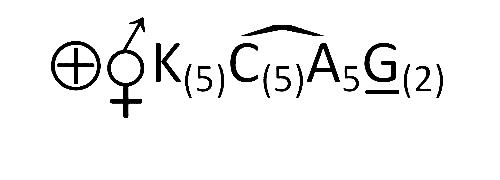
AIPMT 2015 Cancelled Paper Biology - Morphology of Flowering Plants Question 44 English is the floral formula of
(A)
Petunia
(B)
Brassica
(C)
Allium
(D)
Sesbania.
(A)

Solution

The given floral formula is of Family Solanaceae. Among the given options, only Petunia belongs to Family Solanaceae. Allium is a member of Family Liliaceae, Sesbania is of Family Leguminosae and Brassica is a member of Family Brassicaceae or Cruciferae.
Q.29
Leaves become modified into spines in
(A)
onion
(B)
silk cotton
(C)
Opuntia
(D)
pea
(C)

Solution

In xerophytic plants, the leaves modify into sharp, pointed spines e.g. Aloe, Solanum surattense, Opuntia, Asparagus etc. This modification is either for protection of plant or to lessen transpiration, or for both.
Q.30
Perigynous flowers are found in
(A)
China rose
(B)
rose
(C)
guava
(D)
cucumber.
(B)

Solution

Ovary is partly superior and partly inferior in perigynous flower.
Q.31
Multiple alleles are present
(A)
on different chromosomes
(B)
at the same locus of the chromosome
(C)
at different loci on the same chromosome.
(D)
on non-sister chromatids
(B)

Solution

All alleles of a gene are situated on the same loci of chromosome in organisms.
Q.32
How many pairs of contrasting characters in pea plants were studied by Mendel in his experiments?
(A)
Eight
(B)
Five
(C)
Seven
(D)
Six
(C)

Solution

Seven pairs of contrasting characters were selected in pea plant and studied by Mendel in his experiment.
Q.33
A man with blood group ‘A’ marries a woman with blood group ‘B’. What are all the possible blood groups of their offsprings?
(A)
A and B only
(B)
A, B, AB and O
(C)
A, B and AB only
(D)
O only
(B)

Solution

The man has blood group A, thus its genotype can either be IAIA or IAIO. Similarly, woman can either have IBIB, or IBIO genotype. Thus, theiroffspring can have any of the blood groups A (IAIA or IAIO), B (IBIB or IBIO), AB (IAIB) or O (IOIO).
Q.34
Alleles are
(A)
true breeding homozygotes
(B)
different phenotype
(C)
heterozygotes
(D)
different molecular forms of a gene
(D)

Solution

Genes are the units of inheritance and contain the information that is required to express a particular trait in an organism. Alternating forms of a single gene which code for a pair of contrasting traits are known as alleles. For example, two alleles determine the height of pea plant (tall and dwarf).
Q.35
The movement of a gene from one linkage group to another is called
(A)
inversion
(B)
translocation
(C)
duplication
(D)
crossing over
(B)

Solution

In translocation, the movement of a gene takes place from one linkage group to another between non-homologous chromosomes.
Q.36
An abnormal human baby with ‘XXX’ sex chromosomes was born due to
(A)
formation of abnormal sperms in the father
(B)
fusion of two ova and one sperm
(C)
formation of abnormal ova in the mother
(D)
fusion of two sperms and one ovum
(C)

Solution

The abnormal baby has an extra X chromosome, thus it must have been produced by fusion of abnormal XX ovum with a normal X sperm. Abnormal XX sperm is not possible because, males have XY genotype, and if produce abnormal sperms, then XY sperms and O sperms will be produced. If fusion of multiple gametes have occurred (either two ova with one sperm or two sperms with one ovum), then the human baby will have triploid genotype not the trisomy of sex chromosomes.
Q.37
In sea urchin DNA, which is double stranded, 17% of the bases were shown to be cytosine, The percentages of the other three bases expected to be present in this DNA are
(A)
G 17%, A 16.5%, T 32.5%
(B)
G 17%, A 33%, T 33%
(C)
G 8.5%, A 50%, T 24.5%
(D)
G 34%, A 24.5%, T 24.5%
(B)

Solution

Chargaff’s rule states that A = T and G ≡ C. The molar amount of adenine = molar amount of thymine. The molar amount of guanine = molar amount of cytosine.
Hence,
G is 17%, so, C = 17%
A = 33%, so, T = 33%
Q.38
Gene regulation governing lactose operon of E.coli that involves the lac I gene product is
(A)
negative and inducible because repressor protein prevents transcription.
(B)
positive and inducible because it can be induced by lactose
(C)
negative and repressible because repressor protein prevents transcription
(D)
feedback inhibition because excess of -galactosidase can switch off transcription
(A)

Solution

The control of expression of lac operon is negative (as it is turned off normally) and inducible. Inducible operon is an operon which remains switched off normally but becomes operational in the presence of an inducer (lactose, actually allolactose a metabolite of lactose, in case of lac operon). The inducible operon generally functions in catabolic pathways. In the presence of an inducer, the repressor has a higher affinity for the inducer than for the operator gene.

When lactose is added, a few lactose molecules are carried into the cell by the enzyme lactose permease as small amount of this enzyme is present in the cell even when the operon is not working. These few lactose molecules are converted into allolactose molecules which act as an inducer and bind to the repressor (a product of regulator gene). The repressor-inducer complex fails to join with the operator gene, thus it is turned on.
Q.39
Which of the following enhances or induces fusion of protoplasts ?
(A)
Sodium chloride and potassium chloride
(B)
IAA and kinetin
(C)
Polyethylene glycol and sodium nitrate
(D)
IAA and gibberellins
(C)

Solution

Polyethylene glycol and sodium nitrate play an important role in the fusion of protoplasts from the same or different species. It is done for the formation of somatic hybrid cells. This process is adopted when normal sexual reproduction is not possible for the production of hybrids.
Q.40
A technique of micropropagation is
(A)
somatic embryogenesis
(B)
embryo rescue
(C)
protoplast fusion
(D)
somatic hybridisation
(A)

Solution

Development of embryo like structure from explant by the method of tissue culture, is called somatic embryogenesis.
Q.41
Which body of the Government of India regulates GM research and safety of introducing GM organisms for public services ?
(A)
Research Committee on Genetic Manipulation
(B)
Genetic Engineering Approval Committee
(C)
Indian Council of Agricultural Research
(D)
Bio - safety committee
(B)

Solution

Genetic modification of organisms can have unpredictable results, when such organisms are introduced into the ecosystem. Therefore, the Indian Government has set up organizations such as GEAC (Genetic Engineering Approval Committee), which makes decisions regarding the validity of GM research and the safety of introducing GM-organisms for public services.
Q.42
In Bt cotton, the Bt toxin present in plant tissue as pro - toxin is converted into active toxin due to :
(A)
action of gut micro-organisms
(B)
presence of conversion factors in insect gut
(C)
alkaline pH of the insect gut
(D)
acidic pH of the insect gut
(C)

Solution

Bt toxin are solubilised in alkaline pH of the insect gut causing death.
Q.43
The crops engineered for glyphosate are resistant/ tolerant to :
(A)
Bacteria
(B)
Herbicides
(C)
Fungi
(D)
Insects
(B)

Solution

Today plants having the broad leaves are made resistant to a powerful biodegradable herbicide glyphosate. It is an active ingredient of Round Up ready plant. It disturbs the working of EPSP synthetase enzyme. If it is taken up by crop plants they will die. So, the bioengineers have transferred gene for synthesis of EPSP synthetase enzyme to crop plant.
Q.44
The following graph depicts changes in two populations (A and B) of herbivores in a grassy field. A possible reason for these changes is that:

AIPMT 2015 Cancelled Paper Biology - Organisms and Populations Question 78 English
(A)
Population B competed more successfully for food than population A
(B)
Population A consumed the members of population B
(C)
Both plant populations in this habitat decreased
(D)
Population A produced more offspring than population B
(A)

Solution

The given graph illustrates that population B got success in the grassy field in comparison to population A
Q.45
The UN Conference of Parties on climate change in the year 2011 was held in :
(A)
Peru
(B)
Qatar
(C)
Poland
(D)
South Africa
(D)

Solution

The UN Conference of Parties on climate change in 2011, was held in Durban, South Africa. It aimed at decrease of pollutant emission.
Q.46
High value of BOD (Biochemical Oxygen Demand) indicates that :
(A)
water is highly polluted
(B)
consumption of organic matter in the water is higher by the microbes
(C)
water is pure
(D)
water is less polluted
(B)

Solution

Biochemical oxygen demand or BOD is the oxygen required for microbial decomposition of a unit mass of organic remains. The degree of impurity of water due to organic matter is measured in terms of BOD. A higher BOD of a river indicates that water is highly polluted.
Q.47
Rachel Carson's famous book "Silent Spring" is related to:
(A)
Population explosion
(B)
Pesticide pollution
(C)
Ecosystem management
(D)
Noise pollution
(B)

Solution

Rachel Carson’s book ‘Silent Spring’ reveals the harmful effect of DDT, a fatal pesticide. The writer opposed to chemical industry in U.S.A. This book influenced the national policy over pesticide use in many countries all over the world.
Q.48
Which of the following is not one of the prime health risks associated with greater UV radiation through the atmosphere due to depletion of stratospheric ozone?
(A)
Increased liver cancer
(B)
Increased skin cancer
(C)
Damage to eyes
(D)
Reduced Immune System
(A)

Solution

Ultraviolet radiations are of three types-UV-C (100 - 280 nm), UV-B (280 - 320nm) and UV-A (320 - 390nm). Shorter ultraviolet radiations (UV-C) are absorbed by the atmosphere. The longer ones (UV-A) are not much harmful. The intermediate or UVB are harmful as well as capable of deep penetration. Thinning of ozone layer increases the amount of UV-B radiations reaching the earth. UV-B radiations damage skin cells, cause ageing of skin, skin cancer and eye damage.
Q.49
In which of the following, gametophyte is not independent free living?
(A)
Pteris
(B)
Pinus
(C)
Funaria
(D)
Marchantia
(B)

Solution

Pinus belongs to gymnosperms in which male and female gametophytes do not have an independent free living existance. They remain within the sporangia which are of two types — microsporangia and megasporangia.
Q.50
Male gametes are flagellated in
(A)
Ectocarpus
(B)
Spirogyra
(C)
Polysiphonia
(D)
Anabaena.
(A)

Solution

Male gametes are flagellated in Ectocarpus (phaeophyceae). They possess heterokont, lateral flagella.
Q.51
Which one of the following statements is wrong?
(A)
Chlorella and Spirulina are used as space food.
(B)
Mannitol is stored food in Rhodophyceae.
(C)
Algin and carrageenan are products of algae.
(D)
Agar-agar is obtained from Gelidium and Gracilaria.
(B)

Solution

Laminarin and mannitol are food reserves of brown algae or Phaeophyceae. Rhodophycean algae store food in the form of floridean starch.
Q.52
Read the following five statements (A to E) and select the option with all correct statements.
A.   Mosses and lichens are the first organisms to colonise a bare rock.
B.   Selaginella is a homosporous pteridophyte
C.   Coralloid roots in Cycas have VAM.
D.   Main plant body in bryophytes is gametophytic, whereas in pteridophytes it is sporophytic.
E.   In gymnosperms, male and female gametophytes are present within sporangia located on sporophyte.
(A)
A, D and E
(B)
B, C and E
(C)
A, C and D
(D)
B, C and D
(A)

Solution

Selaginella is a heterosporus pteridophyte containing micro & megaspores. In Cycas, corolloid root has the cyanobacteria - Anabaena.
Q.53
Typical growth curve in plants is
(A)
stair-steps shaped
(B)
parabolic
(C)
sigmoid
(D)
linear.
(C)

Solution

Geometric growth cannot be sustained for long in natural condition. Limited nutrient availability slows down the growth. It leads to a stationary phase or even a decline. Plotting the growth against time, gives a typical sigmoid or S-curve. Sigmoid curve of growth is typical of most organisms in their natural environment including plants.
An idealised sigmoid growth curve is drawn below: AIPMT 2015 Cancelled Paper Biology - Plant Growth and Development Question 71 English Explanation
Q.54
What causes a green plant exposed to the light, on only one side, to bend towards the source of light as it grows?
(A)
Light stimulates plant cells on the lighted side to grow faster.
(B)
Auxin accumulates on the shaded side, stimulating greater cell elongation there.
(C)
Green plants need light to perform photosynthesis.
(D)
Green plants seek light because they are photoreopic.
(B)

Solution

Auxin stimulates cell elongation. It accumulates on shaded side which results in more elongation of cells towards shaded side of the plant. This causes bending of the plant towards source of light.
Q.55
Vertical distribution of different species occupying different levels in a biotic community is known as :
(A)
Stratification
(B)
Pyramid
(C)
Divergence
(D)
Zonation
(A)

Solution

Stratification is the occurrence of vertical zonation in the ecosystem & indicates the presence of favorable environmental conditions, for e.g., trees occupy top vertical strata or layer of a forest, shrubs the second. Herbs & grasses occupy the bottom layers. It is absent or poor where environmental conditions are unfavorable, e.g. desert ecosystems have very few trees & shrubs.
Q.56
In an ecosystem the rate of production of organic matter during photosynthesis is termed as :
(A)
Secondary productivity
(B)
Net Productivity
(C)
Net primary productivity
(D)
Gross primary productivity
(D)

Solution

The amount of energy accumulation in green plants as biomass or organic matter per unit area over a time period is known as primary productivity. The rate of total capture of energy, or the rate of total production of organic material (biomass), is known as gross primary productivity.
Q.57
The mass of living material at a trophic level at a particular time is called :
(A)
Net primary productivity
(B)
Standing state
(C)
Standing crop
(D)
Gross primary productivity
(C)

Solution

Standing crop is the amount of living biomass in an ecosystem. It indicates the productivity & luxuriance of growth. It is expressed in the form of number or biomass of organisms per unit area.
Q.58
Secondary Succession takes place on/in :
(A)
Newly created pond
(B)
Newly cooled lava
(C)
Bare rock
(D)
Degraded forest
(D)

Solution

Secondary succession (subsere) is the biotic succession that occurs in an area which become secondarily bare due to the destruction of community previously present there. Secondary succession starts from previously built up substrata with already existing living matter. The action of any external force, such as a sudden change in climatic factors, biotic intervention, fire, etc., had resulted in the destruction of previous community. Thus, area became devoid of living matter but its substratum, is built up. It has organic matter, so is biologically fertile and thus the successions are comparatively more rapid.
Q.59
Most animals are tree dwellers in a:
(A)
temperate deciduous forest
(B)
tropical rain forest
(C)
coniferous forest
(D)
thorn woodland
(B)

Solution

In tropical rain forest zone, most of the animals prefer to live on trees. The reason is that the floor of forest is full of humidity, decomposing leaves and other organic matters and is the habitat of insects etc.
Q.60
Match each disease with its correct type of vaccine
Column I Column II
A. Tubeculosis (i) Harmless virus
B. Whooping cough (ii) Inactivated toxin
C. Diphtheria (iii) Killed bacteria
D. Polio (iv) Harmless bacteria
(A)
A - (i), B - (ii), C - (iv), D - (iii)
(B)
A - (iv), B - (iii), C - (ii), D - (i)
(C)
A - (ii), B - (i), C - (iii), D - (iv)
(D)
A - (iii), B - (ii), C - (iv), D - (i)
(B)

Solution

Tuberculosis vaccine (BCG) has inactivated bacteria. In whooping cough vaccine, there are killed pathogens of Bordetella pertussis which cause whooping cough. In DPT diphtheria toxoid is present. Sabin polio vaccine contains inactivated virus.
Q.61
HIV that causes AIDS, first starts destroying
(A)
thrombocytes
(B)
leucocytes
(C)
helper T-lymphocytes
(D)
B-lymphocytes
(C)

Solution

After infection, HIV starts to destroy the T-cells (T-helper lymphocytes). T. cells are very important for the immune system. In the early stage of infection, the decline in numbers of T.cells is observed.
Q.62
The active form of Entamoeba histolytica feeds upon
(A)
food in intensine
(B)
mucosa and submucosa of colon only
(C)
blood only
(D)
erythrocytes, mucosa and submucosa of colon
(D)

Solution

Entamoeba histolytica is a parasitic protozoan that causes amoebiasis. It primarily affects the colon, where it can cause a range of symptoms from mild diarrhea to severe dysentery. The active, trophozoite form of Entamoeba histolytica feeds on various components in the colon.

The correct answer is:

Option D: erythrocytes, mucosa and submucosa of colon

This is because the trophozoites of Entamoeba histolytica invade the mucosal lining of the colon, leading to ulceration and tissue destruction. They feed on the mucosa and submucosa tissues. Additionally, the trophozoites can ingest erythrocytes (red blood cells), which contribute to their growth and proliferation.

The trophozoite stage is particularly harmful because it can cause significant damage to the host tissues, leading to clinical symptoms and complications associated with amoebiasis.

Q.63
Blood pressure in the mammalian aorta is maximum during
(A)
systole of the left ventricle
(B)
diastole of the right atrium
(C)
systole of the left atrium
(D)
diastole of the right ventricle.
(A)

Solution

The temporary rise in blood pressure during the contraction of the heart is called systolic pressure and the temporary fall in blood pressure during relaxation of the heart is called diastolic pressure. Blood pressure is expressed as the ratio of the systolic pressure over the diastolic pressure. For a healthy resting adult person, the average systolic/diastolic pressures are 120/80 mmHg. Aorta is directly supplied by left ventricle thus, the blood pressure in aorta is highest during systole of left ventricle. During it, left ventricle contracts and pushes blood into aorta.
Q.64
Which one of the following is correct?
(A)
Lymph = Plasma + RBC + WBC
(B)
Blood = plasma + RBC + WBC + Platelets
(C)
Plasma = Blood Lymphocytes
(D)
Serum = Blood + Fibrinogen
(B)

Solution

Lymph = Plasma + WBC
Plasma = Blood – Cellular components
Serum = Plasma – Clotting factors
Q.65
Erythropoiesis starts in
(A)
spleen
(B)
red bone marrow
(C)
kidney
(D)
liver
(B)

Solution

Erythropoiesis is the process of formation of R.B.C. In the first month of pregnancy, yolk sac is the haemopoietic tissue. After 5 weeks, it is followed by the liver. Red bone marrow from 6 months onwards becomes the principal site of erythropoiesis.
Q.66
Glenoid cavity articulates
(A)
clavicle with scapula
(B)
humerus with scapula
(C)
clavicle with acromion
(D)
scapula with acromion.
(B)

Solution

Upper rounded end of the humerus (bone of arm) is called head that articulates into the glenoid cavity of the pectoral girdle (shoulder girdle) of scapula or shoulder blade bone.
Q.67
Sliding filament theory can be best explained as
(A)
actin and myosin filaments do not shorten but rather slide pass each other
(B)
when myofilaments slide pass each other, myosin filaments shorten while actin filaments do not shorten
(C)
when myofilaments slide pass each other actin filaments shorten while myosin filaments do not shorten
(D)
actin and myosin filaments shorten and slide pass each other.
(A)

Solution

Sliding filament theory was given by Huxley and Huxley (1954). It states that Actin and Myosin filaments do not become short but rather slide pass each other. Because of sliding of actin filaments over myosin the length of I-band will change.
Q.68
Which of the following regions of the brain is incorrectly paired with its function?
(A)
Corpus callosum - communication between the left and right cerebral cortices
(B)
Cerebrum - calculation and contemplation
(C)
Medulla oblongata - homeostatic control
(D)
Cerebellum - language comprehension
(D)

Solution

Cerebellum maintains the balance and body posture. It is not concerned with logical part.
Q.69
A gymnast is able to balance his body upside down even in the total darkness because of
(A)
tectorial membrane
(B)
organ of corti
(C)
cochlea
(D)
vestibular apparatus.
(D)

Solution

Vestibular apparatus has specific receptors called crista and macula to maintain the balance and posture of body.
Q.70
In ginger, vegetative propagation occurs through
(A)
bulbils
(B)
runners
(C)
rhizome
(D)
offsets.
(C)

Solution

Vegetative propagation takes place through rhizome in ginger.
Q.71
Which of the following viruses is not transferred through semen of an infected male?
(A)
Ebola virus
(B)
Chikungunya virus
(C)
Hepatitis B virus
(D)
Human immunodeficiency virus
(B)

Solution

The virus of chikunguniya is Arbovirus transmitted by Aedes mosquito. In this disease the patient feels fever lasting 2-7 days.
Q.72
Which of the following is not a sexually transmitted desease?
(A)
Trichomoniasis
(B)
Syphilis
(C)
Encephalitis
(D)
Acquired Immuno Deficiency Syndrome (AIDS)
(C)

Solution

Encephalitis is a disease of inflammation of the brain. It is not transmitted sexually. Most commonly it is caused by a virus.
Q.73
The terga, sterna and pleura of cockroach body are joined by :
(A)
Cartilage
(B)
Cementing glue
(C)
Arthrodial membrane
(D)
Muscular tissue
(C)

Solution

Between the various sclerite, a flexible membrane exists which is known as arthrodial membrane.
Q.74
Which of the following statements is not correct?
(A)
Oxyntic cells are present in the mucosa of stomach and secrete HCl.
(B)
Acini are present in the pancreas and secrete carboxypeptidase.
(C)
Brunner's glands are present in the submucosa of stomach and secrete pepsinogen.
(D)
Goblet cells are present in the mucosa of intestine and secrete mucus.
(C)

Solution

Duodenum contains Brunner’s glands which secrete mucus and digestive juices.
Q.75
Gastric juice of infants contains
(A)
pepsinogen, lipase, rennin
(B)
amylase, remain, pepsinogen
(C)
maltase, pepsinogen, rennin
(D)
nuclease, pepsinogen
(A)

Solution

The secretion of the cells of the gastric glands form gastric juice with pH 2 to 3.7. It contains two proenzymes, pepsinogen and prorennin and enzyme gastric lipase, mucous and hydrochloric acid. Rennin (chymosin) is responsible for clotting milk by acting on soluble milk protein caseinogen, and converting it into insoluble casein. This ensures that milk remains in stomach long enough to be acted on by protein digesting enzymes. Rennin’s concentration is highest in young mammals (as their primary diet is milk) which reduces gradually with age.
Q.76
Which of the following does not favour the formation of large quantities of dilute urine?
(A)
Renin
(B)
Areial-natriuretic factor
(C)
Alcohol
(D)
Caffeine
(A)

Solution

Angiotensinogen is an -globulin protein produced by liver. Renin serves as an enzyme in the conversion of the plasma protein angiotensinogen into angiotensin. This protein stimulates the adrenal cortex to produce aldosterone which acts on the cells of the ascending limb of the loop of Henle and increases the rate of reabsorption of Na+ . Reabsorption of Na+ brings about the uptake of an osmotically equivalent amount of water. Absorption of sodium and water increases blood volume and pressure.
Q.77
Removal of proximal convoluated tubule from the nephron will result in
(A)
no change in quality and quantity of urine
(B)
no urine formation
(C)
more diluted urine
(D)
more concentrated urine.
(C)

Solution

Correct answer: Option C — more diluted urine

The proximal convoluted tubule (PCT) is the part of nephron where maximum reabsorption takes place. According to NCERT, nearly all essential nutrients and about of electrolytes and water are reabsorbed in the PCT.

If the PCT is removed:

  • Reabsorption of a large amount of water will not occur.

  • More water will remain in the filtrate.

  • So, the urine formed will be more in quantity and more diluted.

Hence, removal of PCT will result in more diluted urine.

Q.78
A chemical signal that has both endocrine and neural roles is
(A)
epinephrine
(B)
cortisol
(C)
melatonin
(D)
calcitonin.
(A)

Solution

Epinephrine has two role as a hormone and as a neurotransmitter.
Q.79
Which of these is not an important component of initiation of parturition in humans?
(A)
Release of oxytocin
(B)
Release of prolactin
(C)
Increase in estrogen and progesterone ratio
(D)
Synthesis of prostaglandins
(B)

Solution

The role of prolactin is not concerned with initiation of parturition in humans. Prolactin is responsible for milk synthesis in mammary glands. When the levels of estrogen and progesterone become low at parturition, then anterior pituitary activates to release prolactin.
Q.80
Capacitation refers to changes in the
(A)
ovum after fertilisation
(B)
sperm after fertilisation
(C)
sperm before fertilisation
(D)
ovum before fertilisation
(C)

Solution

Capacitation and acrosomal reaction occur before fertilization. The process of capacitation happens when sperms enter vagina. During this period, cholesterol vesicles are removed from the acrosome.
Q.81
Which of the following cells during gametogenesis is normally diploid?
(A)
Spermatogonia
(B)
Secondary polar body
(C)
Primary polar body
(D)
Spermatid
(A)

Solution

Spermatogonia are diploid cells which mature into primary spermatocytes (2n) by growth. They then produce two haploid secondary spermatocytes by meiosis I. Each secondary spermatocyte (n) completes the meiosis II and produces two spermatids (n). Each spermatid (n) develops into a spermatozoan or sperm (n). Similarly, in females, oogonia are the diploid cells from which through meiosis, polar bodies (n) and single ovum (n) are produced.
Q.82
Hysterectomy is surgical removal of
(A)
vas deferens
(B)
mammary glands
(C)
uterus
(D)
prostate gland
(C)

Solution

Hysterectomy is the surgical removal of uterus. It may also involve removal of the cervix, ovaries, Fallopian tubes and other surrounding structures.
Q.83
Which of the following animals is not viviparous?
(A)
Platypus
(B)
Whale
(C)
Flying fox (Bat)
(D)
Elephant
(A)

Solution

Duck-billed platypus is an egg laying mammal. It is found in the rivers in Eastern Australia and Tasmania. It is a beaver like monotreme about 50-60 cm long and well adapted to live in water. Usually, two eggs are laid at a time.

The female curls around them for incubation and remains inactive for about two weeks. Newly hatched young ones are very immature, naked, blind and each is 2.5 cm long.
Q.84
Which of the following represents the correct combination without any exception?
(A)
Characteristics Class
Sucking and circular mouth;
jaws absent,integument without
scals; paired appendages.
Cyclostomata
(B)
Characteristics Class
Body covered with feathers;
skin moist and glandular,
forelimbs form wings; lungs-
with air sacs.
Aves             
(C)
Characteristics Class
Mammary gland; hair on body;
pinnae; two pairs of limbs.
Mammalia
(D)
Characteristics Class
Mouth ventral; gills without
operculum; skin with placoid
scales; persistent notochord.
Chondrichthyes
(D)

Solution

(i) Aves possess dry skin, without glands except oil gland near the base of tail.
(ii) Pinnae are not found in aquatic animals and egg laying mammals.
(iii) In cyclostomes, unpaired appendages (joints) are found.
Q.85
Which of the following endoparasites of humans does show viviparity?
(A)
Trichinella spiralis
(B)
Ascaris lumbricoides
(C)
Ancylostoma duodenale
(D)
Enterobius vermicularis
(A)

Solution

Trichinella spiralis is a minute nematode parasite that shows viviparity i.e., produces live youngs (larvae) not eggs. The adults of T. spiralis live in the human small intestine, where the females release large numbers of larvae.

These larvae bore through the intestine and can cause trichinosis or trichiniasis which has symptoms like diarrohea, nausea, vertigo, pain in limbs and fever etc.

Humans get infected after eating imperfectly cooked meat infected with the parasite’s larval cysts.
Q.86
Which of the following characteristics is mainly responsible for diversification of insects on land?
(A)
Exoskeleton
(B)
Eyes
(C)
Segmentation
(D)
Bilateral symmetry
(A)

Solution

The exoskeleton of insects consists of chitinous cuticle. It gets hardened due to deposition of calcium. It prevents dessication and gives protection.
Q.87
When you hold your breath, which of the following gas changes in blood would first lead to the urge to breathe?
(A)
Falling CO2 concentration
(B)
Rising CO2 and falling O2 concentration
(C)
Falling O2 concentration
(D)
Rising CO2 concentration
(D)

Solution

Excess CO2 mainly stimulates the respiratory centre of the brain and increases the inspiratory and expiratory signals to the respiratory muscles. O2 does not have a significant direct effect on the respiratory centre of the brain in controlling respiration.