NEET-UG 2014

NEET 2014

Biology (Maximum Marks: 24)
  • This section contains 6 questions.
  • Each question has FOUR options (A), (B), (C) and (D). ONLY ONE of these four options is the correct answer.
  • Full Marks : +4 If ONLY the correct option is chosen;
  • Zero Marks : 0 If none of the options is chosen (i.e. the question is unanswered);
  • Negative Marks : −1 In all other cases.
Q.1
A human female with Turner’s syndrome :
(A)
is able to produce children with normal husband.
(B)
has 45 chromosomes with XO.
(C)
exhibits male characters.
(D)
has one additional X chromosome.
(B)

Solution

A human female with Turner’s syndrome has single sex chromosome i.e., 44 + X0 (45). Such females are called sterile females with rudimentary ovaries. Other associated phenotypes of this condition are short stature, webbed-neck, broad chest, lack of secondary sexual characteristics and sterility. Thus, any imbalance in the copies of the sex chromosomes may disrupt the genetic information necessary for normal sexual development.
Q.2
Fruit colour in squash is an example of :
(A)
Recessive epistasis
(B)
Dominant epistasis
(C)
Complementary genes
(D)
Inhibitory genes
(B)

Solution

Epistasis is the phenomenon of suppression of phenotypic expression of gene by a nonallelic gene which shows its own effect. A dominant epistatic allele suppresses the expression of a nonallelic gene whether the latter is dominant or recessive. For example, fruit colour of Summer Squash (Cucurbita pepo) is governed by a gene which pruduces yellow colour in dominant state (Y-) and green colour in recessive state (yy).
Q.3
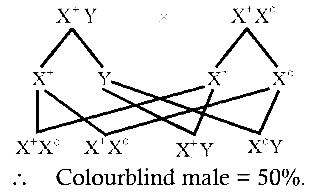
A man whose father was colour blind marries a women who had a colour blind mother and normal father. What percentage of male children of this couple will be colour blind?
(A)
50%
(B)
25%
(C)
0%
(D)
75%
(A)

Solution

Colour blindness is a X-chromosome linked character. NEET 2014 Biology - Principles of Inheritance and Variation Question 156 English Explanation
Q.4
Forelimbs of cat, lizard used in walking, forelimbs of whale used in swimming and forelimbs of bats used in flying are an example of:
(A)
Analogous organs
(B)
Homologous organs
(C)
Convergent evolution
(D)
Adaptive radiation
(B)

Solution

Organs which have a common fundamental anatomical plan and similar embryonic origin whatever varied functions they may perform are regarded as homologous organs. For examples the flippers of a whale, a bats wing, fore-limb of a horse, a bird’s wing and forelimbs of human are structurally as well as functionally different.
Q.5
In a population of 1000 individuals 360 belong to genotype AA, 480 to Aa and the remaining 160 to aa. Based on this data, the frequency of allele A in the population is :
(A)
0.4
(B)
0.5
(C)
0.6
(D)
0.7
(C)

Solution

According to Hardy Weinberg principle
p2 + 2pq + q2 = 1; (p + q)2 = 1
(AA) p2 = 360 out of 1000 individual
or p2 = 0.36
Therefore, p = 0.6.
Q.6
Which one of the following are analogous structures?
(A)
Flippers of Dolphin and Legs of Horse
(B)
Thorns of Bougainvillea and Tendrils of Cucurbita
(C)
Wings of Bat and Wings of Pigeon
(D)
Gills of Prawn and Lungs of Man
(C, D)

Solution

The organs which have similar functions but are different in their structural details and origin are called analogous organs. The wings of bat are analogous to wings of pigeon. It is due to the fact that the basic structure of the wings of the mammal is different from the wings of bird. However, their function is similar. Similarly, gills of prawn and lungs of man, both are respiratory organs yet they have very different basic structure.