NEET-UG 2015

NEET 2015

Biology (Maximum Marks: 32)
  • This section contains 8 questions.
  • Each question has FOUR options (A), (B), (C) and (D). ONLY ONE of these four options is the correct answer.
  • Full Marks : +4 If ONLY the correct option is chosen;
  • Zero Marks : 0 If none of the options is chosen (i.e. the question is unanswered);
  • Negative Marks : −1 In all other cases.
Q.1
A gene showing codominance has :
(A)
alleles tightly linked on the same chromosome
(B)
one allele dominant on the other
(C)
both alleles independently expressed in the heterozygote
(D)
alleles that are recessive to each other
(C)

Solution

In codominance both alleles are independently expressed in the heterozygote.
Q.2
A colour blind man marries a woman with normal sight who has no history of colour blindness in her family. What is the probability of their grandson being colour blind?
(A)
1
(B)
Nil
(C)
0.25
(D)
0.5
(C)

Solution

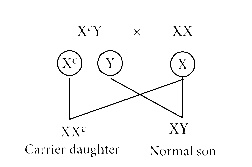
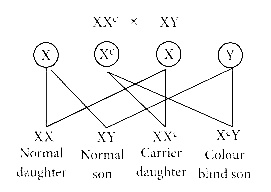
When a colour blind man (XcY) marries a normal woman (XX), all of their daughters are carriers and all of their sons are normal, as shown in following figure: NEET 2015 Biology - Principles of Inheritance and Variation Question 161 English Explanation 1 When the carrier daughter (XXc) is married to a normal man, the probability of their son being colour blind is 0.25, as shown in following figure: NEET 2015 Biology - Principles of Inheritance and Variation Question 161 English Explanation 2 From above crosses, it is clear that the probability of occurrence of colour blindness in the grandson of a colour blind man and a normal woman is 0.25.
Q.3
A pleiotropic gene -
(A)
is a gene evolved during Pliocene
(B)
is expressed only in primitive plants
(C)
Controls multiple traits in an individual
(D)
controls a trait only in combination with anther gene
(C)

Solution

A pleiotropic gene regulates multiple traits (characteristics) in an individual.
Q.4
In his classic experiments on pea plants, Mendel did not use :
(A)
Seed colour
(B)
Flower position
(C)
Seed shape
(D)
Pod length
(D)

Solution

Mendel did not use pod length for his experiment.
Q.5
The term "linkage" was coined by -
(A)
G. Mendel
(B)
T.H. Morgan
(C)
W. Sutton
(D)
T. Boveri
(B)

Solution

Linkage is the phenomenon of certain genes staying together during inheritance through generations without any change or separation due to their being present on the same chromosome. Linkage was first suggested by Sutton and Boveri (1902-1903) when they propounded the famous “chromosomal theory of inheritance.” Bateson and Punnett (1906) while working on sweet pea found that the factors for certain characters do not show independent assortment. However, it was Morgan (1910) who clearly proved and defined linkage on the basis of his breeding experiments in fruit fly (Drosophila melanogaster).
Q.6
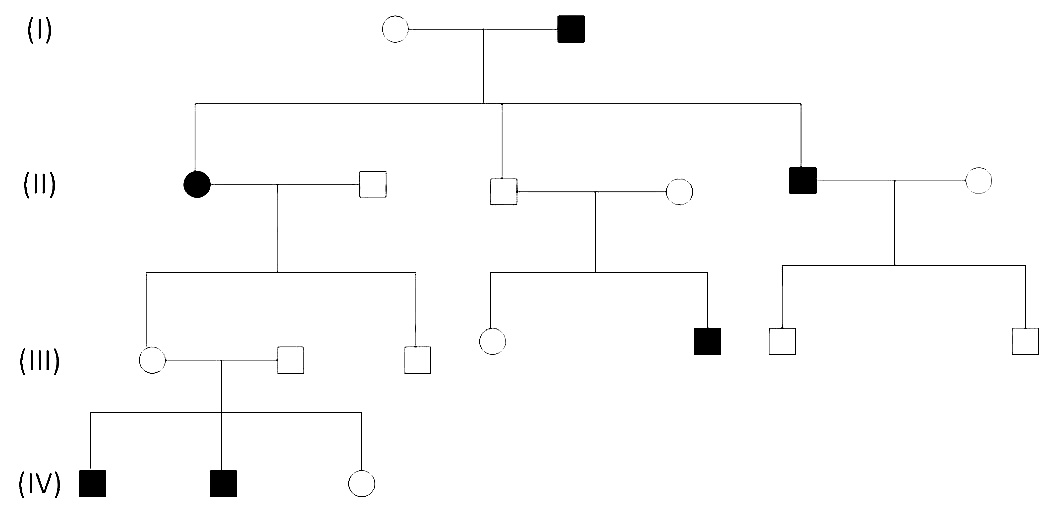
In the following human pedigree, the filled symbols represent the affected individuals. Identify the type of given pedigree. NEET 2015 Biology - Principles of Inheritance and Variation Question 159 English
(A)
X-linked dominant
(B)
Autosomal dominant
(C)
Autosomal recessive
(D)
X-linked recessive
(C)

Solution

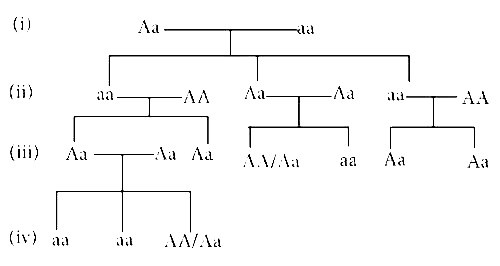
Autosomal recessive traits are the traits which are caused by recessive autosomal genes when present in homozygous condition. The given pedigree can be explained as: NEET 2015 Biology - Principles of Inheritance and Variation Question 159 English Explanation As the trait appears only in homozygous recessive individuals (aa), therefore it is an autosomal recessive trait.
Q.7
The wings of a bird and the wings of an insect are :
(A)
homologous structures and represent divergent evolution
(B)
phylogenetic structures and represent divergent evolution
(C)
homologous structures and represent convergent evolution
(D)
analogous structures and represent convergent evolution
(D)

Solution

Analogous organs are the organs which have similar function but are different in their structural details and origin. The analogous structures are the result of convergent evolution. The wings of an insect are analogous to wings of a bird because the basic structure of the wings of the insects is different from the wings of bird. However, their function is similar.
Q.8
Industrial melanism is an example of -
(A)
Mutation
(B)
Natural selection
(C)
Neo Darwinism
(D)
Neo Lamarckism
(B)

Solution

Natural selection is the most widely accepted theory concerning the principal causal mechanism of evolutionary change profounded by Charles Darwin and Alfred Russel Wallace. It results from the differential reproduction (some members of a population produce abundant offspring, some only a few and still others none), one phenotype as compared with other phenotypes in the same population. This determines the relative share of different genotypes which individuals possess and propagate in a population. Industrial melanism supports evolution by natural selection. It is an adaptation where the moths living in the industrial areas developed melanin pigments to match their bodies to the tree trunks.