NEET-UG 2016

NEET 2016 Phase 1

Physics (Maximum Marks: 180)
  • This section contains 45 questions.
  • Each question has FOUR options (A), (B), (C) and (D). ONLY ONE of these four options is the correct answer.
  • Full Marks : +4 If ONLY the correct option is chosen;
  • Zero Marks : 0 If none of the options is chosen (i.e. the question is unanswered);
  • Negative Marks : −1 In all other cases.
Q.1
If the velocity of a particle is v = At + Bt2, where A and B are constants, then the distance travelled by it between 1 s and 2 s is
(A)
(B)
(C)
(D)
(A)

Solution

Given, v = At + Bt2

= At + Bt2


x =

At t = 1, particle is at

x(t = 1) =

At t = 2, particle is at

x(t = 2) =

distance travelled by the particle between 1 s and 2 s is,

= x(t = 2) - x(t = 1)

= () - ()

=
Q.2
If the magnitude of sum of two vectors is equal to the magnitude of difference of the two vectors, the angle between these vectors is
(A)
45o
(B)
180o
(C)
0o
(D)
90o
(D)

Solution

Let the two vectors are and

Given that,

=

= 0

0

= 0

= 90o
Q.3
A particle moves so that its position vector is given by where is a constant.

Which of the following is true?
(A)
Velocity is perpendicular to and acceleration is directed towards the origin.
(B)
Velocity is perpendicular to and acceleration is directed away from the origin.
(C)
Velocity and acceleration both are perpendicular to
(D)
Velocity and acceleration both are parallel to
(A)

Solution


and =

= 0


As position vector is directly away from the origin, so, acceleration () is directed towards the origin.
Q.4
A car is negotiating a curved road of radius R. The road is banked at an angle . The coefficient of friction between the tyres of the car and the road is s. The maximum safe velocity on this road is
(A)
(B)
(C)
(D)
(D)

Solution

On a banked road,


Maximum safe velocity of a car on the banked road
Q.5
What is the minimum velocity with which a body of mass m must enter a vertical loop of radius R so that it can complete the loop?
(A)
(B)
(C)
(D)
(B)

Solution

To complete the loop a body must enter a vertical loop of radius R with the minimum velocity v = .
Q.6
A particle of mass 10 g moves along a circle of radius 6.4 cm with a constant tangential acceleration. What is the magnitude of this acceleration if the kinetic enegy of the particle becomes equal to 8 104 J by the end of the second revoluation after the beginning of the motion ?
(A)
0.18 m/s2
(B)
0.2 m/s2
(C)
0.1 m/s2
(D)
0.15 m/s2
(C)

Solution

Given: Mass of particle, M = 10g

radius of circle R = 6.4 cm
Kinetic energy E of particle = 8 × 10⁻⁴J
acceleration at = ?


Now, using
v2 = u2 + 2ats (s = 4R)


Q.7
A body of mass 1 kg begins to move under the action of a time dependent force where and are unit vectors along x and y axis. What power will be developed by the force at the time t ?
(A)
(2t3 + 3t4) W
(B)
(2t3 + 3t5) W
(C)
(2t2 + 3t3) W
(D)
(2t2 + 4t4) W
(B)

Solution

Given force

According to Newton's second law of motion,


Power (P) =

= (2t3 + 3t5)W
Q.8
From a disc of radius R and mass M, a circular hole of diameter R, whose rim passes through the centre is cut. What is the moment of inertia of the remaining part of the disc about a perpendicular axis, passing through the centre?
(A)
11 MR2/32
(B)
9 MR2/32
(C)
15 MR2/32
(D)
13 MR2/32
(D)

Solution

Moment of inertia of complete disc about point 'O'.


Mass of removed disc


Moment of inertia of removed disc about point 'O'.

IRemoved (about same perpendicular axis)


Therefore the moment of inertia of the remaining part of the disc about a perpendicular axis passing through the centre,

IRemaing disc = ITotal – IRemoved

Q.9
A disc and a sphere of same radius but different masses roll off on two inclined planes of the same altitude and length. Which one of the two objects gets to the bottom of the plane first?
(A)
Both reach at the same time
(B)
Depends on their masses
(C)
Disc
(D)
Sphere
(D)

Solution

Time taken by the body to reach the bottom when it rolls down on an inclined plane without slipping is given by


Since g is constant and , R and sin are same for both


Q.10
A uniform circular disc of radius 50 cm at rest is free to turn about an axis which is perpendicular to its plane and passes through its centre. It is subjected to a torque which produces a constant angular acceleration of 2.0 rad s2. Its net acceleration in m s2 at the end of 2.0 s is approximately
(A)
6.0
(B)
3.0
(C)
8.0
(D)
7.0
(C)

Solution

Given, r = 50 cm = 0.5 m, = 2.0 rad s–2 , = 0

At the end of 2 s,
Tangential acceleration, at
= r = 0.5 × 2 = 1 m s–2

Radial acceleration, =

= (0 + 2 × 2)2 × 0.5 = 8 m s–2

Net acceleration,
Q.11
The ratio of escape velocity at earth (ve) to the escape velocity at a planet (vp) whose radius and mean density are twice as that of earth is
(A)
1 : 4
(B)
1 :
(C)
1 : 2
(D)
1 : 2
(D)

Solution

As we know, escape velocity,


Ration
Q.12
At what height from the surface of earth the gravitation potential and the value of g are 5.4 107 J kg1 and 6.0 m s2 respectively? Take the radius of earth as 6400 km.
(A)
1400 km
(B)
2000 km
(C)
2600 km
(D)
1600 km
(C)

Solution

As we know, gravitational potential (v) and acceleration due to gravity (g) with height

   ...(i)

and    ...(ii)

Dividing (i) by (ii)


R + h = 9000 km so, h = 2600 km
Q.13
Coefficient of linear expansion of brass and steel rods are 1 and 2. Lengths of brass and steel rods are 1 and 2 respectively. If (1 2) is maintained same at all temperatures, which one of the following relations holds good?
(A)
12 = 2 21
(B)
11 = 2l2
(C)
12 = 21
(D)
122 = 212
(B)

Solution

From question, is maintained same at all temperatures hence change in length for both rods should be same

i.e.,

As we know, coefficient of linear expansion,


Q.14
Two non-mixing liquids of densities and n (n > 1) are put in a container. The height of each liquid is h. A solid cylinder of length L and density d is put in this container. The cylinder floats with its axis vertical and length L ( < 1) in the denser liquid. The density d is equal to
(A)
(B)
(C)
(D)
(B)

Solution

According to Archimedes principle,

Weight of the cylinder = (upthrust)1 + (upthrust)2

i.e.,


Q.15
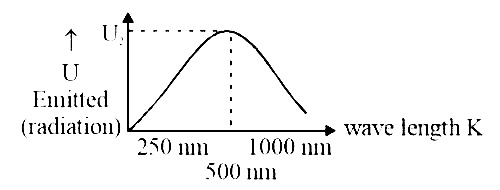
A black body is at a temperature of 5760 K. The energy of radiation emitted by the body at wavelength 250 nm is U1, at wavelength 500 nm is U2 and that at 1000 nm is U3. Wien's constant, b = 2.88 106 nm K. Which of the following is correct ?
(A)
U1 > U2
(B)
U2 > U1
(C)
U1 = 0
(D)
U3 = 0
(B)

Solution

According to wein's displacement law, maximum amount of emitted radiation corresponding to


NEET 2016 Phase 1 Physics - Properties of Matter Question 75 English Explanation

From the graph U1 < U2 > U3
Q.16
A piece of ice falls from a height h so that it melts completely. Only one-quarter of the heat produced is absorbed by the ice and all energy of ice gets converted into heat during its fall. The value of h [Latent heat of ice is J/kg and g = 10 N/Kg]
(A)
136 km
(B)
68 km
(C)
34 km
(D)
544 km
(A)

Solution

Energy gained by the ice during its fall E = mgh

As,


Q.17
A refrigerator works between 4oC and 30oC. It is required to remove 600 calories of heat every second in order to keep the temperature of the refrigerated space constant. The power required is (Take 1 cal = 4.2 Joules)
(A)
236.5 W
(B)
2365 W
(C)
2.365 W
(D)
23.65 W
(A)

Solution

Now


= (600 × 4.2) × 26/277 = 236.53 W
Q.18
The molecules of a given mass of a gas have r.m.s. velocity of 2000 m s1 at 27oC and 1.0 105 N m2 pressure. When the temperature and pressure of the gas are respectively, 127oC and 0.05 105 N m2, the r.m.s. velocity of its molecules in m s1 is
(A)
(B)
(C)
(D)
(D)

Solution

It is observed that the rms velocity of molecule is directly proportional to temperature, so


Hence,
Q.19
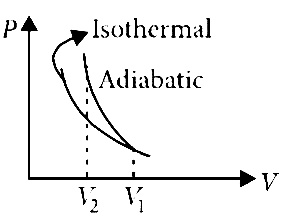
A gas is compressed isothermally to half its initial volume. The same gas is compressed separately through an adiabatic process until its volume is again reduced to half. Then
(A)
Compressing the gas isothermally or adiabatically will require the same amount of work.
(B)
Which of the case (whether compression through isothermal or through adiabatic process) requires more work will depend upon the atomicity of the gas.
(C)
Compressing the gas isothermally will require more work to be done.
(D)
Compressing the gas through adiabatic process will require more work to be done.
(D)

Solution

NEET 2016 Phase 1 Physics - Heat and Thermodynamics Question 84 English Explanation
V1 = V, V2 = V/2

On P-V diagram, Area under adiabatic curve > Area under isothermal curve.

So compressing the gas through adiabatic process will require more work to be done.
Q.20
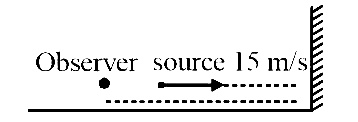
A siren emitting a sound of frequency 800 Hz moves away from an observer towards a cliff at a speed of 15 m s1. Then, the frequency of sound that the observer hears in the echo reflected from the cliff is

(Take velocity of sound in air = 330 m s1)
(A)
838 Hz
(B)
885 Hz
(C)
765 Hz
(D)
800 Hz
(A)

Solution

According to Doppler's effect in sound

NEET 2016 Phase 1 Physics - Waves Question 58 English Explanation

Apparent frequency,


The frequency of sound observer hears in the echo reflected from the cliff is 838 Hz.
Q.21
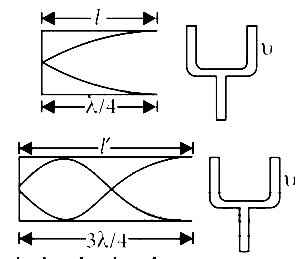
An air column, closed at one end open at the other, resonates with a tuning fork when the smallest length of the column is 50 cm. The next larger length of the column resonating with the same tuning fork is
(A)
150 cm
(B)
200 cm
(C)
66.7 cm
(D)
100 cm
(A)

Solution

From figure,

NEET 2016 Phase 1 Physics - Waves Question 57 English Explanation

First harmonic is obtained at


Third harmonic is obtained for resonance,

Q.22
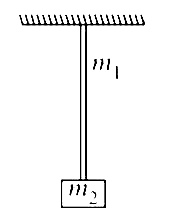
A uniform rope of length L and mass m1 hangs vertically from a rigid support. A block of mass m2 is attached to the free end of the rope. A transverse pulse of wavelength 1 is produced at the lower end of the rope. The wavelength of the pulse when it reaches the top of the rope is 2. The ratio 2/1 is
(A)
(B)
(C)
(D)
(D)

Solution

NEET 2016 Phase 1 Physics - Waves Question 56 English Explanation
Wavelength of pulse at the lower end


Similarly,


Q.23
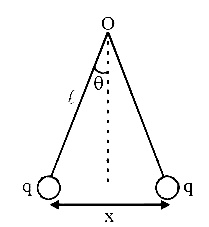
Two identical charged spheres suspended from a common point by two massless strings of lengths , are initially at a distance d(d < < ) apart because of their mutual repulsion. The charges begin to leak from both the spheres at a constant rate. As a result, the spheres approach each other with a velocity v. Then v varies as a function of the distance x between the spheres, as
(A)
v x1/2
(B)
v x1
(C)
v x1/2
(D)
v x
(A)

Solution

NEET 2016 Phase 1 Physics - Electrostatics Question 72 English Explanation
From figure


   ...(i)


Differentiating eq. (1) w.r.t. time

but is constant

so x2(v) q Replace q from eq. (2)

x2(v) x3/2 v x–1/2
Q.24
The charge flowing through a resistance R varies with time t is Q = at bt2, where and are positive constants. The total heat produced in R is
(A)
(B)
(C)
(D)
(C)

Solution

Given: Charge Q = at – bt2

Current


From joule's law of heating, heat produced
dH = i2Rdt


Q.25
A potentiometer wire is 100 cm long and a constant potential difference is maintained across it. Two cells are connected in series first to support one another and then in opposite direction. The balance points are obtained at 50 cm and 10 cm from the positive end of the wire in the two cases. The ratio of emf's is
(A)
3 : 4
(B)
3 : 2
(C)
5 : 1
(D)
5 : 4
(B)

Solution

When two cells are connected in series i.e., E1 + E2 the balance point is at 50 cm. And when two cells are connected in opposite direction i.e., E1 – E2 the balance point is at 10 cm. According to principle of potential


Q.26
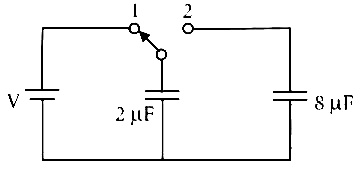
A capacitor of 2 F is charged as shown in the diagram. When the switch S is turned to position 2, the percentage of its stored energy dissipated is
NEET 2016 Phase 1 Physics - Capacitor Question 37 English
(A)
75%
(B)
80%
(C)
0%
(D)
20%
(B)

Solution

Initially, the energy stored in 2 F capacitor is


Initially, the charge stored in 2 F capacitor is
Qi = CV = (2 × 10⁻⁶)V = 2V × 10–6 coulomb. When switch S is turned to position 2, the charge flows and both the capacitors share charges till a common potential VC is reached.


Finally, the energy stored in both the capacitors


% loss of energy,

Q.27
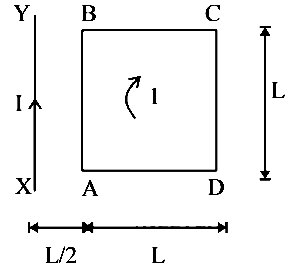
A square loop ABCD carrying a current , is placed near and coplanar with a long straight conductor XY carrying a current , the net force on the loop will be NEET 2016 Phase 1 Physics - Moving Charges and Magnetism Question 76 English
(A)
(B)
(C)
(D)
(C)

Solution

Force on arm AB due to current in conductor XY is


acting towards XY in the plane of loop.

Force on arm CD due to current in conductor XY is


acting away from XY in the plane of loop.

Net force on the loop = F1 – F2

Q.28
A long straight wire of radius carries a steady current . The current is uniformly distributed over its cross-section. The ratio of the magnetic fields B and B', at radial distance and 2 respectively, from the axis of the wire is
(A)
1
(B)
4
(C)
(D)
(A)

Solution

For points inside the wire i.e., (r R)

Magnetic field

For points outside the wire (r R)

Magnetic field,

Q.29
The magnetic susceptibility is negative for
(A)
ferromagnetic material only
(B)
paramagnetic and ferromagnetic materials
(C)
diamagnetic material only
(D)
paramagnetic material only
(C)

Solution

Magnetic susceptibility is negative for diamagnetic material only.
Q.30
A long solenoid has 1000 turns. When a current of 4 A flows through it, the magnetic flux linked with each turn of the solenoid is 4 Wb. The self-inductance of the solenoid is
(A)
2 H
(B)
1 H
(C)
4 H
(D)
3 H
(B)

Solution

Total flux linked with the solenoid, = N0

= 1000 4 10-3 Wb = 4 Wb

Self-inductance of solenoid

L = = 1 H
Q.31
An inductor 20 mH, a capacitor 50 and a resistor 40 are connected in series across a source of emf V = 10 sin 340t. The power loss in A.C. circuit is
(A)
0.76 W
(B)
0.89 W
(C)
0.51 W
(D)
0.67 W
(C)

Solution

XL = L = 340 20 10-3 = 6.8

XC = = 58.82

Average power in impedance

Z =

= = 65.62

Power loss in A.C. circuit,

= Vrms Irms cos

= V0 I0 cos

=

= 0.46 W
Q.32
A small signal voltage V(t) = V0 sint is applied across an ideal capacitor C
(A)
Current is in phase with voltage .
(B)
Current leads voltage V(t) by 180o
(C)
Current , legs voltage by 90o.
(D)
Over a full cycle the capacitor C foes not consume any energy from the voltage source.
(D)

Solution

In ideal capacitor, I leads from voltage by 90o and capacitor does not consume energy.
Q.33
Out of the following options which one can be used to produce a propagating electromagnetic wave ?
(A)
A chargeless particle
(B)
An accelerating charge
(C)
A charge moving at constant velocity
(D)
A stationary charge
(B)

Solution

For producing electromagnetic waves, accelerating charged particle is required.
Q.34
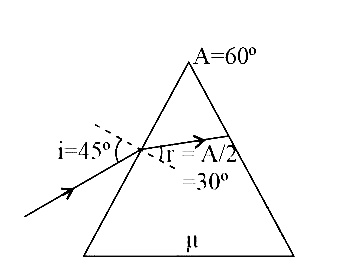
The angle of incidence for a ray of light at a refracting surface of a prism is 45o. The angle of prism is 60o. If the ray suffers minimum deviation through the prism, the angle of minimum deviation and refractive index of the material of the prism respectively, are
(A)
(B)
(C)
(D)
(D)

Solution

NEET 2016 Phase 1 Physics - Geometrical Optics Question 76 English Explanation

i =

45o =


sin45º = sin30º


=
Q.35
Match the corresponding entries of column 1 with column 2. [Where m is the magnification produced by the mirror]

Column 1 Column 2
(A) m = - 2 (p) Convex mirror
(B) m = - (q) Concave mirror
(C) m = +2 (r) Real image
(D) m = + (s) Virtual image
(A)
A    p   and   s;   B q and r;   C q and s;   D q and r
(B)
A    r   and   s;   B q and s;   C q and r;   D p and s
(C)
A    q  and  r;   B q and r;   C q and s;   D p and s
(D)
A    p   and   r;   B p and s;   C p and q;   D r and s
(C)

Solution

Magnification in the mirror, m =

m = –2 v = 2u

As v and u have same signs so the mirror is concave and image formed is real.

v =

Concave mirror and real image.

m = + 2 v = –2u


As v and u have different signs but magnification is 2 so the mirror is concave and image formed is virtual.

v =

As v and u have different signs with magnification so the mirror is convex and image formed is virtual.
Q.36
A astronomical telescope has objective and eyepiece of focal lengths 40 cm and 4 cm respectively. To view an object 200 cm away from the objective, the lenses must be separated by a distance
(A)
50.0 cm
(B)
54.0 cm
(C)
37.3 cm
(D)
46.0 cm
(B)

Solution

Given: Focal length of objective, f0 = 40cm

Focal length of eye–piece fe = 4 cm

image distance, u0 = 200 cm

Using lens formula for objective lens


=

v0 = 50 cm

Tube length() = Distance between lenses = vo + fe = 50 + 4 = 54 cm
Q.37
In a diffraction pattern due to a single slit of width , the first minimum is observed at an angle 30o when light of wavelength 5000 is incident on the slit. The first secondary maximum is observed at an angle of
(A)
sin1
(B)
(C)
(D)
(B)

Solution

For the first minima, the path difference between extreme waves

sin =

=

= 2

For first secondary maximum, the path difference between extreme waves

=

=
Q.38
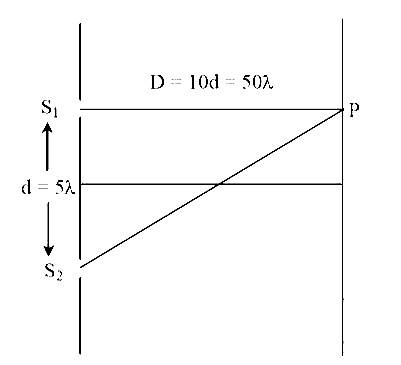
The intensity at the maximum in a Young's double slit experiment is 0. Distance between two slits is d = 5, where is the wavelength of light used in the expreriment. What will be the intensity in front of one of the slits on the screen placed at a distance D = 10d ?
(A)
(B)
(C)
I0
(D)
(B)

Solution

NEET 2016 Phase 1 Physics - Wave Optics Question 34 English Explanation

Path difference S2P – S1P = - 50 = 0.25

S2P – S1P =

Phase difference,

= =

So, resultant intensity at the desired point 'P' is

I = I0cos2 = I0cos2 =
Q.39
When an -particle of mass m moving with velocity v bombards on a heavy nucleus of charge Ze, its distance of closest approach from the nucleus depends on m as
(A)
(B)
m
(C)
(D)
(C)

Solution

At closest distance of approach, the kinetic energy of the particle will convert completely into electrostatic potential energy.

Kinetic energy =

Potential energy =

=

r
Q.40
Given the value of Rydberg constant is 107 m1, the wave number of the last line of the Balmer series in hydrogen spectrum will be
(A)
0.25 107 m1
(B)
2.5 107 m1
(C)
0.025 104 m1
(D)
0.5 107 m1
(A)

Solution

The wave number of the last line of the Balmer series in hydrogen spectrum is given by


= = = 0.25 107 m1
Q.41
An electron of mass m and a photon have same energy E. The ratio of de-Broglie wavelengths associated with them is
(A)
(B)
(C)
(D)
(C)

Solution

For electron De-Broglie wavelength,

e =

For photon of energy, E = h =

p =

= =
Q.42
When a metallic surface is illuminated with radiation of wavelength , the stopping potential is V. If the same surface is illuminated with radiation of wavelength 2 , the stopping potential is . The threshold wavelength for the metallic surface is
(A)
(B)
3
(C)
4
(D)
5
(B)

Solution

According to Einstein's photoelectric effect,

eV = - .......(1)

e = - .......(2)

Dividing equation (i) by (ii) by,

4 =

0 = 3
Q.43
Consider the junction diode as ideal. The value of current flowing through AB is

NEET 2016 Phase 1 Physics - Semiconductor Electronics Question 110 English
(A)
101 A
(B)
103 A
(C)
0 A
(D)
102 A
(D)

Solution

Here, the p-n junction diode is forward biased, hence it offers zero resistance.

So IAB = = 10-2 A
Q.44
A npn transistor is connected in common emitter configuration in a given amplifier. A load resistance of 800 is connected in the collector circuit and the voltage frop across it is 0.8 V. If the current amplification factor is 0.96 and the input resistance of the circuit is 192 , the voltage gain and the power gain of the amplifier will respectively be
(A)
4, 4
(B)
4, 3.69
(C)
4, 3.84
(D)
3.69, 3.84
(C)

Solution

Voltage gain = Current gain × Resistance gain

= 0.96 = 4

Power gain = [Current gain] × [Voltage gain]

= 0.96 × 4 = 3.84
Q.45
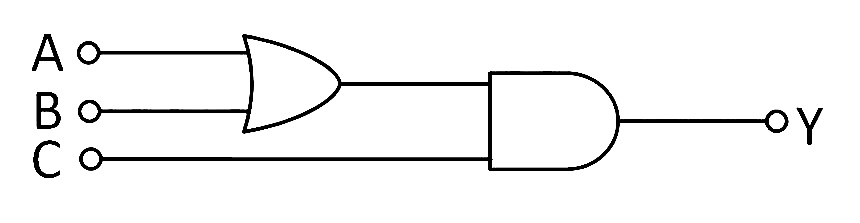
To get output 1 for the following circuit, the correct choice for the input is

NEET 2016 Phase 1 Physics - Semiconductor Electronics Question 112 English
(A)
A = 1, B = 1, C = 0
(B)
A = 1, B = 0, C = 1
(C)
A = 0, B = 1, C = 0
(D)
A = 1, B = 0, C = 0
(B)

Solution

Output of the circuit, Y = (A + B)·C

Y = 1 if C = 1 and A = 0, B = 1

or A = 1, B = 0 or A = B = 1
Chemistry (Maximum Marks: 180)
  • This section contains 45 questions.
  • Each question has FOUR options (A), (B), (C) and (D). ONLY ONE of these four options is the correct answer.
  • Full Marks : +4 If ONLY the correct option is chosen;
  • Zero Marks : 0 If none of the options is chosen (i.e. the question is unanswered);
  • Negative Marks : −1 In all other cases.
Q.1
Two electrons occupying the same orbital are distinguished by
(A)
azimuthal quantum number
(B)
spin quantum number
(C)
principal quantum number
(D)
magnetic quantum number
(B)

Solution

For any two electrons occupying the same orbital values of n, l and ml are same but ms is different [ + and - ]
Q.2
Equal moles of hydrogen and oxygen gases are placed in a container with a pin-hole through which both can escape. What fraction of the oxygen escapes in the time required for onehalf of the hydrogen to escape?
(A)
3/8
(B)
1/2
(C)
1/8
(D)
1/4
(C)

Solution

Let the number of moles of each gas = x

Fraction of hydrogen escaped =


Then, fraction of oxygen escaped =
Q.3
Consider the following liquid-vapour equilibrium.
Liquid Vapour
Which of the following relations is correct ?
(A)
(B)
(C)
(D)
(B)

Solution

This is Clausius-Clapeyron equation.

Q.4
MY and NY3, two nearly insoluble salts, have the same Ksp values of 6.2 1013 at room temperature. Which statement would be true in regard to MY and NY3?
(A)
The salts MY and NY3 are more soluble in 0.5 M KY than in pure water.
(B)
The addition of the salt of KY to solution of MY and NY3 will have no effect on their solubilities.
(C)
The molar solubilities of MY and NY3 in water are identical.
(D)
The molar solubility of MY in water is less than that of NY3.
(D)

Solution

MY ⇌ M+ + Y
   s        s       s

Ksp = s.s = s2

s =

= 7.87 × 10⁻⁷ mol L–1

NY3 ⇌ N+ + 3Y
   s        s       3s

Ksp = s.(3s)3 = 27s4

6.2 × 10–13 = 27s4

s = 3.89 × 10⁻⁴ mol L–1

Hence, molar solubility of MY in water is less than that of NY3.
Q.5
At 100oC the vapour pressure of a solution of 6.5 g of a solute in 100 g water is 732 mm. If Kb = 0.52, the boiling point of this solution will be
(A)
102oC
(B)
103oC
(C)
101oC
(D)
100oC
(C)

Solution

Given that

ws = 6.5 g, wA = 100 g

ps = 732 mm of Hg

kb = 0.52, Tob = 100oC

po = 760 mm of Hg


n2 = 0.2046 mol

Tb = Kb × m

Tb - Tob =

Tb - 100oC = = 1.06

Tb = 101.06 oC
Q.6
Which of the following statements about the composition of the vapour over an ideal 1 : 1 molar mixture of benzene and toluene is correct? Assume that the temperature is constant at 25oC. (Given, vapour pressure data at 25oC, benzene = 12.8 kPa, toluene = 3.85 kPa)
(A)
The vapour eill contain equal amounts of benzene and toluene.
(B)
Not enough information is given to make a prediction.
(C)
The vapour will contain a higher percentage of benzene.
(D)
The vapour will contain a higher percentage of toluene
(C)

Solution

pBenzene = xBenzene. poBenzene

pToluene = xToluene. poToluene

For an ideal 1 : 1 molar mixture of benzene and toluene

xBenzene = and xToluene =

pBenzene = poBenzene = = 6.4 kPa

pToluene = poToluene = = 1.925 kPa

Thus, the vapour will contain a high percentage of benzene as the partial vapour pressure of benzene is higher as compared to that of toluene.
Q.7
The correct thermodynamic conditions for the spontaneous reaction at all temperatures is
(A)
H < 0 and S > 0
(B)
H < 0 and S < 0
(C)
H < 0 and S = 0
(D)
H > 0 and S < 0
(A, C)

Solution


If H < 0 and S > 0
   

then at all temperatures, = -ve, spontaneous reaction.

If H < 0 and S = 0
   

then at all temperatures, = -ve at all temperatures.
Q.8
The pressure of H2 required to make the potential of H2-electrode zero in pure water at 298 K is
(A)
1010 atm
(B)
104 atm
(C)
1014 atm
(D)
1012 atm
(C)

Solution

2H+ (aq) + 2e H2(g)

Ecell = Eocell -

0 = 0 -


PH2 = 10–14 atm
Q.9
The rate of first-order reaction is 0.04 mol L1 s1 at 10 seconds and 0.03 mol L1 s1 at 20 seconds after initiation of the reaction. The half-life period of the reaction is
(A)
44.1 s
(B)
54.1 s
(C)
24.1 s
(D)
34.1 s
(C)

Solution

For the first order reaction

A Product

Rate [A]

k =

=

= 0.0287 sec-1

= 24.14 sec
Q.10
The addition of a catalyst during a chemical reaction alters which of the following quantities?
(A)
Enthalpy
(B)
Activation energy
(C)
Entropy
(D)
Internal energy
(B)

Solution

A catalyst provides an alternate path to the reaction which has lower activation energy.
Q.11
The ionic radii of A+ and B ions are 0.98 1010 m and 1.81 1010 m. The coordination number of each ion in AB is
(A)
8
(B)
2
(C)
6
(D)
4
(C)

Solution

From radius ratio, = 0.541

It lies in the range of 0.414 to 0.732 hence coordination number of each ion will be 6 as the compound will have NaCl type structure i.e., octahedral arrangement.
Q.12
Lithium has a bcc structure. Its density is 530 kg m3 and its atomic mass is 6.94 g mol. Calculate the edge length of a unit cell of lithium metal. (NA = 6.02 1023 mol1)
(A)
527 pm
(B)
264 pm
(C)
154 pm
(D)
352 pm
(D)

Solution

For bcc structure we have, Z = 2

Given, = 530 kg m–3

atomic mass of Li = 6.94 mol–1

NA= 6.02 × 10²³ mol–1

= 530 kg m–3 = 0.53 g cm–3

Also, =


=

= 43.5 10-10 cm3

= 352 × 10–10 cm = 352 pm
Q.13
Fog is a colloidal solution of
(A)
solid in gas
(B)
gas in gas
(C)
liquid in gas
(D)
gas in liquid.
(C)

Solution

Fog is a colloidal system having dispersed phase as liquid and dispersion medium as gas.
Q.14
Which one of the following characteristics is associated with adsorption?
(A)
G and H are negative but S is positive.
(B)
G and S are negative but H is positive.
(C)
G is negative but H and S are positive.
(D)
G, H and S all are negative.
(D)

Solution

Adsorption is spontaneous process, therefore change in the free energy ( G) for the process is negative.

As we know that

G = H – TS

S is negative because adhering of gas molecules to the surface lowers the randomness.

G can be –ve only when H is –ve.
Q.15
In which of the following options the order of arrangement does not agree with the variation of property indicated against it ?
(A)
I < Br < Cl < F (increasing electron gain enthalpy)
(B)
Li < Na < K < Rb (increasing metallic radius)
(C)
Al3+ < Mg2+ < Na+ < F (increasing ionic size)
(D)
B < C < N < O (increasing first ionisation enthalpy)
(A, D)

Solution

The correct order of increasing negative electron gain enthalpy is : I < Br < F < Cl and the correct order of increasing first ionisation enthalpy is B < C < O < N.
Q.16
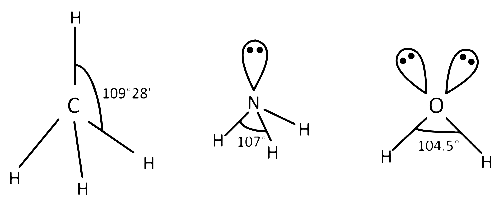
Consider the molecules CH4, NH3 and H2O.

Which of the given statements is false?
(A)
The H O H bond angle in H2O is smaller than the H N H bond angle in NH3.
(B)
The H C H bond angle in CH4 is larger than the H N H bond angle in NH3.
(C)
The H C H bond angle in CH4, the H N H bond angle in NH3, and the H O H bond angle in H2O are all greater than 90o.
(D)
The H O H bond angle in H2O is larger than the H C H bond angle in CH4.
(D)

Solution

NEET 2016 Phase 1 Chemistry - Chemical Bonding and Molecular Structure Question 112 English Explanation

In CH4, there is no lone pair of electrons so it is perfectly tetrahedral in shape and has H-C-H bond angle of 109°28′ but in NH3 there is one lone pair which due to more repulsion with bond pairs of electrons pushes them more closer thus bond angle decreases to 107°. In H2O, there are two lone pair of electrons which suppress the bond angle more to 104.5°.
Q.17
Predict the correct order among the following :
(A)
bond pair - bond pair > long pair - bond pair > lone pair - lone pair
(B)
lone pair - bond pair > bond pair - bond pair > lone pair - lone pair
(C)
lone pair - lone pair > lone pair - bond pair > bond pair - bond pair
(D)
lone pair - lone pair > bond pair - bond pair > lone pair - bond pair
(C)

Solution

According to VSEPR theory, the repulsive forces between lone pair and lone pair are grater than between lone pair and bond pair which are further greater than bond pair and bond pair.
Q.18
Match items of Column I with the items of Column II and assign the correct code :
Column Column
(A) Cyanide process (i) Ultrapure Ge
(B) Froth floatation process (ii) Dressing of ZnS
(C) Electrolytic reduction (iii) Extraction of Al
(D) Zone refining (iv) Extraction of Au
(v) Purification of Ni
(A)
(A) (i);  (B) (ii);  (C) (iii);  (D) (iv)
(B)
(A) (iii);  (B) (iv);  (C) (v);  (D) (i)
(C)
(A) (iv);  (B) (ii);  (C) (iii);  (D) (i)
(D)
(A) (ii);  (B) (iii);  (C) (i);  (D) (v)
(C)

Solution

Cyanide process is used for the extraction of gold.

Froth floatation method is used for dressing of ZnS.

Aluminium is extracted by electrolytic reduction.

Zone refining is used for getting extra pure element like Ge.
Q.19
The product obtained as a result of a reaction of nitrogen with CaC2 is
(A)
CaCN2
(B)
Ca2CN
(C)
Ca(CN)2
(D)
CaCN
(A)

Solution

CaC2 + N2 CaCN2 + C
Q.20
Which of the following statments is false?
(A)
Ca2+ ions are not important in maintaining the regular beating of the heart.
(B)
Mg2+ ions are important in the green parts of the plants.
(C)
Mg2+ ions form a complex with ATP.
(D)
Ca2+ ions are important in blood clotting.
(A)

Solution

Ca2+ ions are required to trigger the contraction of muscles and to maintain the regular beating of the heart.
Q.21
Which of the following statements about hydrogen is incorrect?
(A)
Hydronium ion, H3O+ exists freely in solution.
(B)
Dihydrogen does not act as a reducing agent.
(C)
Hydrogen has three isotopes of which tritium is the most common.
(D)
Hydrogen never acts as cation in ionic salts.
(B, C)

Solution

Dihydrogen acts as a powerful reducing agent and reduces metal oxides such as CuO, ZnO, PbO and Fe3O4 to their respective metals.

CuO + H2 Cu + H2O

ZnO + H2 Zn + H2O

Fe3O4 + 4H2 3Fe + 4H2O

Hydrogen has three isotopes of which protium is the most common and tritium is radioactive.
Q.22
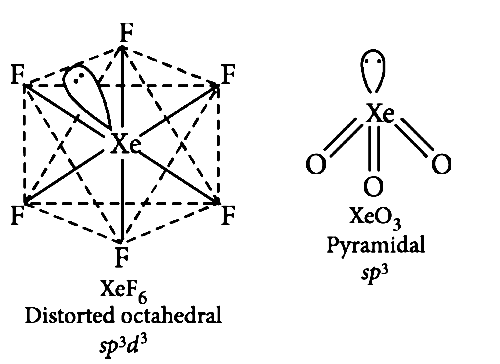
Match the compounds given in column I with the hybridisation and shape given in column II and mark the correct option

Column Column
(A) XeF6 (i) distorted octahedral
(B) XeO3 (ii) square planar
(C) XeOF4 (iii) pyramidal
(D) XeF4 (iv) square pyramidal
(A)
(A) (iv);  (B) (iii);  (C) (i);  (D) (ii)
(B)
(A) (iv);  (B) (i);  (C) (ii);  (D) (iii)
(C)
(A) (i);  (B) (iii);  (C) (iv);  (D) (ii)
(D)
(A) (i);  (B) (ii);  (C) (iv);  (D) (iii)
(C)

Solution

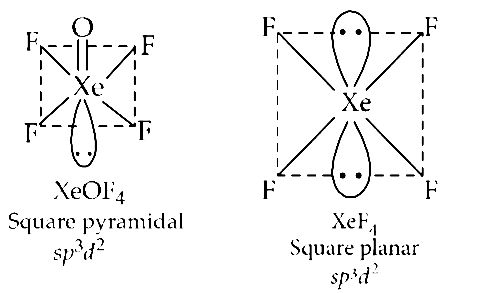
NEET 2016 Phase 1 Chemistry - p-Block Elements Question 67 English Explanation 1 NEET 2016 Phase 1 Chemistry - p-Block Elements Question 67 English Explanation 2
Q.23
Among the following the correct order of acidity is
(A)
HClO2 < HClO < HClO3 < HClO4
(B)
HClO4 < HClO2 < HClO < HClO3
(C)
HClO3 < HClO4 < HClO2 < HClO
(D)
HClO < HClO2 < HClO3 < HClO4
(D)

Solution

The acidic character of the oxoacids increases with increase in oxidation number of the halogen atom i.e.,

HClO < HClO2 < HClO3 < HClO4

Since the stability of the anion decreases in the order.

ClO4- > ClO3- > ClO2- > ClO

Acid strength also decreases in the same order.
Q.24
Which one of the following orders is correct for the bond dissociation enthalpy of halogen molecules?
(A)
Br2 > I2 > F2 > Cl2
(B)
F2 > Cl2 > Br2 > I2
(C)
I2 > Br2 > Cl2 > F2
(D)
Cl2 > Br2 > F2 > I2
(D)

Solution

Bond dissociation enthalpy decreases as the bond distance increases from F2 to I2. This is due to increase in the size of the atom, on moving from F to I.

F – F bond dissociation enthalpy is smaller then Cl – Cl and even smaller than Br – Br. This is because F atom is very small and hence the three lone pairs of electrons on each F atom repel the bond pair holding the F-atoms in F2 molecules.

The order of bond dissociation enthalpy is :

Cl2 > Br2 > F2 > I2
Q.25
When copper is heated with conc. HNO3 it produces
(A)
Cu(NO3)2, NO and NO2
(B)
Cu(NO3)2 and N2O
(C)
Cu(NO3)2 and NO2
(D)
Cu(NO3)2 and NO
(C)

Solution

Cu +4HNO3 (conc.) Cu(NO3)2 + 2NO2 + 2H2O
Q.26
Which is the correct statement for the given acids?
(A)
Phosphinic acid is a monoprotic acid while phosphonic acid is a diprotic acid.
(B)
Phosphinic acid is a diprotic acid while phosphonic acid is a monoprotic acid.
(C)
Both are diprotic acids.
(D)
Both are triprotic acids.
(A)

Solution

NEET 2016 Phase 1 Chemistry - p-Block Elements Question 66 English Explanation
Q.27
Which one of the following statements is correct when SO2 is passed through acidified K2Cr2O7 solution?
(A)
SO2 is reduced.
(B)
Green Cr2(SO4)3 is formed.
(C)
The solution turns blue.
(D)
The solution is decolourised.
(B)

Solution

K2Cr2O7 + H2SO4 + 3SO2

           K2SO4 + Cr2(SO4)3 (Green) + H2O
Q.28
The electronic configuration of Eu (Atomic No. 63), Gd (Atomic No. 64) and Tb (Atomic No.65) are
(A)
[Xe]4f65d16s2,
[Xe]4f75d16s2 and [Xe]4f85d16s2
(B)
[Xe]4f7 6s2, [Xe]4f7 5d1 6s2 and [Xe]4f9 6s2
(C)
[Xe]4f7 6s2, [Xe]4f8 6s2 and [Xe]4f8 5d1 6s2
(D)
[Xe]4f6 5d1 6s2, [Xe]4f7 5d1 6s2 and [Xe]4f9 6s2
(B)

Solution

Eu (63) = [Xe] 4f7 6s2

Gd (64) = [Xe] 4f7 5d1 6s2

Tb (65) = [Xe] 4f9 6s2
Q.29
Which of the following has longest CO bond length? (Free CO bond length in CO is 1.128 .)
(A)
[Fe(CO)4]2
(B)
[Mn(CO)6]+
(C)
Ni(CO)4
(D)
[Co(CO)4]
(A)

Solution

[Fe(CO)4]2 has the lowest C—O bond order means the longest bond length.

Since metal atom is carrying maximum –ve charge therefore it would show maximum synergic bonding as a resultant C—O bond length would be maximum.
Q.30
The correct statement regarding the comparison of staggered and eclipsed conformations of ethane, is
(A)
the eclipsed conformation of ethane is more stable than staggered conformation even through the eclipsed conformation has torsional strain
(B)
the staggered conformation of ethane is more stable than eclipsed conformation, because staggered conformation has no torsional strain
(C)
the staggered conformation of ethane is less stable than eclipsed conformation, because staggered conformation has torsional strain
(D)
the eclipsed conformation of ethane is more stable than stggered conformation, because eclipsed conformation has no torsional strain.
(B)

Solution

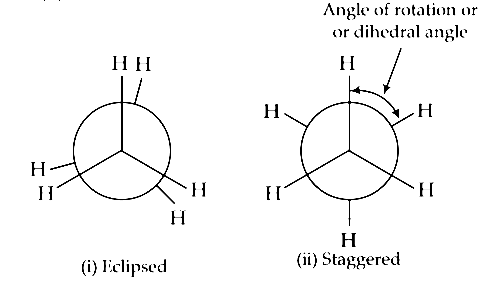
NEET 2016 Phase 1 Chemistry - Some Basic Concepts of Organic Chemistry Question 54 English Explanation
In staggered conformation any two hydrogen atoms on adjacent carbon atoms are as far apart as possible there by minimising repulsion between the electron clouds - of bonds of two non-bonded H-atomic (torsional strain)
Q.31
The pair of electrons in the given carbanion, CH3C C, is present in which of the following orbitals?
(A)
sp2
(B)
sp
(C)
2p
(D)
sp3
(B)

Solution

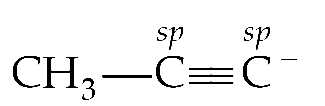
NEET 2016 Phase 1 Chemistry - Hydrocarbons Question 57 English Explanation
Thus, pair of electrons is present in sp-hybridised orbital.
Q.32
For the following reactions :

(A)  CH3CH2CH2Br + KOH
                 CH3CH CH2 + KBr + H2O
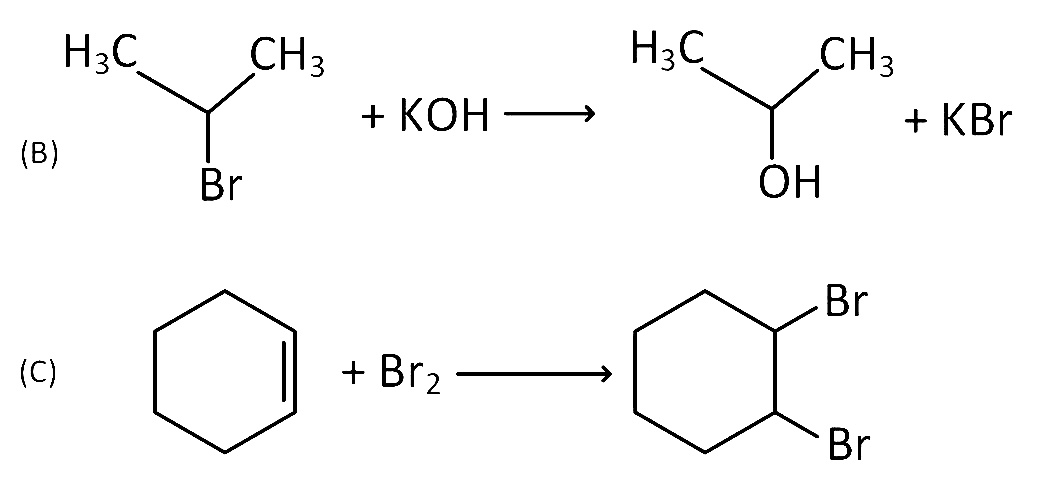
NEET 2016 Phase 1 Chemistry - Hydrocarbons Question 70 English
Which of the following statements is correct?
(A)
(A) is elimination, (B) and (C) are substitution reactions.
(B)
(A) is substitution, (B) and (C) are addition reactions.
(C)
(A) and (B) are elimination reactions and (C) is addition reaction.
(D)
(A) is elimination, (B) is substitution and (C) is addition reaction.
(D)

Solution

(A) Saturated compound is converted into unsaturated compound by removal of group of atoms hence, it is an elimination reaction.

(B) —Br group is replaced by —OH group hence, it is a substitution reaction.

(C) Addition of Br2 converts an unsaturated compound into a saturated compound hence, it is an addition reaction.
Q.33
Consider the nitration of benzene using mixed conc.H2SO4 and HNO3. If a large amount of KHSO4 is added to the mixture, the rate of nitration will be
(A)
unchanged
(B)
doubled
(C)
faster
(D)
slower
(D)

Solution

H2SO4 + HNO3 + +

KHSO4 K+ +

Due to common ion effect backward reaction will take place so the formation decrease so nitration process will become slower.
Q.34
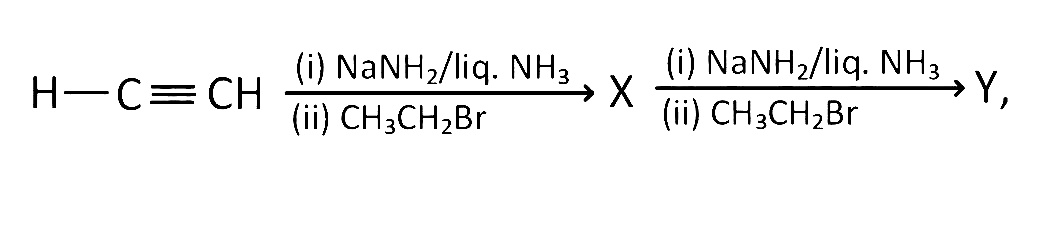
In the reaction

NEET 2016 Phase 1 Chemistry - Hydrocarbons Question 56 English
X and Y are
(A)
X = 2-Butyne,  Y = 2-Hexyne
(B)
X = 1-Butyne,  Y = 2-Hexyne
(C)
X = 1-Butyne,  Y = 3-Hexyne
(D)
X = 2-Butyne,  Y = 3-Hexyne
(C)

Solution

NEET 2016 Phase 1 Chemistry - Hydrocarbons Question 56 English Explanation 1 NEET 2016 Phase 1 Chemistry - Hydrocarbons Question 56 English Explanation 2
Q.35
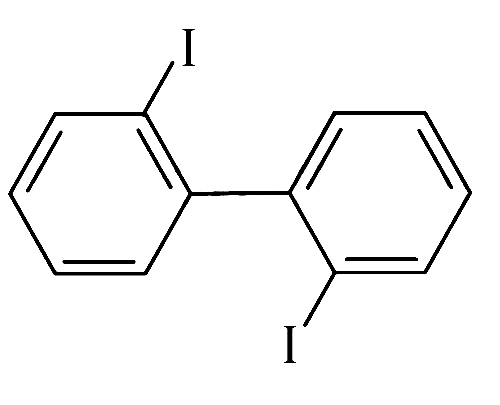
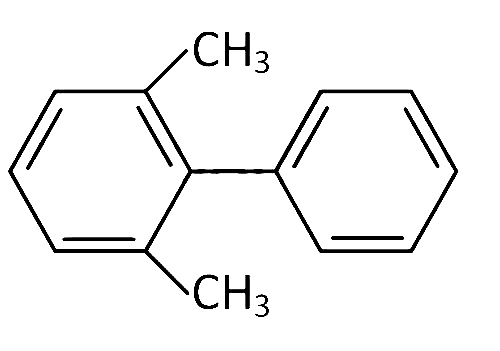
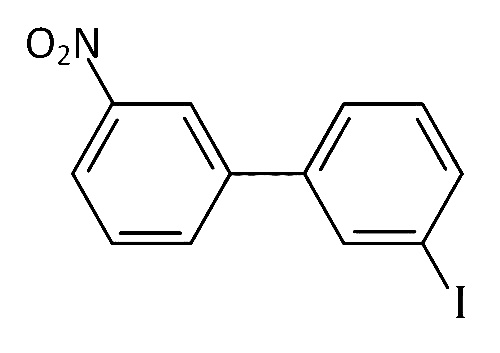
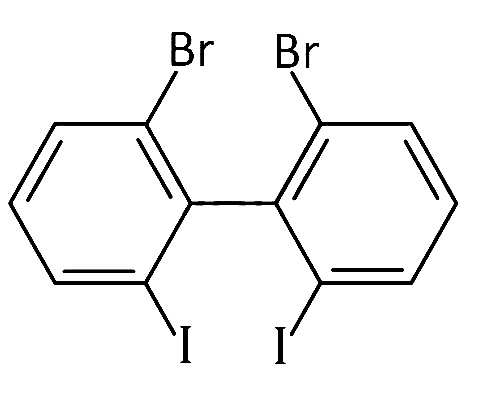
Which of the following biphenyls is optically active ?
(A)
NEET 2016 Phase 1 Chemistry - Haloalkanes and Haloarenes Question 38 English Option 1
(B)
NEET 2016 Phase 1 Chemistry - Haloalkanes and Haloarenes Question 38 English Option 2
(C)
NEET 2016 Phase 1 Chemistry - Haloalkanes and Haloarenes Question 38 English Option 3
(D)
NEET 2016 Phase 1 Chemistry - Haloalkanes and Haloarenes Question 38 English Option 4
(D)

Solution

Ortho substituted biphenyls are optically active as both the rings are not in one plane and their mirror images are non-superimposable.
Q.36
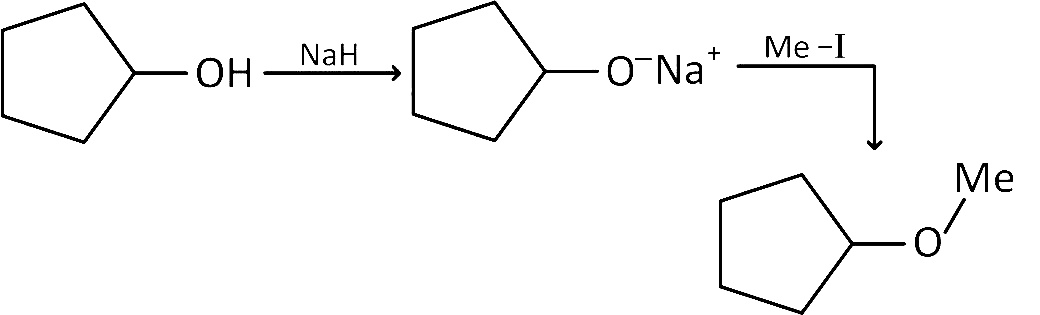
The reaction

NEET 2016 Phase 1 Chemistry - Alcohol, Phenols and Ethers Question 23 English
can be classified as
(A)
dehydration reaction
(B)
Williamson alcohol synthesis reaction
(C)
Williamson ether synthesis reaction
(D)
alcohol formation reaction.
(C)

Solution

The treatment of sodium alkoxide with a suitable alkyl halide to form an ether is called as Williamson ether synthesis reaction.
Q.37
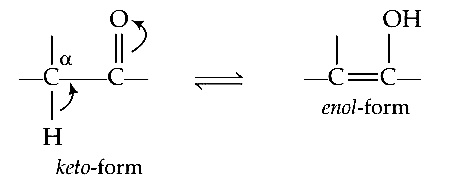
The correct statement regarding a carbonyl compound with a hydrogen atom on its alpha-carbon, is
(A)
a carbonyl compound with a hydrogen atom on its alpha-carbon rapidly equilibrates with its corresponding enol and this process is known as carbonylation
(B)
a carbonyl compound with a hydrogen atom on its alpha-carbon rapidly equilibrates with its corresponding enol and this process is known as keto-enol tautomerism
(C)
a carbonyl compound with a hydrogen atom on its alpha-carbon never equilibrates with its corresponding enol
(D)
a carbonyl compound with a hydrogen atom on its alpha-carbon rapidly equilibrates with its corresponding enol and this process is known as aldehyde-ketone equilibration.
(B)

Solution

Keto-enol tautomerism is as follows :
NEET 2016 Phase 1 Chemistry - Aldehydes, Ketones and Carboxylic Acids Question 94 English Explanation
Q.38
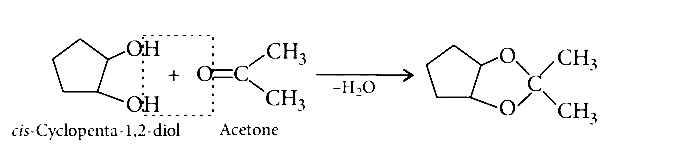
Which of the following reagents would distinguish cis-cyclopenta-1-2-diol from the trans-isomer?
(A)
MnO2
(B)
Aluminimum isopropoxide
(C)
Acetone
(D)
Ozone
(C)

Solution

NEET 2016 Phase 1 Chemistry - Aldehydes, Ketones and Carboxylic Acids Question 95 English Explanation

Trans isomer does not react with acetone as removal of H2O molecule is difficult.
Q.39
The product formed by the reaction of an aldehyde with a primary amine is
(A)
carboxylic acid
(B)
aromatic acid
(C)
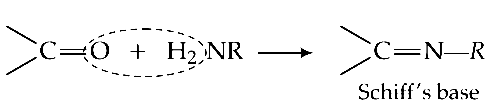
Schiff's base
(D)
ketone
(C)

Solution

NEET 2016 Phase 1 Chemistry - Organic Compounds Containing Nitrogen Question 51 English Explanation
Q.40
The correct statement regarding the basicity of arylamines is
(A)
arylamines are generally more basic than alkalmines because of aryl group
(B)
arylamines are generally more basic than alkylmines, because the nitrogen atom in arylamines is sp-hybridised
(C)
arylamines are generally less basic than alkylamines because the nitrogen lone-pair electrons are delocalised by interaction with the aromatic ring -electron system
(D)
arylamines are generally more basic than alkylamines because the nitrogen lone-pair electrons are not delocalised by interaction with the aromatic ring -electron system.
(C)

Solution

In arylamines, lone pair of electrons on nitrogen atom is delocalized over the benzene ring, thus not available for donation so arylamine are less basic than alkylamines.
Q.41
Natural rubber has
(A)
alternate cis- and trans-configuration
(B)
random cis- and trans-configuration
(C)
all cis-configuration
(D)
all trans-configuration.
(C)

Solution

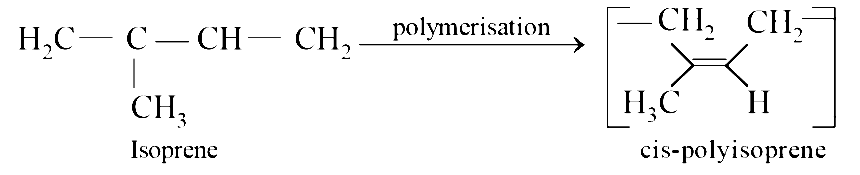
Natural rubber is cis-polyisoprene. NEET 2016 Phase 1 Chemistry - Polymers Question 35 English Explanation
Q.42
The correct statement regarding RNA and DNA, respectively is
(A)
The sugar component in RNA is a arabinose and the sugar component in DNA is ribose
(B)
The sugar component in RNA is 2'-deoxyribose and the sugar component in DNA is arabinose
(C)
the sugar component in RNA is arabinose and the sugar component in DNA is 2'-deoxyibose
(D)
the sugar component in RNA is ribose and the sugar component in DNA is 2'-deoxyribose.
(D)

Solution

Sugar in DNA is 2'-deoxyribose whereas sugar in RNA is ribose.
Q.43
Which one given below is a non-reducing sugar?
(A)
Glucose
(B)
Sucrose
(C)
Maltose
(D)
Lactose
(B)

Solution

All monosaccharides whether aldoses or ketoses are reducing sugars. Disaccharides such as sucrose in which the two monosaccharide units are linked through their reducing centres i.e., aldehydic or ketonic groups are non-reducing.
Q.44
In a protein molecule various amino acids are linked together by
(A)
peptide bond
(B)
dative bond
(C)
-glycosidic bond
(D)
-glycosidic bond.
(A)

Solution

In a protein molecule various amino acids are linked together by peptide bond.
Q.45
Which of the following is an analgesic?
(A)
streptomycin
(B)
chloromycetin
(C)
Novalgin
(D)
Penicillin
(C)

Solution

Streptomycin, chloromycetin and penicillin are antibiotics while novalgin is an analgesic.
Biology (Maximum Marks: 360)
  • This section contains 90 questions.
  • Each question has FOUR options (A), (B), (C) and (D). ONLY ONE of these four options is the correct answer.
  • Full Marks : +4 If ONLY the correct option is chosen;
  • Zero Marks : 0 If none of the options is chosen (i.e. the question is unanswered);
  • Negative Marks : −1 In all other cases.
Q.1
Microtubules are the constituents of
(A)
Cilia, Flagella and Peroxisomes
(B)
Centrosome, Nucleosome and Centrioles
(C)
Spindle fibres, Centrioles and Cilia
(D)
Centrioles, spindle fibres and chromatin
(C)

Solution

Microtubules are long, hollow cylinders made up of polymerised - and -tubulin dimers. Microtubules are part of a structural network (the cytoskeleton) within the cell’s cytoplasm. Roles of the microtubule cytoskeleton include mechanical support, organization of the cytoplasm, transport, motility and chromosome segregation so they are present in cilia and flagella for cellular movement, centrioles for chromosomal movement and spindle fibres for structural organization as well as chromosomal movement during nuclear division.
Q.2
Which one of the following cell organelles is enclosed by a single membrane?
(A)
Mitochondria
(B)
Chloroplasts
(C)
Lysosomes
(D)
Nuclei
(C)

Solution

Double Membrane bound Organelles: Mitochondria, Chloroplasts, Endoplasmic Reticulum, Golgi Body, and Nucleus. Single Membrane bound Organelles: Lysosomes, Peroxisomes, and Vacuoles. Organelles lacking any membrane: Ribosomes, Centrioles, Nucleolus.
Q.3
Mitochondria and chloroplast are-
(a) semi-autonomous organelles
(b) formed by division of pre existing organelles and they contain DNA but lack protein synthesising machinery
Which one of the following options is correct?
(A)
Both (a) and (b) are false
(B)
Both (a) and (b) are correct
(C)
(b) is true but (a) is false
(D)
(a) is true but (b) is false
(D)

Solution

Mitochondria & chloroplast are semiautonomous cell organelle which are formed by division of pre-existing organelle & contain DNA but they also contain protein synthesizing machinery, thus (a) is true & (b) is false.
Q.4
Which one of the following statements is wrong?
(A)
Uracil is a pyrimidine.
(B)
Glycine is a sulphur containing amino acid.
(C)
Sucrose is a disaccharide.
(D)
Cellulose is a polysaccharide.
(B)

Solution

Glycine (abbreviated as Gly or G) is the smallest of the 20 amino acids commonly found in proteins, and indeed is the smallest possible (having a hydrogen substituent as its side-chain). The formula is NH2CH2COOH. Its codons are GGU, GGC, GGA, GGG of the genetic code.
Q.5
A typical fat molecule is made up of
(A)
one glycerol and one fatty acid molecule
(B)
three glycerol and three fatty acid molecules
(C)
three glycerol molecules and one fatty acid molecule
(D)
one glycerol and three fatty acid molecules.
(D)

Solution

Neutral or true fats are triglycerides which are formed by esterification of three molecules of fatty acids with one molecule of trihydric alcohol, glycerol (glycerine or trihydroxy propane).
Q.6
In meiosis crossing over is initiated at
(A)
zygotene
(B)
diplotene
(C)
pachytene
(D)
leptotene.
(C)

Solution

Crossing over is a process of exchange of genetic material or chromatid segments between two homologous chromosomes. It is initiated during pachytene stage of meiosis.
Q.7
Which of the following is not a characteristic feature during mitosis in somatic cells?
(A)
Chromosome movement
(B)
Synapsis
(C)
Spindle fibres
(D)
Disappearance of nucleolus
(B)

Solution

Synapsis is the pairing of two homologous chromosomes that occurs during meiosis. It allows matching-up of homologous pairs prior to their segregation, and possible chromosomal crossover between them. Synapsis takes place during prophase I, of zygotene of meiosis.
Q.8
Spindle fibres attach on to
(A)
centromere of the chromosome
(B)
kinetosome of the chromosome
(C)
telomere of the chromosome
(D)
kinetochore of the chromosome.
(D)

Solution

Attachment of microtubules to chromosomes is mediated by kinetochores, which actively monitor spindle formation and prevent premature anaphase onset during mitosis.
Q.9
Proximal end of the filament of stamen is attached to the
(A)
Placenta
(B)
thalamus or prtal
(C)
anther
(D)
connective.
(B)

Solution

The proximal end is attached to the thalamus whereas the distal end bears anther.
Q.10
Seed formation without fertilisation in flowering plants involves the process of
(A)
somatic hybridisation
(B)
apomixis
(C)
sporulation
(D)
budding.
(B)

Solution

Apomixis is a reproductive process which does not involve gametic fusion. In apomictic flowering plants there is no fertilisation and embryos develop simply by division of a cell of ovule.
Q.11
Which one of the following statements is not true?
(A)
Pollen grains of many species cause severe allergies.
(B)
Stored pollen in liquid nitrogen can be used in the crop breeding programmes.
(C)
Tapetum helps in the dehiscence of anther.
(D)
Exine of pollen grains is made up of sporopollenin.
(C)

Solution

Tapetum is important for the nutrition and development of pollen grains, as well as a source of precursors for the pollen coat.
Q.12
The coconut water from tender coconut represents
(A)
free nuclear proembryo
(B)
free nuclear endosperm
(C)
endocarp
(D)
fleshy mesocarp.
(B)

Solution

Coconut water is the clear liquid inside young green coconuts (fruits of the coconut palm). In early development, it serves as a suspension for the endosperm of the coconut during the nuclear phase of development. As growth continues, the endosperm matures into its cellular phase and deposits into the rind of the coconut meat.
Q.13
Which of the following statements is not correct?
(A)
Pollen germination and pollen tube growth are regulated by chemical componrnts of pollen interacting with those of the pistil.
(B)
Some reptiles have also been reported as pollinators in some plant species.
(C)
Pollen grains of many species can germinate on the stigma of a flower, but only one pollen tube of the same species grows into the style.
(D)
Insects that consume pollen or nectar without bringing about pollination are called pollen/ nectar robbers.
(C)

Solution

Pollen-pistil interaction is the group of events that occur from the time of pollen deposition over the stigma to the time of pollen tube entry into ovule. It is a safety measure to ensure that illegitimate crossing does not occur. Pollen grains of number of plants may settle over a stigma. The pollens belonging to same species would germinate while other fail to do so but the pollen tube of the compatible pollen will grow through the style to reach the ovule whereas growth of incompatible pollens will be arrested at stigmatic disc or sometimes in the beginning part of style.
Q.14
Which of the following is wrongly matched in the given table?
(A)
Microbe - Streptococcus, Product - Streptokinase, Application - Removal of clot from blood vessel
(B)
Microbe - Trichoderma polysporum, Product - Cyclosporin A, Application - Immunosuppressive drug
(C)
Microbe - Monascus purpureus, Product - Statins, Application - Lowering of blood cholesterol
(D)
Microbe - Clostridium butylicum , Product - Lipase, Application - Removal of oil stains
(D)

Solution

Clostridium butylicum helps in the production of butyric acid. Candida lipolytica and Geotrichum candidum help in production of lipases that are added in detergents for removing oily stains from laundry.
Q.15
Specialised epidermal cells surrounding the guard cells are called -
(A)
Lenticels
(B)
Complementary cells
(C)
Bulliform cells
(D)
Subsidiary cells
(D)

Solution

Specialized epidermal cells surrounding the guard cells are known as Subsidiary or accessory cell.
Q.16
In which of the following all three are macronutrients?
(A)
Molybdenum, magnesium, manganese
(B)
Nitrogen, phosphorus, sulphur
(C)
Boron, Zinc, manganese
(D)
Iron, copper, molybdenum
(B)

Solution

Nitrogen, phosphorus, potassium, calcium, sulfur and magnesium are the macronutrients.
Q.17
Which of the following is a restriction endonuclease ?
(A)
DNase I
(B)
Hind II
(C)
RNase I
(D)
Protease
(B)

Solution

A restriction enzyme or restriction endonuclease is an enzyme that cuts DNA at or near specific recognition nucleotide sequences known as restriction sites. Hind II among these is a type of restriction endonuclease.
Q.18
Which of the following is not required for any of the techniques of DNA fingerprinting available at present?
(A)
DNA – DNA hybridization
(B)
Polymerase chain reaction
(C)
Zinc finger analysis
(D)
Restriction enzymes
(C)

Solution

Any small, functional, freely folded domain in which coordination of one or more zinc ions is required to stabilise its structure is known as zinc finger. The zinc finger domains are widely dispersed in eukaryotic genomes and are actively involved in sequence specific binding to DNA/RNA and contribute in protein-protein recognitions.
Q.19
The taq polymerase enzyme is obtained from
(A)
Thermus aquaticus
(B)
Bacillus subtilis
(C)
Pseudomonas putida
(D)
Thiobacillus ferroxidans
(A)

Solution

The Taq polymerase enzyme is obtained from Thermus aquaticus which lives in hot springs.
Q.20
Which of the following is not a feature of the plasmids ?
(A)
Single-stranded
(B)
Transferable
(C)
Independent replication
(D)
Circular structure
(A)

Solution

Plasmid has an extra chromosomal, double stranded circular DNA.
Q.21
Which of the following is the most important cause of animals and plants being driven to extinction ?
(A)
Co-extinctions
(B)
Over-exploitation
(C)
Alien species invasion
(D)
Habitat loss and fragmentation
(D)

Solution

The primary cause of human-induced extinction events is simply human overpopulation of planet Earth. The most important causal anthropogenic activities are habitat destruction and fragmentation.
Q.22
Which is the National Aquatic Animal of India ?
(A)
River dolphin
(B)
Sea-horse
(C)
Gangetic shark
(D)
Blue whale
(A)

Solution

River Dolphin is the National Aquatic Animal of India. This mammal is also said to represent the purity of the holy Ganga as it can only survive in pure and fresh water. Platanista gangetica has a long pointed snout and also have visible teeth in both the upper and lower jaws.
Q.23
Nomenclature is governed by certain universal rules. Which one of the following is countrary to the rules of nomenclature?
(A)
The names are written in Latin and are italicised.
(B)
When written by hand the names are to be underlined.
(C)
Biological names can be written in any language.
(D)
The first word in a biological name represents the genus name and the second is a specific epithet.
(C)

Solution

Binomial nomenclature is a formal system of naming species of living things by giving each a name composed of two parts, both of which use Latin grammatical forms, although they can be based on words from other languages.
Q.24
Which one of the following statements is wrong?
(A)
Eubacteria are also called false bacteria.
(B)
Phycomycetes are also called algal fungi.
(C)
Cyanobacteria are also called blue-green algae.
(D)
Golden algae are also called desmids.
(A)

Solution

Eubacteria are also called true bacteria
Q.25
Chrysophytes, Euglenoids, Dinoflagellates and Slime moulds are included in the Kingdom
(A)
Fungi
(B)
Animalia
(C)
Monera
(D)
Protista.
(D)

Solution

All unicellular eukaryotic organism like diatoms, desmids (chrysophytes), euglenoids, dinoflagellates and slime mould are included in Protista
Q.26
Which of the following statements is wrong for viroids?
(A)
They cause infections.
(B)
Their RNA is of high molecular weight.
(C)
They lack a protein coat.
(D)
They are smaller than viruses.
(B)

Solution

Viroids, the smallest known pathogens, are naked, circular, single-stranded RNA molecules that do not encode protein but autonomously replicate when introduced into host plants.

Viroids only infect plants; some cause economically important diseases of crop plants, while others appear to be benign.
Q.27
One of the major components of cell wall of most fungi is
(A)
cellulose
(B)
hemicellulose
(C)
chitin
(D)
peptidoglycan.
(C)

Solution

Fungal cell wall contains chitin or fungal cellulose along with other polysaccharides, proteins, lipids and a number of other substances
Q.28
The primitive prokaryotes responsible for the production of biogas from the dung of ruminant animals, include the
(A)
methanogens
(B)
eubacteria
(C)
halophiles
(D)
thermoacidophiles.
(A)

Solution

Methanogens are microorganisms that produce methane as a metabolic byproduct in anoxic conditions. They are obligate anaerobic ancient and primitive bacteria. They are involved in methanogenesis
Q.29
Stems modified into flat green organs performing the functions of leaves are known as
(A)
phylloclades
(B)
scales
(C)
cladodes
(D)
phyllodes.
(A)

Solution

Phylloclades are flattened green stems which have taken over the function of photosynthesis while cladodes are only the branches of stem that are modified to take over the function of leaves. Cladodes may not be flattened as in Ruscus aculeatus, cladodes are leaf-like with spiny tip whereas in Asparagus, they are slightly flattened, fleshy, straight or curved pointed structures which develop in clusters in the axil of scale leaves.
Q.30
Tricarpellary, syncarpous gynoecium is found in flowers of
(A)
Fabaceae
(B)
Poaceae
(C)
Liliaceae
(D)
Solanaceae
(C)

Solution

The Liliaceae are a huge variety, comprising about 280 genera and 4000 species of perennial herbs mostly. It includes starchy rhizomes, corms or bulbs, characterized by alternate leaves which are whorled. The flowers are often showy, mostly bisexual and actinomorphic. Also, they exhibit tricarpellary syncarpous gynoecium. Example of such a class is the Erythronium montanum, the alpine fawn lily
Q.31
Cotyledon of maize grain is called
(A)
coleoptile
(B)
scutellum
(C)
plumule
(D)
coleorhiza.
(B)

Solution

The cotyledons are known as seed leaves, they are attached to the embryonic axis. Dicotyledons typically have two cotyledons and monocotyledons have only one cotyledon. The single shield-shaped cotyledon in grains known as scutellum.
Q.32
Which of the following is not a stem modification?
(A)
Tendrils of cucumber
(B)
Flattened structures of Opuntia
(C)
Pitcher of Nepenthes
(D)
Thorms of citrus
(C)

Solution

Pitcher of Nepenthes or pitcher plant is modification of leaf whereas thorns in citrus tendrils of cucumber and flattened structure of Opuntia are all stem modification.
Q.33
The standard petal of a papilionaceous corolla is also called
(A)
vexillum
(B)
corona
(C)
carina
(D)
pappus.
(A)

Solution

Papilionaceous flowers are flowers with the characteristic irregular and butterfly-like corolla. A single, large upper petal is known as the banner or vexillum and the name has been derived from an ancient military standard.
Q.34
Water vapour comes out from the plant leaf through the stomatal opening. Through the same stomatal opening carbon dioxide diffuses into the plant during photosynthesis. Reason out the above statements using one of following options.
(A)
The above processes happen only during night time.
(B)
One process occurs during day time and the other at night.
(C)
Both processes cannot happen simultaneously.
(D)
Both processrs can happen together because the diffusion coefficient of water and CO2 is different.
(D)

Solution

In actively growing plants, water is continuously evaporating from the surface of leaf cells through stomatal opening exposed to air. This is called transpiration. Through the same stomatal opening carbon dioxide diffuses into the plant during photosynthesis. Simultaneously as both are the process of simple diffusion occurs in order of diffusion pressure gradient or diffusion coefficient.
Q.35
In a chloroplast the highest number of protons are found in
(A)
intermembrane space
(B)
antennae complex
(C)
stroma
(D)
lumen of thylakoids.
(D)

Solution

Proton concentration is higher in the lumen of thylakoid due to photolysis of water, H+ pumping and NADP reductase activity in stroma. During the light-dependent reaction, protons are pumped across the thylakoid membrane into the lumen making it acidic down to pH 4.
Q.36
Emerson's enhancement effect and Red drop have been instrumental in the discovery of
(A)
photophosphorylation and cyclic electron transport
(B)
oxidative phosphorylation
(C)
photophosphorylation and non-cyclic electron transport
(D)
two photosystems operating simultaneously.
(D)

Solution

Emerson et al. (1957) found that if light of shorter wavelengths was provided at the same time as the longer red wavelengths, photosynthesis was even faster than the sum of the two rates with either colour alone. This synergism or enhancement became known as the Emerson enhancement effect.

The two separate groups of pigments or photosystems cooperate in photosynthesis-long red wavelengths are absorbed only by one photosystem, called photosystem I (PS I) and the second photosystem, photosystem II (PS II), absorbs wavelengths shorter than 690 nm, and for maximum photosynthesis wavelengths absorbed by both systems must function together. The two photosystems normally cooperate to cause photosynthesis at all wavelengths shorter than 690 nm, because both photosystems absorb those wavelengths. The importance of Emerson’s work is that it suggested the presence of two distinct photosystems.
Q.37
Water soluble pigments found in plant cell vacuoles are
(A)
carotenoids
(B)
anthocyanins
(C)
xanthophylls
(D)
chlorophylls.
(B)

Solution

Many leaves produce water-soluble vacuolar pigments, which are stored within cell vacuoles (microscopic water sacs within each cell). Two major classes of leaf vacuolar pigments are anthocyanins and betalains.
Q.38
A plant in your garden avoids photorespiratory losses, has improved water use efficiency, shows high rates of photosynthesis at high temperatures and has improved efficiency of nitrogen utilisation. In which of the following physiological groups would you assign this plant?
(A)
CAM
(B)
Nitrogen fixer
(C)
C3
(D)
C4
(D)

Solution

C4 plants are adapted to hot and dry climate and lack photorespiration due to Kranz anatomy and have Greater productivity of biomass.
Q.39
Pick out the correct statements :
(a) Haemophilia is a sex-linked recessive disease.
(b) Down's syndrome is due to aneuploidy.
(c) Phenylketonuria is an autosomal recessive gene disorder.
(d) Sickle cell anaemia is an X – linked recessive gene disorder.
(A)
(a), (b) and (c) are correct
(B)
(a), (c) and (d) are correct.
(C)
(a) and (d) are correct
(D)
(b) and (d) are correct.
(A)

Solution

Sickle cell disease is inherited in an autosomal recessive pattern.
Q.40
A cell at telophase stage is observed by a student in a plant brought from the field. He tells his teacher that this cell is not like other cells at telophase stage. There is no formation of cell plate and thus the cell is contaning more number of chromosomes as compared to other dividing cells. This would results in -
(A)
Polyteny
(B)
Aneuploidy
(C)
Polyploidy
(D)
Somaclonal variation
(C)

Solution

Polyploidy is the phenomenon of occurrence of more than two sets of chromosomes in the nucleus of a cell. Polyploidy is more common in plants. Polyploidy arises as a result of total non-disjunction of chromosomes during mitosis or meiosis.
Q.41
Match the terms in Column-I with their description in Column-II and choose the correct option :
Column-I Column-II
(a) Dominance (i) Many genes govern a single character
(b) Codominance (ii) In a heterozygous organism only one allele expresses
itself
(c) Pleiotropy (iii) In a heterozygous organism both alleles express
themselves fully
(d) Polygenic inheritance (iv) A single gene influences many characters
(A)
(a) - (ii), (b) - (iii), (c) - (iv), (d) - (i)
(B)
(a) - (iv), (b) - (i), (c) - (ii), (d) - (iii)
(C)
(a) - (ii), (b) - (ii), (c) - (iv), (d) - (iii)
(D)
(a) - (iv), (b) - (iii), (c) - (i), (d) - (ii)
(A)

Solution

Let's match the terms in Column-I with their descriptions in Column-II:

  • (a) Dominance: Describes a relationship between alleles of a gene, where one allele masks the expression of another allele at the same locus.

  • (b) Codominance: Occurs when both alleles at a locus are expressed and the phenotype is a combination or simultaneous expression of both alleles.

  • (c) Pleiotropy: Occurs when one gene influences multiple different phenotypic traits.

  • (d) Polygenic inheritance: This term refers to a situation where a single trait is controlled by more than one gene (often, many genes contribute to the phenotype).

Now we match them with the descriptions:

  • (a) - (ii) "In a heterozyous organism only one allele expresses itself" aligns with the concept of Dominance.

  • (b) - (iii) "In a heterozyous organism both alleles express themselves fully" is correct for Codominance.

  • (c) - (iv) "A single gene influences many characters" corresponds to Pleiotropy.

  • (d) - (i) "Many genes govern a single character" is the definition of Polygenic inheritance.

Therefore, the correct match is:

Option A

(a) - (ii), (b) - (iii), (c) - (iv), (d) - (i)

Q.42
Which of the following most appropriately describes haemophilia ?
(A)
Chromosomal disorder
(B)
X-linked recessive gene disorder
(C)
Dominant gene disorder
(D)
Recessive gene disorder
(B)

Solution

Haemophilia is a sex-linked disease. It occurs due to the presence of a recessive sex linked gene h, which is carried by X-chromosome.
Q.43
In a testcross involving F1 dihybrid flies, more parental-type offspring were produced than the recombinant-typeoffspring. This indicates
(A)
Both of the characters are controlled by more than one gene
(B)
The two genes are linked and present on the same chromosome
(C)
The two genes are located on two different chromosomes
(D)
Chromosomes failed to separate during meiosis
(B)

Solution

If in a dihybrid test cross more parental combinations appear as compared to the recombinants in F2 generation, then it is indicative of involvement of linkage. Linkage is the tendency of two different genes on the same chromosome to remain together during the separation of homologous chromosomes at meiosis. During complete linkage no recombinants are formed whereas in incomplete linkage few recombinants are produced along with parental combinations.
Q.44
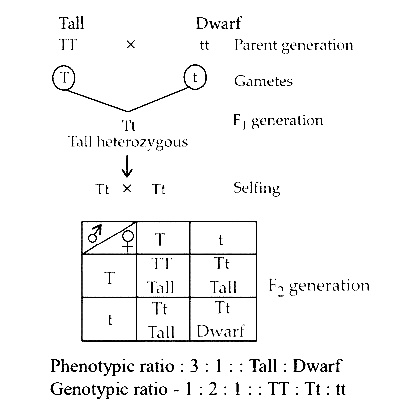
A tall true breeding garden pea plant is crossed with a dwarf true breeding garden pea plant. When the F1 plants were selfed the resulting genotypes were in the ratio of -
(A)
3 : 1 :: Tall : Dwarf
(B)
1 : 2 : 1 :: Tall heterozygous : Tall homozygous : Dwarf
(C)
1 : 2 : 1 :: Tall homozygous : Tall heterozygous : Dwarf
(D)
3 : 1 :: Dwarf : Tall
(C)

Solution

When a tall true breeding garden pea plant is crossed with a dwarf true breeding garden pea plant and the F1 plants were selfed the resulting genotypes were in the ratio of 1 : 2 : 1 i.e., Tall homozygous : Tall heterozygous : Dwarf
It can be illustrated as given below:
NEET 2016 Phase 1 Biology - Principles of Inheritance and Variation Question 167 English Explanation
Q.45
A complex of ribosomes attached to a single strand of RNA is known as :
(A)
Polypeptide
(B)
Okazaki fragment
(C)
Polysome
(D)
Polymer
(C)

Solution

A polysome or polyribosome is a complex of an mRNA molecule and two or more ribosomes, which is formed during the active translation process. They were initially named as ergosomes in 1963. However, further research by Jonathan Warner and Alex Rich characterized polysome
Q.46
Which of the following is required as inducer(s) for the expression of Lac operon?
(A)
lactose
(B)
lactose and galactose
(C)
glucose
(D)
galactose
(A)

Solution

In Lac operon, lactose is an inducer. It binds with suppressor and inactivates it. It allows RNA polymers access to the promoter and transcription proceeds.
Q.47
Which one of the following is the starter codon ?
(A)
AUG
(B)
UAG
(C)
UAA
(D)
UGA
(A)

Solution

The start codon is the first codon of a messenger RNA (mRNA) transcript translated by a ribosome. The start codon always codes for methionine in eukaryotes and a modified Met (fMet) in prokaryotes. The most common start codon is AUG.
Q.48
A system of rotating crops with legume or grass pasture to improve soil structure and fertility is called -
(A)
Shifting agriculture
(B)
Strip farming
(C)
Ley farming
(D)
Contour farming
(C)

Solution

The growing of grass or legumes in rotation with grain or tilled crops as a soil conservation measure is called Ley farming.
Q.49
The two polypeptides of human insulin are linked together by
(A)
Hydrogen bonds
(B)
Covalent bond
(C)
Disulphide bridges
(D)
Phosphodiester bond
(C)

Solution

Insulin is a hormone consisting of 2 polypeptide chains. Each chain is composed of a specific sequence of amino acid residues connected by peptide bonds. In humans, chain A has 21 amino acids, and chain B has 30. Post translational modifications result in the connection of these two chains by disulfide bridges. Cysteine residues on A7 and B7, as well as A20 to B19 are covalently connected by disulfide bridges.
Q.50
Which part of the tobacco plant is infected by Meloidogyne incognita ?
(A)
Flower
(B)
Stem
(C)
Leaf
(D)
Root
(D)

Solution

Meloidogyne incognita is a nematode (roundworm) in the family Heteroderidae. It is commonly called the “southern rootknot nematode” or the “cotton root-knot nematode”.
Q.51
When does the growth rate of a population following the logistic model equal zero?
The logistic model is given as dN/dt = rN(1-N/K)
(A)
When death rate is greater than birth rate.
(B)
When N/K equals zero.
(C)
When N/K is exactly one.
(D)
When N nears the carrying capacity of the habitat.
(C)

Solution

In logistic growth model population growth equation is described as

N = population density at time t;
r = Intrinsic rate of natural increase;
K = carrying capacity
When N/K = 1; = 0
Therefore,
Q.52
Gause's principle of competitive exclusion states that -
(A)
Larger organisms exclude smaller ones through competition
(B)
More abundant species will exclude the less abundant species through competition
(C)
Competition for the same resources excludes species having different food preferences
(D)
No two species can occupy the same niche indefinitely for the same limiting resources
(D)

Solution

Gause’s principle of competitive exclusion can be restated to say that no two species can occupy the same niche indefinitely when resources are limiting. Certainly species can and do coexist while competing for some of the same resources. Nevertheless, Gause’s theory predicts that when two species coexist on a long-term basis, either resources must not be limited or their niches will always differ in one or more features; otherwise, one species will outcompete the other and the extinction of the second species will inevitably result, a process referred to as competitive exclusion.
Q.53
It is much easier for a small animals to run uphill than for a large animal, because -
(A)
The efficiency of muscles in large animals is less than in the small animals
(B)
Smaller animals have a higher metabolic rate
(C)
It is easier to carry a small body weight
(D)
Small animals have a lower O2 requirement
(B)

Solution

Basal metabolic rate is the minimum amount of energy needed to keep the body functioning. It is inversely proportional to the size of body, thus smaller animals have a higher metabolic rate.
Q.54
Joint Forest Management Concept was introduced in India during :
(A)
1990s
(B)
1970s
(C)
1960s
(D)
1980s
(D)

Solution

Joint Forest Management originated in West Bengal accidentally at the Arabari Forest Range in West Midnapore, near Midnapore town in 1971. After the initial successes in West Bengal and Haryana, the JFM schemes received national importance in the legislation of 1988.
Q.55
A river with an inflow of domestic sewage rich in organic waste may result in -
(A)
Death of fish due to lack of oxygen
(B)
Increased population of aquatic food web organisms
(C)
Drying of the river very soon due to algal bloom
(D)
An increased production of fish due to biodegradable nutrients
(A)

Solution

Domestic sewage rich in organic waste leads to increase in Biological Oxygen Demand, which leads to decrease D.O. (dissolved oxygen) which leads to death of fishes.
Q.56
Depletion of which gas in the atmosphere can lead to an increased incidence of skin cancers
(A)
Methane
(B)
Ozone
(C)
Nitrous oxide
(D)
Ammonia
(B)

Solution

The ozone layer or ozone shield refers to a region of Earth’s stratosphere that absorbs most of the Sun’s ultraviolet (UV) radiation. It contains high concentrations of ozone (O3) relative to other parts of the atmosphere.
Q.57
In bryophytes and pteridophytes, transport of male gametes requires
(A)
birds
(B)
water
(C)
wind
(D)
insects.
(B)

Solution

The sperms of bryophytes and pteridophytes are flagellated and hence require an external supply of water to reach archaegonia.
Q.58
Select the correct statement
(A)
Sequoia is one of the tallest trees.
(B)
The leaves of gymnosperms are not well adapted to extremes of climate.
(C)
Gymnosperms are both homosporous and heteroporous.
(D)
Salvinia, Ginkgo and Pinus all are gymnosperms.
(A)

Solution

Sequoia semepervirans is one of the tallest trees.
Q.59
The Avena curvature is used for bioassay of
(A)
IAA
(B)
ethylene
(C)
ABA
(D)
GA3.
(A)

Solution

Auxin has been clearly demonstrated in the leaf sheath or coleoptile of oat plant (Avena sativa). This plant coleoptile has been used for the test of hormone Auxin (IAA) participating in the growth of the plant.
Q.60
Which one of the following is a characteristic feature of cropland ecosystem ?
(A)
Absence of weeds
(B)
Absence of soil organisms
(C)
Ecological succession
(D)
Least genetic diversity
(D)

Solution

Cropland ecosystem is an artificial or manmade terrestrial ecosystem which is created and maintained by human beings for their maximum benefits. Therefore, they will have least genetic diversity.
Q.61
Which of the following would appear as the pioneer organisms on bare rocks?
(A)
Lichens
(B)
Green algae
(C)
Liverworts
(D)
Mosses
(A)

Solution

Lichens produce small amounts of carbonic acids from their “roots” and these slowly dissolve the rock, releasing nutrients. Other nutrients are obtained from water-borne or air-borne particles of both organic and inorganic materials. The body of a lichen contains an alga; this is able to photosynthesise sugars, some of which are passed on to the fungal component of the lichen. In return the alga gets a tiny but significant amount of shelter within the tissues of the lichen.
Q.62
The term ecosystem was coined by :
(A)
E.P. Odum
(B)
E. Haeckel
(C)
E. Warming
(D)
A.G. Tansley
(D)

Solution

Sir Arthur George Tansley was an English botanist and a pioneer in the science of ecology who coined the term ecosystem.
Q.63
Antivenom injection contains preformed antibodies while polio drops that are administered into the body contain -
(A)
Attenuated pathogens
(B)
Activated pathogens
(C)
Harvested antibodies
(D)
Gamma globulin
(A)

Solution

Oral Polio Vaccine consists of a mixture of attenuated (weakened) poliovirus strains of all three poliovirus types.
Q.64
Which of the following statements is not true for cancer cells in relation to mutations ?
(A)
Mutations inhibit production of telomerase
(B)
Mutations in proto-oncogenes accelerate the cell cycle
(C)
Mutations destroy telomerase inhibitor
(D)
Mutations inactivate the cell control
(A)

Solution

Telomerase production is increased in cancer. Telomerase has been examined in hundreds of studies as a potentially sensitive biomarker for screening, early cancer detection, prognosis or in monitoring as an indication of residual disease.
Q.65
In higher vertebrates, the immune system can distinguish self-cells and non-self. If this property is lost due to genetic abnormally and it attacks self-cells, then it leads to
(A)
Active immunity
(B)
Allergic response
(C)
Graft rejection
(D)
Auto-immune disease
(D)

Solution

Autoimmunity is a disorder of the body’s defence mechanisms in which an immune response is elicited against its own tissues, which are thereby damaged or destroyed. Autoimmunity may be caused due to genetic or environmental factors.
Q.66
Blood pressure in the pulmonary artery is
(A)
more than that in the pulmonary vein
(B)
less than that in the venae cavae
(C)
same as that in the aorta
(D)
more than that in the carotid.
(A)

Solution

Arteries have higher blood pressure than vein because blood is forced inside them from heart and also their lumen is narrow.
Q.67
In mammals, which blood vessel would normally carry largest amount of urea?
(A)
Hepatic Vein
(B)
Hepatic Portal Vein
(C)
Renal Vein
(D)
Dorsal Aorta
(A)

Solution

Hepatic Vein, because the liver produces urea and other waste materials and then it pours it all in the right ventricle of the heart for oxygenation. The heart distributes the blood to various parts of the body from here. So the impure blood brought by the Hepatic Vein and other blood vessels get distributed through the aorta. This will automatically imply that the Renal Artery will contain lesser impure blood than the Hepatic Vein.
Q.68
Lack of relaxation between successive stimuli in sustained muscle contraction is known as
(A)
tetanus
(B)
tonus
(C)
spasm
(D)
fatigue.
(A)

Solution

Sustained contraction with no relaxation phase is called muscle tetanus.
Q.69
Photosensitive compound in human eye is made up of
(A)
opsin and retinol
(B)
transducin and retinene
(C)
guanosine and retinol
(D)
opsin and retinal.
(D)

Solution

The rods contain a photosensitive pigment called the rhodopsin. Rhodopsin is composed of opsin and retinene. The opsin is a protein and is called scotopsin in rhodopsin. The retinene is an aldehyde of vitamin A and is called retinal.
Q.70
In context of Amniocentesis, which of the following statement is incorrect ?
(A)
It can be used for detection of Down syndrome
(B)
It is usually done when a woman is between 14-16 weeks pregnant
(C)
It is used for prenatal sex determination
(D)
It can be used for detection of Cleft palate
(D)

Solution

Amniocentesis (also referred to as amniotic fluid test or AFT) is a medical procedure used in prenatal diagnosis of chromosomal abnormalities and fetal infections, and also used for sex determination in which a small amount of amniotic fluid, which contains fetal tissues, is sampled from the amniotic sac. Cleft palate is a developmental abnormality which can only be detected by sonography.
Q.71
Which of the following approaches does not give the defined action of contraceptive ?
(A)
Intra uterine devices Increase phagocytosis of sperms, suppress sperm motility and fertilizing capacity of sperm
(B)
Barrier methods Prevent fertilization
(C)
Hormonal contraceptives Prevent/retard entry of sperm, prevent ovulation and fertilization
(D)
Vasectomy Prevents spermatogenesis
(D)

Solution

Vasectomy is a surgical procedure for male sterilization or permanent contraception. During the procedure, the male vas deferens are severed and then tied or sealed in a manner so as to prevent sperm from entering into the seminal stream (ejaculate) and thereby prevent fertilization.
Q.72
Which type of tissue correctly matches with its locations ?
(A)
Tissue Smooth muscle , Location Wall of intestine
(B)
Tissue Areolar tissue, Location Tendons
(C)
Tissue Cuboidal epithelium, Location Lining of stomach
(D)
Tissue Transitional epithelium, Location Tip of nose
(A)

Solution

Wall of intestine is made of smooth muscle. Tendons consist of dense regular connective tissue fascicles encased in dense irregular connective tissue sheaths. Tip of nose consists of squamous epithelium. Lining of epithelium is made of columnar epithelium.
Q.73
Which of the following features is not present in Periplaneta americana?
(A)
Indeterminate and radial cleavage during embryonic development
(B)
Schizocoelom as body cavity
(C)
Metamerically segmented body
(D)
Exoskeleton composed of N-acetylglucosamine
(A)

Solution

Periplanata americana shows spiral and determinate types of cleavage during embryonic development which is a feature of Protostomes.
Q.74
Which of the following guards the opening of hepatopanjcreatic duct into the duodenum?
(A)
Pyloric sphincter
(B)
Sphincter of Oddi
(C)
Semilunar valve
(D)
Ileocaecal valve
(B)

Solution

The sphincter of Oddi is a muscular valve that controls the flow of digestive juices (bile and pancreatic juice) through the hepatopancreatic duct into the duodenum.
Q.75
In the stomach, gastric acid is secreted by the
(A)
peptic cells
(B)
acidic cells
(C)
gastrin secreting cells
(D)
parietal cells.
(D)

Solution

The main constituent of gastric acid is hydrochloric acid which is produced by parietal cells (also called oxyntic cells) in the gastric glands in the stomach.
Q.76
The amino acid tryptophan is the precursor for the synthesis of
(A)
estrogen and progesterone
(B)
cortisol and cortisone
(C)
melatonin and serotonin
(D)
thyroxine and triiodothyronine.
(C)

Solution

Tryptophan is a precursor to neurotransmitters serotonin and melatonin. Thyroxine (3,5,3’,5’-tetraiodothyronine) is produced by follicular cells of the thyroid gland. It is produced as the precursor thyroglobulin. Estrogen is biosynthesized from progesterone (in two steps from cholesterol, via intermediate pregnenolone). Cortisone is one of several end-products of a process called steroidogenesis. Cortisol is produced in the adrenal cortex of kidney
Q.77
Which of the following pairs of hormones are not antagonistic (having opposite effects) to each other?
(A)
Aldosterone     -    Atrial Natriuretic Factor
(B)
Relaxin     -     Inhibin
(C)
Parathormone     -     Calcitonin
(D)
Insulin     -     Glucagon
(B)

Solution

Relaxin hormone is secreted by ovary and placenta during pregnancy, which relaxes ligaments in pelvis and softens and widens cervix during childbirth. Inhibin secreted by granulosa cells in the ovaries inhibits secretion of FSH by anterior pituitary. Thus, relaxin and inhibin have different functions and are not antagonistic.
Q.78
Fertilisation in humans is practically feasible only if
(A)
the ovum and sperms are transported simultaneously to ampullary-isthmic junction of the cervix
(B)
the sperms are transported into cervix within 48 hrs of release of ovum in uterus
(C)
the sperms are transported into vagina just after the release of ovum in Fallopian tube
(D)
the ovum and sperms are transported simultaneously to ampullaryisthmic junction of the Fallopian tube.
(D)

Solution

The word ampulla is derived from the Latin word ‘flask’. Being the second portion of the fallopian tube, it is the intermediate dilated portion which immediately curves over the ovary. This is the common site of human fertilization as both the ovum and sperms are simultaneously transported here.
Q.79
Select the incorrect statement.
(A)
LH and FSH decreases gradually during the follicular phase.
(B)
LH triggers secretion of androgen from the Leydig cells.
(C)
FSH stimulates the sertolicells which help in spermiogenesis.
(D)
LH triggers ovulation in ovary.
(A)

Solution

Considering the female reproductive endocrinology, ovulation is the process of the monthly release of the viable oocyte from the ovary between the time of menarche and menopause. During this time, there is a surge in the production of LH and FSH, termed as gonadotropins, thereby initiating estradiol and progesterone secretion from the ovary. Both these hormones are very important for the menstrual cycle.
Q.80
Changes in GnRH pulse frequency in females is controlled by circulating levels of
(A)
progesterone only
(B)
progesterone and inhibin
(C)
estrogen and progesterone
(D)
estrogen and inhibin.
(C)

Solution

At the pituitary, GnRH stimulates the synthesis and secretion of the gonadotropins, follicle-stimulating hormone (FSH), and luteinizing hormone (LH). These processes are controlled by the size and frequency of GnRH pulses, as well as by feedback from progesterone and estrogens. Lowfrequency GnRH pulses are required for FSH release, whereas high-frequency GnRH pulses stimulate LH pulses in a one to one manner
Q.81
Identify the correct statement on 'inhibin'.
(A)
Is produced by granulosa cells in ovary and inhibits the secretion of LH
(B)
Is produced by nurse cells in testes and inhibits the secretion of LH
(C)
Inhibits the secretion of LH, FSH and prolaction
(D)
Is produced by granulosa cells in ovary and inhibits the secretion of FSH
(D)

Solution

In both females and males, inhibin inhibits FSH production. In females, FSH stimulates the secretion of inhibin from the granulosa cells of the ovarian follicles in the ovaries. In turn, inhibin suppresses FSH. In males, androgens stimulate inhibin production. It is secreted from the Sertoli cells, located in the seminiferous tubules inside the testes.
Q.82
Which of the following features is not present in the Phylum Arthropoda?
(A)
Parapodia
(B)
Jointed appendages
(C)
Chitinous exoskeleton
(D)
Metameric segmentation
(A)

Solution

Parapodia are flattened, fleshy, vertical flaplike outgrowths of body wall found in annelids on lateral sides of trunk segments. These are hollow structures enclosing coelom which is continuous with that of trunk segments. These serve the dual purpose of locomotion and respiration.
Q.83
Which one of the following characteristics is not shared by birds and mammals?
(A)
Viviparity
(B)
Warm blooded nature
(C)
Ossified endoskeleton
(D)
Breathing using lungs
(A)

Solution

Giving birth to young that develop within the mother’s body rather than hatching from eggs. All mammals except the monotremes are viviparous.
Q.84
Which of the following characteristic features always holds true for the corresponding group of animals?
(A)
Possess a mouth with an
upper and a lower jaw
     Chordata
(B)
3-chambered heart with
one incompletely divided
ventricle
Reptilia
(C)
Cartilaginous endoskeleton Chondrichthyes
(D)
Viviparous Mammalia
(C)

Solution

Phylum Chordata includes both jawless vertebrates (Agnatha) and jawed vertebrates (Gnathostomata). Crocodile of Class Reptilia has four chambered heart with two auricles and two ventricles. Duck billed platypus and spiny anteater are oviparous mammals.
Q.85
Name the chronic repiratory disorder caused mainly by cigarette smoking.
(A)
Respiratory acidosis
(B)
Respiratory alkalosis
(C)
Emphysema
(D)
Asthma
(C)

Solution

Emphysema results when the delicate linings of the air sacs in the lungs become damaged beyond repair. Most commonly, the toxins in cigarette smoke create the damage. Emphysema is called smoker’s disease.
Q.86
Reduction in pH of blood will
(A)
decrease the affinity of haemoglobin with oxygen
(B)
release bicarbonate ions by the liver
(C)
reduce the rate of heart beat
(D)
reduce the blood supply to the brain.
(A)

Solution

Reduction of pH of blood will decrease the affinity of hemoglobin with oxygen which in turn causes acidosis.
Q.87
Asthma may be attributed to
(A)
inflammation of the trachea
(B)
accumulation of fluid in the lungs
(C)
bacterial infection of the lungs
(D)
allergic reaction of the mast cells in the lungs.
(D)

Solution

Asthma is an allergic condition in which the tissue surrounding the bronchioles of the lungs swell up and compress the bronchioles thus causing difficulty in breathing. This allergy mainly involves IgE antibodies and chemicals like histamine and serotonin from the mast cells.
Q.88
Following are the two statements regarding the origin of life -
(a) The earliest organisms that appeared on the earth were non-green and presumably anaerobes
(b) The first autotrophic organisms were the chemoautotrophs that never released oxygen
Of the above statements which one of the following options is correct ?
(A)
Both (a) and (b) are false
(B)
Both (a) and (b) are correct
(C)
(b) is correct but (a) is false
(D)
(a) is correct but (b) is false
(B)

Solution

Both statements are correct because primitive atmosphere was reducing and chlorophyll appeared later on. Chemoautotrophs were the first autotrophic organisms unable to perform photolysis of water and never released oxygen.
Q.89
Analogous structures are a result of :
(A)
Divergent evolution
(B)
Convergent evolution
(C)
Stabilizing selection
(D)
Shared ancestry
(B)

Solution

Analogous structures are those that have the same function, but they are not derived from a common ancestor and have undergone different patterns of development i.e., Convergent evolution which is natural selection that favors the same type of structure in different ancestors.
Q.90
Which of the following structures is homologus to the wing of a bird ?
(A)
Wing of a Moth
(B)
Dorsal fin of a Shark
(C)
Flipper of Whale
(D)
Hindlimb of Rabbit
(C)

Solution

Wings of a bird and flippers of a whale are modified forelimbs.