NEET-UG 2017

NEET 2017

Physics (Maximum Marks: 180)
  • This section contains 45 questions.
  • Each question has FOUR options (A), (B), (C) and (D). ONLY ONE of these four options is the correct answer.
  • Full Marks : +4 If ONLY the correct option is chosen;
  • Zero Marks : 0 If none of the options is chosen (i.e. the question is unanswered);
  • Negative Marks : −1 In all other cases.
Q.1
A physical quantity of the dimensions of length that can be formed out of c, G and is [c is velocity of light, G is the universal constant of gravitation and e is charge]
(A)
(B)
(C)
(D)
(D)

Solution

Dimension of
= [ F d2 ] = [ML3T-2]

Dimension of G = [M-1L3T-2],

Dimension of c = [LT-1]

Now assume dimension of length is related as,

L = [c]x[G]y[]z

[L1] = [ML3T-2]z [M-1L3T-2]y [LT-1]x

Comparing both sides and solving we get,

x = -2, y = , z =

L =
Q.2
Preeti reached the metro station and found that the escalator was not working. She walked up the sationary escalator in time t1. On another days, if she remains stationary on the the moving escalator, then the escalator takes her up in time t2. The time taken by her to walk up on the moving escalator will be
(A)
(B)
(C)
(D)
(B)

Solution

Velocity of preeti with respect to elevator v1 =

Velocity of elevator with respect to ground v2 =

Net velocity of preeti on moving escalator with respect to the ground

v = v1 + v2

= +

= +

t =

Here t is the time taken by preeti to walk up on the moving escalator.
Q.3
The x and y coordinates of the particle at any time are x = 5t 2t2 and y = 10t respectively, where x and y are in metres and t in seconds. The acceleration of the particle at t = 2 s is
(A)
5 m s2
(B)
4 m s2
(C)
8 m s2
(D)
0
(B)

Solution

x = 5t 2t2 and y = 10t

= 5 - 4t, = 10

vx = 5 - 4t, vy = 10

= - 4, = 0

= - 4, = 0

= m/s2

Acceleration of the particle at t = 2 s is - 4 m/s2
Q.4
One end of string of length is connected to a particle of mass 'm' and the other end is connected to a small peg on a smooth horizontal table. If the particle moves in circle with speed '', the net force on the particle (directed towards centre) will be (T represents the tension in the string)
(A)
(B)
(C)
zero
(D)
(D)

Solution

Centripetal force is provided by tension so net force on the particle will be equal to tension T.
Q.5
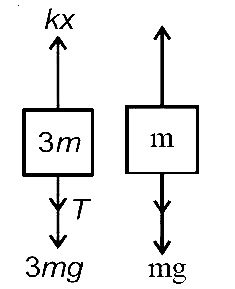
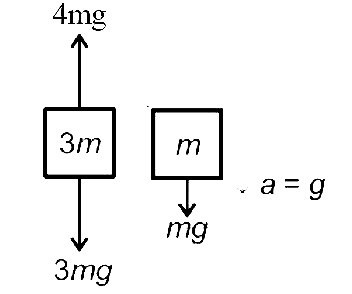
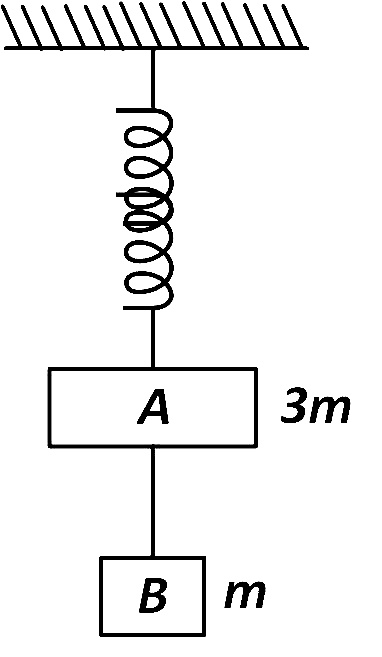
Two blocks A and B of masses 3m and m respectively are connected by a massless and inextensible string. The whole system is suspended by a massless spring as shown in figure. The magnitudes of acceleration of A and B immediately after the string is cut, are respectively

NEET 2017 Physics - Laws of Motion Question 29 English
(A)
(B)
(C)
(D)
(A)

Solution

NEET 2017 Physics - Laws of Motion Question 29 English Explanation 1 Before cutting the string
kx = T + 3 mg ...(i)
T = mg ...(ii)
kx = 4mg

After cutting the string T = 0


NEET 2017 Physics - Laws of Motion Question 29 English Explanation 2
and
Q.6
Consider a drop of rain water having mass 1 g falling from a height of 1 km. It hits the ground with a speed of 50 m s1. Take 'g' constant with a value 10 m s2. The work done by the (i) gravitational force and the (ii) resistive force of air is
(A)
(i) 1.25 j   (ii) 8.25 J
(B)
(i) 100 j   (ii) 8.75 J
(C)
(i) 10 j   (ii) 8.75 J
(D)
(i) 10 j   (ii) 8.25 J
(C)

Solution

From work-energy theorem,
Wg + Wa = K.E

or mgh + Wa =


which is the work done due to air resistance

Work done due to gravity = mgh

= 10–3 × 10 × 103 = 10 J
Q.7
Which of the following statements are correct ?

(1)   Centre of mass of a body always coincides with the centre of gravity of the body.

(2)   Centre of mass of a body is the point at which the total gravitational torque on the body is zero.

(3)   A couple on a body produces both translational and rotational motion in a body

(4)   Mechanical advantage greater than one means that small effort can be used to lift a large load.
(A)
(1) and (2)
(B)
(2) and (3)
(C)
(3) and (4)
(D)
(4)
(D)

Solution

Centre of gravity of a body is the point at which the total gravitational torque on body is zero. Centre of mass and centre of gravity coincides only for symmetrical bodies.
Hence statements (1) and (2) are incorrect.
A couple of a body produces rotational motion only.
Hence statement (3) is incorrect.
Mechanical advantage greater than one means that the system will require a force that is less than the load in order to move it.
Hence statement (4) is correct.
Q.8
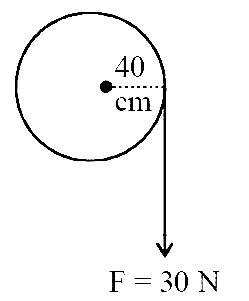
A rope is wound around a hollow cylinder of mass 3 kg and radius 40 cm. What is the angular acceleration of the cylinder if the rope is pulled with a force of 30 N?
(A)
0.25 rad s2
(B)
25 rad s2
(C)
5 m s2
(D)
25 m s2
(B)

Solution

NEET 2017 Physics - Rotational Motion Question 90 English Explanation
Given, mass of cylinder m = 3kg
R = 40 cm = 0.4 m
F = 30 N ; = ? As we know, torque = Ia

F × R = MR2

=


Q.9
Two discs of same moment of inertia rotating about their regular axis passing through centre and perpendicular to the plane of disc with angular velocities and . They are brought into contact face to face coinciding the axis of rotation. The expression for loss of energy during this process is
(A)
(B)
(C)
(D)
(A)

Solution

According to the problem,
I + I = 2I

=


Loss


Q.10
The acceleration due to gravity at a height at a height 1 km above the rearth is the same as at a depth d below the surface of earth. Then
(A)
d = 1 km
(B)
d = km
(C)
d = 2 km
(D)
d = km
(C)

Solution

Above earth surface


Below earth surface


According to question, gh = gd
=

Clearly, d = 2h = 2 km
Q.11
Two astronauts are floating in gravitational free space after having lost contact with their spaceship. The two will
(A)
move towards each other.
(B)
move away from each other.
(C)
will become stationary.
(D)
keep floating at the same distance between them.
(A)

Solution

Since two astronauts are floating in gravitational free space. The only force acting on the two astronauts is the gravitational pull of their masses,

which is attractive in nature.
Hence they move towards each other.
Q.12
The bulk modulus of a spherical object is 'B'. If it is subjected to uniform pressure 'P', the fractional decrease in radius is
(A)
(B)
(C)
(D)
(C)

Solution

Bulk modulus is given by


   (here, = fractional decreases in radius)

Q.13
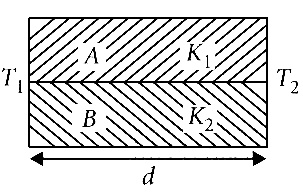
Two rods A and B of different materials are welded together as shown in figure. Their thermal conductivities are K1 and K2. The thermal conductivity of the composite will be

NEET 2017 Physics - Properties of Matter Question 85 English
(A)
(B)
(C)
(D)
(D)

Solution

Equivalent thermal conductivity of the composite rod in parallel combination will be,

Q.14
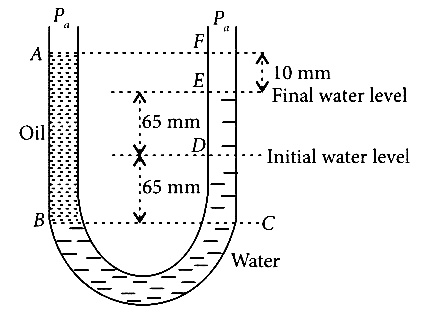
A U tube with both ends open to the atmosphere, is partially filled with water. Oil, which is immiscible with water, is poured into one side until it stands at a distance of 10 mm above the water level on the other side. Meanwhile the water rises by 65 mm from its original level (see diagram). The density of the oil is

NEET 2017 Physics - Properties of Matter Question 82 English
(A)
425 kg m3
(B)
800 kg m3
(C)
928 kg m3
(D)
650 kg m3
(C)

Solution

Here,


Q.15
A spherical black body with a radius of 12 cm radiates 450 watt power at 500 K. If the radius were halved and the temperature doubled, the power radiated in watt would be
(A)
450
(B)
1000
(C)
1800
(D)
225
(C)

Solution

Given r1 = 12 cm , r2 = 6 cm

T1 = 500 K and T2 = 2 × 500 = 1000 K

P1 = 450 watt

Rate of power loss


Solving we get, P2 = 1800 watt
Q.16
A gas mixture consists of 2 moles of O2 and 4 moles of Ar at temperature T. Neglecting all vibrational modes, the total internal energy of the system is
(A)
15 RT
(B)
9 RT
(C)
11 RT
(D)
4 RT
(C)

Solution

Internal energy of the system is given by


Degree of freedom
Fdiatomic = 5
fmonoatomic = 3

and, number of moles n(O2) = 2
n(Ar) = 4

Q.17
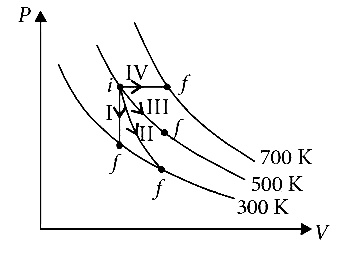
Thermodynamic processes are indicated in the following diagram.

NEET 2017 Physics - Heat and Thermodynamics Question 90 English
Match the following

Column-1 Column-2
P. Process I A. Adiabatic
Q. Process II B. Isobaric
R. Process III C. Isochoric
S. Process IV D. Isothermal
(A)
P C,  Q A,  R D,   S B
(B)
P C,  Q D,  R B,   S A
(C)
P D,  Q B,  R A,   S C
(D)
P A,  Q C,  R D,   S B
(A)

Solution

Process I volume is constant hence, it is isochoric

In process IV, pressure is constant hence, it is isobaric.
Q.18
A carnot engine having an efficiency of as heat engine, is used as a refrigerator. If the work done on the system is 10 J, the amount of energy absorbed from the reservoir at lower temperature is
(A)
90 J
(B)
99 J
(C)
100 J
(D)
1 J
(A)

Solution

Given, efficiency of engine,

work done on system W = 10J

Coefficient of performance of refrigerator


Energy absorbed from reservoir


Q.19
A spring of force constant k is cut into lengths of ratio 1 : 2 : 3. They are connected in series and the new force constant is K'. Then they are connected in parallel and force constant is k''. Then k' : k'' is
(A)
1 : 9
(B)
1 : 11
(C)
1 : 14
(D)
1 : 6
(B)

Solution

Let us assume, the length of spring be l.

When we cut the spring into ratio of length 1 : 2 : 3, we get three springs of lengths and with force constant,


When connected in series,


When connected in parallel,

k'' = 6k + 3k + 2k = 11k

Q.20
A particle executes linear simple harmonic motion with an amplitude of 3 cm. When the particle is at 2 cm from the mean position, the magnitude of its velocity is equal to that of its acceleration. Then its time period in second is
(A)
(B)
(C)
(D)
(B)

Solution

Given, Amplitude A = 3 cm
When particle is at x = 2 cm
According to question, magnitude of velocity = acceleration


Q.21
Two cars moving in opposite directions approach each other with speed of 22 m s1 and 16.5 m s1 respectively. The driver of the first car blows a horn having a frequency 400 Hz. The frequency heard by the driver of the second car is (velocity of sound is 340 m s1)
(A)
361 Hz
(B)
411 Hz
(C)
448 Hz
(D)
350 Hz
(C)

Solution

As we known from Doppler's Effect


fapprent = 448 Hz
Q.22
The two nearest harmonics of a tube closed at one end and open at other end are 220 Hz and 260 Hz. What is the fundamental frequency of the system ?
(A)
20 Hz
(B)
30 Hz
(C)
40 Hz
(D)
10 Hz
(A)

Solution

The difference of frequencies of closed pipe


So, the fundamental frequency
Q.23
The diagrams below show regions of equipotentials.

NEET 2017 Physics - Electrostatics Question 74 English
A positive charge is moved from A to B in each diagram.
(A)
In all the four cases the work done is the same.
(B)
Minimum work is required to move q in figure(I).
(C)
Maximum work is required to move q in figure (II).
(D)
Maximum work is required to move q in figure (III)
(A)

Solution

As the regions are of equipotentials, so Work done W = qV

V is same in all the cases hence work - done will also be same in all the cases.
Q.24
Suppose the charge of a proton and an electron differ slightly. One of them is e, the other is (e + e). If the net of electrostatic force and gravitational force between two hydrogen atoms placed at a distance d (musch greater than atomic size) apart is zero, then e is of the order of
[Given : mass of hydrogen mh = 1.67 1027 kg]
(A)
1023 C
(B)
1037 C
(C)
1047 C
(D)
1020 C
(B)

Solution

According to question, the net electrostatic force (FE) = gravitational force (FG)

FE = FG


Q.25
A potentiometer is an accurate and versatile device to make electrical measurements of EMF because the method involves
(A)
potential gradients
(B)
a condition of no current flow through the galvanometer
(C)
a combination of cells, galvanometer and resistances
(D)
cells
(B)

Solution

A potentiometer is an accurate and versatile device to make electrical measurements of E.M.F. because the method involves zero deflection without any current in galvanometer.
Q.26
The resistance of a wire is 'R' ohm. If it is melted and stretched to 'n' times its original length. its new resistance will be
(A)
(B)
n2R
(C)
(D)
nR
(B)

Solution

Resistance

and


Q.27
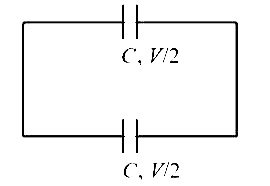
A capacitor is charged by a battery. The battery is removed and another identical unchanged capacitor is connected in parallel. The total electrostatic energy of resulting system
(A)
decreases by a factor of 2
(B)
remains the same
(C)
increases by a factor of 2
(D)
increases by a factor of 4
(A)

Solution

When the capacitor is charged by a battery of potential V, then energy stored in the capacitor,

   ...(i)

When the battery is removed and another identical uncharged capacitor is connected in parallel

NEET 2017 Physics - Capacitor Question 39 English Explanation
Common potential,

Then the energy stored in the capacitor,

   ...(ii)

From eqns. (i) and (ii)


that means the total electrostatic energy of resulting system will decreases by a factor of 2.
Q.28
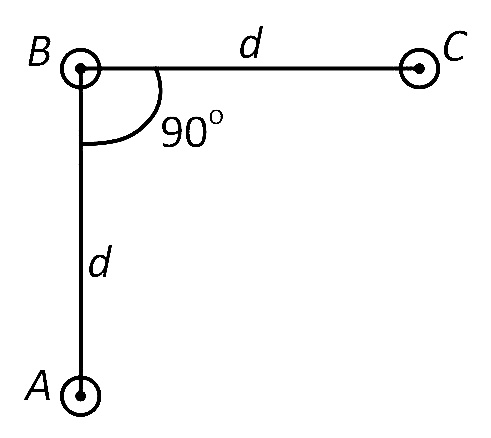
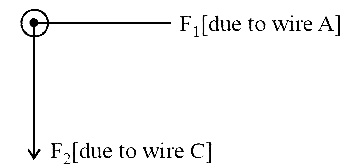
An arrangement of three parallel straight wires placed perpendicular to plane of paper carrying same current along the same direction as shown in fogure. Magnitude of force per unit length on the middle wire is given by

NEET 2017 Physics - Moving Charges and Magnetism Question 80 English
(A)
(B)
(C)
(D)
(C)

Solution

NEET 2017 Physics - Moving Charges and Magnetism Question 80 English Explanation

Since same current flowing through both the wires

ii = i2 = i

So F1 = = F2

Magnitude of force per unit length on the middle wire 'B'

Fnet = =
Q.29
A 250-turn rectangular coil of length 2.1 cm and width 1.25 cm carries a current of 85 A and subjected to a magnetic field of strength 0.85 T. Work done for rotating the coil by 180o against the torque is
(A)
4.55 J
(B)
2.3 J
(C)
1.15 J
(D)
9.1 J
(D)

Solution

Given: n = 250, l = 2.1 cm, W = 1.25 cm, i = 85 μA, B = 0.85 T

Now W = MB (cos θ1 – cos θ2) = 2MB = 2(iNA)B

= 2 × 85 × 10–6 × 250 × 2.1 × 1.25 × 10–4 × 0.85

= 9.1 × 10⁻⁶ J
Q.30
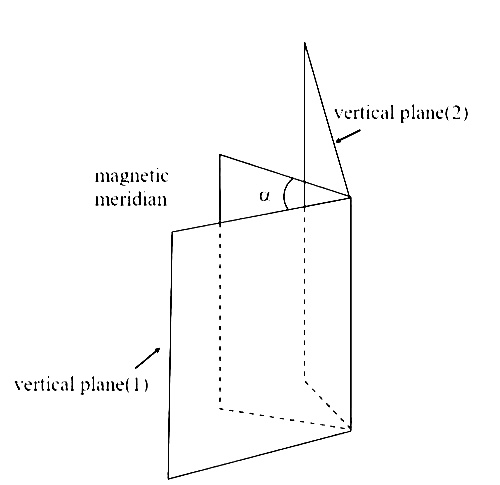
If 1 and 2 be the apparent angles of dip observed in two vertical planes at right angles to each other, then the true angle of dip is given by
(A)
tan2 = tan21 + tan22
(B)
cot2 = cot21 cot22
(C)
tan2 = tan21 tan22
(D)
cot2 = cot21 + cot22
(D)

Solution

NEET 2017 Physics - Magnetism and Matter Question 47 English Explanation
If 1 and 2 are opparent angles of dip.

Let be the angle which one of the plane make with the magnetic meridian.

For magnetic meridian and plane (1)

tan 1 =

cos = .....(1)

For magnetic meridian and plane (2)

tan 1 =

....(2)

(1)2 + (2)2

1 =

cot2 = cot21 + cot22
Q.31
A long solenoid of diameter 0.1 m has 2 104 turns per meter. At the centre of the solenoid, a coil of 100 turns and radius 0.01 m is placed with its axis coinciding with the solenoid axis. The current in the solenoid reduces at a constant rate to 0 A from 4 A in 0.05 s. If the resistance of the coil is 10 2 , the total charge flowing through the coil during this time is
(A)
16 C
(B)
32 C
(C)
16 C
(D)
32 C
(B)

Solution

q =

=

=

=

= 32 10-6 C = 32 C
Q.32
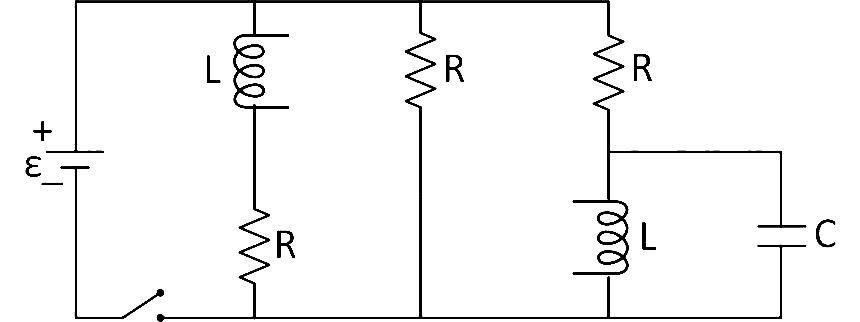
Figure shows a circuit that contains three identical resistors with resistance R = 9.0 each, two identical inductors with inductance = 2.0 mH each, and an ideal battery with emf . The current through the battery just after the switch closed is

NEET 2017 Physics - Alternating Current Question 65 English
(A)
0.2 A
(B)
4 A
(C)
0 ampere
(D)
2 mA
(B)

Solution

At t = 0, there will be no current flowing through an inductor as it resists the change in current, whereas current will slowly build in it. Also, as switch is closed, inductor will give an infinite resistance where capacitor shows zero resistance, so, current through battery, will be

I = = 4 A
Q.33
In an electromagnetic wave in free space that root mean square value of the electric field is Erms = 6 V m1. The peak value of the magnetic field is
(A)
2.83 108 T
(B)
0.70 108 T
(C)
4.23 108 T
(D)
1.41 108 T
(A)

Solution

The rms value of magnetic field

Brms = = = 2 × 10– 8 T

Now peak value of magnetic field

Bpeak = = 2.83 108 T
Q.34
A thin prism having refracting angle 10o is made of glass of refractive infex 1.42. This prism is combined with another thin prism of glass of refractive index 1.7. This combination producess dispersion without deviation. The refracting angle of second prism should be
(A)
6o
(B)
8o
(C)
10o
(D)
4o
(A)

Solution

The condition for dispersion without deviation is given as

|( – 1)|A = |(' – 1)| A'

(1.42 – 1) × 10o = (1.7 – 1)A'

4.2 = 0.7A' or A' = 6o
Q.35
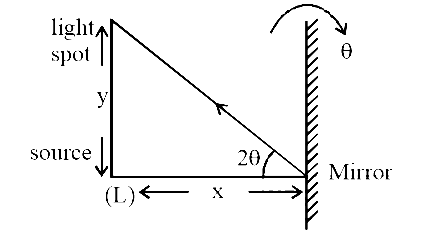
A beam of light from a source L is incident normally on a plane mirror fixed at a certain distance x from the source. The beam is reflected back as a spot on a scale placed just above the source L. When the mirror is rotated through a small angle , the spot of the light is found to move through a distance y on the scale. The angle is given by
(A)
(B)
(C)
(D)
(D)

Solution

NEET 2017 Physics - Geometrical Optics Question 83 English Explanation

As the mirror is rotated θ, the reflected ray rotates 2θ.

Using trigonometry, tan 2θ = y/x

θ being small, 2θ = y/x or θ = y/2x
Q.36
Young's double slit experiment is first performed in air and then in a medium other than air. It is found that 8th bright fringe in the medium lies where 5th dark fringe lies in air. The refractive index of the medium is nearly
(A)
1.59
(B)
1.69
(C)
1.78
(D)
1.25
(C)

Solution

Position of 8th bright fringe in medium

x =

Position of 5th dark fringe in air,

x' = =

According to question

=

= 1.78
Q.37
Two polaroids P1 and P2 are placed with their axis perpendicular to each other. Unpolarised light 0 is incident on P1. A third polaroid P3 is kept in between P1 and P2 such that its axis makes an angle 45o with that of P1. The intensity of transmitted light through P2 is
(A)
(B)
(C)
(D)
(B)

Solution

Apply Malus' Law,

Intensity of light from first polaroid P1, I1 =

Intensity of light from second polaroid P3,

I2 = =

Intensity of transmitted light through P2,

I3 = = =
Q.38
The ratio of resolving powers of an optical microscope for two wavelength 1 = 4000 and = 6000 is
(A)
9 : 4
(B)
3 : 2
(C)
16 : 81
(D)
8 : 27
(B)

Solution

The resolving power of an optical microscope,

RP =

RP

Now,

= =
Q.39
Radioactive material 'A' has decay constant '8 ' and material 'B' has decay constant ''. Initially they have same number of nuclei. After what time, the ratio of number of nuclei of material 'B' to that 'A' will be e ?
(A)
(B)
(C)
(D)
(A)

Solution

Ratio of number of nuclei

=

According to question,

=

t =
Q.40
The ratio of wavelengths of the last line of Balmer series and the last line of Lyman series is
(A)
1
(B)
4
(C)
0.5
(D)
2
(B)

Solution

In case of Balmer series :

n1 = , n2 = 2

=

In case of Lyman series :

n1 = , n2 = 1

= Rc

= = 4
Q.41
The de-Broglie wavelength of a neutron in thermal equilibrium with heavy water at a temperature T (kelvin) and mass m, is
(A)
(B)
(C)
(D)
(A)

Solution

Wavelength, =

=

=

=
Q.42
The photoelectric threshold wavelength of silver is 3250 1010 m. The velocity of the electron ejected from a silver surface by ultraviolet light of wavelength 2536 1010 m is
{Given h = 4.14 1015 eV s and c = 3 108 m s1 ]
(A)
0.6 106 m s1
(B)
61 103 m s1
(C)
0.3 106 m s1
(D)
6 105 m s1
(A, D)

Solution

Minimum energy, E0 = eV

E0 = 3.81 eV

Ultraviolet wavelength, = 2536

Imparted energy, E = = 4.88 eV

Now, max kinetic energy, = E - E0

v =

v = 0.61 × 10⁶ m/s = 6.0 × 10⁵ m/s
Q.43
In a common emitter transistor amplifier the audio sgnal voltage across the collector is 3 V. The resistance of collector is 3 k. If current gain is 100 and the base resistance is 2 k, the voltage and power gain of the amplifier is
(A)
15 and 200
(B)
150 and 15000
(C)
20 and 2000
(D)
200 and 1000
(B)

Solution

Given: Vi = 3 V, RC = 3 k, RB = 2 k, = 100

Voltage gain of the CE amplifier

AV = = 100 = 150

Power gain = AV = 150(100) = 15000
Q.44
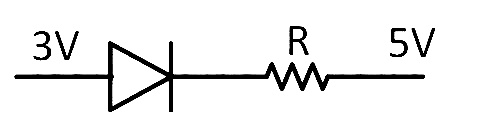
Which one of the following represents forward bias diode ?
(A)
NEET 2017 Physics - Semiconductor Electronics Question 117 English Option 1
(B)
NEET 2017 Physics - Semiconductor Electronics Question 117 English Option 2
(C)
NEET 2017 Physics - Semiconductor Electronics Question 117 English Option 3
(D)
NEET 2017 Physics - Semiconductor Electronics Question 117 English Option 4
(D)

Solution

A diode is said to be forward biased if p-side is at higher potential than n-side of p-n junction.
Q.45
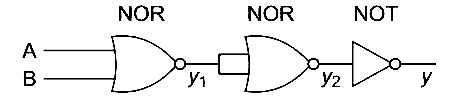
The given electrical network is equivalent to

NEET 2017 Physics - Semiconductor Electronics Question 118 English
(A)
OR gate
(B)
NOR gate
(C)
NOT gate
(D)
AND gate
(B)

Solution

NEET 2017 Physics - Semiconductor Electronics Question 118 English Explanation
y1 =

y2 =

=

y = =

So it is NOR gate.
Chemistry (Maximum Marks: 180)
  • This section contains 45 questions.
  • Each question has FOUR options (A), (B), (C) and (D). ONLY ONE of these four options is the correct answer.
  • Full Marks : +4 If ONLY the correct option is chosen;
  • Zero Marks : 0 If none of the options is chosen (i.e. the question is unanswered);
  • Negative Marks : −1 In all other cases.
Q.1
Which of the following is dependent on temperature?
(A)
Molarity
(B)
Mole fraction
(C)
Weight percentage
(D)
Molality
(A)

Solution

Molarity =
Number of moles of solute
Volume of solution (in L)


Molality =
Number of moles of solute
Mass of solvent (in kg)


Mole fraction =
Number of moles of component
Total number of moles of all components


Weight percentage =
Weight of a component
Total weight of solution
100

KEY Concept : Those units which are volume related will be affected by the change in temperature.

The definition of molarity is - Number of moles of solute present in one litre of solution. From definition you can see it is depends on volume which increases with increasing temperature and decreases with decreasing temperature.

All the other three options (Molality, Mole fraction, Weight fraction of solute) are mass related units and temperature has no effect on mass.
Q.2
Which one is the wrong statement ?
(A)
The uncertainty principle is

(B)
Half filled and fully filled orbitals have greater stability due to greater exchange energy, greater symmetry and more balanced arrangement.
(C)
The energy of 2s-orbital is less than the energy of 2p-orbital in case of hydrogen like atoms.
(D)
de-Broglie's wavelength is given by

, where m = mass of the particle,

v group velocity of the particle.
(C)

Solution

In the case of hydrogen type atoms, energy depends on the principal quantum number only. Therefore 2-s orbital will have energy equal to 2-p orbital.
Q.3
The equilibrium constants of the following are

N2 + 3H2 2NH3;     K1

N2 + O2 2NO;     K2

H2 + O2 H2O;     K3

The equilibrium constant (K) of the reaction :

2NH3 + O2 2NO + 3H2O will be
(A)
K2K33/K1
(B)
K2K3/K1
(C)
K23K3/K1
(D)
K1K33/K2
(A)

Solution

2NH3 N2 + 3H2;     

N2 + O2 2NO;     K2

3H2 + O2 3H2O;     (K3)3

By adding all equations, we get

2NH3 + O2 2NO + 3H2O

K =
Q.4
A 20 litre container at 400 K contains CO2(g) at pressure 0.4 atm and an excess of SrO (neglect the volume of solid SrO). The volume of the container is now decreased by moving the movable piston fitted in the container. The maximum volume of the container, when pressure of CO2 attains its maximum value, will be

(Given that : SrCO3(s) SrO(s) + CO2(g), Kp = 1.6 atm)
(A)
10 litre
(B)
4 litre
(C)
2 litre
(D)
5 litre
(D)

Solution

Initially, P1 = 0.4 atm

V1 = 20 L

T1 = 400 K

Max. pressure of CO2 = Pressure of CO2 at equilibrium

For reaction,

SrCO3(s) ⇌ SrO(s) + CO2

Kp = PCO2 = 1.6 atm = maximum pressure of CO2 volume of container at this stage.

V2 = ......(i)

Since, reaction was not at equilibrium earlier and also container is sealed.

n = constant

n = .....(ii)

From (i) and (ii)

V2 = = = 5 L
Q.5
Concentration of the Ag+ ions in a saturated solution of Ag2C2O4 is 2.2 104 mol L1. Solubility product of Ag2C2O4 is
(A)
2.66 1012
(B)
4.5 1011
(C)
5.3 1012
(D)
2.42 108
(C)

Solution

Ag2C2O4(s) 2Ag+ + C2O4 2–
      S                  2S           S

Ksp = [Ag+] 2 [C2O4 2–] = [2S]2 [S]

[Ag+] = 2S = 2.2 × 10⁻⁴

or S = 1.1 × 10⁻⁴ M

Ksp = [2.2 × 10⁻⁴ ]2 [1.1 × 10⁻⁴] = 5.3 × 10⁻¹²
Q.6
If molality of the dilute solution is doubled, the value of molal depression constant (Kf) will be
(A)
halved
(B)
tripled
(C)
unchanged
(D)
doubled.
(C)

Solution

The value of molal depression constant, Kf is constant for a particular solvent, thus, it will be unchanged when molality of the dilute solution is doubled.
Q.7
For a given reaction, H = 35.5 kJ mol1 and S = 83.6 J K1 mol1. The reaction is spontaneous at (Assume that H and S do not vary with temperature.)
(A)
T > 425 K
(B)
all temperatures
(C)
T > 298 K
(D)
T < 425 K
(A)

Solution

For a spontaneous reaction,

G < 0 i.e. H - TS < 0


Q.8
A gas is allowed to expand in a well insulated container against a constant external pressure of 2.5 atm from an initial volume of 2.50 L to a final volume of 4.50 L. The change in internal energy U of the gas in joules will be
(A)
500 J
(B)
505 J
(C)
+ 505 J
(D)
1136.25 J
(B)

Solution

w = - PextV = -2.5(4.50 - 2.50)

- 5 L atm = - 5 1.01.325 J = - 506.625 J

U = q + w

As, the container is insulted, thus q = 0

Hence, U = w = -506.625 J
Q.9
In the electrochemical cell :

the emf of this Daniell cell is E1. When the concentration of ZnSO4 is changed to 1.0 M and that of CuSO4 changed to 0.01 M, the emf changes to E2. From the followings, which one is the relationship between E1 and E2? (Given, RT/F = 0.059)
(A)
E1 < E2
(B)
E1 > E2
(C)
E2 = 01E1
(D)
E1 = E2
(B)

Solution

Ecell = Eo -

E1 = Eo -

= Eo -

E1 = Eo + 0.059

E2 = Eo -

E2 = Eo -

E2 = Eo - 0.059

E1 > E2
Q.10
Mechanism of a hypothetical reaction
X2 + Y2 2XY, is given below :
(i)   X2 X + X (fast)
(ii)  X + Y2 XY + Y (slow)
(iii) X + Y XY (fast)
The overall order of the reaction will be
(A)
2
(B)
0
(C)
1.5
(D)
1
(C)

Solution

Slow step is the rate determining step.

Rate = k[X][Y2] ......(i)

Equilibrium constant for fast step,

K =

[X] =

By substituting [X] in equation (i), we get

Rate = k[Y2] = k' [Y2]

Order of reaction = = 1.5
Q.11
A first order reaction has a specific reaction rate of 102 sec1. How much time will it take for 20 g of the reactant to reduce to 5 g?
(A)
138.6 sec
(B)
346.5 sec
(C)
693.0 sec
(D)
238.6 sec
(A)

Solution

For a first order reaction,

k =

10-2 =

t = 138.6 sec
Q.12
Which is the incorrect statement?
(A)
Density decreases in case of crystals with Schottky defect.
(B)
NaCl(s) is insulator, silicon is semi conductor, silver is conductor, quartz is piezoelectric crystal.
(C)
Frenkel defect is favoured in those ionic compounds in which sizes of cation and anions are almost equal
(D)
FeO0.98 has no-stoichimetric metal deficiency defect.
(C, D)

Solution

Frenkel defect is favoured in those ionic compounds in which there is large difference in the size of cations and anions.

Non-stoichiometric defects due to metal deficiency is shown by FexO where x = 0.93 to 0.96.
Q.13
Which one of the following statements is not correct?
(A)
The value of equilibrium constant is changed in the presence of a catalyst in the reaction at equilibrium.
(B)
Enzymes catalyse mainly bio-chemical reactions.
(C)
Coenzymes increase the catalytic activity of enzyme.
(D)
Catalyst does not initiate any reaction.
(A)

Solution

A catalyst accelerates the forward and backward reaction to the same extent thus, the equilibrium constant does not change. Catalyst only speed up the reactions to attain equilibrium faster and does not alter equilibrium constant. Equilibrium constant varies only when temperature condition of reaction gets changed.
Q.14
The element Z = 114 has been discovered recently. It will belong to which of the following family/group and electronic configuration ?
(A)
Carbon family, [Rn] 5f14 6d10 7s2 7p2
(B)
Oxygen family, [Rn] 5f14 6d10 7s2 7p4
(C)
Nitrogen family, [Rn] 5f14 6d10 7s2 7p6
(D)
Halogen family, [Rn] 5f14 6d10 7s2 7p5
(A)

Solution

The electronic configuration of th element with Z = 114 is [Rn] 5f14 6d10 7s2 7p2. Hence it belongs to the carbon family which has the same outer electronic configuaration.
Q.15
Which one of the following pairs of species have the same bond order ?
(A)
O2, NO+
(B)
CN, CO
(C)
N2, O2
(D)
CO, NO
(B)

Solution

CN- and CO have same no. of electrons and have same bond order equal to 3.
Q.16
The species, having bond angles of 120o is
(A)
ClF3
(B)
NCl3
(C)
BCl3
(D)
PH3
(C)

Solution

BCl3-Trigonal planar, sp2-hybridised, 120o angle
Q.17
Which of the following pairs of compounds is isostructural ?
(A)
Tel2, XeF2
(B)
IBr2, XeF2
(C)
IF3, XeF2
(D)
BeCl2, XeF2
(B, D)

Solution

Species No. of electrons Structure
TeI2 158 Bent
XeF2 72 Linear
IBr2 124 Linear
XeF2 72 Linear
IF3 80 T-shaped
XeF3 72 Linear
BeCl2 38 Linear
XeF2 72 Linear
Q.18
Extraction of gold and silver involves leaching with CN ion. Silver is later recovered by
(A)
distillation
(B)
zone refining
(C)
displacement with Zn
(D)
liquation
(C)

Solution

Zn being more reactive displaces Ag and Au.

4M(s) + 8NaCN(aq) + 2H2O(aq) + O2(g)
          4Na[M(CN)2](aq) + OH(aq)

2Na[M(CN)2](aq) + Zn(s) Na2[Zn(CN)4](aq) +2M(s)

Here M = Ag or Au

This method is known as Mac-Arthur forest cyanide process.
Q.19
Ionic mobility of which of the following alkali metal ions is lowest when aqueous solution of their salts are put under an electric field?
(A)
K
(B)
Rb
(C)
Li
(D)
Na
(C)

Solution

Li+ being smallest, has maximum charge density.

So, Li+ is most heavily hydrated among all alkali metal ions. Effective size of Li+ in aqueous solution is therefore, largest. So, moves slowest under electric field.
Q.20
Match the interhalogen compounds of column-I with the geometry in column-II and assign the correct code.

Column Column
(A) XX' (i) T-shape
(B) XX'3 (ii) Pentagonal bipyramidal
(C) XX'5 (iii) Linear
(D) XX'7 (iv) Square pyramidal
(v) Tetrahedral
(A)
(A) (iii);  (B) (i);  (C) (iv);  (D) (ii)
(B)
(A) (v);  (B) (iv);  (C) (iii);  (D) (ii)
(C)
(A) (iv);  (B) (iii);  (C) (ii);  (D) (i)
(D)
(A) (iii);  (B) (iv);  (C) (i);  (D) (ii)
(A)

Solution

XX' Linear (e.g. ClF, BrF)

XX3' T-Shape (e.g. ClF3, BrF3)

XX5' Square pyramidal (e.g. BrF5, IF5)

XX7' Pentagonal bipyramidal (e.g. IF7)
Q.21
It is because of inability of ns2 electrons of the valence shell to participate in bonding that
(A)
Sn2+ is oxidising while Pb4+ is reducing
(B)
Sn2+ and Pb2+ are both oxidising and reducing
(C)
Sn4+ is reducing while Pb4+ is oxidising
(D)
Sn2+ is reducing while Pb4+ is oxidising
(D)

Solution

The inertness of s-subshell electrons towards bond formation is known as inert pair effect. This effect increases down the group thus, for Sn, +4 oxidation state is more stable, whereas, for Pb, +2 oxidation state is more stable, i.e., Sn2+ is reducing while Pb4+ is oxidising
Q.22
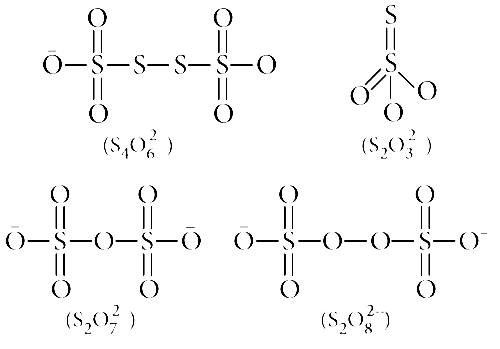
In which pair of ions both the species contain S S bond?
(A)
S4O62, S2O32
(B)
S2O72, S2O82
(C)
S4O62, S2O72
(D)
S2O72, S2O32
(A)

Solution

S4O62– and S2O32– have S—S bond.

NEET 2017 Chemistry - p-Block Elements Question 68 English Explanation
Q.23
HgCl2 and I2 both when dissolved in water containing I ions, the pair of species formed is
(A)
HgI2, I
(B)
HgI, I
(C)
Hg2I2, I
(D)
HgI2, I
(B)

Solution

HgCl2 + 4I (aq) HgI42– (aq) + 2Cl(aq)

I2(s) + I (aq) I3(aq)
Q.24
Name the gas that can readily decolourise acidified KMnO4 solution.
(A)
SO2
(B)
NO2
(C)
P2O5
(D)
CO2
(A)

Solution

Acidified KMnO4 is a strong oxidizing agent thus, among the given option which readily undergoes oxidation with KMnO4 will decolourise it. CO2, NO2 and P2O5 are already in their highest oxidation state while SO2 can further oxidize with KMnO4 to give sulphate ions.

2MnO4 + 5SO2 + 2H2O 2Mn2+ + 5SO42– + 4H+
Q.25
The reason for greater range of oxidation states in actinoids is attributed to
(A)
actinoid contraction
(B)
5, 6d and 7s levels having comparable energies
(C)
4 and 5d levels being close in energies
(D)
the radioactive nature of actinoids.
(B)

Solution

Minimum or comparable energy gap between 5f, 6d and 7s subshell makes electron excitation easier, hence there is a greater range of oxidation states in actinoids.
Q.26
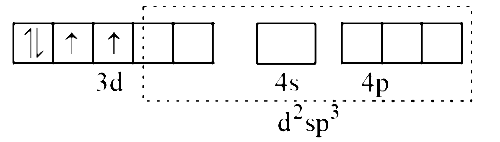
Pick out the correct statement with respect to [Mn(CN)6]3.
(A)
It is sp3d2 hybridised and tetrahedral.
(B)
It is d2sp3 hybridised and octahedral.
(C)
It is dsp2 hybridised and square planar.
(D)
It is sp3d2 hybridised and octahedral.
(B)

Solution

25Mn = [Ar] 3d54s2

Mn+3 = [Ar] 3d4

CN is a strong field ligand thus, it causes pairing of electrons in 3d-orbital. NEET 2017 Chemistry - Coordination Compounds Question 102 English Explanation
As, coordination number of Mn = 6, so it will form an octahedral complex.
Q.27
Correct increasing order for the wavelengths of absorption in the visible region for the complexes of Co3+ is
(A)
[Co(H2O)6]3+, [Co(en)3]3+, [Co(NH3)6]3+
(B)
[Co(H2O)6]3+, [Co(NH3)6]3+, [Co(en)3]3+
(C)
[Co(NH3)6]3+, [Co(en)3]3+, [Co(H2O)6]3+
(D)
[Co(en)3]3+, [Co(NH3)6]3+, [Co(H2O)6]3+
(D)

Solution

Increasing order of wavelength of absorption is

0 = en > NH3 > H2

0 = E =

Thus, increasing order of wavelength of absorption is:

[Co(en)3]3+ [Co(NH3)6]3+ [Co(H2O)6]3+
Q.28
The correct order of the stoichiometries of AgCl formed when AgNO3 in excess is treated with the complexes : CoCl3.6NH3, CoCl3.5NH3, CoCl3.4NH3 respectively is
(A)
3AgCl, 1AgCl. 2AgCl
(B)
3AgCl, 2AgCl, 1AgCl
(C)
2AgCl, 3AgCl, 2AgCl
(D)
1AgCl, 3AgCl, 2AgCl
(B)

Solution

[Co(NH3)6]Cl3 + 3AgNO3 3AgCl + [Co(NH3)6](NO3)3

[Co(NH3)5Cl]Cl2 + 2AgNO3 2AgCl + [Co(NH3)5Cl](NO3)2

[Co(NH3)4Cl2]Cl + AgNO3 AgCl + [Co(NH3)4Cl2]NO3
Q.29
An example of a sigma bonded organometallic compound is
(A)
Grignard's reagent
(B)
ferrocene
(C)
cobaltocene
(D)
ruthenocene.
(A)

Solution

Grignard's reagent is an organometallic compound in which carbon atom is bonded to metal ion with sigma bond while in ruthenocene, ferrocene and cobaltocene are the organo metallic compounds in which carbon atom is attached to metal ion thorough -bonding.
Q.30
Which of the following is a sink for CO?
(A)
Microorganisms present in the soil
(B)
Oceans
(C)
Plants
(D)
Haemoglobin
(A)

Solution

Microorganisms present in the soil is a sink for CO.
Q.31
The correct statement regarding electrophile is
(A)
electrophile is a negatively charged species and form a bond by accepting a pair of electrons from another electrophile
(B)
electrophiles are generally neutral species and can form a bond by accepting a pair of electrons from a nucleophile
(C)
electrophile can be either neutral or positively charged species and can form a bond by accepting a pair of electrons from a nucleophile
(D)
electrophile is a negatively charged species and can form a bond by accepting a pair of electrons from a nucleophile.
(C)

Solution

Electrophile can be either neutral or positively charged species and can form a bond by accepting a pair of electrons from a nucleophile.
Q.32
The IUPAC name of the compound
NEET 2017 Chemistry - Some Basic Concepts of Organic Chemistry Question 99 English
(A)
5-formylhex-2-en-3-one
(B)
5-methyl-4-oxohex-2-en-5-al
(C)
3-keto-2-methylhex-5-enal
(D)
3-keto-2-methylhex-4-enal
(D)

Solution

NEET 2017 Chemistry - Some Basic Concepts of Organic Chemistry Question 99 English Explanation
Q.33
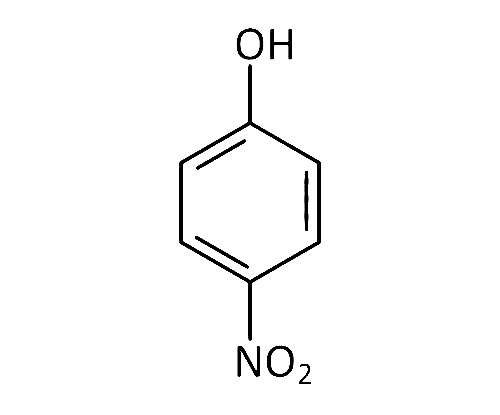
The most suitable method of separation of 1 : 1 mixture of ortho and para-nitrophenols is
(A)
chromatography
(B)
crystallisation
(C)
steam distillation
(D)
sublimation.
(C)

Solution

Steam distillation is the most suitable method of separation of 1 : 1 mixture of ortho and para nitrophenols as there is intramolecular hydrogen bonding in o-nitrophenol.
Q.34
Which one is the correct order of acidity?
(A)
CHCH > CH3 CCH
                    > CH2 CH2 > CH3CH3
(B)
CH CH > CH2 CH2
                    > CH3C CH > CH3 CH3
(C)
CH3CH3 > CH2 CH2
                    > CH3 C CH > CHCH
(D)
CH2CH2 > CH3 CH CH2
                    > CH3 C CH > CH CH
(A)

Solution

Greater the character of C-atom in hydrocarbons, greater the electronegativity of that carbon and thus greater the acidic nature of the H attached to electronegative carbon.

Thus CHCH > CH3 CCH
                    > CH2 CH2 > CH3CH3
Q.35
Predict the correct intermediate and product in the following reaction :

(A)
NEET 2017 Chemistry - Hydrocarbons Question 66 English Option 1
(B)
NEET 2017 Chemistry - Hydrocarbons Question 66 English Option 2
(C)
NEET 2017 Chemistry - Hydrocarbons Question 66 English Option 3
(D)
NEET 2017 Chemistry - Hydrocarbons Question 66 English Option 4
(C)

Solution

NEET 2017 Chemistry - Hydrocarbons Question 66 English Explanation
Q.36
With respect to the conformers of ethane, which of the following statements is true?
(A)
Bond angle changes but bond length remains same.
(B)
Both bond angle and bond length change.
(C)
Both bond angle and bond length remain same.
(D)
Bond angle remains same but bond length changes.
(C)

Solution

Conformers are the isomers which are formed by rotation about single bonds without any cleavage of any bond. These conformers have same bond angle between them and have same bond length while their dihedral angle changes.
Q.37
Identify and predict the type of reaction.
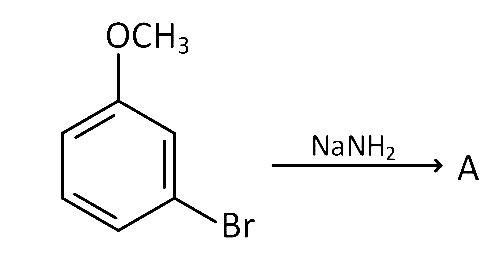
NEET 2017 Chemistry - Haloalkanes and Haloarenes Question 26 English
(A)
NEET 2017 Chemistry - Haloalkanes and Haloarenes Question 26 English Option 1
(B)
NEET 2017 Chemistry - Haloalkanes and Haloarenes Question 26 English Option 2
(C)
NEET 2017 Chemistry - Haloalkanes and Haloarenes Question 26 English Option 3
(D)
NEET 2017 Chemistry - Haloalkanes and Haloarenes Question 26 English Option 4
(D)

Solution

NEET 2017 Chemistry - Haloalkanes and Haloarenes Question 26 English Explanation
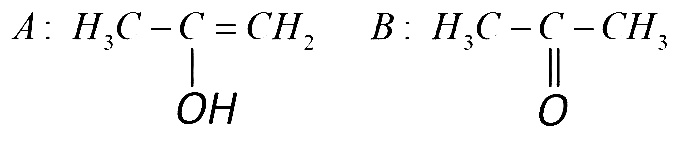
m-Bromoanisole gives only the respective meta substituted aniline. This is a substitution reaction which goes by an elimination-addition pathway.
Q.38
The heating of phenyl methyl ether with HI produces
(A)
iodobenzene
(B)
phenol
(C)
benzene
(D)
ethyl chloride.
(B)

Solution

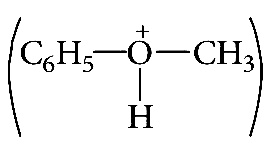
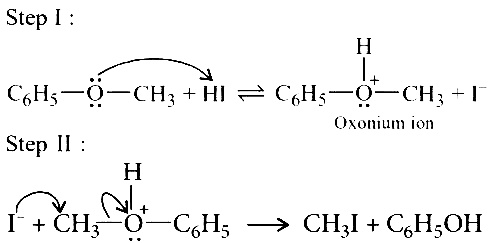
In case of phenyl methyl ether, methyl phenyl oxonium ion NEET 2017 Chemistry - Alcohol, Phenols and Ethers Question 53 English Explanation 1

is formed by protonation of ether. The O—CH3 bond is weaker than O—C6H5 bond as O—C6H5 has partial double bond character. Therefore, the attack by I– ion breaks O—CH3 bond to form CH3I. NEET 2017 Chemistry - Alcohol, Phenols and Ethers Question 53 English Explanation 2
Q.39
Which one is the most acidic compound?
(A)
NEET 2017 Chemistry - Alcohol, Phenols and Ethers Question 52 English Option 1
(B)
NEET 2017 Chemistry - Alcohol, Phenols and Ethers Question 52 English Option 2
(C)
NEET 2017 Chemistry - Alcohol, Phenols and Ethers Question 52 English Option 3
(D)
NEET 2017 Chemistry - Alcohol, Phenols and Ethers Question 52 English Option 4
(C)

Solution

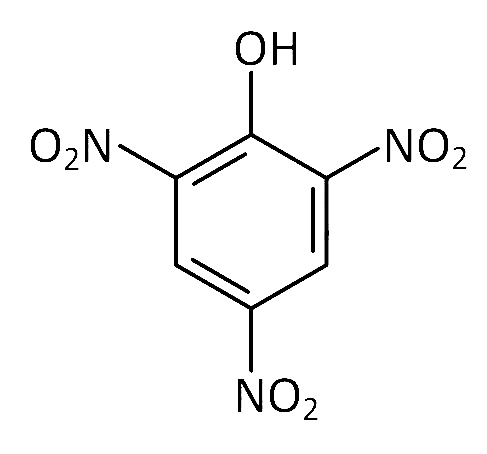
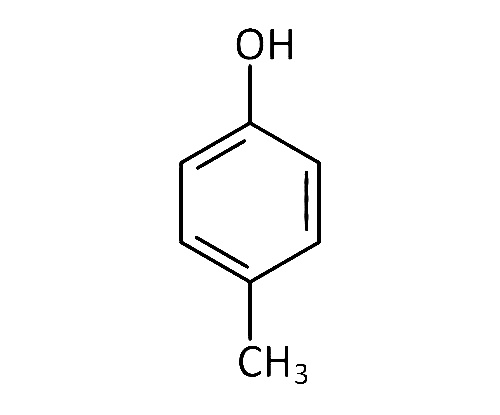
Electron withdrawing group at o and p-position w.r.t. OH group of phenol, increase the acidic strength.

Picric acid (2, 4, 6-trinitrophenol) is extremely more acidic among the given compounds due to the presence of three strong electron withdrawing groups ( NO2 group) at ortho and para-positions.
Q.40
Consider the reactions,
NEET 2017 Chemistry - Aldehydes, Ketones and Carboxylic Acids Question 76 English
Identify A, X, Y and Z.
(A)
A-Methoxymethane, X-Ethanol,
Y-Ethanoic acid, Z-Semicarbazide.
(B)
A-Ethanal, X-Ethanol,
Y-But-2-enal, Z-Semicarbazone.
(C)
A-Ethanol, X-Acetalfehyde,
Y-Butanone, Z-Hydrazone.
(D)
A-Methoxymethane, X-Ethanoic acid,
Y-Acetate ion, Z-Hydrazine.
(B)

Solution

Since, A gives silver mirror test, it must be an aldehyde and aldehydes are formed by oxidation of 1o alcohols. Thus, ‘X’ is a 1o alcohol, i.e., CH3CH2OH. NEET 2017 Chemistry - Aldehydes, Ketones and Carboxylic Acids Question 76 English Explanation
Q.41
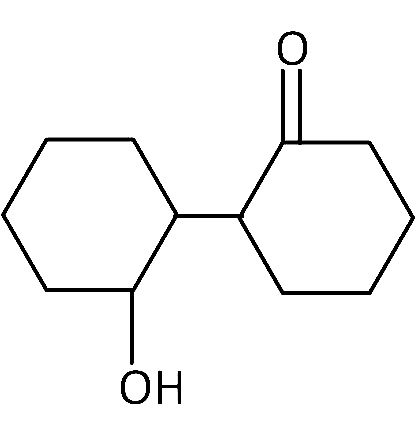
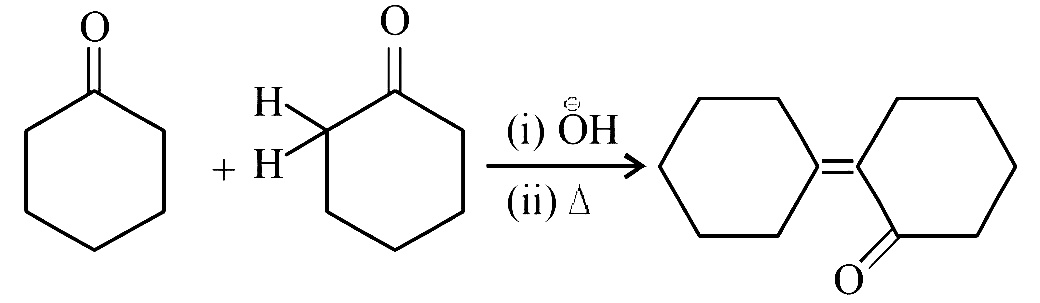
Of the following, which is the product formed when cyclohexanone undergoes aldol condensation followed by heating?
(A)
NEET 2017 Chemistry - Aldehydes, Ketones and Carboxylic Acids Question 77 English Option 1
(B)
NEET 2017 Chemistry - Aldehydes, Ketones and Carboxylic Acids Question 77 English Option 2
(C)
NEET 2017 Chemistry - Aldehydes, Ketones and Carboxylic Acids Question 77 English Option 3
(D)
NEET 2017 Chemistry - Aldehydes, Ketones and Carboxylic Acids Question 77 English Option 4
(A)

Solution

NEET 2017 Chemistry - Aldehydes, Ketones and Carboxylic Acids Question 77 English Explanation
Q.42
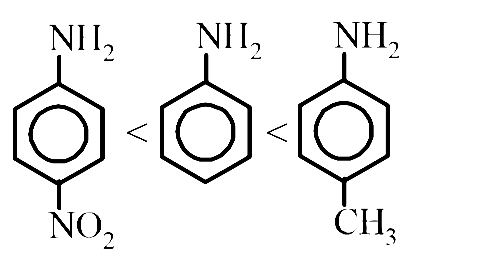
The correct increasing order of basic strength for the following compounds is
NEET 2017 Chemistry - Organic Compounds Containing Nitrogen Question 56 English
(A)
III < I < II
(B)
III < II < I
(C)
II < I < III
(D)
II < III < I
(C)

Solution

– NO2 group has strong – R effect and – CH3 shows +R effect.

Order of basic strength is

NEET 2017 Chemistry - Organic Compounds Containing Nitrogen Question 56 English Explanation
Q.43
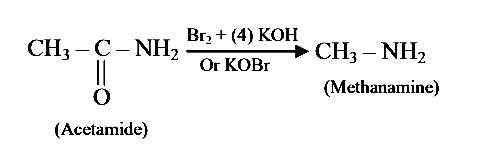
Which of the following reactions is appropriate for converting acetamide to methanamine?
(A)
Hoffmann hypobromamide reaction
(B)
Stephen's reaction
(C)
Gabriel phthalimide synthesis
(D)
Carbylamine reaction
(A)

Solution

NEET 2017 Chemistry - Organic Compounds Containing Nitrogen Question 55 English Explanation
It is called Hoffmann's hypobromamide reaction.
Q.44
Which of the following statements is not correct?
(A)
Ovalbumin is a simple food reserve in egg-white.
(B)
Blood proteins thrombin and fibrinogen are involved in blood clothing.
(C)
Denaturation makes the proteins more active.
(D)
Insulin maintains sugar level in the blood of a human body.
(C)

Solution

Denaturation changes the structure of a protein and protein loses its activity.
Q.45
Mixture of chloroxylenol and terpineol acts as
(A)
antiseptic
(B)
antipyretic
(C)
antibiotic
(D)
analgesic
(A)

Solution

Dettol which is a well known antiseptic is a mixture of chloroxylenol and -terpineol in a suitable solvent.
Biology (Maximum Marks: 364)
  • This section contains 91 questions.
  • Each question has FOUR options (A), (B), (C) and (D). ONLY ONE of these four options is the correct answer.
  • Full Marks : +4 If ONLY the correct option is chosen;
  • Zero Marks : 0 If none of the options is chosen (i.e. the question is unanswered);
  • Negative Marks : −1 In all other cases.
Q.1
Which of the following cell organelles is responsible for extracting energy from carbohydrates to form ATP?
(A)
Ribosome
(B)
Mitochondrion
(C)
Chloroplast
(D)
Lysosome
(B)

Solution

The site of aerobic oxidation of carbohydrates in cells to generate ATP are mitochondria.
Q.2
Which of the following are not polymeric?
(A)
Proteins
(B)
Polysaccharides
(C)
Lipids
(D)
Nucleic acids
(C)

Solution

– Nucleic acids are polymers of nucleotides
– Proteins are polymers of amino acids
– Polysaccharides are polymers of monosaccharides
– Lipids are the tri-esters of fatty acids with glycerol.
Q.3
Which of the following statements is correct with reference to enzymes?
(A)
Holoenzyme = Apoenzyme + Coenzyme
(B)
Coenzyme = Apoenzyme + Holoenzyme
(C)
Holoenzyme = Coenzyme + Co-factor
(D)
Apoenzyme = Holoenzyme + Coenzyme
(A)

Solution

Holoenzyme is the complete conjugate enzyme consisting of an apoenzyme and a cofactor. Cofactor may be organic or inorganic in nature. Organic cofactors are of two types-coenzyme and prosthetic group.
Q.4
Anaphase Promoting Complex (APC) is a protein degradation machinery necessary for proper mitosis of animal cell. If APC is defective in a human cell, which of the following is expected to occur?
(A)
Chromosomes will be fragmented.
(B)
Chromosomes will not segregate.
(C)
Recombination of chromosome arms will occur.
(D)
Chromosomes will not condense.
(B)

Solution

During anaphase, Anaphase Promoting Complex (APC) is a protein necessary for separation of daughter chromosomes. A defective APC will cause the chromosomes fail to segregate during anaphase.
Q.5
Which of the following options gives the correct sequence of events during mitosis?
(A)
Condensation    Nuclear membrane disassembly Arrangement at equator Centromere division Segregation Telophase
(B)
Condensation Crossing over Nuclear membrane disassembly Segregation Telophase
(C)
Condensation Arrangement at equator Centromere division Segregation Telophase
(D)
Condensation Nuclear membrane disassembly Crossing over Segregation Telophase
(A)

Solution

(a) The correct sequence of events occur during mitosis would be as follows
(i) DNA condensation occurs so that chromosomes become visible during early to mid-prophase.
(ii) Disassembly of nuclear membrane begins at late prophase or transition to metaphase.
(iii) Chromosomes align at equator during metaphase.
(iv) Centromere division occurs during anaphase forming daughter chromosomes.
(v) During anaphase segregation also occurs in which daughter chromosomes separate and move to opposite poles.
(vi) Telophase finally leads to formation of two daughter nuclei.
Q.6
Flowers which have single ovule in the ovary and are packed into inflorescence are usualy pollinated by
(A)
bee
(B)
wind
(C)
bat
(D)
water
(B)

Solution

Wind pollination or anemophily occurs in flowers which are having a single ovule in each ovary, and numerous flowers packed in an inflorescence. It is a non-directional pollination.
Q.7
Attractants and rewards are required for
(A)
entromophily
(B)
hydrophily
(C)
cleistogamy
(D)
anemophily.
(A)

Solution

Insect pollinated plants provide rewards as edible pollen grain and nectar as usual rewards. In order to materialize and maximize pollination flowers have developed a set of attributes which are aimed at attracting the pollinators called attractants.
Q.8
Double fertilisation is exhibited by
(A)
algae
(B)
fungi
(C)
angiosperms
(D)
gymnosperms.
(C)

Solution

Double fertilisation is the characteristic feature of angiosperms. Here, two male gametes are released in the embryo sac or female gametophyte. One male gamete fuses with the egg cell to form zygote that gives rise to embryo whereas the other male gamete fuses with the secondary nucleus to form primary endosperm nucleus (PEN) that gives rise to endosperm.
Q.9
Functional megaspore in an angiosperm develops into an
(A)
endosperm
(B)
embryo sac
(C)
embryo
(D)
ovule.
(B)

Solution

In angiosperms, the functional megaspore is the first cell of female gametophyte. It enlarges and undergoes three nuclear mitotic divisions to form embryo sac.
Q.10
A dioecious flowering plant prevents both
(A)
autogamy and geitonogamy
(B)
geitonogamy and xenogamy
(C)
cleistogamy and xenogamy
(D)
autogamy and xenogamy.
(A)

Solution

Autogamy occurs in bisexual flowers. Geitonogamous flowers are unisexual but present in the same plant. Dioecious condition is observed when unisexual male and female flowers are present on different plants and it prevents both autogamy and geitonogamy.
Q.11
Which of the following is correctly matched for the product produced by them ?
(A)
Acetobacter aceti : Antibiotics
(B)
Penicillium notatum : Acetic acid
(C)
Methanobacterium : Lactic acid
(D)
Sacchromyces cerevisiae : Ethanol
(D)

Solution

Saccharomyces cerevisiae commonly know as Brewer’s yeast, causes fermentation of carbohydrates and produces ethanol.
Q.12
Which of the following in sewage treatment removes suspended solids ?
(A)
Secondary treatment
(B)
Tertiary treatment
(C)
Primary treatment
(D)
Sludge treatment
(C)

Solution

Primary treatment is a physical process which involves two process, i.e. filtration and sedimentation of big solid waste.
Q.13
Select the mismatch :
(A)
Rhodospirillum - Mycorrhiza
(B)
Anabaena - Nitrogen fixer
(C)
Rhizobium - Alfalfa
(D)
Frania - Alnus
(A)

Solution

Rhodospirillum is facultative anaerobe and free living nitrogen fixer. Mycorrhiza show symbiotic relationship between fungi and roots of higher plants.
Q.14
Which of the following is made up of dead cells ?
(A)
Collenchyma
(B)
Xylem parenchyma
(C)
Phellem
(D)
Phloem
(C)

Solution

Cork cambium undergoes periclinal division and cuts off thick walled suberised dead cells towards outside i.e. phellem (cork) and it cuts off thin walled living cells i.e., phelloderm on inner side.
Q.15
Identify the wrong statement in context of heartwood :
(A)
It is highly durable.
(B)
It comprises dead elements with highly lignified walls
(C)
It conducts water and minerals efficiently
(D)
Organic compounds are deposited in it
(C)

Solution

Heartwood is inactive physiologically due to deposition of organic compounds and formation of tyloses so it will not conduct water and minerals.
Q.16
Root hairs develop from the region of :
(A)
Meristematic activity
(B)
Root cap
(C)
Maturation
(D)
Elongation
(C)

Solution

In roots, the root hairs develops from zone of maturation. This zone is differentiated zone thus bearing root hairs.
Q.17
The vascular cambium normally gives rise to :
(A)
Primary phloem
(B)
Secondary xylem
(C)
Periderm
(D)
Phelloderm
(B)

Solution

Cells of vascular cambium divide periclinally both on the outer and inner sides to form secondary permanent tissues, i.e., secondary xylem and secondary phloem.
Q.18
Which of the following facilitates opening of stomatal aperture?
(A)
Decrease in turgidity of guard cells
(B)
Radial orientation of cellulose microfibrils in the cell wall of guard cells
(C)
Longitudinal orientation of cellulose microfibrils in the cell wall of guard cells
(D)
Contraction of outer wall of guard cells
(B)

Solution

Cellulose microfibrils are arranged radially rather than longitudinally which makes easy for the stomata to open.
Q.19
The water potential of pure water is
(A)
less than zero
(B)
more than zero but less than one
(C)
more than one
(D)
zero
(D)

Solution

By convention, the water potential of pure water at standard temperature, which is not under any pressure, is taken to be zero. (Ψw = 0)
Q.20
Which statement is wrong for Krebs' cycle?
(A)
There is one point in the cycle where FAD+ is reduced to FADH2.
(B)
During conversion of succinyl CoA to succinic acid, a molecule of GTP is synthesised.
(C)
The cyclic starts with condensation of acetyl group (acetyl CoA) with pyruvic acid to yield citric acid.
(D)
There are three points in the cycle where NAD+ is reduced to NADH + H+.
(C)

Solution

Krebs cycle begins with condensation of acetyl CoA (2C) with oxaloacetic acid (4C) to form citric acid (6C).
Q.21
The DNA fragments separated on an agarose gel can be visualised after staining with
(A)
Bromophenol blue
(B)
Aniline blue
(C)
Ethidium bromide
(D)
Acetocarmine
(C)

Solution

Ethidium bromide (Et Br) is used to stain the DNA fragments and will appear as orange coloured bands when kept under UV light.
Q.22
What is the criterion for DNA fragments movement on agarose gel during gel electrophoresis ?
(A)
Positively charged fragment move to farther end
(B)
Negatively charged fragments do not move
(C)
The smaller the fragment size, the farther it moves
(D)
The larger the fragment size, the farther it moves
(C)

Solution

DNA fragments during gel electrophoresis, separate (resolve) according to their size due to sieving effect provided by agarose gel.
Q.23
DNA fragments are
(A)
Positively charged
(B)
Either positively or negatively charged depending on their size
(C)
Neutral
(D)
Negatively charged
(D)

Solution

DNA fragments are negatively charged because of presence of phosphate group.
Q.24
A gene whose expression helps to identify transformed cell is known as
(A)
Selectable marker
(B)
Plasmid
(C)
Vector
(D)
Structural gene
(A)

Solution

Selectable markers in recombinant DNA technology, helps in identification and elimination of non-transformants and selectively permits the growth of the transformants.
Q.25
The process of separation and purification of expressed protein before marketing is called :
(A)
Upstream processing
(B)
Bioprocessing
(C)
Downstream processing
(D)
Postproduction processing
(C)

Solution

The various stages of processing that occur after the completion of fermentation or biosynthetic stage which include separation and purification of product called downstream processing.
Q.26
Which one of the following is related to Ex-situ conservation of threatened animals and plants ?
(A)
Biodiversity hot spots
(B)
Himalayan region
(C)
Amazon rainforest
(D)
Wildlife Safari Parks
(D)

Solution

Ex-situ conservation is offsite strategy for conservation of biological diversity in zoological park and botanical gardens respectively.
Q.27
Alexander Von Humbolt described for the first time :
(A)
Laws of limiting factor
(B)
Population Growth equation
(C)
Species area relationships
(D)
Ecological Biodiversity
(C)

Solution

Alexander Von Humboldt noticed that within a region species richness increases with the increase in area.
Q.28
The region of Biosphere Reserve which is legally protected and where no human activity is allowed is known as :
(A)
Transition zone
(B)
Restoration zone
(C)
Buffer zone
(D)
Core zone
(D)

Solution

Core zone or Natural zone area of a biosphere reserve is undisturbed and legally protected ecosystem. No human activity is allowed in this zone. Little human activity is allowed in the buffer zone whereas in transition zone, an active cooperation is present between reserve management and local people for activities like settlements, cropping, etc. Restoration region is degraded area which is selected for restoration to near natural form.
Q.29
Which of the following are found in extreme saline conditions?
(A)
Eubacteria
(B)
Cyanobacteria
(C)
Mycobacteria
(D)
Archaebacteria
(D)

Solution

Halophiles, a type of archaebacteria, usually occur in extreme saline conditions like salt pans, salt beds and salt marshes
Q.30
Viroids differ from viruses in having
(A)
DNA molecules without protein coat
(B)
RNA molecules with protein coat
(C)
RNA molecules without protein coat
(D)
DNA molecules with protein coat
(C)

Solution

Viroids are free RNA particles that lack protein coat. They are infectious agents smaller than viruses.
Q.31
Which among the following are the smallest living cells, known without a definite cell wall, pathogenic to plants as well as animals and can survise without oxygen?
(A)
Pseudomonas
(B)
Mycoplasma
(C)
Nostoc
(D)
Bacillus
(B)

Solution

Mycoplasmas are smallest, prokaryotes lacking cell wall and are pleomorphic in nature. These are pathogenic to both plants and animals.
Q.32
Which of the following components provides sticky character to the bacterial cell?
(A)
Nuclear membrane
(B)
Plasma membrane
(C)
Glycocalyx
(D)
Cell wall
(C)

Solution

Glycocalyx is the outermost mucilage layer of the cell envelope which consists of non-cellulosic polysaccharides with or without proteins. It gives sticky character to the cell.
Q.33
DNA replication in bacteria occurs
(A)
within nucleolus
(B)
prior to fission
(C)
just before transcription
(D)
during S phase
(B)

Solution

In bacteria DNA replication occurs in cytoplasm prior to fission. Prokaryotes due to their primitive nature do not show well marked S-phase.
Q.34
The morphological nature of the edible part of coconut is
(A)
cotyledon
(B)
endosperm
(C)
pericarp
(D)
perisperm.
(B)

Solution

The edible part of coconut is its endosperm. Coconut has double endosperm, liquid endosperm and cellular.
Q.35
In Bougainvillea, throns are the modifications of
(A)
adventitious root
(B)
stem
(C)
leaf
(D)
stipules.
(B)

Solution

Thorns are hard, pointed straight structures for protection against grazing animal. These are modified stem.
Q.36
Coconut fruit is a
(A)
berry
(B)
nut
(C)
capsule
(D)
drupe.
(D)

Solution

Coconut fruit is a drupe. A drupe is a fleshy fruit with thin skin and central stone containing the seed.
Q.37
With reference to factors affecting the rate of photosynthesis, which of the following statements is not correct?
(A)
Increasing atmospheric CO2 concentration up to 0.05% can enhance CO2 fixation rate.
(B)
C3 plants respond to higher temperature with enhanced photosynthesis while C4 plants have much lower temperature optimum.
(C)
Tomato is a greenhouse crop which can be grown in CO2 -enriched atmosphere for higher yield.
(D)
Light saturation for CO2 fixation occurs at 10% of full sunlight.
(B)

Solution

C4 plants respond to higher temperature with enhanced photosynthesis while C3 plants have lower temperature optimum.
Q.38
Phosphoenol pyruvate (PEP) is the primary CO2 acceptor in
(A)
C4 plants
(B)
C2 plants
(C)
C3 and C4 plants
(D)
C3 plants
(A)

Solution

In the mesophyll cells cytoplasm of C4 plants like sugarcane, maize, sorghum etc. PEP is 3C compound which serves as primary CO2 acceptor.
Q.39
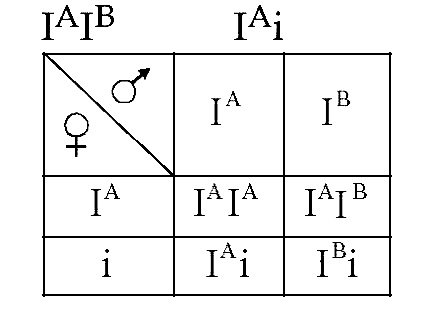
The genotypes of a Husband and Wife are IAIB and IAi.
Among the blood types of their children, how many different genotypes and phenotypes are possible?
(A)
4 genotypes ; 3 phenotypes
(B)
4 genotypes ; 4 phenotypes
(C)
3 genotypes ; 4 phenotypes
(D)
3 genotypes ; 3 phenotypes
(A)

Solution

Husband × Wife
NEET 2017 Biology - Principles of Inheritance and Variation Question 174 English Explanation Number of genotypes = 4
Number of phenotypes = 3
IAIA and IAi = A IAIB = AB
IBi = B
Q.40
Which one from those given below is the period for Mendel’s hybridisation experiments ?
(A)
1870 – 1877
(B)
1857 – 1869
(C)
1840 – 1850
(D)
1856 – 1863
(D)

Solution

The correct period for Mendel's hybridization experiments is Option D, 1856 – 1863. Gregor Mendel conducted his experiments on plant hybridization using pea plants between these years. During this period, he meticulously crossbred peas and observed the inheritance patterns of certain traits, which led to the formation of the fundamental laws of genetics, known as Mendel's Laws of Inheritance.

Q.41
Among the following characters, which one was not considered by Mendel in his experiments on pea?
(A)
Stem-Tall or dwarf
(B)
Pod-Inflated or constricted
(C)
Trichomes-Glandular or non-glandular
(D)
Seed-Green or yellow
(C)

Solution

During his experiments Mendel have taken seven characters in a pea plant. In which nature of trichomes i.e., glandular or non-glandular was not considered by Mendel.
Q.42
Thalassemia and sickle cell anemia are caused due to a problem in globin molecule synthesis. Select the correct statement.
(A)
Both are due to a qualitative defect in globin chain synthesis
(B)
Thalassemia is due to less synthesis of globin molecules
(C)
Sickle cell anemia is due to a quantitative problem of globin molecules
(D)
Both are due to a quantitative defect in globin chain synthesis
(B)

Solution

Sickle cell anaemia is caused due to point mutation in which at the 6th position of beta globin chain, glutamic acid is replaced by valine. Thus, it is a qualitative defect in functioning of globin molecules. Thalassemia is caused due to either mutation or deletion which ultimately results in reduced rate of synthesis of one of the globin chains that make up haemoglobin. Hence, it is a quantitative defect in functioning of globin molecules.
Q.43
A disease caused by an autosomal primary non-disjunction is :
(A)
Klinefelter's Syndrome
(B)
Down's Syndrome
(C)
Turner's Syndrome
(D)
Sickle Cell Anemia
(B)

Solution

Down’s syndrome is caused by nondisjunction of 21st chromosome i.e. Trisomy
Q.44
The final proof for DNA as the genetic material came from the experiments of
(A)
Griffith
(B)
Hargobind Khorana
(C)
Avery, Mcleod and McCarty
(D)
Hershey and chase
(D)

Solution

Hershey and Chase proved that DNA as genetic material. They used bacteriophage for their experiment.
Q.45
Spliceosomes are not found in cells of :
(A)
Bacteria
(B)
Plants
(C)
Animals
(D)
Fungi
(A)

Solution

Spliceosomes helps in removal of introns. They will not occur in prokaryotes because prokaryotes do not have introns and thus, processing does not require splicing of mRNA.
Q.46
Which of the following RNAs should be most abundant in animal cell ?
(A)
m-RNA
(B)
mi-RNA
(C)
r-RNA
(D)
t-RNA
(C)

Solution

Ribosomal RNA (rRNA) is most abundant in animal cell. It constitutes 80% of total RNA of the cell.
Q.47
During DNA replication, Okazaki fragments are used to elongate
(A)
The leading strand away from replication fork
(B)
The lagging strand towards replication fork
(C)
The lagging strand away from the replication fork
(D)
The leading strand towards replication fork
(C)

Solution

Two DNA polymerase molecules simultaneously work at the DNA fork, one on the leading strand and the other on the lagging strand.

DNA polymerase synthesizes each Okazaki fragment at lagging strand in 5′-3′ direction. As the replication fork opens further, new Pkazaki fragments appear. The first Okazaki fragment appears away from the replication fork and thus the direction of elongation would be away from replication fork.
Q.48
If there are 999 bases in an RNA that codes for a protein with 333 amino acids, and the base at position 901 is deleted such that the length of the RNA becomes 998 bases, how many codons will be altered ?
(A)
1
(B)
11
(C)
333
(D)
33
(D)

Solution

If deletion happen at 901st position than the remaining 98 bases specifying for 33 codons of amino acids will be altered.
Q.49
The association of histone H1 with a nucleosome indicates :
(A)
DNA replication is occurring
(B)
Transcription is occurring
(C)
The DNA is condensed into a Chromatin Fibre
(D)
The DNA double helix is exposed
(C)

Solution

Histones help in packaging of DNA. In eukaryotes, DNA packaging is carried out with the help of positively charged basic proteins called histones. Histones are of five types – H1 , H2A, H2B, H3 and H4 . H1 is attached over the linker DNA. Histone contains a large proportion of the positively charged (basic) amino acids, lysine and arginine in their structure. DNA is negatively charged due to the phosphate groups on its backbone. The result of these opposite charges is strong attraction and therefore, high binding affinity between histones and DNA.
Q.50
Homozygous purelines in cattle can be obtained by :
(A)
mating of related individuals of same breed
(B)
mating of individuals of different species
(C)
mating of individuals of different breed
(D)
mating of unrelated individuals of same breed
(A)

Solution

Inbreeding increases homozygosity. So, mating of the related individuals of same breed will give homozygous purelines.
Q.51
Artificial selection to obtain cows yielding higher milk output represents :
(A)
directional as it pushes the mean of the character in one direction
(B)
stabilizing followed by disruptive as it stabilizes the population to produce higher yielding cows.
(C)
disruptive as it splits the population into two, one yielding higher output and the other lower output.
(D)
stabilizing selection as it stabilizes this character in the population.
(A)

Solution

Artificial selection to obtain cow yielding higher milk output will shift the peak to one direction, so this represent an example of Directional selection. In stabilizing selection, the organisms with the mean value of the trait are selected. In disruptive selection, both extremes get selected.
Q.52
Presence of plants arranged into well defined vertical layers depending on their height can be seen best in :
(A)
Grassland
(B)
Tropical Savannah
(C)
Temperate Forest
(D)
Tropical Rain Forest
(D)

Solution

The tropical rain forest have five vertical strata on the basis of plants height i.e., ground vegetation, shrubs, short canopy trees, tall canopy trees and tall emergent trees.
Q.53
Asymptote in a logistic growth curve is obtained when :
(A)
K > N
(B)
The value of 'r' approaches zero
(C)
K< N
(D)
K = N
(D)

Solution

Asymptote in a logistic growth curve is obtained when population density (N) reaches the carrying capacity (K), i.e., N = K.
Q.54
Mycorrhizae are the example of :
(A)
Fungistasis
(B)
Antibiosis
(C)
Mutualism
(D)
Amensalism
(C)

Solution

Mycorrhizae is a symbiotic association between fungi and roots of higher plants.
Q.55
Plants which produce characteristic pneumatophores and show vivipary belong to :
(A)
Halophytes
(B)
Psammophytes
(C)
Hydrophytes
(D)
Mesophytes
(A)

Solution

Halophytes growing in saline soils show vivipary for seed germination and have pneumatophores for gaseous exchange.
Q.56
Which one of the following statements is not valid for aerosols ?
(A)
They alter rainfall and monsoon patterns
(B)
They have negative impact on agricultural land
(C)
They cause increased agricultural productivity
(D)
They are harmful to human health
(C)

Solution

Aerosols through its direct or indirect effects on plants can cause various problems in agriculture. However, continuous increase in air pollution may represent a threat to agriculture in the future that is persistent and largely irreversible.
Q.57
An example of colonial alga is
(A)
Volvox
(B)
Ulothrix
(C)
Spirogyra
(D)
Chlorella
(A)

Solution

Volvox is motile colonial fresh water green alga. It forms spherical colonies.
Q.58
Zygotic meiosis is characteristic of
(A)
Fucus
(B)
Funaria
(C)
Chlamydomonas
(D)
Marchanita.
(C)

Solution

In Chlamydomonas, zygote divides by meiosis. It exhibits haplontic type of life cycle.
Q.59
Life cycles of Ectocarpus and Fucus respectively are
(A)
diplontic, haplodiplontic
(B)
haplodiplontic, diplontic
(C)
haplodiplontic, haplontic
(D)
haplontic, diplontic.
(B)

Solution

Ectocarpus possesses haplodiplontic whereas Fucus possesses diplontic life cycle.
Q.60
Select the mismatch
(A)
Cycas            Dioecious
(B)
Salvinia            Heterosporous
(C)
Equisetum            Homosporous
(D)
Pinus            Dioecious
(D)

Solution

Pinus is monoecious plant comprising of both male and female cones on same plant
Q.61
Fruit and leaf drop at early stages can be prevented by the application of
(A)
ethylene
(B)
auxins
(C)
gibberellic acid
(D)
cytokinins.
(B)

Solution

In low concentrations, auxins such as 2, 4- D(2,4- Dichlorophenoxy acetic acid) is useful in preventing pre-harvest fruit drop and leaf drop.
Q.62
Which ecosystem has the maximum biomass ?
(A)
Pond ecosystem
(B)
Lake ecosystem
(C)
Grassland ecosystem
(D)
Forest ecosystem
(D)

Solution

Forest ecosystem has the maximum biomass.
Some very high productive ecosystem are
– Tropical rain forest
– Coral reef
– Estuaries
– Sugarcane fields
Q.63
Transplantation of tissues/ organs fails often due to non-acceptance by the patient's body. Which type of immuneresponse is responsible for such rejections ?
(A)
Cell-mediated immune response
(B)
Physiological immune response
(C)
Hormonal immune response
(D)
Autoimmune response
(A)

Solution

Cell mediated immune response causes non-acceptance or rejection of graft or transplanted tissues/organs.
Q.64
MALT constitutes about ________ percent of the lymphoid tissue in human body
(A)
20%
(B)
70%
(C)
10%
(D)
50%
(D)

Solution

MALT or Mucosa Associated Lymphoid Tissue constitutes about 50 percent of the lymphoid tissue in human body. It is scattered along mucosal lining in the human body
Q.65
The hepatic portal vein drains blood to liver from
(A)
stomach
(B)
kidneys
(C)
intestine
(D)
heart.
(C)

Solution

In hepatic portal system, hepatic portal vein drains blood to liver from intestine.
Q.66
Adult human RBCs are enucleate. Which of the following statement(s) is/are most appropriate explanation for this feature?
(1)  They do not need to reproduce.
(2)  They are somatic cells.
(3)  They do not metabolise.
(4)  All their internal space is available for oxygen transport.
(A)
Only (1)
(B)
(1), (3) and (4)
(C)
(2) and (3)
(D)
Only (4)
(D)

Solution

Red blood cells of adult humans do not have cell organelles including nucleus, Golgi bodies, mitochondria, ribosomes, etc. It increases the surface area of RBCs and enables them to contain more haemoglobin (the oxygen carrying pigment).
Q.67
Out of 'X' pairs of ribs in humans only 'Y' pairs are true ribs. Select the option that correctly represents values of X and Y and provides their explanation.
(A)
X=12, Y=5

  
True ribs are attached dorsally
to vertebral column and sternum
on the two ends
(B)
X=24, Y=2

The true ribs are dorsally attached
to vertebral column but are free on
ventral side
(C)
X=24, Y=12


True ribs are dorsally attached
to vertebral column but are free on
ventral side
(D)
X=12, Y=7


True ribs are attached dorsally to
vertebral column and ventrally to
the sternum
(D)

Solution

In human, 12 pairs of ribs are present out of which 7 pairs of ribs (1st to 7th pair) are dorsally attached to vertebral column and ventrally to the sternum.
Q.68
The pivot joint between atlas and axis is a type of
(A)
cartilaginous joint
(B)
synovial joint
(C)
saddle joint
(D)
fibrous joint.
(B)

Solution

Pivot joint is a type of synovial joint which provide freely movement between atlas and axis vertebrae of vertebral column.
Q.69
Receptor sites for neurotransmitters are present on
(A)
pre-synaptic membrane
(B)
tips of axons
(C)
post-synaptic membrane
(D)
membranees of synaptic vesicles.
(C)

Solution

Pre-synaptic membrane is involved in the release of neurotransmitter in the chemical synapse. The receptors sites for neurotransmitters are present on postsynaptic membrane of neuron.
Q.70
Myelin sheath is produced by
(A)
astrocytes and Schwann cell
(B)
oligodendrocytes and osteoclasts
(C)
osteoclasts and astrocytes
(D)
Schwann cells and oligodendrocytes.
(D)

Solution

Myelin sheath wrapped around the nerve axon. Oligodendrocytes are neuroglial cells which produce myelin sheath in central nervous system while Schwann cell produces myelin sheath in peripheral nervous system.
Q.71
Good vishion depends on adequate intake of carotene rich food.

Select the best option from the following statements.
(1)  Vitamins A derivatives are formed from carotene,
(2)  The photopigments are embedded in the membrane discs of the inner segment.
(3)  Retinal is a derivative of vitamin A.
(4)  Retinal is a light absorbing part of all the visual photopigments.
(A)
(1), (3) and (4)
(B)
(1) and (3)
(C)
(2), (3) and (4)
(D)
(1) and (2)
(A)

Solution

Vitamins A derivatives are formed from carotene which is a type of pigment that is found in certain foods, such as carrots, sweet potatoes, and spinach. The body converts carotene into vitamin A, which is essential for good vision.

Retinal is a derivative of vitamin A and it is a light-absorbing part of all the visual photopigments. Photopigments are embedded in the membrane discs of the inner segment of the rod and cone cells in the retina.

Therefore, options (1), (3), and (4) are correct.
Q.72
The function of copper ions in copper releasing IUD's is :
(A)
They suppress sperm motility and fertilising capacity of sperms.
(B)
They inhibit gametogenesis.
(C)
They make uterus unsuitable for implantation
(D)
They inhibit ovulation
(A)

Solution

Cu2+ interfere in the sperm movement, which suppress the sperm motility and fertilising capacity of sperms.
Q.73
Match the following sexually transmitted diseases (Column – I) with their causative agent (Column – II) and select the correct option

Column – I Column – II
(a) Gonorrhea (i) HIV
(b) Syphilis (ii) Neisseria
(c) Genital Warts (iii) Treponema
(d) AIDS (iv) Human papilloma – virus
(A)
(a) - (iii). (b) - (iv), (c) - (ii), (d) - (ii)
(B)
(a) - (iv). (b) - (ii), (c) - (iii), (d) - (i)
(C)
(a) - (ii). (b) - (iii), (c) - (iv), (d) - (i)
(D)
(a) - (iv). (b) - (iii), (c) - (ii), (d) - (i)
(C)

Solution

Gonorrhoea – Neisseria (Bacteria)
Syphilis – Treponema (Bacteria)
Genital Warts – Human papilloma virus
AIDS – HIV (Virus)
Q.74
In case of a couple where the male is having a very low sperm count, which technique will be suitable for fertilization ?
(A)
Artifical Insemination
(B)
Gamete intracytoplasmic fallopian transfer
(C)
Intracytoplasmic sperm injection
(D)
Intrauterine transfer
(A, C)

Solution

Infertility cases due to inability of the male partner to inseminate the female or due to very low sperm count in the ejaculates, could be corrected by using artificial insemination (AI) technique. In this procedure semen is injected directly into the vagina or uterus.
Q.75
Select the correct route for the passage of sperms in male frogs :
(A)
Testes Vasa efferentia Kidney Seminal vesicle Urinogenital duct Cloaca
(B)
Testes Vasa efferentia Bidder's canal Ureter Cloaca
(C)
Testes Vasa efferentia Kidney Bidder's canal Urinogenital duct Cloaca
(D)
Testes Bidder's canal Kidney Vasa efferentia Urinogenital duct Cloaca
(C)

Solution

The correct route for transport of sperms in male frog is Testes Vasa efferentia Kidney Bidder’s canal Urinogenital duct Cloaca.
Q.76
Frog’s heart when taken out of the body continues to beat for sometime. Select the best option from the following statements.
(a) Frog is a poikilotherm
(b) Frog does not have any coronary circulation
(c) Heart is “myogenic” in nature
(d) Heart is autoexcitable
(A)
Only (d)
(B)
(a) and (b)
(C)
Only (c)
(D)
(c) and (d)
(D)

Solution

The vertebrates process myogenic heart which is self contractile system or autoexcitable; it will thus keep working outside the body for some time.
Q.77
Which of the following options best represents the enzyme composition of pancreatic juice?
(A)
Amylase, Pepsin, Trypsinogen, Maltase
(B)
Peptidase, Amylase, Pepsin, Rennin
(C)
Lipase, Amylase, Trypsinogen, Procarbo-xypeptidase
(D)
Amylase, Peptidase, Trypsinogen, Rennin
(C)

Solution

Rennin and Pepsin enzymes are present in the gastric juice whereas Maltase is present in the intestinal juice.
Q.78
Which cells of 'Crypts of Lieberkuhn' secrete antibacterial lysozyme?
(A)
Paneth cells
(B)
Zymogen cells
(C)
Kupffer cells
(D)
Argentaffin cells
(A)

Solution

Paneth cells, present in the bottom of crypts of Lieberkuhn, are rich in zinc and contain acidophilic granules. There is evidence that these cells secrete antibacterial lysozyme. Zymogen cells or peptic cells are present in stomach and secrete pepsinogen. Kupffer cells are present in liver. They are phagocytic in nature and engulf disease causing microorganisms, dead cells, etc. Argentaffin cells, found in crypts of Lieberkuhn, synthesise hormone secretin and 5- hydroxytryptamine.
Q.79
A baby boy aged two years is admitted to play school and passes through a dental check-up. The dentist observed that the boy had twenty teeth. Which teeth were absent?
(A)
Canines
(B)
Pre-molars
(C)
Molars
(D)
Incisors
(B)

Solution

Total number of teeth in a human child is 20. In primary dentition premolars are absent.
Q.80
Which of the following statements is correct?
(A)
The descending limb of loop of Henle is impermeable to water
(B)
The ascending limb of loop of Henle is permeable to water.
(C)
The descending limb of loop of Henle is permeable to electrolytes.
(D)
The asecending limb of loop of Henle is impermeable to water.
(D)

Solution

Descending limb of loop of Henle is permeable to water but impermeable to electrolytes whereas ascending limb is impermeable to water but permeable to electrolytes.
Q.81
A decrease in blood pressure/volume will not cause the release of
(A)
atrial natriuretic factor
(B)
aldosterone
(C)
ADH
(D)
renin
(A)

Solution

Atrial natriuretic factor (ANF) is responsible for lowering of blood pressure and volume. The walls of the atria of the heart release ANF in response to an increase in blood volume and pressure. It opposes regulation by RAAS. It inhibits release of renin from JGA thereby inhibiting NaCl reabsorption by the collecting duct and reduces aldosterone release from adrenal gland.
Q.82
Hypersecretion of growth hormone in adults does not cause further increase in height, because
(A)
epiphyseal plates close after adolescence
(B)
bones loose their sensitivity to growth hormone in adults
(C)
muscle fibres do not grow in size after birth
(D)
growth hormone becomes inactive in adults.
(A)

Solution

Epiphyseal plate which is responsible for bone growth close after adolescence so hypersecretion of growth hormone in adults does not cause further increase in height. The epiphyseal plate is a hyaline cartilage plate in the metaphysis at each end of a long bone.
Q.83
GnRH, a hypothalamic hormone, needed in reproduction, acts on
(A)
anterior pituitary gland and stimulates secretion of LH and FSH
(B)
posterior pituitary gland and stimulates secretion of oxytocin and FSH
(C)
posterior pituitary gland and stimulates secretion of LH and relaxin
(D)
anterior pituitary gland and stimulates secretion of LH and oxytocin.
(A)

Solution

Gonadotropin releasing hormone (GnRH) is secreted by the hypothalamus which stimulates the anterior lobe of pituitary gland to secrete luteinising hormone (LH) and Follicle Stimulating Hormone (FSH).
Q.84
A temporary endocrine gland in the human body is
(A)
corpus cardiacum
(B)
corpus luteum
(C)
corpus allatum
(D)
pineal gland.
(B)

Solution

Corpus luteum is the temporary endocrine gland formed in the ovary after ovulation. It release hormones like progesterone, oestrogen etc.
Q.85
Capacitation occurs in
(A)
epididymis
(B)
vas deferens
(C)
female reproductive tract
(D)
rete testis.
(C)

Solution

The sperms in the female’s genital tract are made capable of fertilising the egg by secretions of the female genital tract. These secretions remove coating substances deposited on the surface of the sperms particularly those on the acrosome. Thus, the receptor sites on the acrosome are exposed and sperm becomes active to penetrate the egg. This phenomenon of sperm activation in mammals is known as capacitation.
Q.86
In case of poriferans, the spongocoel is lined with flagellated cells called
(A)
mesenchymal cells
(B)
oscula
(C)
ostia
(D)
choanocytes
(D)

Solution

In poriferans (sponges) choanocytes (collar cells) form lining of spongocoel. Flagella present in collar cells provide circulation to water in water canal system.
Q.87
In case of proiferans, the spongocoel is lined with flagellated cells called
(A)
oscula
(B)
choanocytes
(C)
mesenchymal cells
(D)
ostia.
(B)
Q.88
Which of the following represents order of 'Horse'?
(A)
Perissodactyla
(B)
Caballus
(C)
Ferus
(D)
Equidae
(A)

Solution

Horse belongs to :
Orders - Perissodactyla
Family - Equidae
Genus - Equus
Species - ferus
Subspecies - caballus
Q.89
Important characteristic that hemichordates share with chordates is
(A)
ventral tubular nerve cord
(B)
pharynx with gill slits
(C)
pharynx without gill slits
(D)
absence of motochord.
(B)

Solution

Pharyngeal gill slits are present in hemichordates and in chordates. Notochord is present in chordates only. Ventral tubular nerve cord is present in non-chordates.
Q.90
Which among these is the correct combination of aquatic mammals?
(A)
Dolphins, Seals, Trygon
(B)
Whales, Dolphins, Seals
(C)
Trygon, Whales, Seals
(D)
Seals, Dolphins, Sharks
(B)

Solution

Whales, dolphin and seals are examples of aquatic mammals. Trygon and sharks are cartilaginous fishes.
Q.91
Lungs are made up of air-filed sacs, the alveoli. The do not collapse even after forceful expiration, because of
(A)
inspiratory reserve volume
(B)
tidal volume
(C)
expiratory reserve volume
(D)
residual volume.
(D)

Solution

Residual volume is the volume of air which remains in the lungs after the most forceful expiration. This residual air enables the lungs to continue exchange of gases even after maximum exhalation. Due to this, lungs do not collapse even after forceful expiration.