NEET-UG 2018

NEET 2018

Physics (Maximum Marks: 180)
  • This section contains 45 questions.
  • Each question has FOUR options (A), (B), (C) and (D). ONLY ONE of these four options is the correct answer.
  • Full Marks : +4 If ONLY the correct option is chosen;
  • Zero Marks : 0 If none of the options is chosen (i.e. the question is unanswered);
  • Negative Marks : −1 In all other cases.
Q.1
A student measured the diameter of a small steel ball using a screw gauge of least count 0.001 cm. The main scale reading is 5 mm and zero of circular scale division coincides with 25 divisions above the reference level. If screw gauge has a zero error of –0.004 cm, the correct diameter of the ball is
(A)
0.521 cm
(B)
0.525 cm
(C)
0.053 cm
(D)
0.529 cm
(D)

Solution

Diameter of the ball

= MSR + CSR × (Least count) – Zero error

= 5 mm + 25 × 0.001 cm – (–0.004) cm

= 0.5 cm + 25 × 0.001 cm – (–0.004) cm = 0.529 cm.
Q.2
Which one of the following statements is incorrect?
(A)
Rolling friction is smaller than sliding friction.
(B)
Limiting value of static friction is directly proportional to normal reaction.
(C)
Frictional force opposes the relative motion.
(D)
Coefficient of sliding friction has dimensions of length.
(D)

Solution

We know,

F = N

MLT–2 = MLT–2

= M0L0T0

Coefficient of sliding friction has no dimension.
Q.3
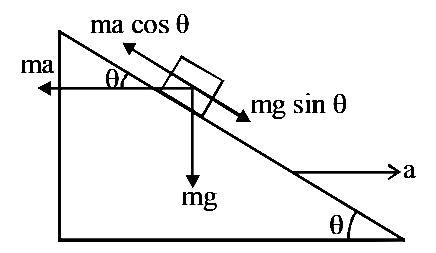
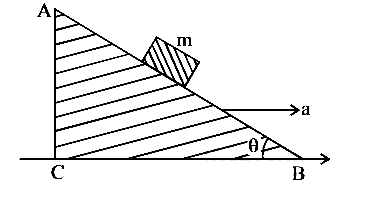
A block of mass m is placed on a smooth inclined wedge ABC of inclination q as shown in the figure. The wedge is given an acceleration ‘a’ towards the right. The relation between a and q for the block to remain stationary on the wedge is NEET 2018 Physics - Laws of Motion Question 15 English
(A)
(B)
(C)
(D)
(D)

Solution

NEET 2018 Physics - Laws of Motion Question 15 English Explanation
At equilibrium

ma cos = mg sin

a = g tan
Q.4
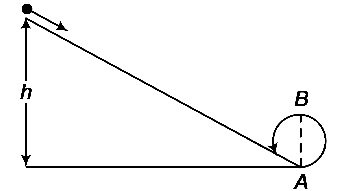
A body initially at rest and sliding along a frictionless track from a height h (as shown in the figure) just completes a vertical circle of diameter AB = D. The height h is equal to NEET 2018 Physics - Work, Energy and Power Question 15 English
(A)
D
(B)
(C)
(D)
(D)

Solution

Since from the given figure, in order to complete the vertical circle, velocity at the bottom of vertical circle should be .

As body is at rest initially, i.e., speed = 0.
At point A, speed = v.
As track is frictionless, so total mechanical energy will remain constant.

0 + mgh = + 0

h =

For completing the vertical circle, v

h = = =
Q.5
A moving block having mass m, collides with another stationary block having mass 4m. The lighter block comes to rest after collision. When the initial velocity of the lighter block is v, then the value of coefficient of restitution (e) will be
(A)
0.5
(B)
0.25
(C)
0.8
(D)
0.4
(B)

Solution

From the law of conservation of linear momentum,

momentum before collision = momentum after collision, so

mv + 4m × 0 = m × 0 + 4mv′

mv = 4mv′ or v = 4v′

Coefficient of restitution,

e = = 0.25
Q.6
A solid sphere is in rolling motion. In rolling motion a body possesses translational kinetic energy (Kt) as well as rotational kinetic energy (Kr) simultaneously. The ratio Kt : (Kt + Kr) for the sphere is
(A)
7 : 10
(B)
5 : 7
(C)
10 : 7
(D)
2 : 5
(B)

Solution

In rolling motion,

Translational kinetic energy, Kt =

Rotational kinetic energy, Kr =

Kt + Kr = +

=

=

=
Q.7
The moment of the force, at
(2, 0, –3), about the point (2, –2, –2), is given by
(A)
(B)
(C)
(D)
(D)

Solution

Given,

We know,
Moment of force,

Where

and

=

=


=

= (-12 + 5) - (+4) + (-8)

=
Q.8
A solid sphere is rotating freely about its symmetry axis in free space. The radius of the sphere is increased keeping its mass same. Which of the following physical quantities would remain constant for the sphere?
(A)
Angular velocity
(B)
Moment of inertia
(C)
Rotational kinetic energy
(D)
Angular momentum
(D)

Solution

As sphere is in free space and no external torque is acting over it so its angular momentum will remain constant.
Q.9
Three objects, A : (a solid sphere), B : (a thin circular disk) and C : (a circular ring), each have the same mass M and radius R. They all spin with the same angular speed about their own symmetry axes. The amounts of work (W) required to bring them to rest, would satisfy the relation
(A)
WC > WB > WA
(B)
WA > WB > WC
(C)
WB > WA > WC
(D)
WA > WC > WB
(A)

Solution

Work done required to bring them rest

W = KE (work-energy theorem)

W =

For same , W I

For a solid sphere, IA =

For a thin circular disk, IB =

For a circular ring, IC = MR2

IC > IB > IA

So, WC > WB > WA
Q.10
If the mass of the Sun were ten times smaller and the universal gravitational constant were ten times larger in magnitude, which of the following is not correct?
(A)
Raindrops will fall faster.
(B)
Walking on the ground would become more difficult.
(C)
Time period of a simple pendulum on the Earth would decrease.
(D)
g on the Earth will not change.
(D)

Solution

If universal gravitational constant becomes ten times, then G' = 10 G

Acceleration due to gravity, g =

So, acceleration due to gravity increases, hence ‘g’ on the Earth will not change is not correct.
Q.11
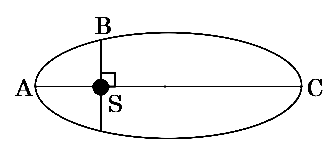
The kinetic energies of a planet in an elliptical orbit about the Sun, at positions A, B and C are KA, KB and KC, respectively. AC is the major axis and SB is perpendicular to AC at the position of the Sun S as shown in the figure. Then NEET 2018 Physics - Gravitation Question 22 English
(A)
KA < KB < KC
(B)
KA > KB > KC
(C)
KB < KA < KC
(D)
KB > KA > KC
(B)

Solution

Speed of the planet will be maximum when its distance from the sun is minimum as mvr = constant.
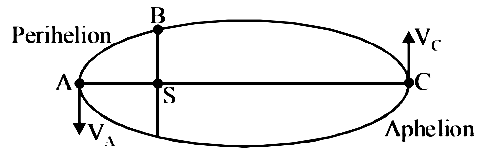
NEET 2018 Physics - Gravitation Question 22 English Explanation
Point A is perihelion and C is aphelion.

Clearly, VA > VB > VC

So, KA > KB > KC
Q.12
A small sphere of radius ‘r’ falls from rest in a viscous liquid. As a result, heat is produced due to viscous force. The rate of production of heat when the sphere attains its terminal velocity, is proportional to
(A)
r3
(B)
r2
(C)
r5
(D)
r4
(C)

Solution

Power = rate of production of heat = F.V

= 6rVT.VT = = 6rVT2

[ As F = 6rVT from stoke’s formula ]

Terminal velocity VT =

VT r2

Power 6r

Power r5
Q.13
Two wires are made of the same material and have the same volume. The first wire has cross-sectional area A and the second wire has cross-sectional area 3A. If the length of the first wire is increased by l on applying a force F, how much force is needed to stretch the second wire by the same amount?
(A)
6F
(B)
F
(C)
9F
(D)
4F
(C)

Solution

Let the wire 1 is of length = l and wire 2 of length =

Now area of wire 1 = A while area of wire 2 = 3A

For wire 1,
l = ....(i)

For wire 2, let F' force is applied

l = ....(2)

From equation (i) & (ii)

=

F' = 9F
Q.14
The power radiated by a black body is P and it radiates maximum energy at wavelength, 0 . If the temperature of the black body is now changed so that it radiates maximum energy at wavelength , the power radiated by it becomes nP. The value of n is
(A)
(B)
(C)
(D)
(C)

Solution

From Wien's law, maxT = constant

max1T1 = max2T2

0T1 = T2


According to Stefan-Boltzmann law, energy emitted
unit time by a black body is AeT4,

P T4

So =

Here, P2 = nP and P1 = P

So,
Q.15
The efficiency of an ideal heat engine working between the freezing point and boiling point of water, is
(A)
26.8%
(B)
20%
(C)
6.25%
(D)
12.5%
(A)

Solution

Efficiency of ideal heat engine,


Freezing point of water = 0oC = 273 K

Boiling point of water = 100oC = (100 + 273) K = 373 K

Sink temperature, T2 = 0oC = 0 + 273 = 273 K

Source temperature, T1 = 100oC = 100 + 273 = 373 K

Percentage efficiency, %

=

= = 26.8%
Q.16
A sample of 0.1 g of water at 100°C and normal pressure (1.013 × 10⁵ N m–2) requires 54 cal of heat energy to convert to steam at 100°C. If the volume of the steam produced is 167.1 cc, the change in internal energy of the sample, is
(A)
104.3 J
(B)
208.7 J
(C)
42.2 J
(D)
84.5 J
(B)

Solution

Using first law of thermodynamics,

Q = U + W

54 × 4.18 = U + 1.013 × 10⁵(167.1 × 10⁻⁶ – 0)

U = 208.7 J
Q.17
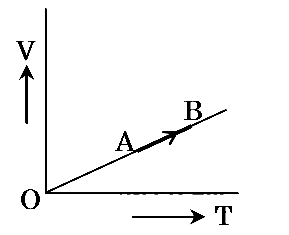
The volume (V) of a monatomic gas varies with its temperature (T), as shown in the graph. The ratio of work done by the gas, to the heat absorbed by it, when it undergoes a change from state A to state B, is NEET 2018 Physics - Heat and Thermodynamics Question 35 English
(A)
(B)
(C)
(D)
(A)

Solution

Gas is monatomic, so Cp =

Given process is isobaric.

dQ = nCpdT

or dQ = ndT

Also, dW = PdV = nRdT ( PV = nRT)

Required ratio = = =
Q.18
At what temperature will the rms speed of oxygen molecules become just sufficient for escaping from the Earth’s atmosphere?
(Given : Mass of oxygen molecule (m) = 2.76 × 10⁻²⁶ kg, Boltzmann’s constant kB = 1.38 × 10⁻²³ J K–1)
(A)
2.508 × 10⁴ K
(B)
8.360 × 10⁴ K
(C)
5.016 × 10⁴ K
(D)
1.254 × 10⁴ K
(B)

Solution

Escape velocity from the Earth’s surface is vescape = 11200 m s–1

Let at temperature T, rms speed of oxygen molecules become just sufficient for escaping from the Earth’s atmosphere.

Also, Vrms = Vescape =

11200 =

T = 8.360 × 10⁴ K
Q.19
A pendulum is hung from the roof of a sufficiently high building and is moving freely to and fro like a simple harmonic oscillator. The acceleration of the bob of the pendulum is 20 m s–2 at a distance of 5 m from the mean position. The time period of oscillation is
(A)
2 s
(B)
s
(C)
2 s
(D)
1 s
(B)

Solution

Given, acceleration, a = 20 m/s2,
and displacement, y = 5m

Magnitude of acceleration of a particle
moving in a SHM is, |a| = y; where y is amplitude.

20 = (5)

rad/s

Time period of pendulum,

T = = s
Q.20
A tuning fork is used to produce resonance in a glass tube. The length of the air column in this tube can be adjusted by a variable piston. At room temperature of 27°C two successive resonances are produced at 20 cm and 73 cm of column length. If the frequency of the tuning fork is 320 Hz, the velocity of sound in air at 27°C is
(A)
330 m s–1
(B)
339 m s–1
(C)
350 m s–1
(D)
300 m s–1
(B)

Solution

Two successive resonance are produced at 20 cm and 73 cm of column length

= (73 - 20) 10-2 m

= 2 (73 - 20) 10-2 m

Velocity of sound, v = n

= 2 320 (73 - 20) 10-2 m

= 339 m/s
Q.21
The fundamental frequency in an open organ pipe is equal to the third harmonic of a closed organ pipe. If the length of the closed organ pipe is 20 cm, the length of the open organ pipe is
(A)
13.2 cm
(B)
8 cm
(C)
12.5 cm
(D)
16 cm
(A)

Solution

For closed organ pipe, third harmonic

n = ( N = 2 )

For open organ pipe, fundamental frequenty

n = ( N = 1 )

Given, third harmonic for closed organ pipe = fundamental frequency for open organ pipe.


l' = = = = 13.33 cm
Q.22
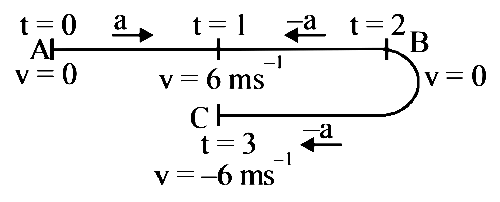
A toy car with charge q moves on a frictionless horizontal plane surface under the influence of a uniform electric field . Due to the force q , its velocity increases from 0 to 6 m s–1 in one second duration. At that instant the direction of the field is reversed. The car continues to move for two more seconds under the influence of this field. The average velocity and the average speed of the toy car between 0 to 3 seconds are respectively
(A)
2 m s–1, 4 m s–1
(B)
1 m s–1, 3 m s–1
(C)
1 m s–1, 3.5 m s–1
(D)
1.5 m s–1, 3 m s–1
(B)

Solution

NEET 2018 Physics - Electrostatics Question 28 English Explanation

Acceleration, a = = = 6 ms-2

For t = 0 to t = 1 s,

S1 = = 3 m ...(i)

For t = 1 s = to t = 2 s,

S2 = 6.1 - = 3 m ...(ii)

For t = 2 s to t = 3 s,

S3 = 0 - = -3 m ...(ii)

Total displacement S = S1 + S2 + S3 = 3 m

Average velocity = = 1 ms-1

Total distance travelled = 9 m

Average speed = = 3 ms-1
Q.23
An electron falls from rest through a vertical distance h in a uniform and vertically upward directed electric field E. The direction of electric field is now reversed, keeping its magnitude the same. A proton is allowed to fall from rest in it through the same vertical distance h. The time of fall of the electron, in comparison to the time of fall of the proton is
(A)
smaller
(B)
5 times greater
(C)
10 times greater
(D)
equal
(A)

Solution

Force experienced by a charged particle in an electric field, F = qE

As F = ma

ma = qE

a =

As electron and proton both fall from same height at rest. Then initial velocity = 0

From the formula, s = ut +

h =

h =

t =

t as ‘q’ is same for electron and proton.

Since, electron has smaller mass so it will take smaller time.
Q.24
A carbon resistor of (47 4.7) k is to be marked with rings of different colours for its identification. The colour code sequence will be
(A)
Violet – Yellow – Orange – Silver
(B)
Yellow – Violet – Orange – Silver
(C)
Yellow – Green – Violet – Gold
(D)
Green – Orange – Violet – Gold
(B)

Solution

Colour code for carbon resistor

0 - Black
1 - Brown
2 - Red
3 - Orange
4 - Yellow
5 - Green
6 - Blue
7 - Violet
8 - Grey
9 - White

Tolerance :
± 5% Gold
± 10% Silver
± 20% No colour

(47 4.7) k = 47 103 10%

Which shows the colour code Yellow – Violet – Orange – Silver.
Q.25
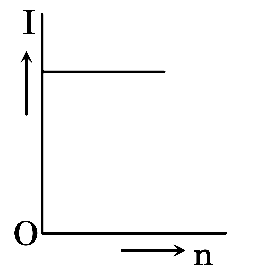
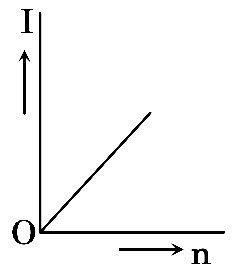
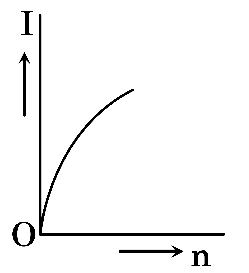
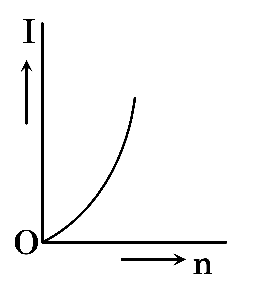
A battery consists of a variable number n of identical cells (having internal resistance r each) which are connected in series. The terminals of the battery are short-circuited and the current I is measured. Which of the graphs shows the correct relationship between I and n?
(A)
NEET 2018 Physics - Current Electricity Question 43 English Option 1
(B)
NEET 2018 Physics - Current Electricity Question 43 English Option 2
(C)
NEET 2018 Physics - Current Electricity Question 43 English Option 3
(D)
NEET 2018 Physics - Current Electricity Question 43 English Option 4
(A)

Solution

Current drawn from the cell is

I =
NEET 2018 Physics - Current Electricity Question 43 English Explanation

So, I is independent of n and I is constant.
Q.26
A set of n equal resistors, of value R each, are connected in series to a battery of emf E and internal resistance R. The current drawn is I. Now, the n resistors are connected in parallel to the same battery. Then the current drawn from battery becomes 10I. The value of n is
(A)
10
(B)
11
(C)
20
(D)
9
(A)

Solution

n series grouping equivalent resistance

Rseries = nR

In parallel grouping equivalent resistance

Rparallel =

Current drawn from a battery when n resistors are connected in series is

I = ......(i)

Current drawn from same battery when n resistors are connected in parallel is

10I = ......(ii)

On dividing eqn. (ii) by (i),

10 =

Solving we get, n = 10
Q.27
The electrostatic force between the metal plates of an isolated parallel plate capacitor C having a charge Q and area A, is
(A)
Independent of the distance between the plates
(B)
Linearly proportional to the distance between the plates
(C)
Proportional to the square root of the distance between the plates
(D)
Inversely proportional to the distance between the plates
(A)

Solution

In an isolated capacitor Q is constant, so an electrostatic force between metal plates is given as:

F = QE = Q = [ ]

F is independent of the distance between plates.
Q.28
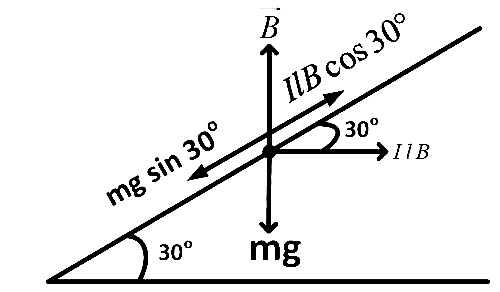
A metallic rod of mass per unit length 0.5 kg m–1 is lying horizontally on a smooth inclined plane which makes an angle of 30° with the horizontal. The rod is not allowed to slide down by flowing a current through it when a magnetic field of induction 0.25 T is acting on it in the vertical direction. The current flowing in the rod to keep it stationary is
(A)
7.14 A
(B)
5.98 A
(C)
14.76 A
(D)
11.32 A
(D)

Solution

Given Mass per unit length of a metallic rod is
= 0.5 kg m-1 NEET 2018 Physics - Moving Charges and Magnetism Question 26 English Explanation

From figure, for equilibrium

mg sin 30o = IB cos 30o

I =

= = 11.32 A
Q.29
Current sensitivity of a moving coil galvanometer is 5 div/mA and its voltage sensitivity (angular deflection per unit voltage applied) is 20 div/V. The resistance of the galvanometer is
(A)
40
(B)
25
(C)
250
(D)
500
(C)

Solution

Current sensitivity of moving coil galvanometer

Is = .....(i)

Voltage sensitivity of moving coil galvanometer,

Vs =

Dividing eqn. (i) by (ii)

Resistance of galvanometer

RG =
Q.30
A thin diamagnetic rod is placed vertically between the poles of an electromagnet. When the current in the electromagnet is switched on, then the diamagnetic rod is pushed up, out of the horizontal magnetic field. Hence the rod gains gravitational potential energy. The work required to do this comes from
(A)
The current source
(B)
The magnetic field
(C)
The lattice structure of the material of the rod
(D)
The induced electric field due to the changing magnetic field
(A)

Solution

Energy of current source will be converted into gravitational potential energy of the rod.
Q.31
An inductor 20 mH, a capacitor 100 F and a resistor 50 are connected in series across a source of emf, V = 10 sin 314 t. The power loss in the circuit is
(A)
0.79 W
(B)
0.43 W
(C)
2.74 W
(D)
1.13 W
(A)

Solution

Average power in impedance

Z =

where XC = capacitive reactance and XL = inductive reactance.

Also XC = and XL =

Z =

Z = 56.15

Irms = =

Hence power loss in the circuit

= = 0.79 W
Q.32
The magnetic potential energy stored in a certain inductor is 25 mJ, when the current in the inductor is 60 mA. This inductor is of inductance
(A)
0.138 H
(B)
138.88 H
(C)
1.389 H
(D)
13.89 H
(D)

Solution

From question energy stored in inductor, U = 25 × 10–3 J

Current, I = 60 mA

Also, energy stored in inductor, U =

25 × 10–3 =

L = = 13.89 H
Q.33
An EM wave is propagating in a medium with a velocity . The instantaneous oscillating electric field of this em wave is along +y axis. Then the direction of oscillating magnetic field of the em wave will be along
(A)
z direction
(B)
+z direction
(C)
–y direction
(D)
–x direction
(B)

Solution

As we know,


[ As given Electric field vector is along +y axis and ]

so .

Direction of magnetic field vector is along +z direction.
Q.34
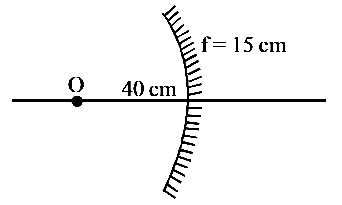
An object is placed at a distance of 40 cm from a concave mirror of focal length 15 cm. If the object is displaced through a distance of 20 cm towards the mirror, the displacement of the image will be

(A)
30 cm away from the mirror
(B)
36 cm away from the mirror
(C)
30 cm towards the mirror
(D)
36 cm towards the mirror
(B)

Solution

NEET 2018 Physics - Geometrical Optics Question 30 English Explanation
Using mirror formula,


v1 = –24 cm

When object is displaced by 20 cm towards mirror.

Here u2 = –20

So,


v2 = -60 cm

So, the image will be shift away from mirror by (60 – 24) cm = 36 cm.

Q.35
An astronomical refracting telescope will have large angular magnification and high angular resolution, when it has an objective lens of
(A)
small focal length and large diameter
(B)
large focal length and small diameter
(C)
large focal length and large diameter
(D)
small focal length and small diameter
(C)

Solution

For telescope, angular magnification = , which shows that focal length of objective lens to be large.

Angular resolution = which is large, hence objective should have large focal length and larger diameter.
Q.36
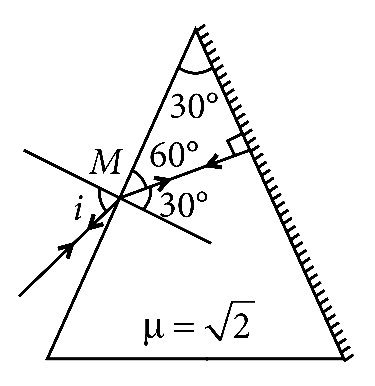
The refractive index of the material of a prism is and the angle of the prism is 30°. One of the two refracting surfaces of the prism is made a mirror inwards, by silver coating. A beam of monochromatic light entering the prism from the other face will retrace its path (after reflection from the silvered surface) if its angle of incidence on the prism is
(A)
600
(B)
450
(C)
300
(D)
zero
(B)

Solution

For retracing the path, light ray should be normally incident on silvered face.

NEET 2018 Physics - Geometrical Optics Question 31 English Explanation

Applying Snell’s law at point M,


sin i = =

i = 45o
Q.37
In Young’s double slit experiment the separation d between the slits is 2 mm, the wavelength of the light used is 5896 and distance D between the screen and slits is 100 cm. It is found that the angular width of the fringes is 0.20o. To increase the fringe angular width to 0.21o (with same and D) the separation between the slits needs to be changed to
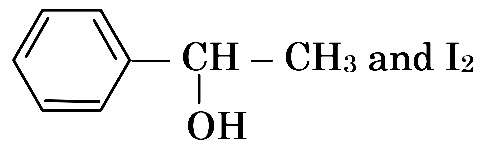
(A)
1.9 mm
(B)
1.8 mm
(C)
2.1 mm
(D)
1.7 mm
(A)

Solution

Angular width =

0.20o =

= 0.2 2

Again, 0.21o =

So using value of λ, we have

d = = 1.9 mm
Q.38
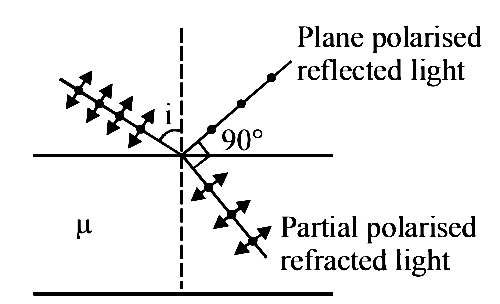
Unpolarised light is incident from air on a plane surface of a material of refractive index . At a particular angle of incidence i, it is found that the reflected and refracted rays are perpendicular to each other. Which of the following options is correct for this situation?
(A)
Reflected light is polarised with its electric vector parallel to the plane of incidence
(B)
Reflected light is polarised with its electric vector perpendicular to the plane of incidence
(C)
(D)
i = tan-1
(B)

Solution

If reflected and refracted light rays are perpendicular, reflected light gets polarised with electric field vector perpendicular to the plane of incidence. NEET 2018 Physics - Wave Optics Question 18 English Explanation

Also, tan i = (i = Brewster's angle)
Q.39
For a radioactive material, half-life is 10 minutes. If initially there are 600 number of nuclei, the time taken (in minutes) for the disintegration of 450 nuclei is
(A)
20
(B)
10
(C)
30
(D)
15
(A)

Solution

Given N0 = 600, N1 = 450, T = 10 min

Number of nuclei remaining, N = 600 – 450 = 150 after time ‘t’


According to the law of radioactive decay,

N = N0e-t


t = 2T1/2 = 2 10 minutes = 20 minutes
Q.40
The ratio of kinetic energy to the total energy of an electron in a Bohr orbit of the hydrogen atom, is
(A)
1 : 1
(B)
1 : -1
(C)
2 : -1
(D)
1 : -2
(B)

Solution

In a Bohr orbit of the hydrogen atom,

Kinetic energy = – (Total energy)

So, Kinetic energy : Total energy = 1 : –1
Q.41
An electron of mass m with an initial velocity (v0 > 0) enters an electric field (E0 = constant > 0) at t = 0. If 0 is its de-Broglie wavelength initially, then its de- Broglie wavelength at time t is
(A)
(B)
(C)
0t
(D)
0
(A)

Solution

Given, Initial velocity v = v0

Electric field E = – E0

Initial de-Brogile wavelength,

0 =

Now force due to electric field on electrons,


Acceleration produced in the electron,


Now, velocity of electron after time t,

=


Now, t =

=

=

= [As ]
Q.42
When the light of frequency 2 (where is threshold frequency), is incident on a metal plate, the maximum velocity of electrons emitted is v1 . When the frequency of the incident radiation is increased to 5 , the maximum velocity of electrons emitted from the same plate is v2 . The ratio of v1 to v2 is
(A)
1 : 2
(B)
1 : 4
(C)
4 : 1
(D)
2 : 1
(A)

Solution

From Einstein’s equation


Again,

Q.43
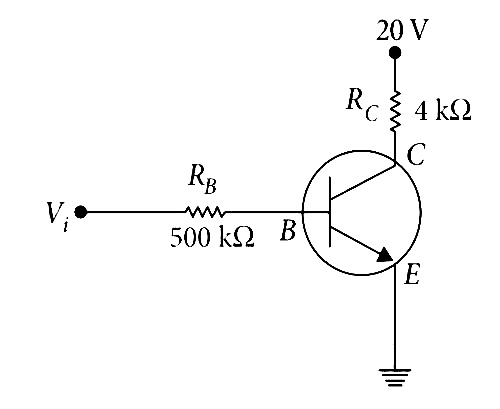
In the circuit shown in the figure, the input voltage Vi is 20 V, VBE = 0 and VCE = 0. The values of IB , IC and are given by NEET 2018 Physics - Semiconductor Electronics Question 35 English
(A)
IB = 40 A, IC = 10 mA, = 250
(B)
IB = 25 A, IC = 5 mA, = 200
(C)
IB = 20 A, IC = 5 mA, = 250
(D)
IB = 40 A, IC = 5 mA, = 125
(D)

Solution

From question, VBE = 0, Vi = 20 V

VCE = 0

Vb = 0 (earthed)

We need to find values of base and collector currents IB and IC and amplification factor , so

VCC = ICRC + VCE

IC = VCC – VCE/RC = 20 V – 0 V/4000 = 5 mA

Base current IB = Vi /RB = = 40 μA

Amplification factor = = = 125
Q.44
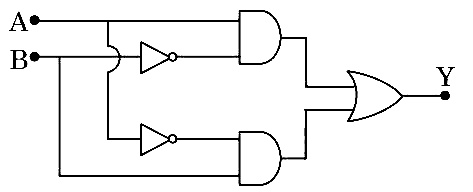
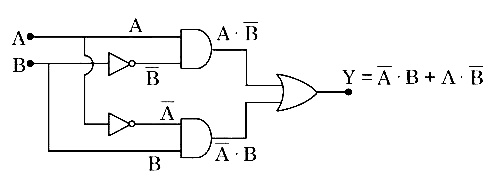
In the combination of the following gates the output Y can be written in terms of inputs A and B as NEET 2018 Physics - Semiconductor Electronics Question 36 English
(A)
(B)
(C)
(D)
(B)

Solution

NEET 2018 Physics - Semiconductor Electronics Question 36 English Explanation
Q.45
In a p-n junction diode, change in temperature due to heating
(A)
affects only reverse resistance
(B)
affects only forward resistance
(C)
does not affect resistance of p-n junction
(D)
affects the overall V - I characteristics of p-n junction
(D)

Solution

As a result of heating, temperature increases which generates large number of electron-hole pairs which lead to increase in conductivity. As
current increases I = I0(), overall resistance of diode changes which affects forward and reversed biasing.
Chemistry (Maximum Marks: 180)
  • This section contains 45 questions.
  • Each question has FOUR options (A), (B), (C) and (D). ONLY ONE of these four options is the correct answer.
  • Full Marks : +4 If ONLY the correct option is chosen;
  • Zero Marks : 0 If none of the options is chosen (i.e. the question is unanswered);
  • Negative Marks : −1 In all other cases.
Q.1
A mixture of 2.3 g formic acid and 4.5 g oxalic acid is treated with conc. H2SO4 . The evolved gaseous mixture is passed through KOH pellets. Weight (in g) of the remaining product at STP will be
(A)
1.4
(B)
3.0
(C)
2.8
(D)
4.4
(C)

Solution

HCOOH H2O + CO
Initial 0 0
Final 0
H2C2O4 H2O + CO + CO2
Initial 0 0 0
Final 0


KOH will absorb CO2 and conc. H2SO4 will absorb obtain water so in final solution only CO left.

Moles of CO formed from both reactions,
= + =

Mass of CO = moles × molar mass = = 2.8 g
Q.2
In which case is number of molecules of water maximum?
(A)
18 mL of water
(B)
0.18 g of water
(C)
0.00224 L of water vapours at 1 atm and 273 K
(D)
10–3 mol of water
(A)

Solution

(a) 18 mL water :
Since, density of H2O = 1 g/mL
Mass of water = V × d = 18 × 1 = 18 g
No. of molecules of H2O = NA = 1 NA

(b) 0.18 g of water :
No. of molecules of H2O = NA = 0.01 NA

(c) Volume of H2O(g) STP = 0.00224 L
No. of molecules of H2O = NA
= NA = 0.0001 NA

(d) No of Molecules of water = mole × NA = 10–3 NA
Q.3
Which one is a wrong statement?
(A)
Total orbital angular momentum of electron in s-orbital is equal to zero.
(B)
An orbital is designated by three quantum numbers while an electron in an atom is designated by four quantum numbers
(C)
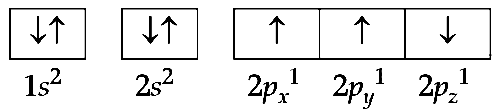
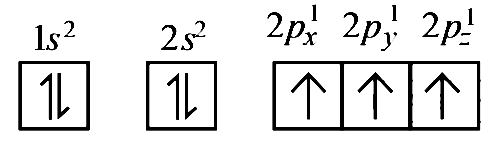
The electronic configuration of N atom is NEET 2018 Chemistry - Structure of Atom Question 20 English Option 3
(D)
The value of m for dz2 is zero.
(C)

Solution

In degnerate orbital all unpaired electrons show same spin. So the correct configuration of N atom is NEET 2018 Chemistry - Structure of Atom Question 20 English Explanation
Q.4
The correct order of N-compounds in its decreasing order of oxidation states is
(A)
HNO3 , NO, N2 , NH4Cl
(B)
HNO3 , NO, NH4Cl, N2
(C)
HNO3 , NH4Cl, NO, N
(D)
NH4Cl, N2 , NO, HNO3
(A)

Solution

Q.5
For the redox reaction,
MnO4 + C2O4 2– + H+ Mn2+ + CO2 + H2O
The correct coefficients of the reactants for the balanced equation are
(A)
MnO4- C2O42- H+
16 5 2
(B)
MnO4- C2O42- H+
2 5 16
(C)
MnO4- C2O42- H+
2 16 5
(D)
MnO4- C2O42- H+
5 16 2
(B)

Solution

The correct balanced equation is
2MnO4 + 5C2O4 2– + 16H+ 2Mn2+ + 10CO2 + 8H2O
Q.6
The correction factor ‘a’ to the ideal gas equation corresponds to
(A)
density of the gas molecules
(B)
volume of the gas molecules
(C)
electric field present between the gas molecules
(D)
forces of attraction between the gas molecules.
(D)

Solution

In Ideal gases ‘a’ account for the intermolecular attractive forces between gas molecules.
Q.7
Given van der Waals’ constant for NH3 , H2, O2 and CO2 are respectively 4.17, 0.244, 1.36 and 3.59, which one of the following gases is most easily liquefied?
(A)
NH3
(B)
H2
(C)
O2
(D)
CO2
(A)

Solution

van der Waals’ constant ‘a’ signifies the intermolecular forces of attraction between the particle of gas. So, higher the value of ‘a’, easier will be the liquefaction of gas.
Q.8
Which one of the following conditions will favour maximum formation of the product in the reaction
A2(g) + B2(g) ⇌ X2(g) , rH = –X kJ ?
(A)
Low temperature and high pressure
(B)
Low temperature and low pressure
(C)
High temperature and high pressure
(D)
High temperature and low pressure
(A)

Solution

On increasing the pressure and decreasing the temperature, equilibrium will shift in forward direction.
Q.9
The solubility of BaSO4 in water is 2.42 × 10⁻³ g L–1 at 298 K. The value of its solubility product (Ksp) will be (Given molar mass of BaSO4 = 233 g mol–1)
(A)
1.08 × 10⁻¹⁰ mol2 L–2
(B)
1.08 × 10⁻¹² mol2 L–2
(C)
1.08 × 10⁻¹⁴ mol2 L–2
(D)
1.08 × 10⁻⁸ mol2 L–2
(A)

Solution

Given, Solubility of BaSO4 = 2.42 × 10⁻³ g L–1

Convert solubility in mol/lit.

s = mol L-1

BaSO4(s) Ba2+(aq) + SO42-(aq)
s s

Ksp = [Ba2+][SO42-] = s2

=

= 1.08 10-10 mol2 L–2
Q.10
Following solutions were prepared by mixing different volumes of NaOH and HCl of different concentrations :

A. 60 mL HCl + 40 mL NaOH

B. 55 mL HCl + 45 mL NaOH

C. 75 mL HCl + 25 mL NaOH

D. 100 mL HCl + 100 mL NaOH

pH of which one of them will be equal to 1?
(A)
B
(B)
A
(C)
D
(D)
C
(D)

Solution

(A) 60 mL HCl + 40 mL NaOH

Mili. moles of HCl = 60 = 6

Mili. moles of NaOH = 40 = 4

Mili. moles of HCl remaining = 6 - 4 = 2

Total volume will be 60 + 40 = 100 mL

Concentration of [H+] = = 2 10-2

pH = 2 - log2 = 1.7

(B) 55 mL HCl + 45 mL NaOH

Mili. moles of HCl = 55 = 5.5

Mili. moles of NaOH = 45 = 4.5

Mili. moles of HCl remaining = 5.5 - 4.5 = 1

Concentration of [H+] = = 10-2

pH = 2

(C) 75 mL HCl + 25 mL NaOH

Mili. moles of HCl = 75 = 15

Mili. moles of NaOH = 25 = 5

Mili. moles of HCl remaining = 15 - 5 = 10

Total volume will be 75 + 25 = 100 mL

Concentration of [H+] = = 10-1

pH = 1

(D) 100 mL HCl + 100 mL NaOH

Mili. moles of HCl = 100 = 10

Mili. moles of NaOH = 100 = 10

Mili. moles of HCl remaining = 10 - 10 = 0

So, it is neutral solution.

pH = 7
Q.11
The bond dissociation energies of X2 , Y2 and XY are in the ratio of 1 : 0.5 : 1. H for the formation of XY is –200 kJ mol–1. The bond dissociation energy of X2 will be
(A)
800 kJ mol–1
(B)
200 kJ mol–1
(C)
400 kJ mol–1
(D)
100 kJ mol–1
(A)

Solution

Let bond dissociation energies of X2 , Y2 and XY are x kJ mol–1 , 0.5x kJ mol–1 and x kJ mol–1 respectively.

X2 + Y2 XY; H = -200 kJ mol-1

H = Σ(B.E)Reactant - Σ(B.E)Product

-200 = -

On solving, x = 800 kJ mol–1
Q.12
Consider the change in oxidation state of bromine corresponding to different emf values as shown in the given diagram : NEET 2018 Chemistry - Electrochemistry Question 23 English
Then the species undergoing disproportionation is :
(A)
BrO4
(B)
BrO3
(C)
Br2
(D)
HBrO
(D)

Solution

Calculate Eocell corresponding to each compound undergoing disproportionation reaction. The reaction for which Eocell comes out + ve is spontaneous.

HBrO Br2, EoHBrO/Br2 = 1.595 V

HBrO BrO3, EoBrO3-/HBrO = 1.595 V

Eocell for the disproportionation of HBrO,

Eocell = EoHBrO/Br2 - EoBrO3-/HBrO

= 1.595 - 1.5

= 0.095 V = + ve

So, Eocell > 0

So, Go < 0 (Spontaneous)
Q.13
When initial concentration of the reactant is doubled, the half-life period of a zero order reaction
(A)
is halved
(B)
is doubled
(C)
is tripled
(D)
remains unchanged.
(B)

Solution

Half life of zero order
t1/2 =

t1/2 [A]0

If [A]0 = doubled then, t1/2 = doubled.
Q.14
The correct difference between first and second order reactions is that
(A)
the rate of a first-order reaction does not depend on reactant concentrations; the rate of a second-order reaction does depend on reactant concentrations
(B)
the half-life of a first-order reaction does not depend on [A]0 ; the half-life of a second order reaction does depend on [A]0
(C)
a first-order reaction can be catalysed; a second-order reaction cannot be catalysed
(D)
the rate of a first-order reaction does depend on reactant concentrations; the rate of a second-order reaction does not depend on reactant concentrations
(B)

Solution

For the first order reaction, t1/2 =
which is independent of initial concentration [A]0.

For second order reaction, t1/2 =
which depends on initial concentration [A]0.
Q.15
Iron exhibits bcc structure at room temperature. Above 900°C, it transforms to fcc structure. The ratio of density of iron at room temperature to that at 900°C (assuming molar mass and atomic radii of iron remains constant with temperature) is
(A)
(B)
(C)
(D)
(C)

Solution

The density of a substance is given by the formula:

Here, is the number of atoms in one unit cell, is the molar mass, is Avogadro’s number, and is the volume of the unit cell.

1. For body-centered cubic (bcc) structure:

In bcc, and the relation between atomic radius and lattice parameter is:

Volume of one unit cell,

2. For face-centered cubic (fcc) structure:

In fcc, and the relation between atomic radius and lattice parameter is:

Volume of one unit cell,

3. Ratio of densities:

Since molar mass and atomic radius (hence atomic mass per atom) remain constant, the ratio of densities between bcc and fcc forms can be written as:

Substituting the values:

Simplifying,

Therefore,

Hence, the ratio of densities of iron in bcc form (at room temperature) to fcc form (above 900°C) is

Q.16
On which of the following properties does the coagulating power of an ion depend?
(A)
The magnitude of the charge on the ion alone
(B)
Size of the ion alone
(C)
Both magnitude and sign of the charge on the ion
(D)
The sign of charge on the ion alone
(C)

Solution

According to Hardy Schulze rule :
1. Coagulation of colloidal solution by using an electrolyte depends on the charge present (positive or negative) on colloidal particles as well as on its size.
2. Coagulating power of an electrolyte depends on the magnitude of charge present on effective ion of electrolyte.
Q.17
The correct order of atomic radii in group 13 elements is
(A)
B < Al < In < Ga < Tl
(B)
B < Al < Ga < In < Tl
(C)
B < Ga < Al < Tl < In
(D)
B < Ga < Al < In < Tl
(D)

Solution

Ga is slightly smaller than Al due poor shielding of d e so Zeff increasing.

So, Atomic size : B < Ga < Al < In < Tl
Q.18
Which of the following oxides is most acidic in nature?
(A)
MgO
(B)
BeO
(C)
BaO
(D)
CaO
(B)

Solution

In metals, on moving down the group, metallic character increases, so basic nature increases hence most acidic will be BeO. In fact, BeO is amphoteric oxide while other given oxides are basic oxides.
Q.19
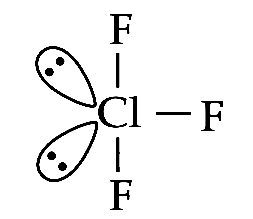
In the structure of ClF3 , the number of lone pairs of electrons on central atom ‘Cl’ is
(A)
one
(B)
two
(C)
four
(D)
three
(B)

Solution

NEET 2018 Chemistry - Chemical Bonding and Molecular Structure Question 38 English Explanation

Hence, Cl has 2 lone pairs of electrons.
Q.20
Consider the following species : CN+ , CN , NO and CN. Which one of these will have the highest bond order?
(A)
NO
(B)
CN
(C)
CN+
(D)
NO
(B)

Solution

Molecular orbital configuration of NO (15 electrons) is

=

Nb = 10

Na = 5

BO = = 2.5

Moleculer orbital configuration of CN (14 electrons) is

=

Nb = 10

Na = 4

BO = = 3

Moleculer orbital configuration of CN (13 electrons) is

=

Nb = 9

Na = 4

BO = = 2.5

Moleculer orbital configuration of CN+ (12 electrons) is

=

Nb = 8

Na = 4

BO = = 2

Hence, CN has highest bond order.
Q.21
Considering Ellingham diagram, which of the following metals can be used to reduce alumina?
(A)
Fe
(B)
Zn
(C)
Mg
(D)
Cu
(C)

Solution

Mg has more – G value than alumina. So it will be in the lower part of Ellingham diagram. Metals which have more – G value can reduce those metal oxides which have less – G value.
Q.22
Among CaH2 , BeH2 , BaH2 , the order of ionic character is
(A)
BeH2 < CaH2 < BaH2
(B)
CaH2 < BeH2 < BaH2
(C)
BeH2 < BaH2 < CaH2
(D)
BaH2 < BeH2 < CaH2
(A)

Solution

Smaller the size of cation, more will be its polarising power. Hence BeH2 will be least ionic.

BeH2 < CaH2 < BaH2
Q.23
Magnesium reacts with an element (X) to form an ionic compound. If the ground state electronic configuration of (X) is 1s22s22p3, the simplest formula for this compound is
(A)
Mg2X3
(B)
MgX2
(C)
Mg2X
(D)
Mg3X2
(D)

Solution

Electronic configuration of element (X) is
1s22s22p3

So, valency of X will be 3.
Since, valency of Mg is 2.
So, formula of compound formed by Mg and X will be Mg3X2.
Q.24
Which of the following statements is not true for halogens?
(A)
All are oxidizing agents.
(B)
All form monobasic oxyacids.
(C)
All but fluorine show positive oxidation states.
(D)
Chlorine has the highest electron-gain enthalpy.
(C)

Solution

All halogens show both positive and negative oxidation states while fluorine shows only negative oxidation state except due to high electronegativity and small size, F forms only one oxoacid, HOF known as Fluoric (I) acid. Oxidation number of F is +1 in HOF.
Q.25
Which one of the following elements is unable to form MF63– ion?
(A)
Ga
(B)
Al
(C)
B
(D)
In
(C)

Solution

Boron does not have vacant d-orbitals in its valence shell, so it cannot extend its covalency beyond 4. i.e., ‘B’ cannot form the ions like MF63–.
Q.26
Which one of the following ions exhibits d-d transition and paramagnetism as well?
(A)
CrO42-
(B)
Cr2O72–
(C)
MnO4-
(D)
MnO42-
(D)

Solution

In CrO42-       Cr+6 (n = 0)       diamagnetic

In Cr2O72–       Cr+6 (n = 0)       diamagnetic

In MnO4-       Mn+7 (n = 0)       diamagnetic

In MnO42-       Mn+6 (n = 1)       paramagnetic

In MnO42-, one unpaired electron(n) is present in d-orbital so, d-d transition is possible.
Q.27
Match the metal ions given in Column I with the spin magnetic moments of the ions given in Column II and assign the correct code :
Column - I Column - II
A. Co3+ (i) B.M.
B. Cr3+ (ii) B.M.
C. Fe3+ (iii) B.M.
D. Ni2+ (iv) B.M.
(v) B.M.
(A)
A B C D
(iv) (v) (ii) (i)
(B)
A B C D
(i) (ii) (iii) (iv)
(C)
A B C D
(iv) (i) (ii) (iii)
(D)
A B C D
(iii) (v) (i) (ii)
(A)

Solution

Co3+ = [Ar]3d6 , unpaired e(n) = 4

Spin magnetic moment () = B.M

Cr3+ = [Ar]3d3 , unpaired e(n) = 3

Spin magnetic moment () = B.M.

Fe3+ = [Ar]3d5 , unpaired e(n) = 5

Spin magnetic moment () = B.M.

Ni2+ = [Ar]3d8 , unpaired e(n) = 2

Spin magnetic moment () = = B.M.
Q.28
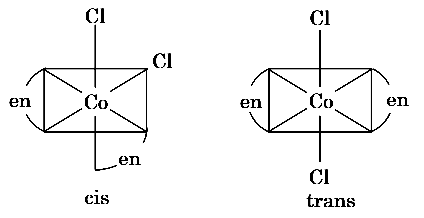
The type of isomerism shown by the complex [CoCl2(en)2] is
(A)
geometrical isomerism
(B)
coordination isomerism
(C)
ionization isomerism
(D)
linkage isomerism.
(A)

Solution

[CoCl2(en)2] shows geometrical isomerism and exist in cis and trans form.

NEET 2018 Chemistry - Coordination Compounds Question 37 English Explanation
Q.29
The geometry and magnetic behaviour of the complex [Ni(CO)4] are
(A)
square planar geometry and diamagnetic
(B)
tetrahedral geometry and diamagnetic
(C)
square planar geometry and paramagnetic
(D)
tetrahedral geometry and paramagnetic.
(B)

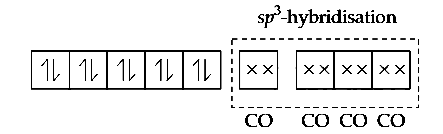
Solution

Ni(28) : [Ar]3d84s2

CO is a strong field ligand, so unpaired electrons get paired. Hence, configuration would be:
NEET 2018 Chemistry - Coordination Compounds Question 36 English Explanation
For, four ‘CO’-ligands hybridisation would be sp3 and thus the complex would be diamagnetic and of tetrahedral geometry.
Q.30
Iron carbonyl, Fe(CO)5 is
(A)
tetranuclear
(B)
mononuclear
(C)
trinuclear
(D)
dinuclear
(B)

Solution

Based on the number of metal atoms present in a complex, they are classified into mononuclear, dinuclear, trinuclear and so on. e.g. :
Fe(CO)5 : mononuclear
Co2(CO)8 : dinuclear
Fe3(CO)12 : trinuclear
Q.31
Which oxide of nitrogen is not a common pollutant introduced into the atmosphere both due to natural and human activity?
(A)
N2O5
(B)
NO2
(C)
N2O
(D)
NO
(A)

Solution

N2O5 is highest oxidation number oxide which will not easily formed by common or natural oxidation of lower oxides of nitrogen.
Q.32
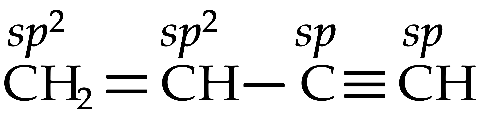
Which of the following molecules represents the order of hybridisation sp2 , sp2 , sp, sp from left to right atoms?
(A)
HC C — C CH
(B)
CH2 = CH — C CH
(C)
CH2 = CH — CH = CH2
(D)
CH3 — CH = CH — CH3
(B)

Solution

NEET 2018 Chemistry - Some Basic Concepts of Organic Chemistry Question 39 English Explanation
Q.33
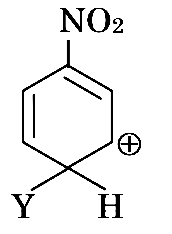
Which of the following carbocations is expected to be most stable?
(A)
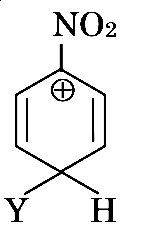
NEET 2018 Chemistry - Some Basic Concepts of Organic Chemistry Question 40 English Option 1
(B)
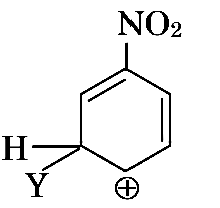
NEET 2018 Chemistry - Some Basic Concepts of Organic Chemistry Question 40 English Option 2
(C)
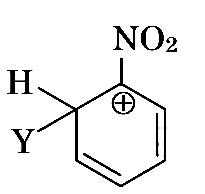
NEET 2018 Chemistry - Some Basic Concepts of Organic Chemistry Question 40 English Option 3
(D)
NEET 2018 Chemistry - Some Basic Concepts of Organic Chemistry Question 40 English Option 4
(C)

Solution

–NO2 group is meta-directing, thus will stabilize a electrophile at m-position.
Q.34
Which of the following is correct with respect to – I effect of the substituents? (R = alkyl)
(A)
– NH2 < – OR < – F
(B)
– NR2 < – OR < – F
(C)
– NH2 > – OR > – F
(D)
– NR2 > – OR > – F
(A, B)

Solution

– I effect increases on increasing electronegativity of atom. So, correct order of – I effect is

– NH2 < – OR < – F

Also, – NR2 < – OR < – F
Q.35
Hydrocarbon (A) reacts with bromine by substitution to form an alkyl bromide which by Wurtz reaction is converted to gaseous hydrocarbon containing less than four carbon atoms. (A) is
(A)
CH CH
(B)
CH2 = CH2
(C)
CH3 - CH3
(D)
CH4
(D)

Solution

NEET 2018 Chemistry - Hydrocarbons Question 16 English Explanation
Q.36
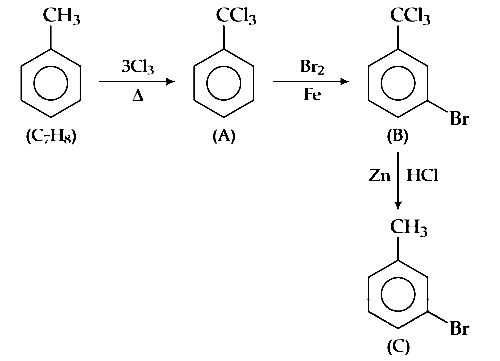
The compound C7H8 undergoes the following reactions : NEET 2018 Chemistry - Haloalkanes and Haloarenes Question 16 English
The product ‘C’ is
(A)
m–bromotoluene
(B)
o–bromotoluene
(C)
3–bromo–2,4,6–trichlorotoluene
(D)
p–bromotoluene
(A)

Solution

NEET 2018 Chemistry - Haloalkanes and Haloarenes Question 16 English Explanation
Q.37
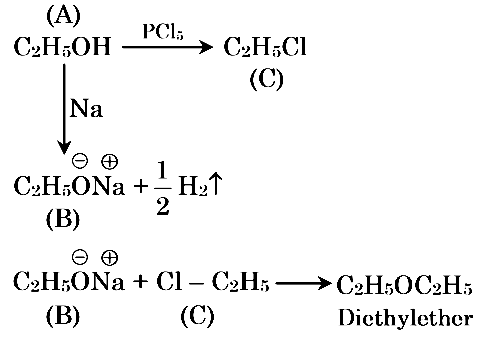
The compound A on treatment with Na gives B, and with PCl5 gives C. B and C react together to give diethyl ether. A, B and C are in the order
(A)
C2H5OH, C2H6 , C2H5Cl
(B)
C2H5OH, C2H5Cl , C2H5ONa
(C)
C2H5Cl, C2H6 , C2H5OH
(D)
C2H5OH, C2H5ONa , C2H5Cl
(D)

Solution

NEET 2018 Chemistry - Alcohol, Phenols and Ethers Question 21 English Explanation
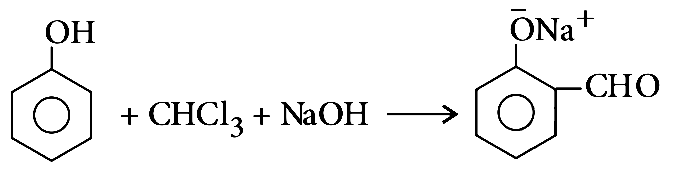
Q.38
In the reaction, NEET 2018 Chemistry - Alcohol, Phenols and Ethers Question 20 English
the electrophile involved is
(A)
dichloromethyl cation (HCl2)
(B)
formyl cation (HO)
(C)
dichloromethyl anion (HCl2)
(D)
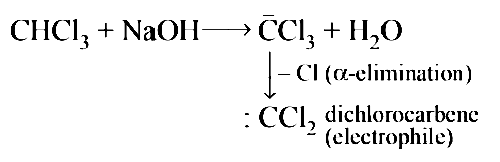
dichlorocarbene (:CCl2)
(D)

Solution

NEET 2018 Chemistry - Alcohol, Phenols and Ethers Question 20 English Explanation
Q.39
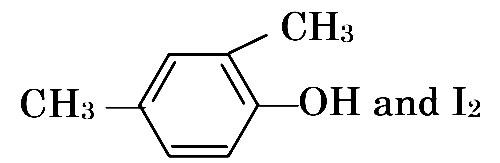
Compound A, C8H10O, is found to react with NaOI (produced by reacting Y with NaOH) and yields a yellow precipitate with characteristic smell. A and Y are respectively
(A)
NEET 2018 Chemistry - Alcohol, Phenols and Ethers Question 19 English Option 1
(B)
NEET 2018 Chemistry - Alcohol, Phenols and Ethers Question 19 English Option 2
(C)
NEET 2018 Chemistry - Alcohol, Phenols and Ethers Question 19 English Option 3
(D)
NEET 2018 Chemistry - Alcohol, Phenols and Ethers Question 19 English Option 4
(C)

Solution

NEET 2018 Chemistry - Alcohol, Phenols and Ethers Question 19 English Explanation
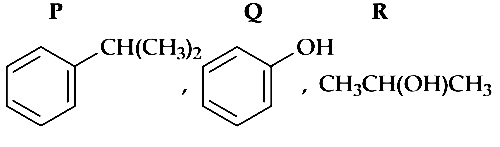
Q.40
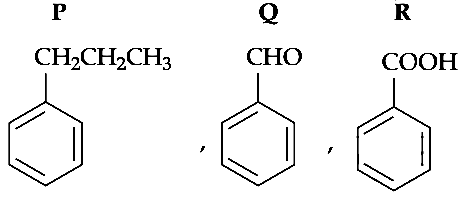
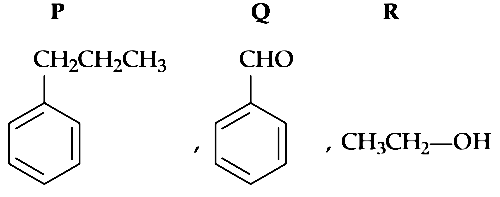
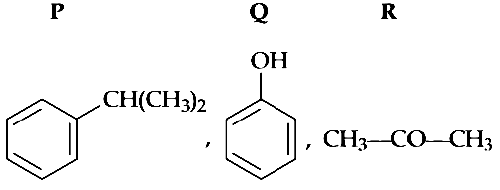
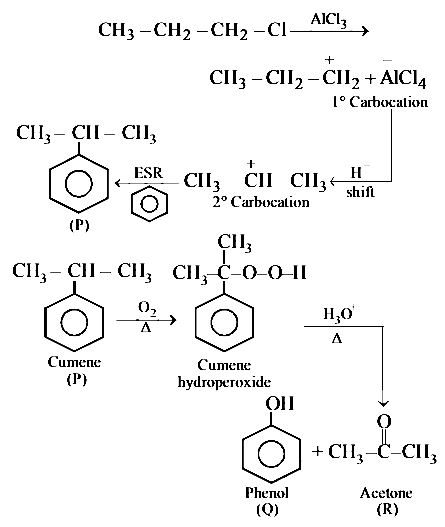
Identify the major products P, Q and R in the following sequence of reactions : NEET 2018 Chemistry - Alcohol, Phenols and Ethers Question 18 English
(A)
NEET 2018 Chemistry - Alcohol, Phenols and Ethers Question 18 English Option 1
(B)
NEET 2018 Chemistry - Alcohol, Phenols and Ethers Question 18 English Option 2
(C)
NEET 2018 Chemistry - Alcohol, Phenols and Ethers Question 18 English Option 3
(D)
NEET 2018 Chemistry - Alcohol, Phenols and Ethers Question 18 English Option 4
(D)

Solution

NEET 2018 Chemistry - Alcohol, Phenols and Ethers Question 18 English Explanation
Q.41
Carboxylic acids have higher boiling points than aldehydes, ketones and even alcohols of comparable molecular mass. It is due to their
(A)
formation of intramolecular H-bonding
(B)
formation of carboxylate ion
(C)
more extensive association of carboxylic acid via van der Waals’ forces of attraction
(D)
formation of intermolecular H-bonding.
(D)

Solution

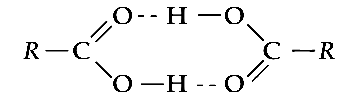
Due to the formation of intermolecular H-bonding, association occurs in carboxylic acids. So, they have higher boiling points than aldehydes, ketones and even alcohols of comparable molecular mass. NEET 2018 Chemistry - Aldehydes, Ketones and Carboxylic Acids Question 38 English Explanation
Q.42
Nitration of aniline in strong acidic medium also gives m-nitroaniline because
(A)
inspite of substituents nitro group always goes to only m-position
(B)
in electrophilic substitution reactions amino group is meta directive
(C)
in absence of substituents nitro group always goes to m-position
(D)
in acidic (strong) medium aniline is present as anilinium ion.
(D)

Solution

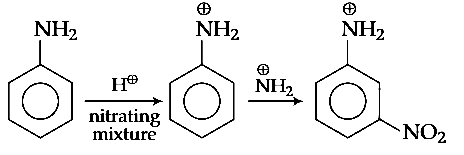
NEET 2018 Chemistry - Organic Compounds Containing Nitrogen Question 21 English Explanation In acidic medium, aniline is protonated to form anilinium ion which is m-directing. Hence besides para (51%) and ortho (2%), meta product (47%) is also formed in significant yield.

Q.43
Regarding cross-linked or network polymers, which of the following statements is incorrect?
(A)
They contain covalent bonds between various linear polymer chains.
(B)
They are formed from bi- and tri-functional monomers.
(C)
Examples are bakelite and melamine.
(D)
They contain strong covalent bonds in their polymer chains.
(D)

Solution

Cross-linked or network polymers are usually formed from bi-functional & tri-functional monomers and contains strong covalent bond between various linear polymer chains like Melamine, Bakelite etc.
Q.44
Which of the following compounds can form a zwitter ion?
(A)
Aniline
(B)
Acetanilide
(C)
Benzoic acid
(D)
Glycine
(D)

Solution

NEET 2018 Chemistry - Biomolecules Question 15 English Explanation
Q.45
The difference between amylose and amylopectin is
(A)
amylopectin have 1 4 -linkage and 1 6 -linkage
(B)
amylose have 1 4 -linkage and 1 6 -linkage
(C)
amylopectin have 1 4 -linkage and 1 6 -linkage
(D)
amylose is made up of glucose and galactose
(A)

Solution

Amylose and amylopectin are polymers of -D-glucose, so -link is not possible. Amylose is linear with 1 4 -linkage whereas amylopectin is branched and has both 1 4 and 1 6 -linkages.
Biology (Maximum Marks: 360)
  • This section contains 90 questions.
  • Each question has FOUR options (A), (B), (C) and (D). ONLY ONE of these four options is the correct answer.
  • Full Marks : +4 If ONLY the correct option is chosen;
  • Zero Marks : 0 If none of the options is chosen (i.e. the question is unanswered);
  • Negative Marks : −1 In all other cases.
Q.1
The Golgi complex participates in
(A)
activation of amino acid
(B)
fatty acid breakdown
(C)
formation of secretory vesicles
(D)
respiration in bacteria
(C)

Solution

The Golgi apparatus receives proteins and lipids from the ER. It modifies them, concentrates and packs them into secretory vesicles that are formed by budding off from the trans-Golgi surface.
Q.2
Which of the following is true for nucleolus?
(A)
It takes part in spindle formation
(B)
Larger nucleoli are present in dividing cells.
(C)
It is a membrane-bound structure.
(D)
It is a site for active ribosomal RNA synthesis.
(D)

Solution

The nucleolus (plural nucleoli) is a large, distinct, spheroidal subcompartment of the nucleus of eukaryote cells that is the site of ribosomal RNA (rRNA) synthesis and assembly of ribosomal subunits.
Q.3
Which of the following events does not occur in rough endoplasmic reticulum?
(A)
Cleavage of signal peptide
(B)
Phospholipid synthesis
(C)
Protein folding
(D)
Protein glycosylation
(B)

Solution

Phospholipid synthesis does not take place in rough endoplasmic reticulum (RER). Smooth endoplasmic reticulum (SER) is involved in lipid synthesis.
Q.4
Select the incorrect match.
(A)
Allosomes – Sex chromosomes
(B)
Sub-metacentric chromosomes – L-shaped chromosomes
(C)
Lampbrush chromosomes – Diplotene bivalents
(D)
Polytene chromosomes – Oocytes of amphibians
(D)

Solution

Polytene chromosomes are found in salivary glands of insects and are also called as salivary chromosomes.
Q.5
The two functional groups characteristic of sugars are
(A)
carbonyl and methyl
(B)
carbonyl and hydroxyl.
(C)
hydroxyl and methyl
(D)
carbonyl and phosphate
(B)

Solution

Sugar is a carbohydrate. These are polyhydroxy aldehyde, ketone or their derivatives, which means they have carbonyl and hydroxyl groups in its structure.
Q.6
The stage during which separation of the paired homologous chromosomes begins is
(A)
zygotene.
(B)
pachytene
(C)
diplotene
(D)
diakinesis
(C)

Solution

Diplotene is recognised by the dissolution of the synaptonemal complex and the tendency of the recombined homologous chromosomes of the bivalents to separate from each other.
Q.7
Which of the following has proved helpful in preserving pollen as fossils?
(A)
Pollenkitt
(B)
Cellulosic intine
(C)
Oil content
(D)
Sporopollenin
(D)

Solution

Sporopollenin cannot be degraded by enzyme; strong acids and alkali, therefore it is helpful in preserving pollen as fossil.
Q.8
Winged pollen grains are present in
(A)
Mustard
(B)
Cycas
(C)
Mango
(D)
Pinus
(D)

Solution

Winged pollen grains are present in Pinus. Each pollen grain has two wing-like structures which enables it to float in air, as an adaptation for dispersal by the wind.
Q.9
Double fertilization is
(A)
fusion of two male gametes of a pollen tube with two different eggs
(B)
fusion of one male gamete with two polar nuclei
(C)
fusion of two male gametes with one egg
(D)
syngamy and triple fusion
(D)

Solution

Double fertilization occurs only in angiosperms. Two types of fusion, syngamy and triple fusion takes place.
Q.10
Conversion of milk to curd improves its nutritional value by increasing the amount of
(A)
vitamin D
(B)
vitamin A
(C)
vitamin B12
(D)
vitamin E
(C)

Solution

Curd has enriched presence of vitamins specially Vitamin B12, which improves its nutritional value than milk.
Q.11
Stomata in grass leaf are
(A)
kidney-shaped
(B)
barrel-shaped
(C)
dumb-bell shaped
(D)
rectangular
(C)

Solution

Grass being a monocot, has Dumb-bell shaped stomata in their leaves.
Q.12
Secondary xylem and phloem in dicot stem are produced by
(A)
vascular cambium
(B)
axillary meristems
(C)
apical meristems
(D)
phellogen
(A)

Solution

The cells of vascular cambium cut off towards pith, mature into secondary xylem and the cells cut off towards periphery mature into secondary phloem during secondary growth in dicot stem.
Q.13
Casparian strips occur in
(A)
pericycle
(B)
epidermis
(C)
endodermis.
(D)
cortex
(C)

Solution

Endodermis have casparian strips on radial and inner tangential wall. It is rich in suberin.
Q.14
Plants having little or no secondary growth are
(A)
deciduous angiosperms
(B)
grasses
(C)
cycads
(D)
conifers
(B)

Solution

Grasses are monocots and monocots usually do not have secondary growth.
Palm like monocots have anomalous secondary growth
Q.15
Stomatal movement is not affected by
(A)
O2 concentration
(B)
temperature
(C)
CO2 concentration.
(D)
light
(A)

Solution

High temperature, light and CO2 concentration affect opening and closing of stomata while O2 concentration has negligible effect on stomatal opening and closing.
Q.16
Which of the following elements is responsible for maintaining turgor in cells?
(A)
Sodium
(B)
Calcium
(C)
Magnesium
(D)
Potassium
(D)

Solution

Plants require potassium ions (K+ ) for protein synthesis and for the opening and closing of stomata, which is regulated by proton pumps to make surrounding guard cells either turgid or flaccid.
Q.17
In which of the following forms is iron absorbed by plants?
(A)
Ferrous
(B)
Both ferric and ferrous
(C)
Ferric
(D)
Free element
(C)

Solution

Iron is absorbed by plants in the form of ferric ions.
Q.18
Which of these statements is incorrect?
(A)
Glycolysis operates as long as it is supplied with NAD that can pick up hydrogen atoms.
(B)
Enzymes of TCA cycle are present in mitochondrial matrix.
(C)
Oxidative phosphorylation takes place in outer mitochondrial membrane.
(D)
Glycolysis occurs in cytosol.
(C)

Solution

Oxidative phosphorylation takes place in inner mitochondrial membrane via F0 – F1 particles.
Q.19
What is the role of NAD+ in cellular respiration?
(A)
It is the final electron acceptor for anaerobic respiration.
(B)
It functions as an enzyme.
(C)
It functions as an electron carrier.
(D)
It is a nucleotide source for ATP synthesis.
(C)

Solution

NAD+ act as an electron carrier in cellular respiration.
Q.20
The correct order of steps in Polymerase Chain Reaction (PCR) is
(A)
extension, denaturation, annealing
(B)
annealing, extension, denaturation
(C)
denaturation, extension, annealing
(D)
denaturation, annealing, extension
(D)

Solution

Each cycle of PCR has three steps :
(1) Denaturation,
(2) Primer annealing,
(3) Extension of primers.
Q.21
All of the following are included in ‘ex-situ conservation’ except
(A)
wildlife safari parks
(B)
sacred groves
(C)
botanical gardens
(D)
seed banks
(B)

Solution

Sacred groves is a type of in-situ conservation.
Q.22
Pollen grains can be stored for several years in liquid nitrogen having a temperature of
(A)
-120oC
(B)
-80oC
(C)
-196oC
(D)
-160oC
(C)

Solution

Pollen grains can be stored for several years in liquid nitrogen at -196oC. This is also known as cryopreservation.
Q.23
Match the items given in column I with those in column II and select the correct option given below.
Column I Column II
A. Herbarium (i) It is a place having a collection of preserved plants and animals.
B. Key (ii) A list that enumerates methodically all the species found in an area with brief description aiding identification.
C. Museum (iii) Is a place where dried and pressed plant specimens mounted on sheets are kept.
D. Catalogue (iv) A booklet containing a list of characters and their alternates which are helpful in identification of various taxa.
(A)
A (ii), B (iv), C (iii), D (i)
(B)
A (iii), B (ii), C (i), D (iv)
(C)
A (iii), B (iv), C (i), D (ii)
(D)
A (i), B (iv), C (iii), D (ii)
(C)

Solution

Herbarium : It is defined as "store house of collected plant speccimens that are dried, pressed and preserved on sheets". Label on herbarium sheets convey following information, such as date and place of collection, botanical, local and english names, family and collector’s name.

Key : A key is an artificial analytical device, consisting of set of alternate characters of various plants and animals and is used for identificion purposes.

Museum : museum is aplaxe used for storing, preservation and exhibition of both plants and animals. All educational institutes and universities maintain museums in their Botany and Zoology departments.

Catalogue: It is a list or register that indicates the alphabetical arrangement of species of a particular place, often with brief description aiding identification.
Q.24
Ciliates differ from all other protozoans in
(A)
having a contractile vacuole for removing excess water
(B)
having two types of nuclei.
(C)
using flagella for locomotion
(D)
using pseudopodia for capturing prey
(B)

Solution

Ciliates differs from other protozoans in having two types of nuclei. e.g., Paramoecium have two types of nuclei i.e. macronucleus & micronucleus.
Q.25
Which among the following is not a prokaryote?
(A)
Mycobacterium
(B)
Saccharomyces
(C)
Oscillatoria
(D)
Nostoc
(B)

Solution

Saccharomyces are commonly known as sac fungi. All fungi are eukaryotes.

Prokaryotes include bacteria (Mycobacterium), cyanobacteria (Nostoc and Oscillatoria), mycoplasma and archaebacteria.Also all bacteria are prokarypte.
Q.26
Select the wrong statement.
(A)
Mushrooms belong to basidiomycetes.
(B)
Cell wall is present in members of fungi and plantae.
(C)
Pseudopodia are locomotory and feeding structures in sporozoans.
(D)
Mitochondria are the powerhouse of the cell in all kingdoms except monera.
(C)

Solution

Cell wall is present in the member of Fungi (made up of chitin) and Plantae (made up of cellulose).

Pseudopadia are locomotory and feeding structures in Amoeboid Protozoans.

Mitochondria and other membrane bound cell organelles are absent in prokaryote (Monera). Mushroom, rust and smut fungus belongs to the class basidiomycetes.
Q.27
Oxygen is not produced during photosynthesis by
(A)
Cycas
(B)
Green sulphur bacteria
(C)
Chara
(D)
Nostoc
(B)

Solution

Green sulphur bacteria do not use H2O as source of proton, therefore they do not evolve O2.
Q.28
Which of the following organisms are known as chief producers in the oceans?
(A)
Euglenoids
(B)
Cyanobacteria
(C)
Dinoflagellates
(D)
Diatoms
(D)

Solution

Diatoms are the chief producers in the oceans.
Q.29
After karyogamy followed by meiosis, spores are produced exogenously in
(A)
Saccharomyces.
(B)
Neurospora
(C)
Alternaria
(D)
Agaricus
(D)

Solution

Karyogamy and meiosis takes place in the basidium producing four basidiospores. The basidiospores are exogenously produced on the basidium. The basidia are arranged in fruiting bodies called basidiocarps. Some common members are agaricus (mushroom).
Q.30
Sweet potato is a modified
(A)
adventitious root
(B)
rhizome
(C)
stem
(D)
taproot
(A)

Solution

Adventitious roots of sweet potato, get swollen and store food. Where as rhizome is fleshy underground stem eg. Ginger, Turmeric.
Q.31
Which of the following is not a product of light reaction of photosynthesis?
(A)
Oxygen
(B)
NADH
(C)
ATP
(D)
NADPH
(B)

Solution

Both ATP and NADPH + H+ are synthesized by electron flow in light reaction, and O2 is also a product of non-cyclic photoposphorylation.
Q.32
Which of the following characteristics represent 'Inheritance of blood groups' in humans?
a. Dominance
b. Co-dominance
c. Multiple allele
d. Incomplete dominance
e. Polygenic inheritance
(A)
b, c and e
(B)
a, b and c
(C)
b, d and e
(D)
a, c and e
(B)

Solution

IAIO, IBIO - Dominant-recessive relationship

IAIB - Codominance

IA, IB & IO - Three different allelic forms of a gene (multiple allelism)
Q.33
Which of the following pairs is wrongly matched?
(A)
Starch synthesis in pea : Multiple alleles
(B)
ABO blood grouping : Co-dominance
(C)
XO type sex determination: Grasshopper
(D)
T.H. Morgan : Linkage
(A)

Solution

The gene for starch synthesis in pea seeds can produce more than one effect which implies it is a pleiotropic gene.
Q.34
A woman has an X-linked condition on one of her X chromosomes. This chromosome can be inherited by
(A)
only daughters
(B)
only sons
(C)
only grandchildren
(D)
both sons and daughters
(D)

Solution

The woman being a carrier, both son and daugther can inherit the X-chromosomes. The son only can be diseased.
Q.35
Select the correct match :
(A)
Ribozyme - Nucleic acid
(B)
F2 Recessive parent - Dihybrid cross
(C)
T.H. Morgan - Transduction
(D)
G. Mendel - Transformation
(A)

Solution

Ribozyme is a catalytic RNA, which is nucleic acid.
Q.36
AGGTATCGCAT is a sequence from the coding strand of a gene. What will be the corresponding sequence of the transcribed mRNA?
(A)
AGGUAUCGCAU
(B)
UGGTUTCGCAT
(C)
ACCUAUGCGAU
(D)
UCCAUAGCGUA
(A)

Solution

Coding strand and mRNA have same nucleotide sequence except, ‘T’ - Thymine is replaced by ‘U’ - Uracil in mRNA.
Q.37
All of the following are part of an operon except
(A)
an operator
(B)
structural genes
(C)
an enhancer
(D)
a promoter
(C)

Solution

Operon concept is for prokaryotes and enchancer sequences are present in eukaryotes.
Q.38
Many ribosomes may associate with a single mRNA to form multiple copies of a polypeptide simultaneously. Such strings of ribosomes are termed as
(A)
polysome
(B)
polyhedral bodies
(C)
plastidome
(D)
nucleosome
(A)

Solution

Ribosomes may occur singly a monosomes or in rosettes and helical groups called polysomes. The different ribosomes of a polysome are connected with a strand of m-RNA.

Nucleosome is a basic unit of DNA packaging in eukaryotes.

Plastidome are the plastids of a cell when they are referred to a functional unit.

Polyhedral bodies are involved in carbon fixation are present in autotrophic bacteria.
Q.39
Select the correct statement :
(A)
Franklin Stahl coined the term ‘‘linkage’’.
(B)
Punnett square was developed by a British scientist.
(C)
Spliceosomes take part in translation.
(D)
Transduction was discovered by S. Altman
(B)

Solution

Punnet square was developed by a British geneticist Reginald C. Punnet.

Franklin Stahl and Meselson proved semiconservative mode of DNA replication.

Morgan coined the term linkage.

Transduction was discovered by Zinder and Lederberg.
Q.40
The experimental proof for semi-conservative replication of DNA was first shown in a
(A)
fungus
(B)
bacterium
(C)
plant
(D)
virus.
(B)

Solution

Semi-conservative DNA replication was first shown in bacterium escherichia coli by Matthew Meselson and Franklin Stahl.
Q.41
Select the correct match :
(A)
Alec Jeffreys - Streptococcus pneumoniae
(B)
Alfred Hershey and - TMV Martha Chase
(C)
Matthew Meselson - Pisum sativum and F. Stahl
(D)
Francois Jacob and - Lac operon Jacques Monod
(D)

Solution

Francois Jacob and Jacque Monod proposed model of gene regulation known as operon model/lac operon. Alec Jeffreys gave DNA fingerprinting technique. Matthew Meselson and F. Stahl gave semiconservative DNA replication in E.coli. Alfred Hershey and Martha Chase proved DNA as genetic material not protein.
Q.42
Which of the following is commonly used as a vector for introducing a DNA fragment in human lymphocytes?
(A)
Retrovirus
(B)
Ti plasmid
(C)
phage
(D)
pBR322
(A)

Solution

Retrovirus is commonly used as vector for introducing a DNA fragment in human lymphocyte.
Q.43
Use of bioresources by multinational companies and organisations without authorisation from the concerned country and its people is called
(A)
bio-infringement
(B)
biodegradation
(C)
biopiracy
(D)
bioexploitation
(C)

Solution

Biopiracy refers to the use of bio-resources by multinational companies and other organizations without proper authorization from the countries and people concerned.
Q.44
In India, the organisation responsible for assessing the safety of introducing genetically modified organisms for public use is
(A)
Indian Council of Medical Research (ICMR)
(B)
Council for Scientific and Industrial Research (CSIR)
(C)
Research Committee on Genetic Manipulation (RCGM)
(D)
Genetic Engineering Appraisal Committee (GEAC)
(D)

Solution

Indian government has set up organisation such as GEAC (Genetic Engineering Appraisal Committee) which makes decisions regarding the validity of GM research and safety of introducing GM organisms for public services.
Q.45
A 'new' variety of rice was patented by a foreign company, though such varieties have been present in India for a long time. This is related to
(A)
Co-667
(B)
Sharbati Sonora
(C)
Lerma Rojo
(D)
Basmati
(D)

Solution

In 1997, an American company got patent rights on Basmati rice through the US Patent and Trademark Office. This allowed the company to sell a ‘new’ variety of Basmati.
Q.46
Which one of the following population interactions is widely used in medical science for the production of antibiotics?
(A)
Commensalism
(B)
Mutualism
(C)
Parasitism
(D)
Amensalism
(D)

Solution

In amensalism, one species is harmed whereas the other is unaffected. Antibiosis also shows this feature where the antibiotics released by the microbial group (Penicillium) Has affect on other microbes (such as Staphylococcus.
Q.47
Pneumatophores occur in
(A)
halophytes
(B)
free-floating hydrophytes
(C)
carnivorous plants
(D)
submerged hydrophytes
(A)

Solution

Halophyte or mangrove grow in oxygen deficient marshy area. In these plants root grow vertically upward & have breathing pore as pneumotophore.
Q.48
Niche is
(A)
all the biological factors in the organism’s environment
(B)
the physical space where an organism lives
(C)
the range of temperature that the organism needs to live
(D)
the functional role played by the organism where it lives
(D)

Solution

Niche is functional role of organism in ecosystem.
Q.49
Natality refers to
(A)
death rate
(B)
birth rate
(C)
number of individuals leaving the habitat
(D)
number of individuals entering a habitat
(B)

Solution

Natality refers to the number of births during a given period in the population that are added to the initial density.
Q.50
Which one of the following plants shows a very close relationship with a species of moth, where none of the two can complete its life cycle without the other?
(A)
Hydrilla
(B)
Yucca
(C)
Banana
(D)
Viola
(B)

Solution

A very close relationship exists between a species of moth and Yucca where both species cannot complete their life cycles with out each other.
Q.51
In a growing population of a country,
(A)
pre-reproductive individuals are more than the reproductive individuals
(B)
reproductive individuals are less than the post-reproductive individuals
(C)
reproductive and pre-reproductive individuals are equal in number
(D)
pre-reproductive individuals are less than the reproductive individuals.
(A)

Solution

In a population where the number of prereproductive individuals or the younger individual is larger than the reproductive individuals, the population will increase.
Q.52
World Ozone Day is celebrated on
(A)
5th June
(B)
21st April
(C)
16th September
(D)
22nd April
(C)

Solution

World Ozone day is celebrated on 16th September.
Q.53
Which of the following is a secondary pollutant?
(A)
CO
(B)
CO2
(C)
SO2
(D)
O3
(D)

Solution

A primary pollutant is an air pollutant emitted directly from a source. A secondary pollutant is not directly emitted as such, but forms when other pollutants (primary pollutants) react in the atmosphere. O3 (ozone) is a secondary pollutant.
Q.54
Match the items given in column I with those in column II and select the correct option given below.
Column I Column II
(A) Eutrophication (i) UV-B radiation
(B) Sanitary landfill (ii) Deforestation
(C) Snow blindness (iii) Nutrient enrichment
(D) Jhum cultivation (iv) Waste disposal
(A)
A B C D
(ii) (i) (iii) (iv)
(B)
A B C D
(i) (iii) (iv) (ii)
(C)
A B C D
(iii) (iv) (i) (ii)
(D)
A B C D
(i) (ii) (iv) (iii)
(C)

Solution

  • (A) Eutrophication: This term refers to the natural aging of a lake by biological enrichment of its water. It is characterized by an increase in nutrients, leading to excessive growth of algae and other aquatic plants.

    • Therefore, (A) Eutrophication matches with (iii) Nutrient enrichment.
  • (B) Sanitary landfill: A sanitary landfill is a method of waste disposal where wastes are dumped in a depression or trench, compacted, and covered with dirt daily. It is an engineering method for municipal solid waste disposal.

    • Therefore, (B) Sanitary landfill matches with (iv) Waste disposal.
  • (C) Snow blindness: This is an inflammation of the cornea in the human eye caused by a high dose of UV-B radiation, which is particularly strong at high altitudes and over snow-covered areas.

    • Therefore, (C) Snow blindness matches with (i) UV-B radiation.
  • (D) Jhum cultivation: Also known as 'slash and burn agriculture', Jhum cultivation is a traditional agricultural practice, especially in the north-eastern states of India, that involves clearing forest land by cutting and burning trees, leading to deforestation.

    • Therefore, (D) Jhum cultivation matches with (ii) Deforestation.

Combining these matches, we get:

  • (A) (iii)

  • (B) (iv)

  • (C) (i)

  • (D) (ii)

Comparing this with the given options, Option C correctly represents these matches.

The final answer is

Q.55
In stratosphere, which of the following elements acts as a catalyst in degradation of ozone and release of molecular oxygen?
(A)
Carbon
(B)
Cl
(C)
Fe
(D)
Oxygen
(B)

Solution

UV rays act on chlorofluorocarbons (CFCs) releasing active chlorine (Cl, ClO) which further reacts with ozone in sequential manner thereby converting it into oxygen.
Q.56
Which of the following statements is correct?
(A)
Selaginella is heterosporous, while Salvinia is homosporous.
(B)
Stems are usually unbranched in both Cycas and Cedrus
(C)
Ovules are not enclosed by ovary wall in gymnosperms
(D)
Horsetails are gymnosperms
(C)

Solution

• The gymnosperms are a group of seedproducing plants. The name is based on the unenclosed condition of their seeds (called ovules in their unfertilized state)

• Horsetail /snake grass/puzzle grass is equisetum (a pteridophyte), a living fossil.

• Majority of pteridophytes are homosporous and few are heterosporous like Selaginella, Salvinia and Marsilea.

• The stems in Cycas is unbranched and in Pinus and Cedrus is branched.
Q.57
Which one is wrongly matched?
(A)
Biflagellate zoospores – Brown algae
(B)
Uniflagellate gametes – Polysiphonia
(C)
Unicellular organism – Chlorella
(D)
Gemma cups – Marchantia
(B)

Solution

Polysiphonia is a member of Rhodophycea (red algae) and reproduce asexually by non-motile spores and sexually by non-motile gametes.

Chlorella is a unicellular green alga.

Gemma cups are green, multicellular, asexual bud found in Marchantia.

Asexual reproduction in most brown algae is biflagellated zoospores that are pear-shaped.
Q.58
What type of ecological pyramid would be obtained with the following data?
Secondary consumer : 120 g
Primary consumer : 60 g
Primary producer : 10 g
(A)
Inverted pyramid of biomass
(B)
Pyramid of energy
(C)
Upright pyramid of numbers
(D)
Upright pyramid of biomass
(A)

Solution

The given data depicts the inverted pyramid of biomass, usually present in aquatic ecosystem. Upright pyramid of biomass and numbers are not possible, as the data depicts primary producer is less than primary consumer and this is less than secondary consumers. Pyramid of energy is always upright.
Q.59
Which of the following is not an autoimmune disease?
(A)
Psoriasis
(B)
Rheumatoid arthritis
(C)
Alzheimer’s disease
(D)
Vitiligo
(C)

Solution

Alzheimer's disease is due to deficiency of neurotransmitter acetylcholine.
Q.60
Which part of poppy plant is used to obtain the drug “smack”?
(A)
Flowers
(B)
Latex
(C)
Roots
(D)
Leaves
(B)

Solution

'Smack' also called as brown sugar/Heroin is formed by acetylation of morphine. It is obtained from the latex of unripe capsule of Poppy plant (Papaver somniferum).
Q.61
In which disease does mosquito transmitted pathogen cause chronic inflammation of lymphatic vessels?
(A)
Elephantiasis
(B)
Ascariasis
(C)
Ringworm disease
(D)
Amoebiasis
(A)

Solution

Lymphatic filariasis, also known as elephantiasis, is a human disease caused by parasitic worms known as filarial worms. It is caused by roundworm, Wuchereria bancrofti and it is transmitted by culex mosquito.
Q.62
Match the items given in column I with those in column II and select the correct option given below.
Column I Column II
A. Tricuspid valve (i) Between left atrium and left ventricle
B. Bicuspid valve (ii) Between right ventricle and pulmonary artery
C. Semilunar valve (iii) Between right atrium and right ventricle
(A)
A (i), B (ii), C (iii)
(B)
A (iii), B (i), C (ii)
(C)
A (i), B (iii), C (ii)
(D)
A (ii), B (i), C (iii)
(B)

Solution

The opening between the right atrium and the right ventricle is guarded by a valve formed of three muscular flaps or cusps, the tricuspid valve, whereas a bicuspid or mitral valve guards the opening between the left atrium and the left ventricle.
Q.63
Match the items given in column I with those in column II and select the correct option given below.
Column I Column II
A. Fibrinogen (i) Osmotic balance
B. Globulin (ii) Blood clotting
C. Albumin (iii) Defence mechanism
(A)
A (i), B (iii), C (ii)
(B)
A (iii), B (ii), C (i)
(C)
A (ii), B (iii), C (i)
(D)
A (i), B (ii), C (iii)
(C)

Solution

Fibrinogen is a protein present in the plasma of the blood. It plays an essential role in blood clotting.

Antibodies are derived from -Globulin fraction of plasma proteins which means globulins are involved in defence mechanisms.

Albumin is a plasma protein mainly responsible for Blood Colloidal Osmotic Pressure (BCOP).
Q.64
Calcium is important in skeletal muscle contraction because it
(A)
detaches the myosin head from the actin filament
(B)
binds to troponin to remove the masking of active sites on actin for myosin
(C)
prevents the formation of bonds between the myosin cross bridges and the actin filament.
(D)
activates the myosin ATPase by binding to it
(B)

Solution

The sarcoplasmic reticulum to release calcium ions into the muscle interior where they bind to troponin, thus causing tropomyosin to shift from the face of the actin filament to which myosin heads need to bind to produce contraction.
Q.65
Nissl’s bodies are mainly composed of
(A)
free ribosomes and RER
(B)
proteins and lipids
(C)
DNA and RNA
(D)
nucleic acids and SER
(A)

Solution

Nissl granules are composed of free ribosomes and RER. They are responsible for protein synthesis.
Q.66
Which of the following structures or regions is incorrectly paired with its functions?
(A)
Medulla oblongata : Controls respiration and cardiovascular reflexes
(B)
Corpus callosum : Band of fibers connecting left and right cerebral hemispheres
(C)
Hypothalamus : Production of releasing hormones and regulation of temperature, hunger and thirst
(D)
Limbic system : Consists of fibre tracts that interconnect different regions of brain controlsmovement
(D)

Solution

Medulla oblongata possess important centres for : Respiration, Cardiovascular reflexes, Gastric secretions.

Corpus callosum : It is a tract of nerve fibres by which the hemispheres are connected with each other.

Hypothalamus : It is centre for body temperature, urge for eating(hunger) and drinking (thirst).

The limbic system (emotional motor system) is responsible for the experience and expression of emotion but not movement. It is located in the core of the brain and includes the amygdala, hippocampus and hypothalamus.
Q.67
The transparent lens in the human eye is held in its place by
(A)
smooth muscles attached to the ciliary body.
(B)
ligaments attached to the ciliary body
(C)
ligaments attached to the iris
(D)
smooth muscles attached to the iris
(B)

Solution

In the human eye, the lens is held in its place by suspensory ligament attached to the ciliary body.
Q.68
Which of the following flowers only once in its lifetime?
(A)
Papaya
(B)
Bamboo species
(C)
Jackfruit
(D)
Mango
(B)

Solution

Bamboo species are monocarpic i.e., flower generally only once in its life-time after 50-100 years.
Q.69
Offsets are produced by
(A)
parthenocarpy
(B)
parthenogenesis
(C)
meiotic divisions
(D)
mitotic divisions
(D)

Solution

An offset is a small, virtually complete daughter plant that has been naturally and asexually produced on the mother plant. They are clones, meaning that they are genetically identical to the mother plant. Offset is a vegetative part of a plant, formed by mitosis.
Q.70
The contraceptive ‘Saheli’
(A)
blocks estrogen receptors in the uterus, preventing eggs from getting implanted
(B)
increases the concentration of estrogen and prevents ovulation in females
(C)
is an IUD
(D)
is a post-coital contraceptive
(A)

Solution

Saheli is a mini pill that contains a nonsteroidal preparation called centchroman which is taken once in a week after an initial intake of twice a week dose for 3 months. It blocks estrogen receptors in the uterus hence alters uterine lining and prevents fertilised egg from being implanted.
Q.71
Which of the following features is used to identify a male cockroach from a female cockroach?
(A)
Forewings with darker tegmina
(B)
Presence of caudal styles
(C)
Presence of anal cerci
(D)
Presence of a boat-shaped sternum on the 9th abdominal segment
(B)

Solution

Male cockroach bears a pair of short threadlike anal/caudal styles which are absent in females. They project backwardly from the sides of 9th abdominal segment in male cockroach.
Q.72
Which of the following terms describe human dentition?
(A)
Pleurodont, Monophyodont, Homodont
(B)
Thecodont, Diphyodont, Homodont
(C)
Pleurodont, Diphyodont, Heterodont
(D)
Thecodont, Diphyodont, Heterodont
(D)

Solution

Dentition in humans have the following features :

(i) Thecodont : Teeth are present in the socket of the jaw bone called alveoli.

(ii) Diphydont : Two sets of the teeth, temporary milk or deciduous teeth are replaced by permanent or adult teeth.

(iii) Heterodont : An adult human has 32 permanent teeth which are of four different types namely incisors, canine, premolars and molars.
Q.73
Which of the following gastric cells indirectly help in erythropoiesis?
(A)
Mucous cells
(B)
Parietal cells
(C)
Chief cells
(D)
Goblet cells
(B)

Solution

Parietal cells are source of HCl and intrinsic factor. HCl converts iron present in diet from ferric to ferrous form for its easier absorption and use during erythropoiesis
Q.74
Match the items given in column I with those in column II and select the correct option given below.
Column I
(Function)
Column II
(Part of excretory system)
A. Ultrafiltration (i) Henle’s loop
B. Concentration of urine (ii) Ureter
C. Transport of urine (iii) Urinary bladder
D. Storage of urine (iv) Malpighian corpuscle
(v) Proximal convoluted tubule
(A)
A (iv), B (i), C (ii), D (iii)
(B)
A (iv), B (v), C (ii), D (iii)
(C)
A (v), B (iv), C (i), D (iii)
(D)
A (v), B (iv), C (i), D (ii)
(A)

Solution

Ultrafiltration occurs at the barrier between the blood and the filtrate in the glomerular capsule (Bowman's capsule) in the kidneys.

Concentration of urine is by contercurrent mechanism which involves Henle’s loop and vasa recta.
Urine is carried from kidney to bladder through ureter. Urinary bladder is for storage of urine.
Q.75
Match the items given in column I with those in column II and select the correct option given below.

Column I Column II
A. Glycosuria (i) Accumulation of uric
acid in joints
B. Gout (ii) Mass of crystallised
salts within the kidney
C. Renal calculi (iii) Inflammation in
glomeruli
D. Glomerular nephritis (iv) Presence of glucose in urine
(A)
A (iv), B (i), C (ii), D (iii)
(B)
A (ii), B (iii), C (i), D (iv)
(C)
A (iii), B (ii), C (iv), D (i)
(D)
A (i), B (ii), C (iii), D (iv)
(A)

Solution

Glycosuria denotes presence of glucose in the urine. This is observed when the blood glucose level rises above 180 mg / 100 mL of blood.

Gout is due to deposition of uric acid crystals in the joint.

Renal calculi are precipitates of calcium phosphate produced in the pelvis of the kidney.

Glomerular nephritis is the inflammatory condition of glomerulus characterised by proteinuria and haematuria.
Q.76
Which of the following hormones can play a significant role in osteoporosis?
(A)
Estrogen and parathyroid hormone
(B)
Aldosterone and prolactin
(C)
Progesterone and aldosterone
(D)
Parathyroid hormone and prolactin
(A)

Solution

Estrogen plays a central role in control of bone strength. In a healthy individual, bone mass is maintained by balanced activity of bone forming osteoblasts and bone resorbing osteoclasts. Both these cell types are reported to respond to estrogen. Estrogen promotes the activity of osteoblast and induces osteoclast apoptosis. After menopause the level of this hormone declines. Hence, in an ageing female osteoporosis occurs. Parathormone promotes mobilisation of calcium from bone into blood. Excessive activity of parathormone causes demineralisation of bone leading to osteoporosis.
Q.77
Which of the following is an amino acid derived hormone?
(A)
Ecdysone
(B)
Estriol
(C)
Epinephrine
(D)
Estradiol
(C)

Solution

Epinephrine is derived from amino acid tyrosine by the removal of carboxylic group.
Q.78
The amnion of mammalian embryo is derived from
(A)
ectoderm and mesoderm
(B)
endoderm and mesoderm
(C)
mesoderm and trophoblast
(D)
ectoderm and endoderm
(A)

Solution

Amnion of mammalian embryo formed by ectoderm & extra embryonic mesoderm.
Q.79
Hormones secreted by the placenta to maintain pregnancy are
(A)
hCG, hPL, progestogens, prolactin
(B)
hCG, hPL, estrogens, relaxin, oxytocin
(C)
hCG, hPL, progestogens, estrogens
(D)
hCG, progestogens, estrogens, glucocorticoids
(C)

Solution

Placenta is temporary organ that helps in exchange of gases, nutrients and waste materials between mother and fetus. During pregnancy, placenta acts as an endocrine gland and secretes some hormones such as estrogen, progesterone, human chorionic gonadotropin (hCG), human placental lactogen (hPL), chorionic thyrotropin, chorionic corticotropin and relaxin.
Q.80
The difference between spermiogenesis and spermiation is
(A)
in spermiogenesis spermatids are formed, while in spermiation spermatozoa are formed
(B)
in spermiogenesis spermatozoa are formed, while in spermiation spermatids are formed
(C)
in spermiogenesis spermatozoa from Sertoli cells are released into the cavity of seminiferous tubules, while in spermiation spermatozoa are formed
(D)
in spermiogenesis spermatozoa are formed, while in spermiation spermatozoa are released from Sertoli cells into the cavity of seminiferous tubules
(D)

Solution

The spermatids are transformed into spermatozoa (sperms) by the process called spermiogenesis.

After spermiogenesis, sperm heads become embedded in the Sertoli calls, and are finally released from the seminiferous tubules by the process called spermiation.
Q.81
Match the items given in column I with those in column II and select the correct option given below.
Column - I Column - II
A. Proliferative phase (i) Breakdown of
endometrial lining
B. Secretory Phase (ii) Follicular Phase
C. Menstruation (iii) Luteal Phase
(A)
A B C
(i) (ii) (iii)
(B)
A B C
(i) (iii) (ii)
(C)
A B C
(ii) (iii) (i)
(D)
A B C
(iii) (i) (ii)
(C)

Solution

Menstruation is a phase of bleeding by breakdown of endometrial long, Proliferate phase is follicular phase where as secretary phase is lacteal phase.
Q.82
Which of the following animals does not undergo metamorphosis?
(A)
Tunicate
(B)
Starfish
(C)
Earthworm
(D)
Moth
(C)

Solution

In earthworm development is direct i.e., there is no larval stage and hence no metamorphosis.
Q.83
Identify the vertebrate group of animals characterised by crop and gizzard in its digestive system.
(A)
Amphibia
(B)
Osteichthyes
(C)
Reptilia
(D)
Aves
(D)

Solution

The digestive tract of aves has additional chambers in their digestive system as crop and gizzard. Crop is concerned with storage of food grains, whereas gizzard is a masticatory organ in birds used to crush food grain.
Q.84
Which one of these animals is not a homeotherm?
(A)
Chelone
(B)
Macropus
(C)
Psittacula
(D)
Camelus
(A)

Solution

Reptiles (Chelone = Turtles) are poikilotherms or cold blooded, whereas birds (Psittacula = Parrot) and mammals (Macropus = Kangroo, Camelus = Camel) are homeotherm which maintain constant body temperature, irrespective of surrounding temperature by metabolic activity.
Q.85
Which of the following is an occupational respiratory disorder?
(A)
Botulism
(B)
Anthracis
(C)
Silicosis
(D)
Emphysema
(C)

Solution

Silicosis is an occupational disease caused due to excess inhalation of silica dust in the workers involved grinding or stone breaking industries.
Q.86
Which of the following options correctly represents the lung conditions in asthma and emphysema, respectively?
(A)
Decreased respiratory surface; Inflammation of bronchioles
(B)
Inflammation of bronchioles; Decreased respiratory surface
(C)
Increased number of bronchioles; Increased respiratory surface
(D)
Increased respiratory surface; Inflammation of bronchioles
(B)

Solution

Asthma is difficulty in breathing causing wheezing due to inflammation of bronchi and bronchioles.

Emphysema is a chronic disorder in which alveolar walls are damaged due to which respiratory surface is decreased. One of the major causes of this is cigarette smoking.
Q.87
Match the items given in column I with those in column II and select the correct option given below.

Column I Column II
A. Tidal volume (i) 2500 – 3000 mL
B. Inspiratory reserve volume (ii) 1100 – 1200 mL
C. Expiratory reserve volume (iii) 500 – 550 mL
D. Residual volume (iv) 1000 – 1100 mL
(A)
A (iii), B (i), C (iv), D (ii)
(B)
A (iv), B (iii), C (ii), D (i)
(C)
A (iii), B (ii), C (i), D (iv)
(D)
A (i), B (iv), C (ii), D (iii)
(A)

Solution

Tidal volume(TV) is the volume of air inspired or expired during a normal respiration. It is approx. 500 mL.

Inspiratory reserve volume(IRV) average 2500-3000 mL and is the additional volume of air inspired forcibly by a person.

Expiratory reserve volume (ERV) is additional volume of air a person can be expired by a forceful expiration. This averages 1000 - 1100 mL.

Residual volume (RV) is volume of air remaining in lungs even after forceful expiration. This averages 1100 - 1200 mL.
Q.88
The similarity of bone structure in the forelimbs of many vertebrates is an example of
(A)
homology
(B)
analogy
(C)
convergent evolution
(D)
adaptive radiation
(A)

Solution

Bird and bat wings are analogous, as forelimb is homologous. In different vertebrates, bones of forelimbs are similar but their forelimbs are adapted in different way as per their adaptation, show homology.
Q.89
According to Hugo de Vries, the mechanism of evolution is
(A)
multiple step mutations
(B)
saltation
(C)
phenotypic variations
(D)
minor mutations
(B)

Solution

As per mutation theory given by Hugo de Vries, the evolution is a discontinuous phenomenon or saltatory phenomenon (single step large mutation).
Q.90
Among the following sets of examples for divergent evolution, select the incorrect option.
(A)
Forelimbs of man, bat and cheetah
(B)
Heart of bat, man and cheetah
(C)
Brain of bat, man and cheetah
(D)
Eye of octopus, bat and man
(D)

Solution

Divergent evolution occurs in the same structure which have developed along different directions due to adaptation to different needs, examples, forelimbs, heart, brain of vertebrates. Eyes of octopus, bat and man are examples showing convergent evolution.