NEET-UG 2022

NEET 2022 Phase 2

Physics (Maximum Marks: 200)
  • This section contains 50 questions.
  • Each question has FOUR options (A), (B), (C) and (D). ONLY ONE of these four options is the correct answer.
  • Full Marks : +4 If ONLY the correct option is chosen;
  • Zero Marks : 0 If none of the options is chosen (i.e. the question is unanswered);
  • Negative Marks : −1 In all other cases.
Q.1

The physical quantity that has the same dimensional formula as pressure is

(A)
Coefficient of viscosity
(B)
Force
(C)
Momentum
(D)
Young's modulus of elasticity
(D)

Solution

Pressure

And, dimensions of Young's modulus

[Force]

[Momentum]

[Coefficient of viscosity]

Q.2

The percentage error in the measurement of g is : (Given that , cm, s)

(A)
7%
(B)
2%
(C)
5%
(D)
3%
(D)

Solution

Given

Fractional error in value of g

Hence, percentage error in measurement of g is 3%

Q.3

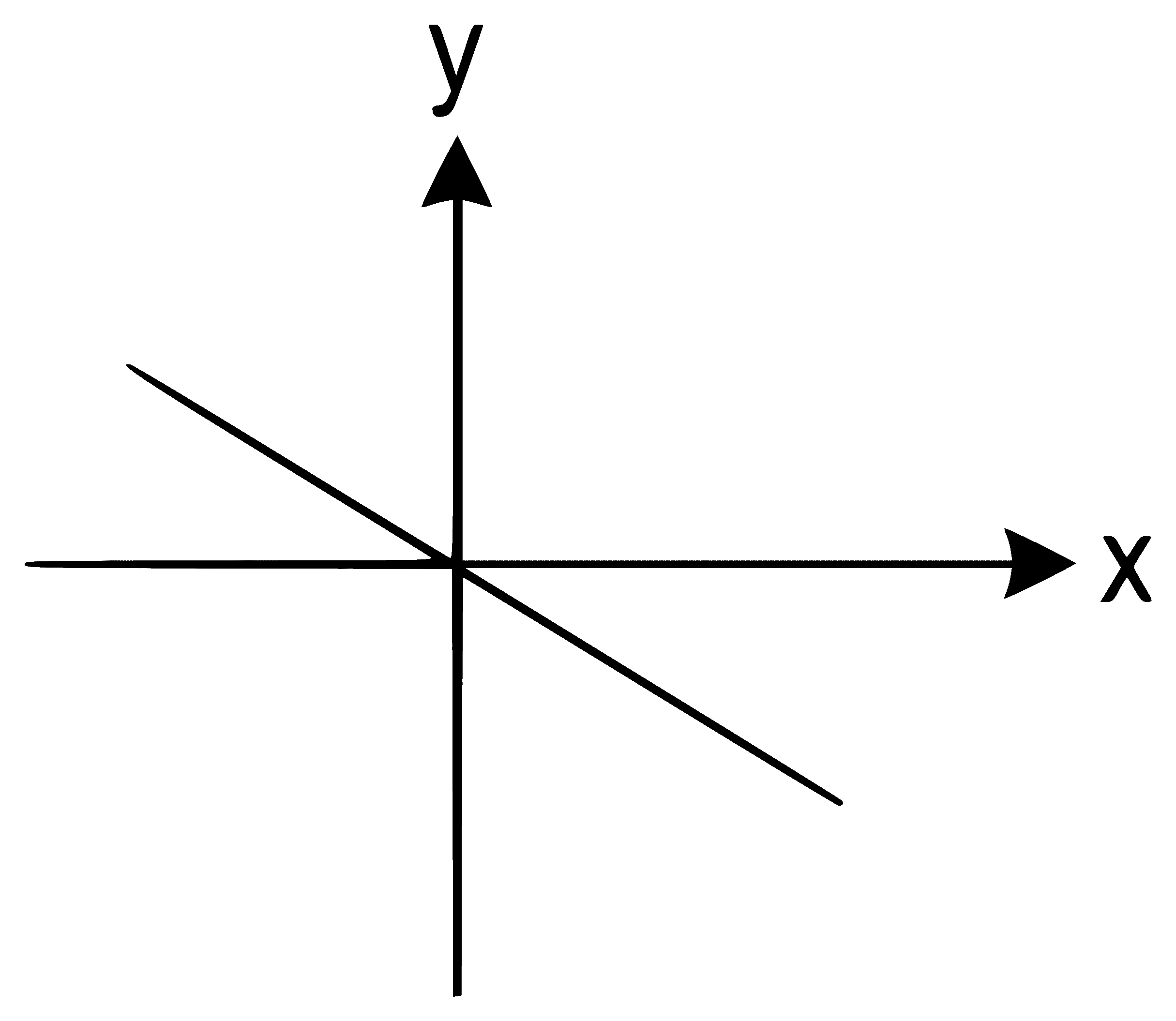
The position-time (x - t) graph for positive acceleration is

(A)
NEET 2022 Phase 2 Physics - Motion in a Straight Line Question 10 English Option 1
(B)
NEET 2022 Phase 2 Physics - Motion in a Straight Line Question 10 English Option 2
(C)
NEET 2022 Phase 2 Physics - Motion in a Straight Line Question 10 English Option 3
(D)
NEET 2022 Phase 2 Physics - Motion in a Straight Line Question 10 English Option 4
(B)

Solution

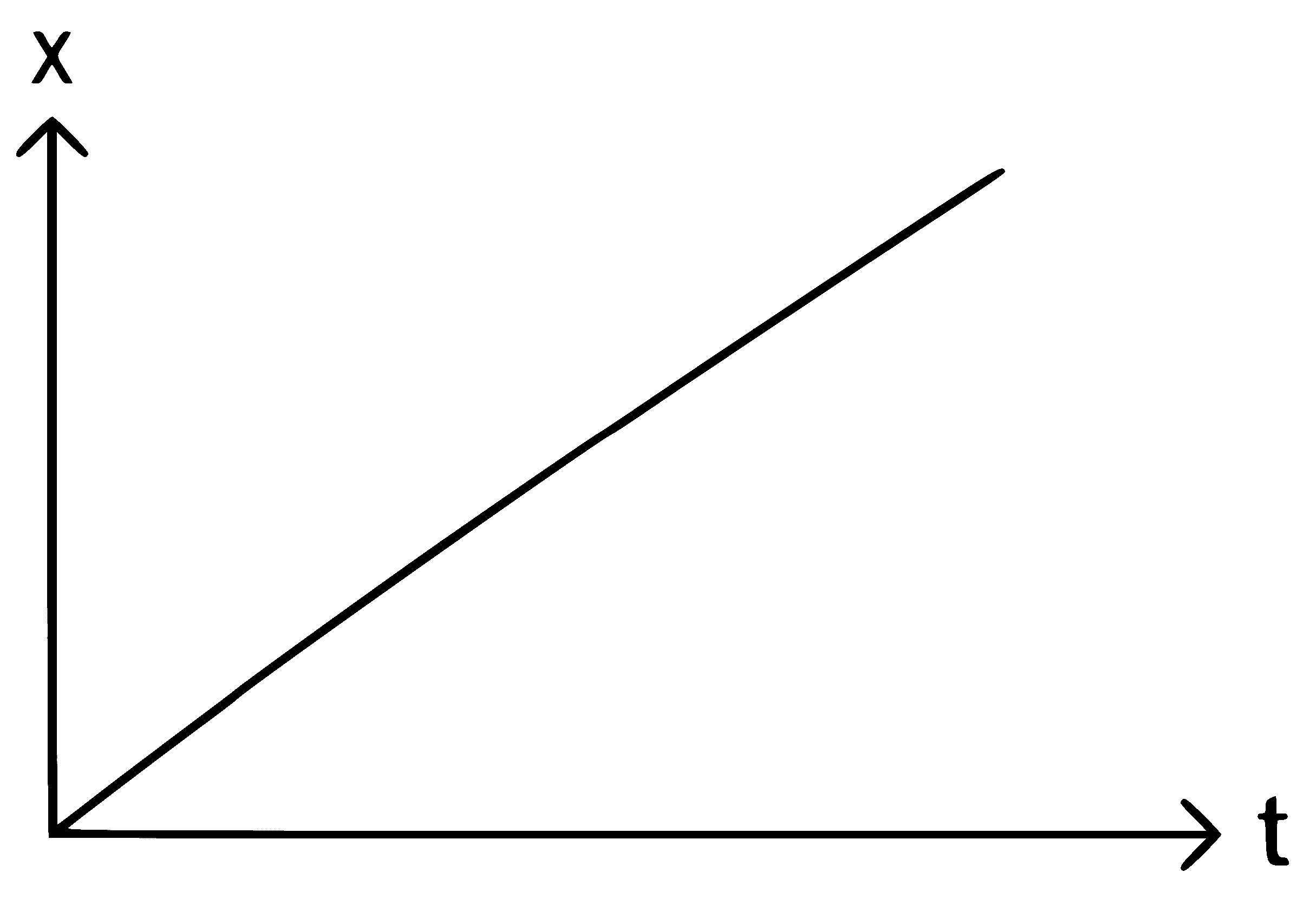
Slope of position-time (x - t) graph represents velocity.

In graph-2, the slope is increasing hence the velocity is increasing hence acceleration is positive.

Q.4

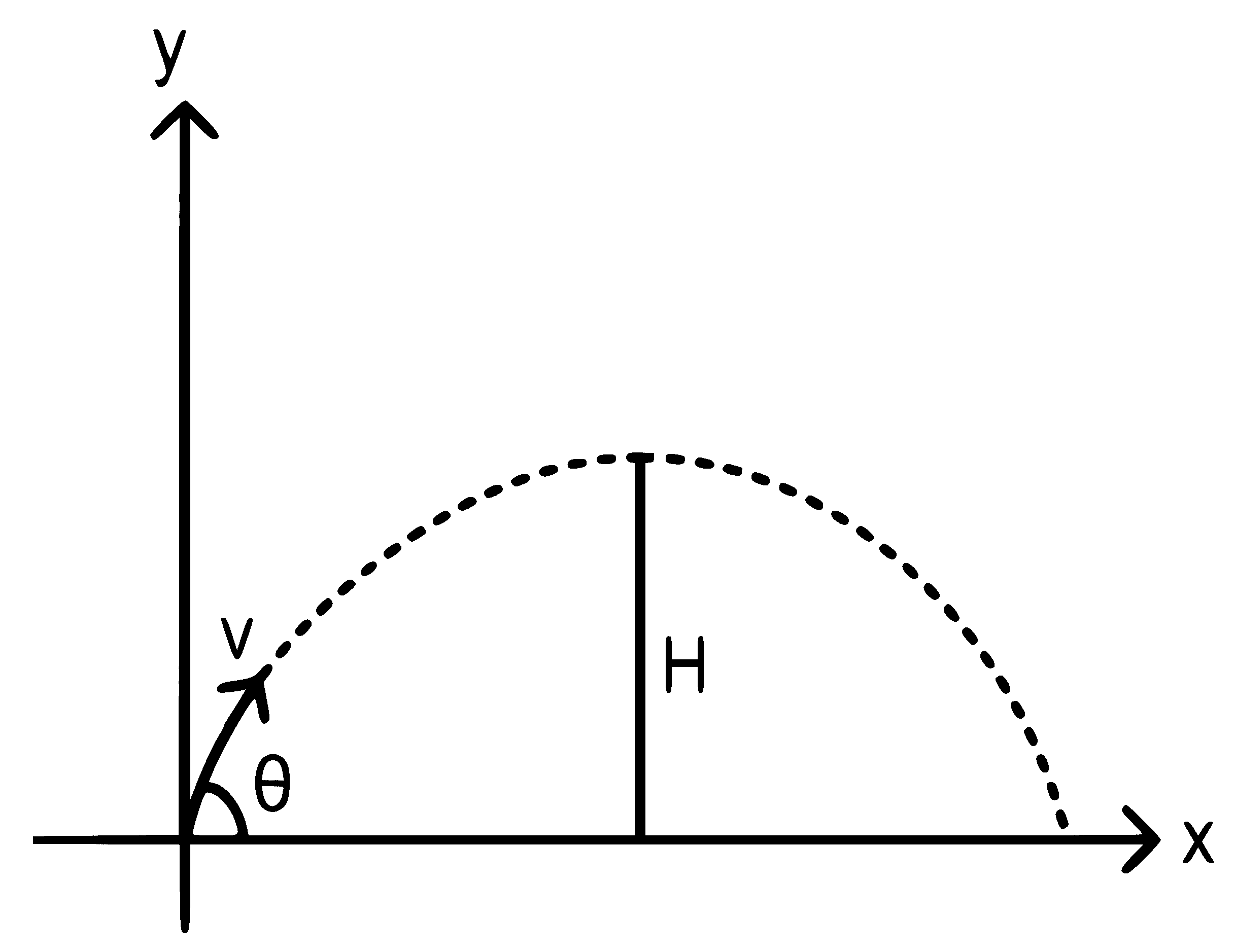
A cricket ball is thrown by a player at a speed of 20 m/s in a direction 30 above the horizontal. The maximum height attained by the ball during its motion is

(g = 10 m/s2)

(A)
25 m
(B)
5 m
(C)
10 m
(D)
20 m
(B)

Solution

NEET 2022 Phase 2 Physics - Motion in a Plane Question 7 English Explanation

Maximum height reached by the ball

Q.5

If and , then the scalar and vector products of and have the magnitudes respectively as

(A)
10, 2
(B)
5,
(C)
4,
(D)
10,
(D)

Solution

Given, and

Q.6

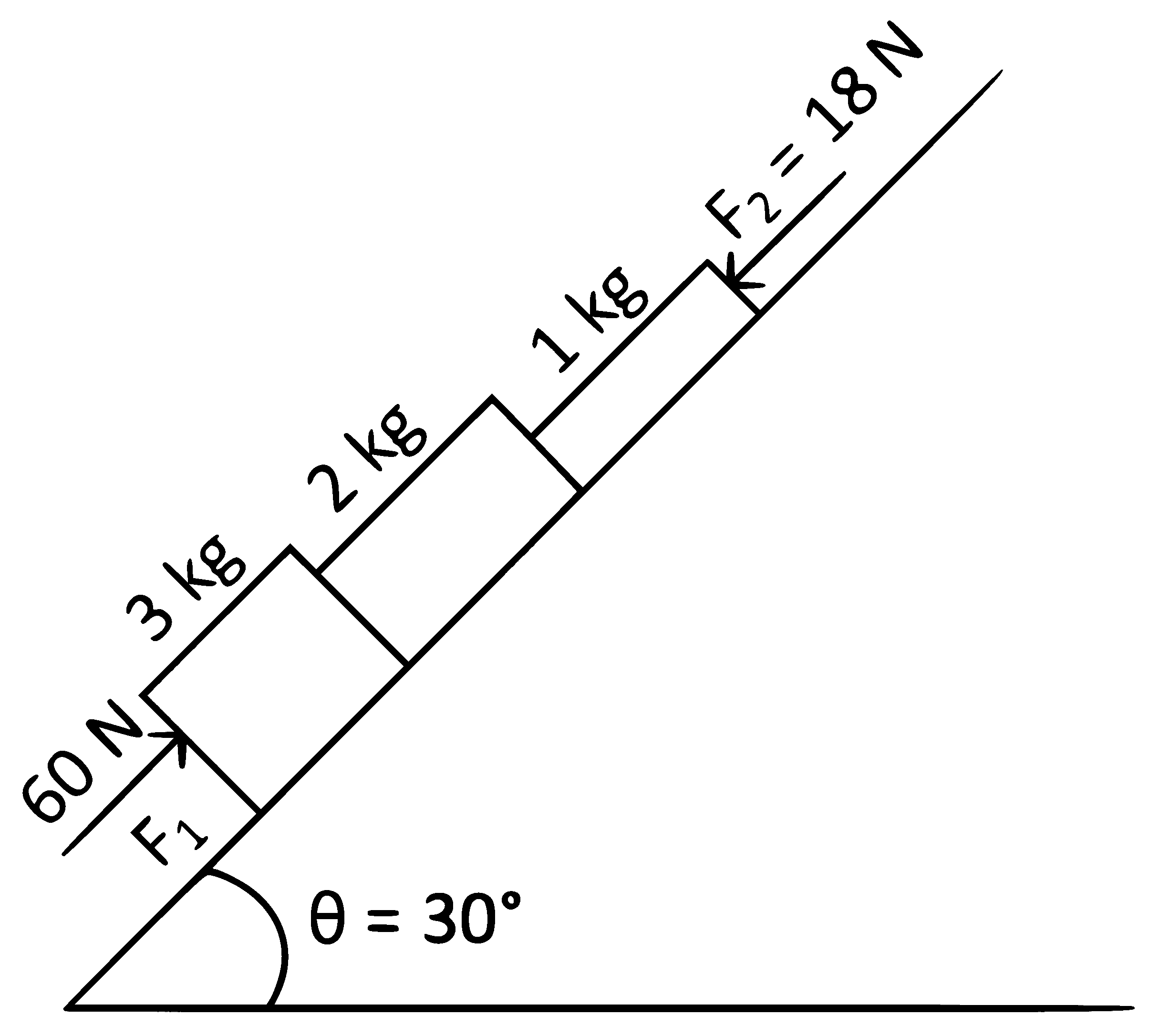
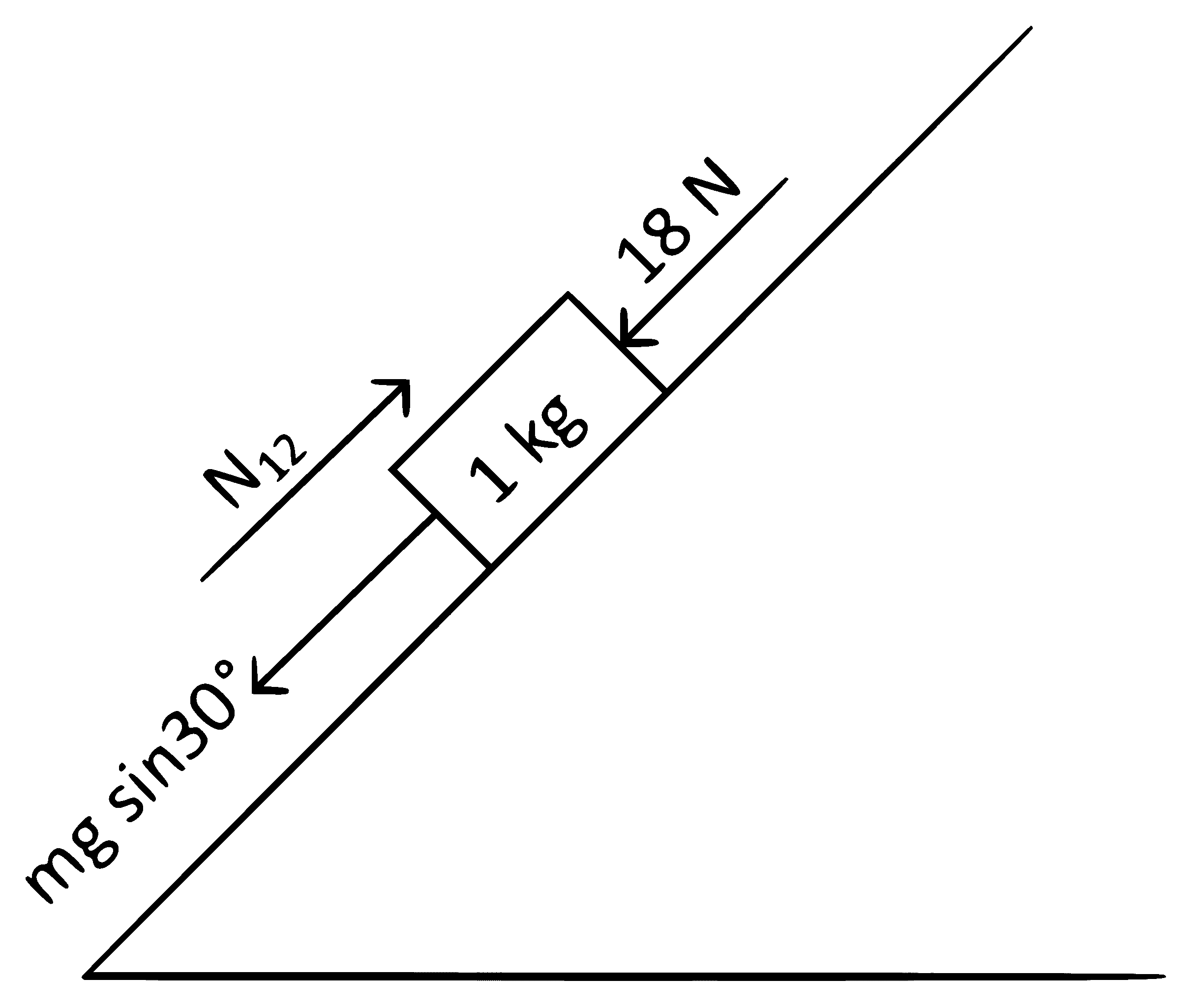
In the diagram shown, the normal reaction force between 2 kg and 1 kg is (Consider the surface, to be smooth) :

(Given g = 10 ms2)

NEET 2022 Phase 2 Physics - Laws of Motion Question 13 English

(A)
10 N
(B)
25 N
(C)
39 N
(D)
6 N
(B)

Solution

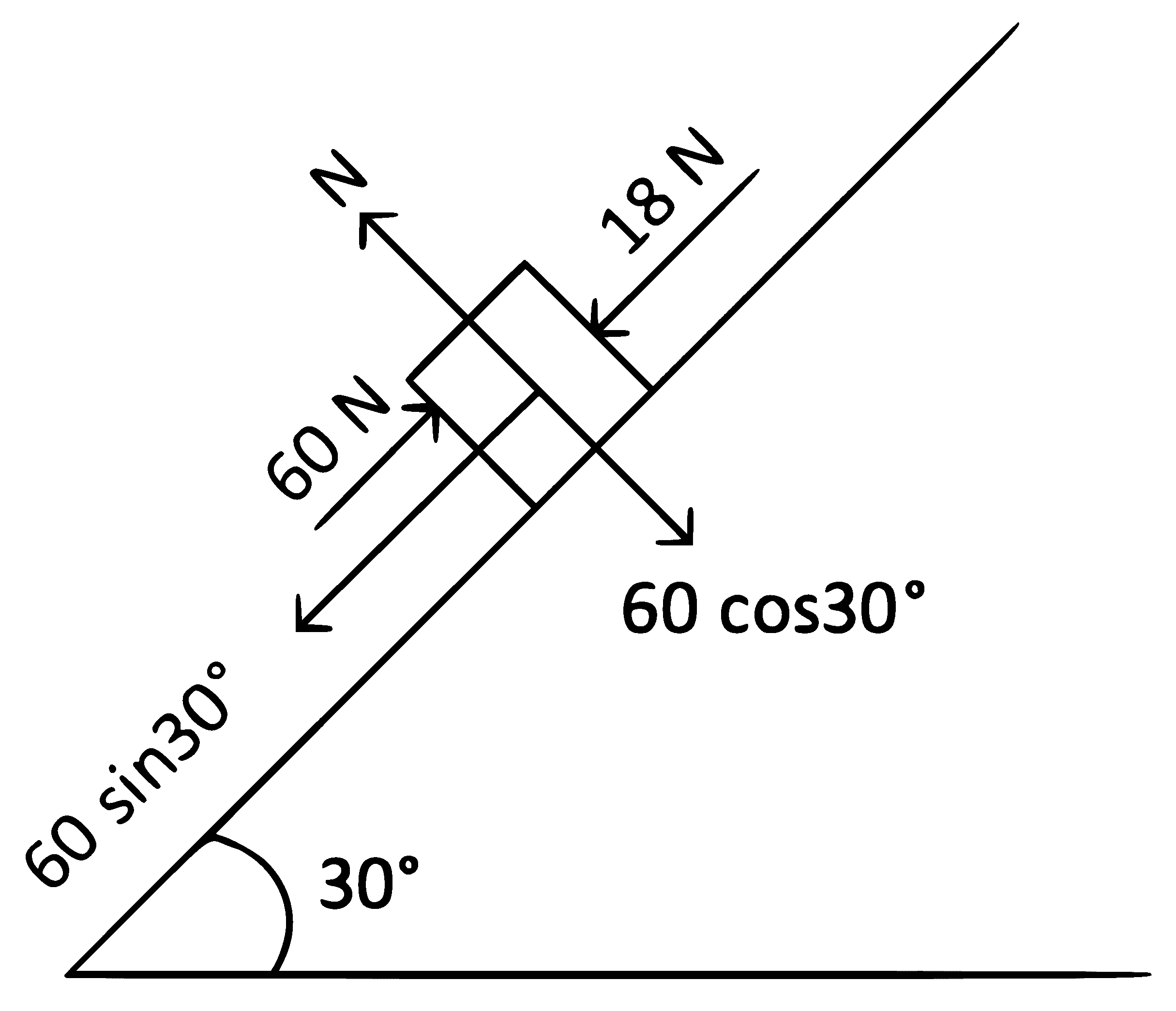
Assuming all three blocks as system

NEET 2022 Phase 2 Physics - Laws of Motion Question 13 English Explanation 1

Hence, acceleration of system

m/s2

m/s2, upward along the incline.

Now, for 1 kg block

NEET 2022 Phase 2 Physics - Laws of Motion Question 13 English Explanation 2

N

Q.7

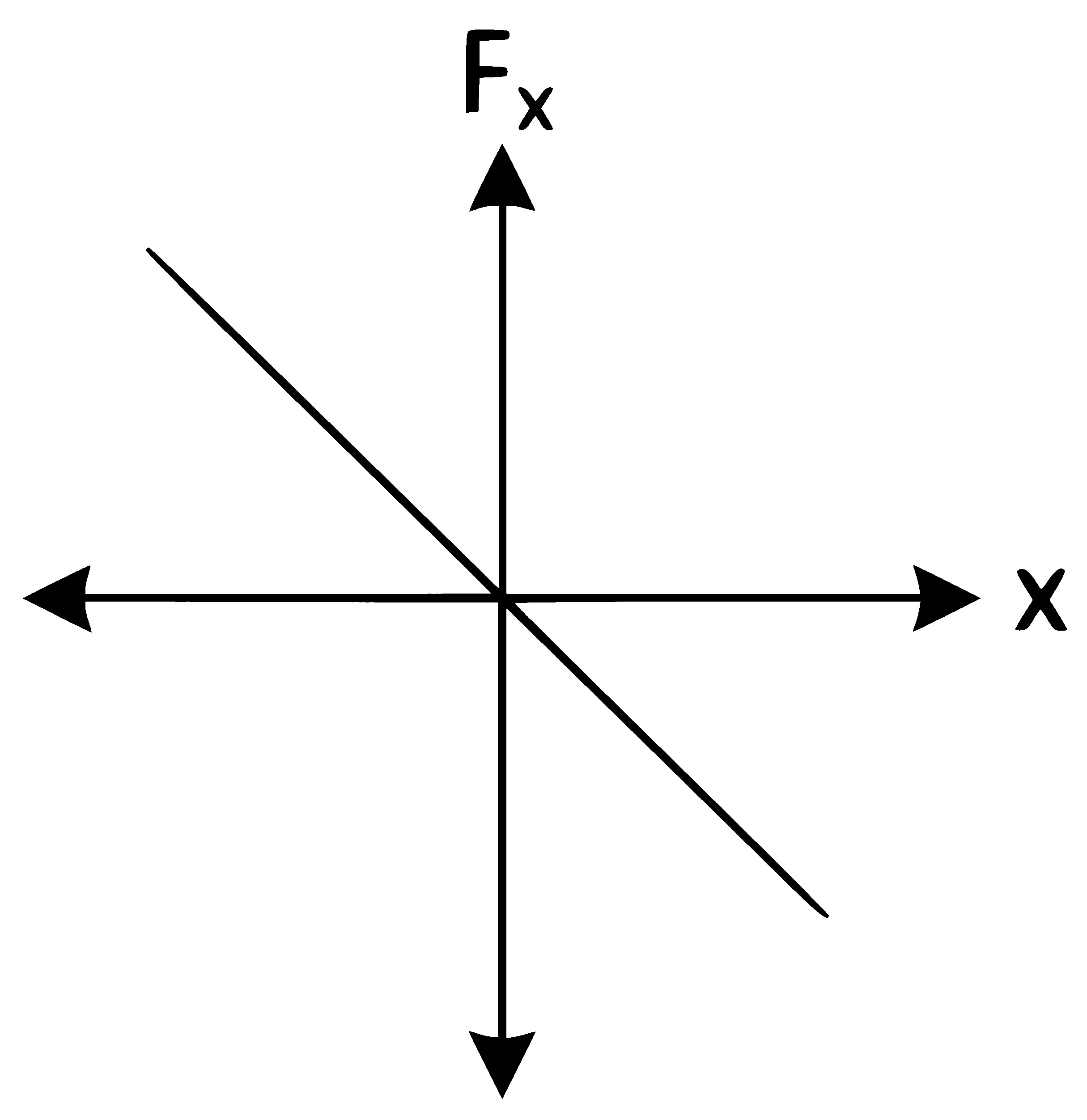
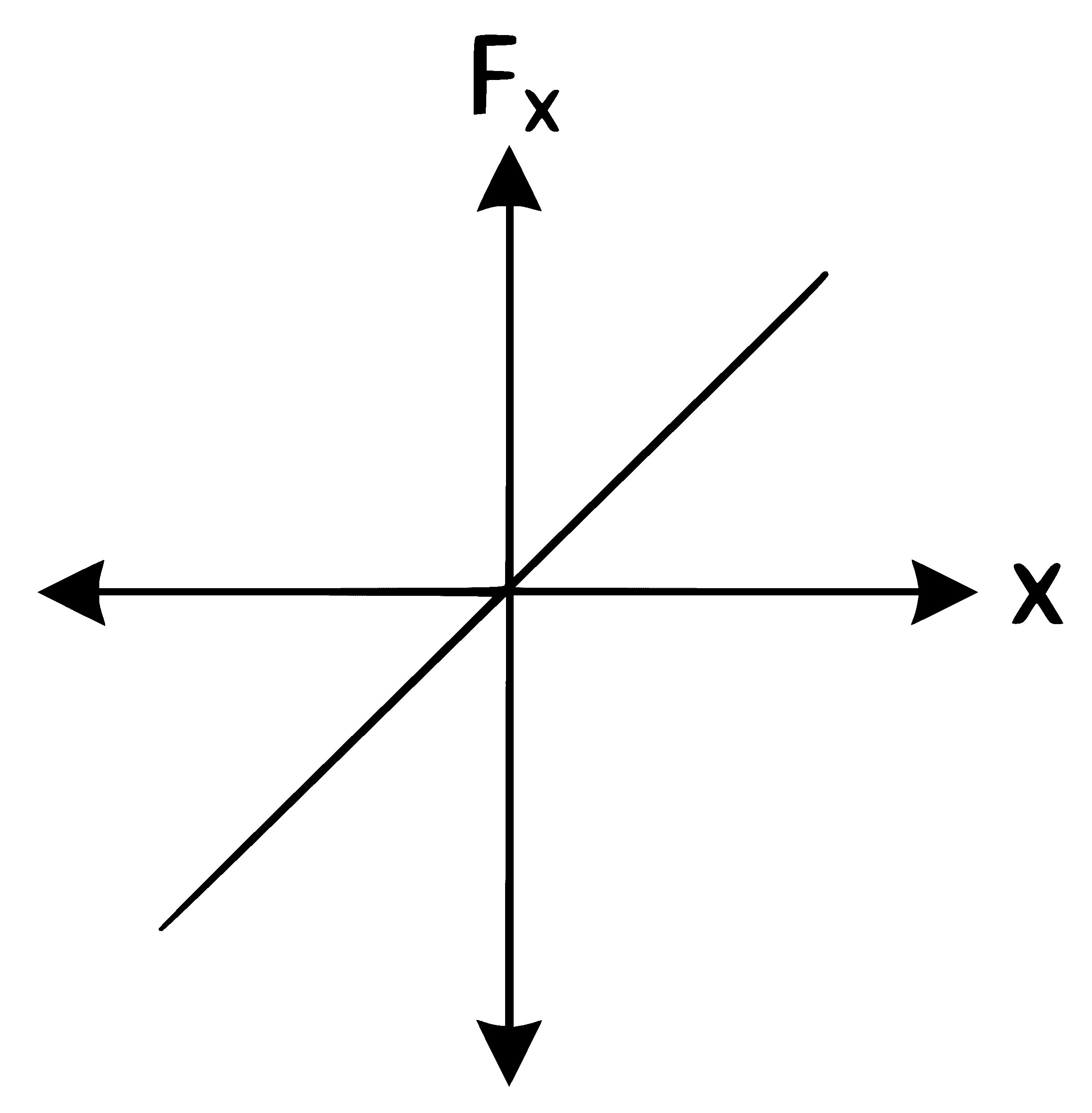
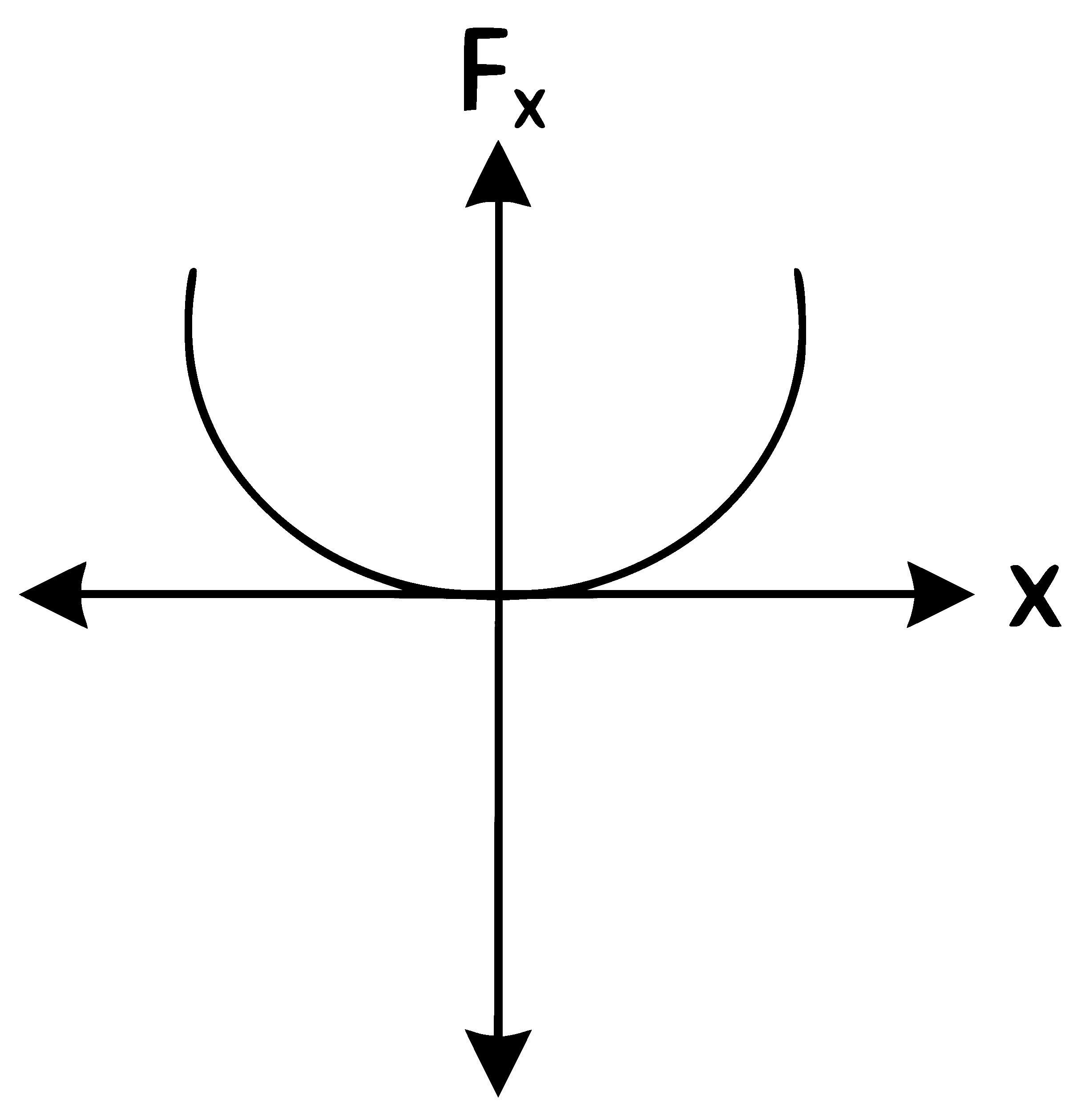
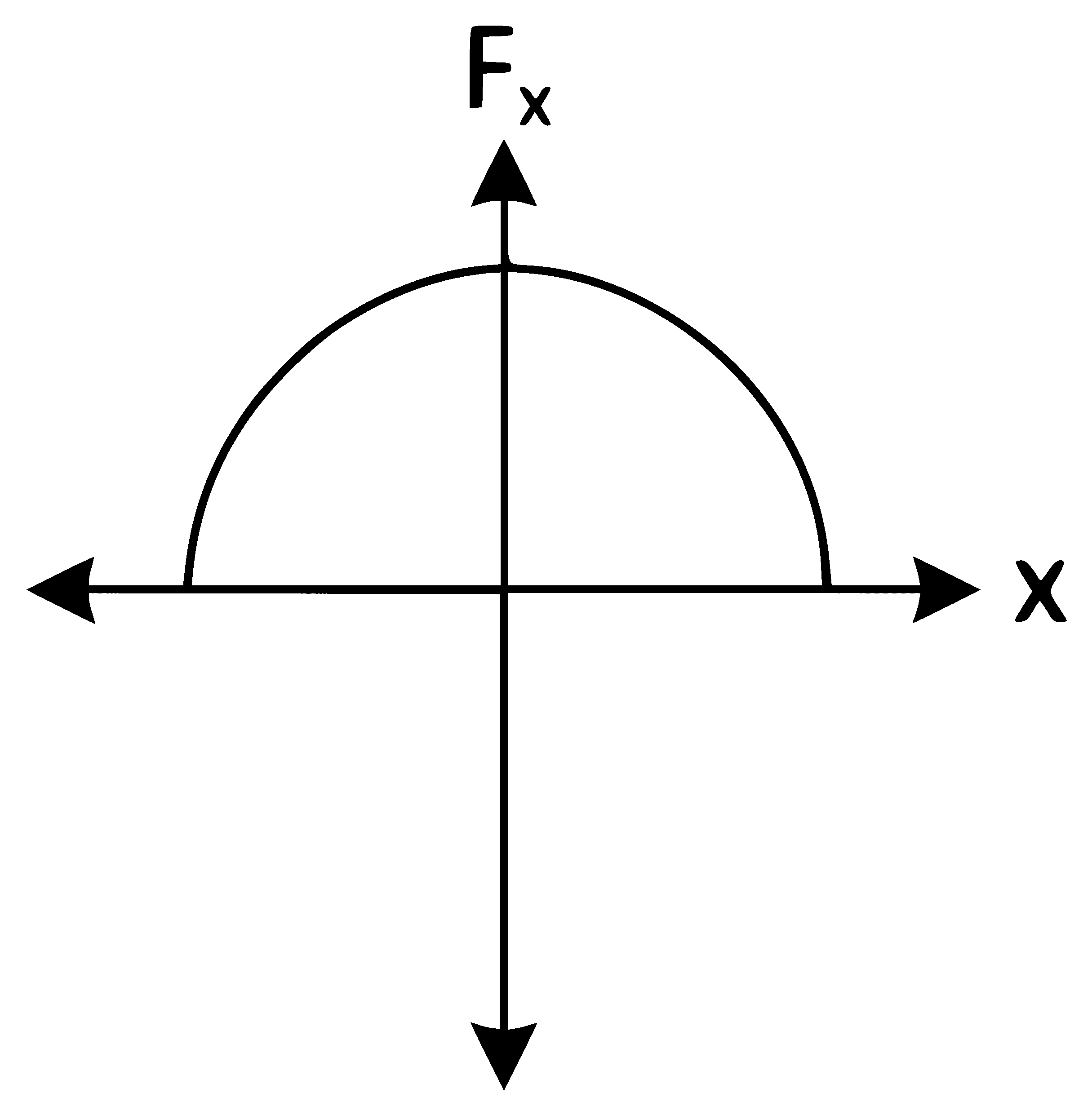
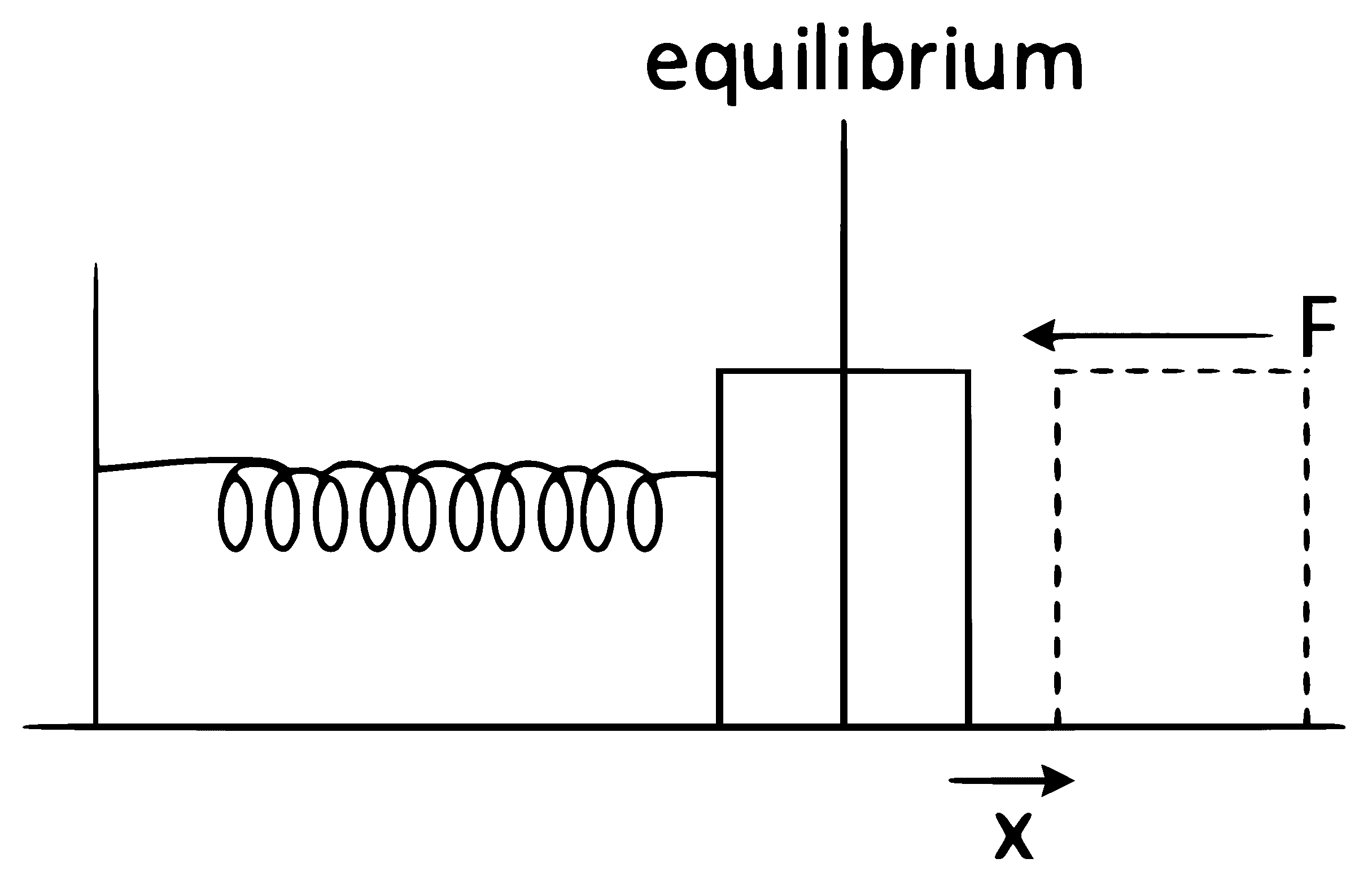
The restoring force of a spring with a block attached to the free end of the spring is represented by

(A)
NEET 2022 Phase 2 Physics - Work, Energy and Power Question 10 English Option 1
(B)
NEET 2022 Phase 2 Physics - Work, Energy and Power Question 10 English Option 2
(C)
NEET 2022 Phase 2 Physics - Work, Energy and Power Question 10 English Option 3
(D)
NEET 2022 Phase 2 Physics - Work, Energy and Power Question 10 English Option 4
(A)

Solution

NEET 2022 Phase 2 Physics - Work, Energy and Power Question 10 English Explanation 1

Where F is restoring force

x is displacement of block from equilibrium position

NEET 2022 Phase 2 Physics - Work, Energy and Power Question 10 English Explanation 2

Q.8

The distance covered by a body of mass 5 g having linear momentum 0.3 kg m/s in 5 s is :

(A)
0.3 m
(B)
300 m
(C)
30 m
(D)
3 m
(B)

Solution

m/s

m

Q.9

Given below are two statements : One is labelled as Assertion (A) and the other is labelled as Reason (R).

Assertion (A) : When a fire cracker (rocket) explodes in mid air, its fragments fly in such a way that they continue moving in the same path, which the fire cracker would have followed, had it not exploded.

Reason (R) : Explosion of cracker (rocket) occurs due to internal force only and no external force acts for this explosion.

In the light of the above statements, choose the most appropriate answer from the option given below

(A)
(A) is not correct but (R) is correct
(B)
Both (A) and (R) are correct and (R) is the correct explanation of (A)
(C)
Both (A) and (R) are correct but (R) is not the correct explanation of (A)
(D)
(A) is correct but (R) is not correct
(A)

Solution

As per Newton's II law for a system

As explosion occurs due to internal forces only, the velocity of centre of mass would remain unchanged. This means that the centre of mass would continue to travel along same path as it was moving before explosion.

The fragments can however move individually along various directions.

Thus (A) is not correct and (R) is correct.

Q.10

An energy of 484 J is spent in increasing the speed of a flywheel from 60 rpm to 360 rpm. The moment of inertia of the flywheel is :

(A)
0.07 kg-m2
(B)
0.7 kg-m2
(C)
3.22 kg-m2
(D)
30.8 kg-m2
(B)

Solution

From work - energy theorem

(change in Kinetic Energy)

In rotation,

kg-m2

Q.11

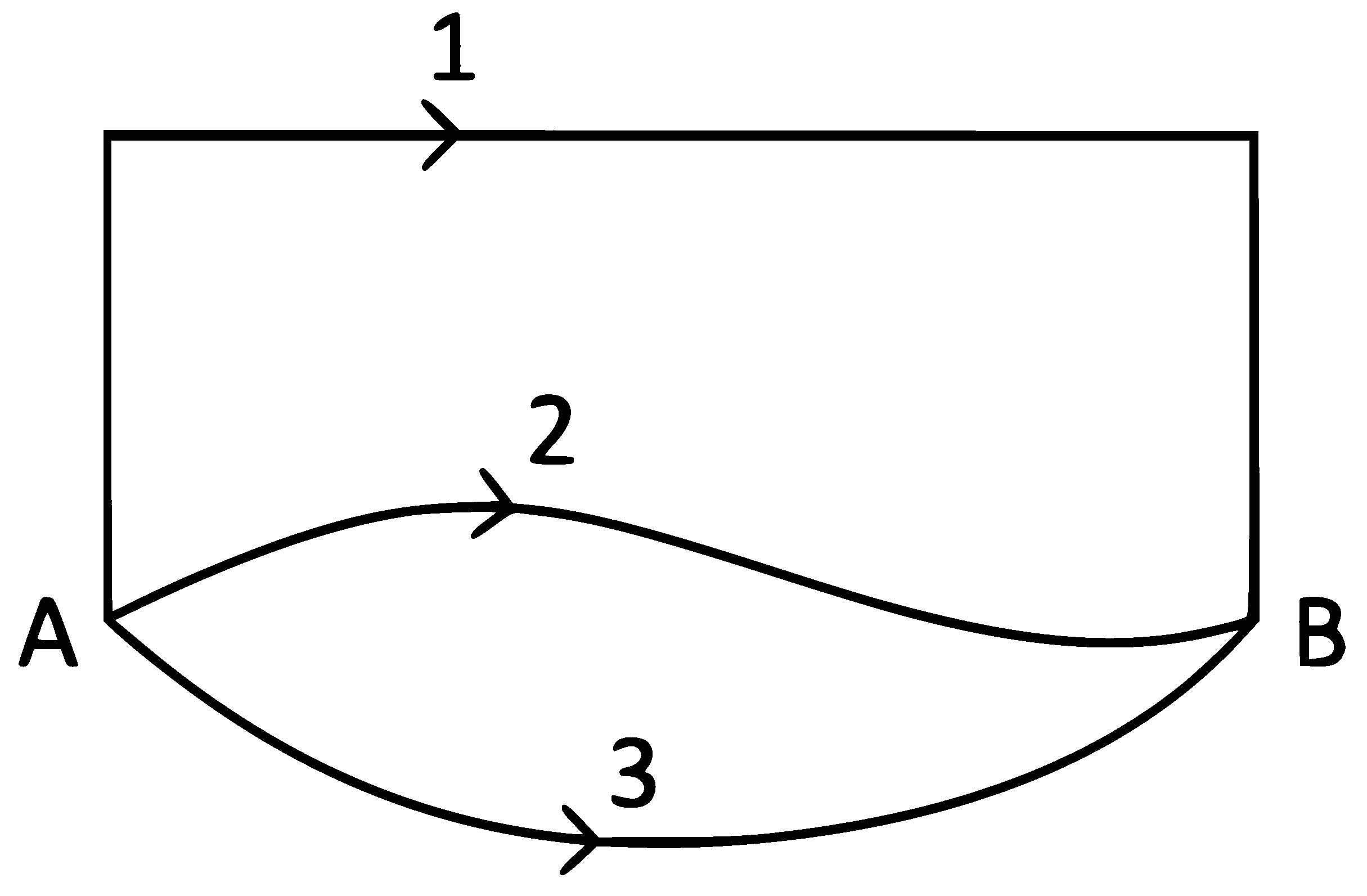
A gravitational field is present in a region and a mass is shifted from A to B through different paths as shown. If W1, W2 and W3 represent the work done by the gravitational force along the respective paths, then :

NEET 2022 Phase 2 Physics - Gravitation Question 15 English

(A)
W1 < W2 < W3
(B)
W1 = W2 = W3
(C)
W1 > W2 > W3
(D)
W1 > W3 > W2
(B)

Solution

Since the gravitational field is conservative in nature hence the work done would depend only on the initial and final positions and not on the path followed by the mass.

Hence, W1 = W2 = W3

Q.12

In a gravitational field, the gravitational potential is given by, (J/Kg). The gravitational field intensity at point (2, 0, 3) m is

(A)
(B)
(C)
(D)
(D)

Solution

Gravitational field intensity

where V is gravitational potential

Gravitational field intensity

at (2, 0, 3)

Q.13

Two copper vessels A and B have the same base area but of different shapes. A takes twice the volume of water as that B requires to fill upto a particular common height. Then the correct statement among the following is :

(A)
Vessel B weighs twice that of A.
(B)
Pressure on the base area of vessels A and B is same.
(C)
Pressure on the base area of vessels A and B is not same.
(D)
Both vessels A and B weigh the same.
(B)

Solution

In hydrostatic condition,

Here, P : absolute pressure at depth h, P0 is atmospheric pressure

Since, height of liquid in both vessel is same therefore pressure on the base of both vessel will be same.

Q.14

The terminal velocity of a copper ball of radius 5 mm falling through a tank of oil at room temperature is 10 cm s1. If the viscosity of oil at room temperature is 0.9 kg m1 s1, the viscous drag force is :

(A)
4.23 106 N
(B)
8.48 103 N
(C)
8.48 105 N
(D)
4.23 103 N
(B)

Solution

Fviscous = 6av

Fviscous = 6 3.14 0.9 5 103 10 102

= 84.78 104

= 8.478 103 N

Q.15

An ideal gas follows a process described by the equation from the initial to final thermodynamic states, where C is a constant. Then

(A)
If then
(B)
If then
(C)
If then
(D)
If then
(D)

Solution

We know,

Given, constant

If

constant

constant

i.e., if

Also, constant

constant

If then

Q.16

Two rods one made of copper and other made of steel of same length and same cross sectional area are joined together. The thermal conductivity of copper and steel are 385 J s1 K1 m1 and 50 J s1 K1 m1 respectively. The free ends of copper and steel are held at 100C and 0C respectively. The temperature at the junction is, nearly :

(A)
(B)
(C)
(D)
(A)

Solution

We know in conduction, rate of flow of heat

As it is a case of steady state heat transfer

Where Tj is temperature of the junction

Q.17

Three vessels of equal capacity have gases at the same temperature and pressure. The first vessel contains helium (monoatomic), the second contains fluorine (diatomic) and the third contains sulfur hexafluoride (polyatomic). The correct statement, among the following is :

(A)
The root mean square speed of sulfur hexafluoride is the largest
(B)
All vessels contain unequal number of respective molecules
(C)
The root mean square speed of molecules is same in all three cases
(D)
The root mean square speed of helium is the largest
(D)

Solution

All three vessels have equal volume and same temperature and pressure.

From ideal gas equation

constant

So, here all three vessels contains equal number of moles and number of gas molecules.

Now,

Here, rms speed of helium is the largest.

Q.18

Match List-I with List-II

List-I
(x-y graphs)
List-II
(Situations)
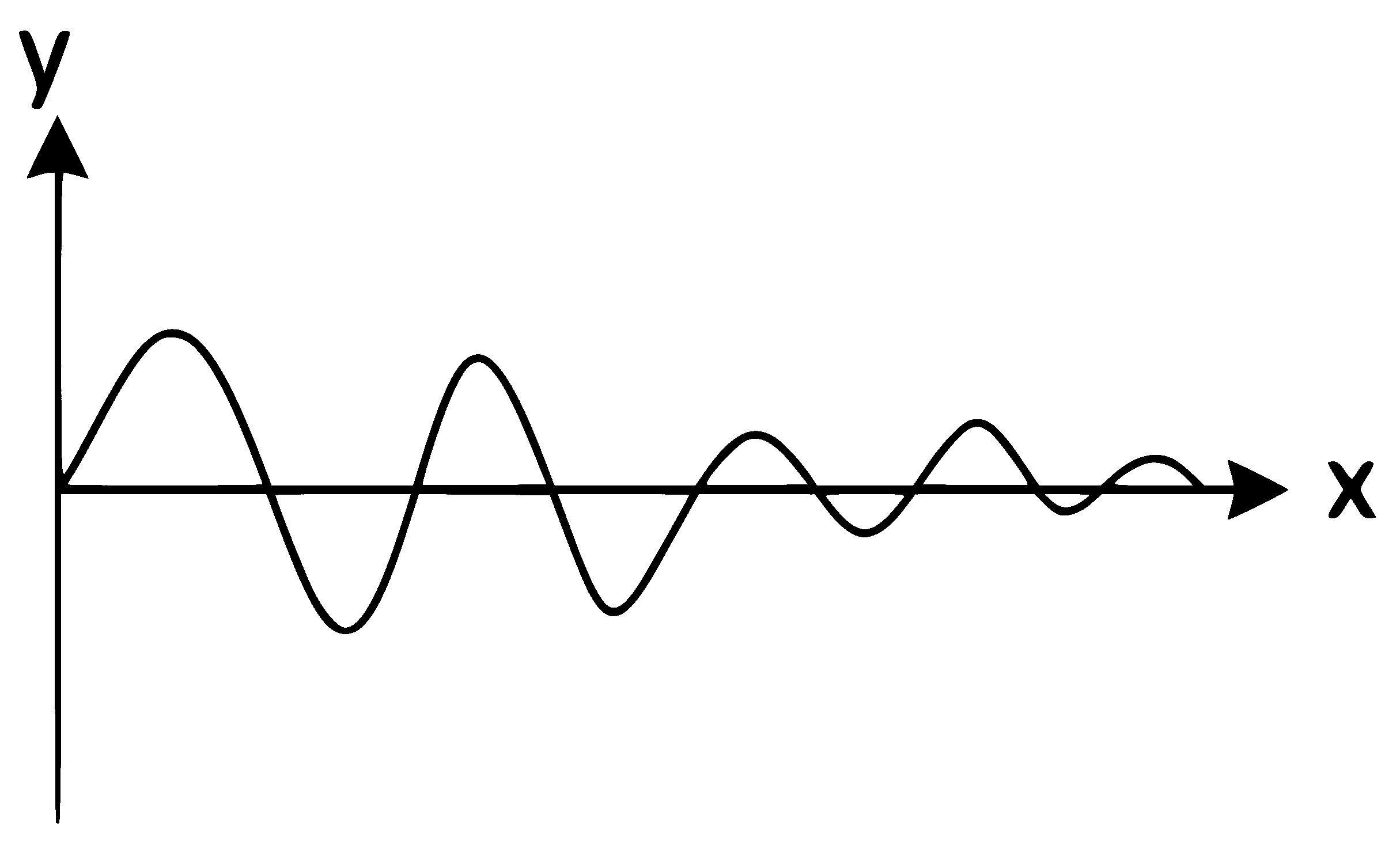
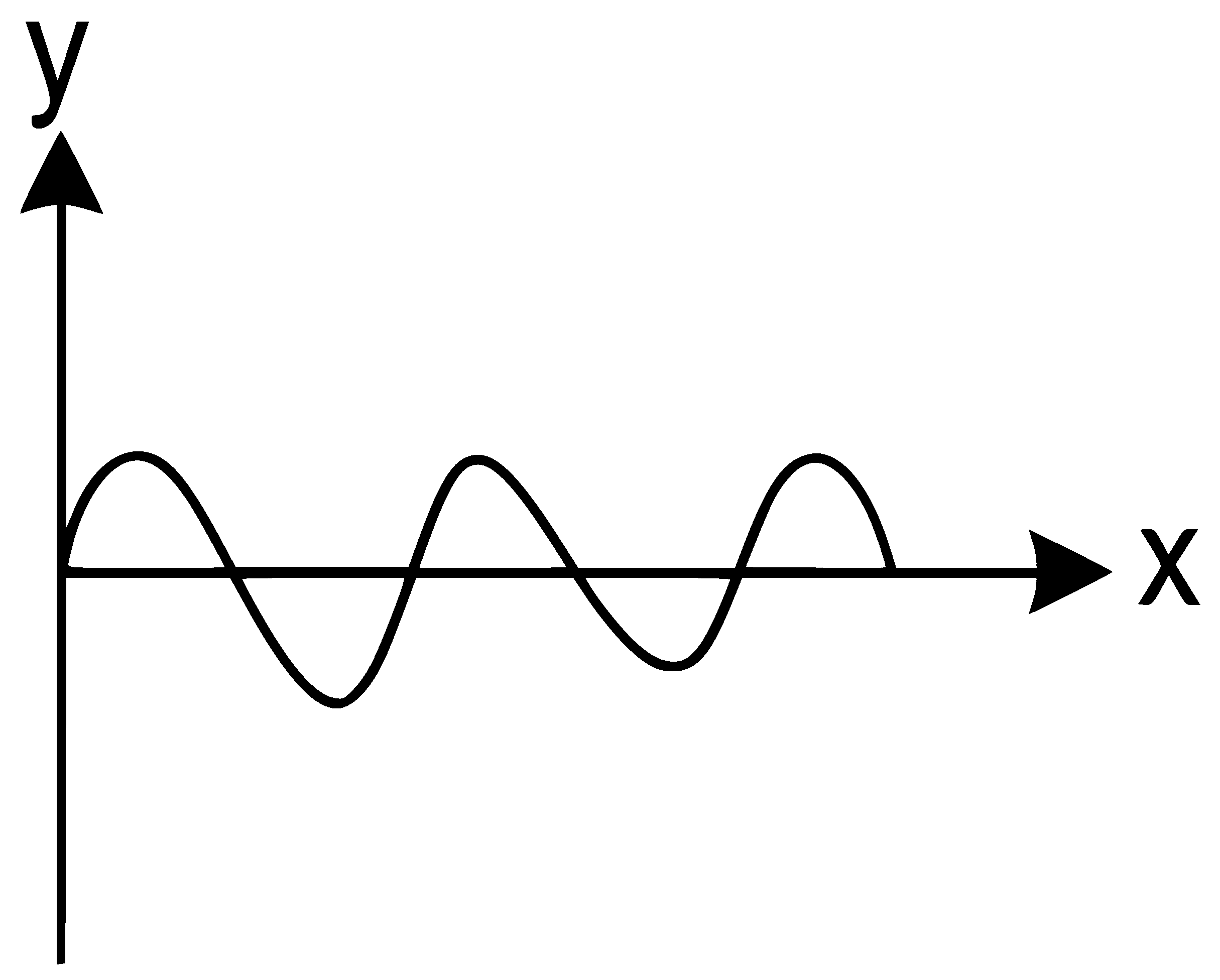
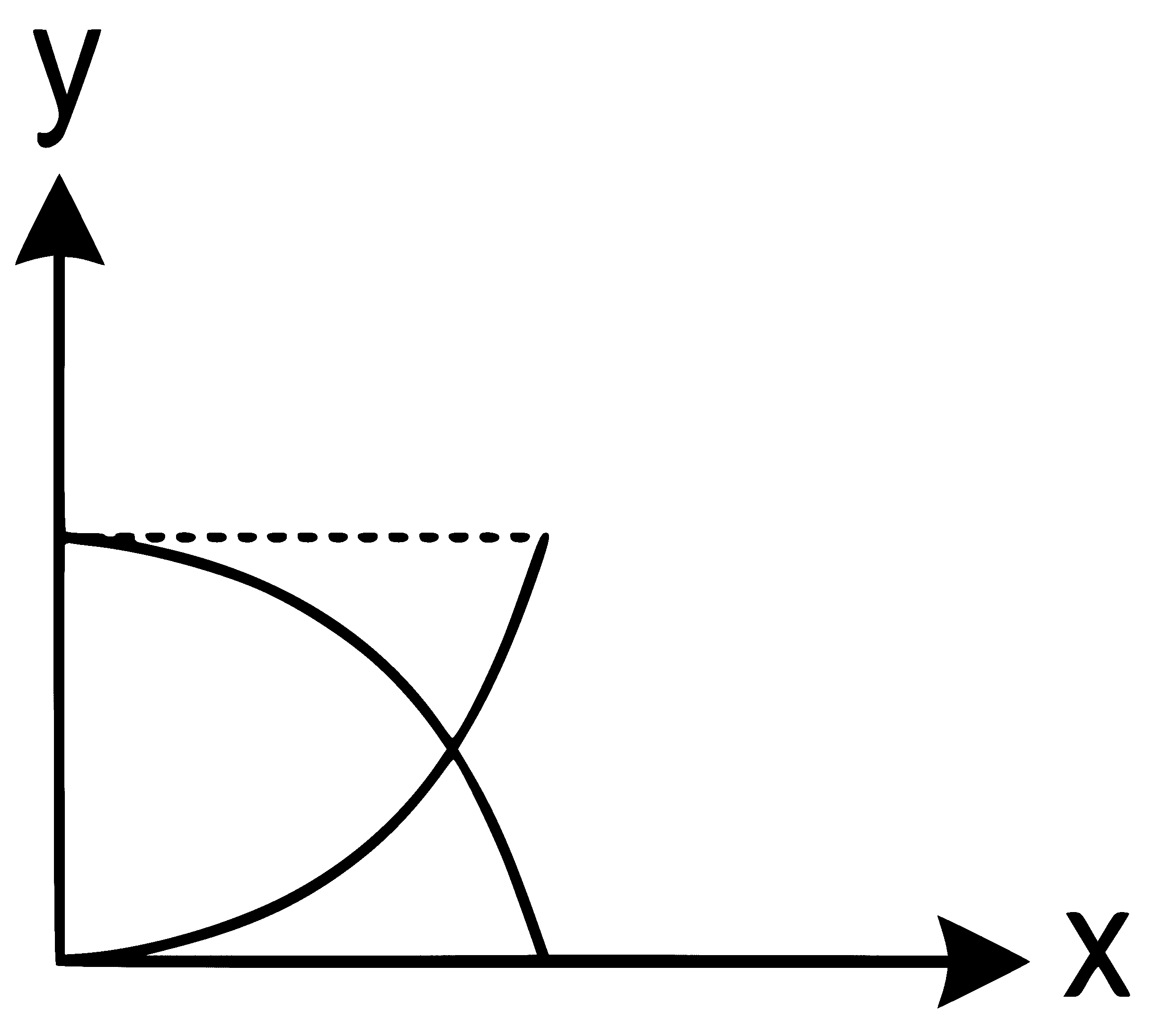
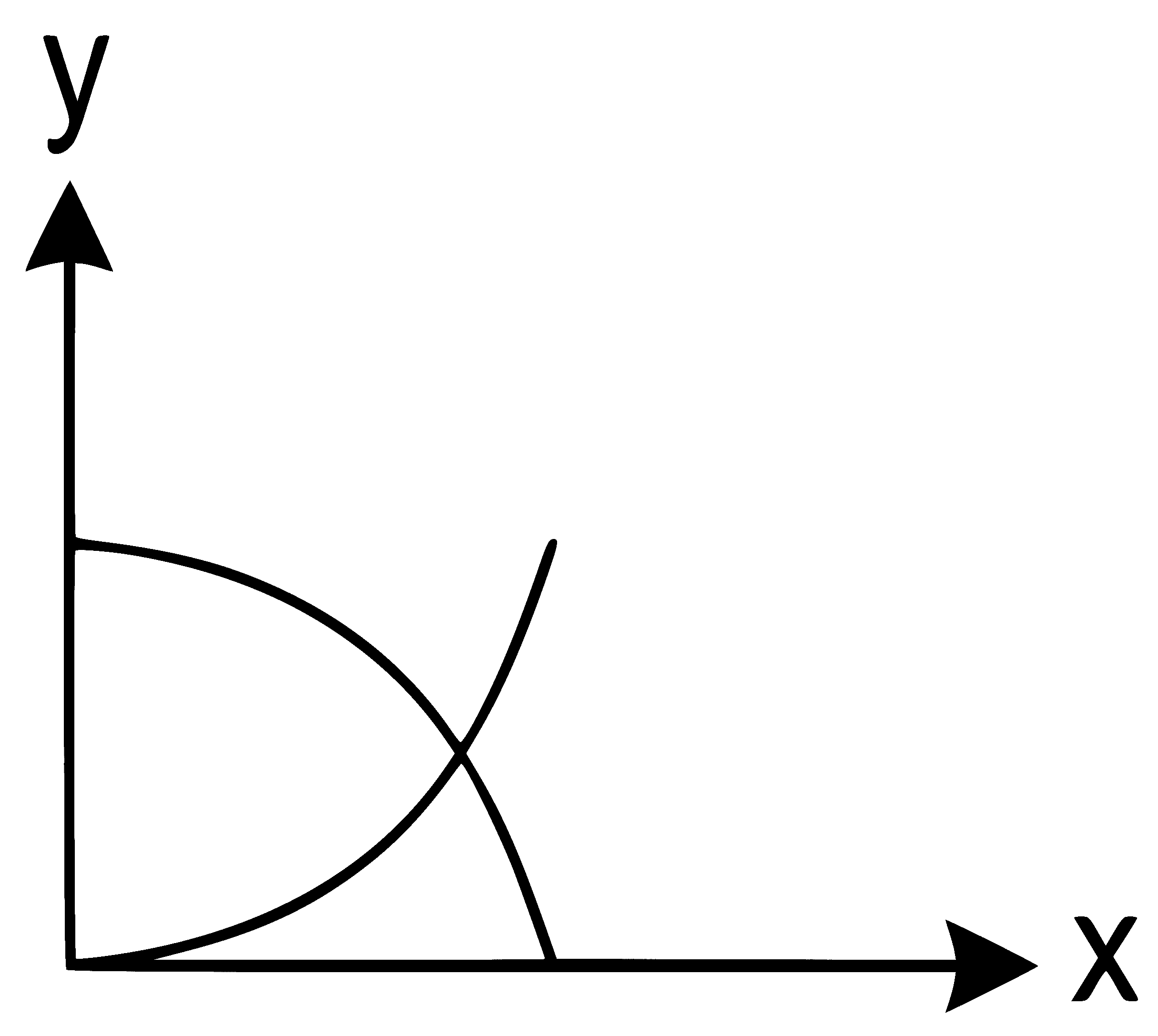
(a) NEET 2022 Phase 2 Physics - Oscillations Question 14 English 1 (i) Total mechanical energy is conserved
(b) NEET 2022 Phase 2 Physics - Oscillations Question 14 English 2 (ii) Bob of a pendulum is oscillating under negligible air friction
(c) NEET 2022 Phase 2 Physics - Oscillations Question 14 English 3 (iii) Restoring force of a spring
(d) NEET 2022 Phase 2 Physics - Oscillations Question 14 English 4 (iv) Bob of a pendulum is oscillating along with air friction

Choose the correct answer from the options given below

(A)
(a) - (iii), (b) - (ii), (c) - (i), (d) - (iv)
(B)
(a) - (iv), (b) - (ii), (c) - (iii), (d) - (i)
(C)
(a) - (iv), (b) - (iii), (c) - (ii), (d) - (i)
(D)
(a) - (i), (b) - (iv), (c) - (iii), (d) - (ii)
(C)

Solution

(a) NEET 2022 Phase 2 Physics - Oscillations Question 14 English Explanation 1

Amplitude of oscillation is continuously decreasing. It means bob of pendulum oscillate with air friction.

(b) NEET 2022 Phase 2 Physics - Oscillations Question 14 English Explanation 2

(restoring force of a spring)

(c) NEET 2022 Phase 2 Physics - Oscillations Question 14 English Explanation 3

Amplitude of oscillation is remains same. It means bob of pendulum is oscillating under negligible air resistance.

(d) NEET 2022 Phase 2 Physics - Oscillations Question 14 English Explanation 4

constant

Q.19

Identify the function which represents a non-periodic motion.

(A)
(B)
(C)
(D)
(B)

Solution

Here,

and clearly suggest a periodic sinusoidal function (SHM)

And is also a periodic sinusoidal function (SHM)

While, is an exponentially decreasing function and thus does not have periodicity.

Q.20

An organ pipe filled with a gas at 27C resonates at 400 Hz in its fundamental mode. If it is filled with the same gas at 90C, the resonance frequency at the same mode will be

(A)
512 Hz
(B)
420 Hz
(C)
440 Hz
(D)
484 Hz
(C)

Solution

Hz

Q.21

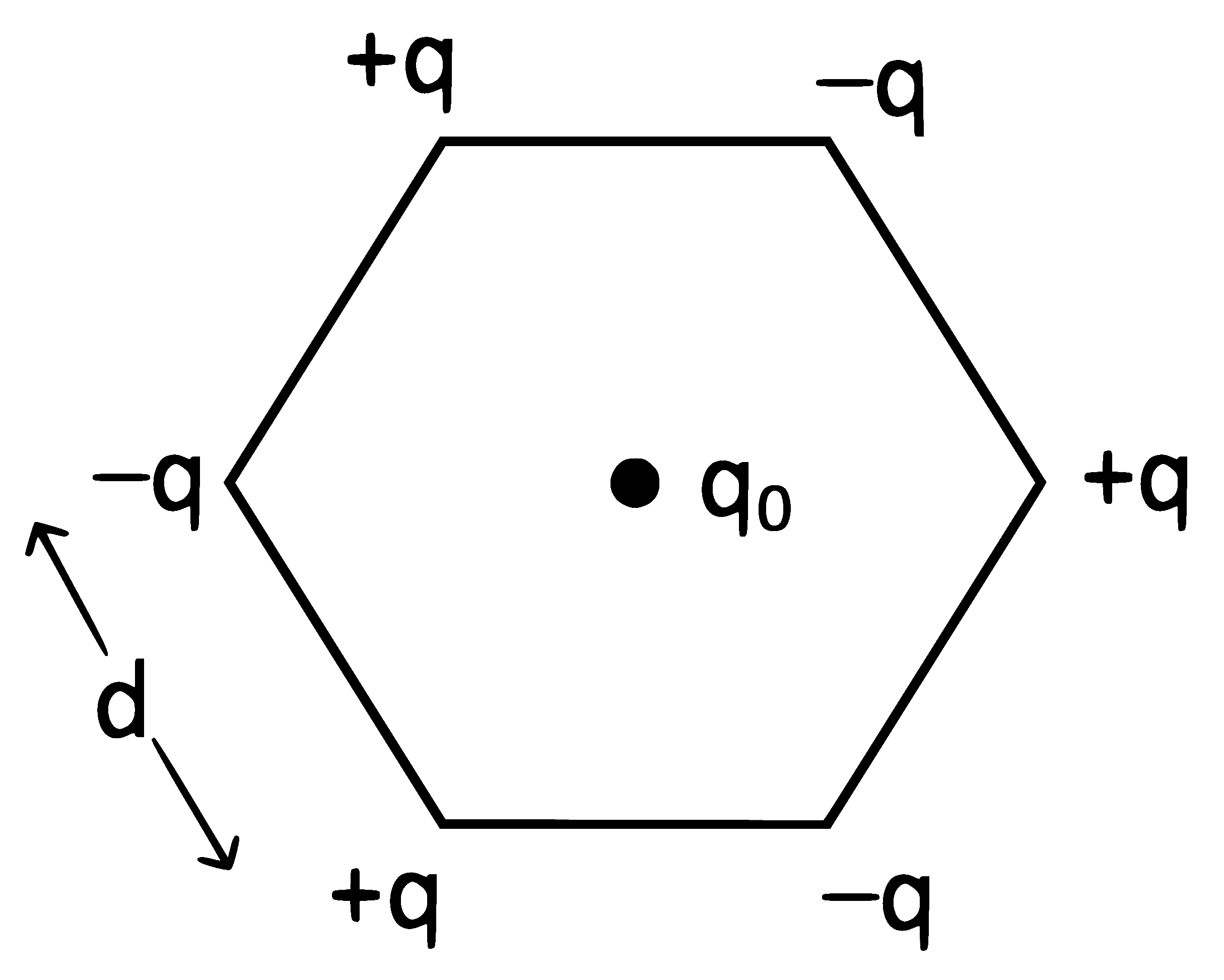
Six charges +q, q, +q, q, +q, and q are fixed at the corners of a hexagon of side d as shown in the figure. The work done in bringing a charge q0 to the centre of the hexagon from infinity is

( - permittivity of free space)

NEET 2022 Phase 2 Physics - Electrostatics Question 17 English

(A)
(B)
Zero
(C)
(D)
(B)

Solution

NEET 2022 Phase 2 Physics - Electrostatics Question 17 English Explanation

Work done

= Zero

Q.22

The reciprocal of resistance is :

(A)
conductance
(B)
reactance
(C)
mobility
(D)
conductivity
(A)

Solution

Thus reciprocal of resistance (R) is conductance (G)

Q.23

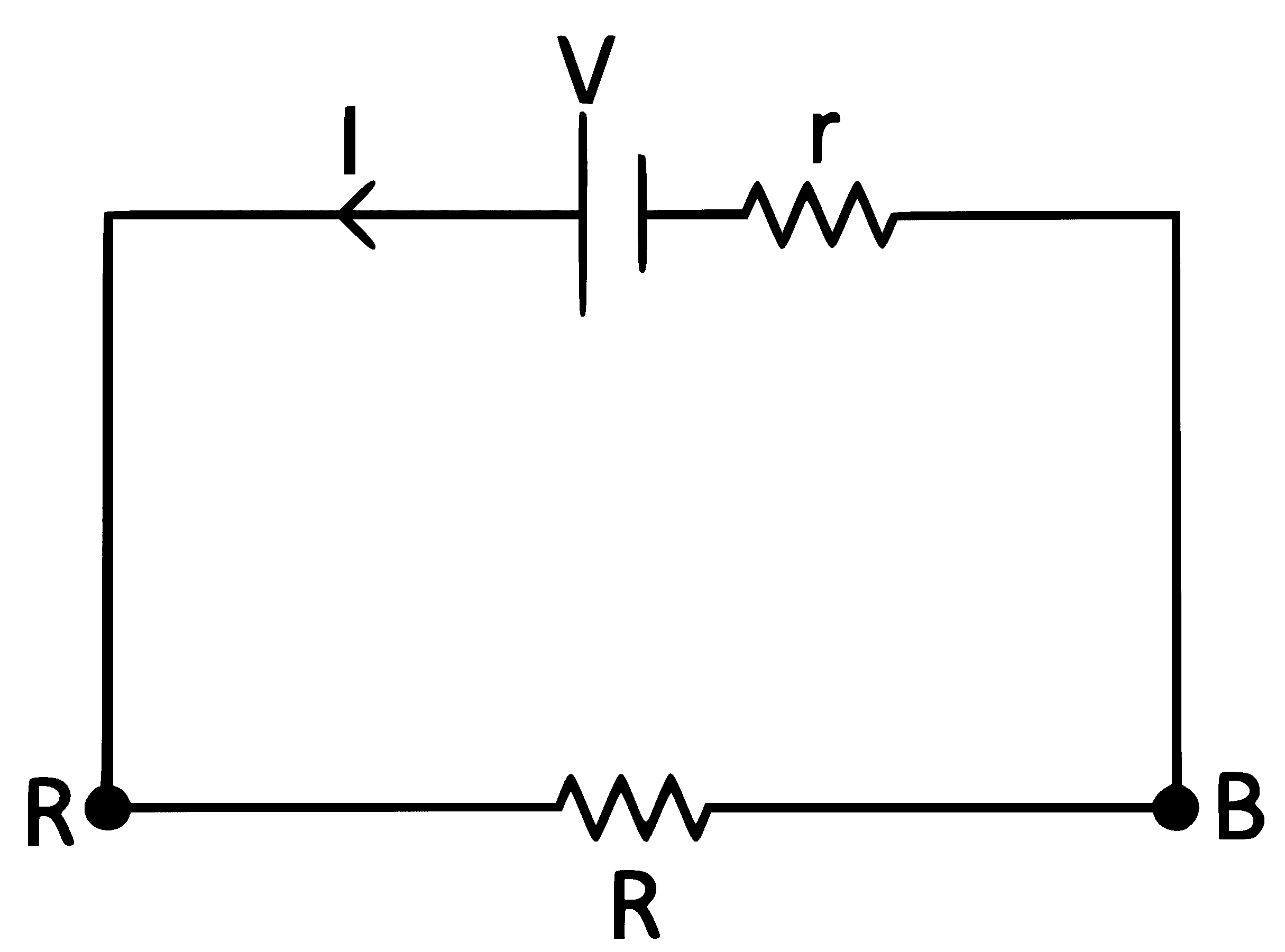
A cell of emf 4 V and internal resistance 0.5 is connected to a 7.5 external resistance. The terminal potential difference of the cell is

(A)
0.375 V
(B)
3.75 V
(C)
4.25 V
(D)
4 V
(B)

Solution

NEET 2022 Phase 2 Physics - Current Electricity Question 28 English Explanation

From Kirchhoff's loop law :

Terminal potential difference across cell,

Q.24

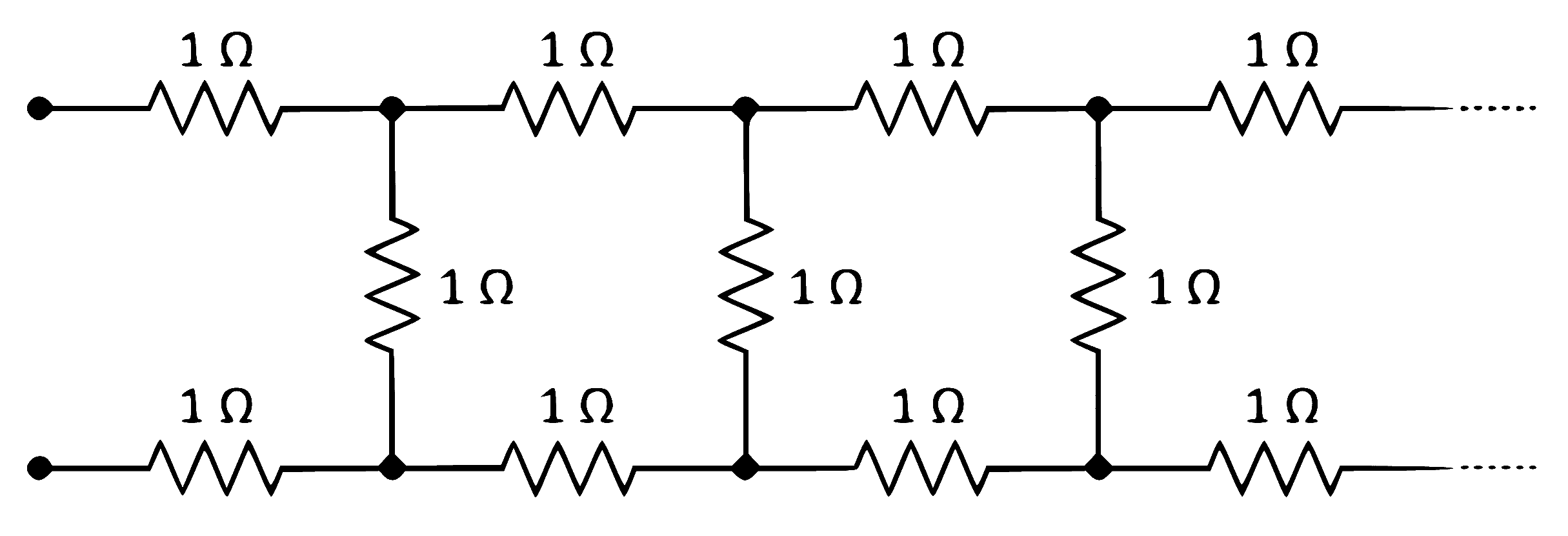
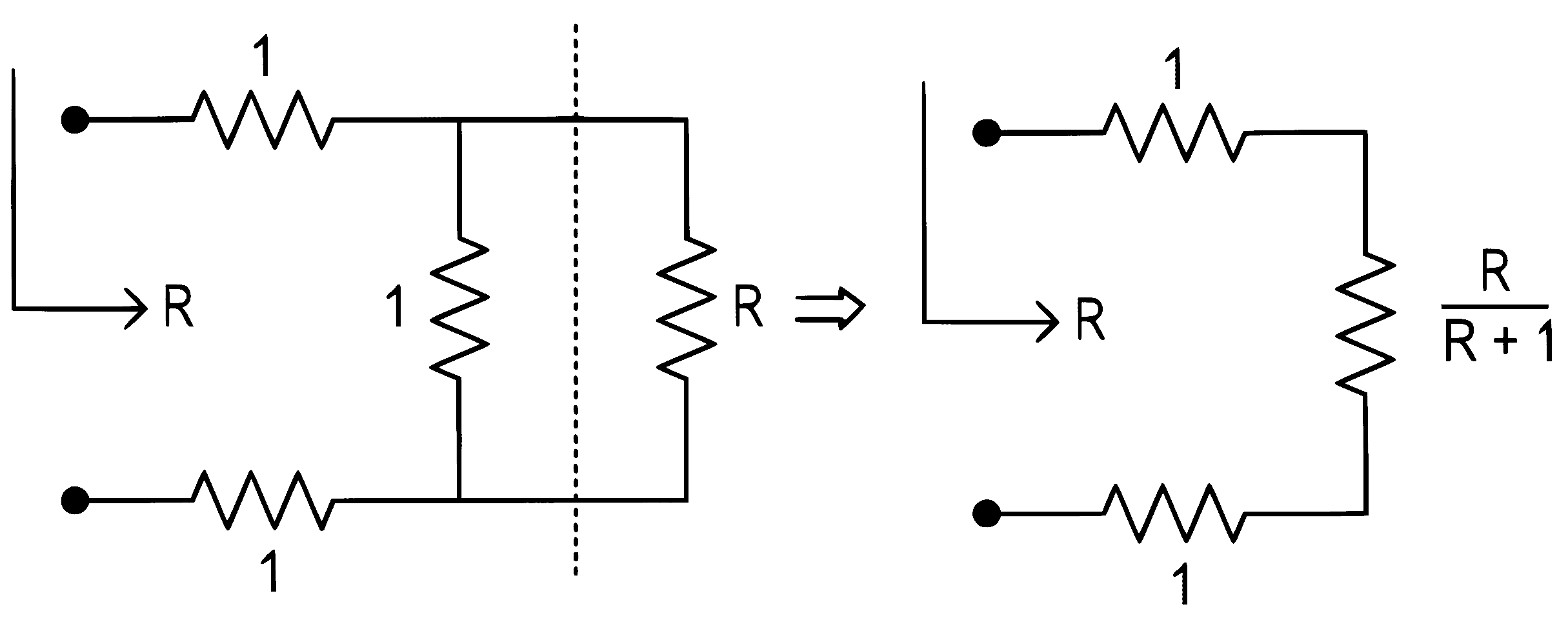
The equivalent resistance of the infinite network given below is :

NEET 2022 Phase 2 Physics - Current Electricity Question 27 English

(A)
(B)
(C)
(D)
(D)

Solution

Let net resistance of the given infinite network be 'R'

Now, the circuit can be modified as

NEET 2022 Phase 2 Physics - Current Electricity Question 27 English Explanation

Now,

Q.25

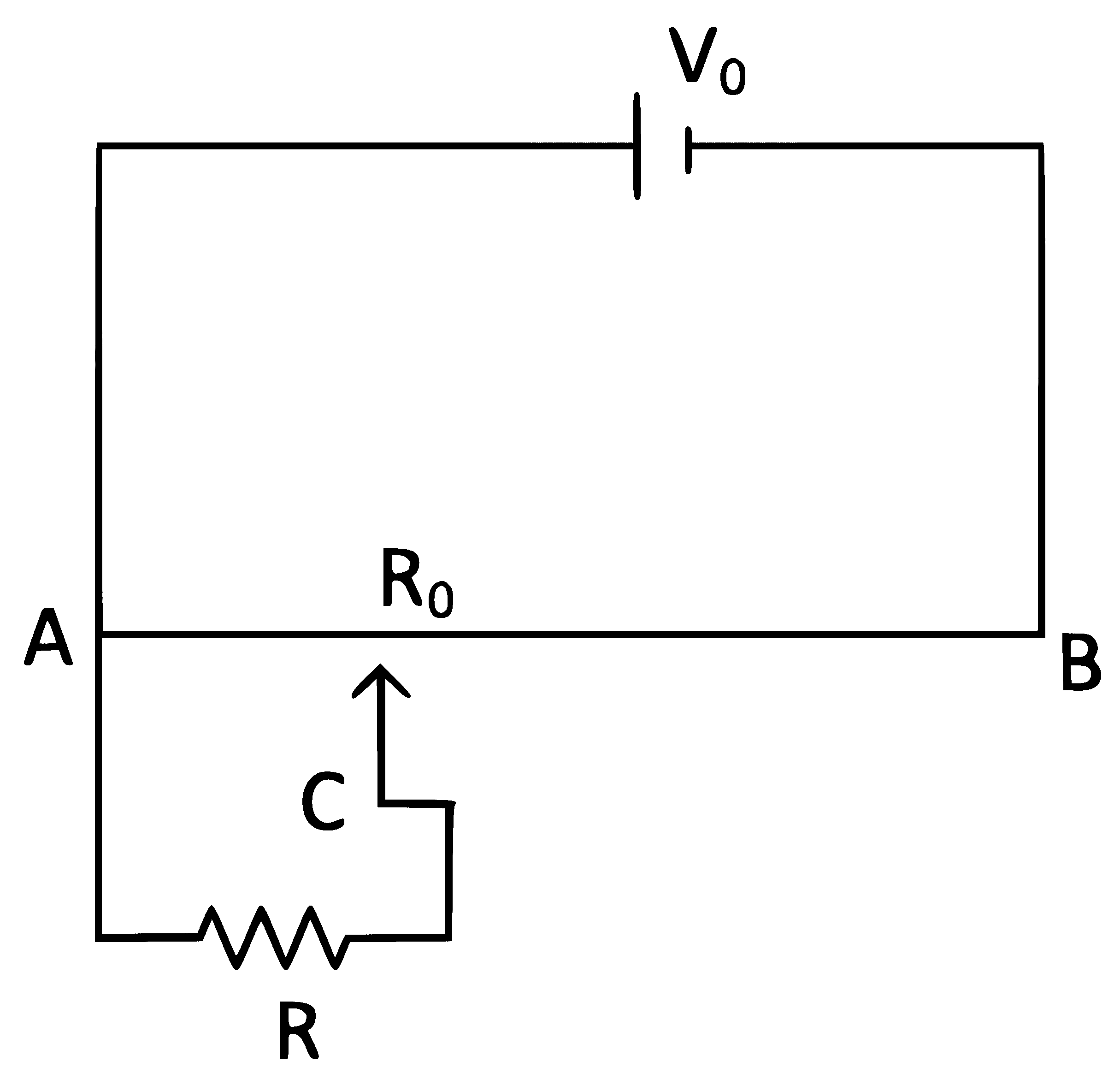
The sliding contact C is at one fourth of the length of the potentiometer wire (AB) from A as shown in the circuit diagram. If the resistance of the wire AB is R0, then the potential drop (V) across the resistor R is

NEET 2022 Phase 2 Physics - Current Electricity Question 25 English

(A)
(B)
(C)
(D)
(B)

Solution

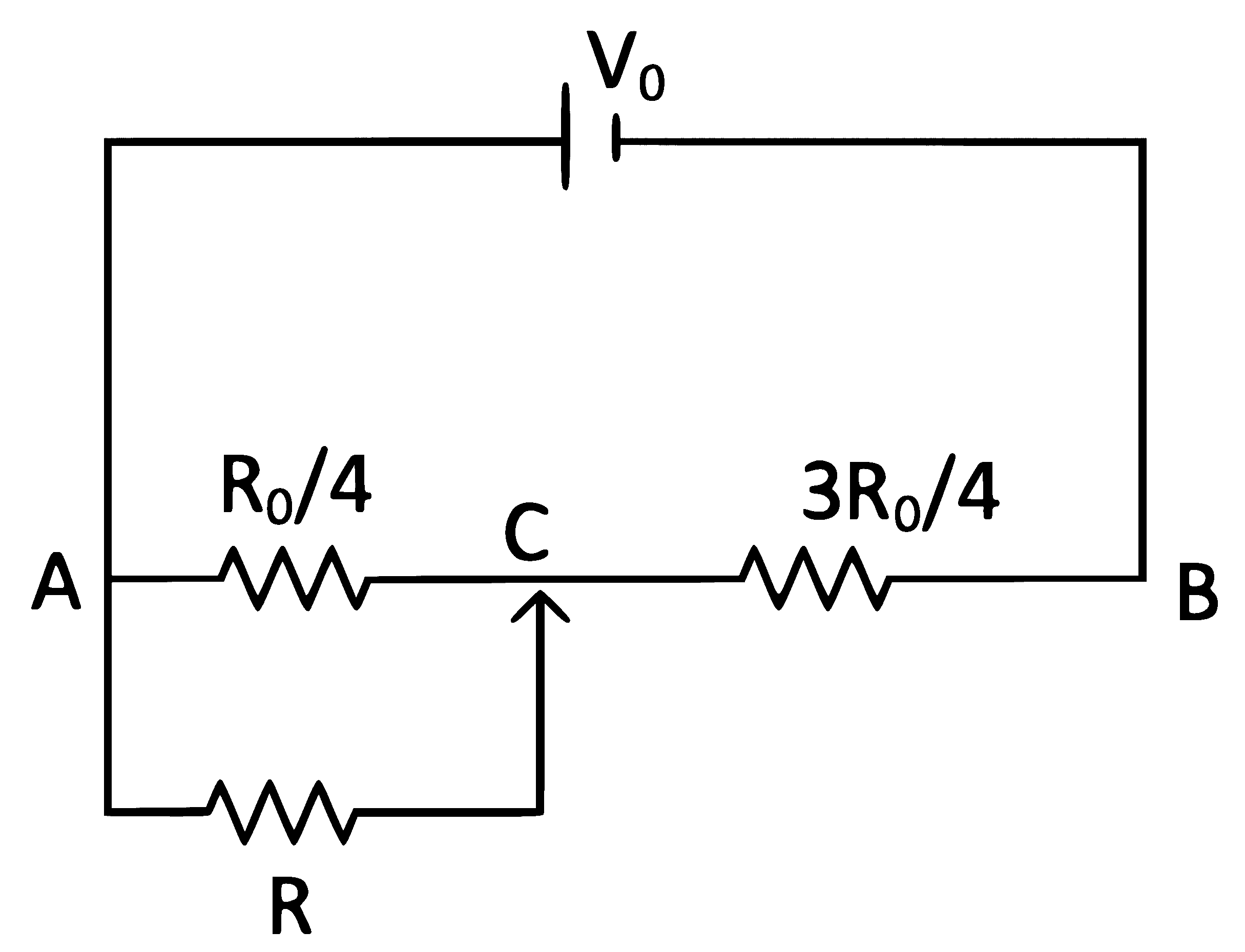
NEET 2022 Phase 2 Physics - Current Electricity Question 25 English Explanation

Equivalent resistance across point AC

From voltage divider rule

Q.26

The distance between the two plates of a parallel plate capacitor is doubled and the area of each plate is halved. If C is its initial capacitance, its final capacitance is equal to

(A)
(B)
2C
(C)
(D)
4C
(A)

Solution

For a capacitor of area A and distance between the plates as d, the capacitance (C) is

On doubling the distance and reducing area to half

Q.27

The effective capacitances of two capacitors are 3 F and 16 F, when they are connected in series and parallel respectively. The capacitance of two capacitors are :

(A)
1.2 F, 1.8 F
(B)
10 F, 6 F
(C)
8 F, 8 F
(D)
12 F, 4 F
(D)

Solution

Here, (Series combination)

While, (Parallel combination)

Solving the above equations we get

and

Q.28

A closely packed coil having 1000 turns has an average radius of 62.8 cm. If current carried by the wire of the coil is 1 A, the value of magnetic field produced at the centre of the coil will be (permeability of free space H/m) nearly

(A)
103 T
(B)
101 T
(C)
102 T
(D)
102 T
(A)

Solution

Magnetic field at the centre of coil

On substituting the given values

Q.29

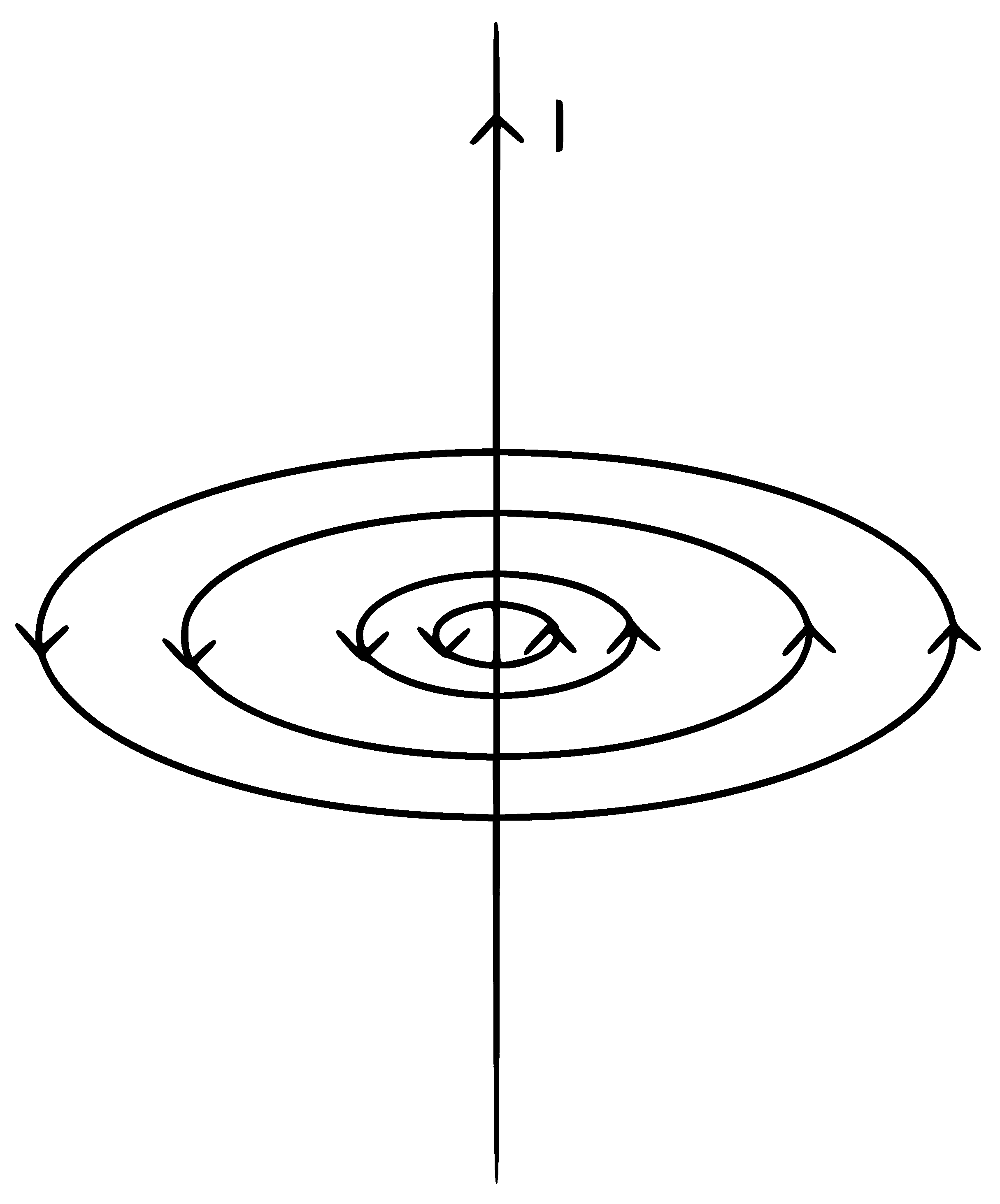
The shape of the magnetic field lines due to an infinite long, straight current carrying conductor is

(A)
a plane
(B)
a straight line
(C)
circular
(D)
elliptical
(C)

Solution

NEET 2022 Phase 2 Physics - Moving Charges and Magnetism Question 15 English Explanation

From the right hand curl rule, the shape of magnetic field lines due to long current carrying wire is circular (concentric circles)

Q.30

Two very long, straight, parallel conductors A and B carry current of 5 A and 10 A respectively and are at a distance of 10 cm from each other. The direction of current in two conductors is same. The force acting per unit length between two conductors is : (0 = 4 107 SI unit)

(A)
1 104 Nm1 and is repulsive
(B)
2 104 Nm1 and is attractive
(C)
2 104 Nm1 and is repulsive
(D)
1 104 Nm1 and is attractive
(D)

Solution

Force per unit length between two long current carrying wires

Nm1

The force is attractive as direction of current in two conductors is same

Hence, required force is Nm1 and it is attractive.

Q.31

The magnetic field on the axis of a circular loop of radius 100 cm carrying current , at point 1 m away from the centre of the loop is given by :

(A)
T
(B)
T
(C)
T
(D)
T
(B)

Solution

Magnetic field at the axis of a current carrying circular loop

T

Q.32

The magnetic flux linked to a circular coil of radius R is

Wb

The magnitude of induced emf in the coil at t = 5 s is

(A)
192 V
(B)
108 V
(C)
197 V
(D)
150 V
(A)

Solution

Given magnetic flux is

Induced emf is given by

At s,

V

Q.33

Given below are two statements

Statement I : In an a.c circuit, the current through a capacitor leads the voltage across it.

Statement II : In a.c circuit containing pure capacitance only, the phase difference between the current and voltage is .

In the light of the above statements, choose the most appropriate answer from the options given below

(A)
Statement I is incorrect but Statement II is correct
(B)
Both Statement I and Statement II are correct
(C)
Both Statement I and Statement II are incorrect
(D)
Statement I is correct but Statement II is incorrect
(D)

Solution

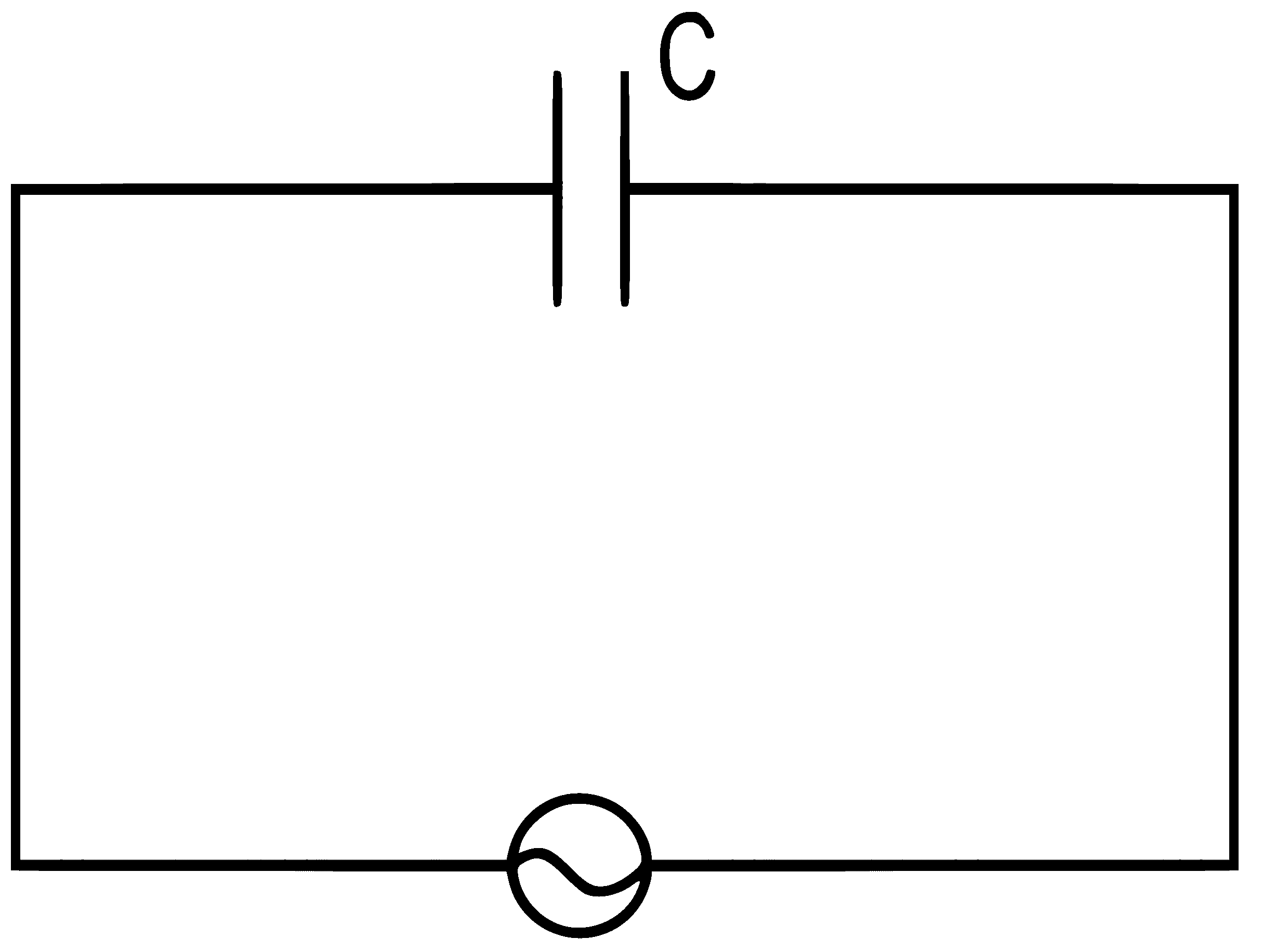
NEET 2022 Phase 2 Physics - Alternating Current Question 20 English Explanation 1

In a.c circuit current lead by voltage by a phase

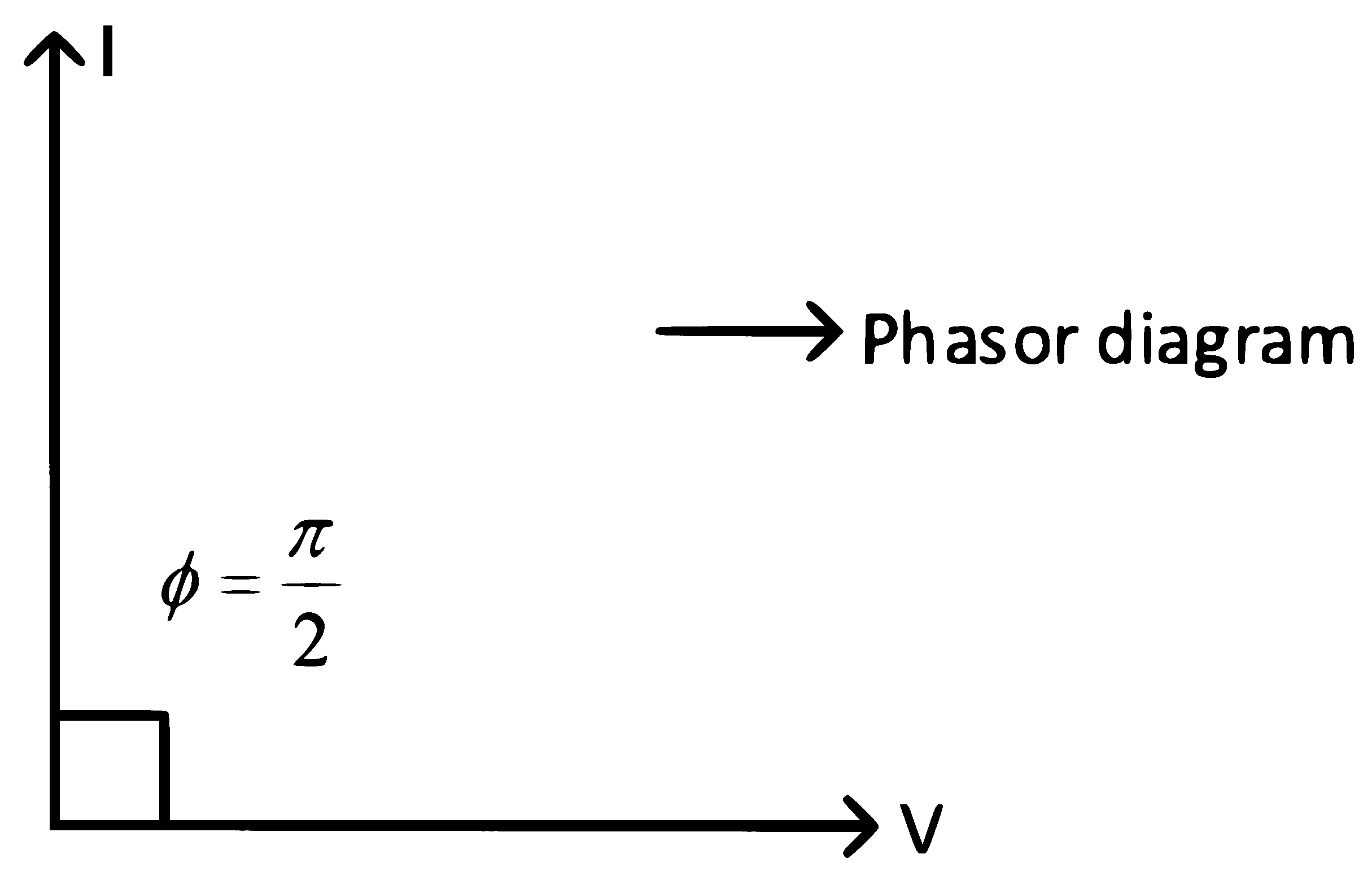
NEET 2022 Phase 2 Physics - Alternating Current Question 20 English Explanation 2

Thus statement I is correct while II is incorrect.

Q.34

An inductor of inductance 2 mH is connected to a 220 V, 50 Hz ac source. Let the inductive reactance in the circuit is X1. If a 220 V dc source replace the ac source in the circuit, then the inductive reactance in the circuit is X2. X1 and X2 respectively are :

(A)
0.628 , infinity
(B)
6.28 , zero
(C)
6.28 , infinity
(D)
0.628 , zero
(D)

Solution

We know, for A.C. source

For D.C. source

The inductor behaves as a closed circuit offering no resistance at all (at steady state) as (For D.C.)

Q.35

A standard filament lamp consumes 100 W when connected to 200 V ac mains supply. The peak current through the bulb will be :

(A)
2 A
(B)
0.707 A
(C)
1 A
(D)
1.414 A
(B)

Solution

Here, as current and voltage are in same phase in a resistor.

Q.36

The magnetic field of a plane electromagnetic wave is given by , then the associated electric field will be :

(A)
V/m
(B)
V/m
(C)
V/m
(D)
V/m
(A)

Solution

For electromagnetic wave,

Here is magnetic field associated with EM wave

is electric field associated with EM wave

c is the speed of EM wave

V/m

Direction can be determined from

Poynting vector

V/m

Q.37

The ratio of the magnitude of the magnetic field and electric field intensity of a plane electromagnetic wave in free space of permeability and permittivity is (Given that c - velocity) of light in free space

(A)
(B)
c
(C)
(D)
(C)

Solution

We know,

(in vacuum) = c

or,

Q.38

During a cloudy day, a primary and a secondary rainbow may be created, then the :

(A)
secondary rainbow is due to single internal reflection and is formed above the primary one.
(B)
primary rainbow is due to double internal reflection and is formed above the secondary one.
(C)
primary rainbow is due to double internal reflection and is formed below the secondary one.
(D)
secondary rainbow is due to double internal reflection and is formed above the primary one.
(D)

Solution

Primary rainbow is result of three-step process, that is, refraction, internal reflection and refraction.

Secondary rainbow is result of four step process, that is, refraction, internal reflection, internal reflection and refraction.

Secondary rainbow appears above the primary rainbow.

Q.39

An astronomical refracting telescope is being used by an observer to observe planets in normal adjustment. The focal lengths of the objective and eye piece used in the construction of the telescope are 20 m and 2 cm respectively. Consider the following statements about the telescope :

(a) The distance between the objective and eye piece is 20.02 m

(b) The magnification of the telescope is () 1000

(c) The image of the planet is erect and diminished

(d) The aperture of eye piece is smaller than that of objective

The correct statements are :

(A)
(a), (b) and (d)
(B)
(a), (b) and (c)
(C)
(b), (c) and (d)
(D)
(c), (d) and (a)
(A)

Solution

Given f0 = 20 m = 2000 cm, fe = 2 cm

Distance between objective and eye piece

l = f0 + fe

= 20 m + 2 cm = 20.02 cm

Magnification of telescope

Image formed by telescope is inverted.

Aperture of eye piece is smaller than that of objective.

So, statements (a), (b) and (c) are correct.

Q.40

If the screen is moved away from the plane of the slits in a Young's double slit experiment, then the :

(A)
linear separation of the fringes decreases
(B)
angular separation of the fringes increases
(C)
angular separation of the fringes decreases
(D)
linear separation of the fringes increase
(D)

Solution

In YDSE,

Separation between fringes is

Related to fringed width

If D is increased increases while

Angular separation is independent of distance between slits and screen (D)

As angular separation

Q.41

After passing through a polariser a linearly polarised light of intensity I is incident on an analyser making an angle of 30 with that of the polariser. The intensity of light emitted from the analyser will be

(A)
(B)
(C)
(D)
(D)

Solution

According to Malu's Law

Q.42

Let R1 be the radius of the second stationary orbit and R2 be the radius of the fourth stationary orbit of an electron in Bohr's model. The ratio is :

(A)
4
(B)
0.25
(C)
0.5
(D)
2
(B)

Solution

Radius of Bohr's orbit depends on principal quantum number (n) as

Now,

Q.43

Given below are two statements

Statement I : The law of radioactive decay states that the number of nuclei undergoing the decay per unit time is inversely proportional to the total number of nuclei in the sample.

Statement II : The half of a radionuclide is the sum of the life time of all nuclei, divided by the initial concentration of the nuclei at time t = 0.

In the light of the above statements, choose the most appropriate answer from the options given below :

(A)
Statement I is incorrect but statement II is correct
(B)
Both statement I and statement II are correct
(C)
Both statement I and statement II are incorrect
(D)
Statement I is correct but statement II is incorrect
(C)

Solution

According to law of radioactive decay

Rate of decay (No. of undecayed nuclei)

Half life is the time in which half of the radioactive sample decays

Both statements are incorrect.

Q.44

At any instant, two elements X1 and X2 have same number of radioactive atoms. If the decay constant of X1 and X2 are 10 and respectively, then the time when the ratio of their atoms becomes respectively will be :

(A)
(B)
(C)
(D)
(C)

Solution

Number of radioactive nuclei at any time is

Initial number of nuclei is same for sample X1 & X2.

Let after time 't' the ratio of their atoms become

Hence,

Q.45

The ratio of Coulomb's electrostatic force to the gravitational force between an electron and a proton separated by some distance is 2.4 1039. The ratio of the proportionality constant, to the gravitational constant G is nearly (Given that the charge of the proton and electron each = 1.6 1019 C, the mass of the electron = 9.11 1031 kg, the mass of the proton = 1.67 1027 kg) :

(A)
10
(B)
1020
(C)
1030
(D)
1040
(B)

Solution

Ratio of magnitude of Coulomb's electrostatic force to the gravitational force

Ratio 1020

Q.46

The light rays having photons of energy 4.2 eV are falling on a metal surface having a work function of 2.2 eV. The stopping potential of the surface is

(A)
6.4 V
(B)
2 eV
(C)
2 V
(D)
1.1 V
(C)

Solution

We know,

( )

Q.47

The threshold frequency of a photoelectric metal is v0. If light of frequency 4v0 is incident on this metal, then the maximum kinetic energy of emitted electrons will be :

(A)
4 hv0
(B)
hv0
(C)
2 hv0
(D)
3 hv0
(D)

Solution

According to Einstein's photoelectric equation

Q.48

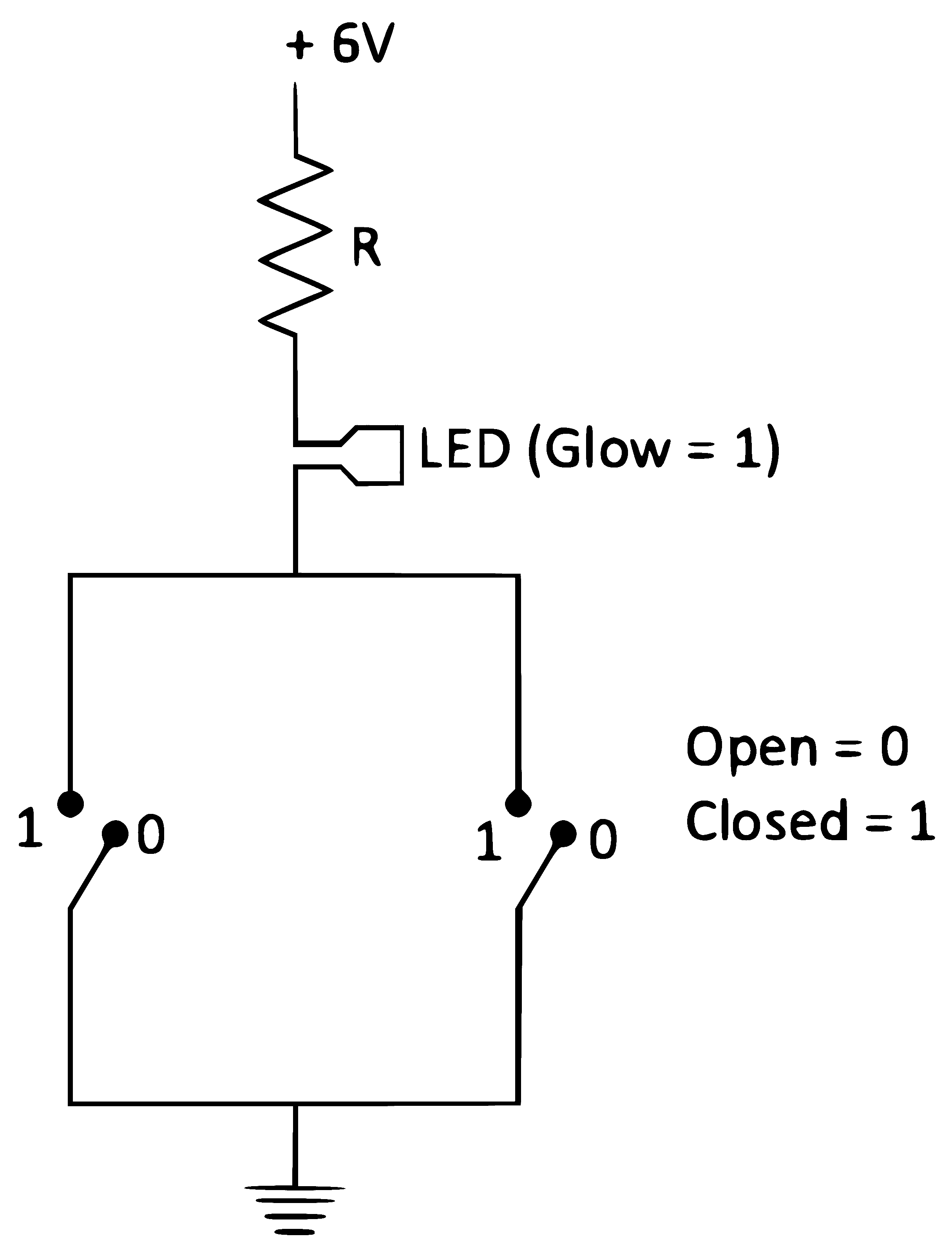
NEET 2022 Phase 2 Physics - Semiconductor Electronics Question 23 English

Identify the equivalent logic gate represented by the given circuit

(A)
NAND
(B)
OR
(C)
NOR
(D)
AND
(B)

Solution

The given circuit clearly indicates that the bulb will glow when either of the switches are closed.

The corresponding truth table will be

Input A Input B Output Y
0 0 0
0 1 1
1 0 1
1 1 1

This suggests that it will correspond to OR gate.

Q.49

The incorrect statement about the property of a Zener diode is :

(A)
p and n regions of Zener diode are heavily doped
(B)
Zener voltage remains constant at breakdown
(C)
It is designed to operate under reverse bias
(D)
Depletion region formed is very wide
(D)

Solution

Zener diode is special purpose p-n junction diode, which is generally operated in reverse bias for its operation of voltage regulation. It is a heavily doped p-n junction. Due to large doping concentration depletion width is narrower.

Q.50

The collector current in a common base amplifier using n-p-n transistor is 24 mA. If 80% of the electrons released by the emitter is accepted by the collector, then the base current is numerically :

(A)
3 mA and entering the base
(B)
6 mA and leaving the base
(C)
3 mA and leaving the base
(D)
6 mA and entering the base
(D)

Solution

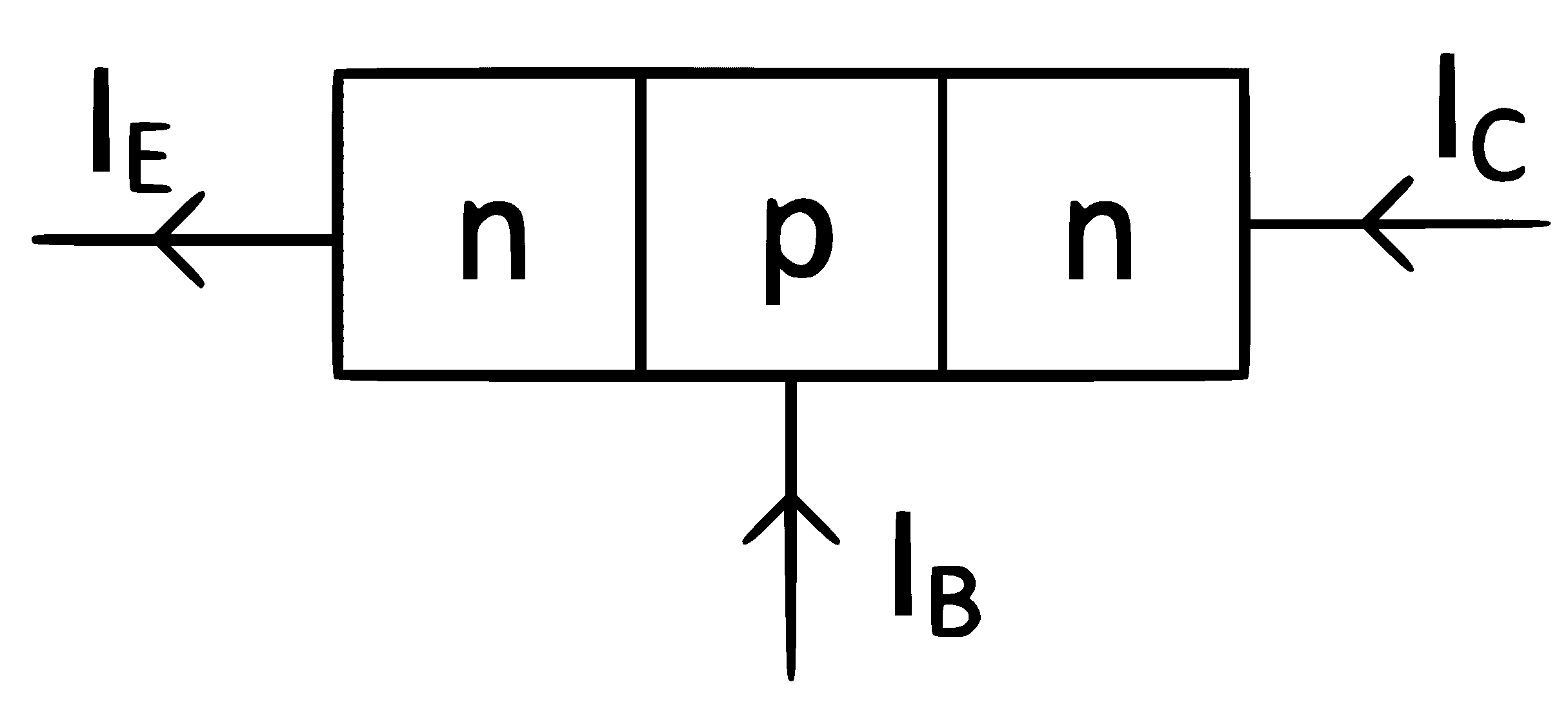
NEET 2022 Phase 2 Physics - Semiconductor Electronics Question 22 English Explanation

Given mA

mA mA

mA, entering the base

Chemistry (Maximum Marks: 200)
  • This section contains 50 questions.
  • Each question has FOUR options (A), (B), (C) and (D). ONLY ONE of these four options is the correct answer.
  • Full Marks : +4 If ONLY the correct option is chosen;
  • Zero Marks : 0 If none of the options is chosen (i.e. the question is unanswered);
  • Negative Marks : −1 In all other cases.
Q.1

The density of the solution is 2.15 g mL1, then mass of 2.5 mL solution in correct significant figures is :

(A)
53.75 g
(B)
5375 103 g
(C)
5.4 g
(D)
5.38 g
(C)

Solution

Mass = Volume Density

= 2.5 2.15

= 5.375 g

Since 2.5 has two significant figures, so the mass of solution in correct significant figures will be 5.4 g.

Q.2

What fraction of Fe exists as Fe(III) in Fe0.96O ?

(Consider Fe0.96O to be made up of Fe(II) and Fe(III) only)

(A)
(B)
(C)
0.08
(D)
(B)

Solution

Fe0.96O

Let Fe(II) present in Fe0.96O = x

Fe(III) present = (0.96 x)

Total charge on Fe = 2x + (0.96 x)3

Total charge on O = 2

2x + (0.96 x)3 = 2

2x + 2.88 3x = 2

x = 0.88

x = 0.88

Fe2+ = 0.88, Fe3+ = 0.08

Fraction of Fe3+ =

Q.3

Match List-I with List-II :

List-I
(quantum number)
List-II
(orbital)
(a) n = 2, l = 1 (i) 2s
(b) n = 3, l = 2 (ii) 3s
(c) n = 3, l = 0 (iii) 2p
(d) n = 2, l = 0 (iv) 3d

Choose the correct answer from the options given below :

(A)
(a) - (iii), (b) - (iv), (c) - (ii), (d) - (i)
(B)
(a) - (iii), (b) - (iv), (c) - (i), (d) - (ii)
(C)
(a) - (iv), (b) - (iii), (c) - (i), (d) - (ii)
(D)
(a) - (iv), (b) - (iii), (c) - (ii), (d) - (i)
(A)

Solution

n l Subshell notation
2 0 2s
2 1 2p
3 0 3s
3 1 3p
3 2 3d

Q.4

When electromagnetic radiation of wavelength 300 nm falls on the surface of a metal, electrons are emitted with the kinetic energy of 1.68 105 J mol1. What is the minimum energy needed to remove an electron from the metal?

(h = 6.626 1034 Js, c = 3 108 ms1, NA = 6.022 1023 mol1)

(A)
2.31 105 J mol1
(B)
2.31 106 J mol1
(C)
3.84 104 J mol1
(D)
3.84 1019 J mol1
(A)

Solution

Energy of one photon ( = 300 nm)

For one mole photons,

J mol1

Kinetic energy J mol1

J mol1

Q.5

Which of the following reactions is a decomposition redox reaction?

(A)
P4(s) + 3OH(aq) + 3H2O(l) PH3(g) + 3H2PO(aq)
(B)
2Pb(NO3)2(s) 2PbO(s) + 4NO2(g) + O2(g)
(C)
N2(g) + O2(g) 2NO(g)
(D)
Cl2(g) + 2OH(aq) ClO(aq) + Cl(aq) + 4H2O(l)
(B)

Solution

Decomposition redox reaction leads to breakdown of a compound into two or more compounds at least one of which must be in the elemental state with change in oxidation number.

Q.6

Four gas cylinders containing He, N2, CO2 and NH3 gases separately are gradually cooled from a temperature of 500 K. Which gas will liquify first?

(Given Tc in K He : 5.3, N2 : 126, CO2 : 304.1 and NH3 : 405.5)

(A)
NH3
(B)
He
(C)
N2
(D)
CO2
(A)

Solution

As from the given data NH3 has highest critical temperature which suggests maximum attractive forces hence NH3 will get liquified first.

Q.7

Kp for the following reaction is 3.0 at 1000 K.

CO2(g) + C(s) 2CO(g)

What will be the value of Kc for the reaction at the same temperature?

(Given : R = 0.083 L bar K1 mol1)

(A)
3.6
(B)
0.36
(C)
3.6 102
(D)
3.6 103
(C)

Solution

CO2(g) + C(s) 2CO(g)

ng = 2 1 = 1

Kp = Kc(RT)ng

Kp = Kc(RT)

[ Kp = 3]

= 0.036

= 3.6 102

Q.8

0.01 M acetic acid solution is 1% ionised, then pH of this acetic acid solution is :

(A)
1
(B)
3
(C)
2
(D)
4
(D)

Solution

For weak acid (i.e. CH3COOH)

M

Q.9

KH value for some gases at the same temperature 'T' are given :

Gas K/k bar
Ar 40.3
CO 1.67
HCHO 1.83 10
CH 0.413

where KH is Henry's Law constant in water. The order of their solubility in water is :

(A)
HCHO < CH4 < CO2 < Ar
(B)
Ar < CO2 < CH4 < HCHO
(C)
Ar < CH4 < CO2 < HCHO
(D)
HCHO < CO2 < CH4 < Ar
(B)

Solution

According to Henry's Law,

p = KHx

Where 'p' is partial pressure of gas in vapour phase.

KH is Henry's Law constant.

'x' is mole fraction of gas in liquid.

Higher the value of KH at a given pressure, lower is the solubility of the gas in the liquid.

Solubility : Ar < CO2 < CH4 < HCHO

Q.10

One mole of an ideal gas at 300 K is expanded isothermally from 1 L to 10 L volume. U for this process is :

(Use R = 8.314 J k1 mol1)

(A)
0 J
(B)
1260 J
(C)
2520 J
(D)
5040 J
(A)

Solution

U = nCvT

For isothermal condition; T = 0

U = 0

Q.11

A vessel contains 3.2 g of dioxygen gas at STP (273.15 K and 1 atm pressure). The gas is now transferred to another vessel at constant temperature, where pressure becomes one third of the original pressure. The volume of new vessel in L is : (Given : molar volume at STP is 22.4 L)

(A)
67.2
(B)
6.72
(C)
2.24
(D)
22.4
(B)

Solution

At constant temperature and amount

[ ]

mole of mole

Volume of L = 2.24 L

At STP (V1)

= 6.72 L

Q.12

Two half cell reactions are given below.

The standard EMF of a cell with feasible redox reaction will be :

(A)
3.47 V
(B)
+7.09 V
(C)
+0.15 V
(D)
+3.47 V
(D)

Solution

Since of Al is more than Co2+, so at anode Al will oxidise and at cathode Co3+ will reduce.

Q.13

Standard electrode potential for the cell with cell reaction

Zn(s) + Cu2+(aq) Zn2+(aq) + Cu(s)

is 1.1 V. Calculate the standard Gibbs energy change for the cell reaction. (Given F = 96487 C mol1)

(A)
200.27 J mol1
(B)
200.27 kJ mol1
(C)
212.27 kJ mol1
(D)
212.27 J mol1
(C)

Solution

Zn(s) + Cu2+(aq) Zn2+(aq) + Cu(s)

E = 1.1 V

G = nFE

n = 2

G = 2 96487 1.1

G = 212271.4 J mol1

G = 212.27 kJ mol1

Q.14

For a chemical reaction

4A + 3B 6C + 9D

Rate of formation of C is 6 102 mol L1 s1 and rate of disappearance of A is 4 102 mol L1 s1. The rate of reaction and amount of B consumed in interval of 10 seconds, respectively will be :

(A)
10 102 mol L1 s1 and 30 102 mol L1
(B)
1 102 mol L1 s1 and 30 102 mol L1
(C)
10 102 mol L1 s1 and 10 102 mol L1
(D)
1 102 mol L1 s1 and 10 102 mol L1
(B)

Solution

4A + 3B 6C + 9D

Rate of reaction =

Rate of reaction mol L1 s1

Rate of reaction

rate of reaction mol L1 s1

After interval of 10 sec.

mol L1

Q.15

The half life of a first order reaction is 2000 years. If the concentration after 8000 years is 0.02 M, then the initial concentration was :

(A)
0.04 M
(B)
0.16 M
(C)
0.32 M
(D)
0.08 M
(C)

Solution

Let the initial concentration is A molar.

Number of half lives in 8000 years

M

Q.16

Match List-I with List-II :

List-I
(Defects)
List-II
(Shown by)
(a) Frenkel defect (i) Non-ionic solids and density of the solid decreases
(b) Schottky defect (ii) Non-ionic solids and density of the solid increases
(c) Vacancy defect (iii) Ionic solids and density of the solid decreases
(d) Interstitial defect (iv) Ionic solids and density of the solid remains constant

Choose the correct answer from the options given below :

(A)
(a) - (iv), (b) - (iii), (c) - (i), (d) - (ii)
(B)
(a) - (i), (b) - (ii), (c) - (iii), (d) - (iv)
(C)
(a) - (i), (b) - (iii), (c) - (ii), (d) - (iv)
(D)
(a) - (iv), (b) - (iii), (c) - (ii), (d) - (i)
(A)

Solution

Frenkel defect : It is shown by ionic solids. The smaller ion (usually cation) is dislocated from its normal site to an interstitial site. It does not change the density of the solid.

Schottky defect : It is a vacancy defect in ionic solids. It decreases the density of substance.

Vacancy defect : When some of the lattice sites are vacant, the crystal is said to have vacancy defect. This results in decrease in density of the substance.

Interstitial defect : When some constituent particles occupy an interstitial site, the crystal is said to have interstitial defect. This defect increases the density of the substance.

Q.17

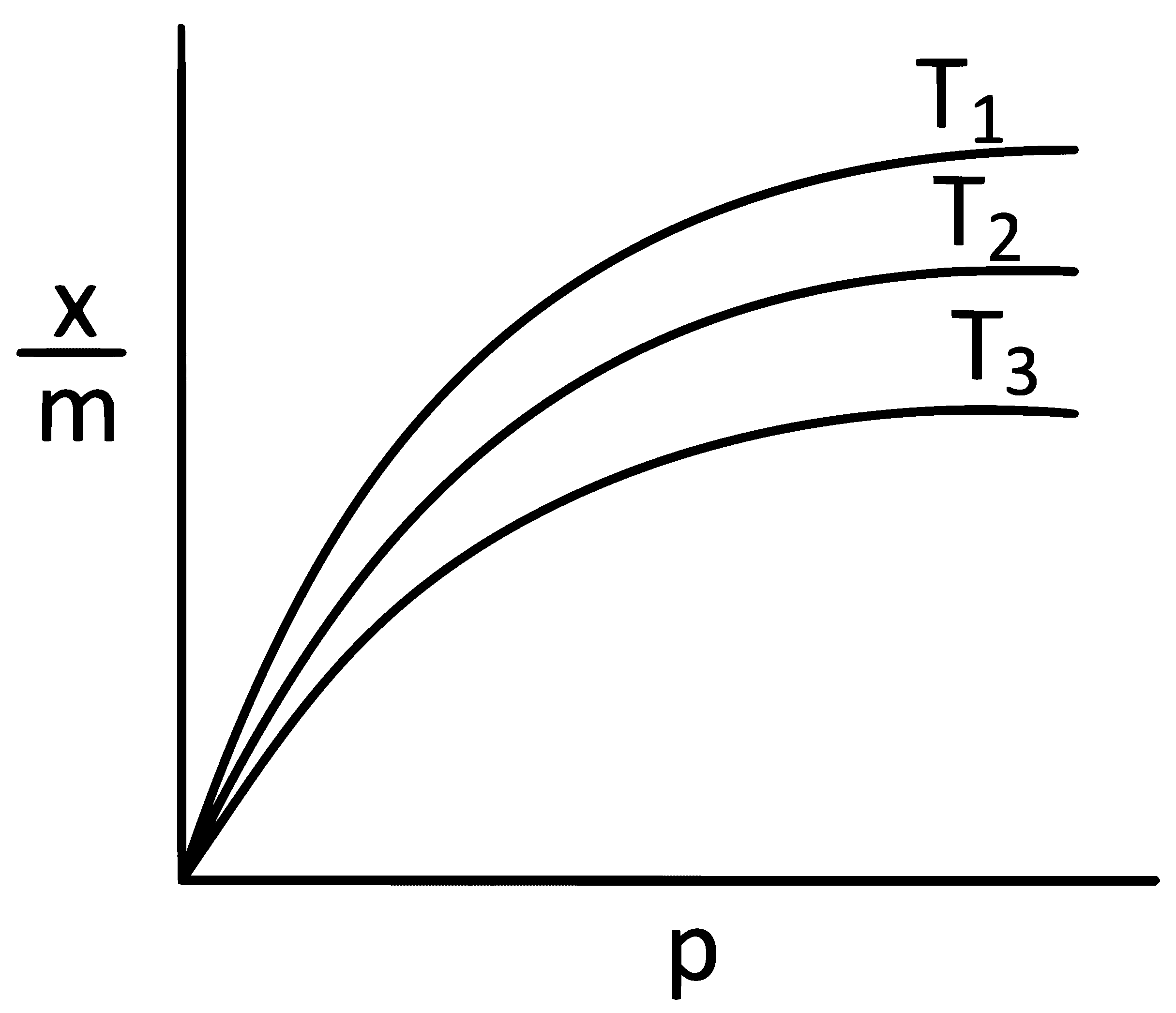
Shown below are adsorption isotherms for a gas 'X' at temperatures T1, T2 and T3 :

NEET 2022 Phase 2 Chemistry - Surface Chemistry Question 4 English

p and represent pressure and extent of adsorption, respectively. The correct order of temperatures for the given adsorption is :

(A)
(B)
(C)
(D)
(C)

Solution

With increase in temperature, extent of adsorption decreases so correct order of temperatures will be

Q.18

The correct order of first ionization enthalpy for the given four elements is :

(A)
C < F < N < O
(B)
C < N < F < O
(C)
C < N < O < F
(D)
C < O < N < F
(D)

Solution

Generally, on moving left to right in a period. First ionization enthalpy of elements increases due to increase in effective nuclear charge.

Due to more stable half-filled outer electronic configuration (2s22p3) of N, its first ionization enthalpy is more than O.

So, correct order of IP is : C < O < N < F

Q.19

Decrease in size from left to right in actinoid series is greater and gradual than that in lanthanoid series due to

(A)
5f orbitals have greater shielding effect
(B)
4f orbitals are penultimate
(C)
4f orbitals have greater shielding effect
(D)
5f orbitals have poor shielding effect
(D)

Solution

Due to more diffused nature of 5f orbitals as compared to 4f orbitals the shielding effect of 5f is poor, resulting in the decrease in size from left to right in actinoid series which is greater and gradual than that in lanthanoid series.
Q.20

Fluorine is a stronger oxidising agent than chlorine because :

(a) F-F bond has a low enthalpy of dissociation.

(b) Fluoride ion (F) has high hydration enthalpy.

(c) Electron gain enthalpy of fluorine is less negative than chlorine.

(d) Fluorine has a very small size.

Choose the most appropriate answer from the options given :

(A)
(b) and (c) only
(B)
(a) and (b) only
(C)
(a) and (c) only
(D)
(a) and (d) only
(B)

Solution

Fluorine is a stronger oxidising agent than chlorine due to

(i) Low dissociation enthalpy of F-F bond

(ii) High hydration enthalpy of F ion

Q.21

If first ionization enthalpies of elements X and Y are 419 kJ mol1 and 590 kJ mol1, respectively and second ionization enthalpies of X and Y are 3069 kJ mol1 and 1145 kJ mol1, respectively. Then correct statement is :

(A)
Both X and Y are alkaline earth metals
(B)
X is an alkali metal and Y is an alkaline earth metal
(C)
X is an alkaline earth metal and Y is an alkali metal
(D)
Both X and Y are alkali metals
(B)

Solution

As it can be observed from given data of question, in case of element 'X' there is huge difference between IP1 and IP2 hence it will have one electron in outermost shell and will be alkali metal.

While for 'Y' difference is not that high hence it will be alkaline earth metal.

Q.22

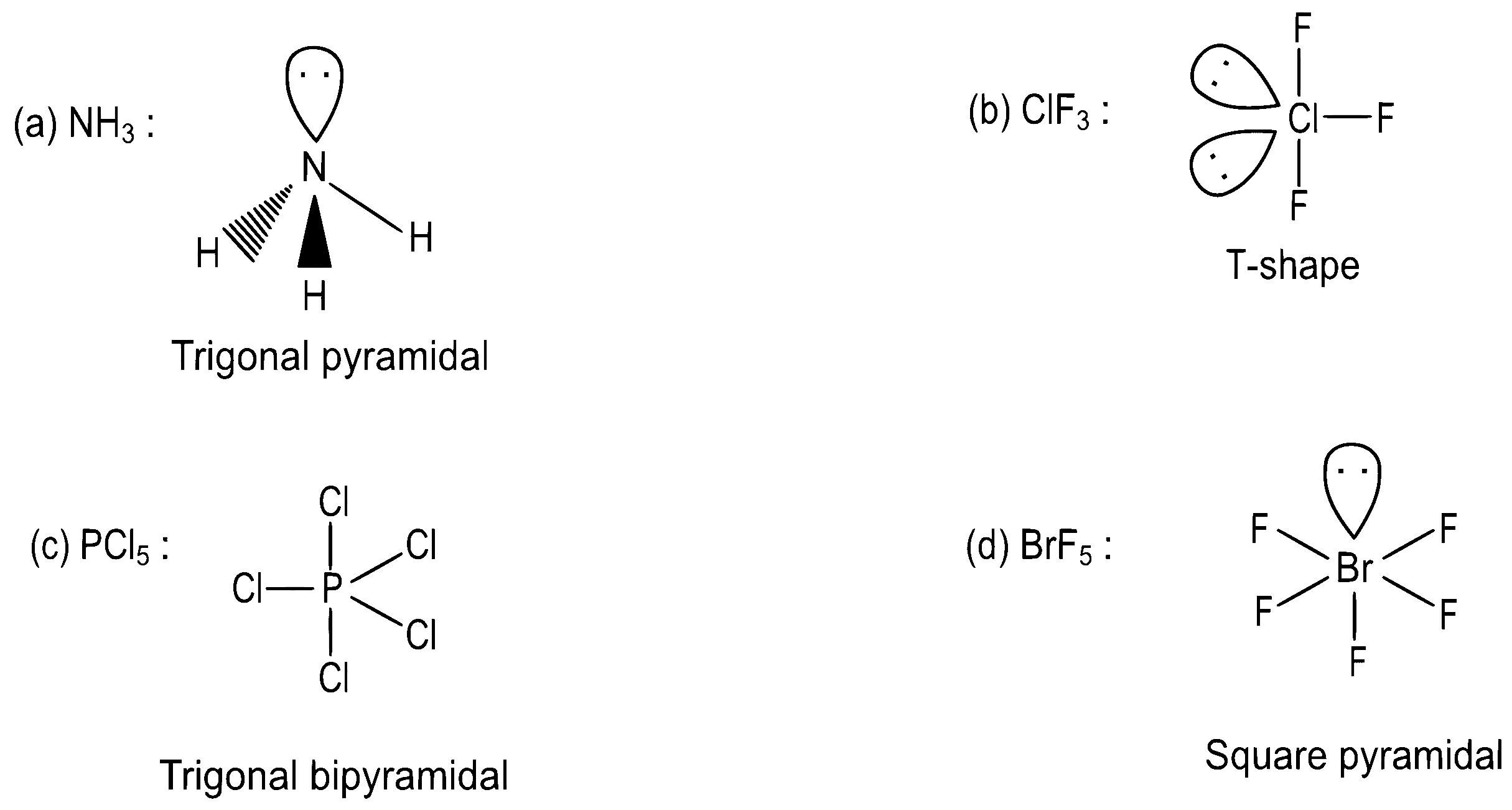
Match List-I with List-II :

List-I
(Molecules)
List-II
(Shape)
(a) NH (i) Square pyramidal
(b) ClF (ii) Trigonal bipyramidal
(c) PCl (iii) Trigonal pyramidal
(d) BrF (iv) T-shape

Choose the correct answer from the options given below :

(A)
(a) - (iii), (b) - (iv), (c) - (i), (d) - (ii)
(B)
(a) - (ii), (b) - (iii), (c) - (iv), (d) - (i)
(C)
(a) - (iii), (b) - (iv), (c) - (ii), (d) - (i)
(D)
(a) - (iv), (b) - (iii), (c) - (i), (d) - (ii)
(C)

Solution

NEET 2022 Phase 2 Chemistry - Chemical Bonding and Molecular Structure Question 27 English Explanation

(a) - (iii), (b) - (iv), (c) - (ii), (d) - (i)

Q.23

The correct order of bond angles in the following compounds/species is :

(A)
CO2 < NH3 < H2O <
(B)
H2O < NH3 < $$\mathop {\mathrm{N{H_4}}}\limits^ + $$ < CO2
(C)
H2O < $$\mathop {\mathrm{N{H_4}}}\limits^ + $$ < NH3 < CO2
(D)
H2O < $$\mathop {\mathrm{N{H_4}}}\limits^ + $$ = NH3 < CO2
(B)

Solution

CO2 sp2 hybridisation, bond angle = 180

NH sp3 hybridisation, bond angle = 109 28'

NH3 sp3 hybridisation with one lone pair on central atom, bond angle 107

H2O sp3 hybridisation with two lone pairs on central atom, bond angle 104.5

Q.24

The element used for welding metals with high melting points is

(A)
He
(B)
Cl2
(C)
H2
(D)
Ne
(C)

Solution

Atomic hydrogen atoms produced by dissociation of dihydrogen with the help of electric arc use for cutting and welding metals with high melting points.

Q.25

CaCl2 and Ca(OCl)2 are components of

(A)
Lime water
(B)
Gypsum
(C)
Portland cement
(D)
Bleaching powder
(D)

Solution

Milk of lime reacts with chlorine to form hypochlorite, a constituent of bleaching powder

2Ca(OH)2 + 2Cl2 + 2H2O

Q.26

Which one of the following is not a calcination reaction?

(A)
CaCO3 + 2HCl CaCl2 + H2O + CO2
(B)
ZnCO3 ZnO + CO2
(C)
Fe2O3 . xH2O Fe2O3 + xH2O
(D)
CaCO3 . MgCO3 CaO + MgO + 2CO2
(A)

Solution

Calcination involves heating when the volatile matter escapes leaving behind the metal oxide.

Fe2O3 . xH2O(s) Fe2O3(s) + xH2O(g)

ZnCO3(s) ZnO(s) + CO2(g)

CaCO3 . MgCO3(s) CaO(s) + MgO(s) + 2CO2(g)

CaCO3 + 2HCl CaCl2 + H2O + CO2 Not calcination

It is a neutralization reaction.

Q.27

Match List-I with List-II :

List-I
(Compounds)
List-II
(Molecular formula)
(a) Borax (i) NaBO
(b) Kernite (ii) NaBO . 4HO
(c) Orthoboric acid (iii) HBO
(d) Borax bead (iv) NaBO . 10HO

Choose the correct answer from the options given below :

(A)
(a) - (i), (b) - (iii), (c) - (iv), (d) - (ii)
(B)
(a) - (iv), (b) - (ii), (c) - (iii), (d) - (i)
(C)
(a) - (ii), (b) - (iv), (c) - (iii), (d) - (i)
(D)
(a) - (iii), (b) - (i), (c) - (iv), (d) - (ii)
(B)

Solution

Borax : Na2B4O7 . 10H2O = Na2[B4O5(OH)4] . 8H2O

Kernite : Na2B4O7 . 4H2O

Orthoboric acid : H3BO3 = B(OH)3

Borax bead : NaBO2 (Sodium metaborate)

Q.28

Which of the following reactions is a part of the large scale industrial preparation of nitric acid?

(A)
Cu(NO3)2 + 2NO2 + 2H2O 4HNO3 + Cu
(B)
NaNO3 + H2SO4 NaHSO4 + HNO3
(C)
4NH3 + 5O2 (from air) 4NO + 6H2O
(D)
4HPO3 + 2N2O5 4HNO3 + P4O10
(C)

Solution

4NH3 + 5O2 (from air) 4NO + 6H2O

2NO(g) + O2(g) 2NO2(g)

3NO2(g) + H2O(l) 2HNO3(aq) + NO(g)

This is industrial method of preparation of nitric acid.

Q.29

Na2B4O7 X + NaBO2

in the above reaction the product "X" is :

(A)
NaB3O5
(B)
H3BO3
(C)
B2O3
(D)
Na2B2O5
(C)

Solution

Na2B4O7 B2O3 + 2NaBO2

Product X is B2O3

Q.30

Given below are two statements :

Statement I : Cr2+ is oxidising and Mn3+ is reducing in nature.

Statement II : Sc3+ compounds are repelled by the applied magnetic field.

In the light of the above statements, choose the most appropriate answer from the options given below :

(A)
Statement I is incorrect but Statement II is correct
(B)
Both Statement I and Statement II are correct
(C)
Both Statement I and Statement II are incorrect
(D)
Statement I is correct but Statement II is incorrect
(A)

Solution

Statement I : Cr2+ is reducing as its configuration changes from d4 to d3, the latter having a half-filled t2g level. On the other hand, the change from Mn3+ to Mn2+ results in the half-filled (d5) configuration which has extra stability.

Statement II : Sc3+ has zero unpaired electron, so magnetic moment is also zero. Hence, Sc3+ will repelled by the applied magnetic field.

Q.31

Match List-I with List-II :

List-I
(Complexes)
List-II
(Types)
(a) and (i) ionisation isomerism
(b) and (ii) coordination isomerism
(c) and (iii) linkage isomerism
(d) and (iv) solvate isomerism

Choose the correct answer from the options given below :

(A)
(a)-(iv), (b)-(iii), (c)-(ii), (d)-(i)
(B)
(a)-(iii), (b)-(i), (c)-(ii), (d)-(iv)
(C)
(a)-(ii), (b)-(iii), (c)-(iv), (d)-(i)
(D)
(a)-(iii), (b)-(ii), (c)-(i), (d)-(iv)
(D)

Solution

(a) and linkage isomerism

(b) and coordination isomerism

(c) and ionisation isomerism

(d) and solvate isomerism

(a)-(iii), (b)-(ii), (c)-(i), (d)-(iv)

Q.32

Given below are two statements : one is labelled as Assertion (A) and the other is labelled as Reason (R).

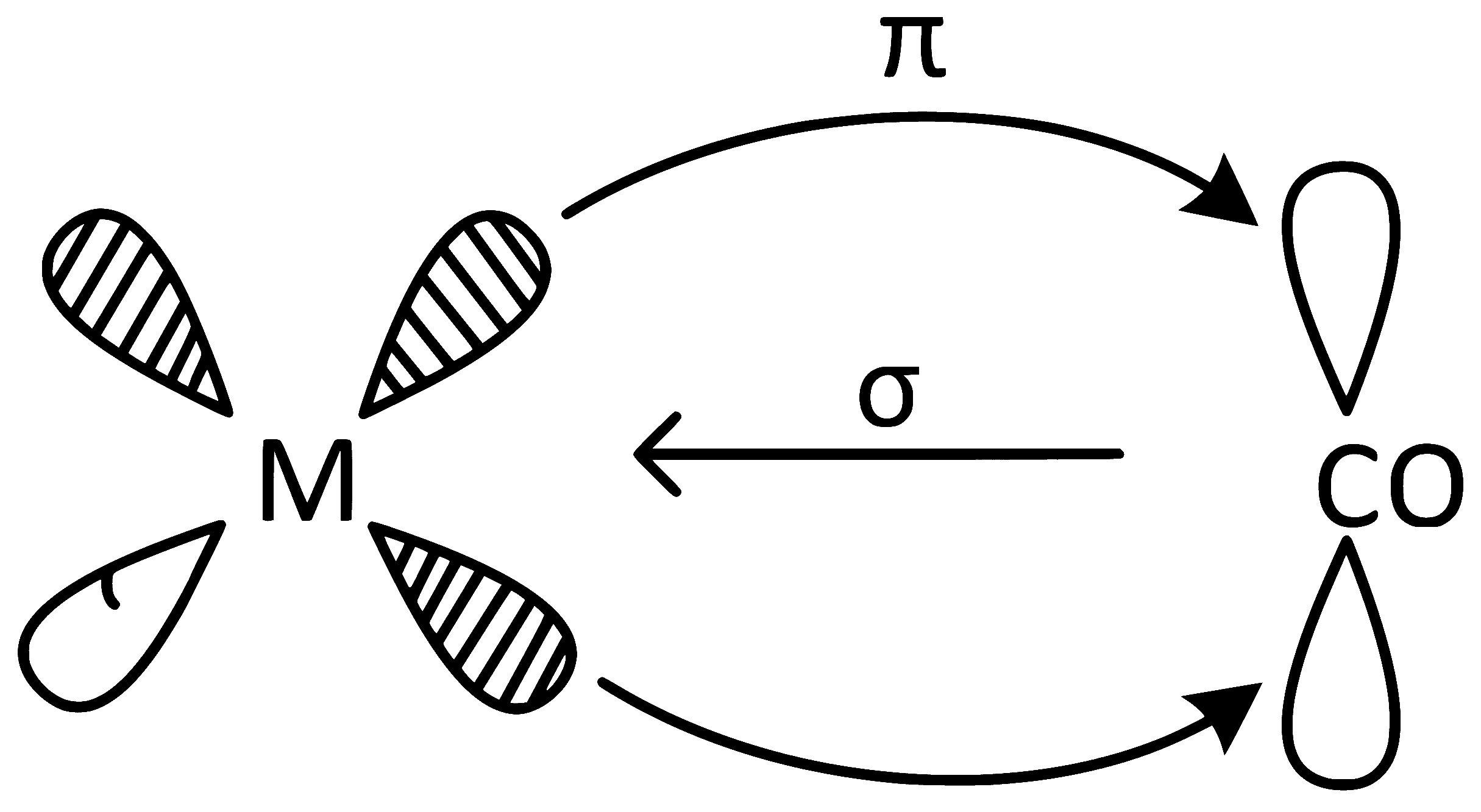
Assertion (A) : The metal carbon bond in metal carbonyls possesses both and character.

Reason (R) : The ligand to metal bond is a bond and metal to ligand bond is a bond.

In the light of the above statements, choose the most appropriate answer from the options given below.

(A)
(A) is not correct but (R) is correct
(B)
Both (A) and (R) are correct and (R) is the correct explanation of (A)
(C)
Both (A) and (R) are correct but (R) is not the correct explanation of (A)
(D)
(A) is correct but (R) is not correct
(D)

Solution

NEET 2022 Phase 2 Chemistry - Coordination Compounds Question 25 English Explanation

In case of metal carbonyls, the bonding has both and nature, where ligand to metal bond is '' (coordinate) bond and metal to ligand bond is '' (synergic) bond.

Q.33

Match List-I with List-II :

List-I
List-II
(a) Biochemical oxygen demand (i) oxidising mixture
(b) Photochemical smog (ii) polar stratospheric cloud
(c) Classical smog (iii) organic matter in water
(d) Ozone layer depletion (iv) reducing mixture

Choose the correct answer from the options given below :

(A)
(a) - (iv), (b) - (iii), (c) - (ii), (d) - (i)
(B)
(a) - (i), (b) - (iv), (c) - (ii), (d) - (iii)
(C)
(a) - (iii), (b) - (iv), (c) - (i), (d) - (ii)
(D)
(a) - (iii), (b) - (i), (c) - (iv), (d) - (ii)
(D)

Solution

List-I
List-II
(a) Biochemical oxygen demand (i) organic matter in water
(b) Photochemical smog (ii) oxidising mixture
(c) Classical smog (iii) reducing mixture
(d) Ozone layer depletion (iv) polar stratospheric cloud

(a) - (iii), (b) - (i), (c) - (iv), (d) - (ii)

Q.34

Given below are two statements : one is labelled as Assertion (A) and the other is labelled as Reason (R).

Assertion (A) : Chlorine is an electron withdrawing group but it is ortho, para directing in electrophilic aromatic substitution.

Reason (R) : Inductive effect of chlorine destabilises the intermediate carbocation formed during the electrophilic substitution, however due to the more pronounced resonance effect, the halogen stabilises the carbocation at ortho and para positioins.

In the light of the above statements, choose the most appropriate answer from the options given below :

(A)
(A) is not correct but (R) is correct
(B)
Both (A) and (R) are correct and (R) is the correct explanation of (A)
(C)
Both (A) and (R) are correct but (R) is not the correct explanation of (A)
(D)
(A) is correct but (R) is not correct
(D)

Solution

Cl has pronounced I effect than +R effect due to large size difference between carbon and chlorine, also due to high electronegativity of chlorine.

Q.35

Predict the order of reactivity of the following four isomers towards SN2 reaction.

(I) CH3CH2CH2CH2Cl

(II) CH3CH2CH(Cl)CH3

(III) (CH3)2CHCH2Cl

(IV) (CH3)3CCl

(A)
(IV) > (II) > (III) > (I)
(B)
(IV) > (III) > (II) > (I)
(C)
(I) > (II) > (III) > (IV)
(D)
(I) > (III) > (II) > (IV)
(D)

Solution

Lesser the steric hinderance on halide carbon, more will be the reactivity of alkyl halide towards SN2 reaction.

So correct order towards SN2 reactivity is :

NEET 2022 Phase 2 Chemistry - Some Basic Concepts of Organic Chemistry Question 28 English Explanation

Q.36

What is the hybridization shown by C1 and C2 carbons, respectively in the given compound?

OHC CH = CH CH2COOCH3

(A)
sp3 and sp3
(B)
sp2 and sp3
(C)
sp2 and sp2
(D)
sp3 and sp2
(B)

Solution

COOCH3 has higher priority than C = C and CHO in IUPAC nomenclature.

NEET 2022 Phase 2 Chemistry - Some Basic Concepts of Organic Chemistry Question 30 English Explanation

C1 = sp2

C2 = sp3

Q.37

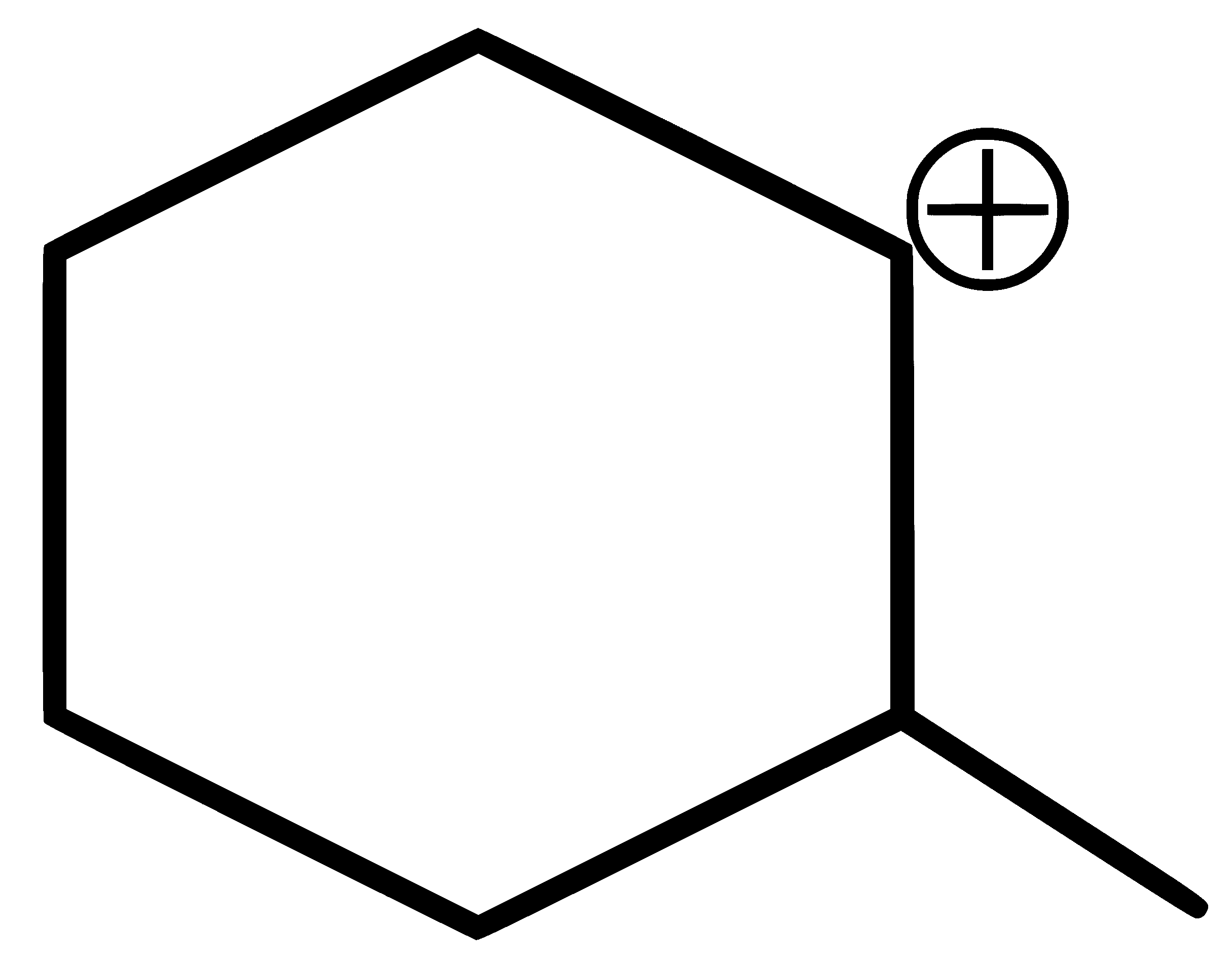
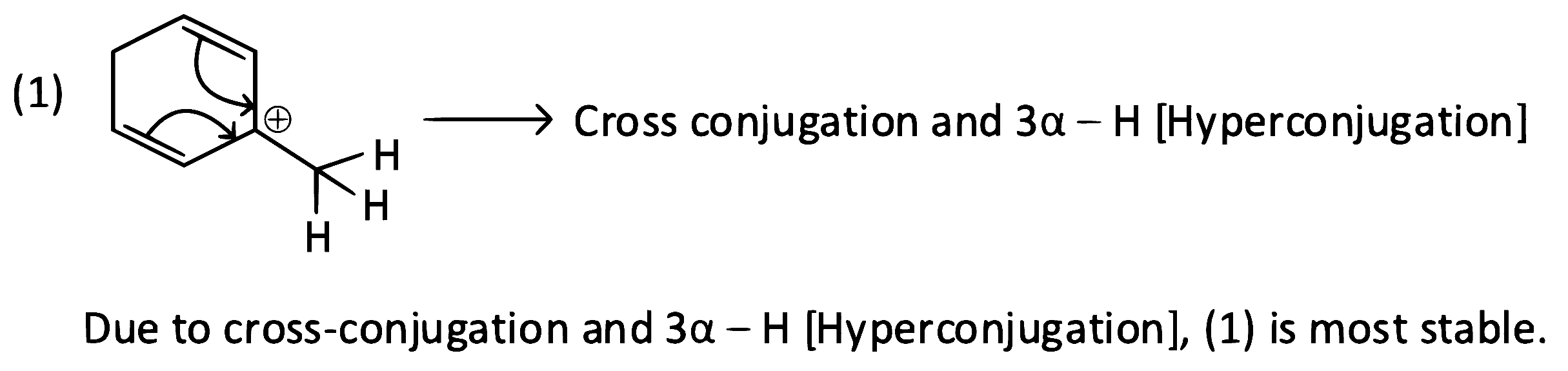
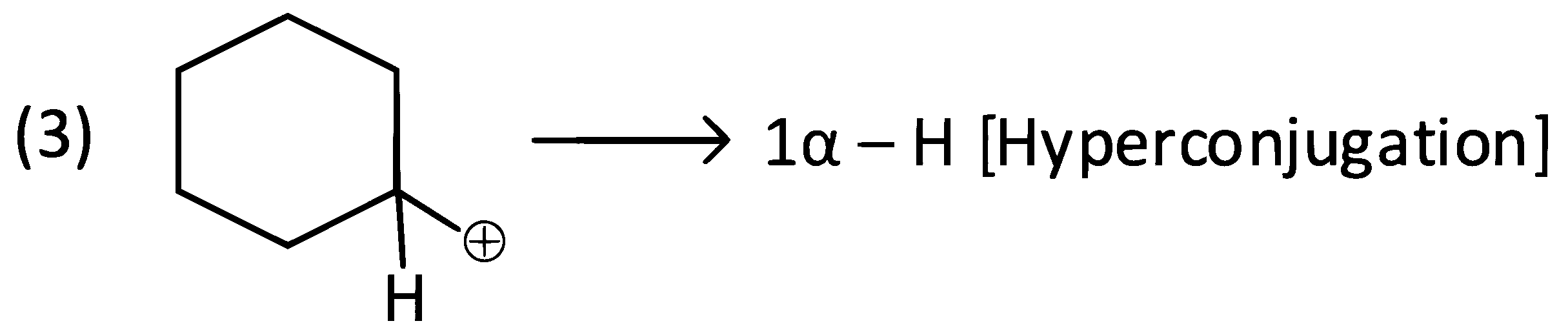
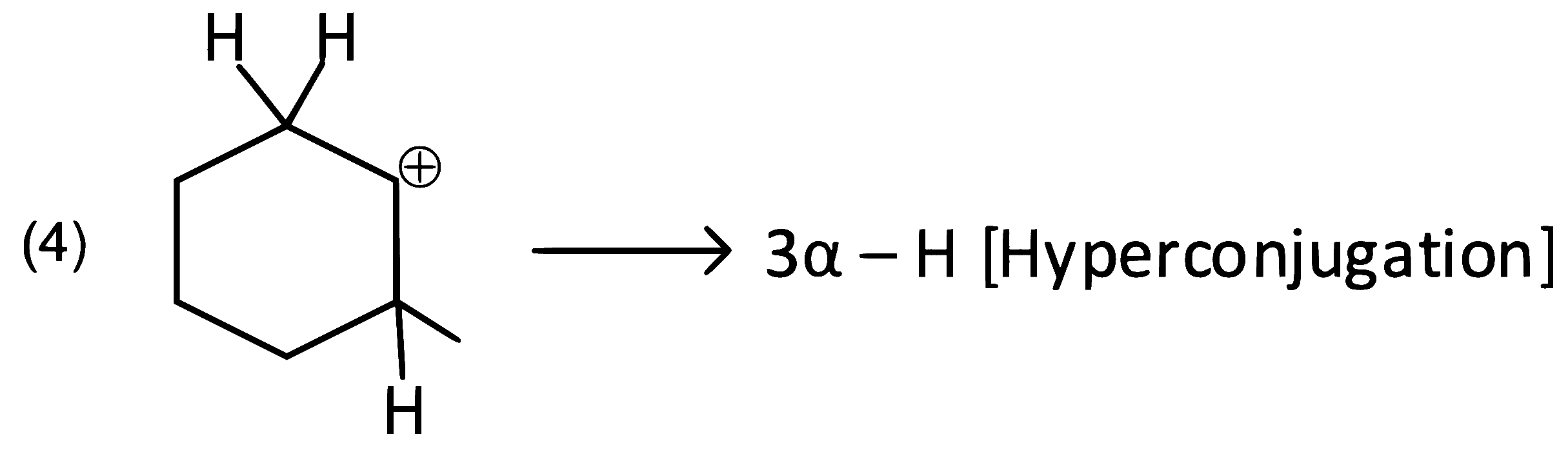
Which of the following is the most stable carbocation?

(A)
NEET 2022 Phase 2 Chemistry - Some Basic Concepts of Organic Chemistry Question 27 English Option 1
(B)
NEET 2022 Phase 2 Chemistry - Some Basic Concepts of Organic Chemistry Question 27 English Option 2
(C)
NEET 2022 Phase 2 Chemistry - Some Basic Concepts of Organic Chemistry Question 27 English Option 3
(D)
NEET 2022 Phase 2 Chemistry - Some Basic Concepts of Organic Chemistry Question 27 English Option 4
(A)

Solution

NEET 2022 Phase 2 Chemistry - Some Basic Concepts of Organic Chemistry Question 27 English Explanation 1NEET 2022 Phase 2 Chemistry - Some Basic Concepts of Organic Chemistry Question 27 English Explanation 2NEET 2022 Phase 2 Chemistry - Some Basic Concepts of Organic Chemistry Question 27 English Explanation 3NEET 2022 Phase 2 Chemistry - Some Basic Concepts of Organic Chemistry Question 27 English Explanation 4

Q.38

The decreasing order of boiling points of the following alkanes is :

(a) heptane

(b) butane

(c) 2-methylbutane

(d) 2-methylpropane

(e) hexane

Choose the correct answer from the options given below :

(A)
(a) > (e) > (c) > (b) > (d)
(B)
(a) > (c) > (e) > (d) > (b)
(C)
(c) > (d) > (a) > (e) > (b)
(D)
(a) > (e) > (b) > (c) > (d)
(A)

Solution

With increase in number of carbons in alkane, boiling point increases

In case of isomeric alkanes, greater is the number of branches, lesser is the boiling point.

Boiling point order :

Q.39

The products A and B in the following reaction sequence are :

NEET 2022 Phase 2 Chemistry - Hydrocarbons Question 13 English

(A)
NEET 2022 Phase 2 Chemistry - Hydrocarbons Question 13 English Option 1
(B)
NEET 2022 Phase 2 Chemistry - Hydrocarbons Question 13 English Option 2
(C)
NEET 2022 Phase 2 Chemistry - Hydrocarbons Question 13 English Option 3
(D)
NEET 2022 Phase 2 Chemistry - Hydrocarbons Question 13 English Option 4
(C)

Solution

NEET 2022 Phase 2 Chemistry - Hydrocarbons Question 13 English Explanation

Q.40

The incorrect method for the synthesis of alkenes is

(A)
Treating vicinal dihalides with Zn metal
(B)
Treating of alkynes with Na in liquid NH3
(C)
Heating alkyl halides with alcoholic KOH
(D)
Treating alkyl halides in aqueous KOH solution
(D)

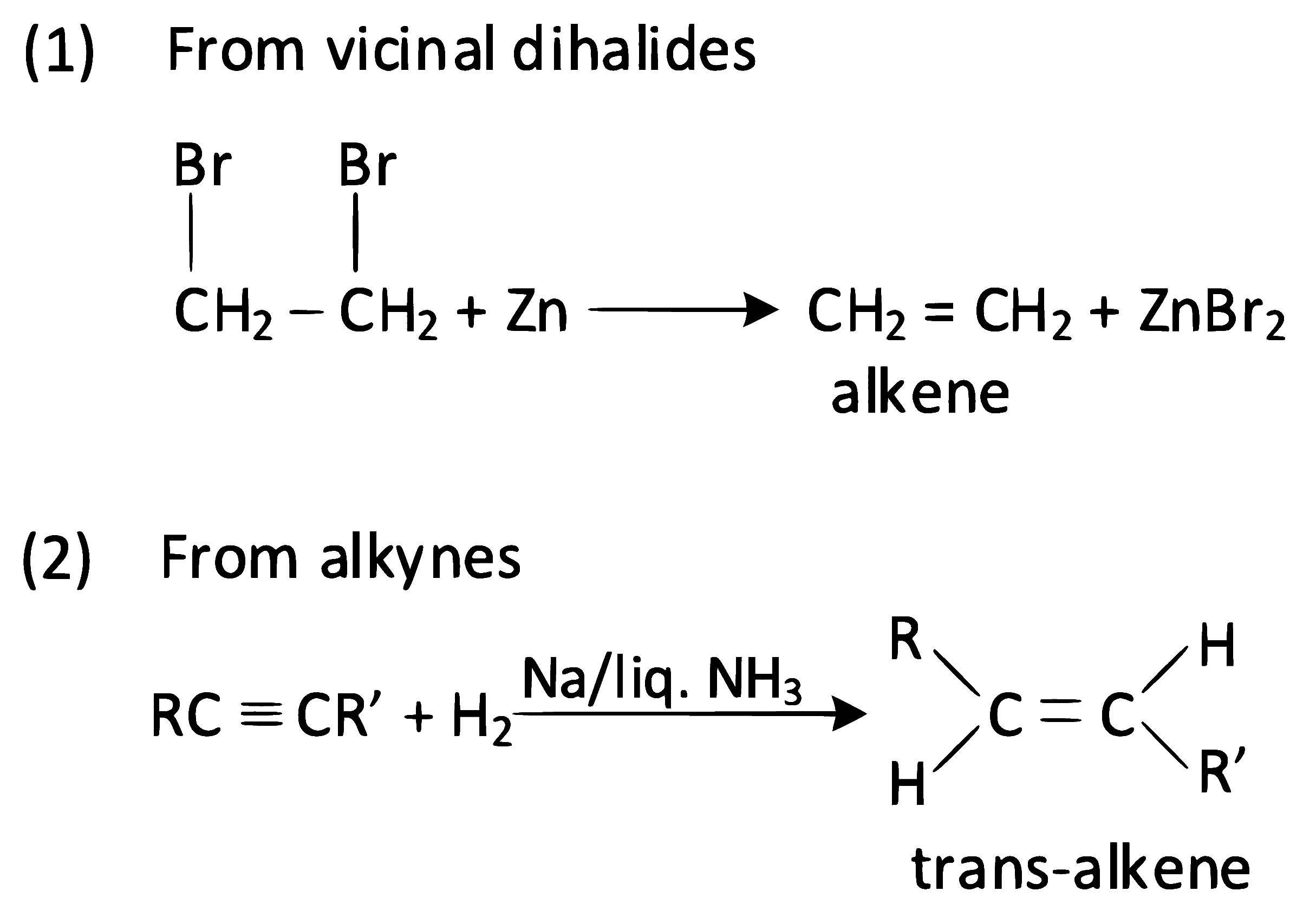
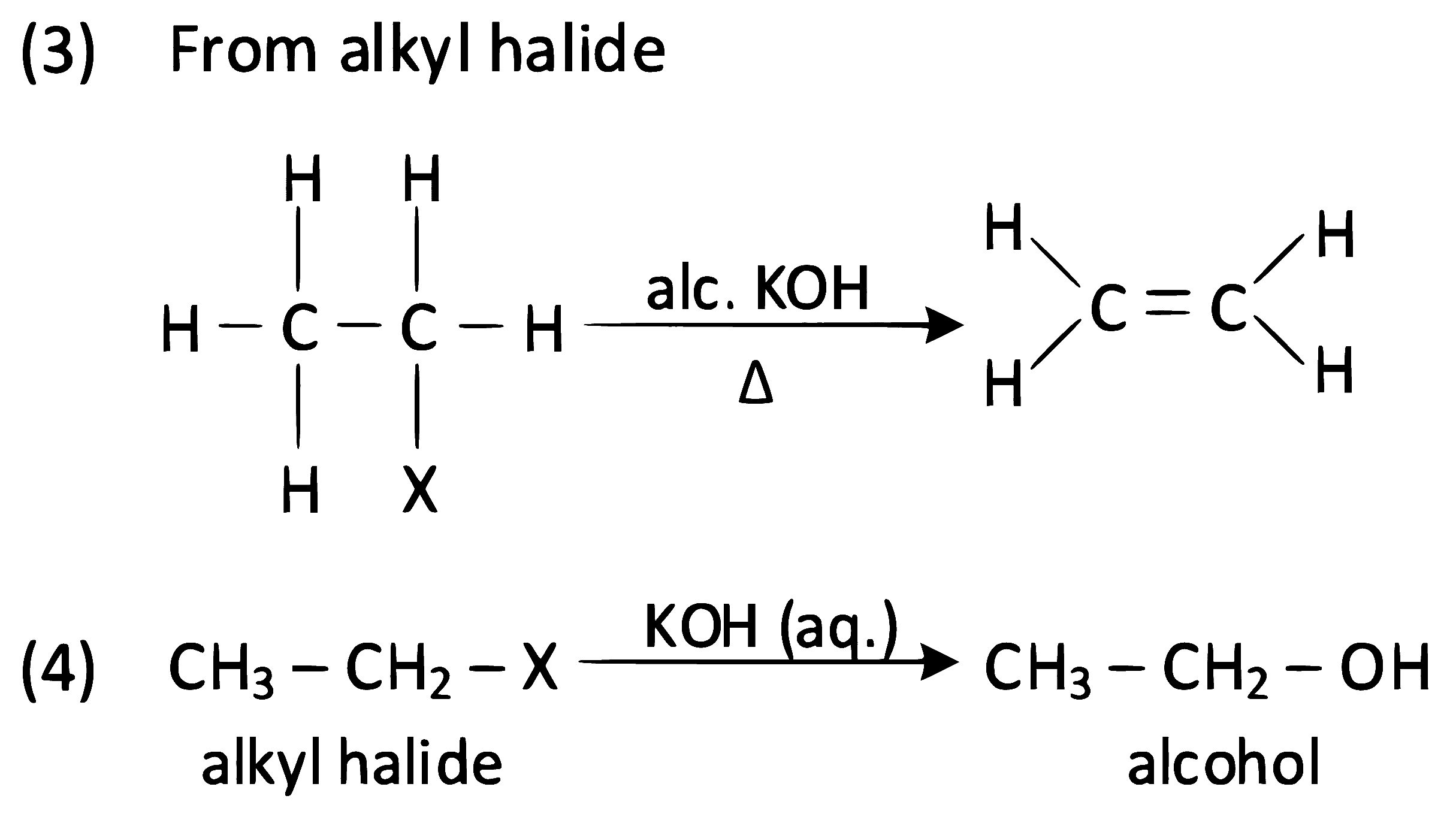
Solution

Alkenes can be prepared

NEET 2022 Phase 2 Chemistry - Hydrocarbons Question 11 English Explanation 1NEET 2022 Phase 2 Chemistry - Hydrocarbons Question 11 English Explanation 2

Q.41

Match the reagents (List-I) with the product (List-II) obtained from phenol.

List-I
List-II
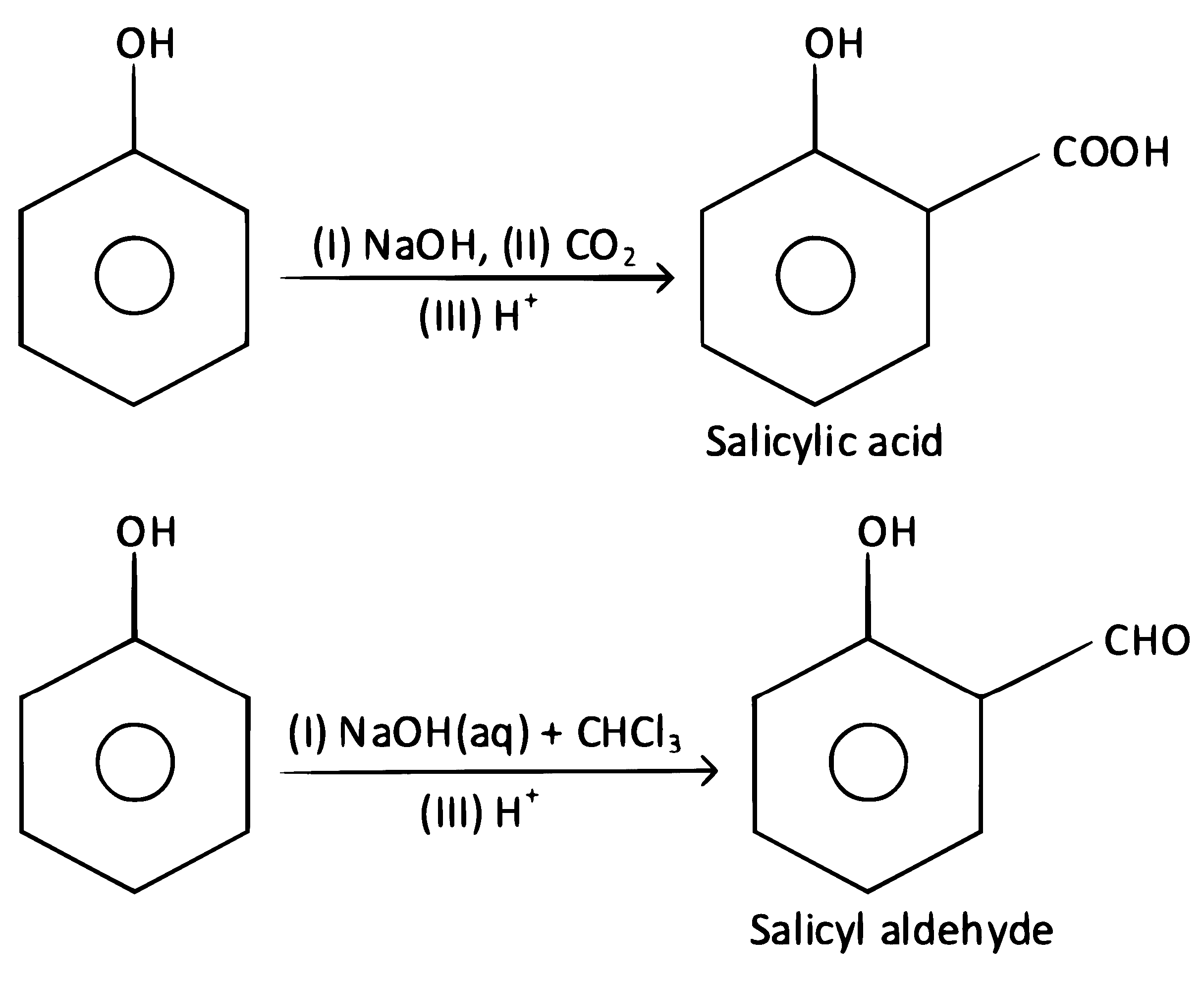
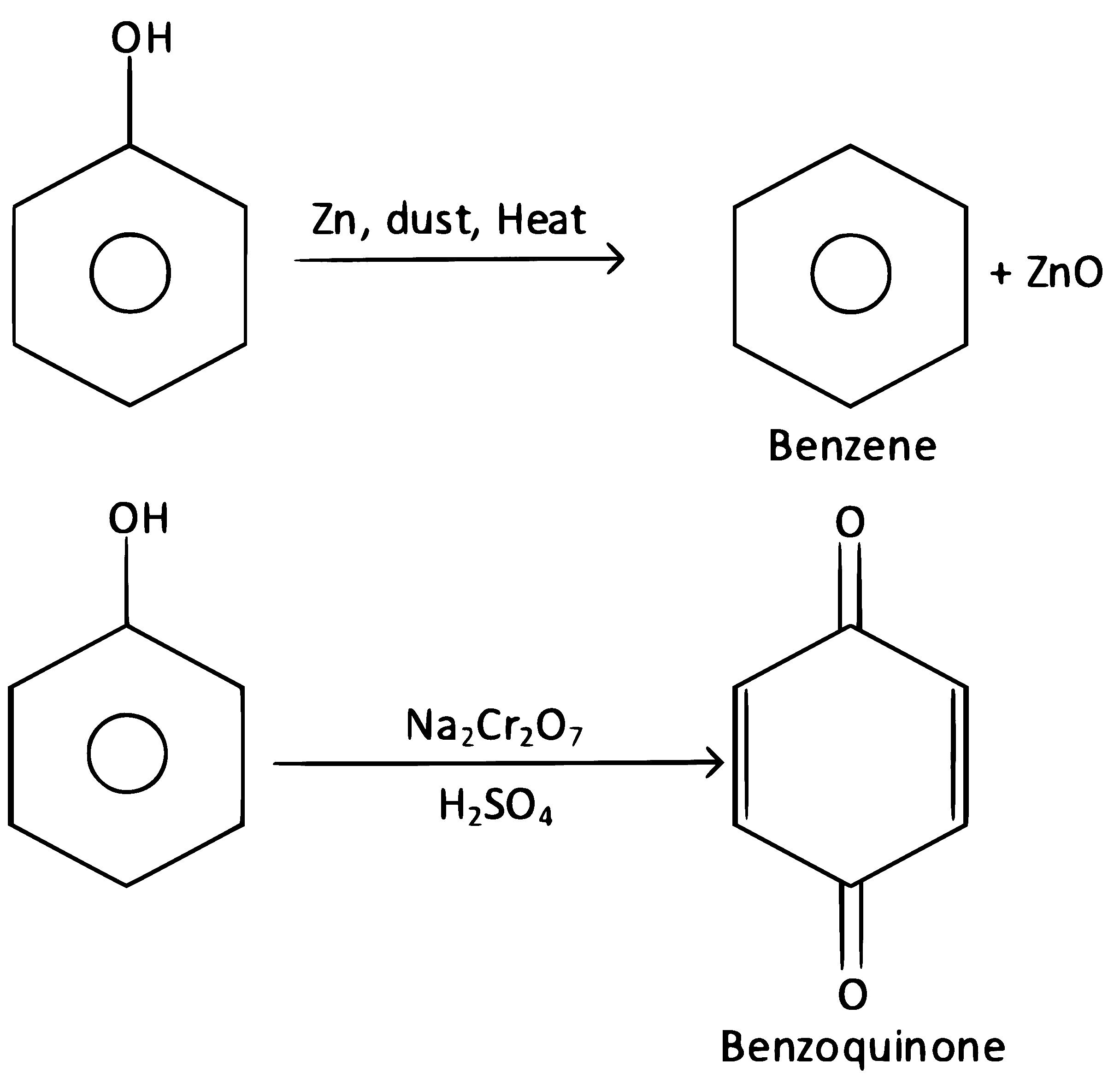
(a) (i) NaOH (ii) CO (iii) H (i) Benzoquinone
(b) (i) Aqueous NaOH + CHCl (ii) H (ii) Benzene
(c) Zn dust, (iii) Salicyl aldehyde
(d) NaCrO, HSO (iv) Salicylic acid

Choose the correct answer from the options given below :

(A)
(a) - (iv), (b) - (ii), (c) - (i), (d) - (iii)
(B)
(a) - (iii), (b) - (iv), (c) - (i), (d) - (ii)
(C)
(a) - (ii), (b) - (i), (c) - (iv), (d) - (iii)
(D)
(a) - (iv), (b) - (iii), (c) - (ii), (d) - (i)
(D)

Solution

NEET 2022 Phase 2 Chemistry - Alcohol, Phenols and Ethers Question 13 English Explanation 1NEET 2022 Phase 2 Chemistry - Alcohol, Phenols and Ethers Question 13 English Explanation 2

Q.42

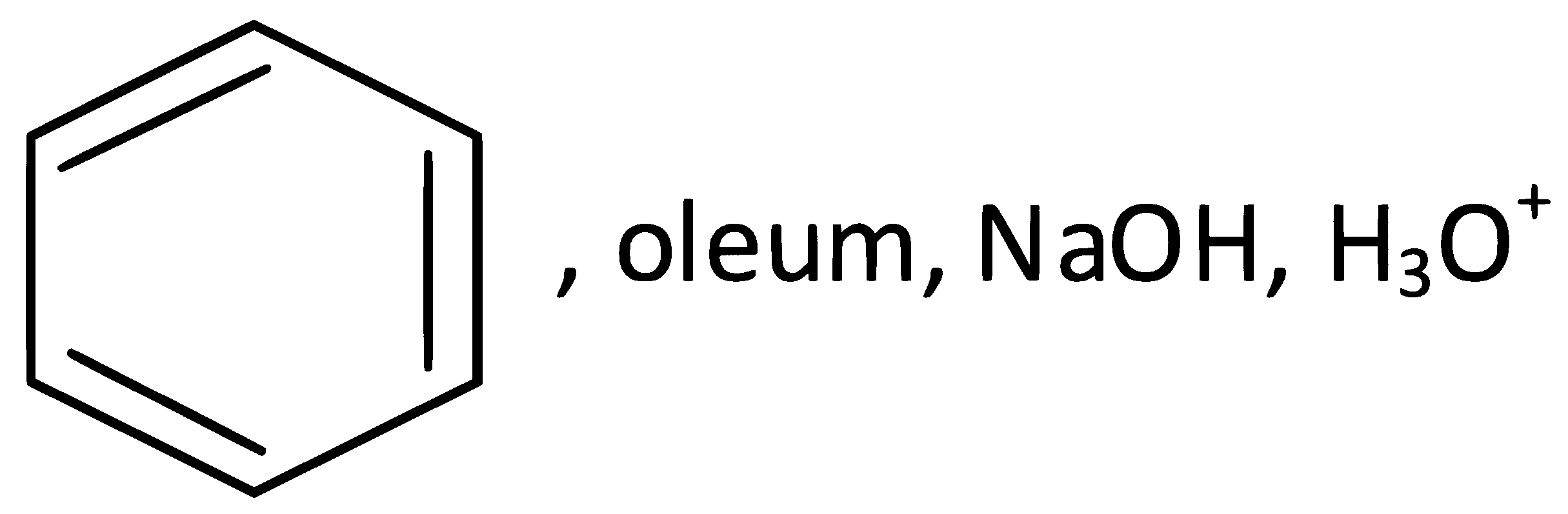
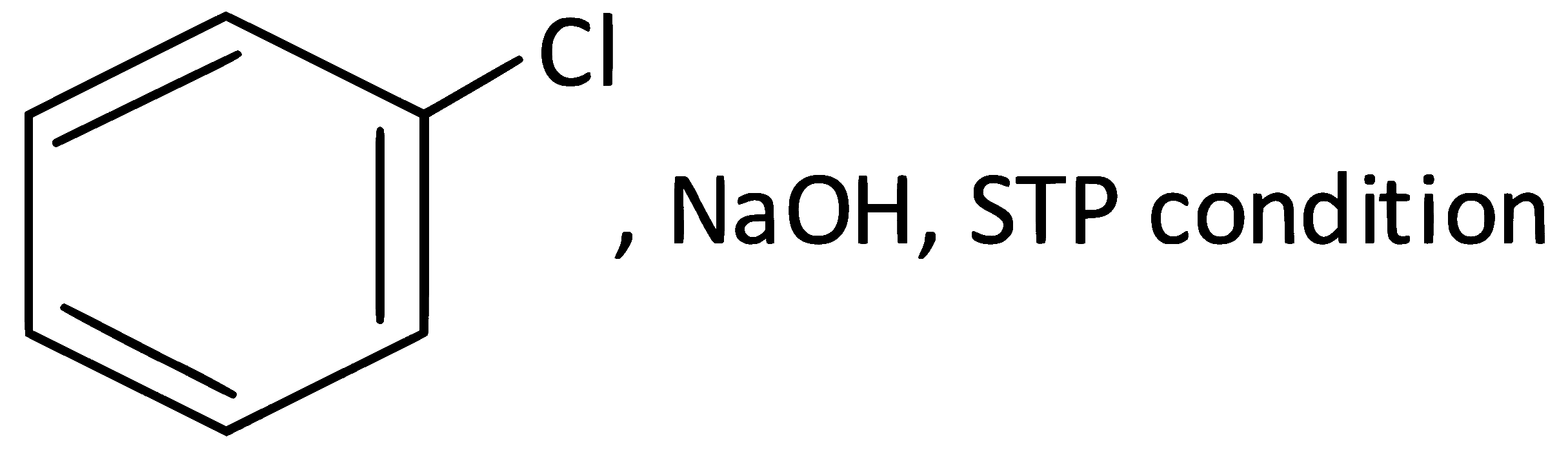
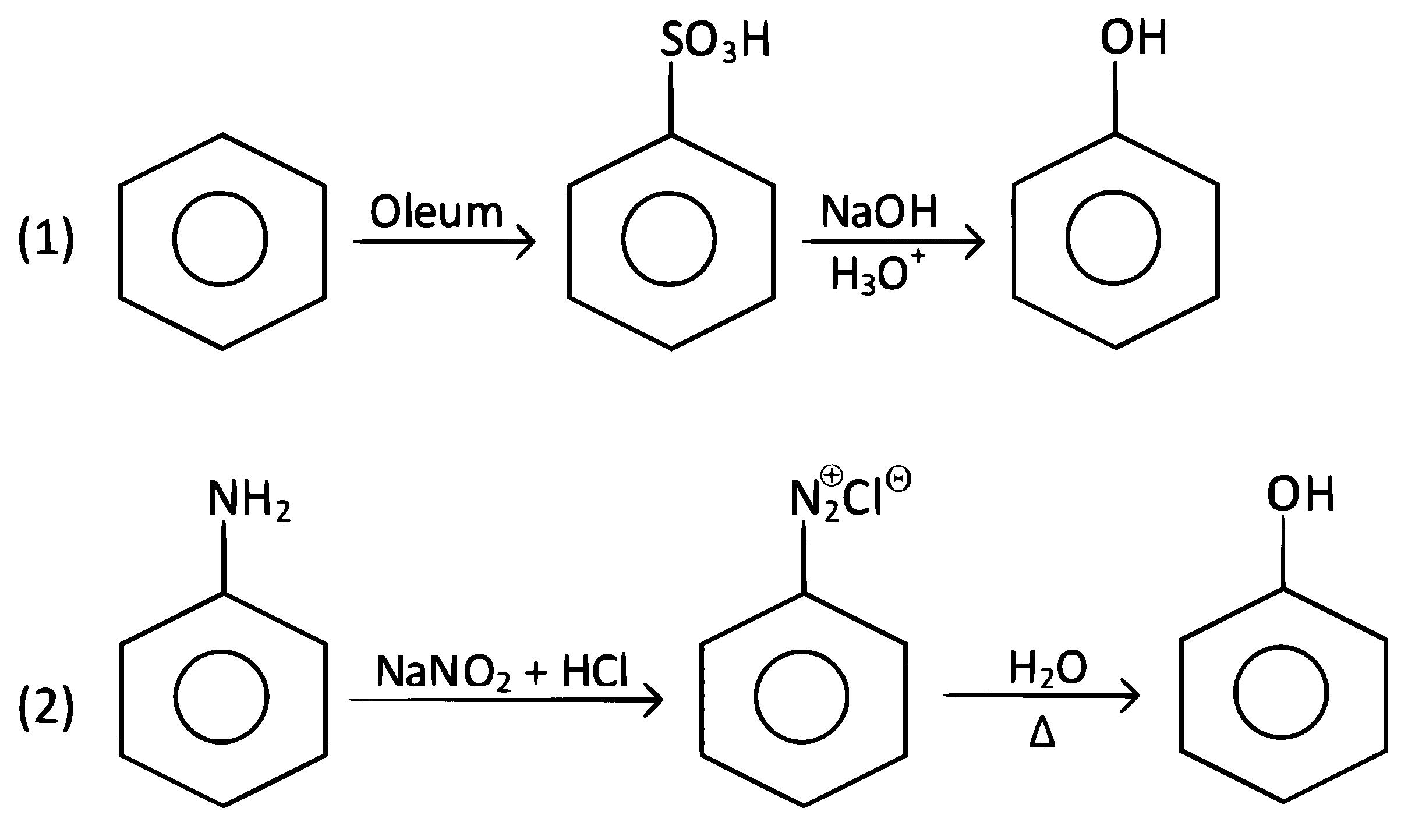
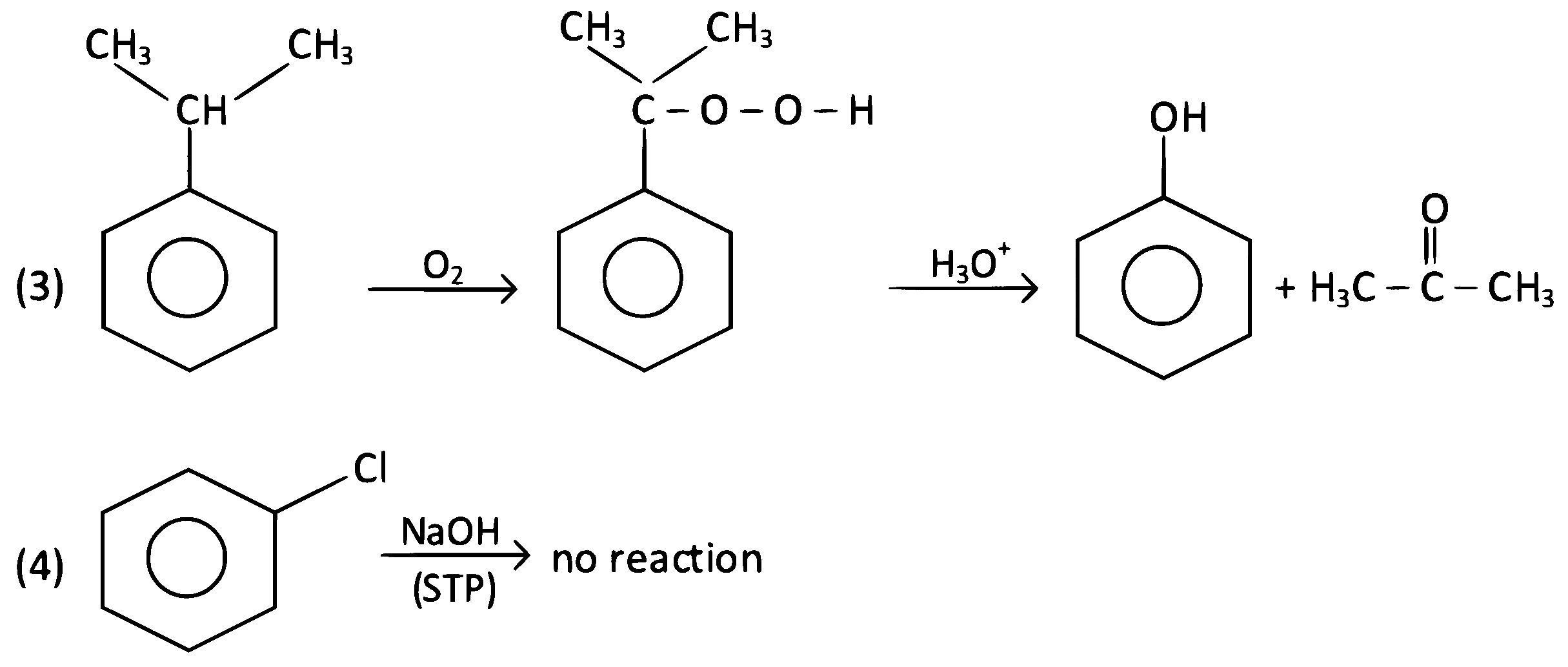
Which one of the following reaction sequence is incorrect method to prepare phenol?

(A)
NEET 2022 Phase 2 Chemistry - Alcohol, Phenols and Ethers Question 14 English Option 1
(B)
Aniline, NaNO2 + HCl, H2O, heating
(C)
Cumene, O2, H3O+
(D)
NEET 2022 Phase 2 Chemistry - Alcohol, Phenols and Ethers Question 14 English Option 4
(D)

Solution

NEET 2022 Phase 2 Chemistry - Alcohol, Phenols and Ethers Question 14 English Explanation 1NEET 2022 Phase 2 Chemistry - Alcohol, Phenols and Ethers Question 14 English Explanation 2

At STP condition substitution at sp2 carbon atom is not feasible.

Q.43

Which of the following reactions is not an example for nucleophilic addition-elimination reaction?

(A)
CH3CHO + NH3 CH3CH = NH + H2O
(B)
NEET 2022 Phase 2 Chemistry - Aldehydes, Ketones and Carboxylic Acids Question 24 English Option 2
(C)
CH3CHO + NH2OH CH3CH = N OH + H2O
(D)
CH3CHO + C6H5NHNH2 CH3CH = N NHC6H5 + H2O
(B)

Solution

It is an example of nucleophilic addition reaction

NEET 2022 Phase 2 Chemistry - Aldehydes, Ketones and Carboxylic Acids Question 24 English Explanation

Q.44

The product formed from the following reaction sequence is

NEET 2022 Phase 2 Chemistry - Aldehydes, Ketones and Carboxylic Acids Question 23 English

(A)
NEET 2022 Phase 2 Chemistry - Aldehydes, Ketones and Carboxylic Acids Question 23 English Option 1
(B)
NEET 2022 Phase 2 Chemistry - Aldehydes, Ketones and Carboxylic Acids Question 23 English Option 2
(C)
NEET 2022 Phase 2 Chemistry - Aldehydes, Ketones and Carboxylic Acids Question 23 English Option 3
(D)
NEET 2022 Phase 2 Chemistry - Aldehydes, Ketones and Carboxylic Acids Question 23 English Option 4
(C)

Solution

NEET 2022 Phase 2 Chemistry - Aldehydes, Ketones and Carboxylic Acids Question 23 English Explanation

Q.45

Match List-I with List-II :

List-I
(Reaction)
List-II
(Product formed)
(a) Gabriel synthesis (i) Benzaldehyde
(b) Kolbe synthesis (ii) Ethers
(c) Williamson synthesis (iii) Primary amines
(d) Etard reaction (iv) Salicylic acid

Choose the correct answer from the options given below :

(A)
(a) - (iii), (b) - (iv), (c) - (ii), (d) - (i)
(B)
(a) - (iii), (b) - (i), (c) - (ii), (d) - (iv)
(C)
(a) - (ii), (b) - (iii), (c) - (i), (d) - (iv)
(D)
(a) - (iv), (b) - (iii), (c) - (i), (d) - (ii)
(A)

Solution

Gabriel phthalimide synthesis is used for preparation of aliphatic primary amines.

Kolbe synthesis with phenol gives salicylic acid

Williamson synthesis gives ether on reaction of alkyl halide and alcoxide

Etard reaction gives benzaldehyde from benzene

Q.46

The incorrect method to synthesize benzaldehyde is

(A)
NEET 2022 Phase 2 Chemistry - Aldehydes, Ketones and Carboxylic Acids Question 22 English Option 1
(B)
NEET 2022 Phase 2 Chemistry - Aldehydes, Ketones and Carboxylic Acids Question 22 English Option 2
(C)
NEET 2022 Phase 2 Chemistry - Aldehydes, Ketones and Carboxylic Acids Question 22 English Option 3
(D)
NEET 2022 Phase 2 Chemistry - Aldehydes, Ketones and Carboxylic Acids Question 22 English Option 4
(A)

Solution

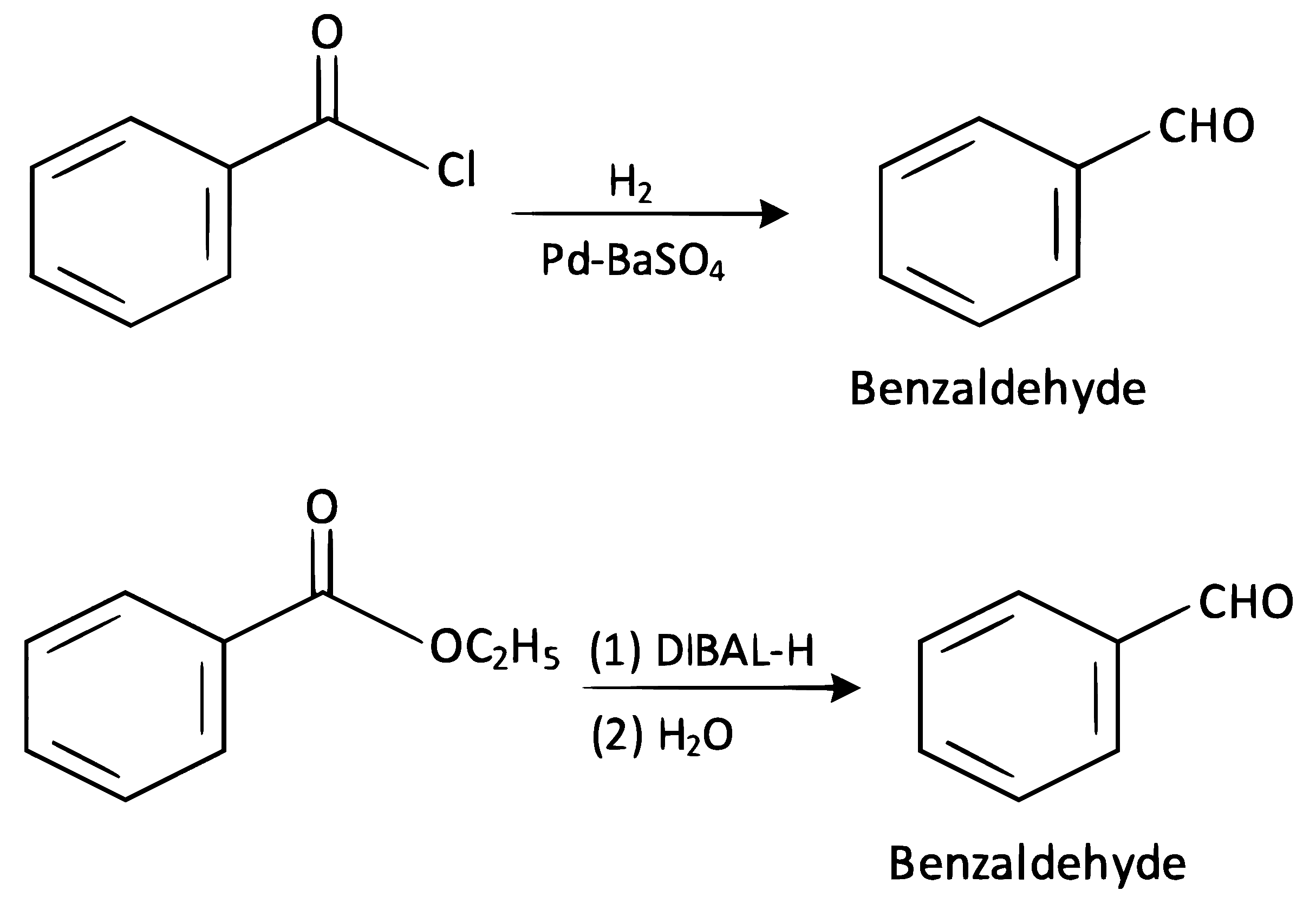
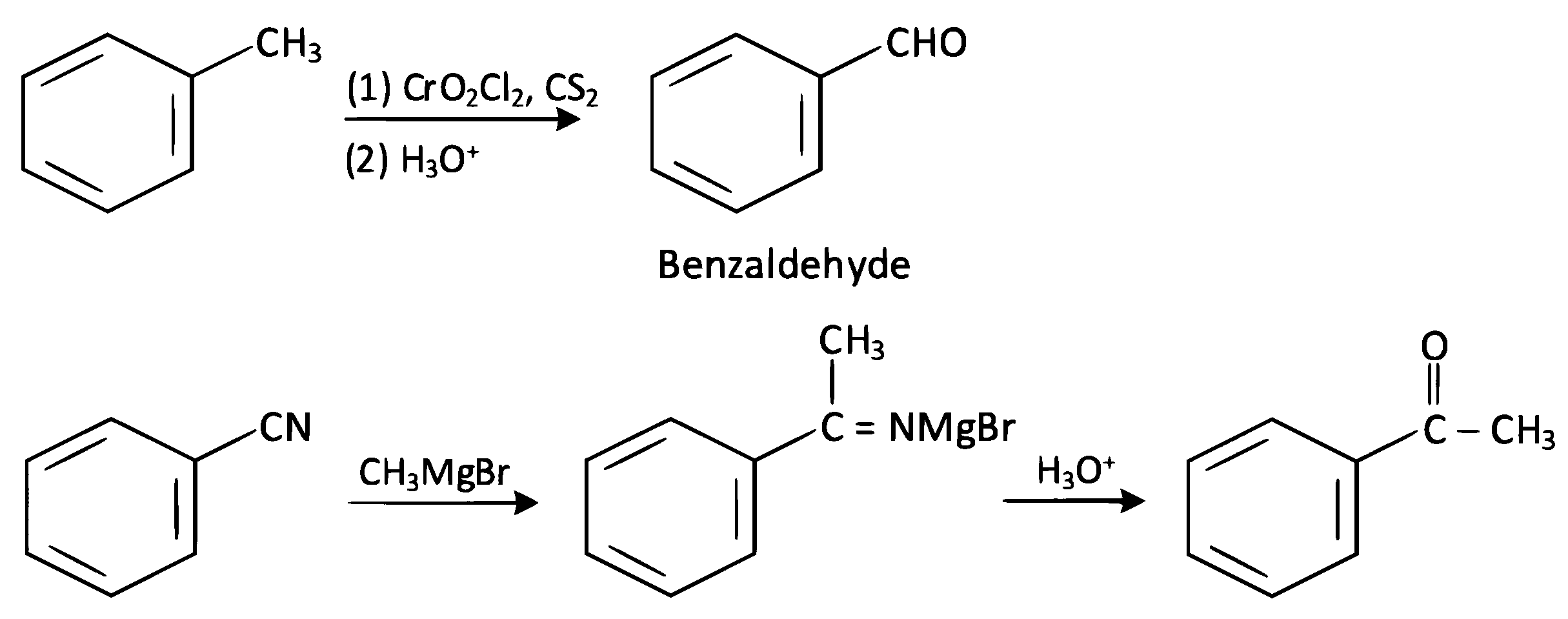
NEET 2022 Phase 2 Chemistry - Aldehydes, Ketones and Carboxylic Acids Question 22 English Explanation 1NEET 2022 Phase 2 Chemistry - Aldehydes, Ketones and Carboxylic Acids Question 22 English Explanation 2

Q.47

The product formed from the following reaction sequence is :

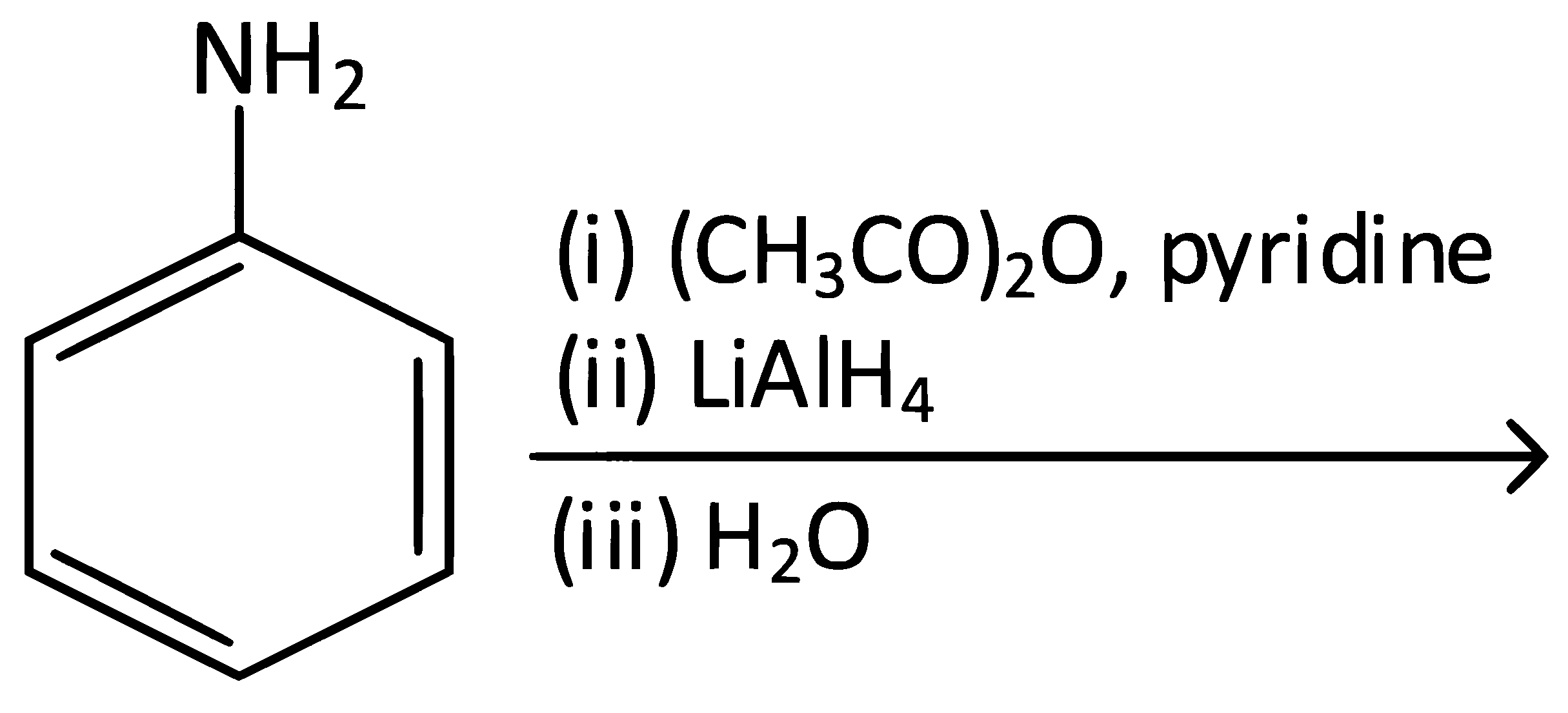
NEET 2022 Phase 2 Chemistry - Organic Compounds Containing Nitrogen Question 15 English

(A)
NEET 2022 Phase 2 Chemistry - Organic Compounds Containing Nitrogen Question 15 English Option 1
(B)
NEET 2022 Phase 2 Chemistry - Organic Compounds Containing Nitrogen Question 15 English Option 2
(C)
NEET 2022 Phase 2 Chemistry - Organic Compounds Containing Nitrogen Question 15 English Option 3
(D)
NEET 2022 Phase 2 Chemistry - Organic Compounds Containing Nitrogen Question 15 English Option 4
(B)

Solution

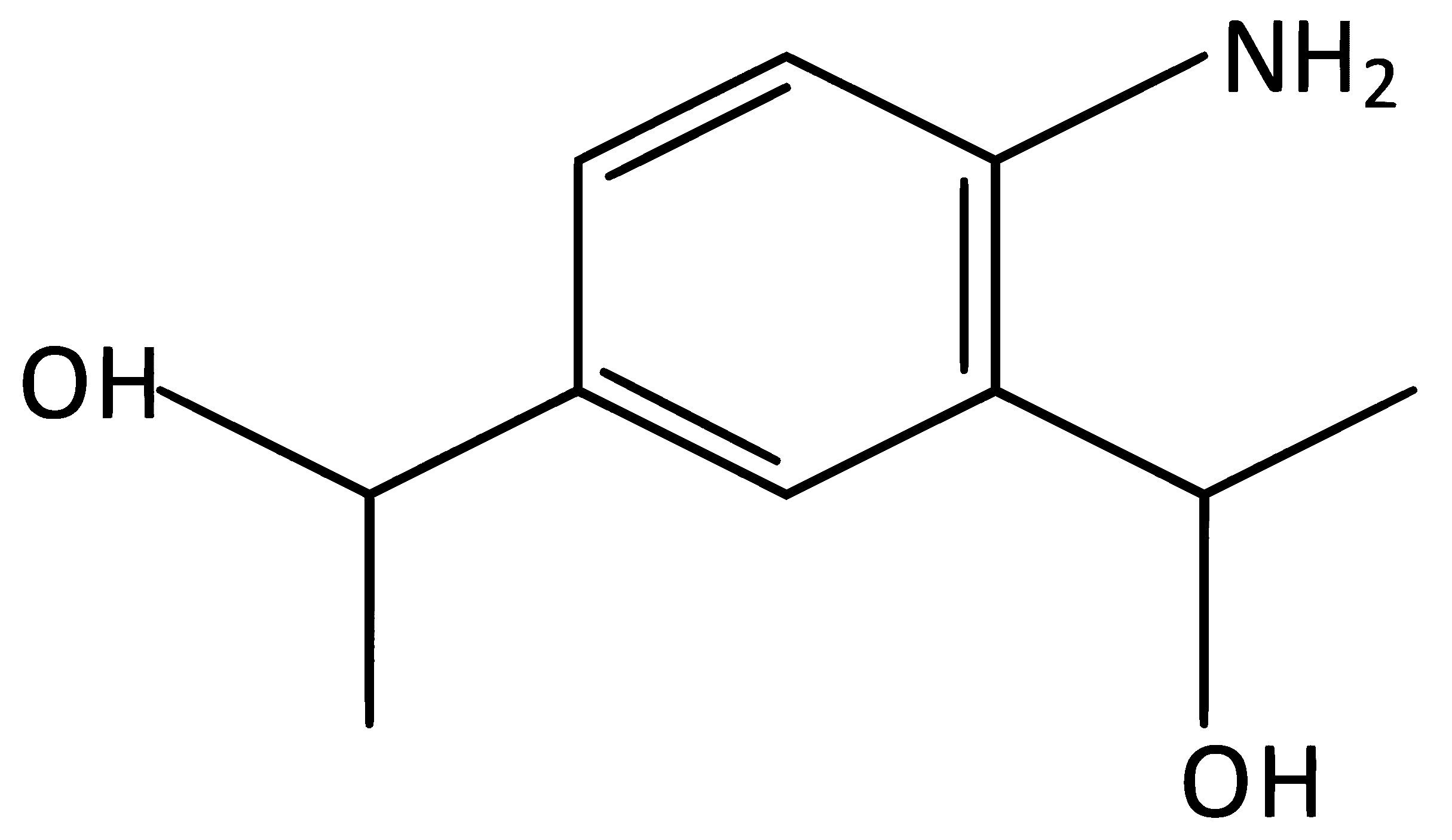
NEET 2022 Phase 2 Chemistry - Organic Compounds Containing Nitrogen Question 15 English Explanation

Q.48

Which among the following is a thermoplastic polymer?

(A)
Melamine polymer
(B)
Bakelite
(C)
Polythene
(D)
Urea-formaldehyde resin
(C)

Solution

Polythene is an example of thermoplastic polymer.

Melamine polymer, Bakelite and Urea-formaldehyde resin are thermosetting polymers.

Q.49

The incorrect statement about denaturation of proteins is :

(A)
Uncoiling of the helical structure takes place
(B)
It results due to change of temperature and/or pH
(C)
It results in loss of biological activity of proteins
(D)
A protein is formed from amino acids linked by peptide bonds
(D)

Solution

Proteins are polymers of -amino acids and they are connected to each other by peptide bond, but this is not denaturation process.

Due to denaturation globules unfold and helix get uncoiled and protein loses its biological activity.

Denaturation can be caused if protein in its native form, is subjected to physical change like change in temperature or chemical change like change in pH

Q.50

Match List-I with List-II :

List-I List-II
(a) Sodium laurylsulphate (i) Toilet soap
(b) Cetyltrimethyl ammonium chloride (ii) Non-ionic detergent
(c) Sodium stearate (iii) Anionic detergent
(d) Polyethyleneglycyl stearate (iv) Cationic detergent

Choose the correct answer from the options given below :

(A)
(a)-(iii), (b)-(i), (c)-(ii), (d)-(iv)
(B)
(a)-(iv), (b)-(iii), (c)-(i), (d)-(ii)
(C)
(a)-(i), (b)-(iv), (c)-(ii), (d)-(iii)
(D)
(a)-(iii), (b)-(iv), (c)-(i), (d)-(ii)
(D)

Solution

(a) Sodium laurylsulphate Anionic detergent

(b) Cetyltrimethyl ammonium chloride Cationic detergent

(c) Sodium stearate Toilet soap

(d) Polyethyleneglycyl stearate Non-ionic detergent

(a)-(iii), (b)-(iv), (c)-(i), (d)-(ii)

Biology (Maximum Marks: 400)
  • This section contains 100 questions.
  • Each question has FOUR options (A), (B), (C) and (D). ONLY ONE of these four options is the correct answer.
  • Full Marks : +4 If ONLY the correct option is chosen;
  • Zero Marks : 0 If none of the options is chosen (i.e. the question is unanswered);
  • Negative Marks : −1 In all other cases.
Q.1

The Phenomenon by which the undividing parenchyma cells start to divide mitotically during plant tissue culture is called as

(A)
Secondary growth
(B)
Differentiation
(C)
Dedifferentiation
(D)
Redifferentiation
(C)

Solution

The phenomenon where certain living differentiated cells regain or attain their ability to divide and form new cells is known as dedifferentiation.

Q.2

Match List-I with List-II

List - I List - II
(a) Porins (i) Pink coloured nodules
(b) leg haemoglobin (ii) Lumen of thylakoid
(c) H accumulation (iii) Amphibolic pathway
(d) Respiration (iv) Huge pores in outer membrane of mitochondria

Choose the correct answer from the options given below.

(A)
(a)-(ii), (b)-(iv), (c)-(i), (d)-(iii)
(B)
(a)-(ii), (b)-(i), (c)-(iv), (d)-(iii)
(C)
(a)-(iv), (b)-(i), (c)-(ii), (d)-(iii)
(D)
(a)-(iii), (b)-(iv), (c)-(ii), (d)-(i)
(C)

Solution

Porins are huge pores in outer membrane of mitochondria.

Leg haemoglobin turns the nodules pink in colour.

H+ accumulation in lumen of thylakoid occurs during photosynthetic electron transport.

Respiration is an amphibolic pathway.

Q.3

Which type of substance would face difficulty to pass through the cell membrane?

(A)
Substance soluble in lipids
(B)
Substance with hydrophobic moiety
(C)
Substance with hydrophilic moiety
(D)
All substance irrespective of hydrophobic and hydrophilic moiety
(C)

Solution

Substances that have a hydrophilic moiety find it difficult to pass through the plasma membrane; thus, their movement has to be facilitated.

Q.4

If the pH in lysosomes is increased to alkaline, what will be the outcome?

(A)
Lysosomal enzymes will be more active
(B)
Hydrolytic enzymes will function more efficiently
(C)
Hydrolytic enzymes will become inactive
(D)
Lysosomal enzymes will be released into the cytoplasm
(C)

Solution

Sol. Lysosomes contain hydrolytic enzymes which become active at acidic pH.

If pH in lysosomes is increased to alkaline or basic then hydrolytic enzymes will become inactive.

Q.5

When a carrier protein facilitates the movement of two molecules across the membrane in same direction, it is called

(A)
Symport
(B)
Uniport
(C)
Transport
(D)
Antiport
(A)

Solution

A symport is the transport of two types of molecules across the membrane in same direction.

Antiport is the transport of two different molecules in opposite directions.

Uniport is transport of a molecule across the membrane independent of other molecule.

Q.6

Match List-I with List-II

List-I
List-II
(a) Adenine (i) Pigment
(b) Anthocyanin (ii) Polysaccharide
(c) Chitin (iii) Alkaloid
(d) Codeine (iv) Purine

Choose the correct answer from the options given below

(A)
(a) - (i), (b) - (iv), (c) - (iii), (d) - (ii)
(B)
(a) - (iv), (b) - (i), (c) - (ii), (d) - (iii)
(C)
(a) - (iv), (b) - (iii), (c) - (ii), (d) - (i)
(D)
(a) - (iii), (b) - (i), (c) - (iv), (d) - (ii)
(B)

Solution

Option (b) is the correct answer as adenine is a purine, anthocyanin is a pigment, chitin is a homopolysaccharide and codeine is an alkaloid.

Q.7

Primary proteins are also called as polypeptides because :

(A)
They can assume many conformations
(B)
They are linear chains
(C)
They are polymers of peptide monomers
(D)
Successive amino acids are joined by peptide bonds
(D)

Solution

Option (4) is the correct answer because primary proteins are heteropolymers containing strings of amino acids linked by peptide bonds.

Option (1) and (2) are incorrect as primary proteins are called polypeptides due to the presence of many monomers linked via peptide bonds, not due to the presence of many conformations.

Option (3) is incorrect because proteins are polymers of amino acid monomers.

Q.8

Which of the following pair represents free living nitrogen fixing aerobic bacteria?

(A)
Pseudomonas and Thiobacillus
(B)
Rhizobium and Frankia
(C)
Azotobacter and Beijernickia
(D)
Anabaena and Rhodospirillum
(C)

Solution

The free living nitrogen fixing aerobic microbes are Azotobacter and Beijernickia

Rhizobium and Frankia are symbiotic nitrogen fixers.

Rhodospirillum is anaerobic nitrogen fixer.

Pseudomonas and Thiobacillus are denitrifying bacteria.

Q.9

Choose the incorrect enzymatic rection:

(A)
Dipeptides Amino acids
(B)
Maltose Glucose + Fructose
(C)
Sucrose Glucose + Fructose
(D)
Lactose Glucose + Galactose
(B)

Solution

Option (b) is the correct answer because maltose is a disaccharide which on hydrolysis gives two molecules of glucose.

Maltose Glucose + Glucose

Options (a), (c) and (d) represent correct enzymatic reactions so they are not the answer.

Q.10

If DNA contained sulfur instead of phosphorus and proteins contained phosphorus instead of sulfur, what would have been the outcome of Hershey and Chase experiment?

(A)
Radioactive phosphorus in bacterial cells
(B)
No radioactive sulfur in bacterial cells
(C)
Both radioactive sulfur and phosphorus in bacterial cells
(D)
Radioactive sulfur in bacterial cells
(D)

Solution

In Hershey-chase experiment when radioactive sulphur was in protein capsule and radioactive phosphorus was in DNA then, no sulphur radioactivity detected in the cells as protein coat remains outside the bacterial cell after infection.

In the given question, sulphur is shown in the DNA and phosphorus in the protein coat. Hence radioactive sulphur will be seen in bacterial cells.

Q.11

Given below are two statements:

Statement I : Amino acids have a property of ionizable nature of NH2 and COOH groups, hence have different structures at different pH.

Statement-II : Amino acids can exist as Zwitterionic form at acidic and basic pH.

In the light of the above statements, choose the most appropriate answer from the options given below:

(A)
Statement I is incorrect but Statement II is correct
(B)
Both Statement I and Statement II are correct
(C)
Both Statement I and Statement II are incorrect
(D)
Statement I is correct but Statement II is incorrect
(D)

Solution

Option (d) is the correct answer as statement I is correct but statement II is incorrect.

A particular property of amino acids is the ionizable nature of NH2 and COOH groups. Hence, in solutions of different pH, the structure of amino acid changes. Amino acid exists as a dipolar ion called a zwitterion at a particular pH called isoelectric point.

NEET 2022 Phase 2 Biology - Biomolecules Question 34 English Explanation

(B) is called zwitterionic form.

Q.12

In the enzyme which catalyses the breakdown of:

H2O2 H2O + O2

the prosthetic group is :

(A)
Niacin
(B)
Nicotinamide adenine dinucleotide
(C)
Haem
(D)
Zinc
(C)

Solution

Option (c) is the correct answer because peroxidase is the enzyme that catalyzes the breakdown of hydrogen peroxide to water and oxygen; haem is the prosthetic group of this enzyme.

Option (a) and (b) are incorrect because co-enzyme nicotinamide adenine dinucleotide (NAD) and NADP contain the vitamin niacin.

Option (d) is incorrect because zinc is a co-factor for the proteolytic enzyme carboxypeptidase.

Q.13

Which stage of meiosis can last for months or years in the oocytes of some vertebrates?

(A)
Diakinesis
(B)
Leptotene
(C)
Pachytene
(D)
Diplotene
(D)

Solution

In oocytes of some vertebrates, diplotene lasts for months or years. This stage is referred as dictyotene stage.

Q.14

Identify the correct sequence of events during Prophase I of meiosis:

(a) Synapsis of homologous chromosomes

(b) Chromosomes become gradually visible under microscope

(c) Crossing over between non-sister chromatids of homologous chromosomes

(d) Terminalisation of chiasmata

(e) Dissolution of synaptonemal complex

Choose the correct answer from the options given below:

(A)
(a), (c), (d), (e), (b)
(B)
(a), (b), (c), (d), (e)
(C)
(b), (c), (d), (e), (a)
(D)
(b), (a), (c), (e), (d)
(D)

Solution

Correct sequence of events during Prophase I of meiosis is : (b) → (a) → (c) → (e) → (d)

(b) Chromosomes become gradually visible under microscope.

(a) Synapsis of homologues chromosomes.

(c) Crossing over between non-sister chromatids of homologous chromosomes.

(e) Dissolution of synaptonemal complex.

(d) Terminalisation of chiasmata.

Q.15

Bivalent or Tetrad formation is a characteristic feature observed during

(A)
Chiasmata in zygotene stage
(B)
Synaptonemal complex in zygotene stage
(C)
Chiasmata in Diplotene stage
(D)
Synaptonemal complex in Pachytene stage
(B)

Solution

Bivalent or tetrad formation is called synapsis which is accompanied by the formation of complex structure called synaptonemal complex.

Q.16

With respect to metaphase, which of the following statements is incorrect?

(A)
Chromosomes lie at the equator of the cell
(B)
Complete disintegration of nuclear envelope takes place
(C)
Chromosomes are highly condensed
(D)
Metaphase chromosomes are made up of four sister chromatids held together by centromere
(D)

Solution

The question asks which statement is incorrect with respect to the metaphase stage of cell division.

Option D is incorrect because metaphase chromosomes are not made up of four sister chromatids held together by the centromere. Instead, metaphase chromosomes consist of two sister chromatids held together by the centromere. The sister chromatids are identical copies of a single chromosome that have been replicated during the S phase of the cell cycle.

Now, let's look at the other options, which are correct :

Option A : Chromosomes lie at the equator of the cell - During metaphase, the chromosomes align along the equatorial plane (also known as the metaphase plate) in the middle of the cell. This arrangement ensures that each daughter cell will receive an equal number of chromosomes during cell division.

Option B : Complete disintegration of the nuclear envelope takes place - In both mitosis and meiosis, the nuclear envelope breaks down during prophase and is completely disintegrated by the time the cell reaches metaphase. This allows the spindle fibers to attach to the chromosomes and facilitate their alignment at the equator.

Option C : Chromosomes are highly condensed - During metaphase, the chromosomes are at their highest level of condensation, which allows them to be more easily visualized under a microscope. This condensation also aids in the proper alignment and segregation of chromosomes during cell division.

Q.17

The residual persistent part which forms the perisperm in the seeds of beet is

(A)
Integument
(B)
Calyx
(C)
Endosperm
(D)
Nucellus
(D)

Solution

Mostly nucellus is consumed after fertilisation due to absorption of food by developing embryo in a seed. Sometimes, the nucellus remains persistent in the seed and is called perisperm.

Q.18

To ensure that only the desired pollens fall on the stigma in artificial hybridization process

(a) the female flower buds of plant producing unisexual flowers need not be bagged.

(b) there is no need to emasculate unisexual flowers of selected female parent

(c) emasculated flowers are to be bagged immediately after cross pollination

(d) emasculated flowers are to be bagged after removal of anthers

(e) bisexual flowers, showing protogyny are never selected for cross

Choose the correct answer from the options given belows

(A)
(a), (d) and (e) only
(B)
(a), (b) and (c) only
(C)
(b), (c) and (d) only
(D)
(b), (c) and (e) only
(C)

Solution

(b) There is no need to emasculate unisexual flowers of the selected female parent - This statement is correct because unisexual flowers do not have male reproductive parts (stamens), so there is no need to remove anthers (emasculate) to prevent self-pollination.

(c) Emasculated flowers are to be bagged immediately after cross-pollination - This statement is correct because, after cross-pollination with the desired pollen, the flowers need to be bagged to prevent further contamination from unwanted pollen or other pollinating agents.

(d) Emasculated flowers are to be bagged after removal of anthers - This statement is correct. The emasculated flowers should be bagged after anther removal and before cross-pollination. This prevents contamination with unwanted pollen. After cross-pollination, the flowers should be bagged again to avoid any further contamination.

The other options are incorrect :

(a) The female flower buds of plant producing unisexual flowers need not be bagged - This statement is incorrect because even unisexual flowers need to be bagged to prevent contamination from unwanted pollen or other pollinating agents.

(e) Bisexual flowers, showing protogyny, are never selected for cross - This statement is incorrect because protogyny (when the female reproductive part matures before the male reproductive part) can reduce the chances of self-pollination, making these flowers suitable for cross-pollination.

Q.19

In general the egg apparatus of embryo sac in angiosperm consists of

(A)
One egg cell, two synergids, two antipodal cells, two Polar nuclei
(B)
One egg cell, two synergids, three antipodal cells, two Polar nuclei
(C)
One egg cell, two synergids, two antipodal cells, three Polar nuclei
(D)
One egg cell, three synergids, two antipodal cells, two Polar nuclei
(B)

Solution

The egg apparatus of an embryo sac consists of one egg cell and two synergids.

Whereas the embryo sac consists of one egg cell, two synergies, three antipodals and two polar nuclei.

As per the question none of the option is correct however considering the composition of embryo sac the correct option should be 2.

Q.20

Given below are two statements: one is labelled as Assertion (A) and the other is labelled as Reason (R).

Assertion (A) : Spirulina is a microbe that can be used for reducing environmental pollution.

Reason (R) : Spirulina is a rich source of protein, carbohydrates, fats, minerals and vitamins.

In the light of the above statements, choose the most appropriate answer from the options given below:

(A)
(A) is not correct but (R) is correct
(B)
Both (A) and (R) are correct and (R) is the correct explanation of (A)
(C)
Both (A) and (R) are correct but (R) is not the correct explanation of (A)
(D)
(A) is correct but (R) is not correct
(C)

Solution

Spirulina can be grown easily on materials like waste water from potato processing plants, so it can reduce environmental pollution. It can serve as food rich in protein, minerals, fats, carbohydrates and vitamins.

Hence, option (c) is correct as both (A) & (R) are correct but (R) is not correct explanation of (A).

Q.21

Interfascicular cambium is present between

(A)
Secondary xylem and secondary phloem
(B)
Primary xylem and primary phloem
(C)
Pericycle and endodermis
(D)
Two vascular bundles
(D)

Solution

During secondary growth in dicot stem, the cells of medullary rays lie between the vascular bundles become dedifferentiated and give rise to new cambium called interfascicular cambium.
Q.22

Initiation of lateral roots and vascular cambium during secondary growth takes place in cells of

(A)
Pericycle
(B)
Epiblema
(C)
Cortex
(D)
Endodermis
(A)

Solution

Initiation of lateral roots and vascular cambium during secondary growth takes place in pericycle cells of dicot roots. Epiblema, endodermis and cortex do not dedifferentiate.

Q.23

The ascent of xylem sap is plants in mainly accomplished by the

(A)
root pressure
(B)
size of the stomatal aperture
(C)
distribution of stomata on the upper and lower epidermis
(D)
cohesion and adhesion between water molecules
(D)

Solution

The ascent of xylem sap in plants is mainly due to negative hydrostatic pressure i.e. transpirational pull, which is accomplished by three physical properties of water i.e., cohesion, adhesion and surface tension.

Q.24

Which of the following protects nitrogenase inside the root nodule of a leguminous plant?

(A)
Glutamate dehydrogenase
(B)
Catalase
(C)
leg haemoglobin
(D)
Transaminase
(C)

Solution

The enzyme nitrogenase functions under anaerobic conditions as it is highly sensitive to molecular oxygen. In order to protect these enzymes, the nodules contain a red or pink-coloured pigment called leg haemoglobin. It is an O2 scavenger.

Q.25

The 5-C compound formed during TCA cycle is

(A)
Fumaric acid
(B)
-ketoglutaric acid
(C)
Oxalo succinic acid
(D)
Succinic acid
(B)

Solution

In TCA cycle, the intermediate which is a 5-C compound is -ketoglutaric acid.

Oxalo succinic acid is a 6-C compound, whereas succinic acid and fumaric are 4-C compounds.

Q.26

The number of time(s) decarboxylation of isocitrate occurs during single TCA cycle is

(A)
Four
(B)
One
(C)
Two
(D)
Three
(C)

Solution

During TCA cycle, 6-C compound isocitrate is converted into succinyl CoA, a 4-C compound by removing two CO2 molecules.

The steps are as follows -

NEET 2022 Phase 2 Biology - Respiration in Plants Question 15 English Explanation

Q.27

Given below are two statements: one is labelled as Assertion (A) and the other is labelled as Reason (R).

Assertion (A) : When a particular restriction enzyme cuts strand of DNA, overhanging stretches or sticky ends are formed.

Reason (R) : Some restriction enzymes cut the strand of DNA a little away from the centre of palindromic site.

In the light of the above statements, choose the correct answer from the options given below :

(A)
(A) is not correct but (R) is correct
(B)
Both (A) and (R) are correct and (R) is the correct explanation of (A)
(C)
Both (A) and (R) are correct but (R) is not the correct explanation of (A)
(D)
(A) is correct but (R) is not correct
(B)

Solution

Option (b) is the correct answer because when restriction enzymes cut the strand of DNA a little away from the centre of the palindrome sites, but between the same two bases on the opposite strands, then single stranded portions are left at the ends. These overhanging stretches on each strand are called sticky ends.

Q.28

Separation of DNA fragments is done by a technique known as

(A)
Gel electrophoresis
(B)
Polymerase Chain Reaction
(C)
Recombinant technology
(D)
Southern blotting
(A)

Solution

Option (1) is the correct answer because separation of DNA fragments which is carried out after restriction enzyme digestion, is done by a technique known as gel electrophoresis.

Option (2) is not the correct answer because polymerase chain reaction (PCR) is a technique used for amplification of gene of interest.

Option (3) is not the correct answer because recombinant DNA technology comprises altering genetic material outside an organism to obtain enhanced and desired characteristics in living organisms or as their products.

Option (4) is not the answer because Southern blotting is a method used for detection of specific DNA sequences in samples.

Q.29

The enzyme (a) is needed for isolating genetic material from plant cells and enzyme (b) for isolating genetic material from fungus. Choose the correct pair of options from the following :

(A)
(a) Cellulase (b) Lipase
(B)
(a) Cellulase (b) Protease
(C)
(a) Cellulase (b) Chitinase
(D)
(a) Chitinase (b) Lipase
(C)

Solution

Option (3) is the correct answer because cellulase is used to isolate genetic material from plant cells and chitinase is used to isolate genetic material from fungal cells.

Option (2) is incorrect because protease is used for digestion of proteins.

Option (1) and (4) are incorrect because lipase is used for the breakdown of lipids.

Q.30

Match List-I with List-II :

List - I List - II
(a) Gene gun (i) Replacement of a faulty gene by a normal healthy gene
(b) Gene therapy (ii) Used for transfer of gene
(c) Gene cloning (iii) Total DNA in the cells of an organism
(d) Genome (iv) To obtain identical copies of a particular DNA molecule

Choose the correct answer from the options given below:

(A)
(a) - (ii), (b) - (iii), (c) - (iv), (d) - (i)
(B)
(a) - (ii), (b) - (i), (c) - (iv), (d) - (iii)
(C)
(a) - (i), (b) - (iii), (c) - (ii), (d) - (iv)
(D)
(a) - (iv), (b) - (i), (c) - (iii), (d) - (ii)
(B)

Solution

Option (2) is the correct answer because

Gene gun or biolistics is a direct gene transfer method suitable for plant cell.

Gene therapy involves replacement of a faulty gene by a normal healthy gene.

Gene cloning is done to make identical copies of a particular DNA molecule.

Genome is the total DNA in the cells of an organism.

Q.31

Pathogenic bacteria gain resistance to antibiotics due to changes in their :

(A)
Nucleoid
(B)
Cosmids
(C)
Plasmids
(D)
Nucleus
(C)

Solution

Plasmid is small circular DNA outside the genomic DNA. The plasmid DNA confers certain unique phenotypic characters to the bacteria such as resistance to antibiotics.

Q.32

Which of the following methods is not commonly used for introducing foreign DNA into the plant cell?

(A)
Bacteriophages
(B)
Agrobacterium mediated transformation
(C)
Gene gun
(D)
‘Disarmed pathogen’ vectors
(A)

Solution

Option (a) is the correct answer because bacteriophages act as a cloning vector for bacterial cells, not the plant cells.

Options (b), (c) and (d) are not the correct answers because Agrobacterium, gene gun and disarmed pathogens as vectors are used for introducing foreign DNA into the plant cells.

Q.33

Refer to the following statements for agarose-gel electrophoresis:

(a) Agarose is a natural polymer obtained from sea-weed.

(b) The separation of DNA molecules in agarose-gel electrophoresis depends on the size of DNA.

(c) The DNA migrates from negatively-charged electrode to the positively-charged electrode

(d) The DNA migrates from positively-charged electrode to the negatively-charged electrode.

Choose the most appropriate answer from the options given below :

(A)
(b), (c) and (d) only
(B)
(a) and (b) only
(C)
(a), (b) and (c) only
(D)
(a), (b) and (d) only
(C)

Solution

Option (c) is the correct answer as the most commonly used matrix in gel electrophoresis is agarose which is a natural polymer extracted from sea weeds.

In agarose gel electrophoresis, the DNA fragments separate (resolve) according to their size through sieving effect provided by the agarose gel.

Since, DNA fragments are negatively charged molecules, they migrate towards the anode (positively-charged electrode) under an electric field through a medium/martix.

Q.34

Give the correct descending order of organisms with reference to their estimated number found in Amazon forest.

(a) Plants (b) Invertebrates (c) Fishes (d) Mammals (e) Birds

Choose the correct answer from the options given below :

(A)
(b) > (a) > (c) > (e) > (d)
(B)
(a) > (b) > (e) > (d) > (c)
(C)
(a) > (c) > (d) > (b) > (e)
(D)
(b) > (a) > (e) > (d) > (c)
(A)

Solution

The numbers of species related to different taxa in Amazonian rain forest are as follows:

Taxa Number of species
Plants > 40,000
Mammals 427
Birds 1,300
Fishes 3,000
Invertebrates > 1,25,000

Q.35

The World Summit on sustainable development held in 2002 in Johannesburg, South Africa pledged for

(A)
Collection and preservation of seeds of different genetic strains of commercially important plants.
(B)
A significant reduction in the current rate of biodiversity loss.
(C)
Declaration of more biodiversity hotspots.
(D)
Increase in agricultural production.
(B)

Solution

In the World Summit on sustainable development held in 2002 in Johannesburg, South Africa, 190 countries pledged their commitment to achieve by 2010, a significant reduction in the current rate of biodiversity loss at global, regional and local levels.

Q.36

Match List - I with List - II :

List - I List - II
(a) Carbon dissolved in oceans (i) 55 billion tons
(b) Annual fixation of carbon through photosynthesis (ii) 71%
(c) PAR captured by plants (iii) 4 10 kg
(d) Productivity of oceans (iv) 2 to 10%

Choose the correct answer from the options given below:

(A)
(a)-(iii), (b)-(ii), (c)-(i), (d)-(iv)
(B)
(a)-(ii), (b)-(iv), (c)-(iii), (d)-(i)
(C)
(a)-(iii), (b)-(iv), (c)-(ii), (d)-(i)
(D)
(a)-(ii), (b)-(iii), (c)-(iv), (d)-(i)
(D)

Solution

About 71% of total carbon is found dissolved in oceans.

Annual fixation of carbon through photosynthesis is 4 1013 kg.

PAR captured by plants is 2 to 10% of total sunlight.

Productivity of oceans is approximately 55 billion tons.

Q.37

Match the List-I with List-II :

List - I List - II
(a) Sacred groves (i) Alien species
(b) Zoological park (ii) Release of large quantity of oxygen
(c) Nile perch (iii) Ex-situ conservation
(d) Amazon forest (iv) Khasi Hills in Meghalaya

Choose the correct answer from the options given below :

(A)
(a) – (iv), (b) – (iii), (c) – (ii), (d) – (i)
(B)
(a) – (iv), (b) – (iii), (c) – (i), (d) – (ii)
(C)
(a) – (ii), (b) – (iv), (c) – (i), (d) – (iii)
(D)
(a) – (iv), (b) – (i), (c) – (ii), (d) – (iii)
(B)

Solution

Khasi Hills in Meghalaya are sacred groves. Zoological park is an ex-situ conservation strategy.

Nile perch is an alien species.

Amazon forest releases large quantity of O2.

Q.38

Frugivorous birds are found in large numbers in tropical forests mainly because of :

(A)
Temperature conducive for their breeding
(B)
Lack of niche specialisation
(C)
Higher annual rainfall
(D)
Availability of fruits throughout the year
(D)

Solution

Frugivorous birds are fruit eating birds found in large number in tropical forest mainly because of availability of fruits throughout the year.

Q.39

Western Ghats have a large number of plants and animal species that are not found anywhere else. Which of the following term is used to notify such species?

(A)
Vulnerable species
(B)
Threatened species
(C)
Keystone species
(D)
Endemic species
(D)

Solution

Endemic species are those species which are confined to a particular area, such as, species found in Western Ghats are not found anywhere else.

Q.40

Which of the following are true about the taxonomical aid 'key'?

(a) Keys are based on the similarities and dissimilarities.

(b) Key is analytical in nature.

(c) Keys are based on the contrasting characters in pair called couplet.

(d) Same key can be used for all taxonomic categories.

(e) Each statement in the key is called Lead.

Choose the most appropriate answer from the options given below:

(A)
(a), (c), (d) and (e) only
(B)
(a), (b) and (c) only
(C)
(b), (c), and (d) only
(D)
(a), (b), (c) and (e) only
(D)

Solution

Key is taxonomical aid used for identification of plants and animals based on the similarities and dissimilarities. The keys are based on the contrasting characters generally in a pair called couplet. Each statement in the key is called a lead. Separate taxonomic keys are required for each taxonomic category such as family, genus and species for identification purposes. Keys are generally analytical in nature.

Q.41

Mad cow disease in cattle and Cr Jacob disease in humans are due to infection by ______.

(A)
Prion
(B)
Bacterium
(C)
Virus
(D)
Viroid
(A)

Solution

Prions are abnormally folded proteins. They cause mad cow disease in cattle and Cr Jacob disease in humans.

Q.42

Which of the following statement is not correct?

(A)
The rhizome is thick, prostrate and branched
(B)
Rhizome is a condensed form of stem
(C)
The apical bud in rhizome always remains above the ground
(D)
The rhizome is aerial with no distinct nodes and internodes
(D)

Solution

Rhizome is an underground (sub-aerial) stem. It bears distinct nodes and internodes.

Q.43

The type of tissue commonly found in the fruit wall of nuts is :

(A)
Sclereid
(B)
Parenchyma
(C)
Collenchyma
(D)
Sclerenchyma
(A)

Solution

The sclereids are the spherical, oval or cylindrical, highly thickened dead cells with very narrow cavities (lumen). These are found commonly in the fruit wall of nuts.

Q.44

Match List - I with List - II :

List - I List - II
(a) Imbricate (i) Calotropis
(b) Valvate (ii) Cassia
(c) Vexillary (iii) Cotton
(d) Twisted (iv) Bean

Choose the correct answer from the options given below

(A)
(a) - (i), (b) - (iii), (c) - (iv), (d) - (ii)
(B)
(a) - (ii), (b) - (i), (c) - (iii), (d) - (iv)
(C)
(a) - (ii), (b) - (i), (c) - (iv), (d) - (iii)
(D)
(a) - (ii), (b) - (iv), (c) - (iii), (d) - (i)
(C)

Solution

Imbricate aestivation is found in Cassia

Valvate aestivation is found in Calotropis

Vexillary aestivation is found in Bean

Twisted aestivation is found in cotton

Q.45

The Floral Diagram represents which one of the following families?

NEET 2022 Phase 2 Biology - Morphology of Flowering Plants Question 27 English

(A)
Liliaceae
(B)
Fabaceae
(C)
Brassicaceae
(D)
Solanaceae
(C)

Solution

The floral diagram given in the question represents Brassicaceae family. It can be easily identified by looking on its parietal placentation.

Q.46

When one CO2 molecule is fixed as one molecule of triose phosphate, which of the following photochemically made, high energy chemical intermediates are used in the reduction phase?

(A)
2 ATP + 2 NADPH
(B)
1 ATP + 1 NADPH
(C)
1 ATP + 2 NADPH
(D)
2 ATP + 1 NADPH
(A)

Solution

The reduction step of Calvin cycle involves utilisation of two molecules of ATP for phosphorylation and two molecules of NADPH for reduction per molecule of CO2 fixed.

Q.47

Identify the correct statements regarding chemiosmotic hypothesis:

(a) Splitting of the water molecule takes place on the inner side of the membrane.

(b) Protons accumulate within the lumen of the thylakoids.

(c) Primary acceptor of electron transfers the electrons to an electron carrier.

(d) NADP reductase enzyme is located on the stroma side of the membrane.

(e) Protons increase in number in stroma.

Choose the correct answer from the options given below:

(A)
(b), (c) and (e)
(B)
(a), (b) and (e)
(C)
(a), (b) and (d)
(D)
(b), (c) and (d)
(C)

Solution

Primary acceptor of electron transfers its electron not to an electron carrier but to an H carrier.

Protons increase in number in lumen of the thylakoid not in stroma.

Q.48

Given below are two statements:

Statement I : Sickle cell anaemia and haemophilia are autosomal dominant traits.

Statement II : Sickle cell anaemia and haemophilia are disorders of the blood.

In the light of the above statements, choose the correct answer from the options given below :

(A)
Statement I is incorrect but Statement II is correct
(B)
Both Statement I and Statement II are correct
(C)
Both Statement I and Statement II are incorrect
(D)
Statement I is correct but Statement II is incorrect
(A)

Solution

Sickle cell anaemia is autosomal recessive disorder, whereas, haemophilia is sex linked recessive disorder.

Both sickle cell anaemia and haemophilia are the genetic disorders related to blood.

Q.49

In meiosis, crossing over and exchange of genetic material between homologous chromosomes are catalyzed by the enzyme

(A)
Polymerase
(B)
Phosphorylase
(C)
Recombinase
(D)
Transferase
(C)

Solution

Crossing over and exchange of genetic material between homologous chromosomes occurs during pachytene stage of meiosis. The enzyme involved in this process is recombinase.

Q.50

The chromosomal theory of inheritance was proposed by

(A)
Robert Brown
(B)
Thomas Morgan
(C)
Sutton and Boveri
(D)
Gregor Mendel
(C)

Solution

Sutton and Boveri proposed chromosomal theory of inheritance. Thomas Morgan experimentally verified the chromosomal theory of inheritance. Gregor Mendel proposed laws of inheritance.

Q.51

What is the expected percentage of F2 progeny with yellow and inflated pod in dihybrid cross experiment involving pea plants with green coloured, inflated pod and yellow coloured constricted pod?

(A)
9%
(B)
100%
(C)
56.25%
(D)
18.75%
(D)

Solution

(G) Green pod colour is dominant over yellow pod colour (g)

(I) Inflated pod is dominant over constricted pod (i)

NEET 2022 Phase 2 Biology - Principles of Inheritance and Variation Question 33 English Explanation

Expected percentage of F2 progeny with yellow – inflated pod in this cross is

Q.52

If a female individual is with small round head, furrowed tongue, partially open mouth and broad palm with characteristic palm crease. Also the physical, psychomotor and mental development is retarded. The karyotype analysis of such an individual will show :

(A)
Trisomy of chromosome 21
(B)
47 chromosomes with XXY sex chromosomes
(C)
45 chromosomes with XO sex chromosomes
(D)
47 chromosomes with XYY sex chromosomes
(A)

Solution

The symptoms described in the question are characteristic of Down syndrome, a genetic disorder caused by the presence of an extra copy of chromosome 21. This results in a trisomy of chromosome 21.

Option A : Trisomy of chromosome 21 - Individuals with Down syndrome typically exhibit a range of physical and developmental features, such as a small round head, furrowed tongue, partially open mouth, and a broad palm with a characteristic single palmar crease. They also tend to have delayed physical, psychomotor, and mental development. Karyotype analysis of an individual with Down syndrome will show three copies of chromosome 21 instead of the normal two copies.

The other options describe different chromosomal abnormalities:

Option B : 47 chromosomes with XXY sex chromosomes - This karyotype is characteristic of Klinefelter syndrome, a condition in which males have an extra X chromosome. Affected individuals have 47 chromosomes, and their symptoms are different from those described in the question.
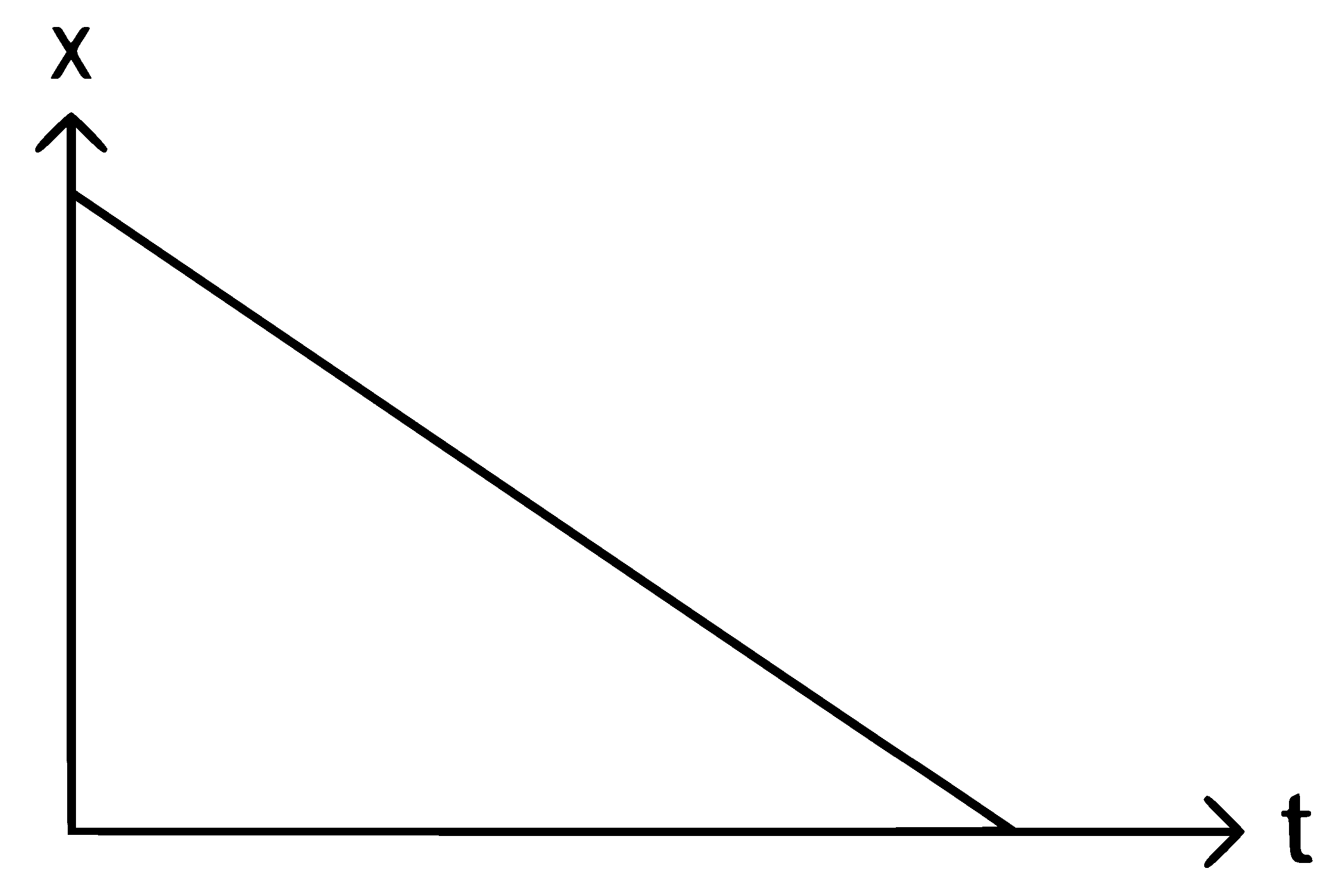
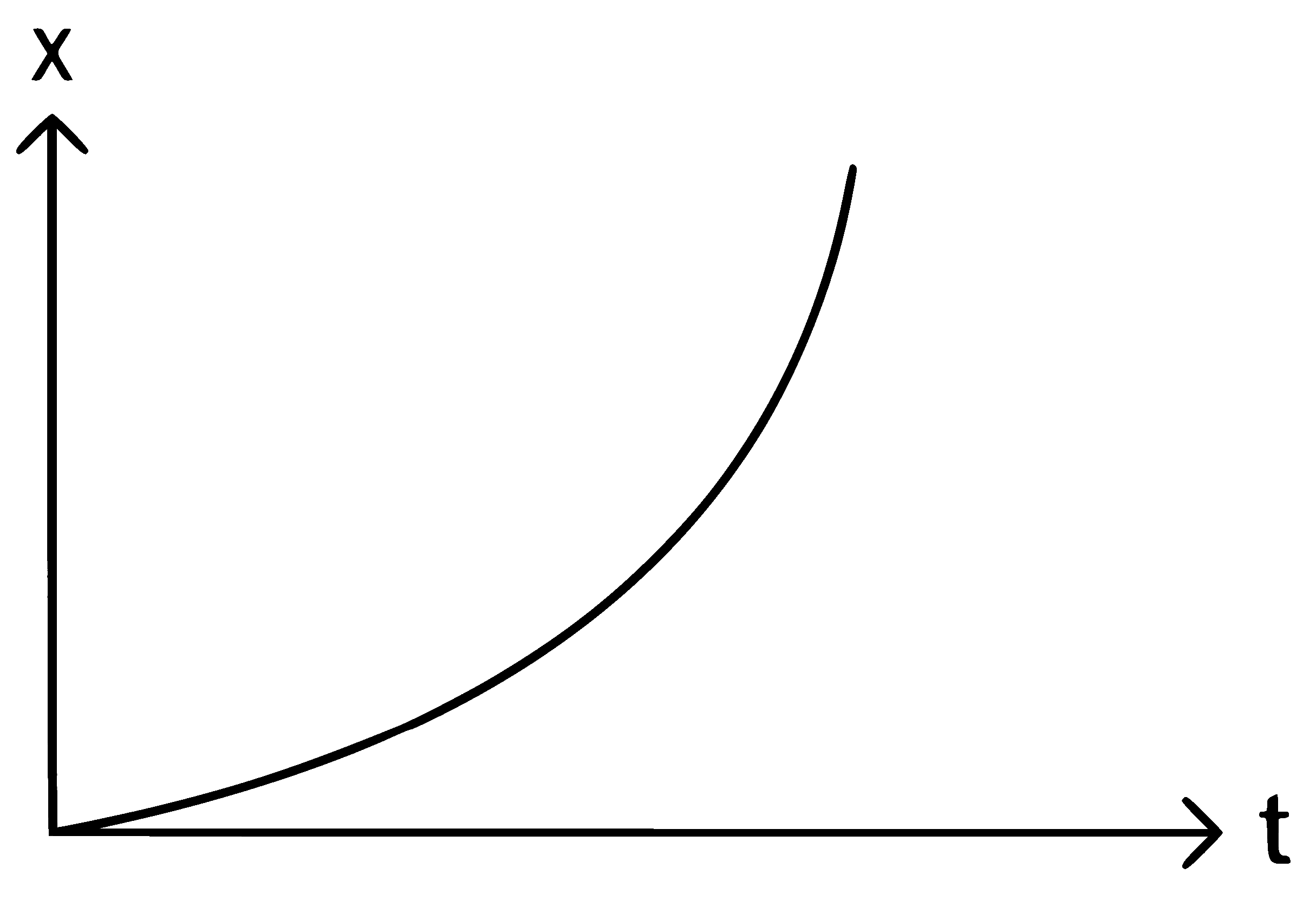
Option C : 45 chromosomes with XO sex chromosomes - This karyotype is characteristic of Turner syndrome, a condition in which females have only one X chromosome. Affected individuals have 45 chromosomes, and their symptoms are different from those described in the question.

Option D : 47 chromosomes with XYY sex chromosomes - This karyotype is characteristic of XYY syndrome, a condition in which males have an extra Y chromosome. Affected individuals have 47 chromosomes, and their symptoms are different from those described in the question.
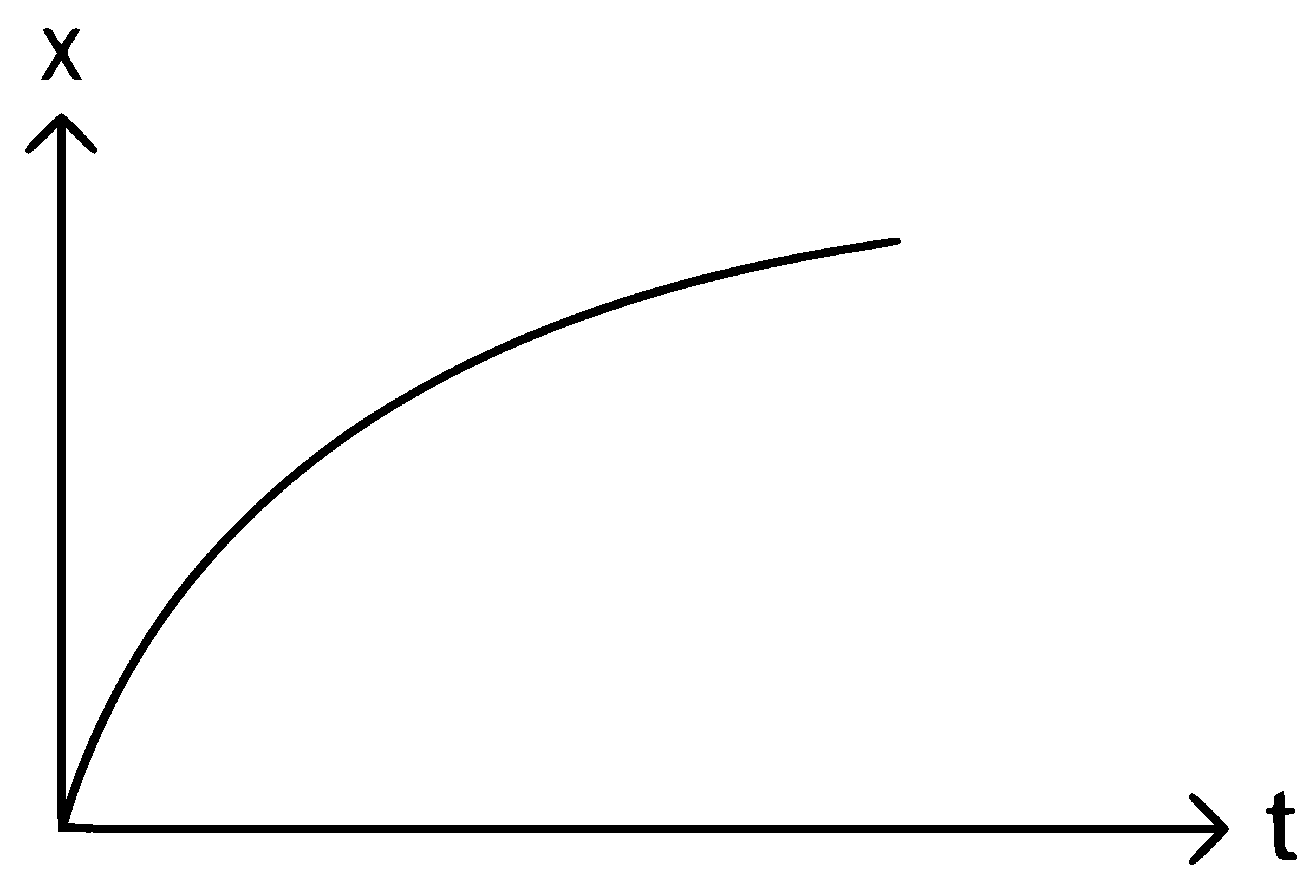
Q.53

Select the incorrect match regarding the symbols used in the Pedigree analysis:

(A)
NEET 2022 Phase 2 Biology - Principles of Inheritance and Variation Question 38 English Option 1
(B)
NEET 2022 Phase 2 Biology - Principles of Inheritance and Variation Question 38 English Option 2
(C)
NEET 2022 Phase 2 Biology - Principles of Inheritance and Variation Question 38 English Option 3
(D)
NEET 2022 Phase 2 Biology - Principles of Inheritance and Variation Question 38 English Option 4
(D)

Solution

Symbol, NEET 2022 Phase 2 Biology - Principles of Inheritance and Variation Question 38 English Explanation 1 in pedigree shows mating between male and female.

Symbol, NEET 2022 Phase 2 Biology - Principles of Inheritance and Variation Question 38 English Explanation 2 shows consanguineous mating.
Q.54

A normal girl, whose mother is haemophilic marries a male with no ancestral history of haemophilia. What will be the possible phenotypes of the offspring?

(a) Haemophilic son and haemophilic daughter.

(b) Haemophilic son and carrier daughter.

(c) Normal daughter and normal son.

(d) Normal son and haemophilic daughter.

Choose the most appropriate answer from the options given below:

(A)
(b) and (d) only
(B)
(a) and (b) only
(C)
(b) and (c) only
(D)
(a) and (d) only
(C)

Solution

NEET 2022 Phase 2 Biology - Principles of Inheritance and Variation Question 35 English Explanation

Hence (b) & (c) are correct which makes option (c) as correct option.

Q.55

In lac operon, z gene codes for

(A)
Transacetylase
(B)
-galactosidase
(C)
Permease
(D)
Repressor
(B)

Solution

In lac operon, z gene codes for -galactosidase.

Transacetylase, permease and repressor protein are coded by genes 'a', 'y' and 'i' respectively.

Q.56

Given below are two statements

Statement I : DNA polymerases catalyse polymerisation only in one direction, that is 5' → 3'.

Statement II : During replication of DNA, on one strand the replication is continuous while on other strand it is discontinuous.

In the light of the above statements, choose the correct answer from the options given below:

(A)
Statement I is incorrect but Statement II is correct
(B)
Both Statement I and Statement II are correct
(C)
Both Statement I and Statement II are incorrect
(D)
Statement I is correct but Statement II is incorrect
(B)

Solution

The DNA-dependent DNA polymerases catalyse polymerisation only in one direction, that is 5' 3'. This creates some additional complications at the replicating fork. Consequently, on one strand (the template with polarity 3' 5'), the replication is continuous, while on the other (the template with polarity 5' 3'), it is discontinuous.

Q.57

Match List - I with List - II.

List - I List - II
(a) In Iac operon i gene codes for (i) transacetylase
(b) In Iac operon z gene codes for (ii) permease
(c) In Iac operon y gene codes for (iii) -galactosidase
(d) In Iac operon a gene codes for (iv) Repressor

Choose the correct answer from the options given below

(A)
(a) - (iii), (b) - (i), (c) - (iv), (d) - (ii)
(B)
(a) - (iii), (b) - (ii), (c) - (i), (d) - (iv)
(C)
(a) - (iv), (b) - (iii), (c) - (ii), (d) - (i)
(D)
(a) - (iv), (b) - (i), (c) - (iii), (d) - (ii)
(C)

Solution

In Iac operon,

The i gene codes for repressor protein.

The z gene codes for -galactosidase.

The y gene codes for permease and the a gene codes for transacetylase.

Q.58

Match List-I with List-II:

List - I List - II
(a) Bacteriophage 174 (i) 48502 base pairs
(b) Bacteriophage lambda (ii) 5386 nucleotides
(c) Escherichia coli (iii) 3.3 10 base pairs
(d) Haploid content of human DNA (iv) 4.6 10 base pairs

Choose the correct answer from the options given below:

(A)
(a)-(i), (b)-(ii), (c)-(iv), (d)-(iii)
(B)
(a)-(i), (b)-(ii), (c)-(iii), (d)-(iv)
(C)
(a)-(ii), (b)-(iv), (c)-(i), (d)-(iii)
(D)
(a)-(ii), (b)-(i), (c)-(iv), (d)-(iii)
(D)

Solution

Genetic material of –

Bacteriophage 174 contains 5386 nucleotides

Bacteriophage lambda contains 48502 base pairs

Escherichia coli contains 4.6 106 base pairs

Haploid content of human DNA contains 3.3 109 base pairs

Q.59

Against the codon 5' UAC 3', what would be the sequence of anticodon on tRNA?

(A)
5' GUA 3'
(B)
5' AUG 3'
(C)
5' ATG 3'
(D)
5' GTA 3'
(B)

Solution

In the process of translation, the mRNA codon pairs with the tRNA anticodon to bring the correct amino acid to the growing polypeptide chain. The pairing between the codon and anticodon follows the complementary base-pairing rules, with adenine (A) pairing with uracil (U), and guanine (G) pairing with cytosine (C).

In this case, the mRNA codon is given as 5' UAC 3'. To determine the tRNA anticodon sequence, we must follow the base-pairing rules:

  • The U (uracil) in the codon pairs with A (adenine) in the anticodon.
  • The A (adenine) in the codon pairs with U (uracil) in the anticodon.
  • The C (cytosine) in the codon pairs with G (guanine) in the anticodon.

Therefore, the anticodon sequence on the tRNA would be 5' AUG 3'.

Q.60

If A and C make 30% and 20% of DNA, respectively, what will be the percentage composition of T and G?

(A)
T : 20%, G : 20%
(B)
T : 20%, G : 30%
(C)
T : 30%, G : 20%
(D)
T : 30%, G : 30%
(C)

Solution

According to Chargaff’s rule, amount of Adenine (A) is equal to thymine and amount of cytosine (c) will be equal to that of Guanine.

So,

A = T = 30% + 30% = 60%

C = G = 20% + 20% = 40%

So, T and G will be 30% and 20% respectively.

Q.61

Which of the following can be expected if scientists succeed in introducing apomictic gene into hybrid varieties of crops?

(A)
There will be segregation of the desired characters only in the progeny
(B)
Polyembryony will be seen and each seed will produce many plantlets
(C)
Seeds of hybrid plants will show longer dormancy
(D)
Farmers can keep on using the seeds produced by the hybrids to raise new crop year after year
(D)

Solution

If hybrid seeds are made into apomicts, there is no segregation of characters in the hybrid progeny

Then the farmers can keep on using the hybrid seeds to raise new crop year after year and he does not have to buy hybrid seeds every year.

Q.62

Select the incorrect statement with respect to inbreeding of animals.

(A)
It exposes harmful recessive genes that are eliminated by selection.
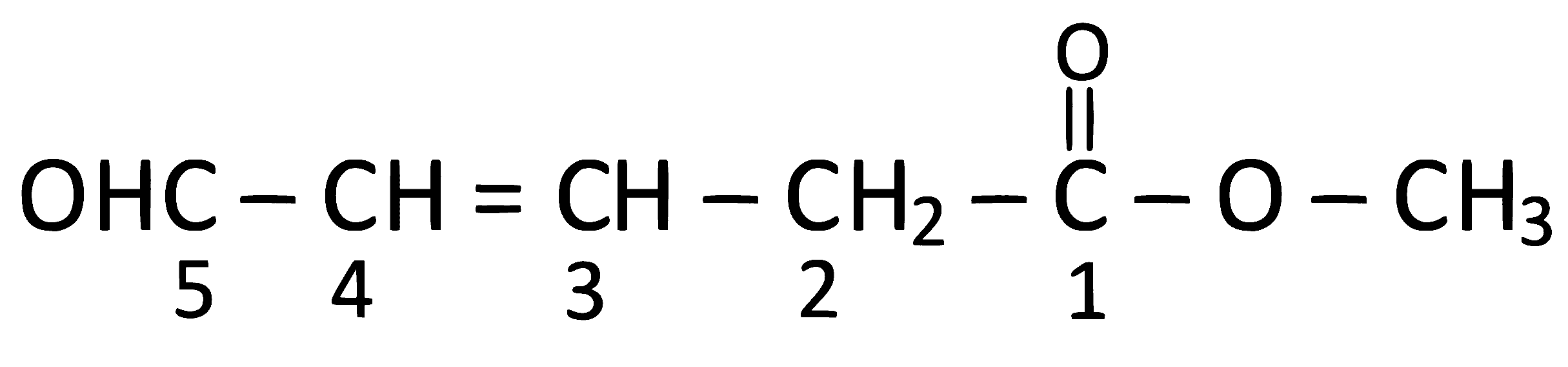
(B)
It is used for evolving pure lines in cattle.
(C)
It helps in accumulation of superior genes and elimination of less desirable genes.
(D)
It decreases homozygosity.
(D)

Solution

Option (d) is the correct answer because inbreeding increases homozygosity.

Option (a) s not the correct answer because inbreeding exposes harmful recessive genes that are eliminated by selection.
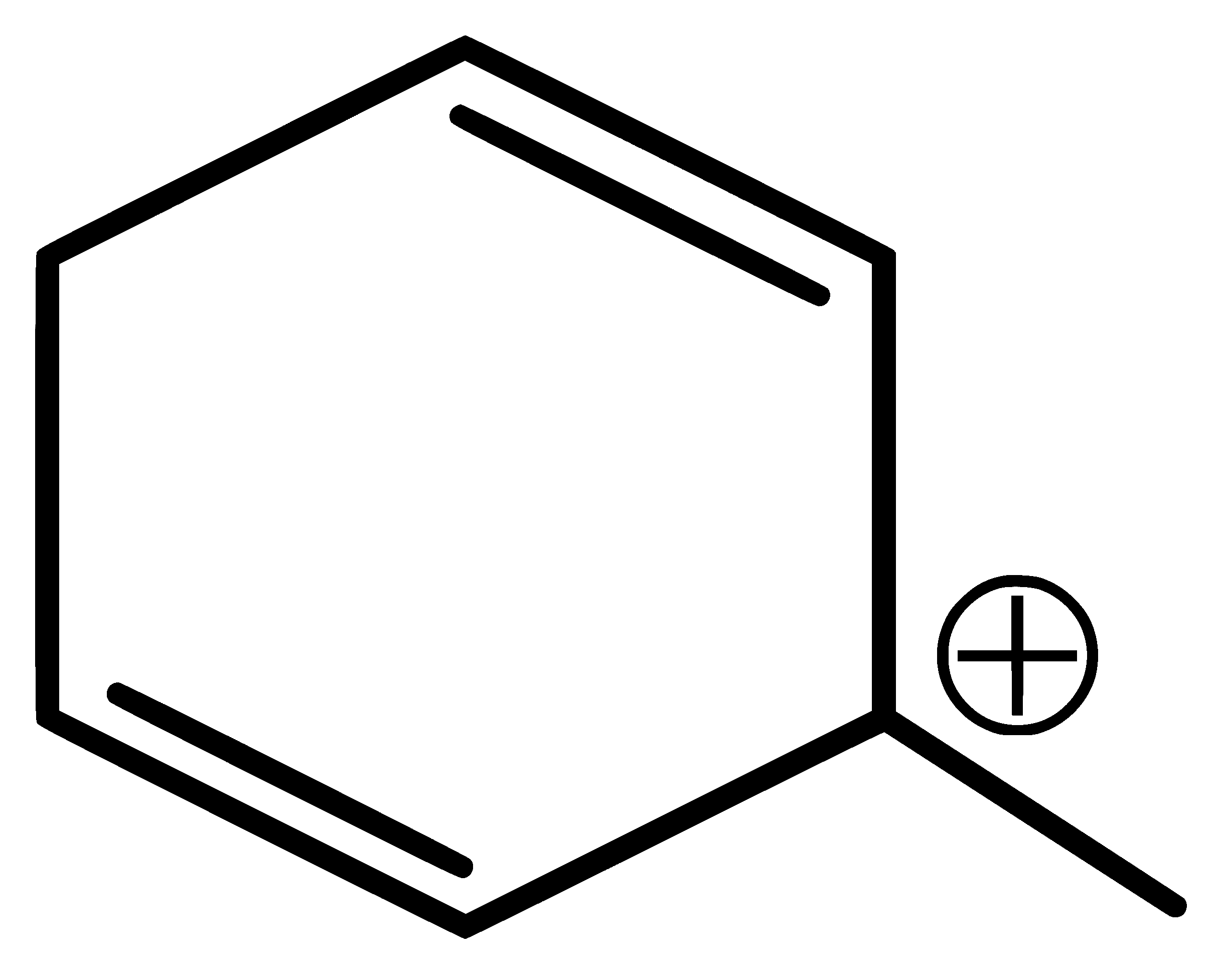
Option (b) is not the correct answer because inbreeding refers to the mating of more closely related individuals within the same breed for 4-6 generations. This strategy was used for developing pure lines in cattle.

Option (c) is not the correct answer because inbreeding helps in accumulation of superior genes and elimination of less desirable genes.

Q.63

Milk of transgenic ‘Cow Rosie’ was nutritionally more balanced product for human babies than natural cow milk because it contained:

(A)
Human enzyme Adenosine Deaminase (ADA)
(B)
Human protein -1-antitrypsin
(C)
Human alpha-lactalbumin
(D)
Human insulin-like growth factor
(C)

Solution

Option (c) is the correct answer because the first transgenic cow Rosie produced human protein-enriched milk. The milk contained the human alpha-lactalbumin and was nutritionally a more balanced product for human babies than natural cow milk.

Option (a) is not the correct answer because ADA deficiency in humans can be cured by gene therapy.

Option (b) is not the correct answer because transgenic sheep produced human -1-antitrypsin that is used to treat emphysema.

Option (d) is not the correct answer because insulin-like growth factor was not present in Rosie’s milk.

Q.64

Why CNG is considered better fuel than diesel?

(a) It can not be adulterated.

(b) It takes less time to fill the fuel tank

(c) It burns more efficiently.

(d) It is cheaper.

(e) It is less inflammable.

Choose the most appropriate answer from the options given below :

(A)
(c), (d), (e) only
(B)
(a), (b), (c), (e) only
(C)
(a), (c), (d) only
(D)
(a), (b), (d), (e) only
(C)

Solution

CNG is better fuel than diesel and petrol because

(1) It burns more efficiently than diesel or petrol

(2) It is cheaper

(3) It can not be adulterated

Q.65

Match List-I with List-II :

List-I
List-II
(a) Chlamydomonas (i) Moss
(b) Cycas (ii) Pteridophyte
(c) Selaginella (iii) Alga
(d) Sphagnum (iv) Gymnosperm

Choose the correct answer from the options given below

(A)
(a) - (ii), (b) - (iii), (c) - (i), (d) - (iv)
(B)
(a) - (iii), (b) - (i), (c) - (ii), (d) - (iv)
(C)
(a) - (iii), (b) - (iv), (c) - (ii), (d) - (i)
(D)
(a) - (iii), (b) - (ii), (c) - (i), (d) - (iv)
(C)

Solution

Chlamydomonas is a unicellular alga. Cycas is a gymnosperm. Selaginella is a heterosporous pteridophyte and Sphagnum is a moss.

Q.66

Read the following statements and identify the characters related to the alga shown in the diagram :

NEET 2022 Phase 2 Biology - Plant Kingdom Question 18 English

(a) It is a member of Chlorophyceae

(b) Food is stored in the form of starch

(c) It is monoecious plant showing oogonium and antheridium

(d) Food is stored in the form of laminarin or mannitol

(e) It shows dominance of pigments Chlorophyll a, c and Fucoxanthin

Choose the correct answer from the options given below :

(A)
(c), (d) and (e) only
(B)
(a), and (b) only
(C)
(a), (b) and (c) only
(D)
(a), (c) and (d) only
(C)

Solution

Alga shown in the diagram is Chara. It is a member of Chlorophyceae. Food is stored in the form of starch.

Chara is monecious plant showing oogonium and antheridium on the same plant body.

Q.67

The ability of plants to follow different pathways in response to environment leading to formation of different kinds of structures is called

(A)
Differentiation
(B)
Redifferentiation
(C)
Development
(D)
Plasticity
(D)

Solution

The ability of plant to follow different pathways and produce different structures in response to environment is called plasticity.

During differentiation, cells lose their ability to divide and form permanent cell.

The process where the differentiated cells again lose the ability to divide and form permanent cells is called redifferentiation.
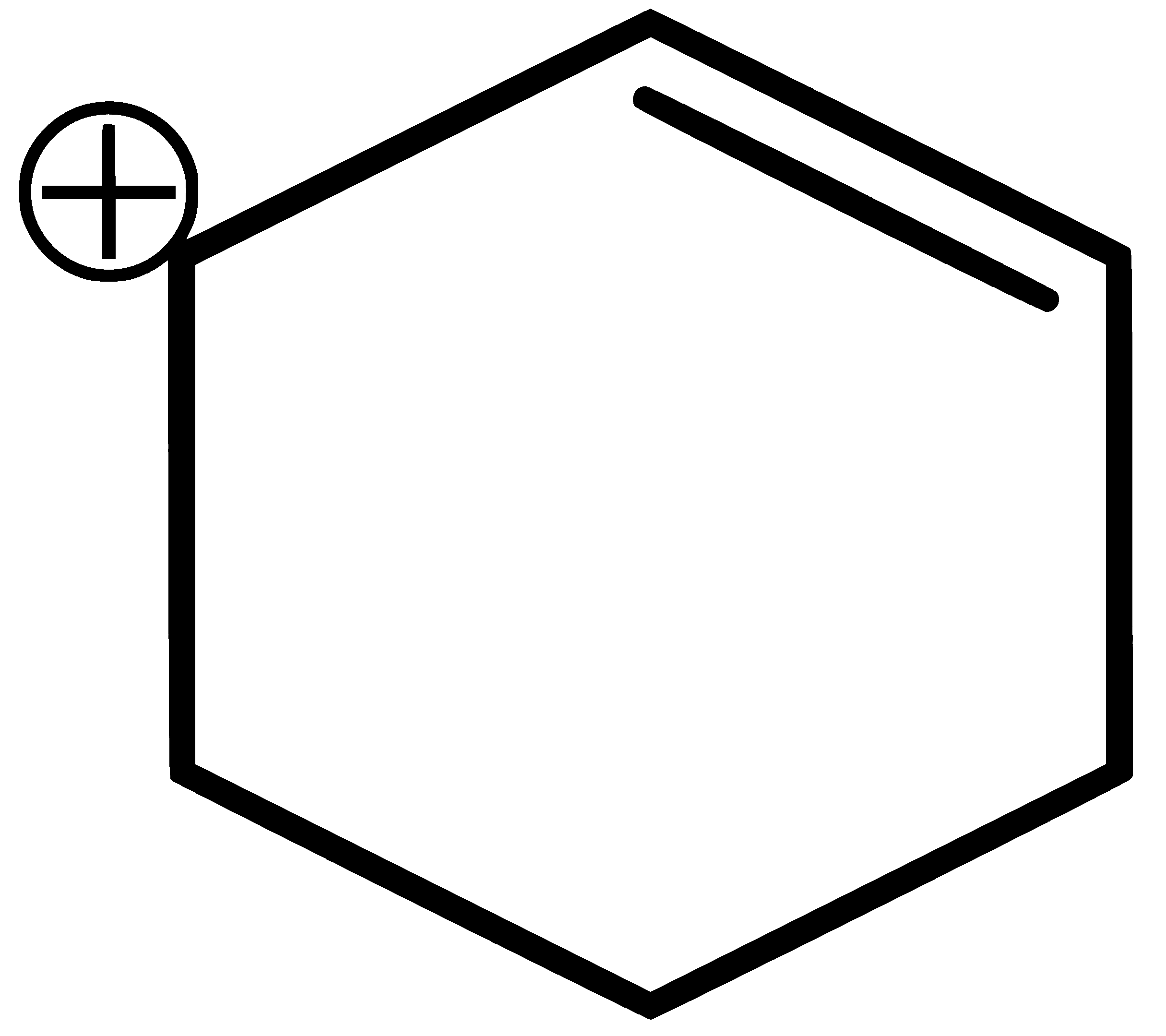
Q.68

Which of the following growth regulators is an adenine derivative?

(A)
Abscisic acid
(B)
Auxin
(C)
Cytokinin
(D)
Ethylene
(C)

Solution

Cytokinins are derived from adenine.
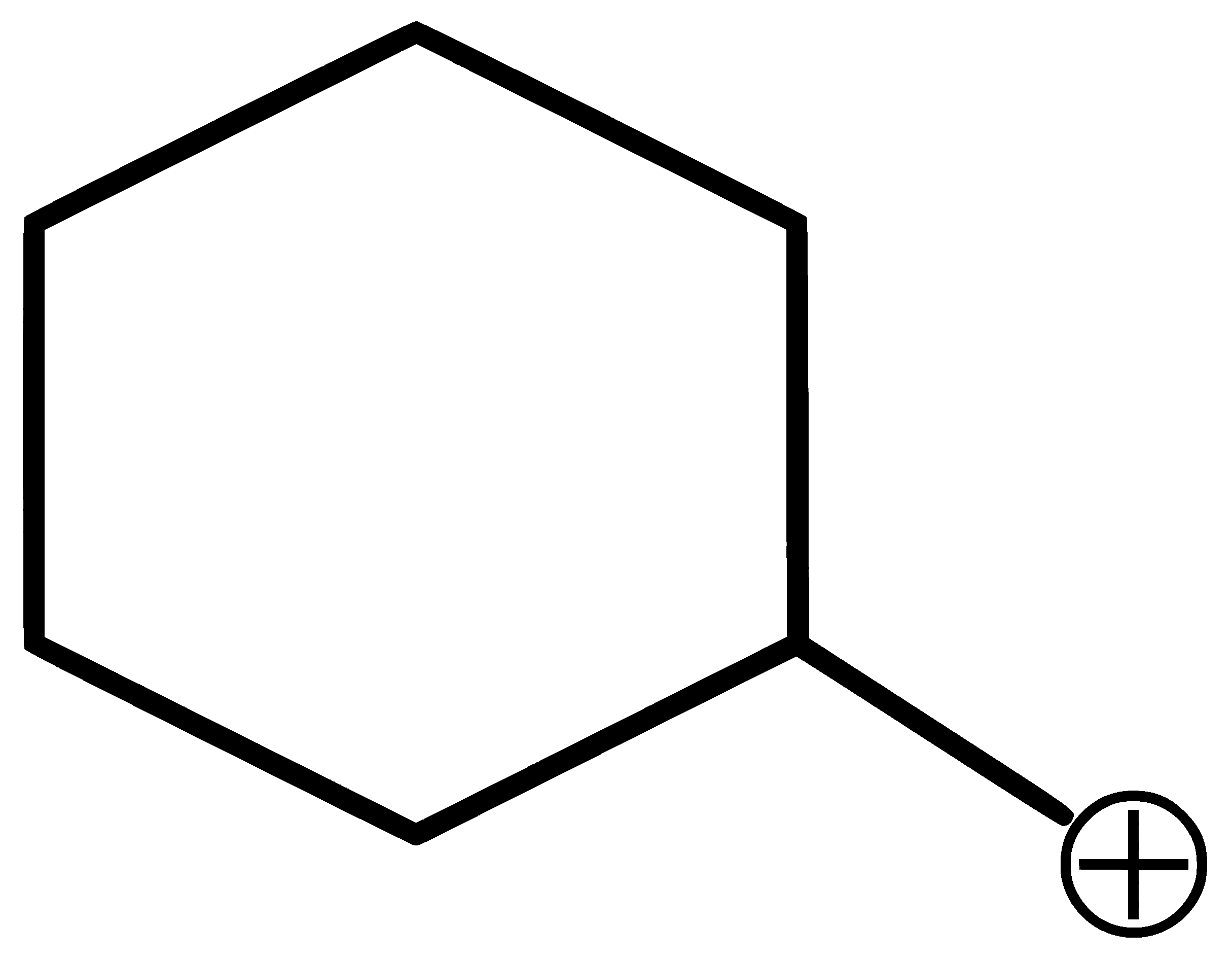
Auxins are derivatives of indole compounds.

Abscisic acid is derived from carotenoids.

Ethylene is derived from methionine.

Q.69

All successions irrespective of the habitat proceed to which type of climax community?

(A)
Edaphic
(B)
Xeric
(C)
Mesic
(D)
Hydrophytic
(C)

Solution

Both hydrarch and xerarch succession lead to medium water condition called mesic condition. This condition is neither too dry nor too wet.

Q.70

The pioneer species in a hydrarch succession are

(A)
Filamentous algae
(B)
Free-floating angiosperms
(C)
Submerged rooted plants
(D)
Phytoplanktons
(D)

Solution

In primary succession in water, the pioneers are the small phytoplanktons, which are replaced with time by rooted-submerged plants, rooted floating angiosperms followed by free-floating plants, then reed-swamp, marsh-meadow, scrub and finally trees.

Q.71

The species that come to appear in bare area are called

(A)
Species of seral community
(B)
Pioneer species
(C)
Invasive species
(D)
Competitive species
(B)

Solution

The species that invade a bare area are called pioneer species.

The individual transitional communities in an ecological succession are termed as seral stages or seral communities.

Q.72

The amount of biomass or organic matter produced per unit area over a time period by plants during photosynthesis is called

(A)
Net primary production
(B)
Secondary production
(C)
Primary production
(D)
Gross primary production
(C)

Solution

Productivity is the total amount of biomass or organic matter produced per unit area. Over a period of time by plants. This is also called Primary production.

Productivity of consumer is called Secondary production.
Q.73

Two butterfly species are competing for the same nectar of a flower in a garden. To survive and coexist together, they may avoid competition in the same garden by :

(A)
Predating on each other
(B)
Feeding at the same time
(C)
Choosing different foraging patterns
(D)
Increasing time spent on attacking each other
(C)

Solution

Two individuals that are competing for same resource can avoid competition by choosing different times for feeding or different foraging patterns.

Q.74

Which of the following reasons is mainly responsible for graft rejection in transplantation of organs?

(A)
Cell-mediated response
(B)
Inability of recipient to differentiate between ‘self’ and ‘non-self’ tissues/cells
(C)
Humoral immune response only
(D)
Auto-immune response
(A)

Solution

Option (1) is the correct answer as the body is able to differentiate between ‘self’ and ‘non-self’ and the cell-mediated immune response is responsible for the graft rejection.

Option (2) is incorrect as body of higher vertebrates have the ability to differentiate foreign organisms from self cells.

Option (4) is incorrect as the autoimmune response occur when the body’s immune system fails to recognize ‘self’ from ‘non-self’ and starts destroying the body’s own cells.

Q.75

Match List - I with List - II :

List - I List - II
(a) Cellular barrier (i) Interferons
(b) Cytokine barrier (ii) Mucus
(c) Physical barrier (iii) Neutrophils
(d) Physiological barrier (iv) HCl in gastric juice

Choose the correct answer from the options given below :

(A)
(a) - (iii), (b) - (i), (c) - (ii), (d) - (iv)
(B)
(a) - (ii), (b) - (iii), (c) - (iv), (d) - (i)
(C)
(a) - (ii), (b) - (iii), (c) - (i), (d) - (iv)
(D)
(a) - (iii), (b) - (iv), (c) - (ii), (d) - (i)
(A)

Solution

Option (a) is the correct answer because cellular barriers include NK cells, macrophages (monocytes) and neutrophils (PMNL).

Cytokine barriers include interferons.

Physical barriers include mucus membranes and skin.

Physiological barriers include HCl in gastric juice, saliva and tears etc.

Q.76

A unique vascular connection between the digestive tract and liver is called______.

(A)
Hepato-cystic system
(B)
Hepato-pancreatic system
(C)
Hepatic portal system
(D)
Renal portal system
(C)

Solution

Option (c) is the correct answer because hepatic portal system is a unique vascular connection between digestive tract and liver.

Option (a) is not correct because hepato-cystic system is part of biliary pathway where common hepatic duct joins cystic duct of gall bladder.

Option (b) is incorrect because hepato-pancreatic system is a part of biliary pathway where common bile duct fuses with pancreatic duct.

Option (d) is incorrect because renal portal system is a unique vascular connection between lower parts of the body and kidney.

Q.77

Arrange the following formed elements in the decreasing order of their abundance in blood in humans:

(a) Platelets

(b) Neutrophils

(c) Erythrocytes

(d) Eosinophils

(e) Monocytes

Choose the most appropriate answer from the options given below:

(A)
(a), (c), (b), (d), (e)
(B)
(c), (a), (b), (e), (d)
(C)
(c), (b), (a), (e), (d)
(D)
(d), (e), (b), (a), (c)
(B)

Solution

Option (b) is the correct answer as a healthy adult man has, on an average, 5 millions to 5.5 millions of RBCs (erythrocytes) mm–3 of blood.

Blood normally contains 1,50,000 – 3,50,000 platelets mm–3.

Neutrophils form 60-65 percent of the total WBCs, monocytes form 6-8 percent of the total WBCs and eosinophils form 2-3 percent of the total WBCs. The total WBCs are approximately 6000-8000 mm–3 of blood.

Thus, the formed elements in the decreasing order of their abundance in blood in humans: -

Erythrocytes – Platelets – Neutrophils – Monocytes – Eosinophils

Q.78

Choose the correct statement about a muscular tissue

(A)
Smooth muscles are multinucleated and involuntary.
(B)
Skeletal muscle fibres are uninucleated and found in parallel bundles.
(C)
Intercalated discs allow the cardiac muscle cells to contract as a unit.
(D)
The walls of blood vessels are made up of columnar epithelium.
(C)

Solution

Option (3) is the correct answer as cardiac muscle fibres possess communication junctions (intercalated discs) at some fusion points that allow the cells to contract as unit, i.e., when one cell receives a signal to contract, its neighbours are also stimulated to contract.

Option (1) is incorrect as smooth muscle fibres are uninucleated.

Option (2) is incorrect as skeletal muscle fibres are multinucleated.

Option (4) is incorrect as the wall of blood vessels are made up of simple squamous epithelium.

Q.79

According to the sliding filament theory:

(A)
The actin filaments slide away from A-band resulting in shortening of sarcomere.
(B)
Actin and myosin filaments slide over each other to increase the length of the sarcomere.
(C)
Length of A-band does not change
(D)
I-band increases in length.
(C)

Solution

Option (c) is the correct answer because length of A band remains unchanged during muscle contraction.

Option (a) is incorrect because actin filaments slide towards A-band.

Option (b) is incorrect because length of sarcomere decreases during muscle contraction.

Option (d) is incorrect because length of I-band decreases during muscle contraction.

Q.80

Gout is a type of disorder which leads to:

(A)
Weakening of bones due to low calcium level
(B)
Inflammation of joints due to accumulation of uric acid crystals
(C)
Weakening of bones due to decreased bone mass
(D)
Inflammation of joints due to cartilage degeneration
(B)

Solution

Option (b) is the correct answer as inflammation of joints due to accumulation of uric acid crystals is known as gout.

Options (a) and (c) are incorrect because weakening of bones due to decreased bones mass, calcium deficiency, decreased levels of estrogen, etc., is termed as osteoporosis.

Option (d) is incorrect because inflammation of joints due to cartilage degeneration is known as osteoarthritis.

Q.81

Match List-I with List - II :

List - I List - II
(a) Multipolar neuron (i) Somatic neural system
(b) Bipolar neuron (ii) Cerebral cortex
(c) Myelinated nerve fibre (iii) Retina of Eye
(d) Unmyelinated nerve fibre (iv) Spinal nerves

Choose the correct answer from the options given below :

(A)
(a) - (ii), (b) - (iii), (c) - (iv), (d) - (i)
(B)
(a) - (iii), (b) - (i), (c) - (iv), (d) - (ii)
(C)
(a) - (ii), (b) - (iv), (c) - (iii), (d) - (i)
(D)
(a) - (ii), (b) - (iii), (c) - (i), (d) - (iv)
(A)

Solution

Option (a) is the correct answer because

(a) Multipolar neurons are present in cerebral cortex.

(b) Bipolar neurons are found in the retina of the eye.

(c) Myelinated nerve fibres are found in spinal and cranial nerves

(d) Unmyelinated nerve fibres are commonly found in autonomous and somatic neural systems.

Q.82

Which of the following is not an Intra Uterine Device?

(A)
Progestasert
(B)
Progestogens
(C)
Multiload 375
(D)
Lippes loop
(B)

Solution

Option (2) is the correct answer as progestogens are the synthetic forms of progesterone.

Option (1) is not the answer as progestasert is an hormone releasing IUD.

Option (3) is not the answer as Multiload-375 is a copper releasing IUD.

Option (4) is not the answer as Lippes loop is an inert IUD.

Q.83

IUDs are small objects made up of plastic or copper that are inserted in the uterine cavity. Which of the following statements are correct about IUDs ?

(a) IUDs decrease phagocytosis of sperm within the uterus.

(b) The released copper ions suppress the sperm motility.

(c) IUDs do not make the cervix hostile to the sperm.

(d) IUDs suppress the fertilization capacity of sperm.

(e) The IUDs require surgical intervention for their insertion in the uterine cavity.

Choose the most appropriate answer from the options given below:

(A)
(d) only
(B)
(a), (d) and (e) only
(C)
(b) and (c) only
(D)
(b) and (d) only
(D)

Solution

Option (d) is the correct answer as only statements (b) and (d) are correct because the Cu ions which are released suppress the sperm motility and the fertilising capacity of sperms.

Option (a) is incorrect as statement (b) is also a correct statement.

Option (b) is incorrect as IUDs increase the phagocytosis of sperms and IUD's insertion does not require surgical intervention.

Option (c) is incorrect as hormonal IUDs suppress endometrial changes and changes in cervical mucus, thereby making the cervix hostile to the sperms.

Q.84

Which of the following types of epithelium is present in the bronchioles and Fallopian tubes?

(A)
Stratified squamous epithelium
(B)
Simple squamous epithelium
(C)
Simple columnar epithelium
(D)
Ciliated epithelium
(D)

Solution

Option (4) is the correct answer as ciliated epithelium is mainly present in the inner lining of hollow organs like bronchioles and fallopian tubes.

Option (1) is incorrect as stratified squamous epithelium covers moist surfaces such as those of buccal cavity, pharynx and oesophagus.

Option (2) is incorrect as simple squamous epithelium is found in the walls of blood vessels and air sacs of lungs.

Option (3) is incorrect as simple columnar epithelium is found in the lining of stomach and intestine.

Q.85

Match List-I with List-II regarding the organs of Cockroach:

List - I List - II
(a) Crop (i) Grinding the food particles
(b) Proventriculus (ii) Secretion of digestive juice
(c) Hepatic caecae (iii) Removal of nitrogenous waste
(d) Malpighian tubules (iv) Storage of food

Choose the correct answer from the options given below :

(A)
(a) - (i), (b) - (iv), (c) - (iii), (d) - (ii)
(B)
(a) - (iv), (b) - (i), (c) - (ii), (d) - (iii)
(C)
(a) - (iii), (b) - (ii), (c) - (i), (d) - (iv)
(D)
(a) - (ii), (b) - (iv), (c) - (i), (d) - (iii)
(B)

Solution

Option (b) is the correct answer because

(a) Crop – Responsible for storage of food

(b) Proventriculus – Grinding the food particles

(c) Hepatic caecae – Secretion of digestive juice

(d) Malpighian tubules – Removal of nitrogenous waste

Q.86

Choose the correct statements:

(a) Bones support and protect softer tissues and organs

(b) Weight bearing function is served by limb bones

(c) Ligament is the site of production of blood cells.

(d) Adipose tissue is specialised to store fats.

(e) Tendons attach one bone to another.

Choose the most appropriate answer from the options given below:

(A)
(a), (b) and (e) only
(B)
(a), (b) and (d) only
(C)
(b), (c) and (e) only
(D)
(a), (c) and (d) only
(B)

Solution

Option (b) is the correct answer because statements (a), (b) and (d) are correct.

Bones are the hardest tissue of our body that support and protect softer tissues and organs.

Limb bones serve weight bearing function.

Adipose tissue is a type of loose connective tissue specialised to store fats.

Option (a) is incorrect because statement (e) is false as tendons attach bones to muscles.

Option (c) is incorrect because statement (c) is false as bone marrow in some bones is the site of production of blood cells.

Option (d) is incorrect because this option includes statement (c) which is false.

Q.87

Excretion in cockroach is performed by all, EXCEPT:

(A)
Hepatic caeca
(B)
Urecose glands
(C)
Malpighian tubules
(D)
Fat body
(A)

Solution

Option (a) is correct answer because hepatic caeca are responsible for secretion of digestive juices in cockroach and it does not participate in excretion. Urecose glands in male cockroach, Malpighian tubules and fat bodies in both male and female cockroach are considered as excretory structures.

Q.88

Role of enamel is to

(A)
Give basic shape to the teeth
(B)
Connect crown of tooth with its root
(C)
Masticate the food
(D)
Form bolus
(C)

Solution

Option (c) is the correct answer because enamel is the hardest substance of the body which covers the exposed part of tooth called crown and helps in mastication of food.

Option (a) is incorrect because basic shape of teeth is provided by dentine which is present in crown, root and neck.

Option (b) is incorrect because neck of tooth connects crown with root.

Option (d) is incorrect because bolus is masticated food mixed with saliva which is ready for swallowing.

Q.89

Select the correct statements.

(a) Angiotensin II activates the cortex of adrenal gland to release aldosterone.

(b) Aldosterone leads to increase in blood pressure.

(c) ANF acts as a check on renin-angiotensin mechanism.

(d) ADH causes vasodilation.

(e) Vasopressin is released from adenohypophysis.

Choose the most appropriate answer from the options given below :

(A)
(a), (b) and (c) only
(B)
(a), (b) and (e) only
(C)
(c), (d) and (e) only
(D)
(b), (c) and (d) only
(A)

Solution

Option (a) is the correct answer because statements (a), (b) and (c) are correct.

Angiotensin II activates the adrenal cortex of adrenal gland to release aldosterone. Aldosterone increases blood volume and thus blood pressure by increasing reabsorption of water and electrolytes from distal parts of nephron. ANF causes vasodilation and decreases blood pressure and thus GFR. Statements (d) and (e) are incorrect as ADH/vasopressin is a potent vasoconstrictor which is released from neurohypophysis.

Q.90

Give below are two statements: one is labelled as Assertion (A) and the other is labelled as Reason (R).

Assertion (A): FSH which interacts with membrane bound receptors does not enter the target cell.

Reason (R): Binding of FSH to its receptors generates second messenger (cyclic AMP) for its biochemical and physiological responses.

In the light of the above statements, choose the most appropriate answer from the options given below

(A)
(A) is not correct but (R) is correct
(B)
Both (A) and (R) are correct and (R) is the correct explanation of (A)
(C)
Both (A) and (R) are correct but (R) is not the correct explanation of (A)
(D)
(A) is correct but (R) is not correct
(C)

Solution

Assertion (A) is correct because FSH, or follicle-stimulating hormone, is a peptide hormone that does not enter the target cell. Instead, it interacts with membrane-bound receptors on the surface of the target cell. This is a common feature of peptide hormones, as they are too large and hydrophilic to pass through the cell membrane.

Reason (R) is also correct. When FSH binds to its receptor, it triggers a cascade of intracellular events, including the production of second messengers like cyclic AMP (cAMP). The second messengers then go on to activate various biochemical and physiological responses within the target cell, such as cell growth and hormone production. This is a typical process for signal transduction initiated by the binding of a hormone to its cell surface receptor.

However, (R) is not the correct explanation of (A) because it doesn't directly address why FSH doesn't enter the target cell. The reason FSH does not enter the target cell is that it is a peptide hormone, which cannot cross the cell membrane. Instead, it interacts with cell surface receptors to initiate a signaling cascade. The generation of second messengers, like cAMP, is a part of the signaling process that takes place after FSH binds to its receptor, but it is not the reason why FSH doesn't enter the cell.

Q.91

How many secondary spermatocytes are required to form 400 million spermatozoa?

(A)
400 million
(B)
50 million
(C)
100 million
(D)
200 million
(D)

Solution

Option (d) is the correct answer because one primary spermatocyte produces two secondary spermatocytes by meiosis I and one secondary spermatocyte produces two spermatozoa via meiosis 2. So, 200 million secondary spermatocytes will produce 400 million spermatozoa.

Q.92

Arrange the components of mammary gland. (from proximal to distal).

(a) Mammary duct

(b) Lactiferous duct

(c) Alveoli

(d) Mammary ampulla

(e) Mammary tubules

Choose the most appropriate answer from the options given below :

(A)
(e) (c) (d) (b) (a)
(B)
(c) (a) (d) (e) (b)
(C)
(b) (c) (e) (d) (a)
(D)
(c) (e) (a) (d) (b)
(D)

Solution

Option (d) is the correct answer because the components of mammary gland (from proximal to distal) is:

(c) (e) (a) (d) (b)

Each mammary lobule is composed of a number of alveoli which open into mammary tubules. The tubules of each lobule join to form a mammary duct. Near the nipple, mammary ducts expand to form mammary ampullae where some milk is stored before going to lactiferous duct which is present at distal end through which milk is sucked out.

Q.93

Given below are two statements: one is labelled as Assertion (A) and the other is labelled as Reason (R).

Assertion (A): During pregnancy the level of thyroxine is increased in the maternal blood.

Reason (R): Pregnancy is characterised by metabolic changes in the mother.

In the light of the above statements, choose the most appropriate answer from the options given below:

(A)
(A) is not correct but (R) is correct
(B)
Both (A) and (R) are correct and (R) is the correct explanation of (A)
(C)
Both (A) and (R) are correct but (R) is not the correct explanation of (A)
(D)
(A) is correct but (R) is not correct
(B)

Solution

Option (b) is the correct answer because thyroxine is the main hormone that increases the basal metabolic rate in our body. A high metabolic rate is required during pregnancy, so levels of thyroxine increase in pregnant females along with other hormones such as cortisol, progesterone, etc.

Q.94

Which of the following animals has three chambered heart?

(A)
Pteropus
(B)
Scoliodon
(C)
Hippocampus
(D)
Chelone
(D)

Solution

Option (4) is the correct answer because Chelone (turtle) is a reptile and the heart of reptiles are usually three-chambered except crocodiles.

Option (1) is incorrect as Pteropus (flying fox) possess four -chambered heart.

Option (2) and (3) are incorrect as Scoliodon (dog fish) and Hippocampus (sea horse) possess two - chambered heart.

Q.95

Match List-I with List-II

List - I List - II
(a) Chlamydomonas (i) Conidia
(b) Penicillium (ii) Zoospores
(c) Hydra (iii) Gemmules
(d) Sponge (iv) Buds

Choose the correct answer from the options given below :

(A)
(a) - (iv), (b) - (iii), (c) - (ii), (d) - (i)
(B)
(a) - (i), (b) - (iv), (c) - (iii), (d) - (ii)
(C)
(a) - (ii), (b) - (i), (c) - (iv), (d) - (iii)
(D)
(a) - (iii), (b) - (ii), (c) - (i), (d) - (iv)
(C)

Solution

Penicillium asexually reproduces by conidia formation

Chlamydomonas asexually reproduces by zoospores

Hydra reproduces by budding whereas sponges produce gemmules for asexual reproduction

Q.96

Select the incorrect statements with respect to Cyclostomes:

(a) They lack scales and paired fins.

(b) They have circular mouth with jaws.

(c) They bear 6-15 pairs of gills.

(d) They migrate to deep sea for spawning.

Choose the most appropriate answer from the options given below:

(A)
(a) and (d) only
(B)
(a) and (b) only
(C)
(b) and (c) only
(D)
(b) and (d) only
(D)

Solution

Option (d) is the correct answer because statement (b) is false as cyclostomes have a circular mouth without jaws and statement (d) is false as they migrate from marine water to fresh water for spawning. Statements (a) and (c) are correct for cyclostomes as they have 6-15 pairs of gills and body is divoid of scales and paired fins.

Q.97

Identify the region of human brain which has pneumotaxic centre that alters respiratory rate by reducing the duration of inspiration.

(A)
Cerebrum
(B)
Medulla
(C)
Pons
(D)
Thalamus
(C)

Solution

Option (c) is the correct answer as pneumotaxic centre is present in the pons region of the brain, that can moderate the functions of the respiratory rhythm centre.

Option (b) is incorrect as medulla oblongata possesses respiratory rhythm centre and a chemosensitive area.

Option (a) and (d) are incorrect as cerebrum and thalamus does not possess any specialised centre to moderate the respiratory rhythm to suit the demands of the body tissues.

Q.98

Which of the following statements are correct with respect to vital capacity?

(a) It includes ERV, TV and IRV

(b) Total volume of air a person can inspire after a normal expiration.

(c) The maximum volume of air a person can breathe in after forced expiration.

(d) It includes ERV, RV and IRV.

(e) The maximum volume of air a person can breath out after a forced inspiration.

Choose the most appropriate answer from the options given below :

(A)
(a) and (e)
(B)
(b), (d) and (e)
(C)
(a), (c) and (d)
(D)
(a), (c) and (e)
(D)

Solution

Option (d) is the correct answer because statements (a), (c) and (e) are correct.

Vital capacity includes ERV, TV and IRV.

Vital capacity is the maximum volume of air a person can breathe in after a forced expiration or the maximum volume of air a person can breathe out after a forced inspiration.

Statement (b) is incorrect as total volume of air a person can inspire after a normal expiration is termed as inspiratory capacity (IC).

Statement (d) is incorrect as ERV, RV, IRV and TV comprise total lung capacity.

Q.99

Panspermia, an idea that is still a favourite for some astronomers, means:

(A)
Transfer of spores as unit of life from other planets to Earth
(B)
Creation of life from dead and decaying matter
(C)
Creation of life from chemicals
(D)
Origin of sperm in human testes
(A)

Solution

Option (a) is the correct answer because some scientists believe that life came from outside. Early Greek thinkers thought units of life called spores were transferred to different planets including earth. This transfer of spores was termed Panspermia.

Option (b) is not the correct answer because theory of spontaneous generation gave the idea for creation of life from dead and decaying matter.

Option (c) is not the correct answer because creation of life from chemicals was the basis for chemical evolution.

Option (d) is not the correct answer as formation of sperm in testes is known as spermatogenesis.

Q.100

Select the correct statement regarding mutation theory of evolution.

(A)
Large differences due to mutations arise gradually in a population
(B)
This theory was proposed by Alfred Wallace
(C)
Variations are small directional changes
(D)
Single step large mutation is a cause of speciation
(D)

Solution

Correct answer is option no. (a) because

Hugo de Vries, based on his work on evening primrose brought forth the idea of mutations. He believed that mutation caused speciation and hence called it saltation (Single step large mutation).

Option (a) is incorrect because mutations are sudden (random) and directionless.

Option (b) is incorrect because mutation theory was proposed by Hugo de Vries.

Option (c) is incorrect because Darwinian variations are small and directional changes, but they are not related to mutation theory of evolution.